
A English
Similar Figures Questions in English
Class 10 Mathematics · Triangles · Similar Figures
12+
Questions
English
Language
100%
With Solutions
Showing 12 of 12 questions in English
1
Medium
Fill in the blanks using the correct word given in brackets:
$(i)$ All circles are $........$ (congruent,similar)
$(ii)$ All squares are $.........$ (similar,congruent)
$(iii)$ All $.........$ triangles are similar. (isosceles,equilateral)
$(iv)$ Two polygons of the same number of sides are similar,if $(a)$ their corresponding angles are $......$ and $(b)$ their corresponding sides are $......$ (equal,proportional)
Solution
(A) $(i)$ All circles have the same shape but not necessarily the same size,therefore they are similar.
$(ii)$ All squares have the same shape (all angles are $90^{\circ}$ and sides are in the same ratio),therefore they are similar.
$(iii)$ All equilateral triangles have angles of $60^{\circ}$ and equal side ratios,therefore they are similar.
$(iv)$ Two polygons are similar if $(a)$ their corresponding angles are equal and $(b)$ their corresponding sides are proportional.
0 likes
View Solution2
Easy
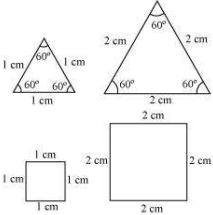
Give two different examples of pairs of similar figures.
Solution
(N/A) Two figures are said to be similar if they have the same shape but not necessarily the same size.
Example $1$: Two equilateral triangles with side lengths $1\, cm$ and $2\, cm$ respectively. Since all equilateral triangles have angles of $60^{\circ}$,they have the same shape.
Example $2$: Two squares with side lengths $1\, cm$ and $2\, cm$ respectively. Since all squares have interior angles of $90^{\circ}$ and proportional sides,they have the same shape.
0 likes
View Solution3
Easy
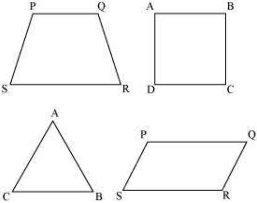
Give two different examples of pairs of non-similar figures.
Solution
(N/A) Two figures are said to be non-similar if they do not have the same shape,even if they have the same number of sides.
Example $1$: $A$ trapezium and a square are non-similar figures because their corresponding angles are not equal and their corresponding sides are not in the same ratio.
Example $2$: $A$ triangle and a parallelogram are non-similar figures because they have a different number of sides and different geometric properties.
0 likes
View Solution4
Easy
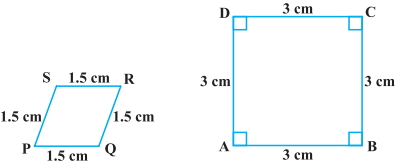
State whether the following quadrilaterals are similar or not.
Solution
(N/A) Two polygons are similar if:
$1$. Their corresponding angles are equal.
$2$. Their corresponding sides are in the same ratio (proportional).
In quadrilateral $PQRS$ and $ABCD$:
- The sides are in the ratio $PQ/AB = QR/BC = RS/CD = SP/DA = 1.5/3 = 1/2$. Thus,the sides are proportional.
- However,the angles of $PQRS$ are not $90^{\circ}$,while all angles of $ABCD$ are $90^{\circ}$.
Since the corresponding angles are not equal,the quadrilaterals $PQRS$ and $ABCD$ are not similar.
0 likes
View Solution5
EasyMCQ
Is the following statement true? Why?
"Two quadrilaterals are similar,if their corresponding angles are equal".
"Two quadrilaterals are similar,if their corresponding angles are equal".
A
True
B
False
C
Cannot be determined
D
Depends on the type of quadrilateral
Solution
(B) The statement is $False$.
Two polygons (including quadrilaterals) are considered similar if and only if two conditions are met:
$1$. Their corresponding angles are equal.
$2$. Their corresponding sides are in the same ratio (proportional).
For example,a square and a rectangle have equal corresponding angles ($90^{\circ}$ each),but they are not similar because their sides are not proportional.
0 likes
View Solution6
Medium
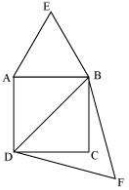
Prove that the area of an equilateral triangle described on one side of a square is equal to half the area of the equilateral triangle described on one of its diagonals.
Solution
(N/A) Let $ABCD$ be a square of side $a$.
Therefore,its diagonal $= \sqrt{2} a$.
Two equilateral triangles are formed: $\Delta ABE$ (on side $AB$) and $\Delta DBF$ (on diagonal $DB$).
Side of equilateral triangle $\Delta ABE$ described on side $AB = a$.
Side of equilateral triangle $\Delta DBF$ described on diagonal $DB = \sqrt{2} a$.
Since all equilateral triangles are similar,the ratio of their areas is equal to the square of the ratio of their corresponding sides.
$\frac{\text{Area of } \Delta ABE}{\text{Area of } \Delta DBF} = \left( \frac{a}{\sqrt{2} a} \right)^2 = \left( \frac{1}{\sqrt{2}} \right)^2 = \frac{1}{2}$.
Thus,$\text{Area of } \Delta ABE = \frac{1}{2} \times \text{Area of } \Delta DBF$.
0 likes
View Solution7
DifficultMCQ
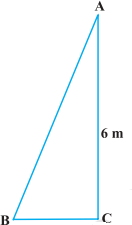
$A$ ladder is placed against a wall such that its foot is at a distance of $2.5\, m$ from the wall and its top reaches a window $6\, m$ above the ground. Find the length of the ladder in $m$.
A
$7$
B
$6.5$
C
$5.9$
D
$8.0$
Solution
(B) Let $AB$ be the ladder and $CA$ be the wall with the window at $A$. The wall and the ground form a right angle at $C$. Thus,$\triangle ABC$ is a right-angled triangle with $\angle C = 90^\circ$.
Given: $BC = 2.5\, m$ (distance of the foot of the ladder from the wall) and $CA = 6\, m$ (height of the window from the ground).
According to the Pythagoras Theorem,in a right-angled triangle,the square of the hypotenuse is equal to the sum of the squares of the other two sides:
$AB^2 = BC^2 + CA^2$
$AB^2 = (2.5)^2 + (6)^2$
$AB^2 = 6.25 + 36$
$AB^2 = 42.25$
$AB = \sqrt{42.25}$
$AB = 6.5\, m$
Therefore,the length of the ladder is $6.5\, m$.
0 likes
View Solution8
DifficultMCQ
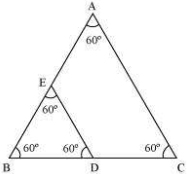
$ABC$ and $BDE$ are two equilateral triangles such that $D$ is the mid-point of $BC$. The ratio of the areas of triangles $ABC$ and $BDE$ is
A
$2:1$
B
$4:1$
C
$1:2$
D
$1:4$
Solution
(B) We know that all equilateral triangles have all their angles equal to $60^{\circ}$ and all their sides of the same length. Therefore,all equilateral triangles are similar to each other.
The ratio of the areas of two similar triangles is equal to the square of the ratio of their corresponding sides.
Let the side length of $\triangle ABC$ be $x$.
Since $D$ is the mid-point of $BC$,the side length of $\triangle BDE$ is $\frac{x}{2}$.
Therefore,the ratio of the areas is:
$\frac{\text{Area}(\triangle ABC)}{\text{Area}(\triangle BDE)} = \left(\frac{x}{\frac{x}{2}}\right)^{2} = (2)^{2} = \frac{4}{1}$.
Hence,the ratio is $4:1$,and the correct answer is $(B)$.
0 likes
View Solution9
Difficult
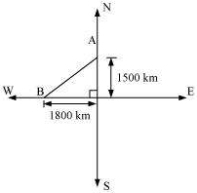
An aeroplane leaves an airport and flies due north at a speed of $1000\, km/h$. At the same time,another aeroplane leaves the same airport and flies due west at a speed of $1200\, km/h$. How far apart will be the two planes after $1 \frac{1}{2}$ hours?
Solution
(N/A) Distance travelled by the plane flying towards north in $1 \frac{1}{2}$ hours $= 1000 \times 1.5 = 1500\, km$.
Distance travelled by the plane flying towards west in $1 \frac{1}{2}$ hours $= 1200 \times 1.5 = 1800\, km$.
Let the airport be at the origin $O$. The plane flying north reaches point $A$ and the plane flying west reaches point $B$.
Since north and west directions are perpendicular,$\triangle AOB$ is a right-angled triangle with $\angle AOB = 90^\circ$.
By Pythagoras theorem,the distance between the two planes is the hypotenuse $AB = \sqrt{OA^2 + OB^2}$.
$AB = \sqrt{1500^2 + 1800^2} = \sqrt{2250000 + 3240000} = \sqrt{5490000}$.
$AB = \sqrt{90000 \times 61} = 300\sqrt{61}\, km$.
Thus,the distance between the two planes after $1 \frac{1}{2}$ hours is $300\sqrt{61}\, km$.
0 likes
View Solution10
Difficult
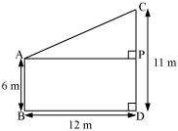
Two poles of heights $6 \, m$ and $11 \, m$ stand on a plane ground. If the distance between the feet of the poles is $12 \, m$,find the distance between their tops.
Solution
(13 M) Let $CD$ and $AB$ be the poles of height $11 \, m$ and $6 \, m$ respectively.
Draw a line segment $AP$ parallel to $BD$ such that $P$ lies on $CD$. Then $AP = BD = 12 \, m$ and $PD = AB = 6 \, m$.
Now,$CP = CD - PD = 11 \, m - 6 \, m = 5 \, m$.
In the right-angled triangle $\triangle APC$,by applying the Pythagoras theorem:
$AC^2 = AP^2 + CP^2$
$AC^2 = (12 \, m)^2 + (5 \, m)^2$
$AC^2 = 144 \, m^2 + 25 \, m^2 = 169 \, m^2$
$AC = \sqrt{169} \, m = 13 \, m$.
Therefore,the distance between their tops is $13 \, m$.
1 likes
View Solution11
MediumMCQ
For the correspondence $ABC \leftrightarrow RPQ$ between $\Delta ABC$ and $\Delta PQR$,$\angle B$ corresponds to $\ldots \ldots \ldots \ldots$
A
$\angle P$
B
$\angle Q$
C
$\angle R$
D
$\angle Q$ or $\angle R$
Solution
(A) In the given correspondence $ABC \leftrightarrow RPQ$,the vertices are mapped as follows:
$A$ corresponds to $R$
$B$ corresponds to $P$
$C$ corresponds to $Q$
Therefore,$\angle B$ corresponds to $\angle P$.
$A$ corresponds to $R$
$B$ corresponds to $P$
$C$ corresponds to $Q$
Therefore,$\angle B$ corresponds to $\angle P$.
0 likes
View Solution12
MediumMCQ
In square $ABCD$,$AB = 4 \sqrt{2}$. Then,the length of a diagonal of the square is......
A
$4$
B
$8 \sqrt{2}$
C
$8$
D
$5 \sqrt{2}$
Solution
(C) In a square,the length of a diagonal is given by the formula: $\text{Diagonal} = \sqrt{2} \times \text{side}$.
Given the side length $AB = 4 \sqrt{2}$.
Substituting the value of the side into the formula:
$\text{Diagonal} = \sqrt{2} \times (4 \sqrt{2})$
$= 4 \times (\sqrt{2} \times \sqrt{2})$
$= 4 \times 2 = 8$.
Therefore,the length of the diagonal is $8$.
Given the side length $AB = 4 \sqrt{2}$.
Substituting the value of the side into the formula:
$\text{Diagonal} = \sqrt{2} \times (4 \sqrt{2})$
$= 4 \times (\sqrt{2} \times \sqrt{2})$
$= 4 \times 2 = 8$.
Therefore,the length of the diagonal is $8$.
0 likes
View SolutionTriangles — Similar Figures · Frequently Asked Questions
1Are these Triangles questions useful for JEE and NEET?
Yes. All questions in this section are mapped to JEE Main and NEET exam patterns. Previous year questions from JEE Main, NEET, GUJCET and state-level exams are included with full solutions.
2Can I switch to Hindi or Gujarati for these questions?
Yes. Use the language tabs in the hero section or the sidebar to view the same questions and solutions in English, Hindi or Gujarati.
3How do I generate a question paper from this subtopic?
Use the Vedclass Exam Paper Generator — select the chapter and subtopic, set difficulty, and generate Sets A, B, C, D automatically. First 3 chapters of every subject are free.
Vedclass Products
For Students
Vedclass Test Series
Mock tests in real JEE/NEET style with performance analysis. 5-day free trial.
Start Free TrialFor Teachers
Exam Paper Generator
Generate Set A/B/C/D papers from this chapter in 2 minutes. 3 chapters free.
Try FreeFor Institutes
Online Exam Module
Live online exams with unlimited students, 360° analytics & white-label branding.
See DemoFor Teachers & Institutes
Generate a Triangles Exam Paper in 2 Minutes
Select subtopic & difficulty — Sets A, B, C, D auto-generated with No Repeat logic.
First 3 chapters of every subject are free — no payment required.