
A English
Mix Examples - Chemical Reactions and Equations Questions in English
Class 10 Science · Chemical Reactions and Equations · Mix Examples - Chemical Reactions and Equations
96+
Questions
English
Language
100%
With Solutions
Showing 50 of 96 questions in English
1
DifficultMCQ
Write a balanced chemical equation with state symbols for the following reactions.
$(i)$ Solutions of barium chloride and sodium sulphate in water react to give insoluble barium sulphate and the solution of sodium chloride.
$(ii)$ Sodium hydroxide solution (in water) reacts with hydrochloric acid solution (in water) to produce sodium chloride solution and water.
$(i)$ Solutions of barium chloride and sodium sulphate in water react to give insoluble barium sulphate and the solution of sodium chloride.
$(ii)$ Sodium hydroxide solution (in water) reacts with hydrochloric acid solution (in water) to produce sodium chloride solution and water.
A
Not applicable
B
Not applicable
C
Not applicable
D
Not applicable
Solution
(N/A) $(i)$ The reaction between barium chloride and sodium sulphate is a double displacement reaction:
$BaCl_{2(aq)} + Na_2SO_{4(aq)} \to BaSO_{4(s)} + 2NaCl_{(aq)}$
$(ii)$ The reaction between sodium hydroxide and hydrochloric acid is a neutralization reaction:
$NaOH_{(aq)} + HCl_{(aq)} \to NaCl_{(aq)} + H_2O_{(l)}$
$BaCl_{2(aq)} + Na_2SO_{4(aq)} \to BaSO_{4(s)} + 2NaCl_{(aq)}$
$(ii)$ The reaction between sodium hydroxide and hydrochloric acid is a neutralization reaction:
$NaOH_{(aq)} + HCl_{(aq)} \to NaCl_{(aq)} + H_2O_{(l)}$
1 likes
View Solution2
Medium
Translate the following statements into chemical equations and then balance them.
$(a)$ Hydrogen gas combines with nitrogen to form ammonia.
$(b)$ Hydrogen sulphide gas burns in air to give water and sulphur dioxide.
$(c)$ Barium chloride reacts with aluminium sulphate to give aluminium chloride and a precipitate of barium sulphate.
$(d)$ Potassium metal reacts with water to give potassium hydroxide and hydrogen gas.
Solution
(A) The reaction is $H_{2(g)} + N_{2(g)} \to NH_{3(g)}$. Balancing gives $3H_{2(g)} + N_{2(g)} \to 2NH_{3(g)}$.
$(b)$ The reaction is $H_{2}S_{(g)} + O_{2(g)} \to H_{2}O_{(l)} + SO_{2(g)}$. Balancing gives $2H_{2}S_{(g)} + 3O_{2(g)} \to 2H_{2}O_{(l)} + 2SO_{2(g)}$.
$(c)$ The reaction is $BaCl_{2(aq)} + Al_{2}(SO_{4})_{3(aq)} \to AlCl_{3(aq)} + BaSO_{4(s)}$. Balancing gives $3BaCl_{2(aq)} + Al_{2}(SO_{4})_{3(aq)} \to 2AlCl_{3(aq)} + 3BaSO_{4(s)}$.
$(d)$ The reaction is $K_{(s)} + H_{2}O_{(l)} \to KOH_{(aq)} + H_{2(g)}$. Balancing gives $2K_{(s)} + 2H_{2}O_{(l)} \to 2KOH_{(aq)} + H_{2(g)}$.
0 likes
View Solution3
Difficult
Write the balanced chemical equation for the following and identify the type of reaction in each case.
$(a)$ Potassium bromide $(aq) +$ Barium iodide $(aq) \rightarrow$ Potassium iodide $(aq) +$ Barium bromide $(s)$
$(b)$ Zinc carbonate $(s) \rightarrow$ Zinc oxide $(s) +$ Carbon dioxide $(g)$
$(c)$ Hydrogen $(g) +$ Chlorine $(g) \rightarrow$ Hydrogen chloride $(g)$
$(d)$ Magnesium $(s) +$ Hydrochloric acid $(aq) \rightarrow$ Magnesium chloride $(aq) +$ Hydrogen $(g)$
Solution
(A-D) $2KBr(aq) + BaI_2(aq) \rightarrow 2KI(aq) + BaBr_2(s)$; Double displacement reaction.
$(b)$ $ZnCO_3(s) \rightarrow ZnO(s) + CO_2(g)$; Decomposition reaction.
$(c)$ $H_2(g) + Cl_2(g) \rightarrow 2HCl(g)$; Combination reaction.
$(d)$ $Mg(s) + 2HCl(aq) \rightarrow MgCl_2(aq) + H_2(g)$; Displacement reaction.
$(b)$ $ZnCO_3(s) \rightarrow ZnO(s) + CO_2(g)$; Decomposition reaction.
$(c)$ $H_2(g) + Cl_2(g) \rightarrow 2HCl(g)$; Combination reaction.
$(d)$ $Mg(s) + 2HCl(aq) \rightarrow MgCl_2(aq) + H_2(g)$; Displacement reaction.
0 likes
View Solution4
Medium
Why is respiration considered an exothermic reaction? Explain.
Solution
(N/A) Respiration is considered an exothermic reaction because energy is released during the process.
$1$. Living organisms require energy to survive, which is obtained from the food we eat.
$2$. During digestion, complex food molecules (like carbohydrates) are broken down into simpler substances like glucose.
$3$. This glucose combines with oxygen in the cells of our body to provide energy.
$4$. Since energy is released in the form of heat (or $ATP$) during this process, it is classified as an exothermic reaction.
The chemical equation for respiration is:
$C_{6}H_{12}O_{6(aq)} + 6O_{2(g)} \to 6CO_{2(g)} + 6H_{2}O_{(l)} + \text{Energy}$
0 likes
View Solution5
Medium
Why are decomposition reactions called the opposite of combination reactions? Write equations for these reactions.
Solution
(N/A) Decomposition reactions are those in which a single compound breaks down to form two or more simpler substances. These reactions typically require an input of energy in the form of heat, light, or electricity to proceed.
Combination reactions are those in which two or more substances combine to form a single new substance, often releasing energy in the process.
Therefore, they are considered opposites because decomposition involves breaking down a substance (requiring energy), while combination involves forming a substance (releasing energy).
Decomposition reaction: $2H_2O(l) \xrightarrow{\text{Electrolysis}} 2H_2(g) + O_2(g)$
Combination reaction: $2H_2(g) + O_2(g) \to 2H_2O(l) + \text{Energy}$
0 likes
View Solution6
Difficult
What is the difference between displacement and double displacement reactions? Write equations for these reactions.
Solution
(N/A) In a displacement reaction,a more reactive element replaces a less reactive element from its compound.
$A + BX \longrightarrow AX + B$; where $A$ is more reactive than $B$.
In a double displacement reaction,two atoms or groups of atoms exchange their positions to form two new compounds.
$AB + CD \longrightarrow AD + CB$
Examples:
Displacement reaction:
$CuSO_{4(aq)} + Zn_{(s)} \longrightarrow ZnSO_{4(aq)} + Cu_{(s)}$
Double displacement reaction:
$Na_2SO_{4(aq)} + BaCl_{2(aq)} \longrightarrow BaSO_{4(s)} + 2NaCl_{(aq)}$
0 likes
View Solution7
EasyMCQ
Which of the following is not a physical change?
A
Combustion of Liquefied Petroleum Gas $(LPG)$
B
Melting of ice to give water
C
Dissolution of salt in water
D
Boiling of water to give water vapour
Solution
(A) physical change is a change in which no new substance is formed and the chemical composition remains the same.
$A$. Combustion of $LPG$ is a chemical change because it involves a chemical reaction with oxygen to produce new substances like carbon dioxide and water,releasing energy.
$B$. Melting of ice is a physical change as it only involves a change in the state of water from solid to liquid.
$C$. Dissolution of salt in water is a physical change because the salt can be recovered by evaporation,and no new chemical substance is formed.
$D$. Boiling of water is a physical change as it only involves a change in the state of water from liquid to gas.
Therefore,the combustion of $LPG$ is not a physical change.
0 likes
View Solution8
MediumMCQ
The following reaction is an example of a:
$4 NH_{3}(g) + 5 O_{2}(g) \rightarrow 4 NO(g) + 6 H_{2}O(g)$
$(i)$ Displacement reaction
$(ii)$ Combination reaction
$(iii)$ Redox reaction
$(iv)$ Neutralisation reaction
$4 NH_{3}(g) + 5 O_{2}(g) \rightarrow 4 NO(g) + 6 H_{2}O(g)$
$(i)$ Displacement reaction
$(ii)$ Combination reaction
$(iii)$ Redox reaction
$(iv)$ Neutralisation reaction
A
$(i)$ and $(iv)$
B
$(i)$ and $(iii)$
C
$(ii)$ and $(iii)$
D
$(iii)$ and $(iv)$
Solution
(B) $1$. Analyze the oxidation states of the elements in the reaction:
- In $NH_{3}$,the oxidation state of $N$ is $-3$ and $H$ is $+1$.
- In $O_{2}$,the oxidation state of $O$ is $0$.
- In $NO$,the oxidation state of $N$ is $+2$ and $O$ is $-2$.
- In $H_{2}O$,the oxidation state of $H$ is $+1$ and $O$ is $-2$.
$2$. Observe the changes:
- Nitrogen $(N)$ changes from $-3$ to $+2$ (oxidation).
- Oxygen $(O)$ changes from $0$ to $-2$ (reduction).
Since both oxidation and reduction occur,it is a redox reaction $(iii)$.
$3$. Identify the reaction type:
- This is a displacement reaction because $O_{2}$ displaces $H$ from $NH_{3}$ to form $NO$ and $H_{2}O$,which is a type of oxidation-reduction displacement $(i)$.
Therefore,the reaction is both a displacement reaction and a redox reaction.
0 likes
View Solution9
MediumMCQ
Which of the following are exothermic processes?
$(i)$ Reaction of water with quick lime
$(ii)$ Dilution of an acid
$(iii)$ Evaporation of water
$(iv)$ Sublimation of camphor (crystals)
$(i)$ Reaction of water with quick lime
$(ii)$ Dilution of an acid
$(iii)$ Evaporation of water
$(iv)$ Sublimation of camphor (crystals)
A
$(iii)$ and $(iv)$
B
$(ii)$ and $(iii)$
C
$(i)$ and $(iv)$
D
$(i)$ and $(ii)$
Solution
(D) An exothermic process is a process that releases energy in the form of heat.
$(i)$ The reaction of water with quick lime $(CaO + H_2O \rightarrow Ca(OH)_2 + \text{Heat})$ is highly exothermic, releasing a large amount of heat.
$(ii)$ The dilution of an acid is a highly exothermic process, which is why it is recommended to add acid to water slowly with constant stirring.
$(iii)$ Evaporation of water is an endothermic process because it requires the absorption of heat from the surroundings to change the state from liquid to gas.
$(iv)$ Sublimation of camphor is an endothermic process as it requires heat energy to change the state from solid to gas.
Therefore, $(i)$ and $(ii)$ are exothermic processes.
0 likes
View Solution10
DifficultMCQ
Which among the following statement$(s)$ is(are) true? Exposure of silver chloride to sunlight for a long duration turns grey due to
$(i)$ the formation of silver by decomposition of silver chloride
$(ii)$ sublimation of silver chloride
$(iii)$ decomposition of chlorine gas from silver chloride
$(iv)$ oxidation of silver chloride
$(i)$ the formation of silver by decomposition of silver chloride
$(ii)$ sublimation of silver chloride
$(iii)$ decomposition of chlorine gas from silver chloride
$(iv)$ oxidation of silver chloride
A
$(ii)$ and $(iii)$
B
$(i)$ and $(iii)$
C
$(iv)$ only
D
$(i)$ only
Solution
(B) When silver chloride $(AgCl)$ is exposed to sunlight, it undergoes a photochemical decomposition reaction.
The chemical equation for this reaction is: $2AgCl(s) \xrightarrow{\text{sunlight}} 2Ag(s) + Cl_2(g)$.
In this reaction, white silver chloride decomposes into grey-colored metallic silver $(Ag)$ and chlorine gas $(Cl_2)$.
Statement $(i)$ is true because the grey color is due to the formation of metallic silver.
Statement $(iii)$ is also true because the decomposition of silver chloride results in the release of chlorine gas.
Therefore, both $(i)$ and $(iii)$ are correct.
0 likes
View Solution11
MediumMCQ
Solid calcium oxide reacts vigorously with water to form calcium hydroxide accompanied by liberation of heat. This process is called slaking of lime. Calcium hydroxide dissolves in water to form its solution called lime water. Which among the following is (are) true about slaking of lime and the solution formed?
$(i)$ It is an endothermic reaction
$(ii)$ It is an exothermic reaction
$(iii)$ The $pH$ of the resulting solution will be more than seven
$(iv)$ The $pH$ of the resulting solution will be less than seven
$(i)$ It is an endothermic reaction
$(ii)$ It is an exothermic reaction
$(iii)$ The $pH$ of the resulting solution will be more than seven
$(iv)$ The $pH$ of the resulting solution will be less than seven
A
$(ii)$ and $(iii)$
B
$(i)$ and $(ii)$
C
$(i)$ and $(iv)$
D
$(iii)$ and $(iv)$
Solution
(A) The reaction between calcium oxide $(CaO)$ and water $(H_2O)$ is represented as: $CaO(s) + H_2O(l) \rightarrow Ca(OH)_2(aq) + \text{Heat}$.
$1$. Since heat is released during this process, it is an exothermic reaction. Thus, statement $(ii)$ is correct.
$2$. Calcium hydroxide $(Ca(OH)_2)$ is a base. When it dissolves in water to form lime water, the resulting solution is basic in nature.
$3$. Basic solutions have a $pH$ value greater than $7$. Thus, statement $(iii)$ is correct.
Therefore, the correct statements are $(ii)$ and $(iii)$.
0 likes
View Solution12
MediumMCQ
Which of the following is(are) an endothermic process(es)?
$(i)$ Dilution of sulphuric acid
$(ii)$ Sublimation of dry ice
$(iii)$ Condensation of water vapours
$(iv)$ Evaporation of water
$(i)$ Dilution of sulphuric acid
$(ii)$ Sublimation of dry ice
$(iii)$ Condensation of water vapours
$(iv)$ Evaporation of water
A
$(i)$ and $(iii)$
B
$(ii)$ only
C
$(iii)$ only
D
$(ii)$ and $(iv)$
Solution
(D) An endothermic process is one that absorbs heat from the surroundings.
$(i)$ Dilution of sulphuric acid is an exothermic process because it releases a large amount of heat.
$(ii)$ Sublimation of dry ice ($CO_2$ solid to gas) requires the absorption of heat,making it an endothermic process.
$(iii)$ Condensation of water vapours (gas to liquid) releases heat,making it an exothermic process.
$(iv)$ Evaporation of water (liquid to gas) requires the absorption of heat,making it an endothermic process.
Therefore,both $(ii)$ and $(iv)$ are endothermic processes.
0 likes
View Solution13
Medium
Write the balanced chemical equations for the following reactions and identify the type of reaction in each case.
$(a)$ Nitrogen gas is treated with hydrogen gas in the presence of a catalyst at $773 \ K$ to form ammonia gas.
$(b)$ Sodium hydroxide solution is treated with acetic acid to form sodium acetate and water.
$(a)$ Nitrogen gas is treated with hydrogen gas in the presence of a catalyst at $773 \ K$ to form ammonia gas.
$(b)$ Sodium hydroxide solution is treated with acetic acid to form sodium acetate and water.
Solution
(N/A) The balanced chemical equation is: ${N_2}(g) + 3{H_2}(g) \xrightarrow[{773 \ K}]{{\text{Catalyst}}} 2NH_3(g)$.
This is a combination reaction because two reactants combine to form a single product.
$(b)$ The balanced chemical equation is: $NaOH(aq) + CH_3COOH(aq) \longrightarrow CH_3COONa(aq) + H_2O(l)$.
This is a double displacement reaction,specifically a neutralisation reaction,as an acid reacts with a base to form salt and water.
0 likes
View Solution14
Medium
Write the balanced chemical equations for the following reactions and identify the type of reaction in each case.
$(a)$ Thermit reaction,iron $(III)$ oxide reacts with aluminium and gives molten iron and aluminium oxide.
$(b)$ Magnesium ribbon is burnt in an atmosphere of nitrogen gas to form solid magnesium nitride.
$(a)$ Thermit reaction,iron $(III)$ oxide reacts with aluminium and gives molten iron and aluminium oxide.
$(b)$ Magnesium ribbon is burnt in an atmosphere of nitrogen gas to form solid magnesium nitride.
Solution
(N/A) $Fe_{2}O_{3}(s) + 2Al(s) \longrightarrow Al_{2}O_{3}(s) + 2Fe(l) + \text{Heat}$
This is a displacement reaction (specifically a thermit reaction) and also a redox reaction.
$(b)$ $3Mg(s) + N_{2}(g) \longrightarrow Mg_{3}N_{2}(s)$
This is a combination reaction.
This is a displacement reaction (specifically a thermit reaction) and also a redox reaction.
$(b)$ $3Mg(s) + N_{2}(g) \longrightarrow Mg_{3}N_{2}(s)$
This is a combination reaction.
0 likes
View Solution15
Medium
Write the balanced chemical equations for the following reactions and identify the type of reaction in each case.
$(a)$ Chlorine gas is passed in an aqueous potassium iodide solution to form potassium chloride solution and solid iodine.
$(b)$ Ethanol is burnt in air to form carbon dioxide,water and releases heat.
$(a)$ Chlorine gas is passed in an aqueous potassium iodide solution to form potassium chloride solution and solid iodine.
$(b)$ Ethanol is burnt in air to form carbon dioxide,water and releases heat.
Solution
(N/A) $2KI(aq) + Cl_2(g) \longrightarrow 2KCl(aq) + I_2(s)$
This is a displacement reaction because chlorine displaces iodine from potassium iodide.
$(b)$ $C_2H_5OH(l) + 3O_2(g) \longrightarrow 2CO_2(g) + 3H_2O(l) + \text{Heat}$
This is a combustion reaction,which is also a type of redox reaction,as ethanol reacts with oxygen to release energy.
This is a displacement reaction because chlorine displaces iodine from potassium iodide.
$(b)$ $C_2H_5OH(l) + 3O_2(g) \longrightarrow 2CO_2(g) + 3H_2O(l) + \text{Heat}$
This is a combustion reaction,which is also a type of redox reaction,as ethanol reacts with oxygen to release energy.
0 likes
View Solution16
Medium
Complete the missing components/variables given as $x$ and $y$ in the following reactions:
$(a)$ $Pb(NO_3)_2(aq) + 2KI(aq) \longrightarrow PbI_2(x) + 2KNO_3(y)$
$(b)$ $Cu(s) + 2AgNO_3(aq) \longrightarrow Cu(NO_3)_2(aq) + x(s)$
$(a)$ $Pb(NO_3)_2(aq) + 2KI(aq) \longrightarrow PbI_2(x) + 2KNO_3(y)$
$(b)$ $Cu(s) + 2AgNO_3(aq) \longrightarrow Cu(NO_3)_2(aq) + x(s)$
Solution
(A) In chemical equations,the physical states of substances are represented as $(s)$ for solid,$(l)$ for liquid,$(g)$ for gas,and $(aq)$ for aqueous solution.
$(a)$ In the reaction $Pb(NO_3)_2(aq) + 2KI(aq) \longrightarrow PbI_2(s) + 2KNO_3(aq)$,$PbI_2$ is a precipitate formed,so $x = (s)$. $KNO_3$ remains dissolved in the solution,so $y = (aq)$.
$(b)$ In the reaction $Cu(s) + 2AgNO_3(aq) \longrightarrow Cu(NO_3)_2(aq) + 2Ag(s)$,silver is displaced as a solid metal,so $x = 2Ag$.
0 likes
View Solution17
Medium
Complete the missing components/variables given as $x$ and $y$ in the following reactions:
$(a)$ $Zn(s) + H_2SO_4(aq) \longrightarrow ZnSO_4(x) + H_2(y)$
$(b)$ $CaCO_3(s) \xrightarrow{x} CaO(s) + CO_2(g)$
$(a)$ $Zn(s) + H_2SO_4(aq) \longrightarrow ZnSO_4(x) + H_2(y)$
$(b)$ $CaCO_3(s) \xrightarrow{x} CaO(s) + CO_2(g)$
Solution
(A) In the reaction between zinc and sulfuric acid, $ZnSO_4$ is formed as an aqueous solution, so $x = (aq)$. Hydrogen gas is released as a product, so $y = (g)$.
$(b)$ The decomposition of calcium carbonate into calcium oxide and carbon dioxide requires the application of heat, so $x = \text{Heat}$.
$(b)$ The decomposition of calcium carbonate into calcium oxide and carbon dioxide requires the application of heat, so $x = \text{Heat}$.
0 likes
View Solution18
MediumMCQ
Which among the following changes are exothermic or endothermic in nature?
$(a)$ Decomposition of ferrous sulphate
$(b)$ Dilution of sulphuric acid
$(c)$ Dissolution of sodium hydroxide in water
$(d)$ Dissolution of ammonium chloride in water
$(a)$ Decomposition of ferrous sulphate
$(b)$ Dilution of sulphuric acid
$(c)$ Dissolution of sodium hydroxide in water
$(d)$ Dissolution of ammonium chloride in water
A
Exothermic: $(a), (b)$; Endothermic: $(c), (d)$
B
Exothermic: $(b), (c)$; Endothermic: $(a), (d)$
C
Exothermic: $(a), (c)$; Endothermic: $(b), (d)$
D
Exothermic: $(c), (d)$; Endothermic: $(a), (b)$
Solution
(B) An exothermic process is one that releases heat into the surroundings, while an endothermic process absorbs heat from the surroundings.
$(a)$ Decomposition of ferrous sulphate $(2FeSO_4(s) \xrightarrow{\Delta} Fe_2O_3(s) + SO_2(g) + SO_3(g))$ requires heat input, so it is endothermic.
$(b)$ Dilution of sulphuric acid is a highly exothermic process as it releases a large amount of heat.
$(c)$ Dissolution of sodium hydroxide in water $(NaOH(s) \rightarrow Na^+(aq) + OH^-(aq) + \text{Heat})$ is an exothermic process.
$(d)$ Dissolution of ammonium chloride in water $(NH_4Cl(s) + \text{Heat} \rightarrow NH_4^+(aq) + Cl^-(aq))$ absorbs heat, so it is endothermic.
Therefore, $(b)$ and $(c)$ are exothermic, while $(a)$ and $(d)$ are endothermic.
0 likes
View Solution19
Medium
Write the balanced chemical equations for the following reactions:
$(a)$ Sodium carbonate on reaction with hydrochloric acid in equal molar concentrations gives sodium chloride and sodium hydrogencarbonate.
$(b)$ Sodium hydrogencarbonate on reaction with hydrochloric acid gives sodium chloride,water,and liberates carbon dioxide.
$(c)$ Copper sulphate on treatment with potassium iodide precipitates cuprous iodide $(Cu_2I_2)$,liberates iodine gas,and also forms potassium sulphate.
Solution
(N/A) $Na_2CO_3 + HCl \longrightarrow NaCl + NaHCO_3$
$(b)$ $NaHCO_3 + HCl \longrightarrow NaCl + H_2O + CO_2$
$(c)$ $2CuSO_4 + 4KI \longrightarrow Cu_2I_2 + 2K_2SO_4 + I_2$
$(b)$ $NaHCO_3 + HCl \longrightarrow NaCl + H_2O + CO_2$
$(c)$ $2CuSO_4 + 4KI \longrightarrow Cu_2I_2 + 2K_2SO_4 + I_2$
0 likes
View Solution20
EasyMCQ
Why do fireflies glow at night?
A
Due to the presence of radioactive substances.
B
Due to a chemical reaction involving bioluminescence.
C
Due to the reflection of moonlight.
D
Due to the presence of heat-generating bacteria.
Solution
(B) Fireflies possess a specialized protein called luciferin,which,in the presence of an enzyme called luciferase and oxygen,undergoes a chemical reaction known as bioluminescence.
This reaction involves the oxidation of luciferin,which releases energy in the form of visible light.
Therefore,fireflies glow at night as a result of this chemical process.
This reaction involves the oxidation of luciferin,which releases energy in the form of visible light.
Therefore,fireflies glow at night as a result of this chemical process.
0 likes
View Solution21
Easy
Grapes hanging on the plant do not ferment,but after being plucked from the plant,they can be fermented. Under what conditions do these grapes ferment? Is it a chemical or a physical change?
Solution
(N/A) Grapes attached to the plant are living,and their internal immune system and metabolic processes prevent fermentation.
Once plucked,the grapes are no longer connected to the parent plant's supply of nutrients and defense mechanisms.
Fermentation occurs when microbes (like yeast) act on the sugars present in the grapes under anaerobic conditions (absence of oxygen).
This process results in the formation of new substances like ethanol and carbon dioxide,which is a chemical change.
0 likes
View Solution22
Medium
Which among the following are physical or chemical changes?
$(a)$ Evaporation of petrol
$(b)$ Burning of Liquefied Petroleum Gas $(LPG)$
$(c)$ Heating of an iron rod to red hot
$(d)$ Curdling of milk
$(e)$ Sublimation of solid ammonium chloride
$(a)$ Evaporation of petrol
$(b)$ Burning of Liquefied Petroleum Gas $(LPG)$
$(c)$ Heating of an iron rod to red hot
$(d)$ Curdling of milk
$(e)$ Sublimation of solid ammonium chloride
Solution
(A) ,$(c)$,and $(e)$ are physical changes because they do not involve the formation of new substances and are often reversible.
$(b)$ and $(d)$ are chemical changes because they involve the formation of new substances with different chemical properties and are generally irreversible.
$(b)$ and $(d)$ are chemical changes because they involve the formation of new substances with different chemical properties and are generally irreversible.
0 likes
View Solution23
Medium
Write a balanced chemical equation for each of the following reactions and also classify them.
$(a)$ Lead acetate solution is treated with dilute hydrochloric acid to form lead chloride and acetic acid solution.
$(b)$ $A$ piece of sodium metal is added to absolute ethanol to form sodium ethoxide and hydrogen gas.
$(a)$ Lead acetate solution is treated with dilute hydrochloric acid to form lead chloride and acetic acid solution.
$(b)$ $A$ piece of sodium metal is added to absolute ethanol to form sodium ethoxide and hydrogen gas.
Solution
(N/A) $Pb(CH_3COO)_2(aq) + 2HCl(aq) \longrightarrow PbCl_2(s) + 2CH_3COOH(aq)$ : Double displacement reaction.
$(b)$ $2Na(s) + 2C_2H_5OH(l) \longrightarrow 2C_2H_5ONa(alc) + H_2(g)$ : Displacement reaction (specifically,a single displacement or redox reaction).
$(b)$ $2Na(s) + 2C_2H_5OH(l) \longrightarrow 2C_2H_5ONa(alc) + H_2(g)$ : Displacement reaction (specifically,a single displacement or redox reaction).
0 likes
View Solution24
Medium
Write a balanced chemical equation for each of the following reactions and also classify them.
$(a)$ Iron $(III)$ oxide on heating with carbon monoxide gas reacts to form solid iron and liberates carbon dioxide gas.
$(b)$ Hydrogen sulphide gas reacts with oxygen gas to form solid sulphur and liquid water.
$(a)$ Iron $(III)$ oxide on heating with carbon monoxide gas reacts to form solid iron and liberates carbon dioxide gas.
$(b)$ Hydrogen sulphide gas reacts with oxygen gas to form solid sulphur and liquid water.
Solution
(N/A) The balanced chemical equation is: $Fe_{2}O_{3}(s) + 3CO(g) \longrightarrow 2Fe(s) + 3CO_{2}(g)$.
This is a redox reaction because iron $(III)$ oxide is reduced to iron,and carbon monoxide is oxidized to carbon dioxide.
$(b)$ The balanced chemical equation is: $2H_{2}S(g) + O_{2}(g) \longrightarrow 2S(s) + 2H_{2}O(l)$.
This is a redox reaction because hydrogen sulphide is oxidized to sulphur,and oxygen is reduced to water.
0 likes
View Solution25
Medium
Balance the following chemical equations and identify the type of chemical reaction.
$(a)$ $Mg(s) + Cl_2(g) \to MgCl_2(s)$
$(b)$ $HgO(s) \xrightarrow{\text{Heat}} Hg(l) + O_2(g)$
$(c)$ $Na(s) + S(s) \xrightarrow{\text{Fuse}} Na_2S(s)$
$(a)$ $Mg(s) + Cl_2(g) \to MgCl_2(s)$
$(b)$ $HgO(s) \xrightarrow{\text{Heat}} Hg(l) + O_2(g)$
$(c)$ $Na(s) + S(s) \xrightarrow{\text{Fuse}} Na_2S(s)$
Solution
(N/A) Balanced equation: $Mg(s) + Cl_2(g) \to MgCl_2(s)$. This is a Combination reaction because two reactants combine to form a single product.
$(b)$ Balanced equation: $2HgO(s) \xrightarrow{\text{Heat}} 2Hg(l) + O_2(g)$. This is a Decomposition reaction because a single reactant breaks down into two simpler products upon heating.
$(c)$ Balanced equation: $2Na(s) + S(s) \xrightarrow{\text{Fuse}} Na_2S(s)$. This is a Combination reaction because two reactants combine to form a single product.
0 likes
View Solution26
Medium
Balance the following chemical equations and identify the type of chemical reaction.
$(a)$ $TiCl_4(l) + Mg(s) \to Ti(s) + MgCl_2(s)$
$(b)$ $CaO(s) + SiO_2(s) \to CaSiO_3(s)$
$(c)$ $H_2O_2(l) \xrightarrow{UV} H_2O(l) + O_2(g)$
$(a)$ $TiCl_4(l) + Mg(s) \to Ti(s) + MgCl_2(s)$
$(b)$ $CaO(s) + SiO_2(s) \to CaSiO_3(s)$
$(c)$ $H_2O_2(l) \xrightarrow{UV} H_2O(l) + O_2(g)$
Solution
(N/A) Balanced equation: $TiCl_4(l) + 2Mg(s) \to Ti(s) + 2MgCl_2(s)$. This is a displacement reaction because $Mg$ displaces $Ti$ from its chloride.
$(b)$ Balanced equation: $CaO(s) + SiO_2(s) \to CaSiO_3(s)$. This is a combination reaction because two reactants combine to form a single product.
$(c)$ Balanced equation: $2H_2O_2(l) \to 2H_2O(l) + O_2(g)$. This is a decomposition reaction because a single reactant breaks down into simpler products.
0 likes
View Solution27
Medium
$A$ magnesium ribbon is burnt in oxygen to give a white compound $X$ accompanied by emission of light. If the burning ribbon is now placed in an atmosphere of nitrogen,it continues to burn and forms a compound $Y.$
$(a)$ Write the chemical formulae of $X$ and $Y.$
$(b)$ Write a balanced chemical equation,when $X$ is dissolved in water.
$(a)$ Write the chemical formulae of $X$ and $Y.$
$(b)$ Write a balanced chemical equation,when $X$ is dissolved in water.
Solution
(A) When magnesium ribbon burns in oxygen,it forms magnesium oxide $(MgO)$:
$2Mg(s) + O_2(g) \longrightarrow 2MgO(s)$ (Compound $X$)
When magnesium ribbon continues to burn in nitrogen,it forms magnesium nitride $(Mg_3N_2)$:
$3Mg(s) + N_2(g) \longrightarrow Mg_3N_2(s)$ (Compound $Y$)
$(a)$ The chemical formula of $X$ is $MgO$ and the chemical formula of $Y$ is $Mg_3N_2$.
$(b)$ When magnesium oxide $(X)$ is dissolved in water,it forms magnesium hydroxide:
$MgO(s) + H_2O(l) \longrightarrow Mg(OH)_2(aq)$
0 likes
View Solution28
Medium
On heating blue coloured powder of copper $(II)$ nitrate in a boiling tube,copper oxide (black),oxygen gas and a brown gas $X$ is formed.
$(a)$ Identify the type of reaction.
$(b)$ What could be the $pH$ range of an aqueous solution of the gas $X$?
$(a)$ Identify the type of reaction.
$(b)$ What could be the $pH$ range of an aqueous solution of the gas $X$?
Solution
(N/A) This is a thermal decomposition reaction.
$(b)$ The brown gas $X$ is nitrogen dioxide $(NO_2)$. When nitrogen dioxide dissolves in water,it forms nitric acid $(HNO_3)$ and nitrous acid $(HNO_2)$,resulting in an acidic solution. Since the solution is acidic,the $pH$ range of the aqueous solution of gas $X$ is less than $7$.
$(b)$ The brown gas $X$ is nitrogen dioxide $(NO_2)$. When nitrogen dioxide dissolves in water,it forms nitric acid $(HNO_3)$ and nitrous acid $(HNO_2)$,resulting in an acidic solution. Since the solution is acidic,the $pH$ range of the aqueous solution of gas $X$ is less than $7$.
0 likes
View Solution29
Medium
Give the characteristic tests for the following gases:
$(a)$ $CO_2$
$(b)$ $SO_2$
$(a)$ $CO_2$
$(b)$ $SO_2$
Solution
(N/A) Carbon dioxide $(CO_2)$ gas turns lime water milky when passed through it due to the formation of insoluble calcium carbonate.
$Ca(OH)_2 + CO_2 \to CaCO_3 + H_2O$
$(b)$ Sulphur dioxide $(SO_2)$ gas,when passed through an acidic potassium permanganate solution (purple in colour),turns it colourless because $SO_2$ is a strong reducing agent.
$2KMnO_4 + 2H_2O + 5SO_2 \to K_2SO_4 + 2MnSO_4 + 2H_2SO_4$
Alternatively,sulphur dioxide gas,when passed through an acidic potassium dichromate solution (orange in colour),turns it green because sulphur dioxide is a strong reducing agent.
0 likes
View Solution30
Medium
Give the characteristic tests for the following gases:
$(a)$ $O_2$
$(b)$ $H_2$
$(a)$ $O_2$
$(b)$ $H_2$
Solution
(N/A) The evolution of oxygen $(O_2)$ gas during a reaction can be confirmed by bringing a burning candle near the mouth of the test tube containing the reaction mixture. The intensity of the flame increases because oxygen supports combustion.
$(b)$ Hydrogen $(H_2)$ gas burns with a 'pop' sound when a burning candle or matchstick is brought near it.
$(b)$ Hydrogen $(H_2)$ gas burns with a 'pop' sound when a burning candle or matchstick is brought near it.
0 likes
View Solution31
Medium
When $Zn$ metal is treated with a dilute solution of a strong acid,a gas is evolved,which is utilised in the hydrogenation of oil. Name the gas evolved. Write the chemical equation of the reaction involved and also write a test to detect the gas formed.
Solution
(N/A) When $Zn$ reacts with a dilute solution of a strong acid (such as $HCl$),it forms a salt and hydrogen gas $(H_2)$ is evolved.
The chemical equation is: $Zn(s) + 2HCl(aq) \rightarrow ZnCl_2(aq) + H_2(g) \uparrow$.
Test to detect the gas: When a burning splinter is brought near the mouth of the test tube containing the gas,it burns with a characteristic 'pop' sound,which confirms the presence of hydrogen gas.
The chemical equation is: $Zn(s) + 2HCl(aq) \rightarrow ZnCl_2(aq) + H_2(g) \uparrow$.
Test to detect the gas: When a burning splinter is brought near the mouth of the test tube containing the gas,it burns with a characteristic 'pop' sound,which confirms the presence of hydrogen gas.
0 likes
View Solution32
EasyMCQ
When air is blown from the mouth into a test-tube containing lime water,the lime water turns milky due to the presence of:
A
oxygen
B
nitrogen
C
carbon dioxide
D
water vapour
Solution
(C) When we exhale,the air we breathe out contains a higher concentration of $CO_2$ compared to the air we inhale.
Lime water is a solution of calcium hydroxide,$Ca(OH)_2$.
When $CO_2$ is passed through lime water,it reacts to form calcium carbonate $(CaCO_3)$,which is insoluble in water and forms a white precipitate.
This reaction is represented as: $Ca(OH)_2(aq) + CO_2(g) \rightarrow CaCO_3(s) + H_2O(l)$.
The formation of this white precipitate of calcium carbonate makes the lime water appear milky.
0 likes
View Solution33
Difficult
On adding a drop of barium chloride solution to an aqueous solution of sodium sulphite,a white precipitate is obtained.
$(a)$ Write a balanced chemical equation of the reaction involved.
$(b)$ What other name can be given to this precipitation reaction?
$(c)$ On adding dilute hydrochloric acid to the reaction mixture,the white precipitate disappears. Why?
$(a)$ Write a balanced chemical equation of the reaction involved.
$(b)$ What other name can be given to this precipitation reaction?
$(c)$ On adding dilute hydrochloric acid to the reaction mixture,the white precipitate disappears. Why?
Solution
(A) The balanced chemical equation is:
$Na_{2}SO_{3}(aq) + BaCl_{2}(aq) \rightarrow BaSO_{3}(s) + 2NaCl(aq)$
$(b)$ This reaction is also known as a double displacement reaction.
$(c)$ $BaSO_{3}$ is a salt of a weak acid,sulphurous acid $(H_{2}SO_{3})$. When dilute hydrochloric acid $(HCl)$ is added,it reacts with the insoluble barium sulphite to form soluble barium chloride,water,and sulphur dioxide gas. The reaction is:
$BaSO_{3}(s) + 2HCl(aq) \rightarrow BaCl_{2}(aq) + H_{2}O(l) + SO_{2}(g)$
Since $BaCl_{2}$ is soluble in water,the white precipitate disappears.
0 likes
View Solution34
Medium
An element $X$ which is a yellow solid at room temperature shows catenation and allotropy. $X$ forms two oxides which are also formed during the thermal decomposition of ferrous sulphate crystals and are the major air pollutants.
$(a)$ Identify the element $X$
$(b)$ Write the electronic configuration of $X$
$(c)$ Write the balanced chemical equation for the thermal decomposition of ferrous sulphate crystals?
$(a)$ Identify the element $X$
$(b)$ Write the electronic configuration of $X$
$(c)$ Write the balanced chemical equation for the thermal decomposition of ferrous sulphate crystals?
Solution
(N/A) The element $X$ is sulphur $(S)$, which is a yellow solid at room temperature and exhibits catenation and allotropy.
$(b)$ The atomic number of sulphur is $16$. Its electronic configuration is $2, 8, 6$ or $1s^2 2s^2 2p^6 3s^2 3p^4$.
$(c)$ The thermal decomposition of ferrous sulphate crystals $(FeSO_4 \cdot 7H_2O)$ is represented by the following balanced chemical equation:
$2FeSO_4(s) \xrightarrow{\Delta} Fe_2O_3(s) + SO_2(g) + SO_3(g)$
0 likes
View Solution35
MediumMCQ
Which one of the following is a chemical change? Give reason also.
$A$. Burning of wax
$B$. Melting of wax
$A$. Burning of wax
$B$. Melting of wax
A
Burning of wax
B
Melting of wax
Solution
(A) The correct answer is $A$. Burning of wax.
Reason: Burning of wax is a chemical change because candle wax is a hydrocarbon that reacts with oxygen to produce new substances like carbon dioxide $(CO_{2})$ and water vapor $(H_{2}O)$. This process is irreversible,as the original wax cannot be recovered from the combustion products.
In contrast,the melting of wax is a physical change because it only involves a change in the state of matter from solid to liquid,and the wax can be solidified again by cooling.
0 likes
View Solution36
EasyMCQ
State one basic difference between a physical change and a chemical change.
A
Physical change is reversible,chemical is not.
B
No new substance is formed in physical change,whereas a new substance is formed in chemical change.
C
Physical change involves energy,chemical does not.
D
Physical change is permanent,chemical is temporary.
Solution
(B) In a physical change,the chemical composition of the substance remains the same and no new substance is formed.
In a chemical change,the chemical composition of the substance changes,resulting in the formation of one or more new substances with different properties.
In a chemical change,the chemical composition of the substance changes,resulting in the formation of one or more new substances with different properties.
0 likes
View Solution37
Medium
Name the type of reaction for the following:
$(i)$ Vegetable matter changing into compost.
$(ii)$ Burning of natural gas.
$(i)$ Vegetable matter changing into compost.
$(ii)$ Burning of natural gas.
Solution
(N/A) $(i)$ Decomposition reaction: The breakdown of complex organic matter into simpler substances by microorganisms is a decomposition process.
$(ii)$ Oxidation (Combustion) reaction: Burning of natural gas $(CH_4)$ in the presence of oxygen is an exothermic oxidation reaction, represented as: $CH_4 + 2O_2 \rightarrow CO_2 + 2H_2O + \text{Heat}$.
$(ii)$ Oxidation (Combustion) reaction: Burning of natural gas $(CH_4)$ in the presence of oxygen is an exothermic oxidation reaction, represented as: $CH_4 + 2O_2 \rightarrow CO_2 + 2H_2O + \text{Heat}$.
0 likes
View Solution38
Easy
Name the type of reaction for the following:
$(i)$ Silver items turning black when left exposed to air.
$(ii)$ Change in colour of copper sulphate from blue to green on dipping an iron nail in it.
$(i)$ Silver items turning black when left exposed to air.
$(ii)$ Change in colour of copper sulphate from blue to green on dipping an iron nail in it.
Solution
(N/A) $(i)$ Corrosion (Oxidation reaction): Silver reacts with sulfur compounds in the air to form silver sulfide $(Ag_2S)$,which is black in color.
$(ii)$ Displacement reaction: Iron $(Fe)$ is more reactive than copper $(Cu)$,so it displaces copper from the copper sulphate $(CuSO_4)$ solution to form ferrous sulphate $(FeSO_4)$,which is green in color.
$(ii)$ Displacement reaction: Iron $(Fe)$ is more reactive than copper $(Cu)$,so it displaces copper from the copper sulphate $(CuSO_4)$ solution to form ferrous sulphate $(FeSO_4)$,which is green in color.
0 likes
View Solution39
Easy
How will you test whether the gas evolved in a reaction is hydrogen?
Solution
(N/A) To test for hydrogen gas,bring a burning matchstick or a burning splinter near the mouth of the test tube from which the gas is being evolved.
If the gas is hydrogen,it will burn with a characteristic '$pop$' sound,which is caused by the rapid combustion of hydrogen in the presence of oxygen.
If the gas is hydrogen,it will burn with a characteristic '$pop$' sound,which is caused by the rapid combustion of hydrogen in the presence of oxygen.
0 likes
View Solution40
Medium
What is the colour of $FeSO_{4} \cdot 7H_{2}O$ crystals? How does this colour change upon heating? Give the balanced chemical equation for the change.
Solution
(N/A) $FeSO_{4} \cdot 7H_{2}O$ crystals are green in colour. Upon heating,they first lose their water of crystallisation and turn white (anhydrous $FeSO_{4}$). On further heating,they decompose to form ferric oxide $(Fe_{2}O_{3})$,which is reddish-brown in colour,along with sulphur dioxide $(SO_{2})$ and sulphur trioxide $(SO_{3})$ gases.
Step $1$: Loss of water of crystallisation:
$FeSO_{4} \cdot 7H_{2}O(s) \xrightarrow{\Delta} FeSO_{4}(s) + 7H_{2}O(g)$
(Green) (White)
Step $2$: Decomposition of anhydrous ferrous sulphate:
$2FeSO_{4}(s) \xrightarrow{\Delta} Fe_{2}O_{3}(s) + SO_{2}(g) + SO_{3}(g)$
(Reddish-brown)
Step $1$: Loss of water of crystallisation:
$FeSO_{4} \cdot 7H_{2}O(s) \xrightarrow{\Delta} FeSO_{4}(s) + 7H_{2}O(g)$
(Green) (White)
Step $2$: Decomposition of anhydrous ferrous sulphate:
$2FeSO_{4}(s) \xrightarrow{\Delta} Fe_{2}O_{3}(s) + SO_{2}(g) + SO_{3}(g)$
(Reddish-brown)
0 likes
View Solution41
Medium
Give differences between the displacement and double displacement reactions.
Solution
(N/A)
| Displacement reactions | Double displacement reactions |
| $1.$ In these reactions, a more active element displaces a less active element from its salt solution. | $1.$ In these reactions, there is an exchange of ions between two reactants. |
| $2.$ These reactions are usually slow and take longer time for their completion. | $2.$ These reactions are usually fast and take place instantaneously. |
| $3.$ During these reactions, a change of color usually takes place. Example: $Fe(s) + CuSO_4(aq) \to FeSO_4(aq) + Cu(s)$ (Blue to Light green). | $3.$ During these reactions, precipitates are usually formed. Example: $AgNO_3(aq) + NaCl(aq) \to AgCl(s) \downarrow + NaNO_3(aq)$ (White precipitate). |
0 likes
View Solution42
Medium
$(a)$ Give an example of a combination reaction which is exothermic.
$(b)$ Identify the oxidizing agent and reducing agent in the following reaction:
$H_{2}S + Cl_{2} \rightarrow 2HCl + S$
$(c)$ Name the phenomenon due to which the taste and smell of oily food changes when kept for a long time in the open. Suggest one method to prevent it.
$(b)$ Identify the oxidizing agent and reducing agent in the following reaction:
$H_{2}S + Cl_{2} \rightarrow 2HCl + S$
$(c)$ Name the phenomenon due to which the taste and smell of oily food changes when kept for a long time in the open. Suggest one method to prevent it.
Solution
(N/A) An example of an exothermic combination reaction is the formation of water from hydrogen and oxygen: $2H_{2}(g) + O_{2}(g) \rightarrow 2H_{2}O(l) + \text{Heat}$.
$(b)$ In the reaction $H_{2}S + Cl_{2} \rightarrow 2HCl + S$:
- The oxidizing agent is $Cl_{2}$ because it gains electrons (or helps in the removal of hydrogen).
- The reducing agent is $H_{2}S$ because it loses hydrogen (or provides electrons).
$(c)$ The phenomenon is known as Rancidity. It can be prevented by storing food in airtight containers to prevent oxidation.
0 likes
View Solution43
Medium
$A$ reddish-brown coloured metal, used in electrical wires, when powdered and heated strongly in an open china dish, its colour turns black. When hydrogen gas is passed over this black substance, it regains its original colour. Based on the above information, answer the following questions:
$(i)$ Name the metal and the black coloured substance formed.
$(ii)$ Write balanced chemical equations for both the reactions.
$(i)$ Name the metal and the black coloured substance formed.
$(ii)$ Write balanced chemical equations for both the reactions.
Solution
(N/A) $(i)$ The metal is copper $(Cu)$.
The black coloured substance formed is copper$(II)$ oxide $(CuO)$.
$(ii)$ The balanced chemical equations are:
Reaction $1$ (Oxidation of copper): $2Cu(s) + O_2(g) \xrightarrow{\Delta} 2CuO(s)$
Reaction $2$ (Reduction of copper oxide): $CuO(s) + H_2(g) \xrightarrow{\Delta} Cu(s) + H_2O(g)$
The black coloured substance formed is copper$(II)$ oxide $(CuO)$.
$(ii)$ The balanced chemical equations are:
Reaction $1$ (Oxidation of copper): $2Cu(s) + O_2(g) \xrightarrow{\Delta} 2CuO(s)$
Reaction $2$ (Reduction of copper oxide): $CuO(s) + H_2(g) \xrightarrow{\Delta} Cu(s) + H_2O(g)$
0 likes
View Solution44
Medium
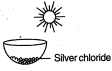
The following diagram displays a chemical reaction. Observe it carefully and answer the following questions:
$(a)$ Identify the type of chemical reaction that will take place and define it. How will the colour of the salt change?
$(b)$ Write the chemical equation of the reaction that takes place.
$(c)$ Mention one commercial use of this salt.
$(a)$ Identify the type of chemical reaction that will take place and define it. How will the colour of the salt change?
$(b)$ Write the chemical equation of the reaction that takes place.
$(c)$ Mention one commercial use of this salt.
Solution
(N/A) It is a photochemical decomposition reaction. It can be defined as the decomposition of a substance in the presence of sunlight in which a single reactant breaks down to give simpler products.
$(b)$ The white silver chloride changes to grey,as it decomposes into silver and chlorine in the presence of sunlight.
The chemical equation is:
$2 AgCl (s) \xrightarrow{\text{Sunlight}} 2 Ag (s) + Cl_2 (g)$
$(c)$ This salt is used in black and white photography.
$(b)$ The white silver chloride changes to grey,as it decomposes into silver and chlorine in the presence of sunlight.
The chemical equation is:
$2 AgCl (s) \xrightarrow{\text{Sunlight}} 2 Ag (s) + Cl_2 (g)$
$(c)$ This salt is used in black and white photography.
0 likes
View Solution45
Medium
Give reasons for the following:
$(i)$ All decomposition reactions are endothermic reactions.
$(ii)$ Colour of copper sulphate solution changes when an iron nail is dipped in it.
$(iii)$ Respiration is an exothermic reaction.
$(i)$ All decomposition reactions are endothermic reactions.
$(ii)$ Colour of copper sulphate solution changes when an iron nail is dipped in it.
$(iii)$ Respiration is an exothermic reaction.
Solution
(N/A) $(i)$ Decomposition reactions require energy in the form of heat,light,or electricity to break down the reactants,meaning energy is absorbed.
$(ii)$ Iron is more reactive than copper. When an iron nail is dipped in a copper sulphate solution,iron displaces copper from the solution to form iron sulphate,which is light green in colour.
$(iii)$ During respiration,glucose $(C_6H_{12}O_6)$ combines with oxygen in the cells of our body to produce carbon dioxide,water,and energy. Since energy is released during this process,it is considered an exothermic reaction.
0 likes
View Solution46
Medium
$(a)$ Classify the following chemical reactions as exothermic or endothermic:
$(i)$ Electrolysis of water
$(ii)$ Burning of natural gas
$(iii)$ Decomposition of calcium carbonate
$(iv)$ Burning of magnesium ribbon in air.
$(i)$ Electrolysis of water
$(ii)$ Burning of natural gas
$(iii)$ Decomposition of calcium carbonate
$(iv)$ Burning of magnesium ribbon in air.
Solution
(N/A) $(i)$ Electrolysis of water is an endothermic reaction because it requires electrical energy to break the bonds of water molecules.
$(ii)$ Burning of natural gas (methane) is an exothermic reaction as it releases a large amount of heat energy during combustion.
$(iii)$ Decomposition of calcium carbonate is an endothermic reaction because it requires heat energy to decompose into calcium oxide and carbon dioxide.
$(iv)$ Burning of magnesium ribbon in air is an exothermic reaction as it releases heat and light energy during the formation of magnesium oxide.
0 likes
View Solution47
Medium
$(a)$ Balance the chemical equation:
$Fe(s) + H_2O(g) \rightarrow Fe_3O_4(s) + H_2(g)$
$(b)$ Identify the type of reaction in the equation given below:
$Na_2SO_4(aq) + BaCl_2(aq) \rightarrow BaSO_4(s) + NaCl(aq)$
$Fe(s) + H_2O(g) \rightarrow Fe_3O_4(s) + H_2(g)$
$(b)$ Identify the type of reaction in the equation given below:
$Na_2SO_4(aq) + BaCl_2(aq) \rightarrow BaSO_4(s) + NaCl(aq)$
Solution
(N/A) To balance the equation $Fe(s) + H_2O(g) \rightarrow Fe_3O_4(s) + H_2(g)$:
$1$. Balance $Fe$: $3Fe(s) + H_2O(g) \rightarrow Fe_3O_4(s) + H_2(g)$
$2$. Balance $O$: $3Fe(s) + 4H_2O(g) \rightarrow Fe_3O_4(s) + H_2(g)$
$3$. Balance $H$: $3Fe(s) + 4H_2O(g) \rightarrow Fe_3O_4(s) + 4H_2(g)$
The balanced equation is $3Fe(s) + 4H_2O(g) \rightarrow Fe_3O_4(s) + 4H_2(g)$.
$(b)$ The reaction $Na_2SO_4(aq) + BaCl_2(aq) \rightarrow BaSO_4(s) + NaCl(aq)$ is a double displacement reaction because there is an exchange of ions between the reactants to form new products.
0 likes
View Solution48
Medium
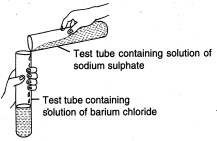
Observe the given figure and answer the following questions:
$(i)$ Write the complete balanced chemical equation for the reaction.
$(ii)$ Write the type of reaction involved.
$(iii)$ Is there any precipitate formed?
$(iv)$ If any precipitate is formed,write the colour of the precipitate.
$(i)$ Write the complete balanced chemical equation for the reaction.
$(ii)$ Write the type of reaction involved.
$(iii)$ Is there any precipitate formed?
$(iv)$ If any precipitate is formed,write the colour of the precipitate.
Solution
(N/A) $(i)$ The balanced chemical equation is:
$Na_{2}SO_{4}(aq) + BaCl_{2}(aq) \longrightarrow BaSO_{4}(s) \downarrow + 2NaCl(aq)$
$(ii)$ This is a double displacement reaction (specifically a precipitation reaction).
$(iii)$ Yes,a precipitate is formed.
$(iv)$ The precipitate formed is barium sulphate $(BaSO_{4})$,which is white in colour.
$Na_{2}SO_{4}(aq) + BaCl_{2}(aq) \longrightarrow BaSO_{4}(s) \downarrow + 2NaCl(aq)$
$(ii)$ This is a double displacement reaction (specifically a precipitation reaction).
$(iii)$ Yes,a precipitate is formed.
$(iv)$ The precipitate formed is barium sulphate $(BaSO_{4})$,which is white in colour.
0 likes
View Solution49
Medium
Write balanced chemical equations for the following reactions:
$(i)$ Calcium carbonate on reaction with hydrochloric acid gives calcium chloride,water and carbon dioxide.
$(ii)$ Nitrogen reacts with hydrogen under pressure to form ammonia.
$(iii)$ Carbon disulphide burns in air to give carbon dioxide and sulphur dioxide.
$(i)$ Calcium carbonate on reaction with hydrochloric acid gives calcium chloride,water and carbon dioxide.
$(ii)$ Nitrogen reacts with hydrogen under pressure to form ammonia.
$(iii)$ Carbon disulphide burns in air to give carbon dioxide and sulphur dioxide.
Solution
(N/A) $(i)$ $CaCO_{3} + 2HCl \longrightarrow CaCl_{2} + H_{2}O + CO_{2}$
$(ii)$ $N_{2} + 3H_{2} \xrightarrow{\text{pressure}} 2NH_{3}$
$(iii)$ $CS_{2} + 3O_{2} \longrightarrow CO_{2} + 2SO_{2}$
$(ii)$ $N_{2} + 3H_{2} \xrightarrow{\text{pressure}} 2NH_{3}$
$(iii)$ $CS_{2} + 3O_{2} \longrightarrow CO_{2} + 2SO_{2}$
0 likes
View Solution50
Medium
Complete and balance the following chemical equations:
$(i)$ $CaCO_{3} + HCl \longrightarrow$
$(ii)$ $Al + HCl \longrightarrow$
$(iii)$ $MnO_{2} + HCl \longrightarrow$
$(i)$ $CaCO_{3} + HCl \longrightarrow$
$(ii)$ $Al + HCl \longrightarrow$
$(iii)$ $MnO_{2} + HCl \longrightarrow$
Solution
(N/A) $(i)$ The reaction between calcium carbonate and hydrochloric acid produces calcium chloride,water,and carbon dioxide: $CaCO_{3} + 2HCl \longrightarrow CaCl_{2} + H_{2}O + CO_{2}$
$(ii)$ The reaction between aluminium and hydrochloric acid produces aluminium chloride and hydrogen gas: $2Al + 6HCl \longrightarrow 2AlCl_{3} + 3H_{2}$
$(iii)$ The reaction between manganese dioxide and hydrochloric acid produces manganese$(II)$ chloride,chlorine gas,and water: $MnO_{2} + 4HCl \longrightarrow MnCl_{2} + Cl_{2} + 2H_{2}O$
0 likes
View SolutionChemical Reactions and Equations — Mix Examples - Chemical Reactions and Equations · Frequently Asked Questions
1Are these Chemical Reactions and Equations questions useful for JEE and NEET?
Yes. All questions in this section are mapped to JEE Main and NEET exam patterns. Previous year questions from JEE Main, NEET, GUJCET and state-level exams are included with full solutions.
2Can I switch to Hindi or Gujarati for these questions?
Yes. Use the language tabs in the hero section or the sidebar to view the same questions and solutions in English, Hindi or Gujarati.
3How do I generate a question paper from this subtopic?
Use the Vedclass Exam Paper Generator — select the chapter and subtopic, set difficulty, and generate Sets A, B, C, D automatically. First 3 chapters of every subject are free.
Vedclass Products
For Students
Vedclass Test Series
Mock tests in real JEE/NEET style with performance analysis. 5-day free trial.
Start Free TrialFor Teachers
Exam Paper Generator
Generate Set A/B/C/D papers from this chapter in 2 minutes. 3 chapters free.
Try FreeFor Institutes
Online Exam Module
Live online exams with unlimited students, 360° analytics & white-label branding.
See DemoFor Teachers & Institutes
Generate a Chemical Reactions and Equations Exam Paper in 2 Minutes
Select subtopic & difficulty — Sets A, B, C, D auto-generated with No Repeat logic.
First 3 chapters of every subject are free — no payment required.