
A English
Oxidation and Reduction Questions in English
Class 10 Science · Chemical Reactions and Equations · Oxidation and Reduction
32+
Questions
English
Language
100%
With Solutions
Showing 32 of 32 questions in English
1
Medium
Identify the substances that are oxidised and the substances that are reduced in the following reactions.
$(i)$ $4Na(s) + O_2(g) \rightarrow 2Na_2O(s)$
$(ii)$ $CuO(s) + H_2(g) \rightarrow Cu(s) + H_2O(l)$
$(i)$ $4Na(s) + O_2(g) \rightarrow 2Na_2O(s)$
$(ii)$ $CuO(s) + H_2(g) \rightarrow Cu(s) + H_2O(l)$
Solution
(A) $(i)$ In the reaction $4Na(s) + O_2(g) \rightarrow 2Na_2O(s)$,Sodium $(Na)$ is oxidised because it gains oxygen to form $Na_2O$,and Oxygen $(O_2)$ is reduced.
$(ii)$ In the reaction $CuO(s) + H_2(g) \rightarrow Cu(s) + H_2O(l)$,Copper oxide $(CuO)$ is reduced to Copper $(Cu)$ because it loses oxygen,while Hydrogen $(H_2)$ is oxidised to Water $(H_2O)$ because it gains oxygen.
$(ii)$ In the reaction $CuO(s) + H_2(g) \rightarrow Cu(s) + H_2O(l)$,Copper oxide $(CuO)$ is reduced to Copper $(Cu)$ because it loses oxygen,while Hydrogen $(H_2)$ is oxidised to Water $(H_2O)$ because it gains oxygen.
0 likes
View Solution2
EasyMCQ
Which of the statements about the reaction below are incorrect?
$2 PbO_{(s)} + C_{(s)} \longrightarrow 2 Pb_{(s)} + CO_{2(g)}$
$(a)$ Lead is getting reduced.
$(b)$ Carbon dioxide is getting oxidised.
$(c)$ Carbon is getting oxidised.
$(d)$ Lead oxide is getting reduced.
$2 PbO_{(s)} + C_{(s)} \longrightarrow 2 Pb_{(s)} + CO_{2(g)}$
$(a)$ Lead is getting reduced.
$(b)$ Carbon dioxide is getting oxidised.
$(c)$ Carbon is getting oxidised.
$(d)$ Lead oxide is getting reduced.
A
$(a)$ and $(b)$
B
$(a)$ and $(c)$
C
$(a)$,$(b)$ and $(c)$
D
all
Solution
(A) In the given reaction: $2 PbO_{(s)} + C_{(s)} \longrightarrow 2 Pb_{(s)} + CO_{2(g)}$
$1$. Lead oxide $(PbO)$ loses oxygen to form lead $(Pb)$,so $PbO$ is being reduced.
$2$. Carbon $(C)$ gains oxygen to form carbon dioxide $(CO_2)$,so $C$ is being oxidised.
Evaluating the statements:
$(a)$ Lead is getting reduced: Incorrect. Lead oxide is being reduced,not lead.
$(b)$ Carbon dioxide is getting oxidised: Incorrect. Carbon is being oxidised to form carbon dioxide.
$(c)$ Carbon is getting oxidised: Correct.
$(d)$ Lead oxide is getting reduced: Correct.
Therefore,statements $(a)$ and $(b)$ are incorrect.
0 likes
View Solution3
Difficult
$A$ shiny brown coloured element $X$ on heating in air becomes black in colour. Name the element $X$ and the black coloured compound formed.
Solution
(N/A) $X$ is copper $(Cu)$ and the black-coloured compound formed is copper oxide $(CuO)$.
The chemical reaction that occurs when copper is heated in air is as follows:
$2Cu (s) + O_2 (g) \xrightarrow{\text{Heat}} 2CuO (s)$
In this reaction,copper reacts with oxygen to form copper$(II)$ oxide,which is black in colour.
The chemical reaction that occurs when copper is heated in air is as follows:
$2Cu (s) + O_2 (g) \xrightarrow{\text{Heat}} 2CuO (s)$
In this reaction,copper reacts with oxygen to form copper$(II)$ oxide,which is black in colour.
0 likes
View Solution4
Difficult
Explain the "Reduction" in terms of gain or loss of oxygen with two examples.
Solution
(N/A) Reduction is defined as the loss of oxygen from a substance during a chemical reaction.
For example:
$(i)$ $\mathop {CO_2 + H_2 \to CO}\limits_{\text{Removal of oxygen - reduction}} + H_2O$
$(ii)$ $\mathop {CuO + H_2 \xrightarrow{\Delta } Cu}\limits_{\text{Loss of oxygen - reduction}} + H_2O$
In equation $(i)$, $CO_2$ is reduced to $CO$ due to the loss of oxygen, and in equation $(ii)$, $CuO$ is reduced to $Cu$ due to the loss of oxygen.
0 likes
View Solution5
EasyMCQ
What are oxidising agents?
A
Substances that remove oxygen from other substances.
B
Substances that add oxygen to other substances.
C
Substances that remove hydrogen from other substances.
D
Both $(B)$ and $(C)$.
Solution
(D) Oxidising agents are substances that have the ability to add oxygen to other substances or remove hydrogen from them during a chemical reaction.
Examples include alkaline potassium permanganate $(KMnO_4)$ and acidified potassium dichromate $(K_2Cr_2O_7)$.
These substances facilitate the oxidation process by providing oxygen to the reactant.
Examples include alkaline potassium permanganate $(KMnO_4)$ and acidified potassium dichromate $(K_2Cr_2O_7)$.
These substances facilitate the oxidation process by providing oxygen to the reactant.
0 likes
View Solution6
MediumMCQ
Which of the following statements about the given reaction are correct?
$3 Fe (s) + 4 H_2 O (g) \rightarrow Fe_3 O_4 (s) + 4 H_2 (g)$
$(i)$ Iron metal is getting oxidised
$(ii)$ Water is getting reduced
$(iii)$ Water is acting as reducing agent
$(iv)$ Water is acting as oxidising agent
$3 Fe (s) + 4 H_2 O (g) \rightarrow Fe_3 O_4 (s) + 4 H_2 (g)$
$(i)$ Iron metal is getting oxidised
$(ii)$ Water is getting reduced
$(iii)$ Water is acting as reducing agent
$(iv)$ Water is acting as oxidising agent
A
$(i), (ii)$ and $(iii)$
B
$(iii)$ and $(iv)$
C
$(i), (ii)$ and $(iv)$
D
$(ii)$ and $(iv)$
Solution
(C) In the given reaction: $3 Fe (s) + 4 H_2 O (g) \rightarrow Fe_3 O_4 (s) + 4 H_2 (g)$
$(i)$ Iron $(Fe)$ gains oxygen to form $Fe_3 O_4$,so it is getting oxidised.
$(ii)$ Water $(H_2 O)$ loses oxygen to form $H_2$,so it is getting reduced.
$(iii)$ Since water provides oxygen to iron,it acts as an oxidising agent.
$(iv)$ Therefore,statement $(iv)$ is correct while statement $(iii)$ is incorrect.
Thus,statements $(i), (ii)$ and $(iv)$ are correct.
0 likes
View Solution7
MediumMCQ
$A$ dilute ferrous sulphate solution was gradually added to the beaker containing acidified permanganate solution. The light purple colour of the solution fades and finally disappears. Which of the following is the correct explanation for the observation?
A
$FeSO_4$ acts as an oxidising agent and oxidises $KMnO_4$.
B
$KMnO_4$ is an oxidising agent,it oxidises $FeSO_4$.
C
The colour disappears due to dilution; no reaction is involved.
D
$KMnO_4$ is an unstable compound and decomposes in presence of $FeSO_4$ to a colourless compound.
Solution
(B) The reaction between acidified potassium permanganate $(KMnO_4)$ and ferrous sulphate $(FeSO_4)$ is a classic redox reaction.
In this reaction,$KMnO_4$ acts as a strong oxidising agent.
It oxidises ferrous ions $(Fe^{2+})$ to ferric ions $(Fe^{3+})$.
During this process,the purple-coloured permanganate ions $(MnO_4^-)$ are reduced to colourless manganese ions $(Mn^{2+})$.
Therefore,the purple colour of the solution fades and eventually disappears as the reaction proceeds.
0 likes
View Solution8
Medium
Identify the reducing agent in the following reactions:
$(a)$ $4 NH_{3} + 5 O_{2} \longrightarrow 4 NO + 6 H_{2}O$
$(b)$ $H_{2}O + F_{2} \longrightarrow HF + HOF$
$(c)$ $Fe_{2}O_{3} + 3 CO \longrightarrow 2 Fe + 3 CO_{2}$
$(d)$ $2 H_{2} + O_{2} \longrightarrow 2 H_{2}O$
$(a)$ $4 NH_{3} + 5 O_{2} \longrightarrow 4 NO + 6 H_{2}O$
$(b)$ $H_{2}O + F_{2} \longrightarrow HF + HOF$
$(c)$ $Fe_{2}O_{3} + 3 CO \longrightarrow 2 Fe + 3 CO_{2}$
$(d)$ $2 H_{2} + O_{2} \longrightarrow 2 H_{2}O$
Solution
(N/A) In $4 NH_{3} + 5 O_{2} \longrightarrow 4 NO + 6 H_{2}O$,the oxidation state of nitrogen in $NH_{3}$ increases from $-3$ to $+2$. Thus,$NH_{3}$ is the reducing agent.
$(b)$ In $H_{2}O + F_{2} \longrightarrow HF + HOF$,the oxidation state of oxygen in $H_{2}O$ increases from $-2$ to $0$ (in $HOF$). Thus,$H_{2}O$ is the reducing agent.
$(c)$ In $Fe_{2}O_{3} + 3 CO \longrightarrow 2 Fe + 3 CO_{2}$,the oxidation state of carbon in $CO$ increases from $+2$ to $+4$. Thus,$CO$ is the reducing agent.
$(d)$ In $2 H_{2} + O_{2} \longrightarrow 2 H_{2}O$,the oxidation state of hydrogen in $H_{2}$ increases from $0$ to $+1$. Thus,$H_{2}$ is the reducing agent.
$A$ reducing agent is a substance that donates electrons or increases its own oxidation state during a chemical reaction.
0 likes
View Solution9
Medium
Identify the oxidising agent (oxidant) in the following reactions:
$(a) Pb_{3}O_{4} + 8HCl \longrightarrow 3PbCl_{2} + Cl_{2} + 4H_{2}O$
$(b) 2Mg + O_{2} \longrightarrow 2MgO$
$(c) CuSO_{4} + Zn \longrightarrow Cu + ZnSO_{4}$
$(d) V_{2}O_{5} + 5Ca \longrightarrow 2V + 5CaO$
$(e) 3Fe + 4H_{2}O \longrightarrow Fe_{3}O_{4} + 4H_{2}$
$(f) CuO + H_{2} \longrightarrow Cu + H_{2}O$
Solution
(A) An oxidising agent is a substance that gains electrons or provides oxygen (or removes hydrogen) in a chemical reaction.
$(a) Pb_{3}O_{4}$: Lead is reduced from $+8/3$ to $+2$,so $Pb_{3}O_{4}$ acts as the oxidising agent.
$(b) O_{2}$: Oxygen is reduced from $0$ to $-2$,so $O_{2}$ acts as the oxidising agent.
$(c) CuSO_{4}$: Copper is reduced from $+2$ to $0$,so $CuSO_{4}$ acts as the oxidising agent.
$(d) V_{2}O_{5}$: Vanadium is reduced from $+5$ to $0$,so $V_{2}O_{5}$ acts as the oxidising agent.
$(e) H_{2}O$: Hydrogen is reduced from $+1$ to $0$,so $H_{2}O$ acts as the oxidising agent.
$(f) CuO$: Copper is reduced from $+2$ to $0$,so $CuO$ acts as the oxidising agent.
0 likes
View Solution10
Medium
The following reaction takes place when aluminium powder is heated with $MnO_2$:
$3MnO_2(s) + 4Al(s) \rightarrow 3Mn(l) + 2Al_2O_3(l) + \text{Heat}$
$(a)$ Is aluminium getting reduced?
$(b)$ Is $MnO_2$ getting oxidised?
$3MnO_2(s) + 4Al(s) \rightarrow 3Mn(l) + 2Al_2O_3(l) + \text{Heat}$
$(a)$ Is aluminium getting reduced?
$(b)$ Is $MnO_2$ getting oxidised?
Solution
(N/A) No, aluminium is not getting reduced. Since oxygen is added to aluminium, it is getting oxidised to form aluminium oxide $(Al_2O_3)$.
$(b)$ No, $MnO_2$ is not getting oxidised. Since manganese has lost oxygen, $MnO_2$ is getting reduced to manganese $(Mn)$.
$(b)$ No, $MnO_2$ is not getting oxidised. Since manganese has lost oxygen, $MnO_2$ is getting reduced to manganese $(Mn)$.
0 likes
View Solution11
Easy
State one industrial application of the reduction process.
Solution
(N/A) The reduction process is widely used in metallurgy for the extraction of metals from their ores. For example,metal oxides are reduced to their respective pure metals by using reducing agents like carbon or hydrogen.
0 likes
View Solution12
Easy
Name the oxidising and reducing agent in the following reaction:
$CuO + H_{2} \longrightarrow Cu + H_{2}O$
$CuO + H_{2} \longrightarrow Cu + H_{2}O$
Solution
(N/A) In the given reaction: $CuO + H_{2} \longrightarrow Cu + H_{2}O$
$1$. The oxidising agent is $CuO$ because it provides oxygen to $H_{2}$ and gets reduced to $Cu$.
$2$. The reducing agent is $H_{2}$ because it removes oxygen from $CuO$ and gets oxidised to $H_{2}O$.
$1$. The oxidising agent is $CuO$ because it provides oxygen to $H_{2}$ and gets reduced to $Cu$.
$2$. The reducing agent is $H_{2}$ because it removes oxygen from $CuO$ and gets oxidised to $H_{2}O$.
0 likes
View Solution13
EasyMCQ
If copper metal is heated over a flame, it develops a coating. What is the colour and composition of this coating?
A
Black, Copper $(II)$ oxide $(CuO)$
B
Red, Copper $(I)$ oxide $(Cu_2O)$
C
Green, Copper carbonate $(CuCO_3)$
D
Blue, Copper sulphate $(CuSO_4)$
Solution
(A) When copper metal is heated in the presence of air (oxygen), it undergoes an oxidation reaction.
The copper reacts with oxygen to form copper $(II)$ oxide, which is represented by the chemical formula $CuO$.
This copper $(II)$ oxide forms a black-coloured coating on the surface of the copper metal.
The chemical equation for this reaction is: $2Cu(s) + O_2(g) \rightarrow 2CuO(s)$.
The copper reacts with oxygen to form copper $(II)$ oxide, which is represented by the chemical formula $CuO$.
This copper $(II)$ oxide forms a black-coloured coating on the surface of the copper metal.
The chemical equation for this reaction is: $2Cu(s) + O_2(g) \rightarrow 2CuO(s)$.
0 likes
View Solution14
Medium
Can oxidation or reduction take place alone? Why or why not? What are such reactions called?
Solution
(N/A) No,oxidation or reduction cannot take place alone. This is because electrons lost during oxidation must be gained by another substance during reduction. Therefore,these processes always occur simultaneously. Such reactions are known as $Redox$ reactions.
0 likes
View Solution15
Medium
Giving chemical equations,answer the following:
$(a)$ What happens when copper is heated in air?
$(b)$ What happens when the product obtained in the above reaction is heated in hydrogen?
$(a)$ What happens when copper is heated in air?
$(b)$ What happens when the product obtained in the above reaction is heated in hydrogen?
Solution
(N/A) When copper is heated in air,it reacts with oxygen to form copper$(II)$ oxide,which is a black-colored substance.
Equation: $2Cu(s) + O_2(g) \xrightarrow{\text{Heat}} 2CuO(s)$
$(b)$ When the product obtained (copper$(II)$ oxide) is heated in hydrogen gas,it undergoes a reduction reaction to form copper metal and water.
Equation: $CuO(s) + H_2(g) \xrightarrow{\text{Heat}} Cu(s) + H_2O(l)$
The black coating turns brown as copper metal is formed.
0 likes
View Solution16
EasyMCQ
Why is a combustion reaction considered an oxidation reaction?
A
It involves the release of energy.
B
It requires the presence of oxygen.
C
It produces carbon dioxide.
D
It involves the reduction of fuel.
Solution
(B) combustion reaction is classified as an oxidation reaction because it involves the addition of oxygen to a substance or the removal of hydrogen from it.
In most combustion processes,the fuel reacts with oxygen to form oxides,which is a fundamental characteristic of oxidation.
For example,the combustion of methane is represented as:
$CH_{4}(g) + 2O_{2}(g) \rightarrow CO_{2}(g) + 2H_{2}O(l)$
In this reaction,oxygen is added to carbon and hydrogen,confirming it as an oxidation process.
0 likes
View Solution17
Medium
You could have noted that when copper powder is heated in a china dish, the surface of copper powder becomes coated with black coloured substance.
$(i)$ Why has this black coloured substance formed?
$(ii)$ What is this black substance?
$(iii)$ Write the chemical equation of the reaction that takes place.
$(i)$ Why has this black coloured substance formed?
$(ii)$ What is this black substance?
$(iii)$ Write the chemical equation of the reaction that takes place.
Solution
(N/A) $(i)$ The black coloured substance is formed because copper reacts with atmospheric oxygen upon heating to form copper $(II)$ oxide.
$(ii)$ This black substance is copper $(II)$ oxide $(CuO)$.
$(iii)$ The chemical equation for the reaction is: $2Cu(s) + O_2(g) \xrightarrow{\text{Heat}} 2CuO(s)$
$(ii)$ This black substance is copper $(II)$ oxide $(CuO)$.
$(iii)$ The chemical equation for the reaction is: $2Cu(s) + O_2(g) \xrightarrow{\text{Heat}} 2CuO(s)$
0 likes
View Solution18
Medium
Give reason why:
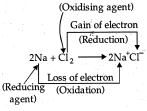
$(i)$ Sodium acts as a reducing agent while chlorine acts as an oxidising agent in the following reaction:
$2 Na (s) + Cl_2 (g) \rightarrow 2 NaCl (s)$
$(i)$ Sodium acts as a reducing agent while chlorine acts as an oxidising agent in the following reaction:
$2 Na (s) + Cl_2 (g) \rightarrow 2 NaCl (s)$
Solution
(N/A) In the reaction $2 Na (s) + Cl_2 (g) \rightarrow 2 NaCl (s)$:
$1$. Sodium $(Na)$ loses electrons to form sodium ions $(Na^+)$. The process of loss of electrons is called oxidation. Since sodium undergoes oxidation and facilitates the reduction of chlorine,it acts as a reducing agent.
$2$. Chlorine $(Cl_2)$ gains electrons to form chloride ions $(Cl^-)$. The process of gain of electrons is called reduction. Since chlorine undergoes reduction and facilitates the oxidation of sodium,it acts as an oxidising agent.
0 likes
View Solution19
MediumMCQ
Which is the reducing agent in the following reaction?
$MnO_{2}(s) + 4HCl(aq) \longrightarrow MnCl_{2}(s) + 2H_{2}O(l) + Cl_{2}(g)$
$MnO_{2}(s) + 4HCl(aq) \longrightarrow MnCl_{2}(s) + 2H_{2}O(l) + Cl_{2}(g)$
A
$HCl(aq)$
B
$MnO_{2}(s)$
C
$MnCl_{2}(s)$
D
$Cl_{2}(g)$
Solution
(A) In a redox reaction,the reducing agent is the substance that gets oxidized (loses electrons or gains oxygen/loses hydrogen).
In the given reaction: $MnO_{2}(s) + 4HCl(aq) \longrightarrow MnCl_{2}(s) + 2H_{2}O(l) + Cl_{2}(g)$
$1$. The oxidation state of $Cl$ in $HCl$ changes from $-1$ to $0$ in $Cl_{2}$. Since it loses electrons,$HCl$ is oxidized.
$2$. The oxidation state of $Mn$ in $MnO_{2}$ changes from $+4$ to $+2$ in $MnCl_{2}$. Since it gains electrons,$MnO_{2}$ is reduced.
$3$. Since $HCl$ undergoes oxidation,it acts as the reducing agent.
Therefore,the correct option is $A$.
0 likes
View Solution20
MediumMCQ
Which is the oxidising agent in the following reaction?
$CuO(s) + H_2(g) \longrightarrow Cu(s) + H_2O(l)$
$CuO(s) + H_2(g) \longrightarrow Cu(s) + H_2O(l)$
A
$H_2(g)$
B
$CuO(s)$
C
$Cu(s)$
D
$H_2O(l)$
Solution
(B) In the given reaction: $CuO(s) + H_2(g) \longrightarrow Cu(s) + H_2O(l)$
$1$. Copper oxide $(CuO)$ loses oxygen to form copper $(Cu)$. The loss of oxygen is defined as reduction.
$2$. Hydrogen $(H_2)$ gains oxygen to form water $(H_2O)$. The gain of oxygen is defined as oxidation.
$3$. An oxidising agent is a substance that provides oxygen or removes hydrogen,thereby undergoing reduction itself.
$4$. Since $CuO$ provides oxygen to $H_2$ and gets reduced to $Cu$,$CuO$ acts as the oxidising agent.
Therefore,the correct option is $B$.
0 likes
View Solution21
EasyMCQ
The colour formed on the surface of copper powder when it is heated in a china dish is:
A
Red
B
Black
C
Green
D
Blue
Solution
(B) When copper powder is heated in a china dish, it reacts with atmospheric oxygen to form copper $(II)$ oxide $(CuO)$.
The chemical reaction is: $2Cu(s) + O_2(g) \xrightarrow{\Delta} 2CuO(s)$.
Copper $(II)$ oxide is a black-coloured compound.
Therefore, the surface of the copper powder turns black.
The chemical reaction is: $2Cu(s) + O_2(g) \xrightarrow{\Delta} 2CuO(s)$.
Copper $(II)$ oxide is a black-coloured compound.
Therefore, the surface of the copper powder turns black.
0 likes
View Solution22
DifficultMCQ
What happens when hydrogen gas is passed over heated copper oxide $(CuO)$?
A
Black coating on the surface turns blue.
B
Black coating on the surface turns green.
C
Black coating on the surface turns brown.
D
Black coating on the surface turns white.
Solution
(C) When hydrogen gas is passed over heated copper oxide $(CuO)$, a redox reaction occurs.
In this reaction, hydrogen reduces copper oxide to copper metal.
The chemical equation for this reaction is: $CuO(s) + H_2(g) \xrightarrow{\Delta} Cu(s) + H_2O(g)$.
Copper oxide $(CuO)$ is black in color, while the copper metal $(Cu)$ formed is reddish-brown in color.
Therefore, the black coating on the surface turns brown.
0 likes
View Solution23
MediumMCQ
Which of the following statements about the given reaction are correct?
$3 Fe (s) + 4 H_2 O (g) \longrightarrow Fe_3 O_4 (s) + 4 H_2 (g)$
$(i)$ Iron metal is getting oxidised
$(ii)$ Water is getting reduced
$(iii)$ Water is acting as reducing agent
$(iv)$ Water is acting as oxidising agent
$3 Fe (s) + 4 H_2 O (g) \longrightarrow Fe_3 O_4 (s) + 4 H_2 (g)$
$(i)$ Iron metal is getting oxidised
$(ii)$ Water is getting reduced
$(iii)$ Water is acting as reducing agent
$(iv)$ Water is acting as oxidising agent
A
$(i), (ii)$ and $(iii)$
B
$(i), (ii)$ and $(iv)$
C
$(iii)$ and $(iv)$
D
$(ii)$ and $(iv)$
Solution
(B) In the given reaction: $3 Fe (s) + 4 H_2 O (g) \longrightarrow Fe_3 O_4 (s) + 4 H_2 (g)$
$1$. Iron $(Fe)$ gains oxygen to form $Fe_3 O_4$,which means iron is getting oxidised.
$2$. Water $(H_2 O)$ loses oxygen to form $H_2$,which means water is getting reduced.
$3$. Since water provides oxygen for the oxidation of iron,it acts as an oxidising agent.
$4$. Therefore,statements $(i)$,$(ii)$,and $(iv)$ are correct.
0 likes
View Solution24
MediumMCQ
$A$ dilute ferrous sulphate solution was gradually added to the beaker containing acidified permanganate solution. The light purple colour of the solution fades and finally disappears. Which of the following is the correct explanation for the observation?
A
$KMnO_4$ is an unstable compound and decomposes in presence of $FeSO_4$ to a colourless compound.
B
$FeSO_4$ acts as an oxidising agent and oxidises $KMnO_4$.
C
The colour disappears due to dilution; no reaction is involved.
D
$KMnO_4$ is an oxidising agent,it oxidises $FeSO_4$.
Solution
(D) The reaction between acidified potassium permanganate $(KMnO_4)$ and ferrous sulphate $(FeSO_4)$ is a classic redox reaction.
In this reaction,$KMnO_4$ acts as a strong oxidising agent.
It oxidises the ferrous ions $(Fe^{2+})$ present in the $FeSO_4$ solution to ferric ions $(Fe^{3+})$.
During this process,the purple-coloured permanganate ions $(MnO_4^-)$ are reduced to colourless manganese ions $(Mn^{2+})$.
As the concentration of $MnO_4^-$ decreases,the purple colour of the solution fades and eventually disappears.
0 likes
View Solution25
EasyMCQ
What is the main principle involved in a Voltaic cell?
A
Conversion of chemical energy into heat energy.
B
Conversion of heat energy into electrical energy.
C
Conversion of chemical energy into electrical energy.
D
Conversion of electrical energy into chemical energy.
Solution
(C) Voltaic cell (also known as a Galvanic cell) is an electrochemical device that generates electrical energy from spontaneous chemical reactions occurring within it.
In this cell,redox reactions (oxidation and reduction) take place at the electrodes.
The chemical potential energy stored in the reactants is converted into electrical energy,which can then be used to power an external circuit.
In this cell,redox reactions (oxidation and reduction) take place at the electrodes.
The chemical potential energy stored in the reactants is converted into electrical energy,which can then be used to power an external circuit.
0 likes
View Solution26
EasyMCQ
Which of the following is a reducing agent?
A
$H_{2}O$
B
$CO_{2}$
C
$Fe$
D
$Al$
Solution
(D) reducing agent is a substance that donates electrons or increases the oxidation state of another substance while being oxidized itself.
In the context of metallurgy and chemical reactions, metals like $Al$ (Aluminum) and $Fe$ (Iron) act as strong reducing agents.
However, $Al$ is a much stronger reducing agent than $Fe$, commonly used in the thermite reaction to reduce metal oxides (e.g., $Fe_{2}O_{3} + 2Al \rightarrow 2Fe + Al_{2}O_{3} + \text{Heat}$).
Therefore, $Al$ is the most appropriate answer among the given choices as it is widely recognized as a powerful reducing agent in chemical processes.
0 likes
View Solution27
EasyMCQ
Which process occurs at the anode during the process of electrolysis?
A
Oxidation
B
Reduction
C
Displacement
D
Decomposition
Solution
(A) In an electrolytic cell,the anode is the positive electrode. During electrolysis,negatively charged ions (anions) migrate towards the anode. At the anode,these anions lose electrons to form neutral atoms or molecules. The loss of electrons is defined as oxidation. Therefore,oxidation always occurs at the anode.
0 likes
View Solution28
EasyMCQ
Which process occurs at the cathode during the process of electrolysis?
A
Displacement
B
Addition
C
Oxidation
D
Reduction
Solution
(D) In an electrolytic cell,the cathode is the negatively charged electrode.
During electrolysis,positively charged ions (cations) move towards the cathode.
At the cathode,these cations gain electrons to become neutral atoms or molecules.
The process of gaining electrons is defined as reduction.
Therefore,reduction always occurs at the cathode.
During electrolysis,positively charged ions (cations) move towards the cathode.
At the cathode,these cations gain electrons to become neutral atoms or molecules.
The process of gaining electrons is defined as reduction.
Therefore,reduction always occurs at the cathode.
0 likes
View Solution29
EasyMCQ
What happens when copper oxide is heated in the presence of dihydrogen gas?
A
Reduction occurs and copper metal is obtained.
B
Copper hydride is formed and dioxygen gas is released.
C
Copper hydroxide is formed.
D
No chemical reaction occurs.
Solution
(A) When copper oxide $(CuO)$ is heated in the presence of dihydrogen gas $(H_2)$, a redox reaction occurs.
In this reaction, $CuO$ loses oxygen to form copper metal $(Cu)$, which is a reduction process.
Simultaneously, $H_2$ gains oxygen to form water $(H_2O)$, which is an oxidation process.
The chemical equation for this reaction is: $CuO(s) + H_2(g) \xrightarrow{\Delta} Cu(s) + H_2O(g)$.
Thus, copper metal is obtained as a product.
0 likes
View Solution30
EasyMCQ
Which color solution is formed when sulfur dioxide gas reduces an acidic potassium dichromate solution?
A
Green
B
Orange
C
Blue
D
Red
Solution
(A) When sulfur dioxide $(SO_2)$ gas is passed through an acidic potassium dichromate $(K_2Cr_2O_7)$ solution,it acts as a reducing agent.
The orange-colored dichromate ion $(Cr_2O_7^{2-})$ is reduced to the green-colored chromium$(III)$ ion $(Cr^{3+})$.
The chemical reaction is: $K_2Cr_2O_7 + 3SO_2 + H_2SO_4 \rightarrow K_2SO_4 + Cr_2(SO_4)_3 + H_2O$.
Due to the formation of chromium$(III)$ sulfate,the solution turns green.
The orange-colored dichromate ion $(Cr_2O_7^{2-})$ is reduced to the green-colored chromium$(III)$ ion $(Cr^{3+})$.
The chemical reaction is: $K_2Cr_2O_7 + 3SO_2 + H_2SO_4 \rightarrow K_2SO_4 + Cr_2(SO_4)_3 + H_2O$.
Due to the formation of chromium$(III)$ sulfate,the solution turns green.
0 likes
View Solution31
EasyMCQ
When sulfur dioxide gas reacts with hydrogen sulfide gas,sulfur is formed. Which of the following statements about sulfur dioxide is incorrect for this reaction?
A
It oxidizes $H_{2}S$ to $S$.
B
$SO_{2}$ is reduced to $S$.
C
It acts as an oxidizing agent.
D
It acts as a weak bleaching agent.
Solution
(D) The chemical reaction is: $SO_{2} + 2H_{2}S \rightarrow 3S + 2H_{2}O$.
In this reaction,$SO_{2}$ oxidizes $H_{2}S$ to $S$ and itself gets reduced to $S$.
Since $SO_{2}$ causes the oxidation of $H_{2}S$,it acts as an oxidizing agent.
Option $D$ states that it acts as a weak bleaching agent. While $SO_{2}$ is a bleaching agent,this property is not relevant to the chemical reaction described in the question. Therefore,the statement in option $D$ is incorrect in the context of this specific reaction.
0 likes
View Solution32
EasyMCQ
What type of reaction occurs when sulfur dioxide $(SO_2)$ reacts with an acidic solution of potassium dichromate $(K_2Cr_2O_7)$?
A
Reduction
B
Oxidation
C
Displacement
D
Bleaching process
Solution
(B) When sulfur dioxide $(SO_2)$ reacts with an acidic solution of potassium dichromate $(K_2Cr_2O_7)$,the sulfur dioxide acts as a reducing agent.
In this reaction,the oxidation state of sulfur in $SO_2$ increases from $+4$ to $+6$ (in $SO_4^{2-}$),meaning $SO_2$ undergoes oxidation.
Simultaneously,the chromium in $K_2Cr_2O_7$ is reduced from $+6$ to $+3$ $(Cr^{3+})$.
Therefore,the overall process involves the oxidation of sulfur dioxide by potassium dichromate.
0 likes
View SolutionChemical Reactions and Equations — Oxidation and Reduction · Frequently Asked Questions
1Are these Chemical Reactions and Equations questions useful for JEE and NEET?
Yes. All questions in this section are mapped to JEE Main and NEET exam patterns. Previous year questions from JEE Main, NEET, GUJCET and state-level exams are included with full solutions.
2Can I switch to Hindi or Gujarati for these questions?
Yes. Use the language tabs in the hero section or the sidebar to view the same questions and solutions in English, Hindi or Gujarati.
3How do I generate a question paper from this subtopic?
Use the Vedclass Exam Paper Generator — select the chapter and subtopic, set difficulty, and generate Sets A, B, C, D automatically. First 3 chapters of every subject are free.
Vedclass Products
For Students
Vedclass Test Series
Mock tests in real JEE/NEET style with performance analysis. 5-day free trial.
Start Free TrialFor Teachers
Exam Paper Generator
Generate Set A/B/C/D papers from this chapter in 2 minutes. 3 chapters free.
Try FreeFor Institutes
Online Exam Module
Live online exams with unlimited students, 360° analytics & white-label branding.
See DemoFor Teachers & Institutes
Generate a Chemical Reactions and Equations Exam Paper in 2 Minutes
Select subtopic & difficulty — Sets A, B, C, D auto-generated with No Repeat logic.
First 3 chapters of every subject are free — no payment required.