
A English
Types of Chemical Reactions Questions in English
Class 10 Science · Chemical Reactions and Equations · Types of Chemical Reactions
72+
Questions
English
Language
100%
With Solutions
Showing 50 of 72 questions in English
1
Difficult
$A$ solution of a substance $X$ is used for whitewashing.
$(i)$ Name the substance $X$ and write its formula.
$(ii)$ Write the reaction of the substance $X$ named in $(i)$ above with water.
$(i)$ Name the substance $X$ and write its formula.
$(ii)$ Write the reaction of the substance $X$ named in $(i)$ above with water.
Solution
(N/A) $(i)$ The substance $X$ is calcium oxide. Its chemical formula is $CaO$.
$(ii)$ Calcium oxide reacts vigorously with water to form calcium hydroxide (slaked lime).
The chemical reaction is:
$CaO_{(s)} + H_2O_{(l)} \to Ca(OH)_{2(aq)}$
Where $CaO$ is Calcium oxide (Quick lime) and $Ca(OH)_2$ is Calcium hydroxide (Slaked lime).
$(ii)$ Calcium oxide reacts vigorously with water to form calcium hydroxide (slaked lime).
The chemical reaction is:
$CaO_{(s)} + H_2O_{(l)} \to Ca(OH)_{2(aq)}$
Where $CaO$ is Calcium oxide (Quick lime) and $Ca(OH)_2$ is Calcium hydroxide (Slaked lime).
0 likes
View Solution2
Easy
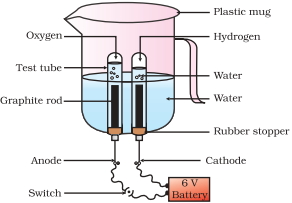
Why is the amount of gas collected in one of the test tubes in the image double the amount collected in the other? Name this gas.
Solution
(N/A) Water $(H_2O)$ consists of two parts hydrogen and one part oxygen by volume.
During the electrolysis of water,the chemical reaction is: $2H_2O(l) \rightarrow 2H_2(g) + O_2(g)$.
This reaction shows that hydrogen gas and oxygen gas are produced in a $2:1$ ratio.
Since hydrogen gas is collected at the cathode and oxygen gas is collected at the anode,the volume of hydrogen collected is double the volume of oxygen collected.
The gas collected in double the amount is hydrogen.
0 likes
View Solution3
Medium
Why does the colour of copper sulphate solution change when an iron nail is dipped in it?
Solution
(N/A) When an iron nail is placed in a copper sulphate solution,iron being more reactive than copper,displaces copper from the copper sulphate solution. This reaction forms iron sulphate,which is green in colour.
$Fe_{(s)} + CuSO_{4(aq)} \rightarrow FeSO_{4(aq)} + Cu_{(s)}$
In this reaction,the blue colour of the copper sulphate solution fades as it is converted into light green iron sulphate solution,and a reddish-brown deposit of copper is formed on the iron nail.
$Fe_{(s)} + CuSO_{4(aq)} \rightarrow FeSO_{4(aq)} + Cu_{(s)}$
In this reaction,the blue colour of the copper sulphate solution fades as it is converted into light green iron sulphate solution,and a reddish-brown deposit of copper is formed on the iron nail.
0 likes
View Solution4
Medium
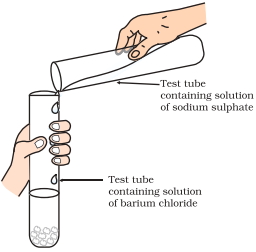
Give an example of a double displacement reaction other than the one given in the image.
Solution
(N/A) Sodium carbonate reacts with calcium chloride to form calcium carbonate and sodium chloride.
$Na_{2}CO_{3(aq)} + CaCl_{2(aq)} \to CaCO_{3(s)} + 2NaCl_{(aq)}$
In this reaction,sodium carbonate and calcium chloride exchange ions to form two new compounds. Hence,it is a double displacement reaction.
$Na_{2}CO_{3(aq)} + CaCl_{2(aq)} \to CaCO_{3(s)} + 2NaCl_{(aq)}$
In this reaction,sodium carbonate and calcium chloride exchange ions to form two new compounds. Hence,it is a double displacement reaction.
0 likes
View Solution5
EasyMCQ
$Fe_{2}O_{3} + 2Al \rightarrow Al_{2}O_{3} + 2Fe$
The above reaction is an example of a:
The above reaction is an example of a:
A
combination reaction.
B
displacement reaction.
C
decomposition reaction.
D
double displacement reaction.
Solution
(B) In the given chemical reaction,$Al$ (aluminum) is more reactive than $Fe$ (iron).
Therefore,$Al$ displaces $Fe$ from its oxide $(Fe_{2}O_{3})$.
This type of reaction,where a more reactive element displaces a less reactive element from its compound,is known as a displacement reaction.
Specifically,this is a thermite reaction.
Therefore,$Al$ displaces $Fe$ from its oxide $(Fe_{2}O_{3})$.
This type of reaction,where a more reactive element displaces a less reactive element from its compound,is known as a displacement reaction.
Specifically,this is a thermite reaction.
0 likes
View Solution6
Medium
What does one mean by exothermic and endothermic reactions? Give examples.
Solution
(N/A) Chemical reactions that release energy in the form of heat,light,or sound are called exothermic reactions.
Example: The reaction of sodium and chlorine to yield table salt:
$Na_{(s)} + \frac{1}{2} Cl_{2(g)} \longrightarrow NaCl_{(s)} + 411 \, kJ$ of energy.
Reactions that absorb energy or require energy in order to proceed are called endothermic reactions.
Example: In the process of photosynthesis,plants use energy from the sun to convert carbon dioxide and water into glucose and oxygen:
$6CO_{2(g)} + 6H_{2}O_{(l)} \xrightarrow{\text{Sunlight}} C_{6}H_{12}O_{6(aq)} + 6O_{2(g)}$
0 likes
View Solution7
Difficult
Write one equation each for decomposition reactions where energy is supplied in the form of heat,light,or electricity.
Solution
(N/A) Thermal decomposition:
$2FeSO_{4(s)} \xrightarrow{\Delta} Fe_2O_{3(s)} + SO_{2(g)} + SO_{3(g)}$
(Ferrous sulphate $\rightarrow$ Ferric oxide + Sulphur dioxide + Sulphur trioxide)
$(b)$ Photolytic decomposition (by light):
$2AgCl_{(s)} \xrightarrow{\text{Light}} 2Ag_{(s)} + Cl_{2(g)}$
(Silver chloride $\rightarrow$ Silver + Chlorine)
$(c)$ Electrolytic decomposition (by electricity):
$2H_2O_{(l)} \xrightarrow{\text{Electricity}} 2H_{2(g)} + O_{2(g)}$
(Water $\rightarrow$ Hydrogen + Oxygen)
1 likes
View Solution8
Medium
What do you mean by a precipitation reaction? Explain by giving examples.
Solution
(N/A) reaction in which an insoluble solid (called precipitate) is formed is called a precipitation reaction.
For example:
$Na_2CO_{3(aq)} + CaCl_{2(aq)} \to CaCO_{3(s)} + 2NaCl_{(aq)}$
In this reaction,calcium carbonate $(CaCO_3)$ is obtained as a white precipitate.
Another example of a precipitation reaction is:
$Na_2SO_{4(aq)} + BaCl_{2(aq)} \to BaSO_{4(s)} + 2NaCl_{(aq)}$
In this reaction,barium sulphate $(BaSO_4)$ is obtained as a white precipitate.
0 likes
View Solution9
Medium
What would you observe when zinc is added to a solution of iron $(II)$ sulphate? Write the chemical reaction that takes place.
Solution
(N/A) Zinc is more reactive than iron. Therefore,when zinc is added to a solution of iron $(II)$ sulphate,it displaces iron from the solution,resulting in the formation of zinc sulphate and iron metal.
The chemical reaction is:
$Zn_{(s)} + FeSO_{4(aq)} \to ZnSO_{4(aq)} + Fe_{(s)}$
The chemical reaction is:
$Zn_{(s)} + FeSO_{4(aq)} \to ZnSO_{4(aq)} + Fe_{(s)}$
1 likes
View Solution10
MediumMCQ
Which among the following is(are) double displacement reaction$(s)$?
$(i)$ $Pb + CuCl_{2} \rightarrow PbCl_{2} + Cu$
$(ii)$ $Na_{2}SO_{4} + BaCl_{2} \rightarrow BaSO_{4} + 2NaCl$
$(iii)$ $C + O_{2} \rightarrow CO_{2}$
$(iv)$ $CH_{4} + 2O_{2} \rightarrow CO_{2} + 2H_{2}O$
$(i)$ $Pb + CuCl_{2} \rightarrow PbCl_{2} + Cu$
$(ii)$ $Na_{2}SO_{4} + BaCl_{2} \rightarrow BaSO_{4} + 2NaCl$
$(iii)$ $C + O_{2} \rightarrow CO_{2}$
$(iv)$ $CH_{4} + 2O_{2} \rightarrow CO_{2} + 2H_{2}O$
A
$(i)$ and $(iv)$
B
$(i)$ and $(ii)$
C
$(ii)$ only
D
$(iii)$ and $(iv)$
Solution
(C) double displacement reaction is a chemical reaction where two reactant compounds exchange ions to form two new compounds.
$(i)$ $Pb + CuCl_{2} \rightarrow PbCl_{2} + Cu$ is a displacement reaction where $Pb$ displaces $Cu$.
$(ii)$ $Na_{2}SO_{4} + BaCl_{2} \rightarrow BaSO_{4} + 2NaCl$ is a double displacement reaction where $Na^+$ and $Ba^{2+}$ ions exchange places.
$(iii)$ $C + O_{2} \rightarrow CO_{2}$ is a combination reaction.
$(iv)$ $CH_{4} + 2O_{2} \rightarrow CO_{2} + 2H_{2}O$ is a combustion reaction.
Therefore,only $(ii)$ is a double displacement reaction.
0 likes
View Solution11
MediumMCQ
Barium chloride on reacting with ammonium sulphate forms barium sulphate and ammonium chloride. Which of the following correctly represents the type of the reaction involved?
$(i)$ Displacement reaction
$(ii)$ Precipitation reaction
$(iii)$ Combination reaction
$(iv)$ Double displacement reaction
$(i)$ Displacement reaction
$(ii)$ Precipitation reaction
$(iii)$ Combination reaction
$(iv)$ Double displacement reaction
A
$(i)$ only
B
$(ii)$ and $(iv)$
C
$(iv)$ only
D
$(ii)$ only
Solution
(B) The chemical equation for the reaction is:
$BaCl_2(aq) + (NH_4)_2SO_4(aq) \rightarrow BaSO_4(s) + 2NH_4Cl(aq)$
$1$. In this reaction, the ions $Ba^{2+}$ and $NH_4^+$ are exchanged between the reactants, which characterizes a $\text{Double displacement reaction}$ $(iv)$.
$2$. Barium sulphate $(BaSO_4)$ is formed as an insoluble white solid, which is known as a precipitate. Therefore, this is also a $\text{Precipitation reaction}$ $(ii)$.
Thus, both $(ii)$ and $(iv)$ are correct.
0 likes
View Solution12
MediumMCQ
Electrolysis of water is a decomposition reaction. The mole ratio of hydrogen and oxygen gases liberated during electrolysis of water is
A
$1:1$
B
$4:1$
C
$2:1$
D
$1:2$
Solution
(C) The chemical equation for the electrolysis of water is: $2H_2O(l) \rightarrow 2H_2(g) + O_2(g)$.
According to the balanced chemical equation,$2$ moles of water decompose to produce $2$ moles of hydrogen gas and $1$ mole of oxygen gas.
Therefore,the mole ratio of hydrogen gas to oxygen gas liberated is $2:1$.
According to the balanced chemical equation,$2$ moles of water decompose to produce $2$ moles of hydrogen gas and $1$ mole of oxygen gas.
Therefore,the mole ratio of hydrogen gas to oxygen gas liberated is $2:1$.
0 likes
View Solution13
MediumMCQ
In the double displacement reaction between aqueous potassium iodide and aqueous lead nitrate,a yellow precipitate of lead iodide is formed. While performing the activity if lead nitrate is not available,which of the following can be used in place of lead nitrate?
A
Lead acetate
B
Lead sulphate (insoluble)
C
Ammonium nitrate
D
Potassium sulphate
Solution
(A) double displacement reaction requires soluble ionic compounds to provide ions in the solution.
Lead nitrate is soluble in water and provides $Pb^{2+}$ ions,which react with $I^-$ ions from potassium iodide to form a yellow precipitate of lead iodide $(PbI_2)$.
Lead acetate is also a soluble lead salt that dissociates to provide $Pb^{2+}$ ions,making it a suitable substitute for lead nitrate in this reaction.
Lead sulphate is insoluble in water and will not provide the necessary $Pb^{2+}$ ions for the reaction to occur.
0 likes
View Solution14
DifficultMCQ
The following reaction is used for the preparation of oxygen gas in the laboratory:
$2KClO_{3(s)} \xrightarrow[Catalyst]{Heat} 2KCl_{(s)} + 3O_{2(g)}$
Which of the following statement$(s)$ is(are) correct about the reaction?
$2KClO_{3(s)} \xrightarrow[Catalyst]{Heat} 2KCl_{(s)} + 3O_{2(g)}$
Which of the following statement$(s)$ is(are) correct about the reaction?
A
It is a decomposition reaction and accompanied by release of heat
B
It is a combination reaction
C
It is a decomposition reaction and endothermic in nature
D
It is a photochemical decomposition reaction and exothermic in nature
Solution
(C) $1$. The given reaction is $2KClO_{3(s)} \xrightarrow[Catalyst]{Heat} 2KCl_{(s)} + 3O_{2(g)}$.
$2$. In this reaction,a single reactant $(KClO_3)$ breaks down into simpler products ($KCl$ and $O_2$),which characterizes it as a decomposition reaction.
$3$. The reaction requires the supply of heat (thermal energy) to proceed,which indicates that it is an endothermic reaction.
$4$. Therefore,the correct statement is that it is a decomposition reaction and endothermic in nature.
0 likes
View Solution15
MediumMCQ
Which one of the following processes involves chemical reactions?
A
Storing of oxygen gas under pressure in a gas cylinder
B
Liquefaction of air
C
Keeping petrol in a china dish in the open
D
Heating copper wire in presence of air at high temperature
Solution
(D) chemical reaction involves the formation of new substances with different chemical properties.
$A$. Storing oxygen gas under pressure is a physical change as it only changes the state of the gas.
$B$. Liquefaction of air is a physical process involving changes in temperature and pressure.
$C$. Keeping petrol in an open dish is a physical process of evaporation.
$D$. Heating copper wire in the presence of air at high temperature leads to the formation of copper$(II)$ oxide $(2Cu + O_2 \rightarrow 2CuO)$. This is a chemical reaction because a new substance is formed.
0 likes
View Solution16
MediumMCQ
Which of the following are combination reactions?
$(i) 2 KClO_3 \xrightarrow{\text{Heat}} 2 KCl + 3 O_2$
$(ii) MgO + H_2O \longrightarrow Mg(OH)_2$
$(iii) 4 Al + 3 O_2 \longrightarrow 2 Al_2O_3$
$(iv) Zn + FeSO_4 \longrightarrow ZnSO_4 + Fe$
$(i) 2 KClO_3 \xrightarrow{\text{Heat}} 2 KCl + 3 O_2$
$(ii) MgO + H_2O \longrightarrow Mg(OH)_2$
$(iii) 4 Al + 3 O_2 \longrightarrow 2 Al_2O_3$
$(iv) Zn + FeSO_4 \longrightarrow ZnSO_4 + Fe$
A
$(i)$ and $(iii)$
B
$(ii)$ and $(iii)$
C
$(ii)$ and $(iv)$
D
$(iii)$ and $(iv)$
Solution
(B) combination reaction is a reaction in which two or more reactants combine to form a single product.
$(i) 2 KClO_3 \xrightarrow{\text{Heat}} 2 KCl + 3 O_2$: This is a decomposition reaction because a single reactant breaks down into simpler products.
$(ii) MgO + H_2O \longrightarrow Mg(OH)_2$: This is a combination reaction because two reactants ($MgO$ and $H_2O$) combine to form a single product $(Mg(OH)_2)$.
$(iii) 4 Al + 3 O_2 \longrightarrow 2 Al_2O_3$: This is a combination reaction because two reactants ($Al$ and $O_2$) combine to form a single product $(Al_2O_3)$.
$(iv) Zn + FeSO_4 \longrightarrow ZnSO_4 + Fe$: This is a displacement reaction because $Zn$ displaces $Fe$ from its salt solution.
Therefore, $(ii)$ and $(iii)$ are combination reactions.
0 likes
View Solution17
Medium
$A$ solution of potassium chloride when mixed with silver nitrate solution,an insoluble white substance is formed. Write the chemical reaction involved and also mention the type of the chemical reaction?
Solution
(N/A) The chemical reaction between potassium chloride $(KCl)$ and silver nitrate $(AgNO_3)$ is as follows:
$KCl(aq) + AgNO_3(aq) \longrightarrow AgCl(s) + KNO_3(aq)$
In this reaction,silver chloride $(AgCl)$ is formed as an insoluble white precipitate.
This is a double displacement reaction because there is an exchange of ions between the reactants.
It is also classified as a precipitation reaction because an insoluble solid (precipitate) is formed.
0 likes
View Solution18
Medium
Ferrous sulphate decomposes with the evolution of a gas having a characteristic odour of burning sulphur. Write the chemical reaction involved and identify the type of reaction.
Solution
(N/A) The chemical reaction for the thermal decomposition of ferrous sulphate is:
$2FeSO_4(s) \xrightarrow{\text{Heat}} Fe_2O_3(s) + SO_2(g) + SO_3(g)$
In this reaction,green ferrous sulphate crystals lose water on heating and then decompose to form ferric oxide,sulphur dioxide,and sulphur trioxide. The gas evolved $(SO_2)$ has the characteristic smell of burning sulphur. Since a single reactant breaks down into multiple products upon heating,it is classified as a thermal decomposition reaction.
0 likes
View Solution19
Medium
Why do we store silver chloride in dark-coloured bottles?
Solution
(N/A) Silver chloride $(AgCl)$ is a light-sensitive compound.
When exposed to sunlight,it undergoes a photochemical decomposition reaction to form metallic silver and chlorine gas.
The chemical equation for this reaction is:
$2AgCl(s) \xrightarrow{\text{sunlight}} 2Ag(s) + Cl_2(g)$
To prevent this decomposition and preserve the chemical,it is stored in dark-coloured bottles that block light.
0 likes
View Solution20
Medium
On heating blue coloured powder of copper $(II)$ nitrate in a boiling tube,copper oxide (black),oxygen gas and a brown gas $X$ is formed.
$(a)$ Write a balanced chemical equation of the reaction.
$(b)$ Identify the brown gas $X$ evolved.
$(a)$ Write a balanced chemical equation of the reaction.
$(b)$ Identify the brown gas $X$ evolved.
Solution
(N/A) Balanced chemical equation:
$2Cu(NO_3)_2(s) \xrightarrow{\text{Heat}} 2CuO(s) + O_2(g) + 4NO_2(g)$
$(b)$ The brown gas $X$ evolved is nitrogen dioxide $(NO_2)$.
$2Cu(NO_3)_2(s) \xrightarrow{\text{Heat}} 2CuO(s) + O_2(g) + 4NO_2(g)$
$(b)$ The brown gas $X$ evolved is nitrogen dioxide $(NO_2)$.
0 likes
View Solution21
MediumMCQ
What can be seen when a strip of copper metal is placed in a solution of silver nitrate?
A
The solution turns green and silver metal is deposited.
B
The solution turns blue and silver metal is deposited.
C
The solution remains colorless and copper metal dissolves.
D
No reaction occurs.
Solution
(B) When a strip of copper metal is placed in a silver nitrate solution,a displacement reaction occurs because copper is more reactive than silver.
Metallic silver is precipitated as a solid,and the solution turns blue due to the formation of copper$(II)$ nitrate.
The chemical equation is: $Cu(s) + 2AgNO_3(aq) \to 2Ag(s) + Cu(NO_3)_2(aq)$.
Metallic silver is precipitated as a solid,and the solution turns blue due to the formation of copper$(II)$ nitrate.
The chemical equation is: $Cu(s) + 2AgNO_3(aq) \to 2Ag(s) + Cu(NO_3)_2(aq)$.
0 likes
View Solution22
EasyMCQ
Which one is a chemical change: Fermentation of fruit juice or diluting fruit juice?
A
Fermentation of fruit juice
B
Diluting fruit juice
C
Both are chemical changes
D
Neither is a chemical change
Solution
(A) chemical change involves the formation of new substances with different chemical properties.
Fermentation of fruit juice is a chemical change because microorganisms (like yeast) convert sugars into alcohol and carbon dioxide,resulting in a new substance.
Diluting fruit juice is a physical change because it only involves adding water to the juice,which does not change the chemical composition of the juice components.
0 likes
View Solution23
Easy
In the electrolysis of water,why is the volume of gas collected over one electrode double that of the gas collected over the other electrode?
Solution
(N/A) During the electrolysis of water,the water molecule $(H_{2}O)$ decomposes into hydrogen gas $(H_{2})$ and oxygen gas $(O_{2})$ in a specific molar ratio.
The chemical equation for this process is:
$2H_{2}O(l) \xrightarrow{\text{Electrolysis}} 2H_{2}(g) + O_{2}(g)$
According to the balanced chemical equation,for every $2$ moles of water decomposed,$2$ moles of hydrogen gas are produced at the cathode and $1$ mole of oxygen gas is produced at the anode.
Therefore,the volume of hydrogen gas collected is double the volume of oxygen gas collected,resulting in a ratio of $2:1$.
0 likes
View Solution24
EasyMCQ
Which one is a chemical change: Electrolysis of water or Sodium chloride exposed to sunlight?
A
Electrolysis of water
B
Sodium chloride exposed to sunlight
C
Both are chemical changes
D
None of the above
Solution
(A) Electrolysis of water is a chemical change because it involves the decomposition of water $(H_2O)$ into hydrogen $(H_2)$ and oxygen $(O_2)$ gases using electricity,resulting in the formation of new substances.
Sodium chloride $(NaCl)$ is stable under sunlight and does not undergo a chemical change when exposed to it.
Sodium chloride $(NaCl)$ is stable under sunlight and does not undergo a chemical change when exposed to it.
0 likes
View Solution25
Medium
When a green iron salt is heated strongly, its colour finally changes to black and the odour of burning sulphur is given out.
$(a)$ Name the iron salt.
$(b)$ Name the type of reaction that takes place during the heating of iron salt.
$(a)$ Name the iron salt.
$(b)$ Name the type of reaction that takes place during the heating of iron salt.
Solution
(N/A) The green iron salt is Ferrous sulphate heptahydrate $(FeSO_{4} \cdot 7H_{2}O)$. Upon strong heating, it loses water of crystallization and then decomposes into Ferric oxide $(Fe_{2}O_{3})$, which is black in colour, along with sulphur dioxide $(SO_{2})$ and sulphur trioxide $(SO_{3})$ gases.
$(b)$ This is a thermal decomposition reaction because a single reactant breaks down into multiple products upon the application of heat.
$(b)$ This is a thermal decomposition reaction because a single reactant breaks down into multiple products upon the application of heat.
0 likes
View Solution26
Easy
State the kind of chemical reactions in the following examples:
$(a)$ Digestion of food in the stomach
$(b)$ Combustion of coal in air.
$(a)$ Digestion of food in the stomach
$(b)$ Combustion of coal in air.
Solution
(N/A) Digestion of food involves the breakdown of complex food molecules into simpler substances,which is a decomposition reaction.
$(b)$ Combustion of coal involves the reaction of carbon with oxygen to form carbon dioxide,which is a combination reaction.
$(b)$ Combustion of coal involves the reaction of carbon with oxygen to form carbon dioxide,which is a combination reaction.
0 likes
View Solution27
Easy
When hydrogen gas burns in the presence of oxygen,water is formed,and when water is electrolysed,hydrogen and oxygen gases are produced. State the kind of reaction that takes place:
$(a)$ In the first case
$(b)$ In the second case
$(a)$ In the first case
$(b)$ In the second case
Solution
(A) Combination reaction: In this reaction,two or more reactants combine to form a single product $(2H_2 + O_2 \rightarrow 2H_2O)$.
$(b)$ Decomposition reaction: In this reaction,a single reactant breaks down into two or more simpler products under the influence of electricity $(2H_2O \xrightarrow{\text{electricity}} 2H_2 + O_2)$.
$(b)$ Decomposition reaction: In this reaction,a single reactant breaks down into two or more simpler products under the influence of electricity $(2H_2O \xrightarrow{\text{electricity}} 2H_2 + O_2)$.
0 likes
View Solution28
Medium
Explain,giving chemical equations,any two uses of chemical decomposition reactions in industry.
Solution
(N/A) $(i)$ In the manufacturing of cement,quicklime $(CaO)$ is used,which is obtained by the thermal decomposition of limestone $(CaCO_3)$:
$CaCO_3(s) \xrightarrow{\text{Heat}} CaO(s) + CO_2(g)$
$(ii)$ In the manufacturing of photochromic glass,silver chloride $(AgCl)$ or silver bromide $(AgBr)$ is used,which undergoes photochemical decomposition in sunlight to form metallic silver,causing the glass to darken:
$2AgCl(s) \xrightarrow{\text{Sunlight}} 2Ag(s) + Cl_2(g)$
$2AgBr(s) \xrightarrow{\text{Sunlight}} 2Ag(s) + Br_2(g)$
0 likes
View Solution29
Easy
Write the essential condition for the following reaction to take place: $2 AgCl \rightarrow 2 Ag + Cl_{2}$ and write one use of this reaction.
Solution
(N/A) $(i)$ The essential condition for the reaction $2 AgCl \rightarrow 2 Ag + Cl_{2}$ to occur is the presence of sunlight (photolytic decomposition).
$(ii)$ This reaction is used in black and white photography.
$(ii)$ This reaction is used in black and white photography.
0 likes
View Solution30
MediumMCQ
Complete the following reaction:
$2 FeSO_{4} \xrightarrow{\text{Heat}} Fe_{2}O_{3} + \dots + \dots$
$2 FeSO_{4} \xrightarrow{\text{Heat}} Fe_{2}O_{3} + \dots + \dots$
A
$SO_{2} + SO_{3}$
B
$SO_{2} + SO_{2}$
C
$SO_{3} + SO_{3}$
D
$S + O_{2}$
Solution
(A) The thermal decomposition of ferrous sulfate $(FeSO_{4})$ is a classic chemical reaction.
When heated,ferrous sulfate crystals lose water and then decompose to form ferric oxide $(Fe_{2}O_{3})$,sulfur dioxide $(SO_{2})$,and sulfur trioxide $(SO_{3})$.
The balanced chemical equation is:
$2 FeSO_{4} \xrightarrow{\text{Heat}} Fe_{2}O_{3} + SO_{2} + SO_{3}$
When heated,ferrous sulfate crystals lose water and then decompose to form ferric oxide $(Fe_{2}O_{3})$,sulfur dioxide $(SO_{2})$,and sulfur trioxide $(SO_{3})$.
The balanced chemical equation is:
$2 FeSO_{4} \xrightarrow{\text{Heat}} Fe_{2}O_{3} + SO_{2} + SO_{3}$
0 likes
View Solution31
Medium
When potassium iodide solution is added to a solution of lead $(II)$ nitrate in a test tube,a precipitate is formed.
$(i)$ What is the colour of this precipitate?
$(ii)$ Name the compound precipitated.
$(i)$ What is the colour of this precipitate?
$(ii)$ Name the compound precipitated.
Solution
(N/A) $(i)$ The colour of the precipitate formed is yellow.
$(ii)$ The compound precipitated is lead iodide,which has the chemical formula $PbI_{2}$.
$(ii)$ The compound precipitated is lead iodide,which has the chemical formula $PbI_{2}$.
0 likes
View Solution32
Medium
When potassium iodide solution is added to a solution of lead $(II)$ nitrate in a test tube,a precipitate is formed.
$(i)$ Write a balanced chemical equation for this reaction.
$(ii)$ What type of reaction is this?
$(i)$ Write a balanced chemical equation for this reaction.
$(ii)$ What type of reaction is this?
Solution
(N/A) $(i)$ The balanced chemical equation is:
$2KI(aq) + Pb(NO_3)_2(aq) \to PbI_2(s) \downarrow + 2KNO_3(aq)$
$(ii)$ This is a double displacement reaction. Since an insoluble solid (precipitate) is formed,it is also classified as a precipitation reaction.
$2KI(aq) + Pb(NO_3)_2(aq) \to PbI_2(s) \downarrow + 2KNO_3(aq)$
$(ii)$ This is a double displacement reaction. Since an insoluble solid (precipitate) is formed,it is also classified as a precipitation reaction.
0 likes
View Solution33
Medium
"$A$ solution of potassium chloride when mixed with silver nitrate solution, an insoluble white substance is formed".
$(i)$ Translate the above statement into a chemical equation.
$(i)$ Translate the above statement into a chemical equation.
Solution
(N/A) $KCl(aq) + AgNO_3(aq) \to AgCl(s) \downarrow + KNO_3(aq)$
In this reaction, potassium chloride reacts with silver nitrate to form silver chloride, which is an insoluble white precipitate, and potassium nitrate.
In this reaction, potassium chloride reacts with silver nitrate to form silver chloride, which is an insoluble white precipitate, and potassium nitrate.
0 likes
View Solution34
Medium
$A$ solution of potassium chloride when mixed with silver nitrate solution, an insoluble white substance is formed. $(i)$ State two types of this reaction.
Solution
(A-D) The chemical reaction is: $KCl(aq) + AgNO_3(aq) \rightarrow AgCl(s) + KNO_3(aq)$.
$(a)$ Double displacement reaction: The ions $K^+$ and $Ag^+$ exchange their partners to form new products.
$(b)$ Precipitation reaction: An insoluble white solid, silver chloride $(AgCl)$, is formed as a precipitate.
$(a)$ Double displacement reaction: The ions $K^+$ and $Ag^+$ exchange their partners to form new products.
$(b)$ Precipitation reaction: An insoluble white solid, silver chloride $(AgCl)$, is formed as a precipitate.
0 likes
View Solution35
MediumMCQ
Write the chemical equation of the reaction with an example in which a change in colour takes place.
A
$N$/$A$
B
$N$/$A$
C
$N$/$A$
D
$N$/$A$
Solution
(N/A) chemical reaction involving a change in colour can be observed when lead nitrate solution reacts with potassium iodide solution. The reaction mixture changes from colourless to a yellow precipitate.
The balanced chemical equation is:
$Pb(NO_3)_2(aq) + 2KI(aq) \rightarrow PbI_2(s) + 2KNO_3(aq)$
In this reaction,lead$(II)$ iodide $(PbI_2)$ is formed as a yellow precipitate.
The balanced chemical equation is:
$Pb(NO_3)_2(aq) + 2KI(aq) \rightarrow PbI_2(s) + 2KNO_3(aq)$
In this reaction,lead$(II)$ iodide $(PbI_2)$ is formed as a yellow precipitate.
0 likes
View Solution36
Easy
Write the chemical equation of the reaction with an example in which a change in temperature takes place.
Solution
(N/A) change in temperature occurs during an exothermic reaction, where heat is released into the surroundings.
Example: The reaction between zinc granules and dilute sulphuric acid.
Chemical equation: $Zn(s) + H_2SO_4(aq) \rightarrow ZnSO_4(aq) + H_2(g) + \text{Heat}$
Example: The reaction between zinc granules and dilute sulphuric acid.
Chemical equation: $Zn(s) + H_2SO_4(aq) \rightarrow ZnSO_4(aq) + H_2(g) + \text{Heat}$
0 likes
View Solution37
Easy
Write the chemical equation of the reaction with an example each in which the following changes have taken place:
$(i)$ Formation of a precipitate.
$(i)$ Formation of a precipitate.
Solution
(N/A) Formation of a precipitate occurs when two aqueous solutions react to form an insoluble solid product,known as a precipitate.
Example: The reaction between barium chloride and sodium sulphate results in the formation of a white precipitate of barium sulphate.
Chemical equation:
$BaCl_{2}(aq) + Na_{2}SO_{4}(aq) \rightarrow BaSO_{4}(s) + 2NaCl(aq)$
Example: The reaction between barium chloride and sodium sulphate results in the formation of a white precipitate of barium sulphate.
Chemical equation:
$BaCl_{2}(aq) + Na_{2}SO_{4}(aq) \rightarrow BaSO_{4}(s) + 2NaCl(aq)$
0 likes
View Solution38
Medium
Write one example for each of the decomposition reactions carried out with the help of:
$(i)$ electricity
$(ii)$ heat
$(iii)$ sunlight
Give balanced chemical equations in each case.
$(i)$ electricity
$(ii)$ heat
$(iii)$ sunlight
Give balanced chemical equations in each case.
Solution
(N/A) $(i)$ Electricity (Electrolytic decomposition):
$2H_{2}O(l) \xrightarrow{\text{Electric current}} 2H_{2}(g) + O_{2}(g)$
$(ii)$ Heat (Thermal decomposition):
$CaCO_{3}(s) \xrightarrow{\text{Heat}} CaO(s) + CO_{2}(g)$
$(iii)$ Sunlight (Photolytic decomposition):
$2AgCl(s) \xrightarrow{\text{Sunlight}} 2Ag(s) + Cl_{2}(g)$
$2H_{2}O(l) \xrightarrow{\text{Electric current}} 2H_{2}(g) + O_{2}(g)$
$(ii)$ Heat (Thermal decomposition):
$CaCO_{3}(s) \xrightarrow{\text{Heat}} CaO(s) + CO_{2}(g)$
$(iii)$ Sunlight (Photolytic decomposition):
$2AgCl(s) \xrightarrow{\text{Sunlight}} 2Ag(s) + Cl_{2}(g)$
0 likes
View Solution39
Medium
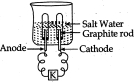
Observe the following diagram and answer the questions that follow:
$(i)$ Identify the gases evolved at anode and cathode.
$(ii)$ Why are the amounts of gases collected in the two test tubes not of the same volume?
$(iii)$ What type of reaction is this?
$(iv)$ Why should we use salt water?
$(i)$ Identify the gases evolved at anode and cathode.
$(ii)$ Why are the amounts of gases collected in the two test tubes not of the same volume?
$(iii)$ What type of reaction is this?
$(iv)$ Why should we use salt water?
Solution
(N/A) $(i)$ $(a)$ At the anode,oxygen gas is evolved.
$(b)$ At the cathode,hydrogen gas is evolved.
$(ii)$ The amounts of gases collected in the two test tubes are not of the same volume because water $(H_2O)$ consists of hydrogen and oxygen in a molar ratio of $2:1$. Thus,twice as much hydrogen gas is produced compared to oxygen gas.
$(iii)$ This reaction is an electrolytic decomposition reaction.
$(iv)$ Pure water is a poor conductor of electricity. Salt water is used to act as an electrolyte,allowing electricity to pass through the solution to facilitate the decomposition of water.
0 likes
View Solution40
Medium
$A$ small amount of quicklime is added to water in a beaker.
$(a)$ Name and define the type of reaction that has taken place.
$(b)$ Write the balanced chemical equation for the above reaction. Write the chemical name of the product obtained.
$(c)$ State two observations that you will make in the reaction.
$(a)$ Name and define the type of reaction that has taken place.
$(b)$ Write the balanced chemical equation for the above reaction. Write the chemical name of the product obtained.
$(c)$ State two observations that you will make in the reaction.
Solution
(N/A) This is a combination reaction. It is defined as a reaction in which a single product is formed from two or more reactants.
$(b)$ The balanced chemical equation is: $CaO(s) + H_2O(l) \rightarrow Ca(OH)_2(aq)$. The chemical name of the product obtained is calcium hydroxide.
$(c)$ Two observations made during the reaction are:
$(i)$ The reaction occurs vigorously with the evolution of heat (exothermic reaction).
$(ii)$ The beaker becomes hot to the touch due to the release of thermal energy.
0 likes
View Solution41
Medium
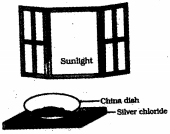
Describe an activity to show a decomposition reaction in which light is used to decompose a reactant. Write the chemical equation of the reaction and state its one use.
Solution
(N/A) $(i)$ Take $2 \, g$ of silver chloride in a china dish.
(ii) Place this china dish in sunlight for some time.
(iii) Observe the colour of silver chloride after some time. Silver chloride turns grey in sunlight due to the decomposition of $AgCl$ into $Ag$ and $Cl_2$.
Chemical equation:
$2AgCl(s) \xrightarrow{\text{Sunlight}} 2Ag(s) + Cl_2(g)$
Use: This reaction is used in black and white photography.
0 likes
View Solution42
Medium
$2 \, g$ of ferrous sulphate crystals are heated in a boiling tube.
$(i)$ State the colour of ferrous sulphate crystals both before heating and after heating.
$(ii)$ Name the gases produced during heating.
$(iii)$ Write the chemical equation for the reaction.
$(i)$ State the colour of ferrous sulphate crystals both before heating and after heating.
$(ii)$ Name the gases produced during heating.
$(iii)$ Write the chemical equation for the reaction.
Solution
(N/A) $(i)$ Before heating: Pale green. After heating: Brown or reddish-brown.
$(ii)$ The gases produced are sulphur dioxide $(SO_{2})$ and sulphur trioxide $(SO_{3})$.
$(iii)$ The chemical equation for the thermal decomposition of ferrous sulphate is:
$2FeSO_{4}(s) \xrightarrow{\text{Heat}} Fe_{2}O_{3}(s) + SO_{2}(g) + SO_{3}(g)$
$(ii)$ The gases produced are sulphur dioxide $(SO_{2})$ and sulphur trioxide $(SO_{3})$.
$(iii)$ The chemical equation for the thermal decomposition of ferrous sulphate is:
$2FeSO_{4}(s) \xrightarrow{\text{Heat}} Fe_{2}O_{3}(s) + SO_{2}(g) + SO_{3}(g)$
0 likes
View Solution43
Easy
List two observations which you record while burning magnesium in air.
Solution
(N/A) $(i)$ Dazzling white light is emitted during the burning of magnesium.
$(ii)$ $A$ white powdery substance (magnesium oxide) is formed after the burning process.
$(ii)$ $A$ white powdery substance (magnesium oxide) is formed after the burning process.
0 likes
View Solution44
Medium
Identify the type of reactions in each of the following reactions:
$(i)$ $Zn + H_{2}SO_{4} \longrightarrow ZnSO_{4} + H_{2}$
$(ii)$ $CaO + H_{2}O \longrightarrow Ca(OH)_{2}$
$(i)$ $Zn + H_{2}SO_{4} \longrightarrow ZnSO_{4} + H_{2}$
$(ii)$ $CaO + H_{2}O \longrightarrow Ca(OH)_{2}$
Solution
(N/A) $(i)$ This is a displacement reaction because zinc $(Zn)$ displaces hydrogen $(H_{2})$ from sulfuric acid $(H_{2}SO_{4})$.
$(ii)$ This is a combination reaction because calcium oxide $(CaO)$ and water $(H_{2}O)$ combine to form a single product,calcium hydroxide $(Ca(OH)_{2})$.
$(ii)$ This is a combination reaction because calcium oxide $(CaO)$ and water $(H_{2}O)$ combine to form a single product,calcium hydroxide $(Ca(OH)_{2})$.
0 likes
View Solution45
Medium
Identify the type of reactions in each of the following reactions:
$(i)$ $CaCO_{3} \xrightarrow{\text{Heat}} CaO + CO_{2}$
$(ii)$ $AgNO_{3}(aq) + NaCl(aq) \longrightarrow AgCl(s) \downarrow + NaNO_{3}(aq)$
$(i)$ $CaCO_{3} \xrightarrow{\text{Heat}} CaO + CO_{2}$
$(ii)$ $AgNO_{3}(aq) + NaCl(aq) \longrightarrow AgCl(s) \downarrow + NaNO_{3}(aq)$
Solution
(N/A) $(i)$ This is a decomposition reaction because a single reactant breaks down into two or more simpler products upon heating.
$(ii)$ This is a double displacement reaction because there is an exchange of ions between the two reactants to form new compounds.
$(ii)$ This is a double displacement reaction because there is an exchange of ions between the two reactants to form new compounds.
0 likes
View Solution46
Medium
Write two observations for the following chemical reaction:
$(a)$ Dilute sulphuric acid is poured over zinc granules.
$(a)$ Dilute sulphuric acid is poured over zinc granules.
Solution
(N/A) The chemical reaction is: $Zn(s) + H_2SO_4(aq) \longrightarrow ZnSO_4(aq) + H_2(g) \uparrow$
Observations:
$(i)$ Evolution of hydrogen gas bubbles is observed.
$(ii)$ The reaction is exothermic,so the temperature of the reaction vessel increases.
Observations:
$(i)$ Evolution of hydrogen gas bubbles is observed.
$(ii)$ The reaction is exothermic,so the temperature of the reaction vessel increases.
0 likes
View Solution47
Medium
Write two observations for the following chemical reaction:
$(a)$ Potassium iodide solution is added to lead nitrate solution.
$(a)$ Potassium iodide solution is added to lead nitrate solution.
Solution
(N/A) The chemical reaction is: $2KI(aq) + Pb(NO_3)_2(aq) \to PbI_2(s) \downarrow + 2KNO_3(aq)$
$(i)$ $A$ yellow precipitate of lead iodide $(PbI_2)$ is formed.
$(ii)$ The reaction is a double displacement reaction where the solution changes appearance due to the formation of an insoluble solid.
$(i)$ $A$ yellow precipitate of lead iodide $(PbI_2)$ is formed.
$(ii)$ The reaction is a double displacement reaction where the solution changes appearance due to the formation of an insoluble solid.
0 likes
View Solution48
Medium
Write two observations for the following chemical reaction:
$(a)$ Lead nitrate is strongly heated in a hard glass test tube.
$(a)$ Lead nitrate is strongly heated in a hard glass test tube.
Solution
(N/A) The chemical equation for the thermal decomposition of lead nitrate is:
$2Pb(NO_{3})_{2}(s) \xrightarrow{\Delta} 2PbO(s) + 4NO_{2}(g) + O_{2}(g)$
Observations:
$(i)$ Evolution of reddish-brown fumes of nitrogen dioxide $(NO_{2})$ gas.
$(ii)$ Formation of a yellow-colored residue of lead$(II)$ oxide $(PbO)$ in the test tube.
$2Pb(NO_{3})_{2}(s) \xrightarrow{\Delta} 2PbO(s) + 4NO_{2}(g) + O_{2}(g)$
Observations:
$(i)$ Evolution of reddish-brown fumes of nitrogen dioxide $(NO_{2})$ gas.
$(ii)$ Formation of a yellow-colored residue of lead$(II)$ oxide $(PbO)$ in the test tube.
0 likes
View Solution49
Medium
State three applications of a decomposition reaction.
Solution
(N/A) Applications of a decomposition reaction:
$(a)$ White silver chloride turns grey in sunlight due to the decomposition of silver chloride into silver and chlorine.
$2 AgCl (s) \xrightarrow{\text{sunlight}} 2 Ag (s) + Cl_2 (g)$
This reaction is used in black and white photography.
$(b)$ Potassium chlorate $(KClO_3)$ decomposes on heating to produce oxygen gas.
$2 KClO_3 (s) \xrightarrow{\text{heat}} 2 KCl (s) + 3 O_2 (g)$
This is a common laboratory method for the preparation of oxygen gas.
$(c)$ Quicklime $(CaO)$ is prepared by the thermal decomposition of calcium carbonate ($CaCO_3$,limestone).
$CaCO_3 (s) \xrightarrow{\text{heat}} CaO (s) + CO_2 (g)$
Quicklime is used in the manufacture of cement and for preparing slaked lime used in whitewashing.
0 likes
View Solution50
Medium
Which two observations will be made when quicklime is added to water? Mention two uses of the product obtained.
Solution
(N/A) Observations:
$(a)$ The reaction occurs vigorously.
$(b)$ $A$ large amount of heat is released (exothermic reaction).
Uses of the product $Ca(OH)_2$ (Calcium hydroxide):
$(a)$ It is used for whitewashing walls. It reacts slowly with $CO_2$ in the air to form a thin layer of calcium carbonate $(CaCO_3)$ on the walls,providing a shiny finish.
$(b)$ It is used as a laboratory reagent for testing the presence of $CO_2$ gas,as it turns milky upon reaction with it.
0 likes
View SolutionChemical Reactions and Equations — Types of Chemical Reactions · Frequently Asked Questions
1Are these Chemical Reactions and Equations questions useful for JEE and NEET?
Yes. All questions in this section are mapped to JEE Main and NEET exam patterns. Previous year questions from JEE Main, NEET, GUJCET and state-level exams are included with full solutions.
2Can I switch to Hindi or Gujarati for these questions?
Yes. Use the language tabs in the hero section or the sidebar to view the same questions and solutions in English, Hindi or Gujarati.
3How do I generate a question paper from this subtopic?
Use the Vedclass Exam Paper Generator — select the chapter and subtopic, set difficulty, and generate Sets A, B, C, D automatically. First 3 chapters of every subject are free.
Vedclass Products
For Students
Vedclass Test Series
Mock tests in real JEE/NEET style with performance analysis. 5-day free trial.
Start Free TrialFor Teachers
Exam Paper Generator
Generate Set A/B/C/D papers from this chapter in 2 minutes. 3 chapters free.
Try FreeFor Institutes
Online Exam Module
Live online exams with unlimited students, 360° analytics & white-label branding.
See DemoFor Teachers & Institutes
Generate a Chemical Reactions and Equations Exam Paper in 2 Minutes
Select subtopic & difficulty — Sets A, B, C, D auto-generated with No Repeat logic.
First 3 chapters of every subject are free — no payment required.