
A English
Hormones in Animals Questions in English
Class 10 Science · Control and Coordination · Hormones in Animals
72+
Questions
English
Language
100%
With Solutions
Showing 50 of 72 questions in English
1
Medium
How does chemical coordination take place in animals?
Solution
(N/A) Chemical coordination in animals is mediated by hormones.
Hormones are chemical messengers that regulate various physiological processes in living organisms.
These substances are secreted by endocrine glands directly into the bloodstream.
The regulation of physiological processes,as well as control and coordination via hormones,is collectively known as the endocrine system.
In animals,the nervous system works in conjunction with the endocrine system to effectively control and coordinate complex physiological activities.
0 likes
View Solution2
MediumMCQ
Why is the use of iodised salt advisable?
A
To prevent diabetes
B
To prevent goitre
C
To increase blood pressure
D
To improve eyesight
Solution
(B) Iodine is essential for the thyroid gland to produce the hormone thyroxin.
Thyroxin regulates the metabolism of carbohydrates,fats,and proteins in the body.
$A$ deficiency of iodine leads to a deficiency of thyroxin,which causes the thyroid gland to enlarge,a condition known as goitre.
Therefore,the use of iodised salt is advised to ensure the normal functioning of the thyroid gland and to prevent goitre.
0 likes
View Solution3
MediumMCQ
How does our body respond when adrenaline is secreted into the blood?
A
It decreases the heart rate.
B
It increases the heart rate and breathing rate.
C
It slows down the digestion process.
D
It has no effect on the body.
Solution
(B) Adrenaline is a hormone secreted by the adrenal glands in response to danger,emergency,or stress.
It is secreted directly into the blood and transported to various target organs.
When secreted in large amounts,it increases the heartbeat to supply more oxygen to the muscles.
The breathing rate also increases due to the contraction of the diaphragm and rib muscles.
Additionally,it increases blood pressure and diverts blood flow to essential organs.
All these physiological responses prepare the body to deal with stressful or emergency situations.
0 likes
View Solution4
Easy
Why are some patients of diabetes treated by giving injections of insulin?
Solution
(N/A) Diabetes is a metabolic disorder characterized by high blood sugar levels (hyperglycemia).
Insulin is a hormone produced by the $\beta$-cells of the pancreas that facilitates the uptake of glucose into cells,thereby lowering blood sugar levels.
In patients with diabetes,the pancreas either does not produce enough insulin or the body cannot effectively use the insulin it produces.
Therefore,external injections of insulin are administered to maintain blood glucose levels within the normal physiological range.
0 likes
View Solution5
EasyMCQ
Iodine is necessary for the synthesis of which hormone?
A
Thyroxin
B
Adrenaline
C
Auxin
D
Insulin
Solution
(A) Iodine is an essential mineral required for the synthesis of the hormone $Thyroxin$ by the thyroid gland.
$Thyroxin$ regulates carbohydrate,protein,and fat metabolism in the body.
$A$ deficiency of iodine in the diet leads to a condition known as goiter,which is characterized by the enlargement of the thyroid gland.
$Thyroxin$ regulates carbohydrate,protein,and fat metabolism in the body.
$A$ deficiency of iodine in the diet leads to a condition known as goiter,which is characterized by the enlargement of the thyroid gland.
0 likes
View Solution6
EasyMCQ
Choose the incorrect statement about insulin.
A
It is produced from the pancreas.
B
It regulates the growth and development of the body.
C
It regulates blood sugar levels.
D
Insufficient secretion of insulin will cause diabetes.
Solution
(B) Insulin is a hormone produced by the pancreas that regulates blood glucose levels by facilitating the uptake of glucose into cells.
Insufficient secretion of insulin leads to high blood sugar levels,a condition known as diabetes mellitus.
Growth and development of the body are primarily regulated by the growth hormone $(GH)$ secreted by the pituitary gland,not by insulin.
Therefore,the statement that insulin regulates the growth and development of the body is incorrect.
0 likes
View Solution7
MediumMCQ
Select the mis-matched pair.
A
Estrogen : Ovary
B
Testosterone : Testes
C
Adrenaline : Pituitary gland
D
Thyroxin : Thyroid gland
Solution
(C) The correct answer is $C$.
$1$. Estrogen is a female sex hormone produced by the ovaries.
$2$. Testosterone is a male sex hormone produced by the testes.
$3$. Adrenaline is a hormone secreted by the adrenal glands, not the pituitary gland.
$4$. Thyroxin is a hormone secreted by the thyroid gland.
Therefore, the pair $Adrenaline : Pituitary \text{ gland}$ is mis-matched.
0 likes
View Solution8
EasyMCQ
Which statement is not true about thyroxin?
A
It regulates carbohydrates,protein and fat metabolism in the body.
B
Iron is essential for the synthesis of thyroxin.
C
Thyroid gland requires iodine to synthesise thyroxin.
D
Thyroxin is also called thyroid hormone.
Solution
(B) Thyroxin is a hormone produced by the thyroid gland.
It plays a crucial role in regulating the metabolism of carbohydrates,proteins,and fats in the body.
Iodine is an essential element required by the thyroid gland for the synthesis of thyroxin.
Therefore,the statement that 'Iron is essential for the synthesis of thyroxin' is incorrect,as iodine is the required element,not iron.
0 likes
View Solution9
EasyMCQ
Dwarfism results due to
A
Excess secretion of thyroxin
B
Less secretion of adrenaline
C
Less secretion of growth hormone
D
Excess secretion of growth hormone
Solution
(C) Dwarfism is a condition characterized by stunted growth. It is primarily caused by the hyposecretion (less secretion) of growth hormone $(GH)$,also known as somatotropin,from the anterior pituitary gland during childhood. When the body does not produce enough growth hormone,the bones and tissues do not grow to their full potential,resulting in a significantly shorter stature.
0 likes
View Solution10
EasyMCQ
$A$ doctor advised a person to take an injection of insulin because
A
his sugar level in blood was high
B
his heart was beating slowly
C
he was suffering from goitre
D
his blood pressure was low
Solution
(A) $Insulin$ is a hormone produced by the pancreas that regulates the amount of glucose in the blood.
When the blood sugar level becomes abnormally high (a condition known as hyperglycemia),the body may not produce enough $insulin$ to manage it.
Therefore,a doctor advises an $insulin$ injection to help lower the blood sugar level to a normal range.
When the blood sugar level becomes abnormally high (a condition known as hyperglycemia),the body may not produce enough $insulin$ to manage it.
Therefore,a doctor advises an $insulin$ injection to help lower the blood sugar level to a normal range.
0 likes
View Solution11
EasyMCQ
The hormone which increases fertility in males is called:
A
oestrogen
B
testosterone
C
insulin
D
growth hormone
Solution
(B) Testosterone is the primary male sex hormone.
It is produced mainly in the testes.
It plays a crucial role in the development of male reproductive tissues such as the testes and prostate,as well as promoting secondary sexual characteristics like increased muscle and bone mass,and the growth of body hair.
Most importantly,it is essential for spermatogenesis,which is the process of sperm production,thereby directly increasing fertility in males.
0 likes
View Solution12
MediumMCQ
Which of the following endocrine glands is unpaired?
A
Adrenal
B
Testes
C
Pituitary
D
Ovary
Solution
(C) The endocrine system consists of various glands that secrete hormones.
$1$. Adrenal glands are paired glands located on top of the kidneys.
$2$. Testes are paired reproductive glands found in males.
$3$. Pituitary gland is a single,unpaired gland located at the base of the brain,often referred to as the master gland.
$4$. Ovaries are paired reproductive glands found in females.
Therefore,the pituitary gland is the correct answer.
0 likes
View Solution13
Medium
Label the endocrine glands in the figure.
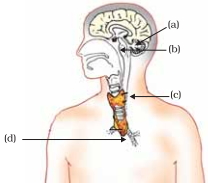
Solution
(N/A) Pineal gland
$(b)$ Pituitary gland
$(c)$ Thyroid gland
$(d)$ Thymus gland
$(b)$ Pituitary gland
$(c)$ Thyroid gland
$(d)$ Thymus gland
0 likes
View Solution14
EasyMCQ
What will happen if the intake of iodine in our diet is low?
A
Thyroxin production increases
B
Metabolism of carbohydrates,proteins,and fats is affected
C
Goitre occurs due to thyroid gland enlargement
D
Both $(b)$ and $(c)$
Solution
(D) If the intake of iodine in our diet is low,the thyroid gland cannot synthesize enough thyroxin hormone.
$(a)$ Since thyroxin regulates the metabolism of carbohydrates,proteins,and fats in the body,a deficiency leads to an imbalance in these metabolic processes.
$(b)$ The thyroid gland enlarges in an attempt to produce more thyroxin,leading to a condition known as goitre.
$(a)$ Since thyroxin regulates the metabolism of carbohydrates,proteins,and fats in the body,a deficiency leads to an imbalance in these metabolic processes.
$(b)$ The thyroid gland enlarges in an attempt to produce more thyroxin,leading to a condition known as goitre.
0 likes
View Solution15
Medium
Answer the following:
$(a)$ Which hormone is responsible for the changes noticed in females at puberty?
$(b)$ Dwarfism results due to deficiency of which hormone?
$(c)$ Blood sugar level rises due to deficiency of which hormone?
$(d)$ Iodine is necessary for the synthesis of which hormone?
$(a)$ Which hormone is responsible for the changes noticed in females at puberty?
$(b)$ Dwarfism results due to deficiency of which hormone?
$(c)$ Blood sugar level rises due to deficiency of which hormone?
$(d)$ Iodine is necessary for the synthesis of which hormone?
Solution
(N/A) Oestrogen is the hormone responsible for the development of secondary sexual characteristics in females at puberty.
$(b)$ Dwarfism is caused by the deficiency of Growth Hormone $(GH)$,which is secreted by the pituitary gland.
$(c)$ Blood sugar level rises (hyperglycemia) due to the deficiency of Insulin,which is secreted by the pancreas.
$(d)$ Iodine is essential for the synthesis of Thyroxin,which is produced by the thyroid gland.
0 likes
View Solution16
Medium
Answer the following:
$(a)$ Name the endocrine gland associated with the brain.
$(b)$ Which gland secretes digestive enzymes as well as hormones?
$(c)$ Name the endocrine gland associated with the kidneys.
$(d)$ Which endocrine gland is present in males but not in females?
$(a)$ Name the endocrine gland associated with the brain.
$(b)$ Which gland secretes digestive enzymes as well as hormones?
$(c)$ Name the endocrine gland associated with the kidneys.
$(d)$ Which endocrine gland is present in males but not in females?
Solution
(N/A) The pituitary gland is located at the base of the brain.
$(b)$ The pancreas acts as a heterocrine (mixed) gland,secreting digestive enzymes into the duodenum and hormones like insulin and glucagon into the blood.
$(c)$ The adrenal glands are located on top of each kidney.
$(d)$ The testes are the primary sex organs in males that function as endocrine glands by secreting testosterone.
0 likes
View Solution17
Medium
Mention one function for each of these hormones:
$(a)$ Thyroxin
$(b)$ Insulin
$(c)$ Adrenaline
$(d)$ Growth hormone
$(e)$ Testosterone.
$(a)$ Thyroxin
$(b)$ Insulin
$(c)$ Adrenaline
$(d)$ Growth hormone
$(e)$ Testosterone.
Solution
(N/A) Thyroxin: Regulates carbohydrate,fat,and protein metabolism in the body.
$(b)$ Insulin: Regulates blood sugar levels by facilitating the uptake of glucose into cells.
$(c)$ Adrenaline: Increases heart rate and blood supply to essential organs during stress or emergency situations.
$(d)$ Growth hormone: Regulates the growth and development of bones and tissues in the body.
$(e)$ Testosterone: Controls the development of secondary sexual characteristics associated with puberty in males.
0 likes
View Solution18
EasyMCQ
How does chemical coordination take place in animals?
A
Through the nervous system
B
Through the endocrine system using hormones
C
Through the digestive system
D
Through the respiratory system
Solution
(B) Chemical coordination in animals is mediated by the endocrine system.
$1$. Different endocrine glands secrete specific chemical messengers known as hormones.
$2$. These hormones are released directly into the bloodstream.
$3$. The blood transports these hormones to specific target tissues or organs.
$4$. Upon reaching the target,the hormone binds to specific receptors and triggers a particular biochemical or physiological response.
0 likes
View Solution19
EasyMCQ
Why is it advised to use iodised salt in our diet?
A
To prevent goitre
B
To improve digestion
C
To increase blood pressure
D
To enhance taste
Solution
(A) Iodine is an essential trace element required by the thyroid gland to synthesize the hormone thyroxine. Thyroxine regulates the metabolism of carbohydrates,proteins,and fats in the body. $A$ deficiency of iodine in the diet leads to an enlargement of the thyroid gland,a condition known as goitre. Therefore,the consumption of iodised salt is advised to ensure adequate iodine intake and prevent such disorders.
0 likes
View Solution20
Medium
Explain how the human body responds when adrenaline is secreted into the blood.
Solution
(N/A) When adrenaline is secreted into the blood,the heart beats faster,which results in the supply of more oxygen to our muscles.
The blood supply to the digestive system and skin is reduced due to the contraction of muscles around small arteries in these organs.
This diverts the blood to our skeletal muscles to prepare the body for 'fight or flight' responses.
The breathing rate also increases because of the contractions of the diaphragm and the rib muscles,allowing for increased oxygen intake.
0 likes
View Solution21
EasyMCQ
Why do endocrine glands release their secretions into the blood?
A
They are ductless glands.
B
They have ducts.
C
They are located near blood vessels.
D
They require blood for the synthesis of hormones.
Solution
(A) Endocrine glands are known as ductless glands. Because they lack ducts to transport their secretions (hormones) directly to the target organs,they release them directly into the surrounding blood capillaries. The blood then carries these hormones to the specific target tissues or organs throughout the body.
0 likes
View Solution22
MediumMCQ
Which gland secretes growth hormone in human beings?
A
Thyroid gland
B
Pituitary gland
C
Adrenal gland
D
Pancreas
Solution
(B) The $Pituitary$ gland is known as the master gland of the human body.
It is located at the base of the brain.
This gland secretes the growth hormone $(GH)$,which is essential for the growth and development of bones and tissues in the human body.
It is located at the base of the brain.
This gland secretes the growth hormone $(GH)$,which is essential for the growth and development of bones and tissues in the human body.
0 likes
View Solution23
EasyMCQ
Which mechanism controls the timing and amount of hormone released?
A
Positive feedback mechanism
B
Negative feedback mechanism
C
Feedback mechanism
D
Neural control mechanism
Solution
(C) The timing and amount of hormone released are regulated by the feedback mechanism.
In this system,the level of hormones in the blood acts as a signal to the endocrine glands to either increase or decrease the production of that specific hormone,ensuring homeostasis within the body.
In this system,the level of hormones in the blood acts as a signal to the endocrine glands to either increase or decrease the production of that specific hormone,ensuring homeostasis within the body.
0 likes
View Solution24
EasyMCQ
What are hormones?
A
Chemical substances secreted by exocrine glands.
B
Chemical substances secreted by endocrine glands in trace amounts.
C
Proteins that act as catalysts in biochemical reactions.
D
Nerve impulses transmitted through neurons.
Solution
(B) Hormones are chemical substances that act as intercellular messenger molecules. They are secreted in trace amounts by specialized tissues known as endocrine glands directly into the bloodstream to regulate various physiological processes in the body.
0 likes
View Solution25
EasyMCQ
Name the plant hormone responsible for the promotion of cell division.
A
Auxin
B
Gibberellin
C
Cytokinin
D
Abscisic acid
Solution
(C) The plant hormone responsible for the promotion of cell division is $Cytokinin$. It promotes cell division (cytokinesis) in plants and also helps in delaying the aging of leaves.
0 likes
View Solution26
Medium
How does the feedback mechanism regulate hormone secretion?
Solution
(N/A) The feedback mechanism regulates the timing and amount of hormone to be secreted.
For example,if a person has high blood sugar levels,this is detected by the cells of the pancreas.
As a result,more insulin is secreted to facilitate the uptake and metabolism of glucose.
Conversely,if blood sugar levels are low,the secretion of insulin is reduced to prevent hypoglycemia.
For example,if a person has high blood sugar levels,this is detected by the cells of the pancreas.
As a result,more insulin is secreted to facilitate the uptake and metabolism of glucose.
Conversely,if blood sugar levels are low,the secretion of insulin is reduced to prevent hypoglycemia.
0 likes
View Solution27
Medium
$(a)$ An old man is advised by his doctor to take less sugar in his diet. Name the disease from which the man is suffering. Mention the hormone due to imbalance of which he is suffering from this disease. Which endocrine gland secretes this hormone?
$(b)$ Name the endocrine gland which secretes growth hormone. What will be its effect on a person of:
$(i)$ Deficiency of growth hormones?
$(ii)$ Excess secretion of growth hormones?
$(b)$ Name the endocrine gland which secretes growth hormone. What will be its effect on a person of:
$(i)$ Deficiency of growth hormones?
$(ii)$ Excess secretion of growth hormones?
Solution
(N/A) The man is suffering from Diabetes Mellitus. Insulin is the hormone whose imbalance leads to this disease. The pancreas is the endocrine gland that secretes insulin.
$(b)$ The pituitary gland secretes the growth hormone.
$(i)$ Deficiency of growth hormone leads to Dwarfism.
$(ii)$ Excess secretion of growth hormone leads to Gigantism.
$(b)$ The pituitary gland secretes the growth hormone.
$(i)$ Deficiency of growth hormone leads to Dwarfism.
$(ii)$ Excess secretion of growth hormone leads to Gigantism.
0 likes
View Solution28
Medium
List the names of hormones secreted by the following endocrine glands and mention their functions:
$(i)$ Thyroid gland $(ii)$ Pituitary gland $(iii)$ Adrenal gland.
$(i)$ Thyroid gland $(ii)$ Pituitary gland $(iii)$ Adrenal gland.
Solution
(N/A) The hormones secreted by the specified endocrine glands and their primary functions are summarized in the table below:
| Gland | Hormone | Function |
|---|---|---|
| $(i)$ Thyroid gland | Thyroxine | Regulates the metabolism of carbohydrates,fats,and proteins in the body. |
| $(ii)$ Pituitary gland | Growth hormone $(GH)$ | Regulates the overall growth and development of the body. |
| $(iii)$ Adrenal gland | Adrenaline | Helps the body manage stress and prepares it for 'fight or flight' responses. |
0 likes
View Solution29
Medium
Answer the following:
$(i)$ Name the endocrine gland associated with the brain.
$(ii)$ Which gland secretes digestive enzymes as well as hormones?
$(iii)$ Name the endocrine gland associated with the kidneys.
$(iv)$ Which endocrine gland is present in males but not in females?
$(v)$ Which hormone is responsible for changes in females during puberty?
$(vi)$ Iodine is necessary for the synthesis of which hormone?
Solution
(N/A) $(i)$ Pituitary gland.
$(ii)$ Pancreas (it acts as both an exocrine gland by secreting digestive enzymes and an endocrine gland by secreting insulin and glucagon).
$(iii)$ Adrenal gland (located on top of the kidneys).
$(iv)$ Testes (these are male gonads that function as endocrine glands).
$(v)$ Oestrogen (or Estrogen).
$(vi)$ Thyroxine (produced by the thyroid gland).
0 likes
View Solution30
Medium
Give reasons :
$(a)$ Pituitary is often termed as master endocrine gland.
$(b)$ Pancreas helps in digestion and also regulates blood sugar level.
$(c)$ Adrenals are known as glands of emergency.
$(a)$ Pituitary is often termed as master endocrine gland.
$(b)$ Pancreas helps in digestion and also regulates blood sugar level.
$(c)$ Adrenals are known as glands of emergency.
Solution
(N/A) The pituitary gland is often called the master endocrine gland because it secretes hormones that control and coordinate the activities of most other endocrine glands.
$(b)$ The pancreas acts as a heterocrine (mixed) gland. It secretes pancreatic juice containing enzymes into the small intestine for digestion,and it also secretes hormones like insulin and glucagon directly into the blood to regulate blood sugar levels.
$(c)$ The adrenal glands are known as glands of emergency because they secrete the hormone adrenaline (epinephrine) during stressful situations. Adrenaline prepares the body for 'fight or flight' by increasing heart rate,breathing rate,and blood flow to skeletal muscles,allowing the body to respond rapidly to emergencies.
0 likes
View Solution31
Medium
Name the hormones secreted by the thyroid,parathyroid,and pancreas.
Solution
(N/A) $(i)$ Thyroid gland: It secretes thyroxine hormone.
$(ii)$ Parathyroid gland: It secretes parathormone $(PTH)$. Note: Calcitonin is secreted by the thyroid gland ($C$-cells),while the parathyroid gland secretes parathormone.
$(iii)$ Pancreas: It secretes two main hormones: Insulin and Glucagon.
$(ii)$ Parathyroid gland: It secretes parathormone $(PTH)$. Note: Calcitonin is secreted by the thyroid gland ($C$-cells),while the parathyroid gland secretes parathormone.
$(iii)$ Pancreas: It secretes two main hormones: Insulin and Glucagon.
0 likes
View Solution32
Medium
$(a)$ Name the hormone which is injected to a diabetic patient.
$(b)$ Why should we use iodised salt in our diet?
$(c)$ If iodine is insufficient in one's diet,what might be the deficiency disease and its symptoms?
$(b)$ Why should we use iodised salt in our diet?
$(c)$ If iodine is insufficient in one's diet,what might be the deficiency disease and its symptoms?
Solution
(A) The hormone injected into a diabetic patient is $Insulin$.
$(b)$ We should use iodised salt in our diet because iodine is essential for the thyroid gland to synthesize and secrete the hormone $Thyroxine$. $Thyroxine$ plays a crucial role in regulating the metabolism of carbohydrates,proteins,and fats in the body,ensuring a balanced growth and development.
$(c)$ If iodine is insufficient in one's diet,it leads to a deficiency disease known as $Goitre$. The primary symptom of $Goitre$ is a swollen neck,caused by the enlargement of the thyroid gland as it attempts to produce more $Thyroxine$ in response to low iodine levels.
0 likes
View Solution33
Medium
$(a)$ Name the diseases by which a person is likely to suffer due to the deficiency of:
$(i)$ Iodine
$(ii)$ Insulin
$(b)$ How are the timing and amount of hormone secretion regulated in the human system? Explain with an example.
$(i)$ Iodine
$(ii)$ Insulin
$(b)$ How are the timing and amount of hormone secretion regulated in the human system? Explain with an example.
Solution
(N/A) $(i)$ Iodine deficiency leads to Goitre.
$(ii)$ Insulin deficiency leads to Diabetes.
$(b)$ The timing and amount of hormone release are regulated by feedback mechanisms.
For example,if the blood sugar level rises,the cells of the pancreas detect this change and respond by secreting more insulin.
As the blood sugar level falls back to the normal range,the secretion of insulin is reduced or inhibited.
This self-regulating system ensures that hormones are secreted only in the required quantity at the appropriate time.
0 likes
View Solution34
Medium
Give the function$(s)$ of the following plant hormones:
$(i)$ Auxins $(ii)$ Gibberellins $(iii)$ Cytokinins $(iv)$ Abscisic acid $(v)$ Ethylene
$(i)$ Auxins $(ii)$ Gibberellins $(iii)$ Cytokinins $(iv)$ Abscisic acid $(v)$ Ethylene
Solution
(N/A) $(i)$ Auxins: Promote cell elongation,root formation,and cell division. They also promote fruit growth.
$(ii)$ Gibberellins: Stimulate stem elongation,seed germination,and flowering.
$(iii)$ Cytokinins: Help in breaking the dormancy of seeds and buds. They delay ageing in leaves and promote the opening of stomata.
$(iv)$ Abscisic acid: Promotes the abscission (falling) of leaves and fruits.
$(v)$ Ethylene: Promotes the ripening of fruits.
0 likes
View Solution35
Easy
How is the timing and the amount of hormone secreted by a gland regulated? Explain with an example.
Solution
(N/A) The timing and amount of hormone secretion are regulated by a feedback mechanism.
This mechanism ensures that hormones are released only when required and in the appropriate quantity.
Example: Regulation of blood sugar levels.
When the blood sugar level rises,the cells of the pancreas detect this change.
In response,the pancreas secretes more insulin to facilitate the uptake and oxidation of glucose by body cells,thereby lowering the blood sugar level.
Conversely,when the blood sugar level drops,the secretion of insulin is reduced to prevent hypoglycemia.
0 likes
View Solution36
Medium
Explain how the human body responds when adrenaline is secreted into the blood.
Solution
(N/A) When the organism confronts any stressful or scary situation,adrenaline is secreted from the adrenal gland and released directly into the blood. It is then circulated to various parts of the body,resulting in the following responses:
$(a)$ The heart beats faster to supply more oxygen to the muscles.
$(b)$ Blood supply to the digestive system and skin is reduced due to the contraction of muscles around small arteries. This diverts more blood to the skeletal muscles.
$(c)$ The breathing rate increases due to the contractions of the diaphragm and rib muscles,which allows for more oxygen intake.
0 likes
View Solution37
Medium
$(a)$ Define hormone. Write four characteristics of hormones in humans.
$(b)$ Name the disorder caused by the following situations:
$(i)$ Under secretion of growth hormone
$(ii)$ Over secretion of growth hormone
$(iii)$ Under secretion of insulin
$(iv)$ Deficiency of iodine
$(b)$ Name the disorder caused by the following situations:
$(i)$ Under secretion of growth hormone
$(ii)$ Over secretion of growth hormone
$(iii)$ Under secretion of insulin
$(iv)$ Deficiency of iodine
Solution
(A-D) Hormones: Hormones are chemical messengers that regulate biological processes in living organisms.
Characteristics of Hormones:
$1$. They are produced by ductless glands,meaning their secretion is released directly into the blood.
$2$. They are released in trace amounts,i.e.,in very small quantities.
$3$. They act on specific tissues or organs known as target organs.
$4$. They are generally slow in action.
$5$. They act away from the site of production.
$(b)$ $(i)$ Dwarfism
$(ii)$ Gigantism
$(iii)$ Diabetes mellitus
$(iv)$ Goitre
0 likes
View Solution38
Medium
Give a reason to explain why:
$(i)$ Adrenaline helps in dealing with emergency situations?
$(ii)$ Secretions of growth hormone should be specific in the human body?
$(iii)$ Some patients of diabetes are treated by giving injections of insulin?
$(i)$ Adrenaline helps in dealing with emergency situations?
$(ii)$ Secretions of growth hormone should be specific in the human body?
$(iii)$ Some patients of diabetes are treated by giving injections of insulin?
Solution
(N/A) $(i)$ Adrenaline increases the heartbeat and breathing rate,which results in the supply of more oxygen to muscles. It reduces blood flow to the digestive system and skin; as a result,blood is diverted to skeletal muscles. All these responses together prepare the body to deal with emergency situations.
$(ii)$ If growth hormone is secreted in excess during childhood,it leads to $\text{gigantism}$,while less secretion of this hormone during childhood causes $\text{dwarfism}$.
$(iii)$ Patients suffering from diabetes have a high blood sugar level because insulin is not secreted in a sufficient amount by the pancreas to lower the blood sugar level. Therefore,to regulate the blood sugar level,insulin hormone is injected into such patients.
0 likes
View Solution39
EasyMCQ
Which statement is not true about thyroxine?
A
Thyroid gland requires iodine to synthesise thyroxine.
B
It regulates carbohydrate,protein and fat metabolism in the body.
C
Iron is essential for the synthesis of thyroxine.
D
Thyroxine is also called thyroid hormone.
Solution
(C) Thyroxine is a hormone produced by the thyroid gland.
Iodine is essential for the synthesis of thyroxine,not iron.
Therefore,the statement that 'Iron is essential for the synthesis of thyroxine' is incorrect.
Thyroxine regulates the metabolism of carbohydrates,proteins,and fats in the body.
Iodine is essential for the synthesis of thyroxine,not iron.
Therefore,the statement that 'Iron is essential for the synthesis of thyroxine' is incorrect.
Thyroxine regulates the metabolism of carbohydrates,proteins,and fats in the body.
0 likes
View Solution40
EasyMCQ
Dwarfism results due to :
A
Excess secretion of thyroxins.
B
Excess secretion of growth hormone.
C
Less secretion of adrenaline.
D
Less secretion of growth hormone.
Solution
(D) Dwarfism is a condition characterized by abnormally short stature.
It is primarily caused by the deficiency or reduced secretion of the $Growth$ $Hormone$ $(GH)$,also known as somatotropin,during the childhood growth phase.
$GH$ is secreted by the anterior pituitary gland and is essential for the growth of bones and tissues.
Excess secretion of $GH$ leads to gigantism,while its deficiency leads to dwarfism.
0 likes
View Solution41
EasyMCQ
Iodine is necessary for the synthesis of which hormone?
A
Adrenaline
B
Thyroxine
C
Auxin
D
Insulin
Solution
(B) Iodine is an essential mineral required by the thyroid gland to produce the hormone $Thyroxine$.
$Thyroxine$ regulates the metabolism of carbohydrates,proteins,and fats in the body.
$A$ deficiency of iodine in the diet can lead to a condition called goiter,where the thyroid gland enlarges due to its inability to synthesize sufficient $Thyroxine$.
$Thyroxine$ regulates the metabolism of carbohydrates,proteins,and fats in the body.
$A$ deficiency of iodine in the diet can lead to a condition called goiter,where the thyroid gland enlarges due to its inability to synthesize sufficient $Thyroxine$.
0 likes
View Solution42
MediumMCQ
Choose the incorrect statement about insulin:
A
It is produced from the pancreas.
B
It regulates blood sugar levels.
C
It regulates the growth and development of the body.
D
Insufficient secretion of insulin will cause diabetes.
Solution
(C) Insulin is a peptide hormone produced by the beta cells of the pancreas.
Its primary function is to regulate blood glucose levels by facilitating the uptake of glucose into cells.
When insulin secretion is insufficient,blood sugar levels rise,leading to a condition known as diabetes mellitus.
Growth and development of the body are primarily regulated by the growth hormone $(GH)$ secreted by the pituitary gland,not by insulin.
Therefore,the statement that insulin regulates the growth and development of the body is incorrect.
0 likes
View Solution43
EasyMCQ
Select the mismatched pair:
A
Thyroxine : Thyroid gland
B
Testosterone : Testes
C
Estrogen : Ovary
D
Adrenaline : Pituitary gland
Solution
(D) The correct answer is $D$.
$A$. Thyroxine is secreted by the thyroid gland. This is a correctly matched pair.
$B$. Testosterone is the primary male sex hormone secreted by the testes. This is a correctly matched pair.
$C$. Estrogen is the primary female sex hormone secreted by the ovaries. This is a correctly matched pair.
$D$. Adrenaline is secreted by the adrenal glands,not the pituitary gland. The pituitary gland secretes hormones like growth hormone,$TSH$,etc. Therefore,this is the mismatched pair.
0 likes
View Solution44
EasyMCQ
Which of the following endocrine glands is unpaired?
A
Pituitary
B
Testes
C
Adrenal
D
Ovary
Solution
(A) The endocrine system consists of several glands.
$A$. The pituitary gland is a single,unpaired gland located at the base of the brain.
$B$. Testes are a pair of male reproductive glands.
$C$. Adrenal glands are a pair of glands located on top of the kidneys.
$D$. Ovaries are a pair of female reproductive glands.
Therefore,the pituitary gland is the only unpaired gland among the given options.
0 likes
View Solution45
MediumMCQ
$(a)$ Name the hormone which is released into the blood when its sugar level rises. Name the organ which produces this hormone and its effect on blood sugar level. Also, mention the digestive enzymes secreted by this organ with one function of each. $(b)$ Explain the need for chemical communication in multicellular organisms.
A
Insulin
B
Glucagon
C
Thyroxine
D
Adrenaline
Solution
(A) The hormone released into the blood when sugar levels rise is $Insulin$. The organ that produces this hormone is the $Pancreas$. $Insulin$ reduces blood sugar levels by facilitating the uptake of glucose by body cells. The digestive enzymes secreted by the $Pancreas$ are:
$1$. $Pancreatic \ amylase$: Breaks down carbohydrates into simpler sugars.
$2$. $Trypsin$: Digests proteins into peptides.
$3$. $Lipase$: Breaks down emulsified fats into fatty acids and glycerol.
$(b)$ In multicellular organisms, electrical impulses (nerve impulses) can only reach a limited number of cells connected by nervous tissue. Furthermore, cells cannot continuously create and transmit electrical impulses. Therefore, to ensure that all cells in the body receive necessary signals, multicellular organisms use chemical communication (hormones), which can travel through the blood to reach every cell in the body.
0 likes
View Solution46
Medium
$A$ doctor advised a patient to take less sugar in his diet. Mention the possible disease the patient would be suffering from? Explain.
Solution
(N/A) The possible disease the patient is suffering from is $Diabetes$ $Mellitus$.
$Insulin$ is a hormone secreted by the $\beta$ cells of the $pancreas$ that regulates blood glucose levels in the body.
When the $pancreas$ fails to produce sufficient $insulin$, or when the body cells do not respond effectively to $insulin$, blood sugar levels rise significantly.
High blood sugar levels lead to $diabetes$, which is why doctors advise patients to reduce sugar intake to manage and control their blood glucose levels.
0 likes
View Solution47
Medium
Complete the following table:
| Name of the gland | Name of hormone | Function |
| $(i)$ Thyroid | ................... | Regulates metabolism of fat,protein and carbohydrates |
| $(ii)$ ................... | Insulin | Regulates blood sugar level |
| $(iii)$ Pituitary | ................... | ................... |
Solution
(N/A) $(i)$ The hormone secreted by the thyroid gland is thyroxine,which regulates the metabolism of carbohydrates,proteins,and fats in the body.
$(ii)$ The gland that secretes insulin is the pancreas. Insulin plays a crucial role in regulating blood sugar levels by facilitating the uptake of glucose into cells.
$(iii)$ The pituitary gland secretes several hormones,most notably the growth hormone $(GH)$,which regulates the growth and development of the body.
0 likes
View Solution48
Easy
Which organ secretes a hormone when the blood sugar rises? Name a digestive enzyme released by this organ.
Solution
(N/A) The $pancreas$ secretes a hormone called $insulin$ when the blood sugar level rises, which helps in regulating the glucose level in the blood.
The $pancreas$ also acts as a digestive gland and releases several digestive enzymes, such as $trypsin$ (which helps in the digestion of proteins) and $lipase$ (which helps in the digestion of fats).
The $pancreas$ also acts as a digestive gland and releases several digestive enzymes, such as $trypsin$ (which helps in the digestion of proteins) and $lipase$ (which helps in the digestion of fats).
0 likes
View Solution49
Medium
Write true or false for the statement: Insulin raises the sugar level in the blood.
Solution
(FALSE) The statement is False. Insulin is a hormone produced by the pancreas that helps regulate blood glucose levels. Instead of raising it,insulin lowers the blood sugar level by facilitating the uptake of glucose into cells for energy production or storage as glycogen in the liver and muscles.
0 likes
View Solution50
Medium
Write true or false for the statement: Deficiency of calcium in our diet causes goitre.
Solution
(FALSE) The statement is False.
Goitre is caused by the deficiency of iodine in the diet,not calcium.
Iodine is essential for the synthesis of the thyroid hormone,thyroxine,by the thyroid gland.
Calcium deficiency typically leads to issues related to bone health,such as osteoporosis or rickets.
Goitre is caused by the deficiency of iodine in the diet,not calcium.
Iodine is essential for the synthesis of the thyroid hormone,thyroxine,by the thyroid gland.
Calcium deficiency typically leads to issues related to bone health,such as osteoporosis or rickets.
0 likes
View SolutionControl and Coordination — Hormones in Animals · Frequently Asked Questions
1Are these Control and Coordination questions useful for JEE and NEET?
Yes. All questions in this section are mapped to JEE Main and NEET exam patterns. Previous year questions from JEE Main, NEET, GUJCET and state-level exams are included with full solutions.
2Can I switch to Hindi or Gujarati for these questions?
Yes. Use the language tabs in the hero section or the sidebar to view the same questions and solutions in English, Hindi or Gujarati.
3How do I generate a question paper from this subtopic?
Use the Vedclass Exam Paper Generator — select the chapter and subtopic, set difficulty, and generate Sets A, B, C, D automatically. First 3 chapters of every subject are free.
Vedclass Products
For Students
Vedclass Test Series
Mock tests in real JEE/NEET style with performance analysis. 5-day free trial.
Start Free TrialFor Teachers
Exam Paper Generator
Generate Set A/B/C/D papers from this chapter in 2 minutes. 3 chapters free.
Try FreeFor Institutes
Online Exam Module
Live online exams with unlimited students, 360° analytics & white-label branding.
See DemoFor Teachers & Institutes
Generate a Control and Coordination Exam Paper in 2 Minutes
Select subtopic & difficulty — Sets A, B, C, D auto-generated with No Repeat logic.
First 3 chapters of every subject are free — no payment required.