
A English
Modes of Asexual Reproduction Questions in English
Class 10 Science · How do Organisms Reproduce? · Modes of Asexual Reproduction
87+
Questions
English
Language
100%
With Solutions
Showing 50 of 87 questions in English
1
Medium
What is the importance of $DNA$ copying in reproduction?
Solution
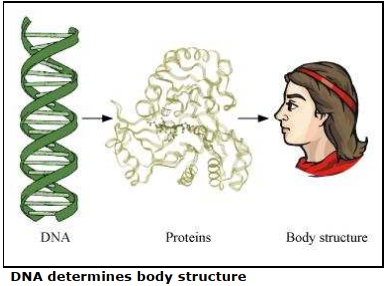
(N/A) $DNA$ (Deoxyribonucleic acid) is the genetic material found in the chromosomes,which are present in the nucleus of a cell.
$DNA$ contains the information necessary for protein synthesis,and each specific type of protein leads to a specific body design.
Therefore,the $DNA$ molecule determines the body design of an individual.
During reproduction,$DNA$ copying ensures that the genetic information is transferred from parents to offspring,which maintains the continuity of species and ensures that offspring resemble their parents.
0 likes
View Solution2
Medium
How does binary fission differ from multiple fission?
Solution
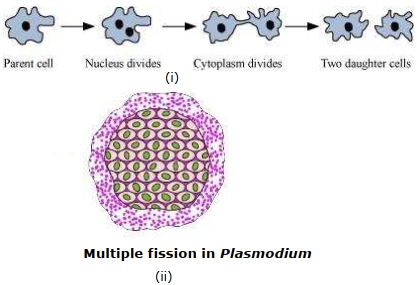
(N/A) In binary fission,a single parent cell divides into two equal daughter cells. Examples include Amoeba and Bacteria. This is shown in image $(i)$.
In multiple fission,a single parent cell divides into many daughter cells simultaneously. An example is Plasmodium. This is shown in image $(ii)$.
In multiple fission,a single parent cell divides into many daughter cells simultaneously. An example is Plasmodium. This is shown in image $(ii)$.
0 likes
View Solution3
MediumMCQ
How will an organism be benefited if it reproduces through spores?
A
It allows for rapid dispersal over long distances.
B
It ensures survival during unfavourable conditions due to thick protective walls.
C
It produces a large number of offspring from a single sporangium.
D
All of the above.
Solution
(D) An organism benefits from spore formation in several ways:
$1$. High Reproductive Output: $A$ large number of spores are produced within a single sporangium,increasing the chances of survival.
$2$. Efficient Dispersal: Spores are lightweight and easily carried by air currents to distant locations,which helps the organism colonize new areas and reduces competition for resources in the parent's habitat.
$3$. Survival in Unfavourable Conditions: Spores are protected by thick,resistant walls that prevent dehydration and damage,allowing the organism to survive harsh environmental conditions until favourable conditions return.
0 likes
View Solution4
Medium
Can you think of reasons why more complex organisms cannot give rise to new individuals through regeneration?
Solution
(N/A) Simple organisms such as $Hydra$ and $Planaria$ are capable of producing new individuals through the process of regeneration.
The process of regeneration involves the formation of new organisms from their body parts.
Simple organisms can utilize this method of reproduction because their entire body is made of similar kinds of cells,where any part of their body can be formed by growth and development.
However,complex organisms have an organ-system level of organization.
All the organ systems of their body work together as an interconnected unit.
While they can regenerate specific lost body parts such as skin,muscles,or blood,they cannot give rise to new individuals through regeneration because their specialized cells are not capable of forming an entire organism from a fragment.
0 likes
View Solution5
Easy
Why is vegetative propagation practised for growing some types of plants?
Solution
(N/A) Vegetative propagation is practiced for the following reasons:
$1$. It is a more rapid and easier method of reproduction.
$2$. It allows plants to grow in regions where seed germination might fail.
$3$. It is highly useful for propagating plants that do not produce viable seeds or produce very few seeds.
$4$. It is an efficient method for producing a large number of genetically identical plants in a short period.
$5$. Examples include the tuber of $Potato$ and the rhizome of $Ginger$.
0 likes
View Solution6
EasyMCQ
Asexual reproduction takes place through budding in
A
yeast
B
amoeba
C
plasmodium
D
leishmania
Solution
(A) Asexual reproduction is a mode of reproduction where a single parent produces offspring.
In $Yeast$ $(Saccharomyces cerevisiae)$, asexual reproduction occurs through the process of budding.
During this process, a small bud develops as an outgrowth from the parent cell, which eventually detaches to form a new individual.
In contrast, $Amoeba$ reproduces by binary fission, $Plasmodium$ by multiple fission, and $Leishmania$ by binary fission.
0 likes
View Solution7
Medium
How are the modes of reproduction different in unicellular and multicellular organisms?
Solution
(N/A) In unicellular organisms,reproduction occurs by the division of the entire cell. The modes of reproduction in unicellular organisms include fission,budding,etc.
In multicellular organisms,specialized reproductive organs are present. Therefore,they can reproduce by complex reproductive methods such as vegetative propagation,spore formation,and sexual reproduction.
In complex multicellular organisms like humans and higher plants,sexual reproduction is the primary mode of reproduction.
0 likes
View Solution8
MediumMCQ
In the list of organisms given below,those that reproduce by the asexual method are:
$(i)$ banana
$(ii)$ dog
$(iii)$ yeast
$(iv)$ Amoeba
$(i)$ banana
$(ii)$ dog
$(iii)$ yeast
$(iv)$ Amoeba
A
$(i), (iii)$ and $(iv)$
B
$(ii)$ and $(iv)$
C
$(i)$ and $(iv)$
D
$(ii), (iii)$ and $(iv)$
Solution
(A) Asexual reproduction is a mode of reproduction in which a single parent produces offspring without the involvement of gamete fusion.
$(i)$ Banana reproduces vegetatively (a form of asexual reproduction).
$(ii)$ Dog reproduces sexually.
$(iii)$ Yeast reproduces asexually by budding.
$(iv)$ Amoeba reproduces asexually by binary fission.
Therefore,organisms $(i), (iii),$ and $(iv)$ reproduce by the asexual method.
$(i)$ Banana reproduces vegetatively (a form of asexual reproduction).
$(ii)$ Dog reproduces sexually.
$(iii)$ Yeast reproduces asexually by budding.
$(iv)$ Amoeba reproduces asexually by binary fission.
Therefore,organisms $(i), (iii),$ and $(iv)$ reproduce by the asexual method.
0 likes
View Solution9
MediumMCQ
Offspring formed by asexual method of reproduction have greater similarity among themselves because
$(i)$ asexual reproduction involves only one parent
$(ii)$ asexual reproduction does not involve gametes
$(iii)$ asexual reproduction occurs before sexual reproduction
$(iv)$ asexual reproduction occurs after sexual reproduction
$(i)$ asexual reproduction involves only one parent
$(ii)$ asexual reproduction does not involve gametes
$(iii)$ asexual reproduction occurs before sexual reproduction
$(iv)$ asexual reproduction occurs after sexual reproduction
A
$(iii)$ and $(iv)$
B
$(i)$ and $(iii)$
C
$(ii)$ and $(iv)$
D
$(i)$ and $(ii)$
Solution
(D) Asexual reproduction involves only a single parent $(i)$.
Since there is only one parent,there is no fusion of gametes $(ii)$,which prevents the mixing of genetic material from two different sources.
As a result,the offspring produced are genetically identical to the parent and to each other,often referred to as clones.
Statements $(iii)$ and $(iv)$ are irrelevant to the genetic similarity of the offspring.
Therefore,the correct combination is $(i)$ and $(ii)$.
0 likes
View Solution10
EasyMCQ
$A$ feature of reproduction that is common to $Amoeba$,$Spirogyra$ and $Yeast$ is that
A
they reproduce only sexually
B
they are all unicellular
C
they reproduce asexually
D
they are all multicellular
Solution
(C) $Amoeba$ reproduces by binary fission,$Spirogyra$ reproduces by fragmentation,and $Yeast$ reproduces by budding. All these methods are types of asexual reproduction. Therefore,the common feature among these organisms is that they all reproduce asexually.
0 likes
View Solution11
EasyMCQ
In $Spirogyra$,asexual reproduction takes place by:
A
Fragmentation
B
Binary fission
C
Multiple fission
D
Budding
Solution
(A) $Spirogyra$ is a filamentous green alga. When it matures,its body breaks into smaller pieces or fragments. Each fragment grows into a new individual. This method of asexual reproduction is known as fragmentation.
0 likes
View Solution12
MediumMCQ
The ability of a cell to divide into several cells during reproduction in $Plasmodium$ is called
A
multiple fission
B
reduction division
C
binary fission
D
budding
Solution
(A) In $Plasmodium$,the organism reproduces by a process known as multiple fission.
During this process,the parent cell divides into many daughter cells simultaneously.
This is an asexual mode of reproduction where the nucleus divides repeatedly,followed by the division of the cytoplasm,resulting in the formation of numerous daughter individuals.
During this process,the parent cell divides into many daughter cells simultaneously.
This is an asexual mode of reproduction where the nucleus divides repeatedly,followed by the division of the cytoplasm,resulting in the formation of numerous daughter individuals.
0 likes
View Solution13
MediumMCQ
In $Rhizopus$,tubular thread-like structures bearing sporangia at their tips are called:
A
filaments
B
roots
C
rhizoids
D
hyphae
Solution
(D) $Rhizopus$ is a common bread mold that reproduces through spore formation.
It consists of a network of fine,thread-like,tubular structures known as $hyphae$.
Some of these $hyphae$ grow vertically and develop swollen,knob-like structures at their tips called $sporangia$.
These $sporangia$ contain spores which,upon release,germinate to form new individuals.
It consists of a network of fine,thread-like,tubular structures known as $hyphae$.
Some of these $hyphae$ grow vertically and develop swollen,knob-like structures at their tips called $sporangia$.
These $sporangia$ contain spores which,upon release,germinate to form new individuals.
0 likes
View Solution14
MediumMCQ
Vegetative propagation refers to the formation of new plants from
A
stem,roots and leaves
B
stem,roots and flowers
C
stem,flowers and fruits
D
stem,leaves and flowers
Solution
(A) Vegetative propagation is a type of asexual reproduction in plants where new individuals are formed from vegetative parts of the parent plant.
These vegetative parts include the stem,roots,and leaves.
Flowers,fruits,and seeds are involved in sexual reproduction,not vegetative propagation.
Therefore,the correct option is $A$.
These vegetative parts include the stem,roots,and leaves.
Flowers,fruits,and seeds are involved in sexual reproduction,not vegetative propagation.
Therefore,the correct option is $A$.
0 likes
View Solution15
MediumMCQ
Factors responsible for the rapid spread of bread mould on slices of bread are:
$(i)$ Large number of spores
$(ii)$ Availability of moisture and nutrients in bread
$(iii)$ Presence of tubular branched hyphae
$(iv)$ Formation of round shaped sporangia
$(i)$ Large number of spores
$(ii)$ Availability of moisture and nutrients in bread
$(iii)$ Presence of tubular branched hyphae
$(iv)$ Formation of round shaped sporangia
A
$(i)$ and $(iii)$
B
$(i)$ and $(ii)$
C
$(ii)$ and $(iv)$
D
$(iii)$ and $(iv)$
Solution
(B) Bread mould (Rhizopus) reproduces through spore formation.
$(i)$ The production of a large number of spores allows the fungus to disperse widely and increase the probability of landing on a suitable substrate.
$(ii)$ Bread provides an ideal environment for the growth of mould because it contains moisture and nutrients (carbohydrates) necessary for the fungus to thrive.
$(iii)$ and $(iv)$ are structural characteristics of the fungus,but they are not the primary factors responsible for the 'rapid spread' across the bread surface compared to the reproductive strategy (spores) and environmental conditions (moisture/nutrients).
Therefore,the correct factors are $(i)$ and $(ii)$.
0 likes
View Solution16
EasyMCQ
Can you consider cell division as a type of reproduction in unicellular organisms? Give one reason.
A
Yes,because it increases the cell size.
B
Yes,because it results in the formation of two daughter cells,which are new individuals.
C
No,because it only occurs in multicellular organisms.
D
No,because cell division is only for growth and repair.
Solution
(B) Yes,cell division can be considered a type of reproduction in unicellular organisms.
This is because,in unicellular organisms like bacteria or amoeba,cell division (such as binary fission) directly results in the formation of two or more daughter cells.
Since these daughter cells are independent individuals,the process of cell division effectively increases the population of the organism,which is the definition of reproduction.
0 likes
View Solution17
Easy
What is a clone? Why do offspring formed by asexual reproduction exhibit remarkable similarity?
Solution
(N/A) clone is defined as an individual organism that is genetically and morphologically identical to its parent.
Offspring formed by asexual reproduction exhibit remarkable similarity because they are produced from a single parent without the fusion of gametes.
Since asexual reproduction involves only mitotic cell division,the offspring receive exact copies of the parent's $DNA$,resulting in genetic uniformity.
0 likes
View Solution18
Easy
Why does bread mould grow profusely on a moist slice of bread rather than on a dry slice of bread?
Solution
(N/A) Moisture is an essential factor for the growth of fungal hyphae. $A$ moist slice of bread provides both the necessary moisture and nutrients required for the bread mould to thrive. In contrast,a dry slice of bread provides nutrients but lacks the moisture needed for the spores to germinate and the hyphae to grow,thus preventing the mould from growing.
0 likes
View Solution19
Easy
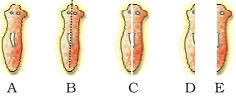
Would a Planaria cut vertically into two halves regenerate into two individuals? Complete Figure $D$ and $E$ by indicating the regenerated regions.
Solution
(N/A) Yes,a Planaria cut vertically into two halves can regenerate into two complete individuals. This is possible due to the presence of specialized cells that proliferate and make large numbers of cells,which then undergo changes to become various cell types and tissues. In the provided figures,the shaded parts in $D$ and $E$ represent the newly regenerated halves that have grown to replace the missing sections.

0 likes
View Solution20
Easy
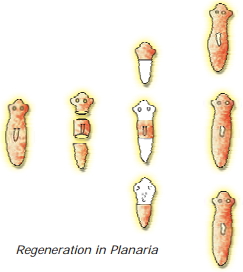
Why are budding,fragmentation,and regeneration all considered as asexual types of reproduction? With neat diagrams,explain the process of regeneration in Planaria.
Solution
(N/A) Budding,fragmentation,and regeneration are considered asexual types of reproduction because they involve only a single parent and do not require the formation or fusion of gametes.
Regeneration in Planaria:
$1$. If a Planaria is accidentally cut into several pieces,each piece contains specialized cells that proliferate and make large numbers of cells.
$2$. From this mass of cells,different cell types undergo changes to become various cell types and tissues.
$3$. These changes take place in an organized sequence referred to as development.
$4$. Eventually,these pieces grow into complete new individuals.
[Image: $1087-$s49]
0 likes
View Solution21
Easy
Name two simple organisms having the ability of regeneration.
Solution
(N/A) Regeneration is the process by which an organism can regrow lost or damaged body parts. Simple organisms like $Planaria$,$Hydra$,and $Earthworm$ possess the ability to regenerate their entire body from a small fragment or piece. Therefore,any two of these,such as $Planaria$ and $Hydra$,are correct examples.
0 likes
View Solution22
EasyMCQ
Give an advantage of vegetative propagation.
A
It produces genetically identical offspring.
B
It allows for faster growth compared to seeds.
C
It can be used to propagate plants that do not produce viable seeds.
D
All of the above.
Solution
(D) Vegetative propagation is an asexual method of reproduction in plants. An important advantage of this method is that it can be used to grow plants that do not produce seeds (e.g.,banana,jasmine) or produce non-viable seeds. Additionally,it ensures the production of genetically identical offspring,which helps in maintaining desirable traits of the parent plant.
0 likes
View Solution23
EasyMCQ
Name the type of cells which undergo regeneration.
A
Specialized cells
B
Stem cells
C
Regenerative cells
D
All of the above
Solution
(C) The cells that undergo regeneration are known as regenerative cells. These are specialized cells that have the ability to proliferate and produce a large number of cells to replace the lost or damaged body parts.
0 likes
View Solution24
Easy
Regeneration is not possible in all types of animals. Why?
Solution
(N/A) Regeneration is a process that relies on the presence of specialized cells known as stem cells or undifferentiated cells.
These cells have the potential to proliferate and differentiate into various cell types to replace lost or damaged tissues.
In complex organisms,the body organization is highly specialized and differentiated,meaning cells have lost their ability to revert to an undifferentiated state.
Therefore,only organisms with a simple body organization and the presence of these specialized regenerative cells can exhibit the phenomenon of regeneration.
0 likes
View Solution25
EasyMCQ
What is the advantage of reproducing through spores?
A
They provide genetic variation.
B
They allow for survival in adverse conditions and easy dispersal.
C
They require less energy than sexual reproduction.
D
They ensure faster growth rates.
Solution
(B) Spores are protected by a thick,resistant cell wall,which allows them to survive in adverse environmental conditions like extreme heat or lack of water.
Additionally,spores are produced in large numbers and are very light in weight,which facilitates their easy dispersal over long distances by wind,water,or animals.
Additionally,spores are produced in large numbers and are very light in weight,which facilitates their easy dispersal over long distances by wind,water,or animals.
0 likes
View Solution26
Medium
Give reasons as to why the following processes are different from each other:
$(a)$ Fission in $Amoeba$ and $Plasmodium$.
$(b)$ Binary fission and Fragmentation.
$(a)$ Fission in $Amoeba$ and $Plasmodium$.
$(b)$ Binary fission and Fragmentation.
Solution
(N/A) In $Amoeba$,binary fission occurs,where the parent cell divides into two daughter cells. In $Plasmodium$,multiple fission occurs,where the parent cell divides into many daughter cells simultaneously.
$(b)$ In binary fission,a single-celled organism divides into two daughter cells. In fragmentation,the body of a multicellular organism breaks into two or more pieces,and each piece develops into a new individual.
$(b)$ In binary fission,a single-celled organism divides into two daughter cells. In fragmentation,the body of a multicellular organism breaks into two or more pieces,and each piece develops into a new individual.
0 likes
View Solution27
Easy
Explain how organisms create an exact copy of themselves.
Solution
(N/A) To create copies of $DNA$ or genetic material,cells utilize biochemical reactions.
These biochemical processes result in the replication of $DNA$.
Along with the $DNA$ copies,the cell synthesizes additional cellular apparatus to support the new cell.
Finally,the cell divides,resulting in the formation of two almost identical daughter cells.
These biochemical processes result in the replication of $DNA$.
Along with the $DNA$ copies,the cell synthesizes additional cellular apparatus to support the new cell.
Finally,the cell divides,resulting in the formation of two almost identical daughter cells.
0 likes
View Solution28
Medium
Define the following processes of asexual reproduction:
$(a)$ Spore formation
$(b)$ Regeneration
$(c)$ Multiple fission
$(a)$ Spore formation
$(b)$ Regeneration
$(c)$ Multiple fission
Solution
(N/A) Spore formation: It is a method of asexual reproduction where organisms produce tiny,unicellular,reproductive bodies called spores. These spores are covered by thick walls to withstand unfavorable conditions and develop into new individuals upon germination.
$(b)$ Regeneration: It is the ability of an organism to regrow lost or damaged body parts. In some organisms,if the body is cut into pieces,each piece can grow into a complete new organism.
$(c)$ Multiple fission: It is a type of asexual reproduction in which a single parent cell divides into many daughter cells simultaneously,often occurring under unfavorable conditions.
0 likes
View Solution29
Medium
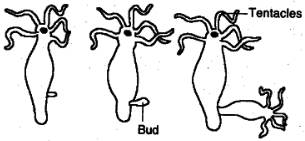
Draw labelled diagrams to illustrate budding in Hydra.
Solution
(N/A) Budding is a form of asexual reproduction in $Hydra$.
$1$. In $Hydra$,a small outgrowth called a bud develops on the body wall due to repeated cell division at a specific site.
$2$. This bud gradually grows and develops into a small,complete $Hydra$ with tentacles and a mouth.
$3$. Once fully developed,the new $Hydra$ detaches from the parent body and begins to live as an independent organism.
(Refer to the provided diagram showing the stages of bud development,the formation of tentacles,and the final detachment of the new individual.)
0 likes
View Solution30
Medium
Differentiate between binary fission and multiple fission.
Solution
(N/A)
| Binary Fission | Multiple Fission |
|---|---|
| $(i)$ The nucleus divides into two parts. | $(i)$ The nucleus divides into many parts. |
| $(ii)$ It occurs during normal conditions. | $(ii)$ It takes place during unfavourable conditions (Encysted stage). |
| $(iii)$ It gives rise to two individuals. | $(iii)$ It forms many individuals. |
| $(iv)$ Cytoplasm divides after each nuclear division. Example: $Amoeba$. | $(iv)$ Cytoplasm does not divide after every nuclear division. Example: $Plasmodium$. |
0 likes
View Solution31
Medium
$(a)$ What is vegetative propagation?
$(b)$ Write any two advantages of practising this method.
$(b)$ Write any two advantages of practising this method.
Solution
(N/A) Vegetative propagation is a type of asexual reproduction in plants where new plants are produced from vegetative parts such as roots,stems,and leaves,rather than from seeds or spores,under appropriate environmental conditions.
$(b)$ Two advantages of vegetative propagation are:
$(i)$ It allows for the propagation of plants that do not produce viable seeds,such as bananas,oranges,and grapes.
$(ii)$ Plants produced through this method are genetically identical to the parent plant,ensuring that desirable traits are preserved and the offspring reach maturity and bear fruit/flowers faster than those grown from seeds.
0 likes
View Solution32
Easy
Name the type of asexual reproduction in:
$(a)$ Planaria
$(b)$ Rhizopus
$(c)$ Spirogyra
$(d)$ Hydra
$(a)$ Planaria
$(b)$ Rhizopus
$(c)$ Spirogyra
$(d)$ Hydra
Solution
(A) Planaria reproduces by Regeneration,where the organism can regrow lost body parts or develop into a new individual from a body fragment.
$(b)$ Rhizopus reproduces by Spore formation,where specialized structures called sporangia produce numerous spores that develop into new individuals.
$(c)$ Spirogyra reproduces by Fragmentation,where the filament simply breaks into smaller pieces upon maturation,and each piece grows into a new filament.
$(d)$ Hydra reproduces by Budding,where a small outgrowth or bud develops on the parent body,which eventually detaches to form a new individual.
0 likes
View Solution33
EasyMCQ
Leaves of $Bryophyllum$ fallen on the ground produce new plants. Why?
A
They contain seeds.
B
They have adventitious buds in the notches along the leaf margin.
C
They reproduce by fragmentation.
D
They have specialized roots for reproduction.
Solution
(B) The leaves of $Bryophyllum$ possess adventitious buds in the notches along the leaf margins.
When these leaves fall on moist soil,the adventitious buds develop into new plantlets under favourable conditions.
This is a form of vegetative propagation.
When these leaves fall on moist soil,the adventitious buds develop into new plantlets under favourable conditions.
This is a form of vegetative propagation.
0 likes
View Solution34
Easy
Mention any four ways of asexual reproduction.
Solution
(N/A) The four common methods of asexual reproduction are:
$1$. Fission: The parent cell divides into two or more daughter cells (e.g.,$Amoeba$).
$2$. Regeneration: The ability of an organism to regrow lost or damaged parts (e.g.,$Planaria$).
$3$. Budding: $A$ new organism develops from an outgrowth or bud on the parent body (e.g.,$Hydra$,$Yeast$).
$4$. Vegetative Propagation: New plants are produced from vegetative parts like roots,stems,or leaves (e.g.,$Potato$,$Bryophyllum$).
(Note: Spore formation is also a method of asexual reproduction.)
0 likes
View Solution35
Easy
$(a)$ List any two methods of asexual reproduction.
$(b)$ Explain how $Spirogyra$ reproduces.
$(b)$ Explain how $Spirogyra$ reproduces.
Solution
(N/A) Two methods of asexual reproduction are:
$(i)$ Budding (e.g.,in $Hydra$ and yeast).
$(ii)$ Spore formation (e.g.,in fungi).
$(b)$ $Spirogyra$ reproduces by a method called fragmentation. Upon maturation,the filamentous body of $Spirogyra$ simply breaks up into smaller pieces or fragments. Each of these fragments then grows and develops into a new individual.
0 likes
View Solution36
Medium
'Regeneration is not reproduction'. Justify this statement with reason.
Solution
(N/A) Regeneration is the ability of an organism to regrow lost or damaged body parts from specialized cells.
However,it is not considered a true form of reproduction because:
$1$. Reproduction is a process intended to produce new individuals of the same species,whereas regeneration is primarily a mechanism for repair or replacement of lost tissues.
$2$. Most organisms do not possess the ability to grow into a complete new organism from a small cut piece.
$3$. Only specific organisms like $Hydra$ or $Planaria$ exhibit this,but for the vast majority of complex organisms,regeneration is limited to healing wounds rather than creating offspring.
0 likes
View Solution37
Medium
Explain the process of regeneration in $Planaria$. How is this process different from reproduction?
Solution
(N/A) $Planaria$ possesses the ability to regenerate its lost body parts. If the body of $Planaria$ is cut into several pieces,each piece can grow into a complete new individual. This occurs because specialized cells present in the body proliferate and form a mass of cells. These cells then undergo differentiation to form various tissues and organs,eventually developing into a complete organism.
Regeneration is not the same as reproduction because,in nature,most organisms do not rely on being cut or injured to produce offspring. Regeneration is primarily a mechanism for the repair of damaged tissues or the replacement of lost body parts,whereas reproduction is a biological process for the continuation of the species.
Regeneration is not the same as reproduction because,in nature,most organisms do not rely on being cut or injured to produce offspring. Regeneration is primarily a mechanism for the repair of damaged tissues or the replacement of lost body parts,whereas reproduction is a biological process for the continuation of the species.
0 likes
View Solution38
Medium
List any two modes of asexual reproduction in animals. Under which mode of reproduction is vegetative propagation placed and why? List two advantages of vegetative propagation.
Solution
(N/A) Two modes of asexual reproduction in animals include $Fission$ and $Budding$ (or $Fragmentation$, $Regeneration$).
Vegetative propagation is classified under asexual reproduction because it involves only a single parent and does not involve the fusion of gametes or the formation of reproductive organs like flowers.
Two advantages of vegetative propagation are:
$(i)$ Plants produced through this method can bear flowers and fruits earlier than those grown from seeds.
$(ii)$ It allows for the propagation of plants that have lost the capacity to produce viable seeds, such as bananas, oranges, and jasmine.
0 likes
View Solution39
Medium
$(a)$ Identify the asexual method of reproduction in each of the following organisms:
$(i)$ Rose
$(ii)$ Yeast
$(iii)$ Planaria
$(b)$ What is fragmentation? Name a multicellular organism which reproduces by this method.
$(i)$ Rose
$(ii)$ Yeast
$(iii)$ Planaria
$(b)$ What is fragmentation? Name a multicellular organism which reproduces by this method.
Solution
(N/A) $(i)$ Rose $\rightarrow$ Cutting (Vegetative propagation)
$(ii)$ Yeast $\rightarrow$ Budding
$(iii)$ Planaria $\rightarrow$ Regeneration
$(b)$ Fragmentation is a type of asexual reproduction in which the body of the parent organism breaks into distinct pieces or fragments,and each fragment develops into a new individual. Spirogyra is a multicellular organism that reproduces by this method.
0 likes
View Solution40
Medium
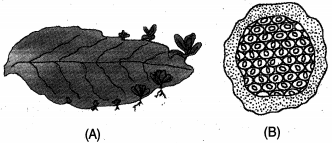
$(a)$ Identify the organisms $A$ and $B$ and the mode of asexual reproduction exhibited by them.
$(b)$ How will an organism be benefitted if it reproduces through spores?
$(c)$ Mention the two asexual methods by which Hydra can reproduce. Explain briefly any one such method.
$(b)$ How will an organism be benefitted if it reproduces through spores?
$(c)$ Mention the two asexual methods by which Hydra can reproduce. Explain briefly any one such method.
Solution
(N/A) $(i)$ Organism $A$ is Bryophyllum,which reproduces by vegetative propagation.
$(ii)$ Organism $B$ is Plasmodium,which reproduces by multiple fission.
$(b)$ Spores are reproductive bodies covered with thick,protective walls. These walls protect the spores from unfavorable environmental conditions (like heat or desiccation) until they come into contact with a moist surface and begin to grow.
$(c)$ The two asexual methods by which Hydra can reproduce are Budding and Regeneration.
Budding: In this process,a bud develops as an outgrowth due to repeated cell division at a specific site on the parent body. These buds develop into tiny individuals,mature,and eventually detach from the parent to become new,independent individuals.
Regeneration: In this process,specialized cells divide to form a large number of cells,which then undergo changes to become various cell types and tissues,eventually forming the complete organism.
0 likes
View Solution41
EasyMCQ
What happens when a mature $Spirogyra$ filament attains considerable length?
A
It undergoes binary fission.
B
It breaks up into smaller fragments,each of which grows into a new individual.
C
It produces spores for reproduction.
D
It dies and decomposes.
Solution
(B) When a mature $Spirogyra$ filament attains a considerable length,it undergoes a process called fragmentation.
Its filament breaks up into smaller fragments or pieces due to maturation or mechanical stress.
Each of these fragments then grows into a new $Spirogyra$ filament or individual through cell division.
Its filament breaks up into smaller fragments or pieces due to maturation or mechanical stress.
Each of these fragments then grows into a new $Spirogyra$ filament or individual through cell division.
0 likes
View Solution42
Medium
Can these two methods,regeneration and fragmentation,be equated to be the same? Answer with a reason.
Solution
(N/A) No,these two methods are not the same.
In fragmentation,multicellular organisms with simple body organization,upon reaching maturity,break their bodies into small pieces (fragments),which then grow into new individuals,as seen in $Spirogyra$.
In regeneration,organisms possess the specialized ability to regrow lost parts of their body or even an entire body from a small fragment,typically following an injury or accidental damage,as seen in $Hydra$ and $Planaria$.
0 likes
View Solution43
Medium
The process of spore formation takes place in many simple multicellular organisms which have certain reproductive parts that can be identified.
$(a)$ Name the organism using this process.
$(b)$ Name the reproductive and non-reproductive parts of such organisms.
$(a)$ Name the organism using this process.
$(b)$ Name the reproductive and non-reproductive parts of such organisms.
Solution
(N/A) The organism that uses this process is Bread mould,scientifically known as $Rhizopus$.
$(b)$ In $Rhizopus$,the thread-like structures that spread on the bread are called hyphae,which are the non-reproductive parts. The small bulb-like structures at the top of the stalks are called sporangia,which contain spores and are the reproductive parts.
$(b)$ In $Rhizopus$,the thread-like structures that spread on the bread are called hyphae,which are the non-reproductive parts. The small bulb-like structures at the top of the stalks are called sporangia,which contain spores and are the reproductive parts.
0 likes
View Solution44
Medium
In the process of reproduction as used in $Spirogyra$,the organism splits itself into small pieces.
$(a)$ What is this process of reproduction called?
$(b)$ Will this type of reproduction be asexual or sexual reproduction? Answer with reason.
$(c)$ Is this process same as regeneration? Give reasons.
$(a)$ What is this process of reproduction called?
$(b)$ Will this type of reproduction be asexual or sexual reproduction? Answer with reason.
$(c)$ Is this process same as regeneration? Give reasons.
Solution
(N/A) This process is called fragmentation.
$(b)$ It is asexual reproduction,because a single parent is capable of giving rise to a new organism without the involvement of gametes.
$(c)$ No,it is not the same as regeneration. In regeneration,an organism can regrow lost parts of its body due to injury or specific biological mechanisms (e.g.,the tail of some lizards). In contrast,in fragmentation,the body of the organism breaks into two or more pieces,and each piece grows into a new individual.
0 likes
View Solution45
Medium
Can we find variations in an asexually reproducing organism like bacteria? Write yes or no and give a reason in support of your answer.
Solution
(A) Yes. Although bacteria reproduce asexually,meaning a single parent gives rise to new organisms,the process of $DNA$ copying is not perfectly accurate. During $DNA$ replication,minor errors or mutations can occur. These small changes in the genetic material lead to variations in the offspring. Therefore,even in asexually reproducing organisms like bacteria,variations can occur.
0 likes
View Solution46
Medium
In the context of reproduction of species,state the main difference between fission and fragmentation. Also,give one example of each.
Solution
(N/A) Fission: It is a method of asexual reproduction primarily observed in unicellular organisms. In this process,the parent cell divides into two or more daughter cells.
Example: $Amoeba$ or $Plasmodium$.
Fragmentation: It is a method of asexual reproduction found in multicellular organisms with relatively simple body organizations. In this process,the organism's body breaks into distinct pieces upon maturation,and each piece develops into a new individual.
Example: $Spirogyra$.
0 likes
View Solution47
Medium
Explain the term "Regeneration" as used in relation to reproduction of organisms. Describe briefly how regeneration is carried out in multicellular organisms like $Hydra$.
Solution
(N/A) Regeneration: It is the ability of an organism to give rise to a new organism or individual from its body parts.
Regeneration in $Hydra$:
$1$. When the body of $Hydra$ is cut into a number of pieces by any means, each piece contains specialized cells.
$2$. These cells proliferate and make a large number of cells.
$3$. From this mass of cells, different cells undergo changes to become various cell types and tissues, finally developing into a new organism.
0 likes
View Solution48
Medium
Some plants do not produce seeds. For such plants,parts like roots,stem,and leaves are used to develop into new plants.
$(a)$ Identify the process.
$(b)$ Which type of reproduction is it—sexual or asexual? Answer with reason.
$(c)$ Give any two examples of this process.
$(a)$ Identify the process.
$(b)$ Which type of reproduction is it—sexual or asexual? Answer with reason.
$(c)$ Give any two examples of this process.
Solution
(N/A) The process is known as Vegetative Propagation.
$(b)$ This is a type of Asexual reproduction. It is considered asexual because only a single parent is involved in the formation of new plants,and no fusion of gametes occurs.
$(c)$ Two examples of this process are:
$(i)$ Stem cutting in plants like rose,jasmine,or sugarcane.
$(ii)$ Leaf buds in $Bryophyllum$.
0 likes
View Solution49
Medium
$(i)$ Some organisms have the capacity of reproducing by using a single parent. Such organisms have a simple body structure.
$(a)$ What is this method called?
$(b)$ Name any four types of this method.
$(c)$ Give two examples of organisms using this method for reproduction.
$(ii)$ Identify the method of reproduction used by $Spirogyra$ and $Rhizopus$.
$(a)$ What is this method called?
$(b)$ Name any four types of this method.
$(c)$ Give two examples of organisms using this method for reproduction.
$(ii)$ Identify the method of reproduction used by $Spirogyra$ and $Rhizopus$.
Solution
(N/A) $(i)$ $(a)$ This method is called asexual reproduction.
$(b)$ The four types of this method are: $(i)$ Fission,$(ii)$ Budding,$(iii)$ Spore formation,$(iv)$ Fragmentation.
$(c)$ Two examples of organisms using this method are: $(i)$ $Amoeba$,$(ii)$ $Spirogyra$.
$(ii)$ $Spirogyra$ reproduces by the process of fragmentation.
$Rhizopus$ reproduces by the process of spore formation.
0 likes
View Solution50
EasyMCQ
What is the advantage of reproduction through spores in the case of $Rhizopus$?
A
It allows for rapid sexual reproduction.
B
The spores are covered by thick walls that protect them under unfavorable conditions.
C
It ensures the production of genetically identical offspring only.
D
It requires a large amount of energy compared to other methods.
Solution
(B) $(i)$ The spores are covered by thick walls that protect them until they come into contact with another moist surface and can begin to grow.
$(ii)$ Spores being lighter easily get dispersed to distant places and provide better chances of survival.
$(ii)$ Spores being lighter easily get dispersed to distant places and provide better chances of survival.
0 likes
View SolutionHow do Organisms Reproduce? — Modes of Asexual Reproduction · Frequently Asked Questions
1Are these How do Organisms Reproduce? questions useful for JEE and NEET?
Yes. All questions in this section are mapped to JEE Main and NEET exam patterns. Previous year questions from JEE Main, NEET, GUJCET and state-level exams are included with full solutions.
2Can I switch to Hindi or Gujarati for these questions?
Yes. Use the language tabs in the hero section or the sidebar to view the same questions and solutions in English, Hindi or Gujarati.
3How do I generate a question paper from this subtopic?
Use the Vedclass Exam Paper Generator — select the chapter and subtopic, set difficulty, and generate Sets A, B, C, D automatically. First 3 chapters of every subject are free.
Vedclass Products
For Students
Vedclass Test Series
Mock tests in real JEE/NEET style with performance analysis. 5-day free trial.
Start Free TrialFor Teachers
Exam Paper Generator
Generate Set A/B/C/D papers from this chapter in 2 minutes. 3 chapters free.
Try FreeFor Institutes
Online Exam Module
Live online exams with unlimited students, 360° analytics & white-label branding.
See DemoFor Teachers & Institutes
Generate a How do Organisms Reproduce? Exam Paper in 2 Minutes
Select subtopic & difficulty — Sets A, B, C, D auto-generated with No Repeat logic.
First 3 chapters of every subject are free — no payment required.