
A English
Excretion Questions in English
Class 10 Science · Life Processes · Excretion
24+
Questions
English
Language
100%
With Solutions
Showing 24 of 24 questions in English
1
Difficult
Describe the structure and functioning of nephrons.
Solution
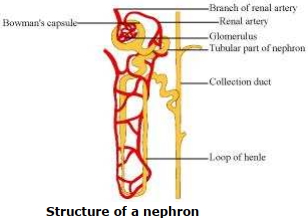
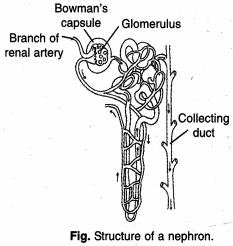
(N/A) Nephrons are the basic filtering units of kidneys. Each kidney possesses a large number of nephrons,approximately $1-1.5$ million. The main components of the nephron are the glomerulus,Bowman's capsule,and a long renal tubule.
Functioning of a nephron:
$1$. The blood enters the kidney through the renal artery,which branches into many capillaries associated with the glomerulus.
$2$. The water and solutes are transferred to the nephron at Bowman's capsule.
$3$. In the proximal tubule,some substances such as amino acids,glucose,and salts are selectively reabsorbed,and unwanted molecules are added to the urine.
$4$. The filtrate then moves down into the loop of Henle,where more water is absorbed.
$5$. From here,the filtrate moves upwards into the distal tubule and finally to the collecting duct. The collecting duct collects urine from many nephrons.
$6$. The urine formed in each kidney enters a long tube called the ureter. From the ureter,it is transported to the urinary bladder and then into the urethra.
1 likes
View Solution2
Easy
What are the methods used by plants to get rid of excretory products?
Solution
(N/A) Plants utilize several methods to eliminate excretory products:
$1$. Transpiration: Plants remove excess water through the process of transpiration.
$2$. Storage in Vacuoles: Many waste products are stored within the cell vacuoles.
$3$. Secretion: Waste materials like gums and resins are stored in old xylem tissues.
$4$. Shedding: Some waste products are stored in leaves,which eventually fall off the plant.
0 likes
View Solution3
MediumMCQ
How is the amount of urine produced regulated?
A
By the amount of excess water in the body.
B
By the amount of dissolved wastes in the body.
C
By the secretion of Antidiuretic hormone $(ADH)$.
D
All of the above.
Solution
(D) The amount of urine produced is regulated by several factors:
$1$. The amount of excess water present in the body: If the body has excess water,more urine is produced.
$2$. The amount of dissolved wastes: The kidneys need water to excrete these wastes.
$3$. Hormonal control: The Antidiuretic hormone $(ADH)$,also known as vasopressin,is secreted by the pituitary gland. It increases the reabsorption of water in the kidney tubules,thereby reducing the volume of urine produced.
$4$. Habitat: Organisms living in aquatic environments generally produce more dilute urine compared to those in terrestrial environments.
0 likes
View Solution4
EasyMCQ
The kidneys in human beings are a part of the system for
A
nutrition.
B
excretion.
C
respiration.
D
transportation.
Solution
(B) In human beings,the kidneys are the primary organs of the excretory system. They function to filter the blood,remove nitrogenous waste products like urea,and regulate water and electrolyte balance,which is the process of excretion.
0 likes
View Solution5
EasyMCQ
The filtration units of kidneys are called:
A
ureter
B
nephrons
C
neurons
D
urethra
Solution
(B) The kidneys contain many filtration units known as $nephrons$.
Each $nephron$ consists of a filtering component called the $glomerulus$ and a tubule.
$Nephrons$ are responsible for filtering the blood,reabsorbing essential substances,and excreting waste products in the form of urine.
Therefore,the correct option is $B$.
Each $nephron$ consists of a filtering component called the $glomerulus$ and a tubule.
$Nephrons$ are responsible for filtering the blood,reabsorbing essential substances,and excreting waste products in the form of urine.
Therefore,the correct option is $B$.
0 likes
View Solution6
MediumMCQ
Choose the correct path of urine in our body.
A
kidney $\to$ ureter $\to$ urethra $\to$ urinary bladder
B
kidney $\to$ ureters $\to$ urinary bladder $\to$ urethra
C
kidney $\to$ urinary bladder $\to$ urethra $\to$ ureter
D
urinary bladder $\to$ kidney $\to$ ureter $\to$ urethra
Solution
(B) The process of urine formation and excretion in the human body follows a specific pathway:
$1$. Urine is produced in the kidneys by the filtration of blood.
$2$. It then travels through the ureters,which are tubes connecting the kidneys to the urinary bladder.
$3$. The urinary bladder stores the urine until it is ready to be excreted.
$4$. Finally,the urine is expelled from the body through the urethra.
Therefore,the correct sequence is: Kidney $\to$ Ureters $\to$ Urinary bladder $\to$ Urethra.
0 likes
View Solution7
Easy
How do leaves of plants help in excretion?
Solution
(N/A) Many plants store waste materials in the vacuoles of mesophyll cells and epidermal cells.
When old leaves fall,the waste materials are excreted along with the leaves.
When old leaves fall,the waste materials are excreted along with the leaves.
0 likes
View Solution8
Medium
Describe the process of urine formation in kidneys.
Solution
(N/A) Urine formation in the kidneys occurs through three main processes:
$1$. Glomerular Filtration: Blood enters the glomerulus under high pressure,where water,glucose,amino acids,and nitrogenous wastes are filtered into the Bowman's capsule.
$2$. Tubular Reabsorption: As the filtrate passes through the renal tubule,essential substances like glucose,amino acids,salts,and a significant amount of water are reabsorbed back into the blood capillaries.
$3$. Tubular Secretion: Certain substances like potassium ions,hydrogen ions,and some drugs are actively secreted from the blood into the filtrate to maintain the ionic balance and $pH$ of the body fluids.
0 likes
View Solution9
EasyMCQ
The volume of glomerular filtrate produced is $180 \, L$ per day,but the volume of urine excreted is just $1-2 \, L$. Give a suitable reason for this statement.
A
The kidneys filter more blood than required.
B
Most of the filtrate is reabsorbed into the blood by the kidney tubules.
C
The bladder stores most of the filtrate.
D
The body consumes most of the water in the filtrate.
Solution
(B) The volume of glomerular filtrate produced is approximately $180 \, L$ per day.
However,the actual volume of urine excreted is only $1-2 \, L$ per day.
This significant difference occurs because the kidney tubules perform the process of selective reabsorption.
During this process,essential substances like water,glucose,amino acids,and salts are reabsorbed back into the blood capillaries surrounding the nephron tubules,leaving behind only the waste products to be excreted as urine.
0 likes
View Solution10
EasyMCQ
What is the main toxic waste that the kidneys filter from the blood?
A
Glucose
B
Urea
C
Oxygen
D
Proteins
Solution
(B) The kidneys are the primary excretory organs in the human body. They filter the blood to remove metabolic waste products. The main nitrogenous waste product filtered from the blood by the kidneys is $Urea$,which is produced in the liver during the breakdown of amino acids.
0 likes
View Solution11
Easy
Name any two substances which are selectively reabsorbed from the tubules of a nephron.
Solution
(N/A) In the nephron, as the filtrate moves along the tubule, substances like $glucose$, $amino \text{ } acids$, $salts$, and $water$ are selectively reabsorbed into the blood capillaries surrounding the nephron tubule. Any two of these can be mentioned, for example: $1$. $Glucose$ and $2$. $Amino \text{ } acids$.
0 likes
View Solution12
MediumMCQ
Where do the following processes take place?
$(i)$ Filtration of blood
$(ii)$ Reabsorption of glucose and water
$(iii)$ Secretion of salts to make final filtrate
$(iv)$ Collection of the final filtrate
$(i)$ Filtration of blood
$(ii)$ Reabsorption of glucose and water
$(iii)$ Secretion of salts to make final filtrate
$(iv)$ Collection of the final filtrate
A
$(i)$ Glomerulus,$(ii)$ Proximal Convoluted Tubule,$(iii)$ Distal Convoluted Tubule,$(iv)$ Collecting Duct
B
$(i)$ Bowman's capsule,$(ii)$ Loop of Henle,$(iii)$ Glomerulus,$(iv)$ Ureter
C
$(i)$ Renal artery,$(ii)$ Collecting duct,$(iii)$ Bowman's capsule,$(iv)$ Urinary bladder
D
$(i)$ Glomerulus,$(ii)$ Collecting duct,$(iii)$ Loop of Henle,$(iv)$ Renal pelvis
Solution
(A) $(i)$ Filtration of blood occurs in the Glomerulus,which is a network of capillaries.
$(ii)$ Reabsorption of glucose and water primarily occurs in the Proximal Convoluted Tubule $(PCT)$ of the nephron.
$(iii)$ Secretion of salts and other substances to maintain the composition of the final filtrate occurs in the Distal Convoluted Tubule $(DCT)$.
$(iv)$ Collection of the final filtrate (urine) occurs in the Collecting Duct,which carries it to the renal pelvis.
0 likes
View Solution13
Medium
State in brief the function of:
$(a)$ Renal artery
$(b)$ Kidney
$(c)$ Ureter
$(d)$ Urinary bladder
$(a)$ Renal artery
$(b)$ Kidney
$(c)$ Ureter
$(d)$ Urinary bladder
Solution
(N/A) Renal artery: It carries oxygenated blood containing nitrogenous wastes from the aorta to the kidney for filtration.
$(b)$ Kidney: It is the primary excretory organ that filters the blood to remove metabolic wastes,excess water,and salts,thereby forming urine.
$(c)$ Ureter: It is a pair of thin muscular tubes that transport urine from the kidneys to the urinary bladder.
$(d)$ Urinary bladder: It is a muscular sac that stores urine temporarily until it is voided from the body through the urethra.
0 likes
View Solution14
Medium
$(a)$ Name the following:
$(i)$ Part in which urine is produced.
$(ii)$ Part which stores the urine.
$(iii)$ Part which connects $(i)$ and $(ii)$.
$(iv)$ Part from which urine is passed out.
$(b)$ Name the factors on which the amount of water reabsorbed along the tubular part of the nephron depends.
$(i)$ Part in which urine is produced.
$(ii)$ Part which stores the urine.
$(iii)$ Part which connects $(i)$ and $(ii)$.
$(iv)$ Part from which urine is passed out.
$(b)$ Name the factors on which the amount of water reabsorbed along the tubular part of the nephron depends.
Solution
(N/A) $(i)$ Kidney
$(ii)$ Urinary bladder
$(iii)$ Ureter
$(iv)$ Urethra
$(b)$ The amount of water reabsorbed in the nephron depends on two main factors:
$1$. The amount of excess water present in the body.
$2$. The amount of dissolved nitrogenous wastes that need to be excreted.
$(ii)$ Urinary bladder
$(iii)$ Ureter
$(iv)$ Urethra
$(b)$ The amount of water reabsorbed in the nephron depends on two main factors:
$1$. The amount of excess water present in the body.
$2$. The amount of dissolved nitrogenous wastes that need to be excreted.
0 likes
View Solution15
Medium
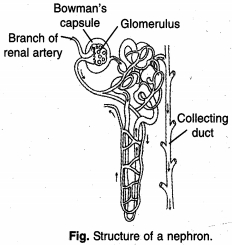
$(a)$ Draw the structure of a nephron and label the following on it: Glomerulus,Bowman's capsule,Renal artery,Collecting duct.
$(b)$ What happens to glucose that enters the nephron along with the filtrate?
$(b)$ What happens to glucose that enters the nephron along with the filtrate?
Solution
(N/A) The structure of a nephron is shown in the figure. The key parts are the Glomerulus (a cluster of capillaries),Bowman's capsule (a cup-shaped structure surrounding the glomerulus),the Renal artery (which brings blood to the nephron),and the Collecting duct (which collects urine from various nephrons).
$(b)$ When blood is filtered through the glomerulus,substances like glucose,amino acids,salts,and water enter the Bowman's capsule as part of the filtrate. As this filtrate moves through the tubular part of the nephron,useful substances like glucose are selectively reabsorbed back into the blood capillaries surrounding the tubule.
$(b)$ When blood is filtered through the glomerulus,substances like glucose,amino acids,salts,and water enter the Bowman's capsule as part of the filtrate. As this filtrate moves through the tubular part of the nephron,useful substances like glucose are selectively reabsorbed back into the blood capillaries surrounding the tubule.
0 likes
View Solution16
Medium
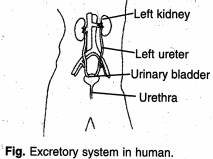
$(a)$ Draw a diagram of the human urinary system and label the following parts:
$(i)$ Kidney
$(ii)$ Ureter
$(iii)$ Urinary bladder
$(iv)$ Urethra
$(b)$ Name the two major components of normal human urine.
$(i)$ Kidney
$(ii)$ Ureter
$(iii)$ Urinary bladder
$(iv)$ Urethra
$(b)$ Name the two major components of normal human urine.
Solution
(N/A) The human urinary system consists of a pair of kidneys,a pair of ureters,a urinary bladder,and a urethra. (Refer to the provided diagram for labeling).
$(b)$ The two major components of normal human urine are:
$1.$ Water (which constitutes about $95\%$ of urine).
$2.$ Nitrogenous waste products,primarily urea (which constitutes about $2\%$ of urine),along with other salts and minerals.
$(b)$ The two major components of normal human urine are:
$1.$ Water (which constitutes about $95\%$ of urine).
$2.$ Nitrogenous waste products,primarily urea (which constitutes about $2\%$ of urine),along with other salts and minerals.
0 likes
View Solution17
Medium
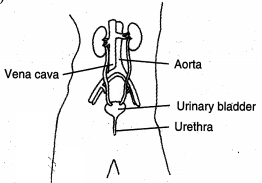
$(a)$ Draw a diagram of the human excretory system and label the following: Aorta,Vena cava,Urinary bladder,Urethra.
$(b)$ List two vital functions of the kidney.
$(b)$ List two vital functions of the kidney.
Solution
(N/A) The diagram of the human excretory system is provided in the image.
$(b)$ Two vital functions of the kidneys are:
$(i)$ They maintain the $pH$ and salt concentration of the body constant,and also regulate the water balance.
$(ii)$ They help in the removal of nitrogenous waste products (like urea) that are harmful to the human body.
$(b)$ Two vital functions of the kidneys are:
$(i)$ They maintain the $pH$ and salt concentration of the body constant,and also regulate the water balance.
$(ii)$ They help in the removal of nitrogenous waste products (like urea) that are harmful to the human body.
0 likes
View Solution18
Easy
Name one nitrogenous waste present in urine. What is the basic filtration unit of kidney called? How is the amount of urine produced regulated?
Solution
(N/A) One nitrogenous waste present in urine is $Urea$.
The basic filtration unit of the kidney is called a $Nephron$.
The amount of urine produced is regulated by the quantity of excess water present in the body and the amount of dissolved nitrogenous wastes that need to be excreted. Additionally,hormones like $ADH$ (Antidiuretic Hormone) play a crucial role in reabsorbing water from the kidney tubules based on the body's hydration status.
0 likes
View Solution19
Medium
$(a)$ Draw the structure of a nephron and label the following parts on it:
$(i)$ Renal artery
$(ii)$ Bowman's capsule
$(iii)$ Glomerulus
$(iv)$ Collecting duct
$(b)$ Name four substances in the initial filtrate which are selectively reabsorbed as the filtrate flows along the tubule.
$(i)$ Renal artery
$(ii)$ Bowman's capsule
$(iii)$ Glomerulus
$(iv)$ Collecting duct
$(b)$ Name four substances in the initial filtrate which are selectively reabsorbed as the filtrate flows along the tubule.
Solution
(N/A) The structure of a nephron is shown in the provided diagram,with the renal artery,Bowman's capsule,glomerulus,and collecting duct clearly labeled.
$(b)$ As the initial filtrate flows along the nephron tubule,the following four substances are selectively reabsorbed into the blood:
$(i)$ Glucose
$(ii)$ Amino acids
$(iii)$ Salts (such as $Na^+$,$Cl^-$)
$(iv)$ Water
$(b)$ As the initial filtrate flows along the nephron tubule,the following four substances are selectively reabsorbed into the blood:
$(i)$ Glucose
$(ii)$ Amino acids
$(iii)$ Salts (such as $Na^+$,$Cl^-$)
$(iv)$ Water
0 likes
View Solution20
EasyMCQ
Choose the correct path of urine in our body:
A
kidney $\rightarrow$ ureter $\rightarrow$ urethra $\rightarrow$ urinary bladder
B
kidney $\rightarrow$ ureter $\rightarrow$ urinary bladder $\rightarrow$ urethra
C
kidney $\rightarrow$ urinary bladder $\rightarrow$ urethra $\rightarrow$ ureter
D
urinary bladder $\rightarrow$ kidney $\rightarrow$ ureter $\rightarrow$ urethra
Solution
(B) The process of urine formation and excretion in the human body follows a specific pathway:
$1$. Urine is produced in the kidneys through the process of filtration.
$2$. From the kidneys,urine travels through the ureters,which are thin tubes that carry urine to the bladder.
$3$. The urinary bladder acts as a storage organ for urine until it is ready to be expelled.
$4$. Finally,urine is expelled from the body through the urethra.
Therefore,the correct sequence is: kidney $\rightarrow$ ureter $\rightarrow$ urinary bladder $\rightarrow$ urethra.
0 likes
View Solution21
EasyMCQ
The chemical process involved in the removal of harmful metabolic wastes from the body is called excretion.
A
True
B
False
Solution
(B) The statement is $False$.
Excretion is defined as the biological process by which an organism eliminates metabolic waste products from its body.
While metabolic processes are chemical in nature,excretion itself is a physiological or biological process,not merely a chemical reaction.
Excretion is defined as the biological process by which an organism eliminates metabolic waste products from its body.
While metabolic processes are chemical in nature,excretion itself is a physiological or biological process,not merely a chemical reaction.
0 likes
View Solution22
EasyMCQ
Just as $CO_{2}$ is removed from the blood in the lungs,nitrogenous wastes such as urea or uric acid are removed from blood in the liver.
A
True
B
False
C
Cannot be determined
D
Partially true
Solution
(B) The statement is False.
While the liver is responsible for the formation of urea through the ornithine cycle (converting toxic ammonia into less toxic urea),the actual removal or filtration of nitrogenous wastes from the blood occurs in the kidneys.
The lungs are responsible for the exchange of gases ($CO_{2}$ and $O_{2}$),whereas the kidneys are the primary organs for the excretion of nitrogenous metabolic wastes.
0 likes
View Solution23
EasyMCQ
Urine is stored in the urinary bladder until the pressure of the expanded bladder leads to the urge to pass it out through the urethra.
A
True
B
False
Solution
(A) The statement is $True$. The urinary bladder is a muscular sac that stores urine produced by the kidneys. As the bladder fills with urine,its walls stretch,increasing the internal pressure. This expansion triggers stretch receptors in the bladder wall,which send nerve impulses to the central nervous system,creating the voluntary urge to micturate (urinate) through the urethra.
0 likes
View Solution24
EasyMCQ
Kidneys are located in the thoracic cavity, one on either side of the backbone.
A
True
B
False
Solution
(B) The statement is $False$.
Kidneys are not located in the thoracic cavity.
They are located in the abdominal cavity, specifically in the retroperitoneal space, one on either side of the vertebral column (backbone).
Kidneys are not located in the thoracic cavity.
They are located in the abdominal cavity, specifically in the retroperitoneal space, one on either side of the vertebral column (backbone).
0 likes
View SolutionLife Processes — Excretion · Frequently Asked Questions
1Are these Life Processes questions useful for JEE and NEET?
Yes. All questions in this section are mapped to JEE Main and NEET exam patterns. Previous year questions from JEE Main, NEET, GUJCET and state-level exams are included with full solutions.
2Can I switch to Hindi or Gujarati for these questions?
Yes. Use the language tabs in the hero section or the sidebar to view the same questions and solutions in English, Hindi or Gujarati.
3How do I generate a question paper from this subtopic?
Use the Vedclass Exam Paper Generator — select the chapter and subtopic, set difficulty, and generate Sets A, B, C, D automatically. First 3 chapters of every subject are free.
Vedclass Products
For Students
Vedclass Test Series
Mock tests in real JEE/NEET style with performance analysis. 5-day free trial.
Start Free TrialFor Teachers
Exam Paper Generator
Generate Set A/B/C/D papers from this chapter in 2 minutes. 3 chapters free.
Try FreeFor Institutes
Online Exam Module
Live online exams with unlimited students, 360° analytics & white-label branding.
See DemoFor Teachers & Institutes
Generate a Life Processes Exam Paper in 2 Minutes
Select subtopic & difficulty — Sets A, B, C, D auto-generated with No Repeat logic.
First 3 chapters of every subject are free — no payment required.