
A English
Respiration Questions in English
Class 10 Science · Life Processes · Respiration
37+
Questions
English
Language
100%
With Solutions
Showing 37 of 37 questions in English
1
MediumMCQ
Why is diffusion insufficient to meet the oxygen requirements of multicellular organisms like humans?
A
The body surface area is too small.
B
Most cells are not in direct contact with the external environment.
C
The rate of diffusion is too fast.
D
Oxygen is not required by all cells.
Solution
(B) Multicellular organisms,such as humans,possess complex body designs.
They have specialized cells and tissues for performing various necessary functions of the body,such as the intake of food and oxygen.
Unlike unicellular organisms,most cells in multicellular organisms are not in direct contact with the outside environment.
Therefore,diffusion is a slow process and cannot meet the oxygen requirements of all cells in a complex body.
0 likes
View Solution2
DifficultMCQ
What advantage over an aquatic organism does a terrestrial organism have with regard to obtaining oxygen for respiration?
A
Terrestrial organisms have more surface area for gas exchange.
B
Terrestrial organisms can breathe faster than aquatic organisms.
C
The amount of dissolved oxygen in air is much higher than the amount of dissolved oxygen in water.
D
Terrestrial organisms do not require oxygen for respiration.
Solution
(C) Terrestrial organisms take up oxygen from the atmosphere,whereas aquatic animals must utilize oxygen dissolved in water.
Air contains a significantly higher concentration of $O_2$ compared to water.
Because the availability of $O_2$ in the atmosphere is high,terrestrial animals do not need to breathe as rapidly as aquatic animals to obtain sufficient oxygen.
Consequently,terrestrial organisms do not require the same complex adaptations for gaseous exchange that aquatic organisms often possess.
0 likes
View Solution3
Medium
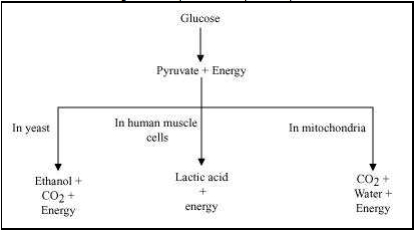
What are the different ways in which glucose is oxidised to provide energy in various organisms?
Solution
(N/A) Glucose is first broken down in the cell cytoplasm into a three-carbon molecule called pyruvate. This process is known as glycolysis.
Pyruvate is further broken down by different pathways to provide energy depending on the availability of oxygen:
$1$. In yeast (anaerobic respiration): Pyruvate is converted into ethanol,$CO_2$,and energy.
$2$. In human muscle cells (lack of oxygen): During vigorous exercise,pyruvate is converted into lactic acid and energy.
$3$. In mitochondria (aerobic respiration): Pyruvate is broken down in the presence of oxygen to produce $CO_2$,water,and a large amount of energy.
0 likes
View Solution4
Medium
How are the lungs designed in human beings to maximize the area for exchange of gases?
Solution
(N/A) The exchange of gases takes place between the blood of the capillaries that surround the alveoli and the gases present in the alveoli.
Thus,alveoli are the site for the exchange of gases.
The lungs get filled with air during the process of inhalation as the ribs are lifted up and the diaphragm is flattened.
The air that rushes inside the lungs fills the numerous alveoli present in the lungs.
Each lung contains $300-350$ million alveoli.
These numerous alveoli significantly increase the surface area for gaseous exchange,making the process of respiration more efficient.
0 likes
View Solution5
MediumMCQ
The breakdown of pyruvate to give carbon dioxide,water and energy takes place in
A
mitochondria
B
cytoplasm
C
chloroplast
D
nucleus
Solution
(A) The breakdown of pyruvate into carbon dioxide $(CO_2)$,water $(H_2O)$,and energy $(ATP)$ occurs during aerobic respiration. This process takes place in the mitochondria of the cell,where the pyruvate produced in the cytoplasm enters the Krebs cycle and the electron transport chain to release energy.
0 likes
View Solution6
Medium
What are the differences between aerobic and anaerobic respiration? Name some organisms that use the anaerobic mode of respiration.
Solution
(N/A)
Organisms that use anaerobic respiration include yeasts,certain bacteria,parasitic worms (like Ascaris),and human muscle cells during intense physical activity.
| Aerobic Respiration | Anaerobic Respiration |
|---|---|
| $1.$ Occurs in the presence of $O_2$. | $1.$ Occurs in the absence of $O_2$. |
| $2.$ Complete breakdown of glucose occurs. | $2.$ Incomplete breakdown of glucose occurs. |
| $3.$ Occurs in the cytoplasm and mitochondria. | $3.$ Occurs only in the cytoplasm. |
| $4.$ End products are $CO_2$ and $H_2O$. | $4.$ End products are ethanol,lactic acid,or $CO_2$. |
| $5.$ Yields a large amount of energy ($36-38$ $ATP$). | $5.$ Yields a small amount of energy ($2$ $ATP$). |
Organisms that use anaerobic respiration include yeasts,certain bacteria,parasitic worms (like Ascaris),and human muscle cells during intense physical activity.
1 likes
View Solution7
Medium
How are the alveoli designed to maximise the exchange of gases?
Solution
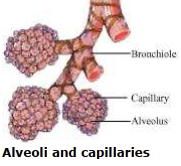
(N/A) The alveoli are small,balloon-like structures present in the lungs.
The walls of the alveoli consist of an extensive network of blood vessels (capillaries).
Each lung contains $300-350$ million alveoli,making a total of approximately $700$ million in both lungs.
When spread out,the total alveolar surface area covers about $80\, m^2$.
This large surface area and the thin,moist walls facilitate efficient gaseous exchange.
1 likes
View Solution8
MediumMCQ
The correct sequence of anaerobic reactions in yeast is:
A
Glucose $\xrightarrow{\text{cytoplasm}}$ Pyruvate $\xrightarrow{\text{mitochondria}}$ Ethanol + Carbon dioxide
B
Glucose $\xrightarrow{\text{cytoplasm}}$ Pyruvate $\xrightarrow{\text{cytoplasm}}$ Lactic acid
C
Glucose $\xrightarrow{\text{cytoplasm}}$ Pyruvate $\xrightarrow{\text{mitochondria}}$ Lactic acid
D
Glucose $\xrightarrow{\text{cytoplasm}}$ Pyruvate $\xrightarrow{\text{cytoplasm}}$ Ethanol + Carbon dioxide
Solution
(D) In yeast,the process of respiration is anaerobic (occurs in the absence of oxygen).
$1$. First,glucose $(C_6H_{12}O_6)$ is broken down into pyruvate in the cytoplasm of the cell,which is a common step for both aerobic and anaerobic respiration.
$2$. In the absence of oxygen,the pyruvate is further converted into ethanol $(C_2H_5OH)$ and carbon dioxide $(CO_2)$ within the cytoplasm of the yeast cell.
$3$. Therefore,the correct sequence is: Glucose $\xrightarrow{\text{cytoplasm}}$ Pyruvate $\xrightarrow{\text{cytoplasm}}$ Ethanol + Carbon dioxide.
0 likes
View Solution9
MediumMCQ
Which of the following is most appropriate for aerobic respiration?
A
Glucose $\xrightarrow{\text{cytoplasm}}$ Pyruvate + Energy $\xrightarrow{\text{mitochondria}}$ $CO_2 + H_2O$ + Energy
B
Glucose $\xrightarrow{\text{cytoplasm}}$ Pyruvate $\xrightarrow{\text{mitochondria}}$ $CO_2 + H_2O$ + Energy
C
Glucose $\xrightarrow{\text{cytoplasm}}$ Pyruvate + Energy $\xrightarrow{\text{mitochondria}}$ $CO_2 + H_2O$
D
Glucose $\xrightarrow{\text{mitochondria}}$ Pyruvate $\xrightarrow{\text{cytoplasm}}$ $CO_2 + H_2O$ + Energy
Solution
(A) Aerobic respiration occurs in two main stages:
$1$. Glycolysis: This process takes place in the cytoplasm,where glucose ($6$-carbon molecule) is broken down into pyruvate ($3$-carbon molecule) and releases a small amount of energy.
$2$. Krebs Cycle and Electron Transport Chain: Pyruvate enters the mitochondria,where it is completely oxidized in the presence of oxygen to produce $CO_2$,$H_2O$,and a large amount of energy $(ATP)$.
Therefore,the correct sequence is: Glucose $\xrightarrow{\text{cytoplasm}}$ Pyruvate + Energy $\xrightarrow{\text{mitochondria}}$ $CO_2 + H_2O$ + Energy.
0 likes
View Solution10
MediumMCQ
Which of the following statement$(s)$ is (are) true about respiration?
$(i)$ During inhalation,ribs move inward and diaphragm is raised
$(ii)$ In the alveoli,exchange of gases takes place i.e.,oxygen from alveolar air diffuses into blood and carbon dioxide from blood into alveolar air
$(iii)$ Haemoglobin has greater affinity for carbon dioxide than oxygen
$(iv)$ Alveoli increase surface area for exchange of gases
A
$(i)$ and $(iv)$
B
$(ii)$ and $(iv)$
C
$(i)$ and $(iii)$
D
$(ii)$ and $(iii)$
Solution
(B) Statement $(i)$ is false because during inhalation,the ribs move outward and the diaphragm moves downward (flattens) to increase the thoracic cavity volume.
Statement $(ii)$ is true because alveoli are the sites of gaseous exchange where oxygen diffuses into the blood and carbon dioxide diffuses out.
Statement $(iii)$ is false because haemoglobin has a much higher affinity for oxygen than for carbon dioxide.
Statement $(iv)$ is true because the millions of alveoli in the lungs significantly increase the surface area available for the exchange of gases.
Therefore,statements $(ii)$ and $(iv)$ are correct.
0 likes
View Solution11
MediumMCQ
Which is the correct sequence of air passage during inhalation?
A
Nostrils $\to$ larynx $\to$ pharynx $\to$ trachea $\to$ lungs
B
Nasal passage $\to$ trachea $\to$ pharynx $\to$ larynx $\to$ alveoli
C
Nostrils $\to$ pharynx $\to$ larynx $\to$ trachea $\to$ alveoli
D
larynx $\to$ nostrils $\to$ pharynx $\to$ lungs
Solution
(C) During inhalation,the air enters the body through the nostrils.
From the nostrils,it passes into the pharynx,which is the common passage for air and food.
Then,the air moves into the larynx (voice box) and enters the trachea (windpipe).
The trachea branches into bronchi,which further divide into bronchioles and finally reach the alveoli,where gas exchange occurs.
Therefore,the correct sequence is: Nostrils $\to$ pharynx $\to$ larynx $\to$ trachea $\to$ alveoli.
0 likes
View Solution12
EasyMCQ
During respiration,the exchange of gases takes place in:
A
trachea and larynx
B
throat and larynx
C
alveoli and throat
D
alveoli of lungs
Solution
(D) During the process of respiration,the exchange of gases ($O_2$ and $CO_2$) occurs in the alveoli of the lungs.
Alveoli are tiny,balloon-like structures present at the terminal ends of the bronchioles.
They provide a large surface area for the diffusion of gases between the air in the lungs and the blood in the surrounding capillaries.
Alveoli are tiny,balloon-like structures present at the terminal ends of the bronchioles.
They provide a large surface area for the diffusion of gases between the air in the lungs and the blood in the surrounding capillaries.
0 likes
View Solution13
EasyMCQ
The blood leaving the tissues becomes richer in
A
oxygen
B
water
C
haemoglobin
D
carbon dioxide
Solution
(D) During cellular respiration,cells consume oxygen to produce energy and release $CO_2$ as a metabolic waste product.
As blood passes through the tissues,oxygen diffuses from the blood into the cells,while $CO_2$ produced by the cells diffuses into the blood.
Therefore,the blood leaving the tissues has a higher concentration of carbon dioxide compared to the blood entering the tissues.
As blood passes through the tissues,oxygen diffuses from the blood into the cells,while $CO_2$ produced by the cells diffuses into the blood.
Therefore,the blood leaving the tissues has a higher concentration of carbon dioxide compared to the blood entering the tissues.
0 likes
View Solution14
MediumMCQ
Which of the following statement$(s)$ is (are) correct?
$(i)$ Pyruvate can be converted into ethanol and carbon dioxide by yeast.
$(ii)$ Fermentation takes place in aerobic bacteria.
$(iii)$ Fermentation takes place in mitochondria.
$(iv)$ Fermentation is a form of anaerobic respiration.
$(i)$ Pyruvate can be converted into ethanol and carbon dioxide by yeast.
$(ii)$ Fermentation takes place in aerobic bacteria.
$(iii)$ Fermentation takes place in mitochondria.
$(iv)$ Fermentation is a form of anaerobic respiration.
A
$(i)$ and $(iii)$
B
$(ii)$ and $(iv)$
C
$(ii)$ and $(iii)$
D
$(i)$ and $(iv)$
Solution
(D) Statement $(i)$ is correct: In yeast,during fermentation,pyruvate is converted into ethanol and $CO_2$ in the absence of oxygen.
Statement $(ii)$ is incorrect: Fermentation is an anaerobic process,not aerobic.
Statement $(iii)$ is incorrect: Fermentation occurs in the cytoplasm,not in the mitochondria.
Statement $(iv)$ is correct: Fermentation is a type of anaerobic respiration where glucose is incompletely oxidized without oxygen.
Therefore,statements $(i)$ and $(iv)$ are correct.
0 likes
View Solution15
MediumMCQ
Lack of oxygen in muscles often leads to cramps among cricketers. This results due to
A
conversion of pyruvate to lactic acid
B
conversion of pyruvate to glucose
C
non conversion of glucose to pyruvate
D
conversion of pyruvate to ethanol
Solution
(A) During intense physical activity,such as cricket,the demand for energy in muscle cells increases significantly.
When the oxygen supply becomes insufficient to meet this demand,muscle cells switch to anaerobic respiration.
In this process,the pyruvate produced from glucose breakdown is converted into lactic acid instead of entering the aerobic pathway.
The accumulation of lactic acid in the muscle tissues causes muscle fatigue and painful cramps.
0 likes
View Solution16
EasyMCQ
During deficiency of oxygen in tissues of human beings,pyruvic acid is converted into lactic acid in the
A
mitochondria
B
chloroplast
C
cytoplasm
D
golgi body
Solution
(C) In human muscle cells,when there is a temporary deficiency of oxygen (anaerobic conditions),the pyruvic acid produced during glycolysis is reduced to lactic acid.
This process occurs in the cytoplasm of the cell.
Glycolysis itself takes place in the cytoplasm,and the subsequent reduction of pyruvate to lactate under anaerobic conditions also occurs in the cytoplasm,not in the mitochondria.
This process occurs in the cytoplasm of the cell.
Glycolysis itself takes place in the cytoplasm,and the subsequent reduction of pyruvate to lactate under anaerobic conditions also occurs in the cytoplasm,not in the mitochondria.
0 likes
View Solution17
Easy
“All plants give out oxygen during day and carbon dioxide during night”. Do you agree with this statement? Give reason.
Solution
(N/A) No,this statement is not entirely correct.
During the day,plants perform both photosynthesis and respiration. Since the rate of photosynthesis is significantly higher than the rate of respiration,the net result is the release of oxygen.
At night,photosynthesis stops because there is no sunlight,but respiration continues. Therefore,plants only release carbon dioxide at night.
Thus,while the statement is partially true regarding the net gas exchange,it is inaccurate to say plants 'only' give out oxygen during the day,as they are also respiring.
0 likes
View Solution18
Medium
If a plant is releasing carbon dioxide and taking in oxygen during the day,does it mean that there is no photosynthesis occurring? Justify your answer.
Solution
(N/A) The release of $CO_2$ and the intake of $O_2$ indicates that either photosynthesis is not occurring or its rate is significantly lower than the rate of cellular respiration. Under normal daylight conditions,the rate of photosynthesis is much higher than the rate of respiration. Consequently,the $CO_2$ produced during respiration is consumed in the process of photosynthesis,meaning no $CO_2$ is released into the atmosphere.
0 likes
View Solution19
Easy
Why do fishes die when taken out of water?
Solution
(N/A) Fishes respire with the help of gills. Gills are richly supplied with blood capillaries and can readily absorb oxygen dissolved in water. Since fishes cannot absorb gaseous oxygen from the atmosphere,they die soon after they are taken out of water.
0 likes
View Solution20
Medium
How does aerobic respiration differ from anaerobic respiration?
Solution
(N/A)
| Aerobic respiration | Anaerobic respiration |
| $1.$ Oxygen is utilised for the breakdown of respiratory substrate. | $1.$ Oxygen is not required. |
| $2.$ It takes place in cytoplasm (glycolysis) and inside mitochondria (Krebs cycle). | $2.$ It takes place in cytoplasm only. |
| $3.$ End products are carbon dioxide and water. | $3.$ End products are lactic acid or ethanol and carbon dioxide. |
| $4.$ More energy is released. | $4.$ Less energy is released. |
0 likes
View Solution21
EasyMCQ
Why is the rate of breathing in aquatic organisms much faster than in terrestrial organisms?
A
Aquatic organisms have smaller lungs.
B
The amount of dissolved oxygen in water is much lower than the amount of oxygen in the air.
C
Aquatic organisms are more active than terrestrial organisms.
D
Aquatic organisms need more energy for swimming.
Solution
(B) Aquatic organisms,such as fishes,obtain oxygen from water in a dissolved state through their gills.
Since the concentration of dissolved oxygen in water is significantly lower compared to the concentration of oxygen in the atmosphere,aquatic organisms must breathe much faster to extract sufficient oxygen for their metabolic needs.
In contrast,terrestrial organisms have easy access to the high concentration of oxygen present in the air,allowing for a slower rate of breathing.
0 likes
View Solution22
Easy
Name the energy currency in the living organisms. When and where is it produced?
Solution
(N/A) The energy currency in living organisms is Adenosine Triphosphate $(ATP)$.
It is produced during the process of cellular respiration in the mitochondria of cells.
In plants,it is also produced during the light-dependent reactions of photosynthesis within the chloroplasts.
It is produced during the process of cellular respiration in the mitochondria of cells.
In plants,it is also produced during the light-dependent reactions of photosynthesis within the chloroplasts.
0 likes
View Solution23
Medium
Explain the process of breathing in humans.
Solution
(N/A) The process of breathing in humans involves two main phases: inhalation and exhalation.
$1.$ Inhalation: The diaphragm contracts and moves downward,and the rib muscles contract,lifting the ribs upward and outward. This increases the volume of the thoracic cavity,decreasing the air pressure inside the lungs. Consequently,air from the atmosphere rushes into the lungs through the respiratory tract.
$2.$ Exhalation: The diaphragm relaxes and moves upward,and the rib muscles relax,causing the ribs to move downward and inward. This decreases the volume of the thoracic cavity,increasing the air pressure inside the lungs. Consequently,air is pushed out of the lungs into the atmosphere.
$3.$ Gaseous Exchange: This occurs in the alveoli. Oxygen from the inhaled air diffuses into the blood,while carbon dioxide from the blood diffuses into the alveoli to be exhaled.
0 likes
View Solution24
MediumMCQ
Explain the three pathways of breakdown of glucose in living organisms.
A
Breakdown into ethanol,$CO_2$ and energy (Anaerobic respiration in yeast).
B
Breakdown into lactic acid and energy (Anaerobic respiration in muscle cells).
C
Breakdown into $CO_2, H_2O$ and energy (Aerobic respiration in mitochondria).
D
All of the above.
Solution
(D) The breakdown of glucose in living organisms occurs through three main pathways:
$1$. In the absence of oxygen (anaerobic respiration) in yeast: Glucose is converted into ethanol $(C_2H_5OH)$,carbon dioxide $(CO_2)$,and energy.
$2$. In the lack of oxygen (anaerobic respiration) in muscle cells: Glucose is converted into lactic acid $(C_3H_6O_3)$ and energy. This usually happens during vigorous exercise.
$3$. In the presence of oxygen (aerobic respiration) in mitochondria: Glucose is converted into carbon dioxide $(CO_2)$,water $(H_2O)$,and a large amount of energy.
0 likes
View Solution25
EasyMCQ
Name the cell organelle in which the breakdown of pyruvate to give carbon dioxide,water,and energy takes place.
A
Cytoplasm
B
Mitochondria
C
Nucleus
D
Ribosome
Solution
(B) The cell organelle in which the breakdown of pyruvate occurs to produce carbon dioxide,water,and energy is the $Mitochondria$. This process is known as aerobic respiration,which takes place in the presence of oxygen.
0 likes
View Solution26
Easy
When we breathe out,why does the air passage not collapse?
Solution
(N/A) The air passage,specifically the trachea and bronchi,is supported by $C$-shaped cartilaginous rings. These rings provide structural rigidity and prevent the airway from collapsing when the air pressure inside decreases during exhalation.
0 likes
View Solution27
EasyMCQ
Why is the rate of breathing in aquatic organisms much faster than that seen in terrestrial organisms?
A
Aquatic organisms have smaller lungs.
B
The amount of dissolved oxygen in water is much lower than the amount of oxygen in the air.
C
Aquatic organisms are more active than terrestrial organisms.
D
Water is denser than air.
Solution
(B) The rate of breathing in aquatic organisms is much faster because the amount of dissolved oxygen in water is significantly lower compared to the amount of oxygen available in the atmosphere. To obtain the same amount of oxygen required for metabolic processes,aquatic organisms must process a larger volume of water through their respiratory organs.
0 likes
View Solution28
Easy
What are the common features of the respiratory organs in aquatic and terrestrial animals?
Solution
(N/A) The common features of respiratory organs in both aquatic and terrestrial animals are as follows:
$1$. Large surface area: Respiratory organs have a large surface area to facilitate the maximum exchange of gases.
$2$. Thin-walled: The surface of the respiratory organs is very thin to allow for easy diffusion of gases.
$3$. Richly supplied with blood: They are well-supplied with blood vessels to ensure efficient transport of oxygen and carbon dioxide.
$4$. Well protected: These organs are usually located inside the body or protected by structures to prevent damage and maintain a moist environment.
0 likes
View Solution29
EasyMCQ
When a sportsman runs,he gets muscle cramps. Why?
A
Due to the accumulation of lactic acid.
B
Due to the accumulation of carbon dioxide.
C
Due to the accumulation of ethanol.
D
Due to the accumulation of pyruvic acid.
Solution
(A) During intense physical activity like running,the demand for energy in muscle cells increases rapidly.
When the oxygen supply is insufficient to meet this demand,muscle cells perform anaerobic respiration.
In this process,pyruvate is converted into lactic acid instead of entering the aerobic pathway.
The accumulation of lactic acid in the muscle fibers leads to muscle fatigue and cramps.
When the oxygen supply is insufficient to meet this demand,muscle cells perform anaerobic respiration.
In this process,pyruvate is converted into lactic acid instead of entering the aerobic pathway.
The accumulation of lactic acid in the muscle fibers leads to muscle fatigue and cramps.
0 likes
View Solution30
Medium
During the respiration of an organism $A$,one molecule of glucose produces two $ATP$ molecules,whereas in the respiration of another organism $B$,one molecule of glucose produces $38$ $ATP$ molecules.
$(a)$ Which organism is undergoing aerobic respiration?
$(b)$ Which organism is undergoing anaerobic respiration?
$(c)$ Which type of organism,$A$ or $B$,can convert glucose into alcohol?
$(d)$ Name one organism which behaves like $A$.
$(e)$ Name two organisms which behave like $B$.
$(a)$ Which organism is undergoing aerobic respiration?
$(b)$ Which organism is undergoing anaerobic respiration?
$(c)$ Which type of organism,$A$ or $B$,can convert glucose into alcohol?
$(d)$ Name one organism which behaves like $A$.
$(e)$ Name two organisms which behave like $B$.
Solution
(A) Organism $B$ is undergoing aerobic respiration because it produces a high yield of $38$ $ATP$ molecules per glucose molecule.
$(b)$ Organism $A$ is undergoing anaerobic respiration because it produces a low yield of only $2$ $ATP$ molecules per glucose molecule.
$(c)$ Organism $A$ can convert glucose into alcohol through the process of fermentation.
$(d)$ Yeast is an organism that behaves like $A$ (undergoes anaerobic respiration).
$(e)$ Human beings and aerobic bacteria are two examples of organisms that behave like $B$ (undergo aerobic respiration).
0 likes
View Solution31
Medium
$(a)$ Name the following:
$(i)$ Part where air is filtered by fine hair and mucus.
$(ii)$ Part which terminates in balloon-like structures.
$(iii)$ Balloon-like structures where exchange of gases takes place.
$(iv)$ Part which separates the chest cavity from the abdominal cavity.
$(b)$ Why is the rate of breathing in aquatic organisms much faster than in terrestrial organisms?
Solution
(N/A) $(i)$ Nasal passage
$(ii)$ Bronchioles
$(iii)$ Alveoli
$(iv)$ Diaphragm
$(b)$ Since the amount of dissolved oxygen in water is fairly low compared to the amount of oxygen in the air,aquatic organisms must breathe much faster to obtain sufficient oxygen for their metabolic needs compared to terrestrial organisms.
$(ii)$ Bronchioles
$(iii)$ Alveoli
$(iv)$ Diaphragm
$(b)$ Since the amount of dissolved oxygen in water is fairly low compared to the amount of oxygen in the air,aquatic organisms must breathe much faster to obtain sufficient oxygen for their metabolic needs compared to terrestrial organisms.
0 likes
View Solution32
Medium
$(a)$ How does the exchange of respiratory gases,oxygen and carbon dioxide,take place between tissues and blood in human beings?
$(b)$ Name the respiratory pigment in humans. Where is it found?
$(b)$ Name the respiratory pigment in humans. Where is it found?
Solution
(N/A) In tissues,oxygen is consumed for metabolic activities,leading to a low concentration of oxygen and a high concentration of carbon dioxide. Conversely,blood arriving from the lungs has a high concentration of oxygen and a low concentration of carbon dioxide. Due to this partial pressure gradient,gases move between the blood and tissues via the process of simple diffusion.
$(b)$ The respiratory pigment in humans is Haemoglobin. It is found inside the Red Blood Corpuscles $(RBCs)$.
$(b)$ The respiratory pigment in humans is Haemoglobin. It is found inside the Red Blood Corpuscles $(RBCs)$.
0 likes
View Solution33
EasyMCQ
After a vigorous exercise,you may experience cramps in your leg muscles. Why does this happen?
A
Due to the accumulation of carbon dioxide.
B
Due to the accumulation of lactic acid.
C
Due to the accumulation of alcohol.
D
Due to the accumulation of glucose.
Solution
(B) This happens due to the build-up of lactic acid in our muscles.
During vigorous exercise,the demand for energy increases,leading to a shortage of oxygen in our muscle cells.
Under these anaerobic conditions,the muscle cells switch to an alternative pathway where pyruvate is converted into lactic acid instead of entering the aerobic respiration cycle.
The accumulation of this lactic acid causes muscle fatigue and cramps.
0 likes
View Solution34
EasyMCQ
Which is the correct sequence of air passage during inhalation?
A
Nostrils $\rightarrow$ larynx $\rightarrow$ pharynx $\rightarrow$ trachea $\rightarrow$ lungs
B
Nostrils $\rightarrow$ pharynx $\rightarrow$ larynx $\rightarrow$ trachea $\rightarrow$ alveoli
C
larynx $\rightarrow$ nostrils $\rightarrow$ pharynx $\rightarrow$ lungs
D
Nasal passage $\rightarrow$ trachea $\rightarrow$ pharynx $\rightarrow$ larynx $\rightarrow$ alveoli
Solution
(B) During inhalation,air enters through the nostrils.
From the nostrils,it passes into the nasal cavity and then into the pharynx.
The pharynx leads to the larynx (voice box).
From the larynx,air moves into the trachea (windpipe).
The trachea branches into bronchi,which further divide into bronchioles and finally reach the alveoli in the lungs for gas exchange.
Therefore,the correct sequence is: Nostrils $\rightarrow$ pharynx $\rightarrow$ larynx $\rightarrow$ trachea $\rightarrow$ alveoli.
0 likes
View Solution35
EasyMCQ
During respiration,exchange of gases takes place in:
A
trachea and larynx
B
alveoli and throat
C
alveoli of Lungs
D
throat and larynx
Solution
(C) During the process of respiration,the exchange of gases ($O_2$ and $CO_2$) occurs in the $alveoli$ of the lungs.
$Alveoli$ are tiny,balloon-like structures present at the terminal ends of the bronchioles.
These structures provide a large surface area for the diffusion of gases between the air in the lungs and the blood in the surrounding capillaries.
The trachea and larynx are parts of the conducting zone and do not participate in gas exchange.
0 likes
View Solution36
MediumMCQ
Which of the following statements is (are) correct?
$(i)$ Pyruvate can be converted into ethanol and carbon dioxide by yeast.
$(ii)$ Fermentation takes place in aerobic bacteria.
$(iii)$ Fermentation takes place in mitochondria.
$(iv)$ Fermentation is a form of anaerobic respiration.
$(i)$ Pyruvate can be converted into ethanol and carbon dioxide by yeast.
$(ii)$ Fermentation takes place in aerobic bacteria.
$(iii)$ Fermentation takes place in mitochondria.
$(iv)$ Fermentation is a form of anaerobic respiration.
A
$(i)$ and $(iii)$
B
$(ii)$ and $(iv)$
C
$(ii)$ and $(iii)$
D
$(i)$ and $(iv)$
Solution
(D) Statement $(i)$ is correct: In yeast,during fermentation,pyruvate is converted into ethanol and carbon dioxide.
Statement $(ii)$ is incorrect: Fermentation is an anaerobic process,not an aerobic one.
Statement $(iii)$ is incorrect: Fermentation occurs in the cytoplasm,not in the mitochondria.
Statement $(iv)$ is correct: Fermentation is a type of anaerobic respiration that occurs in the absence of oxygen.
Therefore,statements $(i)$ and $(iv)$ are correct.
0 likes
View Solution37
MediumMCQ
Lack of oxygen in muscles often leads to cramps among cricketers. This results due to:
A
conversion of pyruvate to lactic acid
B
conversion of pyruvate to glucose
C
non-conversion of glucose to pyruvate
D
conversion of pyruvate to ethanol
Solution
(A) During intense physical activity,such as playing cricket,the demand for energy in muscle cells increases significantly.
When the supply of oxygen is insufficient to meet this demand,muscle cells switch to anaerobic respiration.
In this process,the pyruvate produced from glucose breakdown is converted into lactic acid instead of entering the aerobic pathway (Krebs cycle).
The accumulation of lactic acid in the muscle tissues causes fatigue and painful muscle cramps.
0 likes
View SolutionLife Processes — Respiration · Frequently Asked Questions
1Are these Life Processes questions useful for JEE and NEET?
Yes. All questions in this section are mapped to JEE Main and NEET exam patterns. Previous year questions from JEE Main, NEET, GUJCET and state-level exams are included with full solutions.
2Can I switch to Hindi or Gujarati for these questions?
Yes. Use the language tabs in the hero section or the sidebar to view the same questions and solutions in English, Hindi or Gujarati.
3How do I generate a question paper from this subtopic?
Use the Vedclass Exam Paper Generator — select the chapter and subtopic, set difficulty, and generate Sets A, B, C, D automatically. First 3 chapters of every subject are free.
Vedclass Products
For Students
Vedclass Test Series
Mock tests in real JEE/NEET style with performance analysis. 5-day free trial.
Start Free TrialFor Teachers
Exam Paper Generator
Generate Set A/B/C/D papers from this chapter in 2 minutes. 3 chapters free.
Try FreeFor Institutes
Online Exam Module
Live online exams with unlimited students, 360° analytics & white-label branding.
See DemoFor Teachers & Institutes
Generate a Life Processes Exam Paper in 2 Minutes
Select subtopic & difficulty — Sets A, B, C, D auto-generated with No Repeat logic.
First 3 chapters of every subject are free — no payment required.