
A English
Transportation Questions in English
Class 10 Science · Life Processes · Transportation
51+
Questions
English
Language
100%
With Solutions
Showing 50 of 51 questions in English
1
Difficult
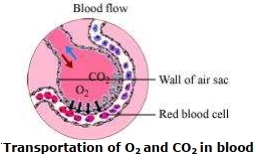
How are oxygen and carbon dioxide transported in human beings?
Solution
(N/A) In human beings,oxygen $(O_2)$ is transported by the respiratory pigment haemoglobin present in red blood cells. Haemoglobin has a very high affinity for $O_2$. It binds with $O_2$ molecules obtained from the lungs during breathing to form oxyhaemoglobin,making the blood oxygenated. This oxygenated blood is then pumped by the heart to all body cells for cellular respiration.
After delivering $O_2$ to the body cells,the blood collects carbon dioxide $(CO_2)$,which is a byproduct of cellular respiration. Since haemoglobin has a much lower affinity for $CO_2$ compared to $O_2$,most of the $CO_2$ is transported in a dissolved form in the blood plasma. This de-oxygenated blood carries $CO_2$ back to the lung alveoli,where it is released and exchanged for fresh $O_2$.
After delivering $O_2$ to the body cells,the blood collects carbon dioxide $(CO_2)$,which is a byproduct of cellular respiration. Since haemoglobin has a much lower affinity for $CO_2$ compared to $O_2$,most of the $CO_2$ is transported in a dissolved form in the blood plasma. This de-oxygenated blood carries $CO_2$ back to the lung alveoli,where it is released and exchanged for fresh $O_2$.
0 likes
View Solution2
Difficult
What are the components of the transport system in human beings? What are the functions of these components?
Solution
(N/A) The main components of the transport system in human beings are the heart, blood, and blood vessels.
$1$. $Heart$: It acts as a pumping organ that circulates oxygenated blood to all parts of the body and collects deoxygenated blood to send it to the lungs for oxygenation.
$2$. $Blood$: As a fluid connective tissue, it transports oxygen, nutrients, $CO_2$, and nitrogenous waste products throughout the body.
$3$. $Blood$ $vessels$: These include arteries, veins, and capillaries. They form a network of tubes that carry blood away from the heart to the tissues and return it back to the heart.
0 likes
View Solution3
Medium
Why is it necessary to separate oxygenated and deoxygenated blood in mammals and birds?
Solution
(N/A) Warm-blooded animals,such as birds and mammals,maintain a constant body temperature by cooling themselves in hotter environments and warming their bodies in cooler environments.
This process requires a significant amount of energy,which is generated through cellular respiration.
To support high rates of cellular respiration,these animals require a constant and efficient supply of oxygen $(O_2)$.
Separating oxygenated and deoxygenated blood ensures that the circulatory system functions at maximum efficiency,preventing the mixing of blood and ensuring that oxygen-rich blood is delivered effectively to all tissues to meet their high energy demands for thermoregulation.
0 likes
View Solution4
EasyMCQ
What are the components of the transport system in highly organised plants?
A
Xylem and Phloem
B
Stomata and Lenticels
C
Root hairs and Leaves
D
Chloroplasts and Mitochondria
Solution
(A) In highly organised plants, there are two different types of conducting tissues: $Xylem$ and $Phloem$.
$Xylem$ is responsible for the conduction of water and dissolved minerals absorbed from the soil by the roots to the various parts of the plant.
$Phloem$ is responsible for the translocation of food materials (synthesized during photosynthesis) from the leaves to other parts of the plant body.
$Xylem$ is responsible for the conduction of water and dissolved minerals absorbed from the soil by the roots to the various parts of the plant.
$Phloem$ is responsible for the translocation of food materials (synthesized during photosynthesis) from the leaves to other parts of the plant body.
0 likes
View Solution5
Medium
How are water and minerals transported in plants?
Solution
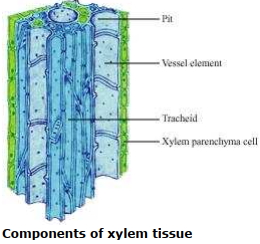
(N/A) The components of $xylem$ tissue (tracheids and vessels) of roots,stems,and leaves are interconnected to form a continuous system of water-conducting channels that reaches all parts of the plant.
Transpiration creates a suction pressure,as a result of which water is forced into the $xylem$ cells of the roots.
Then,there is a steady movement of water from the root $xylem$ to all the plant parts through the interconnected water-conducting channels.
Transpiration creates a suction pressure,as a result of which water is forced into the $xylem$ cells of the roots.
Then,there is a steady movement of water from the root $xylem$ to all the plant parts through the interconnected water-conducting channels.
0 likes
View Solution6
Medium
How is food transported in plants?
Solution
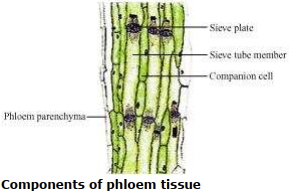
(N/A) In plants,food is transported through a specialized vascular tissue called phloem.
Phloem transports food materials,primarily sucrose,from the leaves (source) to different parts of the plant body (sink),such as roots,stems,and fruits.
The process of food transportation in phloem is known as translocation and is achieved by utilizing energy from $ATP$.
When sucrose is loaded into the phloem,it increases the osmotic pressure in the tissue,causing water to move into the phloem from adjacent xylem vessels.
This increase in pressure creates a pressure gradient that moves the food material in the phloem towards tissues with lower pressure.
This mechanism allows the plant to transport nutrients efficiently according to its metabolic needs.
0 likes
View Solution7
EasyMCQ
The $xylem$ in plants is responsible for:
A
transport of amino acids.
B
transport of food.
C
transport of water.
D
transport of oxygen.
Solution
(C) In plants,the $xylem$ tissue is a complex permanent tissue that is primarily responsible for the upward conduction of water and dissolved minerals from the roots to the stem and leaves. This process is known as the ascent of sap.
0 likes
View Solution8
DifficultMCQ
What would be the consequences of a deficiency of haemoglobin in our bodies?
A
Increased oxygen transport
B
Reduced oxygen-carrying capacity of blood
C
Enhanced cellular respiration
D
No effect on the body
Solution
(B) Haemoglobin is the respiratory pigment responsible for transporting oxygen to body cells for cellular respiration.
Deficiency of haemoglobin reduces the oxygen-carrying capacity of the blood.
This leads to an insufficient supply of oxygen to the body cells,which can cause fatigue,weakness,and a condition known as anaemia.
Deficiency of haemoglobin reduces the oxygen-carrying capacity of the blood.
This leads to an insufficient supply of oxygen to the body cells,which can cause fatigue,weakness,and a condition known as anaemia.
0 likes
View Solution9
Medium
Describe double circulation of blood in human beings. Why is it necessary?
Solution
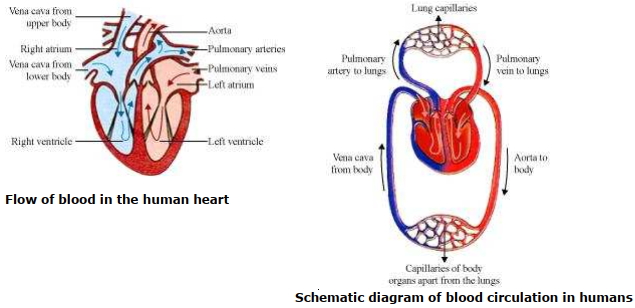
(N/A) The human heart is divided into four chambers: the right atrium,the right ventricle,the left atrium,and the left ventricle.
Flow of blood in the heart:
The heart has superior and inferior vena cava,which carry deoxygenated blood from the upper and lower regions of the body respectively and supply this deoxygenated blood to the right atrium of the heart.
The right atrium then contracts and passes the deoxygenated blood to the right ventricle through an atrioventricular aperture.
Then,the right ventricle contracts and pumps the deoxygenated blood into the two pulmonary arteries,which carry it to the lungs where the blood becomes oxygenated. From the lungs,the pulmonary veins transport the oxygenated blood to the left atrium of the heart.
Then,the left atrium contracts and the oxygenated blood enters the left ventricle through the atrioventricular aperture.
The blood then passes into the aorta from the left ventricle. The aorta gives rise to many arteries that distribute the oxygenated blood to all regions of the body.
Therefore,the blood passes twice through the heart in one complete cycle. This is known as double circulation.
Importance of double circulation:
The separation of oxygenated and deoxygenated blood allows for a more efficient supply of oxygen to the body cells. This efficient system of oxygen supply is essential for warm-blooded animals like human beings.
Warm-blooded animals must maintain a constant body temperature by regulating heat. Hence,they require more $O_2$ for cellular respiration to produce the energy needed to maintain their body temperature. Thus,the circulatory system of humans is highly efficient due to the double circulatory heart.
3 likes
View Solution10
Easy
What are the differences between the transport of materials in xylem and phloem?
Solution
(N/A)
| Transport of materials in xylem | Transport of materials in phloem |
|---|---|
| $(i)$ Xylem tissue helps in the transport of water and minerals. | $(i)$ Phloem tissue helps in the transport of food. |
| $(ii)$ Water is transported upwards from roots to all other plant parts. | $(ii)$ Food is transported in both upward and downward directions. |
| $(iii)$ Transport in xylem occurs with the help of simple physical forces such as transpiration pull. | $(iii)$ Transport of food in phloem requires energy in the form of $ATP$. |
0 likes
View Solution11
MediumMCQ
Consider the following statements about the human heart:
$(i)$ The left atrium receives oxygenated blood from the body.
(ii) The left ventricle pumps oxygenated blood to the body, and the right ventricle pumps deoxygenated blood to the lungs.
(iii) The left atrium transfers blood to the right ventricle.
(iv) The right atrium receives deoxygenated blood from the body, and the left ventricle pumps oxygenated blood to the body.
Which of the following statement$(s)$ is/are true?
A
$(ii)$ and $(iv)$
B
$(ii)$
C
$(i)$
D
$(i)$ and $(iii)$
Solution
(A) Step $1$: Analyze statement $(i)$. The left atrium receives oxygenated blood from the lungs, not the body. Thus, $(i)$ is incorrect.
Step $2$: Analyze statement $(ii)$. The left ventricle pumps oxygenated blood to the body, and the right ventricle pumps deoxygenated blood to the lungs. Thus, $(ii)$ is correct.
Step $3$: Analyze statement $(iii)$. The left atrium transfers blood to the left ventricle, not the right ventricle. Thus, $(iii)$ is incorrect.
Step $4$: Analyze statement $(iv)$. The right atrium receives deoxygenated blood from the body, and the left ventricle pumps oxygenated blood to the body. Thus, $(iv)$ is correct.
Conclusion: Statements $(ii)$ and $(iv)$ are true.
0 likes
View Solution12
EasyMCQ
What prevents backflow of blood inside the heart during contraction?
A
Thick muscular walls of ventricles
B
Valves in heart
C
Thin walls of atria
D
All of the above
Solution
(B) The heart contains specialized structures called valves (such as the tricuspid,bicuspid,and semilunar valves).
These valves act as one-way doors that open to allow blood to flow in the correct direction and close tightly to prevent the backflow of blood when the heart chambers (atria and ventricles) contract.
Therefore,valves are the primary structures responsible for ensuring unidirectional blood flow.
These valves act as one-way doors that open to allow blood to flow in the correct direction and close tightly to prevent the backflow of blood when the heart chambers (atria and ventricles) contract.
Therefore,valves are the primary structures responsible for ensuring unidirectional blood flow.
0 likes
View Solution13
MediumMCQ
Single circulation,i.e.,blood flows through the heart only once during one cycle of passage through the body,is exhibited by:
A
Labeo,Chameleon,Salamander
B
Hyla,Rana,Draco
C
Hippocampus,Exocoetus,Anabas
D
Whale,Dolphin,Turtle
Solution
(C) Single circulation is a characteristic feature of fishes,where the heart receives only deoxygenated blood and pumps it to the gills for oxygenation,from where it passes directly to the rest of the body.
In the given options:
$A$: Labeo (fish),Chameleon (reptile),Salamander (amphibian).
$B$: Hyla (amphibian),Rana (amphibian),Draco (reptile).
$C$: Hippocampus (sea horse),Exocoetus (flying fish),Anabas (climbing perch). All these are bony fishes.
$D$: Whale (mammal),Dolphin (mammal),Turtle (reptile).
Therefore,option $C$ represents a group of organisms that all exhibit single circulation.
0 likes
View Solution14
EasyMCQ
In which of the following vertebrate group/groups,heart does not pump oxygenated blood to different parts of the body?
A
Pisces and amphibians
B
Amphibians and reptiles
C
Amphibians only
D
Pisces only
Solution
(D) In $Pisces$ (fishes),the heart is two-chambered,consisting of one atrium and one ventricle.
It pumps deoxygenated blood to the gills for oxygenation,and this oxygenated blood then goes directly to the rest of the body without returning to the heart.
Therefore,the heart in $Pisces$ only pumps deoxygenated blood.
In contrast,amphibians,reptiles,birds,and mammals have hearts that pump oxygenated blood to the body tissues.
0 likes
View Solution15
MediumMCQ
Choose the correct statement that describes arteries.
A
They have thick elastic walls without valves inside,blood flows under high pressure and carry blood away from the heart to different parts of the body.
B
They have thin walls with valves inside,blood flows under low pressure and carry blood away from the heart to various organs of the body.
C
They have thick elastic walls,blood flows under low pressure; carry blood from the heart to various organs of the body.
D
They have thick elastic walls,blood flows under high pressure; collect blood from different organs and bring it back to the heart.
Solution
(A) Arteries are the blood vessels that carry oxygenated blood away from the heart to various parts of the body (except the pulmonary artery).
Because the blood is pumped directly from the heart,it flows under high pressure.
To withstand this high pressure,arteries have thick,elastic walls.
Unlike veins,arteries do not have valves inside because the high pressure ensures the blood flows in only one direction.
Because the blood is pumped directly from the heart,it flows under high pressure.
To withstand this high pressure,arteries have thick,elastic walls.
Unlike veins,arteries do not have valves inside because the high pressure ensures the blood flows in only one direction.
0 likes
View Solution16
Medium
Leaves of a healthy potted plant were coated with vaseline. Will this plant remain healthy for long? Give reasons for your answer.
Solution
(N/A) This plant will not remain healthy for a long time because:
$(a)$ It will not get oxygen for respiration.
$(b)$ It will not get carbon dioxide for photosynthesis.
$(c)$ The upward movement of water and minerals (transpiration pull) would be hampered due to the blockage of stomata,which prevents transpiration.
$(a)$ It will not get oxygen for respiration.
$(b)$ It will not get carbon dioxide for photosynthesis.
$(c)$ The upward movement of water and minerals (transpiration pull) would be hampered due to the blockage of stomata,which prevents transpiration.
0 likes
View Solution17
Medium
Differentiate between an artery and a vein.
Solution
(N/A)
| Artery | Vein |
|---|---|
| $1.$ Have thick,elastic,muscular walls. | $1.$ Have thin,non-elastic walls. |
| $2.$ Lumen is narrow. | $2.$ Lumen is wide. |
| $3.$ Carry blood from the heart to all body parts. | $3.$ Carry blood from all body parts to the heart. |
| $4.$ Carry oxygenated blood (except pulmonary artery). | $4.$ Carry deoxygenated blood (except pulmonary vein). |
0 likes
View Solution18
Easy
Why is blood circulation in the human heart called double circulation?
Solution
(N/A) The blood circulation in the human heart is called double circulation because the blood passes through the heart twice in one complete cycle of the body.
First,deoxygenated blood enters the right half of the heart to be pumped to the lungs for oxygenation.
Second,oxygenated blood returns to the left half of the heart to be pumped to the rest of the body.
This separation ensures that oxygenated and deoxygenated blood do not mix,making the process highly efficient.
0 likes
View Solution19
MediumMCQ
What is the advantage of having a four-chambered heart?
A
It allows for the mixing of oxygenated and deoxygenated blood.
B
It prevents the mixing of oxygenated and deoxygenated blood,ensuring efficient oxygen supply.
C
It reduces the energy requirement of the body.
D
It simplifies the circulatory system.
Solution
(B) In a four-chambered heart,the left half is completely separated from the right half by septa.
This structural separation prevents oxygenated and deoxygenated blood from mixing.
Consequently,this allows for a highly efficient supply of oxygenated blood to all parts of the body.
This adaptation is particularly beneficial for endothermic animals like birds and mammals,which have high energy requirements to maintain their body temperature.
0 likes
View Solution20
MediumMCQ
Why do veins have thin walls as compared to arteries?
A
To allow for faster blood flow.
B
Because blood in veins is not under high pressure.
C
To store more blood.
D
To facilitate gas exchange.
Solution
(B) Arteries carry blood from the heart to various organs of the body under high pressure,which is why they have thick and elastic walls.
Veins collect blood from different organs and return it to the heart.
Since the blood in veins is no longer under high pressure,their walls are thin.
Additionally,veins contain valves to ensure that blood flows in only one direction.
Veins collect blood from different organs and return it to the heart.
Since the blood in veins is no longer under high pressure,their walls are thin.
Additionally,veins contain valves to ensure that blood flows in only one direction.
0 likes
View Solution21
EasyMCQ
What will happen if platelets were absent in the blood?
A
Blood clotting will not occur.
B
Oxygen transport will stop.
C
Immunity will decrease.
D
Digestion will be affected.
Solution
(A) Platelets are specialized blood cells that play a crucial role in the process of blood coagulation or clotting.
When an injury occurs,platelets aggregate at the site of the wound to form a plug,which prevents excessive blood loss.
If platelets were absent in the blood,the body would be unable to form these clots,leading to continuous bleeding even from minor injuries,which could be life-threatening.
When an injury occurs,platelets aggregate at the site of the wound to form a plug,which prevents excessive blood loss.
If platelets were absent in the blood,the body would be unable to form these clots,leading to continuous bleeding even from minor injuries,which could be life-threatening.
0 likes
View Solution22
Easy
Why and how does water enter continuously into the root xylem?
Solution
(N/A) The cells of the root are in close contact with the soil and actively take up mineral ions from the soil.
This accumulation of ions increases the solute concentration inside the root cells,which in turn increases the osmotic pressure.
Due to this difference in osmotic pressure,water moves from the soil into the root cells by osmosis.
This process creates a steady movement of water,which then enters the root xylem and is transported upwards.
0 likes
View Solution23
EasyMCQ
Why is transpiration important for plants?
A
It helps in the absorption and upward movement of water and minerals.
B
It helps in the synthesis of food.
C
It helps in the excretion of waste products.
D
It helps in the storage of water.
Solution
(A) Transpiration is important for plants due to the following reasons:
$(a)$ It creates a transpiration pull that helps in the absorption and upward movement of water and dissolved minerals from the roots to the leaves.
$(b)$ It helps in regulating the temperature of the plant by cooling the plant parts through the evaporation of water,thereby preventing them from overheating.
0 likes
View Solution24
Medium
Describe the flow of blood through the heart of human beings.
Solution
(N/A) The flow of blood through the human heart follows a specific pathway:
$1$. De-oxygenated blood from the body enters the $Right \text{ Atrium}$ through the $Vena \text{ Cava}$.
$2$. From the $Right \text{ Atrium}$, blood flows into the $Right \text{ Ventricle}$ through the $Tricuspid \text{ Valve}$.
$3$. The $Right \text{ Ventricle}$ pumps this de-oxygenated blood to the lungs via the $Pulmonary \text{ Artery}$ for oxygenation.
$4$. Oxygenated blood returns from the lungs to the $Left \text{ Atrium}$ through the $Pulmonary \text{ Veins}$.
$5$. From the $Left \text{ Atrium}$, blood flows into the $Left \text{ Ventricle}$ through the $Mitral \text{ Valve}$.
$6$. Finally, the $Left \text{ Ventricle}$ pumps the oxygenated blood into the $Aorta$ to be distributed to the rest of the body.
0 likes
View Solution25
Easy
Name the components of blood which transport:
$(i)$ Food,carbon dioxide and nitrogenous wastes
$(ii)$ Oxygen
$(i)$ Food,carbon dioxide and nitrogenous wastes
$(ii)$ Oxygen
Solution
(N/A) $(i)$ Plasma: It is the fluid matrix of blood that transports food,dissolved carbon dioxide,and nitrogenous wastes like urea.
$(ii)$ Haemoglobin: It is a red pigment present in red blood cells $(RBCs)$ that binds with oxygen to form oxyhaemoglobin and transports it to various tissues.
$(ii)$ Haemoglobin: It is a red pigment present in red blood cells $(RBCs)$ that binds with oxygen to form oxyhaemoglobin and transports it to various tissues.
0 likes
View Solution26
EasyMCQ
Name the process of loss of water in the form of vapour from the aerial parts of the plants.
A
Photosynthesis
B
Transpiration
C
Respiration
D
Translocation
Solution
(B) The process of loss of water in the form of water vapour from the aerial parts of the plants,such as leaves and stems,is known as $Transpiration$. This process helps in the upward movement of water and minerals from the roots to the leaves.
0 likes
View Solution27
EasyMCQ
How does the transportation of water occur at night in the absence of transpiration?
A
Due to capillary action
B
Due to root pressure
C
Due to photosynthesis
D
Due to diffusion
Solution
(B) During the day,transpiration is the primary force driving water upward in plants.
However,at night,when stomata are closed and transpiration is minimal or absent,water is transported upward primarily due to root pressure.
Root pressure is generated by the active accumulation of ions from the soil into the vascular tissue of the roots,which creates an osmotic gradient that draws water into the xylem.
0 likes
View Solution28
EasyMCQ
How many chambers are present in the heart of fishes? How many times does blood flow through the heart during each cycle?
A
Two chambers,one time
B
Three chambers,two times
C
Four chambers,two times
D
Two chambers,two times
Solution
(A) The heart of fishes is $2$-chambered,consisting of one atrium and one ventricle.
In fishes,blood passes through the heart only once during each complete circulation through the body,which is known as single circulation.
In fishes,blood passes through the heart only once during each complete circulation through the body,which is known as single circulation.
0 likes
View Solution29
EasyMCQ
Why do ventricles have thicker walls than atria?
A
To store more blood
B
To pump blood to various organs
C
To prevent backflow of blood
D
To receive blood from the lungs
Solution
(B) The ventricles are responsible for pumping blood out of the heart to various organs of the body.
This process requires high pressure to circulate blood through the entire circulatory system.
Therefore,the ventricles have thicker and more muscular walls compared to the atria,which only receive blood and pump it into the ventricles.
This process requires high pressure to circulate blood through the entire circulatory system.
Therefore,the ventricles have thicker and more muscular walls compared to the atria,which only receive blood and pump it into the ventricles.
0 likes
View Solution30
EasyMCQ
What is the function of platelet cells in blood?
A
Transporting oxygen
B
Fighting infections
C
Clotting of blood at the site of injury
D
Regulating body temperature
Solution
(C) Platelet cells,also known as thrombocytes,are essential components of the blood. Their primary function is to circulate throughout the body and initiate the process of blood clotting (coagulation) at the site of an injury. This prevents excessive blood loss and helps in the healing process.
0 likes
View Solution31
Easy
$(a)$ How many chambers are present in the heart of $(i)$ fish $(ii)$ amphibians? $(b)$ Why is it necessary to separate oxygenated and deoxygenated blood in mammals and birds?
Solution
(N/A) $(i)$ Fish heart has $2$ chambers (one atrium and one ventricle).
$(ii)$ Amphibian heart has $3$ chambers (two atria and one ventricle).
$(b)$ Mammals and birds are warm-blooded animals that maintain a constant body temperature. This process requires a significant amount of energy. Separating oxygenated and deoxygenated blood ensures a highly efficient supply of oxygen to the body tissues,which is essential for meeting these high energy demands.
0 likes
View Solution32
Medium
$(i)$ Why are the valves needed in the heart?
$(ii)$ Leakage of blood from vessels reduces the efficiency of the pumping system. How is the leakage prevented?
$(ii)$ Leakage of blood from vessels reduces the efficiency of the pumping system. How is the leakage prevented?
Solution
(N/A) $(i)$ Valves are needed in the heart to ensure that blood flows in only one direction and does not flow backward when the atria or ventricles contract.
$(ii)$ To prevent leakage,blood contains specialized cells called platelets. These platelets circulate throughout the body and plug any leakage by forming a clot at the site of an injury.
$(ii)$ To prevent leakage,blood contains specialized cells called platelets. These platelets circulate throughout the body and plug any leakage by forming a clot at the site of an injury.
0 likes
View Solution33
Medium
What do the following transport:
$(i)$ xylem
$(ii)$ pulmonary artery
$(iii)$ pulmonary vein
$(iv)$ phloem
$(i)$ xylem
$(ii)$ pulmonary artery
$(iii)$ pulmonary vein
$(iv)$ phloem
Solution
(N/A) $(i)$ Xylem: Transports water and dissolved minerals from the roots to the rest of the plant.
$(ii)$ Pulmonary artery: Transports deoxygenated blood from the right ventricle of the heart to the lungs for oxygenation.
$(iii)$ Pulmonary vein: Transports oxygenated blood from the lungs to the left atrium of the heart.
$(iv)$ Phloem: Transports synthesized food (sucrose/sugars) from the leaves to other parts of the plant.
0 likes
View Solution34
Easy
Define transpiration. State its two functions.
Solution
(N/A) The loss of water in the form of vapour from the aerial parts of the plant is known as transpiration.
Functions:
$(i)$ It helps in the absorption and upward movement of water and minerals dissolved in it from roots to the leaves.
$(ii)$ It helps in the regulation of plant temperature by providing a cooling effect.
Functions:
$(i)$ It helps in the absorption and upward movement of water and minerals dissolved in it from roots to the leaves.
$(ii)$ It helps in the regulation of plant temperature by providing a cooling effect.
0 likes
View Solution35
Easy
Explain why transportation of materials is necessary in animals.
Solution
(N/A) Transportation of materials is essential in animals for the following reasons:
$1$. It ensures the distribution of vital substances like food,oxygen,and water to all cells of the body.
$2$. It facilitates the removal of metabolic waste products from the cells to the excretory organs,from where they are expelled from the body.
$3$. It helps in maintaining a uniform internal environment,including the regulation of body temperature and pressure.
0 likes
View Solution36
Medium
$(a)$ What happens to the heart when muscles work harder?
$(b)$ Which body system is directly affected when a person has heart disease?
$(c)$ Which cells increase in number during infection?
$(b)$ Which body system is directly affected when a person has heart disease?
$(c)$ Which cells increase in number during infection?
Solution
(N/A) When muscles work harder,they require more oxygen and nutrients. Consequently,the heart beats faster to increase the rate of blood circulation to meet this increased demand.
$(b)$ The circulatory system (or cardiovascular system) is directly affected when a person suffers from heart disease.
$(c)$ White blood cells (also known as leukocytes or $WBCs$) increase in number during an infection to help the body fight against pathogens.
$(b)$ The circulatory system (or cardiovascular system) is directly affected when a person suffers from heart disease.
$(c)$ White blood cells (also known as leukocytes or $WBCs$) increase in number during an infection to help the body fight against pathogens.
0 likes
View Solution37
Medium
What is lymph? How is the composition of lymph different from blood plasma? What is the direction of its flow? List two functions of the lymphatic system.
Solution
(N/A) Lymph is a clear,colourless fluid that acts as a circulatory medium within the lymphatic system. It is formed from the interstitial fluid that enters the lymphatic capillaries.
Composition difference:
Lymph is similar to blood plasma in composition but contains significantly less protein and lacks red blood cells and platelets.
Direction of flow:
Lymph flows in a unidirectional manner,moving from the interstitial spaces (tissues) towards the heart.
Functions of the lymphatic system:
$(i)$ It transports digested and absorbed fats from the intestine into the bloodstream.
(ii) It drains excess interstitial fluid from the extracellular spaces back into the blood,maintaining fluid balance.
0 likes
View Solution38
Medium
What is $translocation$? Why is it essential for plants? Where in plants are the following synthesized:
$(i)$ Sugars
$(ii)$ Hormones
$(i)$ Sugars
$(ii)$ Hormones
Solution
(N/A) $Translocation$: The transport of food prepared in the leaves to other parts of the plant is known as $translocation$.
$Translocation$ is essential for plants to supply food to all parts of the plant. Food is required for producing energy during its oxidation,and this energy is necessary for all plant parts to perform their metabolic activities.
$(i)$ Sugars are synthesized in the leaves through photosynthesis and then transported to storage organs such as roots,fruits,and seeds.
$(ii)$ Hormones are synthesized primarily at the tips of the stems (shoot apices) and the tips of the roots (root apices).
0 likes
View Solution39
Medium
List the three kinds of blood vessels of the human circulatory system and write their functions in tabular form.
Solution
(N/A) The three types of blood vessels in the human circulatory system are arteries, veins, and capillaries. Their functions are summarized in the table below:
| Blood Vessel | Function |
| Arteries | They carry oxygenated blood away from the heart to various organs of the body. |
| Veins | They collect deoxygenated blood from different organs and bring it back to the heart. |
| Capillaries | They are thin-walled vessels where the exchange of materials (nutrients, gases, and waste) between the blood and surrounding cells takes place. |
0 likes
View Solution40
Medium
List in tabular form,three differences between arteries and veins.
Solution
(N/A)
| Arteries | Veins |
|---|---|
| $(i)$ They carry blood from the heart to various organs of the body. | $(i)$ They collect the blood from different organs and bring it back to the heart. |
| $(ii)$ They have thick,elastic walls. | $(ii)$ They have thin walls. |
| $(iii)$ They do not have valves. | $(iii)$ They have valves. |
0 likes
View Solution41
Medium
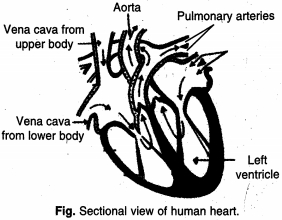
$(a)$ Draw a sectional view of the human heart and label on it Aorta,Pulmonary arteries,Vena cava,Left ventricle.
$(b)$ Why is double circulation of blood necessary in human beings?
$(b)$ Why is double circulation of blood necessary in human beings?
Solution
(N/A) The sectional view of the human heart is shown in the provided figure.
$(b)$ Double circulation of blood is necessary in human beings for the following reasons:
$(i)$ To separate deoxygenated blood from oxygenated blood,preventing their mixing.
$(ii)$ To meet the high energy and oxygen demands of the body,as humans are warm-blooded organisms.
$(iii)$ To maintain a constant body temperature (homeothermy) by ensuring efficient oxygen supply to all tissues.
0 likes
View Solution42
Medium
Explain,giving any three reasons,the significance of transpiration in plants.
Solution
(N/A) Transpiration is the loss of water in the form of water vapor from the aerial parts of the plant,primarily the leaves.
Significance of transpiration:
$(i)$ Cooling effect: Transpiration helps in cooling the plant surface,especially during hot weather,as the evaporation of water consumes heat energy.
$(ii)$ Transport of water and minerals: It creates a transpiration pull (a suction force) that helps in the upward movement of water and dissolved minerals from the roots to the leaves.
$(iii)$ Distribution of water: It ensures the continuous supply and proper distribution of water and essential nutrients throughout the plant body.
$(iv)$ Maintenance of turgidity: It helps in maintaining the turgidity of cells,which is essential for the structural support and growth of the plant.
0 likes
View Solution43
Medium
What is the functional difference between the four chambers of the heart?
Solution
(N/A) The heart consists of four chambers, each with a specific role in the circulatory system:
| Chamber | Function |
|---|---|
| $Right \text{ atrium}$ | Receives deoxygenated (impure) blood from the rest of the body via the $vena \text{ cava}$ and pumps it into the $right \text{ ventricle}$. |
| $Left \text{ atrium}$ | Receives oxygenated (pure) blood from the lungs via the $pulmonary \text{ vein}$ and pumps it into the $left \text{ ventricle}$. |
| $Right \text{ ventricle}$ | Receives deoxygenated blood from the $right \text{ atrium}$ and pumps it to the lungs for oxygenation via the $pulmonary \text{ artery}$. |
| $Left \text{ ventricle}$ | Receives oxygenated blood from the $left \text{ atrium}$ and pumps it to the entire body via the $AORTA$ (the main artery). |
0 likes
View Solution44
MediumMCQ
Which of the following statements is (are) true about the human heart?
$(i)$ The left atrium receives oxygenated blood from different parts of the body.
$(ii)$ The left ventricle pumps oxygenated blood to the entire body, while the right ventricle pumps deoxygenated blood to the lungs.
$(iii)$ The left atrium transfers oxygenated blood to the right ventricle.
$(iv)$ The right atrium receives deoxygenated blood from the body.
A
$(i)$
B
$(ii)$ and $(iv)$
C
$(ii)$
D
$(i)$ and $(iii)$
Solution
(B) The human heart functions as a double pump system:
$1$. The left atrium receives oxygenated blood from the lungs via pulmonary veins, not from the body. Thus, statement $(i)$ is false.
$2$. The left ventricle pumps oxygenated blood to the entire body through the aorta, and the right ventricle pumps deoxygenated blood to the lungs for oxygenation. Thus, statement $(ii)$ is true.
$3$. The left atrium transfers oxygenated blood to the left ventricle, not the right ventricle. Thus, statement $(iii)$ is false.
$4$. The right atrium receives deoxygenated blood from the body, and the left ventricle pumps oxygenated blood to the body. Thus, statement $(iv)$ is true.
Therefore, statements $(ii)$ and $(iv)$ are correct.
0 likes
View Solution45
EasyMCQ
What prevents backflow of blood inside the heart during contraction?
A
Thin walls of atria
B
Thick muscular walls of ventricles
C
Valves in heart
D
All of the above
Solution
(C) The heart contains specialized structures called valves (such as the tricuspid,bicuspid,and semilunar valves).
These valves act as one-way doors that open to allow blood to flow in the correct direction and close tightly to prevent the backflow of blood during the contraction (systole) of the heart chambers.
These valves act as one-way doors that open to allow blood to flow in the correct direction and close tightly to prevent the backflow of blood during the contraction (systole) of the heart chambers.
0 likes
View Solution46
MediumMCQ
Single circulation,i.e.,blood flows through the heart only once during one cycle of passage through the body,is exhibited by:
A
Labeo,Chameleon,Salamander
B
Whale,Dolphin,Turtle
C
Hyla,Rana,Draco
D
Hippocampus,Exocoetus,Anabas
Solution
(D) In single circulation,the heart receives only deoxygenated blood,which is then pumped to the gills for oxygenation and subsequently distributed to the rest of the body without returning to the heart. This type of circulation is characteristic of fishes.
$1$. $Labeo$ (Rohu),$Hippocampus$ (Sea horse),$Exocoetus$ (Flying fish),and $Anabas$ (Climbing perch) are all bony fishes.
$2$. $Chameleon$,$Salamander$,$Whale$,$Dolphin$,$Turtle$,$Hyla$,$Rana$,and $Draco$ are not fishes; they possess either double circulation or incomplete double circulation.
Therefore,the correct group exhibiting single circulation is $Hippocampus$,$Exocoetus$,and $Anabas$.
0 likes
View Solution47
MediumMCQ
In which of the following vertebrate group/groups,does the heart not pump oxygenated blood to different parts of the body?
A
Pisces only
B
Amphibians and reptiles
C
Amphibians only
D
Pisces and amphibians
Solution
(A) In $Pisces$ (fishes),the heart is two-chambered,consisting of one atrium and one ventricle. The heart pumps deoxygenated blood to the gills for oxygenation. This oxygenated blood then goes directly to the rest of the body without returning to the heart. Thus,the heart only pumps deoxygenated blood. This is known as single circulation. In amphibians and reptiles,the heart is three-chambered (or partially four-chambered in reptiles),allowing for the pumping of both oxygenated and deoxygenated blood to the body tissues. Therefore,the correct group is $Pisces$ only.
0 likes
View Solution48
EasyMCQ
The walls of auricles are comparatively thicker than ventricles.
A
True
B
False
Solution
(B) The statement is $False$. In the human heart,the walls of the ventricles are significantly thicker than those of the auricles (atria). This is because the ventricles are responsible for pumping blood out of the heart to the lungs (right ventricle) and to the rest of the body (left ventricle),which requires much higher pressure. The auricles only need to pump blood into the adjacent ventricles,which requires less force.
0 likes
View Solution49
EasyMCQ
The largest artery is the aorta and the largest vein is the vena cava.
A
True
B
False
Solution
(A) The statement is $True$.
In the human circulatory system,the $Aorta$ is the largest artery that carries oxygenated blood from the left ventricle of the heart to the rest of the body.
The $Vena$ $Cava$ (specifically the superior and inferior vena cava) is the largest vein that returns deoxygenated blood from the body to the right atrium of the heart.
0 likes
View Solution50
EasyMCQ
State whether the following statement is true or false: 'Reptiles have a three-chambered heart,mammals have a four-chambered heart,and fishes have a two-chambered heart.'
A
True
B
False
Solution
(B) The statement is False.
$1$. Reptiles (except crocodiles) have a three-chambered heart.
$2$. Mammals have a four-chambered heart,not a two-chambered heart.
$3$. Fishes have a two-chambered heart.
Since the part regarding mammals is incorrect,the entire statement is False.
$1$. Reptiles (except crocodiles) have a three-chambered heart.
$2$. Mammals have a four-chambered heart,not a two-chambered heart.
$3$. Fishes have a two-chambered heart.
Since the part regarding mammals is incorrect,the entire statement is False.
0 likes
View SolutionLife Processes — Transportation · Frequently Asked Questions
1Are these Life Processes questions useful for JEE and NEET?
Yes. All questions in this section are mapped to JEE Main and NEET exam patterns. Previous year questions from JEE Main, NEET, GUJCET and state-level exams are included with full solutions.
2Can I switch to Hindi or Gujarati for these questions?
Yes. Use the language tabs in the hero section or the sidebar to view the same questions and solutions in English, Hindi or Gujarati.
3How do I generate a question paper from this subtopic?
Use the Vedclass Exam Paper Generator — select the chapter and subtopic, set difficulty, and generate Sets A, B, C, D automatically. First 3 chapters of every subject are free.
Vedclass Products
For Students
Vedclass Test Series
Mock tests in real JEE/NEET style with performance analysis. 5-day free trial.
Start Free TrialFor Teachers
Exam Paper Generator
Generate Set A/B/C/D papers from this chapter in 2 minutes. 3 chapters free.
Try FreeFor Institutes
Online Exam Module
Live online exams with unlimited students, 360° analytics & white-label branding.
See DemoFor Teachers & Institutes
Generate a Life Processes Exam Paper in 2 Minutes
Select subtopic & difficulty — Sets A, B, C, D auto-generated with No Repeat logic.
First 3 chapters of every subject are free — no payment required.