
A English
Nutrition Questions in English
Class 10 Science · Life Processes · Nutrition
112+
Questions
English
Language
100%
With Solutions
Showing 50 of 112 questions in English
1
EasyMCQ
What are outside raw materials used for by an organism?
A
For energy production
B
For growth and repair
C
For maintenance of body structures
D
All of the above
Solution
(D) An organism uses outside raw materials,primarily in the form of food and oxygen,to perform various life processes.
These raw materials are essential for energy production,which powers cellular activities.
They are also used for the growth,development,and repair of body tissues.
Furthermore,they help in the maintenance of body structures to ensure the survival of the organism.
The specific raw materials required vary significantly depending on the complexity of the organism and its environment.
0 likes
View Solution2
Difficult
What are the differences between autotrophic nutrition and heterotrophic nutrition?
Solution
(N/A)
| Autotrophic nutrition | Heterotrophic nutrition |
| $(i)$ Food is synthesized from simple inorganic raw materials such as $CO_2$ and water. | $(i)$ Food is obtained directly or indirectly from autotrophs. This food is broken down with the help of enzymes. |
| $(ii)$ Presence of green pigment (chlorophyll) is necessary. | $(ii)$ No pigment is required in this type of nutrition. |
| $(iii)$ Food is generally prepared during daytime. | $(iii)$ Food can be obtained or processed at all times. |
| $(iv)$ All green plants and some bacteria exhibit this type of nutrition. | $(iv)$ All animals and fungi exhibit this type of nutrition. |
0 likes
View Solution3
Medium
Where do plants get each of the raw materials required for photosynthesis?
Solution
(N/A) The following raw materials are required for photosynthesis:
$1$. $CO_2$: It enters the plant from the atmosphere through the stomata present on the surface of the leaves.
$2$. Water $(H_2O)$: It is absorbed from the soil by the plant roots through the process of osmosis and transported to the leaves via the xylem.
$3$. Sunlight: It is the energy source required for the reaction,which is captured by the chlorophyll pigment present in the chloroplasts of the plant cells.
0 likes
View Solution4
MediumMCQ
What is the role of the acid in our stomach?
A
It kills harmful bacteria present in food.
B
It creates an acidic medium for the action of pepsin.
C
It helps in the digestion of proteins.
D
All of the above.
Solution
(D) The hydrochloric acid $(HCl)$ present in our stomach serves several critical functions:
$1$. It creates an acidic medium ($pH$ of $1.5$ to $3.5$) which is essential for the activation of the enzyme pepsinogen into its active form,pepsin.
$2$. Pepsin is a proteolytic enzyme that breaks down complex proteins into simpler peptides.
$3$. The acidic environment also acts as a defense mechanism by killing harmful bacteria and pathogens ingested along with food.
Therefore,all the given options are correct.
0 likes
View Solution5
MediumMCQ
What is the function of digestive enzymes?
A
To synthesize complex food molecules.
B
To break down complex food particles into simple,absorbable forms.
C
To transport nutrients to the cells.
D
To store energy in the form of fat.
Solution
(B) Digestive enzymes such as amylase,lipase,pepsin,and trypsin help in the breaking down of complex food particles into simple,soluble forms. These simple particles can be easily absorbed by the blood and thus transported to all the cells of the body for energy production,growth,and repair.
0 likes
View Solution6
Difficult
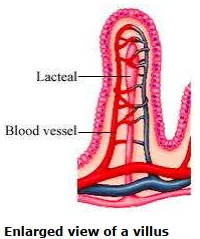
How is the small intestine designed to absorb digested food?
Solution
The inner lining of the small intestine has numerous finger-like projections called villi.
These villi significantly increase the surface area for the absorption of digested food.
Each villus is richly supplied with blood vessels and lacteals (lymph vessels).
The blood vessels absorb the digested food (nutrients like glucose,amino acids) and transport it into the bloodstream.
From the bloodstream,the absorbed food is delivered to each and every cell of the body for energy production,growth,and repair.
0 likes
View Solution7
MediumMCQ
The autotrophic mode of nutrition requires
A
carbon dioxide and water
B
chlorophyll
C
sunlight
D
all of the above
Solution
(D) The autotrophic mode of nutrition,specifically photosynthesis,requires carbon dioxide $(CO_2)$,water $(H_2O)$,chlorophyll,and sunlight to synthesize glucose $(C_6H_{12}O_6)$.
All the listed components are essential for the process to occur.
All the listed components are essential for the process to occur.
0 likes
View Solution8
Easy
How are fats digested in our bodies? Where does this process take place?
Solution
(N/A) Fats are present in the form of large globules in the small intestine. The small intestine receives secretions in the form of bile juice from the liver and pancreatic juice from the pancreas. The bile salts (from the liver) break down the large fat globules into smaller globules,increasing the surface area for the action of enzymes. This process is known as the emulsification of fats. Subsequently,the enzyme lipase (present in pancreatic juice) acts on these emulsified fats to break them down into fatty acids and glycerol. This entire process takes place in the small intestine.
0 likes
View Solution9
EasyMCQ
What is the role of saliva in the digestion of food?
A
It helps in the mechanical breakdown of food.
B
It contains enzymes that break down proteins.
C
It moistens food and contains salivary amylase to break down starch into sugar.
D
It kills all bacteria present in the food.
Solution
(C) Saliva is secreted by the salivary glands located in the mouth.
It performs two primary functions:
$1$. It moistens the food,which helps in the formation of a food bolus for easy swallowing.
$2$. It contains an enzyme called salivary amylase,which initiates the chemical digestion of carbohydrates by breaking down starch into simpler sugars like maltose.
It performs two primary functions:
$1$. It moistens the food,which helps in the formation of a food bolus for easy swallowing.
$2$. It contains an enzyme called salivary amylase,which initiates the chemical digestion of carbohydrates by breaking down starch into simpler sugars like maltose.
0 likes
View Solution10
Medium
What are the necessary conditions for autotrophic nutrition and what are its byproducts?
Solution
(N/A) Autotrophic nutrition occurs through the process of photosynthesis.
The necessary conditions for autotrophic nutrition are:
$1$. Presence of chlorophyll pigment.
$2$. Availability of sunlight.
$3$. Availability of carbon dioxide $(CO_2)$.
$4$. Availability of water $(H_2O)$.
The byproducts of photosynthesis are carbohydrates (glucose,$C_6H_{12}O_6$) and oxygen $(O_2)$.
The chemical equation for the process is:
$6CO_2 + 6H_2O \xrightarrow[\text{Chlorophyll}]{\text{Sunlight}} C_6H_{12}O_6 + 6O_2$
2 likes
View Solution11
EasyMCQ
Which of the following statements about the autotrophs is incorrect?
A
They convert carbon dioxide and water into carbohydrates in the absence of sunlight
B
They store carbohydrates in the form of starch
C
They synthesise carbohydrates from carbon dioxide and water in the presence of sunlight and chlorophyll
D
They constitute the first trophic level in food chains
Solution
(A) Autotrophs are organisms that produce their own food through the process of photosynthesis.
Photosynthesis requires sunlight,chlorophyll,carbon dioxide,and water to synthesize carbohydrates.
Therefore,the statement that they convert carbon dioxide and water into carbohydrates in the absence of sunlight is incorrect,as sunlight is an essential requirement for this process.
Autotrophs store excess carbohydrates as starch in plants.
They form the base of the food chain,representing the first trophic level.
0 likes
View Solution12
EasyMCQ
In which of the following groups of organisms, food material is broken down outside the body and absorbed?
A
Mushroom, green plants, Amoeba
B
Yeast, mushroom, bread mould
C
Paramecium, Amoeba, Cuscuta
D
Cuscuta, lice, tapeworm
Solution
(B) Organisms that break down food material outside the body and then absorb the nutrients are known as saprotrophs.
Saprotrophic nutrition involves the secretion of digestive enzymes onto dead and decaying organic matter, which breaks down complex food substances into simpler forms externally.
$Yeast$, $mushroom$, and $bread$ $\text{mould}$ $(Rhizopus)$ are classic examples of saprotrophic organisms.
In contrast, $Amoeba$ and $Paramecium$ exhibit holozoic nutrition (ingestion), while $Cuscuta$, $lice$, and $tapeworm$ are parasites that derive nutrients from a living host.
0 likes
View Solution13
MediumMCQ
Select the correct statement.
A
Heterotrophs synthesise their own food.
B
Heterotrophs utilise solar energy for photosynthesis.
C
Heterotrophs do not synthesise their own food.
D
Heterotrophs are capable of converting carbon dioxide and water into carbohydrates.
Solution
(C) Heterotrophs are organisms that cannot produce their own food through processes like photosynthesis.
Instead,they rely on other organisms (plants or animals) for their nutrition.
Autotrophs,on the other hand,are capable of synthesizing their own food using solar energy to convert carbon dioxide and water into carbohydrates.
Therefore,the statement that heterotrophs do not synthesise their own food is correct.
0 likes
View Solution14
MediumMCQ
Which is the correct sequence of parts in the human alimentary canal?
A
Mouth $\to$ stomach $\to$ small intestine $\to$ oesophagus $\to$ large intestine
B
Mouth $\to$ oesophagus $\to$ stomach $\to$ large intestine $\to$ small intestine
C
Mouth $\to$ stomach $\to$ oesophagus $\to$ small intestine $\to$ large intestine
D
Mouth $\to$ oesophagus $\to$ stomach $\to$ small intestine $\to$ large intestine
Solution
(D) The human alimentary canal is a continuous tube that begins at the mouth and ends at the anus.
Following the path of food ingestion and digestion,the correct sequence is:
$1$. Mouth (Ingestion)
$2$. Oesophagus (Food pipe)
$3$. Stomach (Mixing and digestion)
$4$. Small intestine (Absorption of nutrients)
$5$. Large intestine (Absorption of water and waste elimination)
Therefore,the correct sequence is: Mouth $\to$ oesophagus $\to$ stomach $\to$ small intestine $\to$ large intestine.
0 likes
View Solution15
MediumMCQ
If salivary amylase is lacking in the saliva,which of the following events in the mouth cavity will be affected?
A
Starch breaking down into sugars
B
Proteins breaking down into amino acids
C
Fats breaking down into fatty acids and glycerol
D
Absorption of vitamins
Solution
(A) Salivary amylase is an enzyme present in saliva that initiates the chemical digestion of carbohydrates in the mouth.
It acts on starch,a complex polysaccharide,and breaks it down into simpler sugars like maltose.
If salivary amylase is absent,the breakdown of starch into sugars will be significantly affected,as this process begins in the oral cavity.
It acts on starch,a complex polysaccharide,and breaks it down into simpler sugars like maltose.
If salivary amylase is absent,the breakdown of starch into sugars will be significantly affected,as this process begins in the oral cavity.
0 likes
View Solution16
EasyMCQ
The inner lining of the stomach is protected from hydrochloric acid by which of the following? Choose the correct one.
A
Pepsin
B
Mucus
C
Salivary amylase
D
Bile
Solution
(B) The stomach lining secretes mucus,which forms a protective barrier against the highly acidic environment created by hydrochloric acid $(HCl)$.
$HCl$ is essential for activating pepsinogen into pepsin and killing bacteria,but it can damage the stomach wall if not for the mucus layer.
Therefore,mucus plays a crucial role in preventing gastric ulcers and protecting the stomach epithelium.
$HCl$ is essential for activating pepsinogen into pepsin and killing bacteria,but it can damage the stomach wall if not for the mucus layer.
Therefore,mucus plays a crucial role in preventing gastric ulcers and protecting the stomach epithelium.
0 likes
View Solution17
EasyMCQ
Which part of the alimentary canal receives bile from the liver?
A
Stomach
B
Large intestine
C
Small intestine
D
Oesophagus
Solution
(C) The liver produces bile, which is stored in the gallbladder. Bile is released into the $duodenum$, which is the first part of the $small \ intestine$. This bile helps in the emulsification of fats, breaking down large fat globules into smaller droplets to facilitate digestion by enzymes.
0 likes
View Solution18
MediumMCQ
$A$ few drops of iodine solution were added to rice water. The solution turned blue-black in colour. This indicates that rice water contains
A
complex proteins
B
simple proteins
C
fats
D
starch
Solution
(D) The iodine test is a chemical test used to detect the presence of starch in a sample.
When iodine solution ($I_2$ in $KI$) is added to a substance containing starch,it forms a starch-iodine complex,which results in a characteristic blue-black colour.
Since rice water turned blue-black upon the addition of iodine,it confirms the presence of starch in the rice water.
Therefore,the correct option is $D$.
0 likes
View Solution19
EasyMCQ
In which part of the alimentary canal is food finally digested?
A
Small intestine
B
Mouth cavity
C
Large intestine
D
Stomach
Solution
(A) The process of digestion is completed in the $Small \, intestine$.
In the $Small \, intestine$, the food receives secretions from the liver (bile) and the pancreas (pancreatic juice).
The enzymes present in the pancreatic juice and the intestinal juice break down complex carbohydrates into glucose, proteins into amino acids, and fats into fatty acids and glycerol.
This is the final site where the digestion of all major nutrients is completed.
0 likes
View Solution20
MediumMCQ
Choose the function of the pancreatic juice from the following:
A
Trypsin digests proteins and lipase digests carbohydrates.
B
Trypsin digests proteins and lipase digests emulsified fats.
C
Trypsin and lipase both digest fats.
D
Trypsin digests emulsified fats and lipase digests proteins.
Solution
(B) Pancreatic juice contains several enzymes,including trypsin and lipase.
$1$. Trypsin is a proteolytic enzyme that breaks down proteins into peptides.
$2$. Lipase is an enzyme that acts on emulsified fats and breaks them down into fatty acids and glycerol.
Therefore,the correct function is that trypsin digests proteins and lipase digests emulsified fats.
$1$. Trypsin is a proteolytic enzyme that breaks down proteins into peptides.
$2$. Lipase is an enzyme that acts on emulsified fats and breaks them down into fatty acids and glycerol.
Therefore,the correct function is that trypsin digests proteins and lipase digests emulsified fats.
0 likes
View Solution21
EasyMCQ
Oxygen liberated during photosynthesis comes from
A
carbon dioxide
B
chlorophyll
C
water
D
glucose
Solution
(C) During the process of photosynthesis,the light-dependent reaction involves the photolysis of water $(H_2O)$.
This process splits water molecules into hydrogen ions $(H^+)$,electrons $(e^-)$,and oxygen $(O_2)$.
The oxygen released is a byproduct of this water-splitting reaction,not from carbon dioxide $(CO_2)$.
Therefore,the correct source of oxygen liberated during photosynthesis is water.
This process splits water molecules into hydrogen ions $(H^+)$,electrons $(e^-)$,and oxygen $(O_2)$.
The oxygen released is a byproduct of this water-splitting reaction,not from carbon dioxide $(CO_2)$.
Therefore,the correct source of oxygen liberated during photosynthesis is water.
0 likes
View Solution22
EasyMCQ
The internal (cellular) energy reserve in autotrophs is
A
glycogen
B
starch
C
protein
D
fatty acid
Solution
(B) Autotrophs are organisms that produce their own food through the process of photosynthesis.
During photosynthesis,plants synthesize glucose,which is then converted into starch for storage.
Starch serves as the primary internal energy reserve in plants (autotrophs).
In contrast,animals (heterotrophs) store their energy in the form of glycogen.
Therefore,the correct answer is starch.
During photosynthesis,plants synthesize glucose,which is then converted into starch for storage.
Starch serves as the primary internal energy reserve in plants (autotrophs).
In contrast,animals (heterotrophs) store their energy in the form of glycogen.
Therefore,the correct answer is starch.
0 likes
View Solution23
MediumMCQ
Which of the following equations is the summary of photosynthesis?
A
$6 CO_{2} + 12 H_{2}O \rightarrow C_{6}H_{12}O_{6} + 6 O_{2} + 6 H_{2}O$
B
$6 CO_{2} + H_{2}O + \text{Sunlight} \rightarrow C_{6}H_{12}O_{6} + O_{2} + 6 H_{2}O$
C
$6 CO_{2} + 12 H_{2}O + \text{Chlorophyll} + \text{Sunlight} \rightarrow C_{6}H_{12}O_{6} + 6 O_{2} + 6 H_{2}O$
D
$6 CO_{2} + 12 H_{2}O + \text{Chlorophyll} + \text{Sunlight} \rightarrow C_{6}H_{12}O_{6} + 6 CO_{2} + 6 H_{2}O$
Solution
(C) Photosynthesis is the process by which green plants synthesize their food using carbon dioxide and water in the presence of sunlight and chlorophyll.
The balanced chemical equation for photosynthesis is:
$6 CO_{2} + 12 H_{2}O \xrightarrow[\text{Chlorophyll}]{\text{Sunlight}} C_{6}H_{12}O_{6} + 6 O_{2} + 6 H_{2}O$.
Option $C$ correctly represents this summary equation,including the essential requirements (sunlight and chlorophyll) and the products (glucose,oxygen,and water).
0 likes
View Solution24
EasyMCQ
Choose the event that does not occur in photosynthesis.
A
Absorption of light energy by chlorophyll
B
Reduction of carbon dioxide to carbohydrates
C
Conversion of light energy to chemical energy
D
Oxidation of carbon to carbon dioxide
Solution
(D) Photosynthesis is a process by which green plants convert light energy into chemical energy.
The main events occurring during photosynthesis are:
$1$. Absorption of light energy by chlorophyll.
$2$. Conversion of light energy to chemical energy and splitting of water molecules into hydrogen and oxygen.
$3$. Reduction of carbon dioxide to carbohydrates.
Option $D$ is incorrect because carbon dioxide is reduced to carbohydrates,not oxidized to carbon dioxide. Oxidation of carbon to carbon dioxide is a process associated with respiration,not photosynthesis.
0 likes
View Solution25
EasyMCQ
The opening and closing of the stomatal pore depends upon
A
water in guard cells
B
temperature
C
oxygen
D
concentration of $CO_2$ in stomata
Solution
(A) The opening and closing of the stomatal pore is primarily regulated by the turgor pressure within the guard cells.
When water enters the guard cells through osmosis,they become turgid and swell,causing the stomatal pore to open.
Conversely,when water leaves the guard cells,they lose their turgidity and become flaccid,causing the stomatal pore to close.
Therefore,the movement of water into and out of the guard cells is the direct cause of stomatal movement.
0 likes
View Solution26
MediumMCQ
Choose the forms in which most plants absorb nitrogen.
$(i)$ Proteins
$(ii)$ Nitrates and Nitrites
$(iii)$ Urea
$(iv)$ Atmospheric nitrogen
$(i)$ Proteins
$(ii)$ Nitrates and Nitrites
$(iii)$ Urea
$(iv)$ Atmospheric nitrogen
A
$(i)$ and $(ii)$
B
$(ii)$ and $(iii)$
C
$(iii)$ and $(iv)$
D
$(i)$ and $(iv)$
Solution
(B) Plants require nitrogen for the synthesis of proteins and other compounds. Although nitrogen is abundant in the atmosphere,plants cannot absorb it directly in its gaseous form $(N_2)$.
Most plants absorb nitrogen from the soil in the form of inorganic compounds,primarily as nitrates $(NO_3^-)$ and nitrites $(NO_2^-)$.
Some plants can also absorb nitrogen in the form of urea or ammonium ions,but nitrates and nitrites are the most common forms absorbed by the majority of plants.
Therefore,the correct forms are $(ii)$ Nitrates and Nitrites and $(iii)$ Urea.
0 likes
View Solution27
EasyMCQ
Which is the first enzyme to mix with food in the digestive tract?
A
Pepsin
B
Cellulase
C
Amylase
D
Trypsin
Solution
(C) The process of digestion begins in the mouth (buccal cavity).
Saliva secreted by the salivary glands contains the enzyme salivary amylase (also known as ptyalin).
This enzyme acts on starch present in the food and breaks it down into simpler sugars like maltose.
Therefore,salivary amylase is the first enzyme to mix with food in the digestive tract.
Saliva secreted by the salivary glands contains the enzyme salivary amylase (also known as ptyalin).
This enzyme acts on starch present in the food and breaks it down into simpler sugars like maltose.
Therefore,salivary amylase is the first enzyme to mix with food in the digestive tract.
0 likes
View Solution28
Medium
Name the following:
$(a)$ The process in plants that links light energy with chemical energy
$(b)$ Organisms that can prepare their own food
$(c)$ The cell organelle where photosynthesis occurs
$(d)$ Cells that surround a stomatal pore
$(e)$ Organisms that cannot prepare their own food
$(f)$ An enzyme secreted from gastric glands in the stomach that acts on proteins
Solution
(N/A) Photosynthesis: The process by which green plants convert light energy into chemical energy stored in glucose.
$(b)$ Autotrophs: Organisms like plants that synthesize their own food using inorganic substances.
$(c)$ Chloroplast: The specialized cell organelle containing chlorophyll where photosynthesis takes place.
$(d)$ Guard Cells: Specialized cells that regulate the opening and closing of the stomatal pore.
$(e)$ Heterotrophs: Organisms that depend on other organisms for their food requirements.
$(f)$ Pepsin: $A$ digestive enzyme secreted by the gastric glands in the stomach that breaks down proteins into peptides.
0 likes
View Solution29
Medium
How do the guard cells regulate the opening and closing of stomatal pores?
Solution
(N/A) The opening and closing of stomatal pores are regulated by the turgor pressure within the guard cells.
$1$. When water enters the guard cells through osmosis,they become turgid and swell.
$2$. Due to the specific orientation of cellulose microfibrils in the guard cell walls,the swelling causes the outer walls to bulge outwards,which pulls the inner walls apart,resulting in the opening of the stomatal pore.
$3$. Conversely,when water leaves the guard cells,they become flaccid and shrink.
$4$. This loss of turgor causes the inner walls to move closer together,thereby closing the stomatal pore.
0 likes
View Solution30
Medium
Differentiate between an autotroph and a heterotroph.
Solution
(N/A)
| Autotroph | Heterotroph |
|---|---|
| $1$. Organisms that prepare their own food using simple inorganic substances. | $1$. Organisms that depend on other organisms for their food. |
| $2$. They contain chlorophyll to perform photosynthesis. | $2$. They lack chlorophyll and cannot perform photosynthesis. |
| $3$. Example: Green plants and some bacteria. | $3$. Example: Animals,fungi,and most bacteria. |
1 likes
View Solution31
Easy
Is 'nutrition' a necessity for an organism? Discuss.
Solution
(N/A) Yes,nutrition is a fundamental necessity for all living organisms for the following reasons:
$(a)$ Energy Provision: Food provides the energy required for various metabolic processes,such as respiration,circulation,and excretion,which are essential for maintaining life.
$(b)$ Growth and Repair: Nutrients are essential for the synthesis of new cellular components,facilitating the growth of the organism and the repair or replacement of damaged or worn-out cells and tissues.
$(c)$ Disease Resistance: Proper nutrition helps in strengthening the immune system,which is necessary to develop resistance against various diseases and infections.
0 likes
View Solution32
Medium
What are the adaptations of leaves for photosynthesis?
Solution
(N/A) Leaves provide a large surface area for maximum light absorption.
$(b)$ Leaves are arranged in a way that minimizes overlapping to maximize light exposure.
$(c)$ The extensive network of veins enables quick transport of water and nutrients to and from the mesophyll cells.
$(d)$ Presence of numerous stomata allows for efficient gaseous exchange.
$(e)$ Chloroplasts are concentrated in the upper surface of leaves to capture maximum sunlight.
0 likes
View Solution33
Medium
Why is the small intestine in herbivores longer than in carnivores?
Solution
(N/A) The digestion of cellulose,a complex carbohydrate found in plant cell walls,requires a longer duration to break down.
Herbivores,which primarily consume grass and plant-based materials,possess a longer small intestine to provide sufficient time and surface area for the complete digestion and absorption of cellulose.
In contrast,carnivores consume meat,which is primarily composed of proteins and fats. These nutrients are easier and faster to digest than cellulose,which is why carnivores have a shorter small intestine.
1 likes
View Solution34
EasyMCQ
The shape of guard cells changes due to change in the
A
protein composition of cells
B
temperature of cells
C
position of nucleus in the cells
D
amount of water in cells
Solution
(D) The shape of guard cells is regulated by the turgor pressure within them.
When water enters the guard cells through osmosis,they become turgid and swell,causing the stomatal pore to open.
Conversely,when water leaves the guard cells,they lose turgor pressure and become flaccid,causing the stomatal pore to close.
Therefore,the change in the amount of water in the cells is the primary factor responsible for the change in their shape.
0 likes
View Solution35
Easy
Colonies of yeast fail to multiply in water,but multiply in sugar solution. Give one reason for this.
Solution
(N/A) Yeast is a heterotrophic organism that requires an external source of energy to perform metabolic activities,including reproduction.
Sugar solution provides the necessary carbohydrates (glucose/sucrose) that yeast cells break down through respiration to generate $ATP$ (energy).
In water,there is no source of nutrition or energy available for the yeast cells to sustain their life processes or to undergo cell division,hence they fail to multiply.
0 likes
View Solution36
DifficultMCQ
What will happen if mucus is not secreted by the gastric glands?
A
The stomach will not be able to digest food.
B
The inner lining of the stomach will be damaged by hydrochloric acid.
C
The stomach will produce more enzymes.
D
The stomach will stop producing hydrochloric acid.
Solution
(B) Gastric glands in the stomach secrete hydrochloric acid $(HCl)$,the enzyme pepsin,and mucus.
Mucus plays a crucial role in protecting the inner lining (mucosa) of the stomach from the corrosive action of $HCl$ and the digestive action of pepsin.
If mucus is not secreted,the protective barrier is lost,which leads to the erosion of the stomach lining.
This condition causes severe acidity,inflammation,and eventually leads to the formation of peptic ulcers.
0 likes
View Solution37
MediumMCQ
What is the significance of emulsification of fats?
A
It converts fats into amino acids.
B
It increases the surface area of fat globules for enzyme action.
C
It helps in the absorption of proteins.
D
It directly converts fats into energy.
Solution
(B) Fats are present in food in the form of large globules,which makes it difficult for enzymes to act on them.
Bile salts present in bile break these large globules down mechanically into smaller globules.
This process is known as emulsification.
By breaking fats into smaller droplets,the surface area available for the action of fat-digesting enzymes (like lipase) is significantly increased,thereby enhancing the efficiency of fat digestion.
0 likes
View Solution38
EasyMCQ
What causes the movement of food inside the alimentary canal?
A
Peristalsis
B
Digestion
C
Absorption
D
Assimilation
Solution
(A) The wall of the alimentary canal contains layers of smooth muscles.
These muscles undergo rhythmic contraction and relaxation,which pushes the food forward through the digestive tract.
This wave-like movement is known as peristalsis,and it occurs throughout the entire length of the alimentary canal.
These muscles undergo rhythmic contraction and relaxation,which pushes the food forward through the digestive tract.
This wave-like movement is known as peristalsis,and it occurs throughout the entire length of the alimentary canal.
0 likes
View Solution39
MediumMCQ
Why does absorption of digested food occur mainly in the small intestine?
A
It is the longest part of the alimentary canal.
B
It has a large surface area due to the presence of villi.
C
It is connected to the liver and pancreas.
D
It secretes digestive enzymes.
Solution
(B) Maximum absorption occurs in the small intestine because:
$(a)$ Digestion is completed in the small intestine.
$(b)$ The inner lining of the small intestine is provided with villi,which significantly increases the surface area for absorption.
$(c)$ The wall of the intestine is richly supplied with blood vessels,which transport the absorbed food to every cell of the body.
0 likes
View Solution40
Easy
Match Group $(A)$ with Group $(B)$:
| Group $(A)$ | Group $(B)$ |
| $(a)$ Autotrophic nutrition | $(i)$ Leech |
| $(b)$ Heterotrophic nutrition | $(ii)$ Paramecium |
| $(c)$ Parasitic nutrition | $(iii)$ Deer |
| $(d)$ Digestion in food vacuoles | $(iv)$ Green plant |
Solution
$(A-IV, B-III, C-I, D-II)$ Autotrophic nutrition is found in organisms that synthesize their own food, such as $(iv)$ Green plants.
$(b)$ Heterotrophic nutrition involves organisms that depend on others for food, such as $(iii)$ Deer (herbivore).
$(c)$ Parasitic nutrition involves organisms that live on or inside a host to derive nutrients, such as $(i)$ Leech.
$(d)$ Digestion in food vacuoles is a characteristic feature of unicellular organisms like $(ii)$ Paramecium.
Therefore, the correct matching is: $(a-iv, b-iii, c-i, d-ii)$.
0 likes
View Solution41
Medium
Mention the major events during photosynthesis.
Solution
(N/A) The major events during photosynthesis are:
$(a)$ Absorption of light energy by chlorophyll.
$(b)$ Conversion of light energy into chemical energy and splitting of water molecules $(H_2O)$ into hydrogen $(H_2)$,oxygen $(O_2)$,and electrons $(e^-)$.
$(c)$ Reduction of carbon dioxide $(CO_2)$ to carbohydrates.
$(a)$ Absorption of light energy by chlorophyll.
$(b)$ Conversion of light energy into chemical energy and splitting of water molecules $(H_2O)$ into hydrogen $(H_2)$,oxygen $(O_2)$,and electrons $(e^-)$.
$(c)$ Reduction of carbon dioxide $(CO_2)$ to carbohydrates.
0 likes
View Solution42
DifficultMCQ
In each of the following situations,what happens to the rate of photosynthesis?
$(a)$ Cloudy days
$(b)$ No rainfall in the area
$(c)$ Good manuring in the area
$(d)$ Stomata get blocked due to dust
$(a)$ Cloudy days
$(b)$ No rainfall in the area
$(c)$ Good manuring in the area
$(d)$ Stomata get blocked due to dust
A
Cloudy days
B
No rainfall in the area
C
Good manuring in the area
D
Stomata get blocked due to dust
Solution
(A-D) Cloudy days: The rate of photosynthesis decreases because light intensity is a limiting factor.
$(b)$ No rainfall in the area: The rate of photosynthesis decreases because water is a raw material for photosynthesis,and its scarcity leads to stomatal closure.
$(c)$ Good manuring in the area: The rate of photosynthesis increases because manure provides essential minerals like magnesium and nitrogen,which are necessary for chlorophyll synthesis and plant growth.
$(d)$ Stomata get blocked due to dust: The rate of photosynthesis decreases because the blockage prevents the exchange of gases ($CO_2$ and $O_2$),which is essential for the process.
0 likes
View Solution43
EasyMCQ
What is common for $Cuscuta$,ticks,and leeches?
A
They are all autotrophs.
B
They are all parasites.
C
They are all saprophytes.
D
They are all decomposers.
Solution
(B) $Cuscuta$ (dodder) is a parasitic plant that derives nutrients from other plants.
Ticks are ectoparasites that feed on the blood of animals.
Leeches are also ectoparasites that feed on the blood of hosts.
Therefore,the common characteristic among them is that they are all parasites,as they derive nutrition from other living organisms (hosts) without killing them immediately.
Ticks are ectoparasites that feed on the blood of animals.
Leeches are also ectoparasites that feed on the blood of hosts.
Therefore,the common characteristic among them is that they are all parasites,as they derive nutrition from other living organisms (hosts) without killing them immediately.
0 likes
View Solution44
Easy
Explain the role of the mouth in the digestion of food.
Solution
(N/A) The teeth crush food into small pieces,increasing the surface area for enzyme action.
$(b)$ Saliva is secreted by the salivary glands,which moistens the food and contains the enzyme salivary amylase.
$(c)$ Salivary amylase breaks down complex starch into simpler sugars (maltose).
$(d)$ The tongue helps in the thorough mixing of food with saliva and facilitates swallowing by forming a food bolus.
0 likes
View Solution45
MediumMCQ
What are the functions of gastric glands present in the wall of the stomach?
A
Secretion of hydrochloric acid,pepsin,and mucus.
B
Secretion of bile and pancreatic juice.
C
Absorption of water and nutrients.
D
Production of insulin and glucagon.
Solution
(A) The gastric glands present in the wall of the stomach perform the following functions:
$(a)$ Secretion of Hydrochloric acid $(HCl)$: It creates an acidic medium which facilitates the action of the enzyme pepsin and kills bacteria present in the food.
$(b)$ Secretion of Pepsin: It is a protein-digesting enzyme that breaks down complex proteins into simpler peptides.
$(c)$ Secretion of Mucus: It protects the inner lining of the stomach from the corrosive action of the hydrochloric acid under normal conditions.
0 likes
View Solution46
EasyMCQ
Match the terms in Column $(A)$ with those in Column $(B)$:
| Column $(A)$ | Column $(B)$ |
| $(a)$ Trypsin | $(i)$ Pancreas |
| $(b)$ Amylase | $(ii)$ Liver |
| $(c)$ Bile | $(iii)$ Gastric glands |
| $(d)$ Pepsin | $(iv)$ Saliva |
A
$(a)-(i), (b)-(iv), (c)-(ii), (d)-(iii)$
B
$(a)-(ii), (b)-(iv), (c)-(i), (d)-(iii)$
C
$(a)-(i), (b)-(ii), (c)-(iv), (d)-(iii)$
D
$(a)-(iv), (b)-(i), (c)-(ii), (d)-(iii)$
Solution
(A) The correct matching is as follows:
$(a)$ Trypsin is a protein-digesting enzyme secreted by the $(i)$ Pancreas.
$(b)$ Amylase is an enzyme found in $(iv)$ Saliva that breaks down starch into sugars.
$(c)$ Bile is a digestive juice produced by the $(ii)$ Liver.
$(d)$ Pepsin is a protein-digesting enzyme secreted by the $(iii)$ Gastric glands in the stomach.
Therefore, the correct sequence is $(a)-(i), (b)-(iv), (c)-(ii), (d)-(iii)$.
0 likes
View Solution47
Easy
Name the correct substrates for the following enzymes:
$(a)$ Trypsin
$(b)$ Amylase
$(c)$ Pepsin
$(d)$ Lipase
$(a)$ Trypsin
$(b)$ Amylase
$(c)$ Pepsin
$(d)$ Lipase
Solution
(N/A) Trypsin acts on Proteins.
$(b)$ Amylase acts on Starch (carbohydrates).
$(c)$ Pepsin acts on Proteins.
$(d)$ Lipase acts on Fats (lipids).
$(b)$ Amylase acts on Starch (carbohydrates).
$(c)$ Pepsin acts on Proteins.
$(d)$ Lipase acts on Fats (lipids).
0 likes
View Solution48
Easy
Plants have low energy needs as compared to animals. Explain.
Solution
(N/A) Plants are stationary organisms and do not move from one place to another.
In a large plant body,a significant proportion of cells are dead,such as those found in sclerenchyma tissue,which provide structural support without requiring metabolic maintenance.
In contrast,animals are mobile and possess a higher proportion of living,metabolically active cells that require constant energy for movement,physiological processes,and maintaining body temperature.
Therefore,plants have lower energy requirements compared to animals.
0 likes
View Solution49
EasyMCQ
Explain the process of nutrition in Amoeba.
A
Holozoic nutrition involving ingestion, digestion, absorption, assimilation, and egestion.
B
Autotrophic nutrition using chlorophyll.
C
Saprophytic nutrition by secreting enzymes outside the body.
D
Parasitic nutrition by living inside a host.
Solution
(A) The process of nutrition in $Amoeba$ is known as holozoic nutrition.
$1$. Ingestion: $Amoeba$ ingests food by forming finger-like projections called $pseudopodia$ around the food particle, which fuse to form a $food \, vacuole$.
$2$. Digestion: Inside the $food \, vacuole$, complex substances are broken down into simpler substances by digestive enzymes.
$3$. Absorption and Assimilation: These simpler substances diffuse into the $cytoplasm$ and are used for energy and growth.
$4$. Egestion: The undigested waste material is moved to the surface of the cell and thrown out of the body.
0 likes
View Solution50
Medium
Describe the alimentary canal of man.
Solution
(N/A) The alimentary canal of man is a long,muscular tube that extends from the mouth to the anus. It consists of the following parts:
$1$. Mouth and Buccal Cavity: The process of digestion begins here with the ingestion of food,mastication by teeth,and mixing with saliva.
$2$. Oesophagus: $A$ muscular tube that transports food from the pharynx to the stomach through peristaltic movements.
$3$. Stomach: $A$ $J$-shaped organ where food is mixed with gastric juices containing $HCl$,pepsin,and mucus for protein digestion.
$4$. Small Intestine: The primary site for complete digestion and absorption of nutrients. It is divided into the duodenum,jejunum,and ileum.
$5$. Large Intestine: It absorbs water and electrolytes from the undigested food and forms feces,which are stored in the rectum and eliminated through the anus.
0 likes
View SolutionLife Processes — Nutrition · Frequently Asked Questions
1Are these Life Processes questions useful for JEE and NEET?
Yes. All questions in this section are mapped to JEE Main and NEET exam patterns. Previous year questions from JEE Main, NEET, GUJCET and state-level exams are included with full solutions.
2Can I switch to Hindi or Gujarati for these questions?
Yes. Use the language tabs in the hero section or the sidebar to view the same questions and solutions in English, Hindi or Gujarati.
3How do I generate a question paper from this subtopic?
Use the Vedclass Exam Paper Generator — select the chapter and subtopic, set difficulty, and generate Sets A, B, C, D automatically. First 3 chapters of every subject are free.
Vedclass Products
For Students
Vedclass Test Series
Mock tests in real JEE/NEET style with performance analysis. 5-day free trial.
Start Free TrialFor Teachers
Exam Paper Generator
Generate Set A/B/C/D papers from this chapter in 2 minutes. 3 chapters free.
Try FreeFor Institutes
Online Exam Module
Live online exams with unlimited students, 360° analytics & white-label branding.
See DemoFor Teachers & Institutes
Generate a Life Processes Exam Paper in 2 Minutes
Select subtopic & difficulty — Sets A, B, C, D auto-generated with No Repeat logic.
First 3 chapters of every subject are free — no payment required.