
A English
Nutrition Questions in English
Class 10 Science · Life Processes · Nutrition
112+
Questions
English
Language
100%
With Solutions
Showing 50 of 112 questions in English
51
Medium
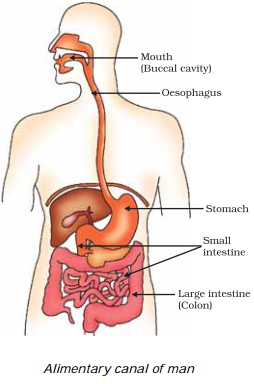
Draw the diagram of the alimentary canal of a human and label the following parts:
Mouth,Oesophagus,Stomach,Intestine.
Mouth,Oesophagus,Stomach,Intestine.
Solution
(N/A) The human alimentary canal is a continuous tube extending from the mouth to the anus. It consists of several organs that work together to digest food and absorb nutrients.
$1$. Mouth (Buccal cavity): The starting point of the alimentary canal where ingestion occurs and mechanical digestion begins with the help of teeth and saliva.
$2$. Oesophagus: $A$ muscular tube that carries food from the mouth to the stomach through peristaltic movements.
$3$. Stomach: $A$ $J$-shaped muscular organ that stores food and mixes it with gastric juices for chemical digestion.
$4$. Intestine: Divided into the small intestine (where major digestion and absorption of nutrients take place) and the large intestine (where water is absorbed and waste is prepared for excretion).
Refer to the provided diagram for the anatomical positions of these parts.
0 likes
View Solution52
Easy
How do carbohydrates,proteins,and fats get digested in human beings?
Solution
(N/A) The digestion of food in humans occurs in the following stages:
$1$. Carbohydrates: Digestion begins in the mouth where salivary amylase breaks down starch into simpler sugars. It continues in the small intestine,where pancreatic amylase converts remaining carbohydrates into glucose.
$2$. Proteins: Digestion begins in the stomach with the action of pepsin in an acidic medium. It is completed in the small intestine by pancreatic enzymes like trypsin and chymotrypsin,which break proteins down into amino acids.
$3$. Fats: Digestion occurs primarily in the small intestine. Bile salts emulsify large fat globules into smaller droplets,and then the enzyme lipase breaks them down into fatty acids and glycerol.
0 likes
View Solution53
Medium
Explain the mechanism of photosynthesis.
Solution
(N/A) The mechanism of photosynthesis involves the following three main steps:
$1$. Absorption of light energy by chlorophyll: The green pigment chlorophyll present in the chloroplasts of plant cells absorbs solar energy.
$2$. Conversion of light energy into chemical energy: The absorbed light energy is used to split water molecules $(H_2O)$ into hydrogen and oxygen. This process is known as photolysis. Chemical energy is stored in the form of $ATP$ and $NADPH$.
$3$. Reduction of $CO_2$ into carbohydrates: The chemical energy generated is used to reduce carbon dioxide $(CO_2)$ into glucose $(C_6H_{12}O_6)$,which serves as the primary food source for the plant.
0 likes
View Solution54
EasyMCQ
Name the organisms which utilize complex substances and break them down to simpler forms.
A
Autotrophs
B
Heterotrophs
C
Chemoautotrophs
D
Photoautotrophs
Solution
(B) Heterotrophic organisms,commonly known as heterotrophs,are those that cannot synthesize their own food. They utilize complex organic substances obtained from other organisms and break them down into simpler forms using enzymes to derive energy. Examples include animals,fungi,and most bacteria.
0 likes
View Solution55
EasyMCQ
Name the component of food that is not digested in the stomach.
A
Carbohydrates
B
Proteins
C
Roughage (Dietary Fiber)
D
Fats
Solution
(C) Roughage,also known as dietary fiber,is the component of food that is not digested in the human stomach. It consists mainly of cellulose,a complex carbohydrate found in plant cell walls,which human digestive enzymes cannot break down. It passes through the digestive tract and helps in the movement of food and waste.
0 likes
View Solution56
EasyMCQ
Name the reserved food of plant cell.
A
Starch
B
Glycogen
C
Glucose
D
Cellulose
Solution
(A) The reserved food material in plant cells is $Starch$. Plants synthesize glucose during photosynthesis and store the excess glucose in the form of $Starch$ for later use.
0 likes
View Solution57
EasyMCQ
Name the stored food of animals.
A
Starch
B
Glycogen
C
Cellulose
D
Glucose
Solution
(B) In animals,carbohydrates are stored in the form of $Glycogen$. This is often referred to as animal starch and is primarily stored in the liver and muscle cells to be used as an energy reserve.
0 likes
View Solution58
EasyMCQ
In which part of the digestive system is water absorbed?
A
Stomach
B
Small intestine
C
Large intestine
D
Oesophagus
Solution
(C) The absorption of water and certain salts from the undigested food material occurs in the large intestine. After the absorption of water,the remaining waste material is solidified and eliminated from the body through the anus.
0 likes
View Solution59
EasyMCQ
Which type of nutrition is present in tapeworm?
A
Autotrophic
B
Holozoic
C
Parasitic
D
Saprophytic
Solution
(C) Tapeworms exhibit $Parasitic$ nutrition. They live inside the body of the host (such as humans) and derive their nutrients directly from the host's digested food, which is a form of heterotrophic nutrition.
0 likes
View Solution60
Easy
Explain holozoic nutrition.
Solution
(N/A) Holozoic nutrition is a type of heterotrophic nutrition in which an organism ingests complex organic food materials,either solid or liquid. This food is then broken down into simpler,absorbable forms through the process of digestion. After digestion,the nutrients are absorbed into the body cells and assimilated. Examples include $Amoeba$,humans,and frogs.
0 likes
View Solution61
EasyMCQ
What role does bile play in digestion?
A
Emulsification of fats
B
Digestion of proteins
C
Absorption of vitamins
D
Synthesis of glucose
Solution
(A) Bile,secreted by the liver and stored in the gallbladder,plays a crucial role in the digestion of fats.
It contains bile salts that break down large fat globules into smaller droplets,a process known as emulsification.
This increases the surface area of the fats,allowing enzymes like lipase to act more efficiently on them.
It contains bile salts that break down large fat globules into smaller droplets,a process known as emulsification.
This increases the surface area of the fats,allowing enzymes like lipase to act more efficiently on them.
0 likes
View Solution62
Easy
How do autotrophs obtain $CO_{2}$ and $N_{2}$ to make their food?
Solution
(N/A) $(i)$ Autotrophs obtain $CO_{2}$ from the atmosphere through the diffusion process via stomata present on the surface of leaves.
$(ii)$ Autotrophs obtain nitrogen $(N_{2})$ from the soil in the form of inorganic nitrates and nitrites,which are absorbed by the roots along with water.
$(ii)$ Autotrophs obtain nitrogen $(N_{2})$ from the soil in the form of inorganic nitrates and nitrites,which are absorbed by the roots along with water.
0 likes
View Solution63
EasyMCQ
Where does digestion of fat take place in our body?
A
Stomach
B
Small intestine
C
Large intestine
D
Oesophagus
Solution
(B) The digestion of fat primarily takes place in the $Small \ intestine$.
First, bile salts from the liver emulsify large fat globules into smaller droplets to increase the surface area for enzyme action.
Then, the enzyme $Lipase$ (secreted by the pancreas) breaks down these emulsified fats into fatty acids and glycerol.
First, bile salts from the liver emulsify large fat globules into smaller droplets to increase the surface area for enzyme action.
Then, the enzyme $Lipase$ (secreted by the pancreas) breaks down these emulsified fats into fatty acids and glycerol.
0 likes
View Solution64
EasyMCQ
Name the organelle in which photosynthesis occurs.
A
Mitochondria
B
Chloroplast
C
Ribosome
D
Lysosome
Solution
(B) Photosynthesis is the process by which green plants synthesize their food. This process takes place in specialized cell organelles known as chloroplasts. Chloroplasts contain the green pigment chlorophyll,which captures light energy to convert carbon dioxide and water into glucose.
0 likes
View Solution65
EasyMCQ
What are the raw materials used during photosynthesis?
A
Oxygen and Water
B
Carbon dioxide and Water
C
Glucose and Oxygen
D
Chlorophyll and Sunlight
Solution
(B) The raw materials required for photosynthesis are:
$(i)$ $CO_{2}$ (Carbon dioxide): Taken from the atmosphere through stomata.
$(ii)$ $H_{2}O$ (Water): Absorbed from the soil by the roots.
These substances,along with sunlight and chlorophyll,are used by plants to synthesize glucose.
$(i)$ $CO_{2}$ (Carbon dioxide): Taken from the atmosphere through stomata.
$(ii)$ $H_{2}O$ (Water): Absorbed from the soil by the roots.
These substances,along with sunlight and chlorophyll,are used by plants to synthesize glucose.
0 likes
View Solution66
Easy
$(a)$ Name the protein-digesting enzyme present in pancreatic juice and the hormone secreted by the pancreas.
$(b)$ What is the function of pancreatic juice?
$(b)$ What is the function of pancreatic juice?
Solution
(N/A) The protein-digesting enzyme present in pancreatic juice is $Trypsin$. The hormone secreted by the pancreas is $Insulin$.
$(b)$ Pancreatic juice contains enzymes like $Trypsin$ for protein digestion,$Lipase$ for fat digestion,and $Amylase$ for carbohydrate digestion. It also contains bicarbonate ions that neutralize the acidic chyme coming from the stomach,creating an alkaline environment necessary for the action of these enzymes.
$(b)$ Pancreatic juice contains enzymes like $Trypsin$ for protein digestion,$Lipase$ for fat digestion,and $Amylase$ for carbohydrate digestion. It also contains bicarbonate ions that neutralize the acidic chyme coming from the stomach,creating an alkaline environment necessary for the action of these enzymes.
0 likes
View Solution67
Easy
Name the two glands associated with the digestive system in humans. Name their secretions also.
Solution
(N/A) $(i)$ Gastric glands: These are present in the walls of the stomach. They secrete $HCl$,a protein-digesting enzyme called pepsin,and mucus.
$(ii)$ Pancreas: This gland secretes pancreatic juice,which contains enzymes like trypsin for digesting proteins and lipase for breaking down emulsified fats.
$(ii)$ Pancreas: This gland secretes pancreatic juice,which contains enzymes like trypsin for digesting proteins and lipase for breaking down emulsified fats.
0 likes
View Solution68
EasyMCQ
What are the final products produced after the digestion of carbohydrates, proteins, and fats?
A
Glucose, amino acids, and fatty acids + glycerol
B
Starch, peptides, and lipids
C
Sucrose, polypeptides, and oils
D
Glycogen, proteins, and fats
Solution
(A) During the process of digestion, complex food molecules are broken down into simpler, absorbable forms.
$1$. Carbohydrates are broken down into simple sugars, primarily $Glucose$.
$2$. Proteins are broken down into their basic building blocks, known as $Amino acids$.
$3$. Fats are broken down into $Fatty acids$ and $Glycerol$.
$1$. Carbohydrates are broken down into simple sugars, primarily $Glucose$.
$2$. Proteins are broken down into their basic building blocks, known as $Amino acids$.
$3$. Fats are broken down into $Fatty acids$ and $Glycerol$.
0 likes
View Solution69
EasyMCQ
How do desert plants perform the photosynthesis process even though their stomata remain closed during the daytime?
A
They use stored oxygen for photosynthesis.
B
They take up $CO_2$ at night and prepare an intermediate product which is acted upon by the energy absorbed by the chlorophyll during the day.
C
They perform photosynthesis only at night.
D
They do not perform photosynthesis.
Solution
(B) Desert plants are adapted to arid environments where they keep their stomata closed during the day to prevent water loss through transpiration.
To perform photosynthesis,they take up $CO_2$ at night and convert it into an intermediate organic acid (like malic acid).
During the daytime,the energy absorbed by the chlorophyll from sunlight is used to process this stored intermediate molecule into glucose,allowing photosynthesis to occur without opening the stomata.
0 likes
View Solution70
Medium
Name any two digestive enzymes secreted in the human digestive system and write their functions.
Solution
(N/A) $1$. Salivary amylase: It is secreted by salivary glands and breaks down starch into simpler sugars like maltose.
$2$. Pepsin: It is secreted by the gastric glands in the stomach and helps in the digestion of proteins into peptides/amino acids.
$3$. Trypsin: It is secreted by the pancreas and helps in the digestion of proteins in the small intestine.
$4$. Lipase: It is secreted by the pancreas and breaks down emulsified fats into fatty acids and glycerol.
0 likes
View Solution71
Medium
Which is the internal energy reserve in plants? Do the animals have the same energy reserve?
Solution
(N/A) Plants store carbohydrates in the form of $Starch$,which serves as their internal energy reserve.
No,animals do not have the same energy reserve. Animals store carbohydrates in the form of $Glycogen$ as their internal energy reserve.
No,animals do not have the same energy reserve. Animals store carbohydrates in the form of $Glycogen$ as their internal energy reserve.
0 likes
View Solution72
Easy
On which type of food does salivary amylase act in the buccal cavity,and what is the name of the initial product formed due to the action of this enzyme?
Solution
(N/A) Salivary amylase acts on starch present in the food within the buccal cavity.
It breaks down complex starch molecules into simpler sugars,specifically maltose,which is the initial product of this enzymatic action.
It breaks down complex starch molecules into simpler sugars,specifically maltose,which is the initial product of this enzymatic action.
0 likes
View Solution73
EasyMCQ
What are the factors needed for maintaining the direction of diffusion in plants?
A
Concentration gradient
B
Permeability of the membrane
C
Temperature and pressure
D
All of the above
Solution
(D) The direction of diffusion in plants is primarily determined by the following factors:
$1$. Concentration gradient: Molecules move from a region of higher concentration to a region of lower concentration.
$2$. Permeability of the membrane: The selective nature of the cell membrane regulates the movement of substances.
$3$. Environmental conditions: Factors like temperature and pressure significantly influence the rate and direction of diffusion.
$4$. Requirement of the plant: The metabolic needs of the plant cells dictate the uptake or release of specific substances.
Therefore,all these factors collectively maintain the direction of diffusion.
0 likes
View Solution74
Medium
Assume that you are a veterinary surgeon and you have removed a significant length of the small intestine of a bear suffering from an intestinal tumour. After its recovery,would you suggest a plant-based or a meat-based diet for the bear? Provide a reason for your answer.
Solution
(B) $I$ would suggest a meat-based diet for the bear.
Reasoning: Herbivores,which consume plant-based diets,require a longer small intestine to allow sufficient time for the digestion of cellulose. Since a significant portion of the bear's small intestine has been removed,its ability to digest complex plant matter is compromised. Meat is easier and faster to digest compared to plant material,making it a more suitable diet for an animal with a shortened digestive tract.
Reasoning: Herbivores,which consume plant-based diets,require a longer small intestine to allow sufficient time for the digestion of cellulose. Since a significant portion of the bear's small intestine has been removed,its ability to digest complex plant matter is compromised. Meat is easier and faster to digest compared to plant material,making it a more suitable diet for an animal with a shortened digestive tract.
0 likes
View Solution75
Easy
State two functions of stomata.
Solution
(N/A) $1$. Gaseous exchange: Stomata facilitate the exchange of gases like $CO_2$ and $O_2$ between the atmosphere and the internal tissues of the leaf,which is essential for photosynthesis and respiration.
$2$. Transpiration: Stomata allow for the loss of water in the form of water vapor from the aerial parts of the plant,a process known as transpiration,which helps in the upward movement of water and minerals from the roots.
$2$. Transpiration: Stomata allow for the loss of water in the form of water vapor from the aerial parts of the plant,a process known as transpiration,which helps in the upward movement of water and minerals from the roots.
0 likes
View Solution76
Easy
Explain the role of bile juice in digesting food.
Solution
(N/A) The food coming from the stomach is acidic in nature. Bile juice makes this food alkaline so that pancreatic enzymes can act upon it.
Bile salts present in the bile juice break down large fat globules into smaller globules,a process known as emulsification.
This increases the surface area of the fat,thereby significantly increasing the efficiency of lipase enzyme action.
Bile salts present in the bile juice break down large fat globules into smaller globules,a process known as emulsification.
This increases the surface area of the fat,thereby significantly increasing the efficiency of lipase enzyme action.
0 likes
View Solution77
Easy
Explain how does Paramecium obtain its food.
Solution
(N/A) Paramecium is a unicellular organism that follows holozoic nutrition.
It possesses a specific region known as the cytostome or oral groove for food ingestion.
The entire surface of the Paramecium is covered with hair-like structures called cilia.
These cilia beat in a coordinated rhythmic motion,creating water currents that sweep food particles (like bacteria) towards the oral groove.
Once the food enters the oral groove,it is engulfed into a food vacuole,where digestion occurs.
0 likes
View Solution78
Medium
$(a)$ Why does a piece of bread taste sweet when chewed for some time?
$(b)$ Cellulose acts as roughage in humans but serves as a source of nutrients in cows. Justify the statement.
$(b)$ Cellulose acts as roughage in humans but serves as a source of nutrients in cows. Justify the statement.
Solution
(N/A) The saliva present in the mouth contains an enzyme called salivary amylase,which breaks down the starch present in the bread into simple sugars. This is why a piece of bread tastes sweet when chewed for some time.
$(b)$ Cellulose is a complex carbohydrate that requires specific enzymes and a longer time for digestion. Herbivorous animals like cows possess a specialized stomach (rumen) and a longer small intestine,which allow for the fermentation and digestion of cellulose by symbiotic bacteria. In contrast,human beings lack the necessary enzymes and the specialized digestive tract to break down cellulose. Therefore,it remains undigested in humans and acts as roughage,which helps in bowel movement.
$(b)$ Cellulose is a complex carbohydrate that requires specific enzymes and a longer time for digestion. Herbivorous animals like cows possess a specialized stomach (rumen) and a longer small intestine,which allow for the fermentation and digestion of cellulose by symbiotic bacteria. In contrast,human beings lack the necessary enzymes and the specialized digestive tract to break down cellulose. Therefore,it remains undigested in humans and acts as roughage,which helps in bowel movement.
0 likes
View Solution79
Medium
$(a)$ What is the role of mucus in the stomach?
$(b)$ How is the exit of food from the stomach regulated?
$(c)$ Where does food enter from the stomach?
$(b)$ How is the exit of food from the stomach regulated?
$(c)$ Where does food enter from the stomach?
Solution
(N/A) Mucus protects the inner lining of the stomach from the action of the acid under normal conditions.
$(b)$ The exit of food from the stomach is regulated by sphincter muscles,which release it in small amounts into the small intestine.
$(c)$ From the stomach,food enters the small intestine.
$(b)$ The exit of food from the stomach is regulated by sphincter muscles,which release it in small amounts into the small intestine.
$(c)$ From the stomach,food enters the small intestine.
0 likes
View Solution80
Medium
$(a)$ What is the nature of food coming from the stomach?
$(b)$ Mention any two structural modifications in the small intestine which help in the absorption of food.
$(b)$ Mention any two structural modifications in the small intestine which help in the absorption of food.
Solution
(N/A) The food coming from the stomach is acidic in nature due to the presence of $HCl$.
$(b)$ $(i)$ The inner lining of the small intestine has numerous finger-like projections called villi,which significantly increase the surface area for the absorption of digested food.
$(ii)$ The small intestine is a long,highly coiled tube,which ensures that the food stays in the intestine for a longer duration,allowing for maximum absorption of nutrients.
0 likes
View Solution81
Medium
$(a)$ Name the extensively coiled structure of the alimentary canal.
$(b)$ Compare the length of the small intestine in herbivores and carnivores.
$(b)$ Compare the length of the small intestine in herbivores and carnivores.
Solution
(N/A) The extensively coiled structure of the alimentary canal is the small intestine.
$(b)$ The length of the small intestine varies in different animals depending on the type of food they consume. Herbivores,which feed on grass,require a longer small intestine to facilitate the digestion of cellulose. In contrast,carnivores possess a shorter small intestine because meat is comparatively easier to digest.
$(b)$ The length of the small intestine varies in different animals depending on the type of food they consume. Herbivores,which feed on grass,require a longer small intestine to facilitate the digestion of cellulose. In contrast,carnivores possess a shorter small intestine because meat is comparatively easier to digest.
0 likes
View Solution82
Medium
Represent the equation of photosynthesis. Explain the steps involved in photosynthesis. In which way are the steps of photosynthesis different in desert plants?
Solution
(N/A) The chemical equation for photosynthesis is: $6CO_2 + 6H_2O \xrightarrow[\text{Chlorophyll}]{\text{Sunlight}} C_6H_{12}O_6 + 6O_2$.
The three main events that occur during photosynthesis are:
$(i)$ Absorption of light energy by chlorophyll.
$(ii)$ Conversion of light energy into chemical energy and the splitting of water molecules into hydrogen and oxygen.
$(iii)$ Reduction of $CO_2$ into carbohydrates.
In desert plants,the process is adapted to conserve water. They take up $CO_2$ at night and prepare an intermediate product. During the day,when chlorophyll absorbs sunlight,this energy is used to act upon the intermediate product to synthesize carbohydrates.
0 likes
View Solution83
MediumMCQ
Name the glands associated with the digestion of starch in the human digestive tract and mention their role. How is the required $pH$ maintained in the stomach and small intestine?
A
Salivary glands,Pancreas,Intestinal glands
B
Stomach: $HCl$ secretion; Small intestine: Bile and pancreatic juice
C
Stomach: Pepsin; Small intestine: Trypsin
D
Stomach: Mucus; Small intestine: Villi
Solution
(A) The glands associated with the digestion of starch are:
$1$. Salivary glands: Secrete salivary amylase,which breaks down starch into simpler sugars in the mouth.
$2$. Pancreas: Secretes pancreatic amylase,which digests starch in the small intestine.
$3$. Intestinal glands: Secrete intestinal amylase,which completes the digestion of starch into glucose.
Maintenance of $pH$:
- In the stomach: The gastric glands secrete Hydrochloric acid $(HCl)$,which creates an acidic medium (low $pH$) necessary for the activation of the enzyme pepsin.
- In the small intestine: The acidic food coming from the stomach is made alkaline by bile juice (from the liver) and pancreatic juice (from the pancreas),which is necessary for the action of pancreatic enzymes.
0 likes
View Solution84
Medium
Name the following with reference to the alimentary canal:
$(a)$ $(i)$ The largest gland.
$(ii)$ The gland that secretes digestive enzymes as well as hormones.
$(iii)$ The part where digested food is absorbed.
$(b)$ What are villi? Mention their function.
$(a)$ $(i)$ The largest gland.
$(ii)$ The gland that secretes digestive enzymes as well as hormones.
$(iii)$ The part where digested food is absorbed.
$(b)$ What are villi? Mention their function.
Solution
(N/A) $(i)$ Liver.
$(ii)$ Pancreas.
$(iii)$ Small intestine.
$(b)$ Villi are numerous finger-like projections present in the inner lining of the small intestine.
Function: They increase the surface area for the absorption of digested food.
$(ii)$ Pancreas.
$(iii)$ Small intestine.
$(b)$ Villi are numerous finger-like projections present in the inner lining of the small intestine.
Function: They increase the surface area for the absorption of digested food.
0 likes
View Solution85
Medium
Name three different glands associated with the digestive system in humans. Also name their secretions.
Solution
(N/A) The digestive system in humans is associated with several glands that produce secretions essential for digestion. Three such glands and their secretions are as follows:
| Name of the gland | Secretions produced |
| Salivary glands | Saliva (contains salivary amylase/ptyalin) |
| Gastric glands | $HCl$, mucus, and pepsin |
| Liver | Bile juice |
| Pancreas | Pancreatic juice (contains trypsin, lipase, and amylase) |
| Intestinal glands | Intestinal juice |
0 likes
View Solution86
Medium
$(a)$ Name the following:
$(i)$ Organ which stores bile
$(ii)$ Organ which produces bile
$(b)$ Name one enzyme present in pancreatic juice and give its functions.
$(c)$ What are peristaltic movements?
$(i)$ Organ which stores bile
$(ii)$ Organ which produces bile
$(b)$ Name one enzyme present in pancreatic juice and give its functions.
$(c)$ What are peristaltic movements?
Solution
(N/A) $(i)$ Gall bladder
$(ii)$ Liver
$(b)$ Pancreatic juice contains several enzymes. One such enzyme is Trypsin,which digests proteins into amino acids. Another is Lipase,which breaks down emulsified fats into fatty acids and glycerol.
$(c)$ Peristaltic movements are the rhythmic contraction and relaxation of the muscles in the lining of the alimentary canal,which push the food forward through the digestive tract.
0 likes
View Solution87
MediumMCQ
The shape of guard cells changes due to change in the :
A
Amount of water in cells.
B
Temperature of cells.
C
Protein composition of cells.
D
Position of nucleus in the cells.
Solution
(A) The shape of guard cells is regulated by the turgor pressure within them.
When water enters the guard cells through osmosis,they become turgid and swell,causing the stomatal pore to open.
Conversely,when water leaves the guard cells,they become flaccid and shrink,causing the stomatal pore to close.
Therefore,the change in the shape of guard cells is primarily due to the amount of water present in the cells.
0 likes
View Solution88
EasyMCQ
Why are green plants called 'producers'?
A
They consume other organisms.
B
They produce their own food using sunlight and chlorophyll.
C
They decompose dead organic matter.
D
They depend on animals for energy.
Solution
(B) Green plants are called 'producers' because they possess chlorophyll,which allows them to capture solar energy.
They use this energy to convert inorganic substances like $CO_2$ and $H_2O$ into organic food (glucose) through the process of photosynthesis.
Since they synthesize their own food,they are known as autotrophs or producers.
They use this energy to convert inorganic substances like $CO_2$ and $H_2O$ into organic food (glucose) through the process of photosynthesis.
Since they synthesize their own food,they are known as autotrophs or producers.
0 likes
View Solution89
Medium
Differentiate between autotrophs,heterotrophs,and decomposers and give one example of each.
Solution
(N/A) Autotrophs: Organisms that can synthesize their own food from simple inorganic substances like $CO_2$ and $H_2O$ using sunlight and chlorophyll are called autotrophs.
Example: All green plants.
Heterotrophs: Organisms that cannot synthesize their own food through photosynthesis and depend on other organisms for their nutritional requirements are called heterotrophs.
Example: All animals.
Decomposers: Organisms that break down complex organic matter present in dead remains of plants and animals into simpler substances are called decomposers.
Example: Bacteria and Fungi.
0 likes
View Solution90
Medium
$(a)$ Bile does not contain any digestive enzyme,yet it is important for the digestion of food. Why?
$(b)$ Name the products formed after the complete digestion of carbohydrates,proteins,and fats in the small intestine.
$(b)$ Name the products formed after the complete digestion of carbohydrates,proteins,and fats in the small intestine.
Solution
(N/A) Bile makes the acidic food coming from the stomach alkaline,which enables pancreatic enzymes to act. Bile salts emulsify large fat globules into smaller ones,which increases the surface area for enzyme action,thereby increasing the efficiency of digestion.
$(b)$ The products formed after complete digestion are:
Carbohydrates: Glucose
Proteins: Amino acids
Fats: Fatty acids and glycerol
$(b)$ The products formed after complete digestion are:
Carbohydrates: Glucose
Proteins: Amino acids
Fats: Fatty acids and glycerol
0 likes
View Solution91
Medium
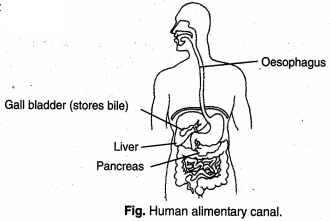
$(a)$ Draw a diagram of the human alimentary canal and label the following: Oesophagus,Gall bladder,Liver,and Pancreas.
$(b)$ Explain the statement: 'Bile does not contain any enzyme but it is essential for digestion.'
$(b)$ Explain the statement: 'Bile does not contain any enzyme but it is essential for digestion.'
Solution
(N/A) Refer to the provided diagram of the human alimentary canal.
$(b)$ Bile does not contain any digestive enzymes,yet it is essential for digestion due to the following reasons:
$(i)$ It makes the acidic food coming from the stomach alkaline,which is necessary for the action of pancreatic enzymes.
$(ii)$ It contains bile salts that help in the emulsification of fats,breaking down large fat globules into smaller ones to increase the efficiency of enzyme action.
0 likes
View Solution92
Medium
Define enzyme. Name one enzyme in humans which digests fats.
Solution
(N/A) Enzymes are biological catalysts that accelerate the rate of biochemical reactions within living organisms. They are primarily proteinaceous in nature.
In humans,the enzyme $Lipase$ is responsible for the digestion of fats (lipids) into fatty acids and glycerol.
In humans,the enzyme $Lipase$ is responsible for the digestion of fats (lipids) into fatty acids and glycerol.
0 likes
View Solution93
Medium
$(a)$ State two functions of bile juice.
$(b)$ Differentiate between the functions of enzymes pepsin and trypsin.
$(b)$ Differentiate between the functions of enzymes pepsin and trypsin.
Solution
(N/A) Functions of bile juice:
$(i)$ It emulsifies large fat globules into smaller ones,thereby increasing the surface area for enzyme action.
$(ii)$ It makes the acidic food coming from the stomach alkaline,which is essential for the activity of pancreatic enzymes.
$(b)$ Differences between pepsin and trypsin:
$1.$ Pepsin: It acts on proteins in an acidic medium in the stomach.
$2.$ Trypsin: It acts on proteins in an alkaline medium in the small intestine.
0 likes
View Solution94
Medium
State the function of the following in the alimentary canal:
$(i)$ Liver $(ii)$ Gall bladder $(iii)$ Villi.
$(i)$ Liver $(ii)$ Gall bladder $(iii)$ Villi.
Solution
(N/A) Liver: Produces bile juice. Bile salts present in it emulsify large fat globules into smaller ones,facilitating digestion. It also stores excess glucose in the form of glycogen.
Gall bladder: Stores and concentrates the bile juice produced by the liver until it is needed for digestion in the small intestine.
Villi: These are numerous finger-like projections present on the inner lining of the small intestine. They increase the surface area for the absorption of digested food. The villi are richly supplied with blood vessels that transport the absorbed nutrients to every cell of the body.
0 likes
View Solution95
Medium
Explain the process by which the energy requirements of autotrophic organisms are fulfilled. In which form are the unused carbohydrates stored?
Solution
(N/A) Autotrophic organisms fulfill their energy requirements through a process called $Photosynthesis$.
In this process, autotrophs take in external substances like $CO_2$ and $H_2O$ and convert them into energy-rich carbohydrates in the presence of sunlight and chlorophyll.
The chemical reaction is: $6CO_2 + 12H_2O \xrightarrow[Chlorophyll]{Sunlight} C_6H_{12}O_6 + 6O_2 + 6H_2O$.
The carbohydrates that are not immediately used by the plant are stored in the form of $Starch$.
0 likes
View Solution96
Medium
Mention the site of photosynthesis. List basic requirements for this process to occur.
Solution
(N/A) The site of photosynthesis is the chloroplast,which is a green-coloured plastid found in plant cells.
$(b)$ The basic requirements for the process of photosynthesis are:
$(i)$ Carbon dioxide $(CO_2)$
$(ii)$ Water $(H_2O)$
$(iii)$ Sunlight (as an energy source)
$(iv)$ Chlorophyll (the photosynthetic pigment)
$(b)$ The basic requirements for the process of photosynthesis are:
$(i)$ Carbon dioxide $(CO_2)$
$(ii)$ Water $(H_2O)$
$(iii)$ Sunlight (as an energy source)
$(iv)$ Chlorophyll (the photosynthetic pigment)
0 likes
View Solution97
Medium
$(a)$ Name the organs which secrete the following enzymes in the human digestive system:
$(i)$ Pepsin
$(ii)$ Salivary amylase
$(iii)$ Trypsin
$(iv)$ Lipase
$(b)$ Name the organs which perform the following functions in the human alimentary canal:
$(i)$ Absorption of digested food
$(ii)$ Absorption of water
$(i)$ Pepsin
$(ii)$ Salivary amylase
$(iii)$ Trypsin
$(iv)$ Lipase
$(b)$ Name the organs which perform the following functions in the human alimentary canal:
$(i)$ Absorption of digested food
$(ii)$ Absorption of water
Solution
(N/A) $(i)$ Pepsin is secreted by the gastric glands present in the stomach wall.
$(ii)$ Salivary amylase is secreted by the salivary glands located in the mouth.
$(iii)$ Trypsin is secreted by the pancreas.
$(iv)$ Lipase is secreted by the pancreas.
$(b)$ $(i)$ The small intestine is the primary site for the absorption of digested food into the bloodstream.
$(ii)$ The large intestine is responsible for the absorption of water and salts from the undigested food material.
0 likes
View Solution98
Medium
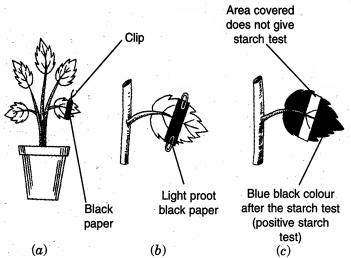
Design an experiment to demonstrate that sunlight is essential for photosynthesis.
Solution
(N/A) $(i)$ Keep a potted plant in a dark room for $48-72$ hours to destarch its leaves. (Fig. $(a)$)
$(ii)$ Cover a portion of a leaf on both sides with strips of black paper using paper clips. This prevents sunlight from reaching the covered area. (Fig. $(b)$)
$(iii)$ Place the plant in bright sunlight for $4-6$ hours.
$(iv)$ Detach the leaf and remove the black paper strips. Perform a starch test by boiling the leaf in alcohol to remove chlorophyll and then adding iodine solution.
$(v)$ The part of the leaf that was covered with black paper does not turn blue-black,indicating the absence of starch. (Fig. $(c)$)
$(vi)$ The uncovered part of the leaf turns blue-black,indicating the presence of starch. This proves that sunlight is essential for photosynthesis.
0 likes
View Solution99
MediumMCQ
The opening and closing of the stomatal pore depends upon:
A
oxygen
B
temperature
C
concentration of $CO_{2}$ in stomata
D
water in guard cells
Solution
(D) The opening and closing of the stomatal pore is regulated by the turgor pressure within the guard cells.
When water enters the guard cells,they become turgid and swell,causing the stomatal pore to open.
Conversely,when water leaves the guard cells,they become flaccid,causing the stomatal pore to close.
Therefore,the movement of water into and out of the guard cells is the primary factor determining the state of the stomata.
0 likes
View Solution100
MediumMCQ
Choose the forms in which most plants absorb nitrogen:
$(i)$ Proteins
$(ii)$ Nitrates and Nitrites
$(iii)$ Urea
$(iv)$ Atmospheric nitrogen
$(i)$ Proteins
$(ii)$ Nitrates and Nitrites
$(iii)$ Urea
$(iv)$ Atmospheric nitrogen
A
$(ii)$ and $(iii)$
B
$(i)$ and $(ii)$
C
$(iii)$ and $(iv)$
D
$(i)$ and $(iv)$
Solution
(A) Plants require nitrogen for the synthesis of proteins and other compounds.
Although nitrogen is abundant in the atmosphere,plants cannot absorb it directly in its gaseous form $(N_2)$.
Most plants absorb nitrogen from the soil primarily in the form of nitrates $(NO_3^-)$ and nitrites $(NO_2^-)$.
Some plants can also absorb nitrogen in the form of urea or ammonium compounds,which are converted into nitrates by soil bacteria.
Therefore,the forms in which most plants absorb nitrogen are nitrates and nitrites,and sometimes urea.
0 likes
View SolutionLife Processes — Nutrition · Frequently Asked Questions
1Are these Life Processes questions useful for JEE and NEET?
Yes. All questions in this section are mapped to JEE Main and NEET exam patterns. Previous year questions from JEE Main, NEET, GUJCET and state-level exams are included with full solutions.
2Can I switch to Hindi or Gujarati for these questions?
Yes. Use the language tabs in the hero section or the sidebar to view the same questions and solutions in English, Hindi or Gujarati.
3How do I generate a question paper from this subtopic?
Use the Vedclass Exam Paper Generator — select the chapter and subtopic, set difficulty, and generate Sets A, B, C, D automatically. First 3 chapters of every subject are free.
Vedclass Products
For Students
Vedclass Test Series
Mock tests in real JEE/NEET style with performance analysis. 5-day free trial.
Start Free TrialFor Teachers
Exam Paper Generator
Generate Set A/B/C/D papers from this chapter in 2 minutes. 3 chapters free.
Try FreeFor Institutes
Online Exam Module
Live online exams with unlimited students, 360° analytics & white-label branding.
See DemoFor Teachers & Institutes
Generate a Life Processes Exam Paper in 2 Minutes
Select subtopic & difficulty — Sets A, B, C, D auto-generated with No Repeat logic.
First 3 chapters of every subject are free — no payment required.