
A English
Mix Examples - Life Processes Questions in English
Class 10 Science · Life Processes · Mix Examples - Life Processes
15+
Questions
English
Language
100%
With Solutions
Showing 15 of 15 questions in English
1
Easy
What criteria do we use to decide whether something is alive?
Solution
(N/A) To decide whether something is alive,we generally look for visible movements such as walking,breathing,or growth.
However,living organisms also exhibit molecular movements that are not visible to the naked eye.
Therefore,the presence of life processes,such as nutrition,respiration,transport,and excretion,is the fundamental criterion used to determine if an organism is alive.
However,living organisms also exhibit molecular movements that are not visible to the naked eye.
Therefore,the presence of life processes,such as nutrition,respiration,transport,and excretion,is the fundamental criterion used to determine if an organism is alive.
0 likes
View Solution2
EasyMCQ
What processes would you consider essential for maintaining life?
A
Nutrition and Respiration
B
Transportation and Excretion
C
All of the above
D
None of the above
Solution
(C) The processes that are essential for maintaining life are collectively known as life processes. These include:
$1$. Nutrition: The process of obtaining energy from food.
$2$. Respiration: The process of breaking down food to release energy.
$3$. Transportation: The movement of substances within the organism.
$4$. Excretion: The removal of metabolic waste products from the body.
$1$. Nutrition: The process of obtaining energy from food.
$2$. Respiration: The process of breaking down food to release energy.
$3$. Transportation: The movement of substances within the organism.
$4$. Excretion: The removal of metabolic waste products from the body.
0 likes
View Solution3
Medium
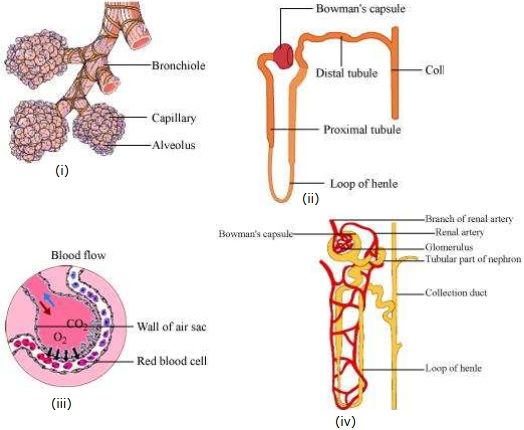
Compare the functioning of alveoli in the lungs and nephrons in the kidneys with respect to their structure and functioning.
Solution
(N/A)
| Alveoli | Nephron |
|---|---|
| Structure | Structure |
| $(i)$ Alveoli are tiny balloon-like structures present inside the lungs. | $(i)$ Nephrons are tubular structures present inside the kidneys. |
| $(ii)$ The walls of the alveoli are one cell thick and contain an extensive network of blood capillaries. | $(ii)$ Nephrons consist of a glomerulus,Bowman's capsule,and a long renal tubule. They also contain a cluster of thin-walled capillaries. |
| Function | Function |
| $(i)$ The exchange of $O_2$ and $CO_2$ takes place between the blood of the capillaries surrounding the alveoli and the gases present in the alveoli. | $(i)$ Blood enters the kidneys through the renal artery,which branches into many capillaries in the glomerulus. Water and solutes are transferred to the nephron at Bowman's capsule. The filtrate then moves through the proximal tubule,the loop of Henle,the distal tubule,and finally into the collecting duct. During this process,substances like glucose,amino acids,and water are selectively reabsorbed. |
| $(ii)$ Alveoli are the primary site of gaseous exchange. | $(ii)$ Nephrons are the basic filtration units of the kidney. |
4 likes
View Solution4
EasyMCQ
Which of the following is an incorrect statement?
A
Movement of molecules does not take place among cells
B
Organisms must repair and maintain their structure
C
Organisms grow with time
D
Energy is essential for life processes
Solution
(A) Life processes are the basic functions performed by living organisms to survive.
$1$. Organisms must repair and maintain their structure to prevent damage and breakdown,which requires energy.
$2$. Organisms grow with time as they synthesize new materials.
$3$. Energy is essential for all life processes,including metabolic activities.
$4$. The movement of molecules is a fundamental characteristic of life; molecules are constantly moving within and between cells to facilitate transport,signaling,and metabolic reactions.
Therefore,the statement that the movement of molecules does not take place among cells is incorrect.
0 likes
View Solution5
Easy
Two green plants are kept separately in oxygen-free containers,one in the dark and the other in continuous light. Which one will live longer? Give reasons.
Solution
(B) The plant kept in continuous light will live longer.
This is because,in the presence of light,the plant performs photosynthesis,which produces $O_2$ as a byproduct.
This $O_2$ is then utilized by the plant for its cellular respiration,allowing it to survive.
In contrast,the plant kept in the dark cannot perform photosynthesis and will quickly consume the limited oxygen available in the container,leading to its death.
0 likes
View Solution6
Easy
Match the items of Column $(A)$ with those of Column $(B)$:
| Column $(A)$ | Column $(B)$ |
|---|---|
| $(a)$ Phloem | $(i)$ Excretion |
| $(b)$ Nephron | $(ii)$ Translocation of food |
| $(c)$ Veins | $(iii)$ Clotting of blood |
| $(d)$ Platelets | $(iv)$ Deoxygenated blood |
Solution
(A) The correct matches are as follows:
$(a)$ Phloem is responsible for the $(ii)$ Translocation of food in plants.
$(b)$ Nephron is the structural and functional unit of the kidney involved in $(i)$ Excretion.
$(c)$ Veins are blood vessels that carry $(iv)$ Deoxygenated blood towards the heart.
$(d)$ Platelets are blood cells that help in the $(iii)$ Clotting of blood.
Therefore,the correct sequence is $(a-ii, b-i, c-iv, d-iii)$.
0 likes
View Solution7
EasyMCQ
When a person is suffering from severe cold,he or she cannot
A
differentiate the taste of an apple from that of an ice cream
B
differentiate a hot object from a cold object
C
differentiate red light from green light
D
differentiate the smell of a perfume from that of an agarbatti
Solution
(A) The sense of taste and the sense of smell are closely linked.
When a person suffers from a severe cold,the nasal passages become congested with mucus,which blocks the olfactory receptors responsible for detecting odors.
Since a significant portion of what we perceive as 'taste' is actually the aroma of food,the inability to smell prevents the brain from fully distinguishing between different flavors,such as an apple and an ice cream.
Therefore,the correct answer is $A$.
0 likes
View Solution8
Medium
Give reasons for the following:
$(a)$ Rings of cartilage are present in the trachea.
$(b)$ Mucus is secreted along with $HCl$ in the stomach.
$(a)$ Rings of cartilage are present in the trachea.
$(b)$ Mucus is secreted along with $HCl$ in the stomach.
Solution
(N/A) Rings of cartilage are present in the trachea to prevent it from collapsing when there is no air inside it,ensuring that the airway remains open for breathing.
$(b)$ $(i)$ Mucus protects the inner lining of the stomach from the corrosive action of $HCl$ under normal conditions.
$(ii)$ Mucus lubricates the food,making it smoother so that it can move easily through the alimentary canal.
$(b)$ $(i)$ Mucus protects the inner lining of the stomach from the corrosive action of $HCl$ under normal conditions.
$(ii)$ Mucus lubricates the food,making it smoother so that it can move easily through the alimentary canal.
0 likes
View Solution9
Medium
$(a)$ Explain why multicellular organisms need a transportation system for carrying food and oxygen.
$(b)$ Why does an organism require an excretory system?
$(b)$ Why does an organism require an excretory system?
Solution
(N/A) In multicellular organisms,cells are not in direct contact with the external environment. Specialized tissues are responsible for the uptake of food and oxygen at specific sites. Since these substances are required by all cells throughout the body,a transportation system is essential to move them from the site of absorption to all other parts.
$(b)$ Metabolic activities within an organism produce various waste products,many of which are toxic or harmful if allowed to accumulate. An excretory system is required to filter and remove these harmful by-products from the body to maintain homeostasis.
$(b)$ Metabolic activities within an organism produce various waste products,many of which are toxic or harmful if allowed to accumulate. An excretory system is required to filter and remove these harmful by-products from the body to maintain homeostasis.
0 likes
View Solution10
Medium
$(a)$ $A$ product is formed in our muscles due to the breakdown of glucose when there is a lack of oxygen. Name the product and also mention the effect of the build-up of this product.
$(b)$ Differentiate between fermentation in yeast and aerobic respiration on the basis of end products formed.
$(b)$ Differentiate between fermentation in yeast and aerobic respiration on the basis of end products formed.
Solution
(N/A) The product formed is lactic acid.
The accumulation of lactic acid in the muscles leads to muscle cramps.
$(b)$ In yeast,fermentation results in the production of ethanol and carbon dioxide. In contrast,aerobic respiration results in the production of carbon dioxide and water. Additionally,the amount of energy $(ATP)$ released during fermentation is significantly lower than that released during aerobic respiration.
0 likes
View Solution11
Medium
What will happen if:
$(a)$ Peristaltic movements do not occur all along the oesophagus?
$(b)$ There are no platelets in the blood?
$(c)$ Rings of cartilage are not present in the trachea?
$(a)$ Peristaltic movements do not occur all along the oesophagus?
$(b)$ There are no platelets in the blood?
$(c)$ Rings of cartilage are not present in the trachea?
Solution
(N/A) If peristaltic movements do not occur,the food will not be pushed forward into the stomach,leading to an inability to swallow or digest food properly.
$(b)$ If there are no platelets in the blood,the blood will not clot in the event of an injury,which could lead to excessive and potentially fatal blood loss.
$(c)$ In the absence of rings of cartilage,the trachea (windpipe) would collapse during inhalation because the air pressure inside the tube decreases,potentially obstructing the airway.
0 likes
View Solution12
Easy
$(a)$ State the reason for the following:
$(i)$ Herbivores need a longer small intestine,while carnivores have a shorter small intestine.
$(ii)$ The lungs in human beings are designed to maximize the area for the exchange of gases.
$(b)$ The rate of breathing in aquatic organisms is much faster than that seen in terrestrial organisms.
$(i)$ Herbivores need a longer small intestine,while carnivores have a shorter small intestine.
$(ii)$ The lungs in human beings are designed to maximize the area for the exchange of gases.
$(b)$ The rate of breathing in aquatic organisms is much faster than that seen in terrestrial organisms.
Solution
(A) $(a) (i)$ Herbivores,which consume grass,possess a longer small intestine to facilitate the digestion of cellulose. Cellulose is a complex carbohydrate that requires more time to break down,necessitating a longer transit time within the digestive tract.
$(a) (ii)$ Carnivores,which consume meat,have a shorter small intestine because meat is protein-rich and relatively easy to digest,requiring less time for nutrient absorption.
$(b) (i)$ Within the lungs,the trachea branches into smaller tubes called bronchi and bronchioles,which terminate in numerous balloon-like structures known as alveoli. These alveoli are surrounded by an extensive network of blood capillaries,providing a massive surface area for the efficient diffusion of gases.
$(b) (ii)$ The concentration of dissolved oxygen in water is significantly lower than the concentration of oxygen in the atmosphere. Consequently,aquatic organisms,such as fish,must pump water through their gills at a much higher rate to extract sufficient oxygen for their metabolic needs.
0 likes
View Solution13
Medium
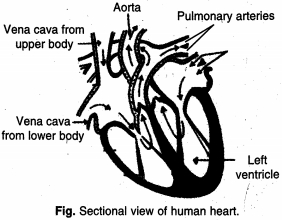
$(a)$ Draw a sectional view of the human heart and label the following parts on it:
Pulmonary artery,right atrium,left ventricle,septum.
$(b)$ What do the following transport?
$(i)$ Xylem
$(ii)$ Phloem
$(iii)$ Pulmonary vein
$(iv)$ Vena cava
Pulmonary artery,right atrium,left ventricle,septum.
$(b)$ What do the following transport?
$(i)$ Xylem
$(ii)$ Phloem
$(iii)$ Pulmonary vein
$(iv)$ Vena cava
Solution
(N/A) The sectional view of the human heart shows the four chambers and major blood vessels. The pulmonary artery carries deoxygenated blood from the right ventricle to the lungs. The right atrium receives deoxygenated blood from the body. The left ventricle pumps oxygenated blood to the rest of the body. The septum separates the right and left sides of the heart to prevent the mixing of oxygenated and deoxygenated blood.
$(b)$ $(i)$ Xylem: Transports water and dissolved minerals from the roots to the leaves.
$(ii)$ Phloem: Transports food (sucrose) synthesized in the leaves to other parts of the plant (translocation).
$(iii)$ Pulmonary vein: Transports oxygenated blood from the lungs to the left atrium of the heart.
$(iv)$ Vena cava: Transports deoxygenated blood from the body tissues to the right atrium of the heart.
0 likes
View Solution14
MediumMCQ
Which of the following is an incorrect statement?
A
Organisms grow with time
B
Organisms must repair and maintain their structure
C
Movement of molecules does not take place among cells
D
Energy is essential for life processes
Solution
(C) Life processes are the basic functions performed by living organisms to survive and maintain their body structure.
$1$. Organisms grow with time as they assimilate nutrients and build new cellular components.
$2$. Maintenance and repair of body structures are continuous processes to replace worn-out tissues.
$3$. Movement of molecules is essential for life; substances like oxygen,carbon dioxide,nutrients,and waste products constantly move between cells and the environment to sustain metabolism.
$4$. Energy is required for all life processes,including growth,repair,and transport.
Therefore,the statement that 'Movement of molecules does not take place among cells' is incorrect.
0 likes
View Solution15
EasyMCQ
Liver is the largest organ as well as the largest gland of the body.
A
True
B
False
Solution
(A) The statement is $True$. The liver is the largest internal organ and the largest gland in the human body. It performs various essential functions,including detoxification,protein synthesis,and the production of biochemicals necessary for digestion.
0 likes
View SolutionLife Processes — Mix Examples - Life Processes · Frequently Asked Questions
1Are these Life Processes questions useful for JEE and NEET?
Yes. All questions in this section are mapped to JEE Main and NEET exam patterns. Previous year questions from JEE Main, NEET, GUJCET and state-level exams are included with full solutions.
2Can I switch to Hindi or Gujarati for these questions?
Yes. Use the language tabs in the hero section or the sidebar to view the same questions and solutions in English, Hindi or Gujarati.
3How do I generate a question paper from this subtopic?
Use the Vedclass Exam Paper Generator — select the chapter and subtopic, set difficulty, and generate Sets A, B, C, D automatically. First 3 chapters of every subject are free.
Vedclass Products
For Students
Vedclass Test Series
Mock tests in real JEE/NEET style with performance analysis. 5-day free trial.
Start Free TrialFor Teachers
Exam Paper Generator
Generate Set A/B/C/D papers from this chapter in 2 minutes. 3 chapters free.
Try FreeFor Institutes
Online Exam Module
Live online exams with unlimited students, 360° analytics & white-label branding.
See DemoFor Teachers & Institutes
Generate a Life Processes Exam Paper in 2 Minutes
Select subtopic & difficulty — Sets A, B, C, D auto-generated with No Repeat logic.
First 3 chapters of every subject are free — no payment required.