
A English
Magnetic Field and Field Lines Questions in English
Class 10 Science · Magnetic Effects of Electric Current · Magnetic Field and Field Lines
98+
Questions
English
Language
100%
With Solutions
Showing 48 of 98 questions in English
51
EasyMCQ
How is the relative strength of a magnetic field shown around a magnet?
A
By the length of the magnet
B
By the degree of closeness of the magnetic field lines
C
By the color of the magnetic field lines
D
By the temperature of the magnet
Solution
(B) The relative strength of a magnetic field is represented by the degree of closeness of the magnetic field lines.
Where the field lines are crowded,the magnetic field is stronger,meaning the force acting on the pole of another magnet placed in that region is greater.
Conversely,where the field lines are widely spaced,the magnetic field is weaker.
Where the field lines are crowded,the magnetic field is stronger,meaning the force acting on the pole of another magnet placed in that region is greater.
Conversely,where the field lines are widely spaced,the magnetic field is weaker.
0 likes
View Solution52
Easy
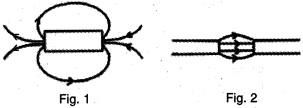
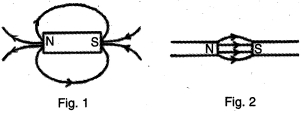
Identify the poles of the magnet in the given figures $(1)$ and $(2).$
Solution
(N/A) In Figure $(1)$,the magnetic field lines emerge from the left side and enter the right side. By convention,magnetic field lines emerge from the North pole $(N)$ and enter the South pole $(S)$. Therefore,the left side is the North pole and the right side is the South pole.
In Figure $(2)$,the magnetic field lines are directed from the left magnet to the right magnet. Thus,the left magnet's pole facing the right is the North pole $(N)$,and the right magnet's pole facing the left is the South pole $(S)$.
In Figure $(2)$,the magnetic field lines are directed from the left magnet to the right magnet. Thus,the left magnet's pole facing the right is the North pole $(N)$,and the right magnet's pole facing the left is the South pole $(S)$.
0 likes
View Solution53
Medium
What are permanent magnets and electromagnets? Give two uses of each.
Solution
(N/A) permanent magnet is a material that retains its magnetic properties for a long time without the need for an external power source. Its magnetic field is constant.
An electromagnet is a temporary magnet formed by passing an electric current through a coil (solenoid) wound around a soft iron core. Its magnetism exists only as long as the current flows.
Uses of Permanent Magnets:
$1$. Electric generators
$2$. Loudspeakers
Uses of Electromagnets:
$1$. Electric cranes for lifting heavy iron objects
$2$. Electric bells
0 likes
View Solution54
Easy
Explain briefly different methods of producing induced electromotive force $(emf)$.
Solution
(N/A) $(i)$ By changing the magnetic flux linked with a coil,an $emf$ can be induced. This can be achieved by varying the current in a neighboring coil (mutual induction).
$(ii)$ By moving a magnet towards or away from a stationary coil,the magnetic field lines passing through the coil change,thereby inducing an $emf$ (electromagnetic induction).
$(iii)$ By rotating a coil within a uniform magnetic field,the angle between the area vector and the magnetic field changes,resulting in a change in magnetic flux and the induction of an $emf$.
0 likes
View Solution55
EasyMCQ
No two magnetic field lines can intersect each other. Explain.
A
They are parallel to each other.
B
They represent the direction of the magnetic field.
C
At the point of intersection,there would be two directions of the magnetic field.
D
They are closed loops.
Solution
(C) Magnetic field lines represent the direction of the magnetic field at any point.
If two magnetic field lines were to intersect,there would be two tangents at the point of intersection.
This would imply that the magnetic field has two different directions at the same point,which is physically impossible.
Therefore,no two magnetic field lines can ever intersect each other.
If two magnetic field lines were to intersect,there would be two tangents at the point of intersection.
This would imply that the magnetic field has two different directions at the same point,which is physically impossible.
Therefore,no two magnetic field lines can ever intersect each other.
0 likes
View Solution56
Medium
What is meant by the term magnetic field lines? List any two properties of magnetic field lines.
Solution
(N/A) Magnetic field lines are the imaginary paths or lines drawn in a magnetic field along which a free north pole would move if placed in that field.
Properties of magnetic field lines:
$(i)$ Magnetic field lines originate from the North Pole and merge at the South Pole outside the magnet.
$(ii)$ No two magnetic field lines intersect each other because if they did,there would be two directions of the magnetic field at the point of intersection,which is impossible.
0 likes
View Solution57
Medium
$(a)$ What is the direction of magnetic field lines inside a bar magnet and outside of it?
$(b)$ What does the degree of closeness of the field lines represent?
$(b)$ What does the degree of closeness of the field lines represent?
Solution
(N/A) The direction of magnetic field lines outside a bar magnet is from the north pole to the south pole,while inside the magnet,it is from the south pole to the north pole.
$(b)$ The degree of closeness of magnetic field lines represents the strength of the magnetic field. The magnetic field is stronger in regions where the field lines are more crowded.
$(b)$ The degree of closeness of magnetic field lines represents the strength of the magnetic field. The magnetic field is stronger in regions where the field lines are more crowded.
0 likes
View Solution58
Medium
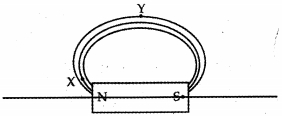
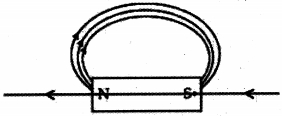
Magnetic field lines are shown in the given diagram. $A$ student makes a statement that the magnetic field at $X$ is stronger than at $Y$. Justify this statement. Also,redraw the diagram and mark the direction of magnetic field lines.
Solution
(N/A) The relative strength of the magnetic field is indicated by the degree of closeness of the magnetic field lines.
Field lines are closer together at point $X$ compared to point $Y$.
Therefore,the magnetic field is stronger at $X$ where the field lines are more crowded.
The direction of magnetic field lines outside a bar magnet is from the North pole $(N)$ to the South pole $(S)$.
Field lines are closer together at point $X$ compared to point $Y$.
Therefore,the magnetic field is stronger at $X$ where the field lines are more crowded.
The direction of magnetic field lines outside a bar magnet is from the North pole $(N)$ to the South pole $(S)$.
0 likes
View Solution59
Medium
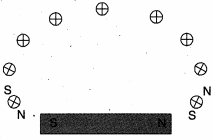
Define magnetic field. Describe an activity to draw magnetic field lines around a bar magnet from one pole to another pole.
Solution
(N/A) Magnetic field is the region around a magnet where the magnetic force can be experienced.
Activity:
$1$. Fix a sheet of white paper on a drawing board using adhesive material.
$2$. Place a bar magnet in the center of the paper and mark its boundary.
$3$. Place a small compass near the north pole of the magnet. The south pole of the compass needle will point towards the north pole of the magnet,and the north pole of the needle will point away from it.
$4$. Mark the positions of the two ends of the compass needle.
$5$. Move the compass to a new position such that its south pole occupies the position previously occupied by its north pole.
$6$. Repeat this process step by step until you reach the south pole of the magnet.
$7$. Join the points marked on the paper to obtain a smooth curve,which represents a magnetic field line.
0 likes
View Solution60
Medium
Can a freely suspended current-carrying solenoid stay in any direction? Justify your answer. What will happen when the direction of current in the solenoid is reversed? Explain.
Solution
(N/A) current-carrying solenoid behaves like a bar magnet because it produces a magnetic field similar to that of a magnet.
Therefore,when suspended freely,it will align itself in the $North-South$ direction,just like a freely suspended magnet.
When the direction of the current in the solenoid is reversed,the polarity of the magnetic poles at the ends of the solenoid is also reversed.
As a result,the solenoid will rotate by $180^{\circ}$ to realign itself with the Earth's magnetic field.
0 likes
View Solution61
Medium
$A$ coil of insulated wire is connected to a galvanometer. Explain what happens if a bar magnet with its north pole towards one face of the coil is:
$(i)$ moved quickly towards the coil,
$(ii)$ kept stationary inside the coil,and
$(iii)$ moved quickly away from the coil?
$(i)$ moved quickly towards the coil,
$(ii)$ kept stationary inside the coil,and
$(iii)$ moved quickly away from the coil?
Solution
(N/A) $(i)$ The increasing magnetic field induces an electric current in the coil,as a result of which the galvanometer shows a momentary deflection (e.g.,towards the right).
$(ii)$ Since there is no change in the magnetic field,no induced current is produced,and the galvanometer shows zero deflection.
$(iii)$ The magnetic field decreases,which induces an electric current in the coil,and the galvanometer shows a momentary deflection in the opposite direction (e.g.,towards the left).
0 likes
View Solution62
Medium
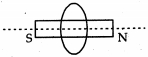
State the condition for electromagnetic induction to take place. $A$ cylindrical bar magnet is kept along the axis of a circular coil as shown in the figure. Will there be a current induced in the coil if the magnet is rotated about its axis? Discuss.
Solution
(N/A) The condition for electromagnetic induction to occur is that there must be a change in the magnetic flux linked with the coil.
This change in magnetic flux can be achieved by:
$(a)$ Relative motion between the coil and the magnet.
$(b)$ Changing the current in a nearby coil.
In the given scenario,when the cylindrical bar magnet is rotated about its own axis,the magnetic field lines associated with the magnet remain symmetric with respect to the axis of rotation. Consequently,the magnetic flux passing through the circular coil does not change over time. Since there is no change in the magnetic flux linked with the coil,no current will be induced in the coil.
0 likes
View Solution63
Medium
$(a)$ Describe an activity to draw a magnetic field line outside a bar magnet from one pole to another.
$(b)$ List any two properties of magnetic field lines.
$(b)$ List any two properties of magnetic field lines.
Solution
(N/A) Place the bar magnet $NS$ on a sheet of paper and mark its boundary. Mark a point $A$ near the north pole of the magnet. Place a compass needle such that its south pole lies exactly over point $A$. Mark point $B$ on the paper at the position of the north pole of the compass needle. Move the compass needle so that its south pole now lies over $B$ and mark point $C$ at the north pole position. Repeat this process until you reach the south pole of the bar magnet. Join all these points with a smooth curve to represent a magnetic field line.
$(b)$ $(i)$ Magnetic field lines never intersect each other.
$(ii)$ Outside the magnet,magnetic field lines emerge from the north pole and merge into the south pole.
$(b)$ $(i)$ Magnetic field lines never intersect each other.
$(ii)$ Outside the magnet,magnetic field lines emerge from the north pole and merge into the south pole.
0 likes
View Solution64
Easy
$A$ coil made of insulated copper wire is connected to a galvanometer. What will happen to the deflection of the galvanometer if this coil is moved towards a stationary bar magnet and then moved away from it? Give reason for your answer and name the phenomenon involved.
Solution
(N/A) When the coil is moved towards a stationary magnet,the magnetic flux linked with the coil changes,which induces an electric current in the coil. This causes the galvanometer to show a deflection in one direction.
When the coil is moved away from the magnet,the magnetic flux linked with the coil changes in the opposite sense,inducing a current in the opposite direction. This causes the galvanometer to show a deflection in the opposite direction.
The phenomenon involved is known as electromagnetic induction.
When the coil is moved away from the magnet,the magnetic flux linked with the coil changes in the opposite sense,inducing a current in the opposite direction. This causes the galvanometer to show a deflection in the opposite direction.
The phenomenon involved is known as electromagnetic induction.
0 likes
View Solution65
Medium
Define magnetic field. $A$ compass needle gets deflected when brought near a bar magnet. Why? List three properties of magnetic field lines.
Solution
(N/A) Magnetic field is the region around a magnet where its magnetic force can be experienced.
$A$ compass needle gets deflected because the magnetic field of the bar magnet exerts a force on the poles of the compass needle.
Properties of magnetic field lines:
$(i)$ The magnetic field lines emerge from the north pole and merge at the south pole outside the magnet.
$(ii)$ They are closed continuous curves.
$(iii)$ No two magnetic field lines intersect each other.
0 likes
View Solution66
Medium
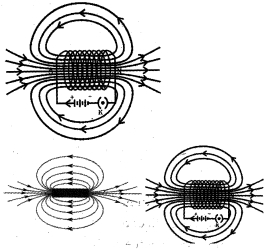
What is a solenoid? Sketch magnetic field lines produced around a current-carrying solenoid. Mark the region where the field is uniform. Compare its field with that of a bar magnet.
Solution
(N/A) solenoid is a coil of many circular turns of insulated copper wire wrapped closely in the shape of a cylinder.
The magnetic field lines around a current-carrying solenoid are similar to those of a bar magnet. The field lines emerge from one end and enter the other,forming closed loops.
The magnetic field is uniform inside the solenoid,which is represented by parallel field lines along the axis of the solenoid.
Comparison with a bar magnet:
$1$. The magnetic field pattern of a current-carrying solenoid is identical to that of a bar magnet.
$2$. One end of the solenoid behaves like the North pole $(N)$,and the other end behaves like the South pole $(S)$.
$3$. Like a bar magnet,the field lines outside the solenoid go from the North pole to the South pole,and inside,they go from the South pole to the North pole.
0 likes
View Solution67
Medium
$(a)$ Explain any three properties of magnetic field lines.
$(b)$ Give two uses of magnetic compass.
$(b)$ Give two uses of magnetic compass.
Solution
(N/A) Properties of magnetic field lines:
$(i)$ Magnetic field lines emerge from the north pole and merge at the south pole outside the magnet.
$(ii)$ They form continuous closed loops.
$(iii)$ The strength of the magnetic field is indicated by the degree of closeness of the field lines; they are stronger where the field lines are crowded.
$(iv)$ No two magnetic field lines can ever intersect each other,as that would imply two directions of the magnetic field at a single point,which is impossible.
$(b)$ Uses of a magnetic compass:
$(i)$ It is used to determine the cardinal directions (North,South,East,West).
$(ii)$ It is used to detect the presence of a magnetic field around a current-carrying conductor or a magnetic material.
0 likes
View Solution68
Medium
$(a)$ What are magnetic field lines? How is the direction of a magnetic field at a point determined?
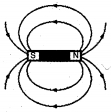
$(b)$ Draw two field lines around a bar magnet along its length on its two sides and mark the field directions on them by arrow marks.
$(c)$ List any three properties of magnetic field lines.
$(b)$ Draw two field lines around a bar magnet along its length on its two sides and mark the field directions on them by arrow marks.
$(c)$ List any three properties of magnetic field lines.
Solution
(N/A) Magnetic field lines are the pictorial representation of a magnetic field. The direction of a magnetic field at a point is determined by placing a magnetic compass (or magnetic needle) at that point. The direction in which the north pole of the compass needle points gives the direction of the magnetic field at that point.
$(b)$ The field lines around a bar magnet are shown in the figure.
$(c)$ Properties of magnetic field lines are:
$(i)$ They emerge from the north pole and merge at the south pole outside the magnet.
$(ii)$ They are continuous closed curves.
$(iii)$ No two field lines can intersect each other.
$(b)$ The field lines around a bar magnet are shown in the figure.
$(c)$ Properties of magnetic field lines are:
$(i)$ They emerge from the north pole and merge at the south pole outside the magnet.
$(ii)$ They are continuous closed curves.
$(iii)$ No two field lines can intersect each other.
0 likes
View Solution69
Medium
Why is pure iron not used for making permanent magnets? Name one material used for making permanent magnets. Describe how permanent magnets are made electrically. State two examples of electrical instruments made by using permanent magnets.
Solution
(N/A) Pure iron is not used for making permanent magnets because it gets easily demagnetized.
$Alnico$,an alloy of iron,nickel,cobalt,and aluminum,is used for making permanent magnets.
Permanent magnets are made electrically by placing a ferromagnetic material (like $Alnico$) inside a solenoid and passing a strong direct current through the coil for a sufficient duration. The magnetic field produced by the solenoid aligns the magnetic domains within the material,resulting in a permanent magnet.
Two examples of electrical instruments that use permanent magnets are $electric$ $motors$ and $electric$ $bells$.
0 likes
View Solution70
Medium
$(a)$ $A$ coil of insulated copper wire is connected to a galvanometer. What will happen if a bar magnet is:
$(i)$ pushed into the coil with its north pole entering first?
$(ii)$ withdrawn from inside the coil?
$(iii)$ held stationary inside the coil?
$(b)$ Name the above phenomenon and mention the name of the scientist who discovered it. State the law that relates the direction of current in the coil with the direction of motion of the magnet.
Solution
(D) $(i)$ $A$ momentary deflection occurs in the galvanometer due to the change in magnetic flux linked with the coil.
$(ii)$ $A$ momentary deflection occurs in the opposite direction because the change in magnetic flux is reversed.
$(iii)$ No deflection occurs because there is no change in magnetic flux when the magnet is stationary.
$(b)$ The phenomenon is called Electromagnetic Induction. It was discovered by Michael Faraday. The law that relates the direction of induced current to the direction of motion of the magnet is Fleming's Right-Hand Rule. It states that if you stretch the thumb,forefinger,and middle finger of your right hand such that they are mutually perpendicular,then the thumb points in the direction of motion of the conductor (or magnet),the forefinger points in the direction of the magnetic field,and the middle finger points in the direction of the induced current.
0 likes
View Solution71
Medium
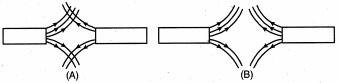
Magnetic field lines of two magnets are shown in figures $A$ and $B$. Select the figure that represents the correct pattern of the field lines. Give reasons for your answer. Also,name the poles of the magnets facing each other.
Solution
(B) Figure $(B)$ represents the correct pattern of magnetic field lines.
Reason: Magnetic field lines never intersect each other. If they were to intersect,it would mean that at the point of intersection,the magnetic field has two different directions at the same time,which is physically impossible.
The poles of the magnets facing each other are North poles,as the field lines are shown emerging from the magnets.
0 likes
View Solution72
Easy
You are given two identical-looking iron bars,out of which one of them is a magnet. Just using these two bars,how will you identify which one is a magnet?
Solution
(N/A) To identify the magnet,place one bar horizontally on a table and hold the other bar vertically. Bring the end of the vertical bar near the center of the horizontal bar.
$1$. If you feel a strong attraction,the vertical bar is the magnet.
$2$. If you feel no attraction or very weak attraction at the center,then the horizontal bar is the magnet.
Alternatively,move the vertical bar along the length of the horizontal bar. If the force of attraction is uniform,the vertical bar is the magnet. If the force is maximum at the ends and minimum at the center,the horizontal bar is the magnet.
0 likes
View Solution73
Medium
Describe an activity with a neat diagram to show the magnetic field lines around a bar magnet.
Solution
(N/A) $1$. Place a sheet of white paper on a drawing board and fix it using adhesive tape.
$2$. Place a bar magnet in the center of the paper and mark its boundary.
$3$. Place a small compass needle near the north pole of the magnet. The south pole of the compass needle will point towards the north pole of the magnet.
$4$. Mark the position of the two ends of the compass needle with a pencil.
$5$. Move the compass to a new position such that its south pole occupies the position previously occupied by the north pole.
$6$. Repeat this process step by step until you reach the south pole of the magnet.
$7$. Join the marked points with a smooth curve. This curve represents a magnetic field line.
$8$. Repeat the process to draw several such lines around the magnet.
0 likes
View Solution74
Medium
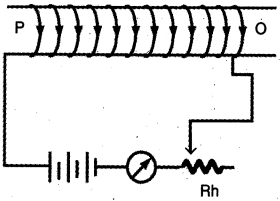
The figure shows a long solenoid,a cylindrical coil of a number of turns of insulated copper wire,connected to a battery through an ammeter $A$ and a rheostat $Rh$.
$(i)$ Which end of the solenoid is a $N$-pole and which end is a $S$-pole?
$(ii)$ Draw the magnetic field lines inside the solenoid and indicate their directions. Are magnetic field lines closed?
$(iii)$ How can you increase the strength of the magnetic field inside the solenoid? Give two methods.
$(i)$ Which end of the solenoid is a $N$-pole and which end is a $S$-pole?
$(ii)$ Draw the magnetic field lines inside the solenoid and indicate their directions. Are magnetic field lines closed?
$(iii)$ How can you increase the strength of the magnetic field inside the solenoid? Give two methods.
Solution
(N/A) $(i)$ Looking at end $P$,the current flows in a clockwise direction,therefore,$P$ acts as a south pole. Looking at end $Q$,the current appears to flow in an anti-clockwise direction,therefore,$Q$ acts as a north pole.
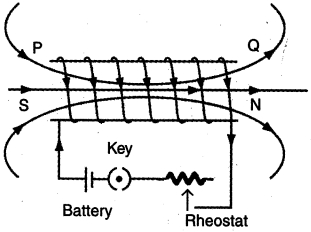
$(ii)$ Magnetic field lines inside a solenoid are shown in the figure. It is important to note that outside the solenoid,field lines are directed from the north pole to the south pole,but inside the solenoid,the field lines are directed from the south pole to the north pole. Yes,magnetic field lines are closed loops.
$(iii)$ The strength of the magnetic field inside a solenoid can be increased by:
$(a)$ Increasing the magnitude of the current flowing through the solenoid.
$(b)$ Increasing the number of turns of the copper wire in the solenoid.
0 likes
View Solution75
EasyMCQ
The induced potential difference produced in a coil when a magnet is inserted into it does not depend upon:
A
Number of turns of the coil
B
The magnetic moment of the magnet
C
The resistance of the coil
D
The speed of approach of the magnet
Solution
(C) According to Faraday's law of electromagnetic induction,the induced electromotive force $(EMF)$ or potential difference is given by the formula: $e = -N \frac{d\phi}{dt}$.
Here,$N$ is the number of turns,and $\frac{d\phi}{dt}$ is the rate of change of magnetic flux.
$1$. The induced $EMF$ depends on the number of turns $(N)$.
$2$. The rate of change of flux $(\frac{d\phi}{dt})$ depends on the magnetic moment of the magnet (which determines the strength of the magnetic field) and the speed of approach of the magnet.
$3$. The resistance of the coil affects the induced current $(I = \frac{e}{R})$,but it does not affect the induced potential difference $(e)$ itself.
Therefore,the induced potential difference does not depend on the resistance of the coil.
0 likes
View Solution76
EasyMCQ
The laws of electromagnetism tell us that energy can be transferred from one object to another:
A
only in pulses but not continuously.
B
instantaneously
C
only if they are connected by a cable
D
even if there is no material medium
Solution
(D) According to the laws of electromagnetism,electromagnetic waves (such as light,radio waves,etc.) are capable of transferring energy through a vacuum. Unlike mechanical waves (like sound),which require a material medium to propagate,electromagnetic waves consist of oscillating electric and magnetic fields that sustain each other. Therefore,energy can be transferred from one object to another even in the absence of any material medium.
0 likes
View Solution77
EasyMCQ
To find the direction of the magnetic field around a current-carrying conductor,we use Fleming's left-hand rule.
A
True
B
False
Solution
(B) The statement is $False$.
Fleming's left-hand rule is used to determine the direction of the force acting on a current-carrying conductor placed in a magnetic field.
To find the direction of the magnetic field around a current-carrying conductor,we use the Right-Hand Thumb Rule (or Maxwell's Corkscrew Rule).
Fleming's left-hand rule is used to determine the direction of the force acting on a current-carrying conductor placed in a magnetic field.
To find the direction of the magnetic field around a current-carrying conductor,we use the Right-Hand Thumb Rule (or Maxwell's Corkscrew Rule).
0 likes
View Solution78
EasyMCQ
$A$ current-carrying solenoid behaves like a bar magnet.
A
True
B
False
Solution
(A) current-carrying solenoid produces a magnetic field pattern that is identical to that of a bar magnet.
One end of the solenoid acts as the North pole $(N)$,while the other end acts as the South pole $(S)$.
Therefore,it behaves exactly like a bar magnet.
One end of the solenoid acts as the North pole $(N)$,while the other end acts as the South pole $(S)$.
Therefore,it behaves exactly like a bar magnet.
0 likes
View Solution79
EasyMCQ
Inside a solenoid,the magnetic field is constant in magnitude and direction.
A
True
B
False
Solution
(A) The magnetic field inside a long solenoid carrying current is uniform,meaning it is constant in both magnitude and direction at all points within the solenoid. This is represented by parallel magnetic field lines.
0 likes
View Solution80
EasyMCQ
Fleming's right-hand rule can be used to find the direction of the magnetic field.
A
True
B
False
Solution
(B) The statement is $False$.
Fleming's right-hand rule is used to determine the direction of the induced current in a conductor moving within a magnetic field.
The direction of the magnetic field around a current-carrying conductor is determined by the Right-Hand Thumb Rule (also known as Maxwell's Right-Hand Grip Rule).
Fleming's right-hand rule is used to determine the direction of the induced current in a conductor moving within a magnetic field.
The direction of the magnetic field around a current-carrying conductor is determined by the Right-Hand Thumb Rule (also known as Maxwell's Right-Hand Grip Rule).
0 likes
View Solution81
EasyMCQ
Like magnetic poles attract each other; unlike poles repel.
A
True
B
False
Solution
(B) The fundamental law of magnetism states that like magnetic poles (North-North or South-South) repel each other,while unlike magnetic poles (North-South) attract each other. Therefore,the given statement is false.
0 likes
View Solution82
EasyMCQ
If you strike a sharp edge of a metallic knife against the north pole of a bar magnet,it will induce a north pole.
A
True
B
False
C
Cannot be determined
D
Depends on the material of the knife
Solution
(B) The statement is $False$. When a magnetic material is magnetized by contact with a magnet,the pole induced at the point of contact is always the opposite of the pole used for magnetization. Therefore,if a metallic knife is stroked against the north pole of a bar magnet,the point of contact on the knife will develop a south pole,not a north pole.
0 likes
View Solution83
EasyMCQ
The direction of magnetic field lines in a region outside the bar magnet is $.....$
A
from the $N$-pole towards the $S$-pole of a magnet.
B
from the $S$-pole toward the $N$-pole of a magnet.
C
in the direction coming out from both the poles of magnet.
D
in the direction entering in both the poles of magnet.
Solution
(A) Magnetic field lines are imaginary lines used to represent the magnetic field.
Outside a bar magnet,the magnetic field lines always emerge from the North $(N)$ pole and enter the South $(S)$ pole.
Inside the magnet,the field lines travel from the South $(S)$ pole to the North $(N)$ pole,forming continuous closed loops.
Therefore,the correct direction outside the magnet is from the $N$-pole towards the $S$-pole.
0 likes
View Solution84
EasyMCQ
Which of the following statements is false?
A
The direction of magnetic field lines is from $N$ to $S$.
B
In the region where the magnetic field lines are at a close distance from each other,there will be a strong magnetic field.
C
The magnetic field lines form closed loops.
D
The magnetic field lines can cross each other.
Solution
(D) Magnetic field lines are imaginary lines that represent the magnetic field.
Properties of magnetic field lines include:
$1$. They emerge from the $N$ pole and enter the $S$ pole outside the magnet,making their direction $N$ to $S$.
$2$. They form continuous closed loops.
$3$. The closeness of the lines indicates the strength of the magnetic field; closer lines mean a stronger field.
$4$. Two magnetic field lines can never cross each other because if they did,there would be two directions for the magnetic field at the point of intersection,which is physically impossible.
Therefore,the statement that magnetic field lines can cross each other is false.
0 likes
View Solution85
EasyMCQ
By which instrument can the presence of a magnetic field be determined?
A
Voltmeter
B
Ammeter
C
Galvanometer
D
Magnetic needle
Solution
(D) magnetic needle (or compass needle) is a small magnet that aligns itself with the direction of a magnetic field.
When placed in a region where a magnetic field exists,the magnetic needle experiences a torque and deflects from its original position.
This deflection indicates the presence of a magnetic field.
While a galvanometer can also detect small currents,the most direct and fundamental instrument used to detect the presence of a magnetic field is a magnetic needle.
0 likes
View Solution86
EasyMCQ
Who first observed the magnetic effect of an electric current?
A
Faraday
B
Oersted
C
Volta
D
Ampere
Solution
(B) In $1820$,the Danish physicist $Hans$ $Christian$ $Oersted$ observed that a magnetic compass needle gets deflected when placed near a current-carrying wire. This observation demonstrated that an electric current produces a magnetic field around it,which is known as the magnetic effect of electric current.
0 likes
View Solution87
EasyMCQ
With the help of which law or rule can the direction of a magnetic field be known?
A
Faraday's law
B
Fleming's right hand rule
C
Right hand thumb rule
D
Fleming's left hand rule
Solution
(C) The direction of the magnetic field produced by a current-carrying conductor is determined by the $Right$ $hand$ $thumb$ $rule$.
According to this rule,if you hold a current-carrying straight conductor in your right hand such that your thumb stretches along the direction of the current,then your fingers will wrap around the conductor in the direction of the magnetic field lines.
According to this rule,if you hold a current-carrying straight conductor in your right hand such that your thumb stretches along the direction of the current,then your fingers will wrap around the conductor in the direction of the magnetic field lines.
0 likes
View Solution88
EasyMCQ
According to the Right-Hand Thumb Rule,what does the thumb indicate?
A
Electric current
B
Magnetic field
C
Magnetic force
D
Motion of the conductor
Solution
(A) The Right-Hand Thumb Rule states that if you hold a current-carrying straight conductor in your right hand such that your thumb points in the direction of the electric current,then your fingers wrapped around the conductor will show the direction of the magnetic field lines. Therefore,the thumb indicates the direction of the electric current.
0 likes
View Solution89
EasyMCQ
Who proposed the principle of electromagnetic induction?
A
Faraday
B
Oersted
C
Ampere
D
Volta
Solution
(A) The principle of electromagnetic induction was discovered by $Michael \ Faraday$ in $1831$.
He demonstrated that a changing magnetic field induces an electromotive force $(EMF)$ or current in a conductor.
Therefore, the correct option is $A$.
He demonstrated that a changing magnetic field induces an electromotive force $(EMF)$ or current in a conductor.
Therefore, the correct option is $A$.
0 likes
View Solution90
EasyMCQ
From which of the following cases,will the induced current in the loop not be obtained?
A
The loop is moved in the direction of the magnet.
B
The magnet is moved in the direction of the loop.
C
The loop and magnet are moved in the opposite direction with the same speed.
D
The loop and magnet are moved in one direction with the same speed.
Solution
(D) According to Faraday's law of electromagnetic induction,an induced current is produced in a loop only when there is a change in the magnetic flux linked with the loop.
Magnetic flux $\phi = B \cdot A \cdot \cos(\theta)$.
In cases $A$,$B$,and $C$,there is a relative motion between the magnet and the loop,which causes a change in the magnetic field $B$ passing through the loop,thereby changing the magnetic flux and inducing a current.
In case $D$,both the loop and the magnet are moving in the same direction with the same speed. Therefore,there is no relative motion between them.
Since there is no relative motion,the magnetic flux linked with the loop remains constant.
As there is no change in magnetic flux,no induced current will be obtained in the loop.
0 likes
View Solution91
EasyMCQ
What is the direction of magnetic field lines inside a bar magnet?
A
From $S$-pole to $N$-pole of the magnet
B
From $N$-pole to $S$-pole of the magnet
C
Outwards from both poles of the magnet
D
Inwards towards both poles of the magnet
Solution
(A) Magnetic field lines are continuous closed loops.
Outside the magnet,the field lines emerge from the $N$-pole and merge into the $S$-pole.
Inside the magnet,the direction of the magnetic field lines is from the $S$-pole to the $N$-pole to complete the closed loop.
Therefore,the correct direction inside the magnet is from $S$ to $N$.
Outside the magnet,the field lines emerge from the $N$-pole and merge into the $S$-pole.
Inside the magnet,the direction of the magnetic field lines is from the $S$-pole to the $N$-pole to complete the closed loop.
Therefore,the correct direction inside the magnet is from $S$ to $N$.
0 likes
View Solution92
EasyMCQ
In a region where magnetic field lines are close to each other,what is the nature of the magnetic field?
A
It is weak.
B
It is strong.
C
It is zero.
D
It is minimum.
Solution
(B) The strength of a magnetic field is represented by the degree of closeness of the magnetic field lines.
If the magnetic field lines are crowded or close to each other,it indicates a strong magnetic field.
Conversely,if the field lines are far apart,it indicates a weak magnetic field.
Therefore,in a region where magnetic field lines are close to each other,the magnetic field is strong.
If the magnetic field lines are crowded or close to each other,it indicates a strong magnetic field.
Conversely,if the field lines are far apart,it indicates a weak magnetic field.
Therefore,in a region where magnetic field lines are close to each other,the magnetic field is strong.
0 likes
View Solution93
EasyMCQ
Which of the following statements is $NOT$ true regarding the magnetic field lines of a bar magnet?
A
They do not intersect each other.
B
They are closer to each other near the poles.
C
Inside the magnet,they are directed from the $N$ pole to the $S$ pole.
D
Outside the magnet,they are directed from the $N$ pole to the $S$ pole.
Solution
(C) Magnetic field lines are continuous closed loops.
Outside the magnet,the field lines emerge from the $N$ pole and enter the $S$ pole.
Inside the magnet,the field lines are directed from the $S$ pole to the $N$ pole to complete the closed loop.
Therefore,the statement that they are directed from the $N$ pole to the $S$ pole inside the magnet is incorrect.
0 likes
View Solution94
EasyMCQ
When an electric current flows through a conducting wire,what is produced in the region around it?
A
Electric field
B
Magnetic field
C
Gravitational field
D
Energy
Solution
(B) When an electric current passes through a conductor,it creates a magnetic field around the conductor. This phenomenon is known as the magnetic effect of electric current,first observed by Hans Christian Oersted. The strength and direction of the magnetic field depend on the magnitude and direction of the current flowing through the wire.
0 likes
View Solution95
EasyMCQ
Which of the following statements is incorrect for a current-carrying solenoid?
A
The magnetic field at all points inside the solenoid is uniform.
B
It acts as a magnet when a soft iron core is placed inside it to produce a strong magnetic field.
C
The pattern of its magnetic field lines is different from that of a bar magnet.
D
Reversing the direction of the current in the solenoid reverses the positions of its $N$ and $S$ poles.
Solution
(C) current-carrying solenoid behaves exactly like a bar magnet. The magnetic field lines inside a solenoid are parallel to the axis,indicating a uniform magnetic field. When a soft iron rod is placed inside,it becomes an electromagnet. The pattern of magnetic field lines for a solenoid is identical to that of a bar magnet,not different. Therefore,statement $C$ is incorrect.
0 likes
View Solution96
EasyMCQ
What is the nature of the magnetic field lines inside a current-carrying solenoid?
A
Circular
B
Parallel straight lines
C
Parabolic
D
Curved
Solution
(B) Inside a current-carrying solenoid,the magnetic field lines are parallel to each other and to the axis of the solenoid. This indicates that the magnetic field is uniform at all points inside the solenoid. Therefore,the correct option is $B$.
0 likes
View Solution97
EasyMCQ
In which of the following cases will maximum electric current be induced in the loop?
A
When magnetic field linked with the loop changes rapidly.
B
When magnetic field linked with the loop changes slowly.
C
When magnetic field linked with the loop remains constant.
D
It does not depend on the magnetic field linked with the loop.
Solution
(A) According to Faraday's law of electromagnetic induction,the induced electromotive force $(e)$ in a loop is given by $e = -\frac{d\phi}{dt}$,where $\phi$ is the magnetic flux linked with the loop.
Since the induced current $I = \frac{e}{R}$ (where $R$ is the resistance of the loop),the induced current is directly proportional to the rate of change of magnetic flux,i.e.,$I \propto \frac{d\phi}{dt}$.
Therefore,the induced current is maximum when the rate of change of magnetic flux $(\frac{d\phi}{dt})$ is maximum.
This occurs when the magnetic field linked with the loop changes rapidly.
0 likes
View Solution98
EasyMCQ
On which principle does an electric bell work?
A
Electromagnet
B
Heating effect of electric current
C
Chemical effect of electric current
D
Thermal effect
Solution
(A) An electric bell works on the principle of the magnetic effect of electric current,specifically using an electromagnet.
When the switch is pressed,the electric current flows through the coil,which acts as an electromagnet.
This electromagnet attracts the iron armature,causing the hammer to strike the gong.
As the armature moves,the circuit is broken,the electromagnet loses its magnetism,and the spring pulls the armature back,completing the circuit again to repeat the process.
0 likes
View SolutionMagnetic Effects of Electric Current — Magnetic Field and Field Lines · Frequently Asked Questions
1Are these Magnetic Effects of Electric Current questions useful for JEE and NEET?
Yes. All questions in this section are mapped to JEE Main and NEET exam patterns. Previous year questions from JEE Main, NEET, GUJCET and state-level exams are included with full solutions.
2Can I switch to Hindi or Gujarati for these questions?
Yes. Use the language tabs in the hero section or the sidebar to view the same questions and solutions in English, Hindi or Gujarati.
3How do I generate a question paper from this subtopic?
Use the Vedclass Exam Paper Generator — select the chapter and subtopic, set difficulty, and generate Sets A, B, C, D automatically. First 3 chapters of every subject are free.
Vedclass Products
For Students
Vedclass Test Series
Mock tests in real JEE/NEET style with performance analysis. 5-day free trial.
Start Free TrialFor Teachers
Exam Paper Generator
Generate Set A/B/C/D papers from this chapter in 2 minutes. 3 chapters free.
Try FreeFor Institutes
Online Exam Module
Live online exams with unlimited students, 360° analytics & white-label branding.
See DemoFor Teachers & Institutes
Generate a Magnetic Effects of Electric Current Exam Paper in 2 Minutes
Select subtopic & difficulty — Sets A, B, C, D auto-generated with No Repeat logic.
First 3 chapters of every subject are free — no payment required.