
A English
Domestic Electric Circuits Questions in English
Class 10 Science · Magnetic Effects of Electric Current · Domestic Electric Circuits
68+
Questions
English
Language
100%
With Solutions
Showing 50 of 68 questions in English
1
Easy
Name some sources of direct current.
Solution
(N/A) Some common sources of direct current $(DC)$ include:
$1$. Electric cells (or batteries).
$2$. $DC$ generators.
$3$. Photovoltaic cells (solar cells).
$1$. Electric cells (or batteries).
$2$. $DC$ generators.
$3$. Photovoltaic cells (solar cells).
0 likes
View Solution2
Medium
Name two safety measures commonly used in electric circuits and appliances.
Solution
(N/A) Two safety measures commonly used in electric circuits and appliances are as follows:
$(i)$ Electric Fuse: Each circuit must be connected with an electric fuse. This prevents the flow of excessive current through the circuit. When the current passing through the wire exceeds the maximum limit of the fuse element, the fuse melts to stop the flow of current, thereby protecting the appliances.
$(ii)$ Earthing: Earthing is essential to prevent electric shocks. Any leakage of current in an electric appliance is transferred to the ground, ensuring that people using the appliance do not receive a shock.
0 likes
View Solution3
Medium
An electric oven of $2\, kW$ power rating is operated in a domestic electric circuit $(220\, V)$ that has a current rating of $5\, A$. What result do you expect? Explain.
Solution
(D) The current drawn by the electric oven can be calculated using the formula:
$P = VI$
$I = \frac{P}{V}$
Where:
$P = 2\, kW = 2000\, W$
$V = 220\, V$
$I = \frac{2000}{220} = 9.09\, A$
Since the current drawn by the oven $(9.09\, A)$ is greater than the current rating of the circuit $(5\, A)$,the circuit will experience an overload.
As a result,the fuse wire will melt due to excessive heating,and the circuit will break,preventing any damage to the appliances.
0 likes
View Solution4
MediumMCQ
What precaution should be taken to avoid the overloading of domestic electric circuits?
A
Connect many appliances to a single socket.
B
Use all high-power appliances simultaneously.
C
Avoid connecting too many appliances to a single socket.
D
Use faulty appliances in the circuit.
Solution
(C) The precautions that should be taken to avoid the overloading of domestic circuits are as follows:
$(a)$ Too many appliances should not be connected to a single socket.
$(b)$ Too many high-power appliances should not be used at the same time.
$(c)$ Faulty appliances should not be connected in the circuit.
$(d)$ $A$ proper fuse should be connected in the circuit to prevent damage during overloading.
0 likes
View Solution5
MediumMCQ
At the time of a short circuit,the current in the circuit:
A
reduces substantially
B
increases heavily
C
does not change
D
varies continuously
Solution
(B) When two naked wires of an electric circuit touch each other,the resistance of the circuit becomes very low,causing the amount of current flowing in the circuit to increase abruptly. This phenomenon is known as a short circuit.
0 likes
View Solution6
MediumMCQ
State whether the following statements are true or false.
$(a)$ The magnetic field at the centre of a long circular coil carrying current consists of parallel straight lines.
$(b)$ $A$ wire with green insulation is usually the live wire of an electric supply.
$(a)$ The magnetic field at the centre of a long circular coil carrying current consists of parallel straight lines.
$(b)$ $A$ wire with green insulation is usually the live wire of an electric supply.
A
$(a)-(T); (b)-(T)$
B
$(a)-(F); (b)-(T)$
C
$(a)-(F); (b)-(F)$
D
$(a)-(T); (b)-(F)$
Solution
(D) True.
$A$ long circular coil acts as a long solenoid. The magnetic field lines inside a long solenoid are parallel straight lines,indicating a uniform magnetic field.
$(b)$ False.
In domestic electric circuits,the live wire typically has red insulation,whereas the earth wire has green insulation.
$A$ long circular coil acts as a long solenoid. The magnetic field lines inside a long solenoid are parallel straight lines,indicating a uniform magnetic field.
$(b)$ False.
In domestic electric circuits,the live wire typically has red insulation,whereas the earth wire has green insulation.
0 likes
View Solution7
Easy
How does the use of a fuse wire protect electrical appliances?
Solution
(N/A) fuse wire is made of a material with a low melting point.
When the current flowing through the circuit exceeds the safe limit (due to overloading or short-circuiting),the heat generated $(H = I^2Rt)$ causes the temperature of the fuse wire to rise rapidly.
Once the temperature reaches the melting point of the wire,it melts and breaks the circuit.
This disconnection stops the flow of current,thereby preventing damage to the electrical appliances.
0 likes
View Solution8
EasyMCQ
Why is parallel arrangement used in domestic wiring?
A
To increase the total resistance of the circuit.
B
To ensure each appliance receives the same potential difference.
C
To ensure the total current remains constant.
D
To prevent the flow of current in the circuit.
Solution
(B) In a parallel circuit,the potential difference across each electrical appliance remains the same as the source voltage.
This allows each appliance to operate independently at its rated voltage.
If one appliance is switched off or fails,the others continue to function normally.
Additionally,the total resistance of the circuit decreases,allowing for higher current capacity.
This allows each appliance to operate independently at its rated voltage.
If one appliance is switched off or fails,the others continue to function normally.
Additionally,the total resistance of the circuit decreases,allowing for higher current capacity.
0 likes
View Solution9
EasyMCQ
The most important safety method used for protecting home appliances from short circuiting or overloading is
A
earthing
B
use of electric meter
C
use of stabilizers
D
use of fuse
Solution
(D) An electric fuse is a safety device used in electrical circuits to protect appliances from damage due to excessive current.
When a short circuit or overloading occurs,the current in the circuit increases significantly.
This high current causes the fuse wire to heat up and melt due to the Joule heating effect $(H = I^2Rt)$.
Once the fuse wire melts,the circuit breaks,preventing the flow of excessive current to the appliances and thereby protecting them from potential damage.
0 likes
View Solution10
Medium
What is the difference between a direct current and an alternating current? How many times does $AC$ used in India change direction in one second?
Solution
(N/A) Direct current $(DC)$ flows in only one direction throughout the circuit. In contrast,alternating current $(AC)$ reverses its direction periodically.
The frequency of $AC$ in India is $50 \, Hz$,which means it completes $50$ cycles per second.
Since the current changes its direction twice in each cycle,the total number of times it changes direction in one second is $2 \times 50 = 100$ times.
The frequency of $AC$ in India is $50 \, Hz$,which means it completes $50$ cycles per second.
Since the current changes its direction twice in each cycle,the total number of times it changes direction in one second is $2 \times 50 = 100$ times.
0 likes
View Solution11
Medium
What is the role of a fuse used in series with any electrical appliance? Why should a fuse with a defined rating not be replaced by one with a larger rating?
Solution
(N/A) fuse is a safety device used to protect electrical appliances from damage caused by short-circuiting or overloading.
It is designed to carry a specific maximum current. When the current flowing through the circuit exceeds this rated value,the fuse wire melts and breaks the circuit,thereby preventing damage to the appliance.
If a fuse with a larger rating is used,it will not melt even when the current exceeds the safe limit of the appliance.
Consequently,the appliance may get damaged or catch fire because the protective mechanism fails to operate. Therefore,one should always use a fuse of the correct rating.
0 likes
View Solution12
Difficult
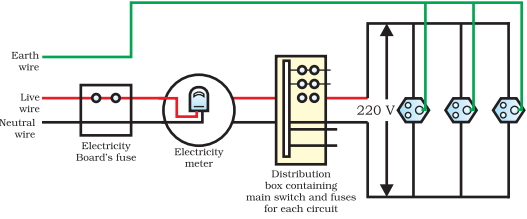
Draw an appropriate schematic diagram showing common domestic circuits and discuss the importance of a fuse. Why is it that a burnt-out fuse should be replaced by another fuse of identical rating?
Solution
(N/A) fuse is a safety device used in domestic circuits to protect electrical appliances and wiring from damage due to excessive current flow,which may occur during overloading or short-circuiting.
It works on the heating effect of electric current. When the current exceeds the rated limit,the fuse wire melts due to excessive heat,thereby breaking the circuit and preventing further damage.
$A$ burnt-out fuse must be replaced by another fuse of the same rating because the rating is specifically designed based on the maximum current capacity of the appliances and the wiring in that circuit.
If a fuse of a higher rating is used,it will not melt during an overload,potentially leading to fire or damage to the appliances. If a fuse of a lower rating is used,it will melt frequently even under normal operating conditions.
0 likes
View Solution13
Easy
Mention the voltage and frequency of the electric current that we receive in our houses.
Solution
(N/A) In domestic electric circuits,the standard supply voltage is $220 \ V$ and the frequency of the alternating current is $50 \ Hz$.
0 likes
View Solution14
Easy
Name the type of current:
$(a)$ used in household supply,
$(b)$ given by a cell.
$(a)$ used in household supply,
$(b)$ given by a cell.
Solution
(N/A) Alternating current (ac): This is the type of current that periodically reverses its direction and changes its magnitude over time. It is the standard form of electricity supplied to homes.
$(b)$ Direct current (dc): This is the type of current that flows in a single,constant direction. $A$ cell or battery provides direct current.
$(b)$ Direct current (dc): This is the type of current that flows in a single,constant direction. $A$ cell or battery provides direct current.
0 likes
View Solution15
MediumMCQ
When does an electric short circuit occur?
A
When the resistance of the circuit becomes very high.
B
When the live wire and the neutral wire come into direct contact.
C
When the current in the circuit is reduced.
D
When the voltage in the circuit is zero.
Solution
(B) An electric short circuit occurs when the resistance of an electric circuit becomes very low,leading to a sudden,extremely high flow of current.
This typically happens when the insulation of the $live$ wire and the $neutral$ wire is damaged due to wear and tear,causing them to come into direct contact with each other.
Additionally,connecting too many high-power appliances to a single socket can also lead to overloading,which may result in a short circuit.
0 likes
View Solution16
Medium
What is the function of an earth wire? Why is it necessary to earth metallic appliances?
Solution
(N/A) The function of an earth wire is to provide a low-resistance path for electric current to flow into the ground in case of any leakage or short circuit.
It is necessary to earth metallic appliances because if there is any leakage of current,the metallic body of the appliance becomes live.
If a person touches such an appliance,the current will pass through their body to the ground,causing a severe electric shock.
By connecting the metallic body to the earth wire,the leakage current is safely transferred to the ground,thereby protecting the user from electric shocks.
0 likes
View Solution17
Easy
Name three colours used and names of the wires used in household wiring.
Solution
(N/A) In household electrical wiring,three types of wires are used based on their function:
$1$. Live wire: It is used to carry current from the source. According to the old convention,it is red in colour,and according to the new international convention,it is brown.
$2$. Neutral wire: It provides a return path for the current. According to the old convention,it is black in colour,and according to the new international convention,it is blue.
$3$. Earth wire: It is used for safety purposes to prevent electric shocks. It is green or yellow-green in colour.
0 likes
View Solution18
EasyMCQ
Name two types of wiring systems adopted for domestic wiring.
A
Tree system and Ring system
B
Series system and Parallel system
C
Single-phase system and Three-phase system
D
Direct system and Indirect system
Solution
(A) The two common types of wiring systems used for domestic purposes are the $Tree$ $system$ and the $Ring$ $system$.
In the $Tree$ $system$,the main supply is divided into several sub-circuits,which further branch out like a tree.
In the $Ring$ $system$,a ring circuit is formed where the supply cable starts from the distribution board,goes through all the points,and returns to the distribution board,allowing for multiple outlets to be connected to the same circuit.
0 likes
View Solution19
EasyMCQ
Why is earthing important for electrical appliances?
A
To increase the efficiency of the appliance.
B
To prevent electric shocks and protect the device from excessive current.
C
To reduce the electricity bill.
D
To improve the aesthetic appearance of the appliance.
Solution
(B) Earthing is a safety measure used to protect users from electric shocks.
If there is a fault in the appliance,such as a short circuit or insulation failure,the metal casing might become live.
Earthing provides a low-resistance path for the leakage current to flow directly into the ground,which triggers the circuit breaker or fuse to cut off the power supply.
This prevents the person operating the device from receiving a dangerous shock and protects the appliance from damage due to excessive current.
0 likes
View Solution20
EasyMCQ
What colour wire is used for earthing or grounding?
A
Red
B
Black
C
Green or yellow
D
Blue
Solution
(C) In an electric circuit,the earthing or grounding wire is used to protect users from electric shocks.
According to the international colour code convention,the earthing wire is typically green or yellow in colour.
According to the international colour code convention,the earthing wire is typically green or yellow in colour.
0 likes
View Solution21
EasyMCQ
What will be the frequency of an alternating current if its direction changes after every $0.01\,s$ (in $,Hz$)?
A
$25$
B
$50$
C
$100$
D
$200$
Solution
(B) An alternating current $(AC)$ changes its direction twice in one complete cycle.
Given that the direction changes every $0.01\,s$,the time taken to complete one full cycle $(T)$ is $2 \times 0.01\,s = 0.02\,s$.
The frequency $(f)$ is the reciprocal of the time period $(T)$,given by $f = 1/T$.
Therefore,$f = 1 / 0.02 = 100 / 2 = 50\,Hz$.
Given that the direction changes every $0.01\,s$,the time taken to complete one full cycle $(T)$ is $2 \times 0.01\,s = 0.02\,s$.
The frequency $(f)$ is the reciprocal of the time period $(T)$,given by $f = 1/T$.
Therefore,$f = 1 / 0.02 = 100 / 2 = 50\,Hz$.
0 likes
View Solution22
EasyMCQ
What is short-circuiting in an electric supply?
A
$A$ condition where the current flows through the earth wire.
B
$A$ condition where the live wire comes in direct contact with the neutral wire.
C
$A$ condition where the voltage exceeds the limit.
D
$A$ condition where the appliance is switched off.
Solution
(B) Short-circuiting in an electric circuit is a condition that occurs when the live wire comes into direct contact with the neutral wire.
This results in a very low resistance path for the current,causing a massive surge of current to flow through the circuit.
This sudden increase in current can lead to overheating,sparking,and potentially a fire.
This results in a very low resistance path for the current,causing a massive surge of current to flow through the circuit.
This sudden increase in current can lead to overheating,sparking,and potentially a fire.
0 likes
View Solution23
EasyMCQ
What is the advantage of the third wire of earth connection in domestic appliances?
A
It prevents the appliance from overheating.
B
It provides a path for leakage current to flow to the ground,preventing electric shocks.
C
It increases the efficiency of the appliance.
D
It helps in reducing the electricity bill.
Solution
(B) In case of a defect in any domestic appliance,current may leak to its metallic body.
The third wire of the earth connection provides a low-resistance path that transfers this leakage current directly to the earth.
As a result of this,the user of the appliance is protected from a potentially fatal electric shock.
The third wire of the earth connection provides a low-resistance path that transfers this leakage current directly to the earth.
As a result of this,the user of the appliance is protected from a potentially fatal electric shock.
0 likes
View Solution24
Easy
Why is the metallic body of electrical devices connected to the earth wire?
Solution
(N/A) The metallic body of electrical devices is connected to the earth wire to provide a low-resistance conducting path for any leakage current to flow directly to the earth. This process,known as earthing,ensures that the potential of the metallic body remains equal to that of the earth $(0 \ V)$. Consequently,if a fault occurs and the live wire touches the metallic casing,the current flows to the ground instead of through the user's body,thereby preventing severe electric shocks.
0 likes
View Solution25
Easy
How is a circuit overloaded?
Solution
(N/A) circuit becomes overloaded when too many electrical appliances are connected to a single socket or circuit simultaneously. This causes the total current flowing through the circuit to exceed its rated capacity,leading to excessive heating of the wires and potential fire hazards.
0 likes
View Solution26
EasyMCQ
What is short-circuiting?
A
$A$ sudden increase in voltage.
B
The direct contact between the live wire and the neutral wire.
C
The failure of an electrical appliance.
D
The overloading of an electrical circuit.
Solution
(B) Short-circuiting occurs when the live wire and the neutral wire come into direct contact with each other.
This results in a very low resistance path,causing a massive amount of current to flow through the circuit.
This sudden surge of current can lead to sparks,overheating,and potentially electrical fires.
This results in a very low resistance path,causing a massive amount of current to flow through the circuit.
This sudden surge of current can lead to sparks,overheating,and potentially electrical fires.
0 likes
View Solution27
Easy
An alternating electric current has a frequency of $50 \, Hz$. How many times does it change its direction in one second? Give reason for your answer.
Solution
(100) The current changes its direction $100$ times in one second.
Reason: $A$ frequency of $50 \, Hz$ means that the alternating current completes $50$ cycles in one second.
In each cycle,the current changes its direction twice (once in the positive half-cycle and once in the negative half-cycle).
Therefore,the total number of direction changes in one second is $50 \times 2 = 100$ times.
0 likes
View Solution28
Medium
$(a)$ Name the type of electric current generated by most of the power stations in our country.
$(b)$ Why is it preferred over the other type?
$(c)$ State the frequency of the power supply generated in India.
$(b)$ Why is it preferred over the other type?
$(c)$ State the frequency of the power supply generated in India.
Solution
(N/A) The type of electric current generated by most power stations in India is Alternating Current $(AC)$.
$(b)$ Alternating Current $(AC)$ is preferred over Direct Current $(DC)$ because it can be transmitted over long distances with minimal loss of electrical energy using step-up transformers.
$(c)$ The frequency of the power supply generated in India is $50 \ Hz$.
$(b)$ Alternating Current $(AC)$ is preferred over Direct Current $(DC)$ because it can be transmitted over long distances with minimal loss of electrical energy using step-up transformers.
$(c)$ The frequency of the power supply generated in India is $50 \ Hz$.
0 likes
View Solution29
Medium
Differentiate between $AC$ and $DC$ along with the graph.
Solution
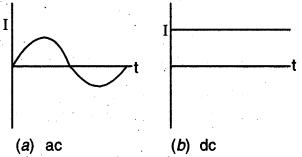
(N/A) The electric current which changes its direction (or polarity) after a certain fixed interval of time is called $AC$ or alternating current. In $AC$,the polarity ($+$ or $-$) is not fixed. The current $v/s$ time graph for $AC$ is shown in figure $(a)$.
The electric current which always flows in the same direction is called direct current or $DC$. In $DC$,the polarity ($+$ or $-$) is fixed. The current obtained from a battery or a cell is $DC$. The current $v/s$ time graph for $DC$ is shown in figure $(b)$.
The electric current which always flows in the same direction is called direct current or $DC$. In $DC$,the polarity ($+$ or $-$) is fixed. The current obtained from a battery or a cell is $DC$. The current $v/s$ time graph for $DC$ is shown in figure $(b)$.
0 likes
View Solution30
Medium
What is a fuse? How does it function?
Solution
(N/A) An electric fuse is a safety device used to limit the current in an electric circuit.
Its primary purpose is to protect the circuit and the connected appliances from damage due to excessive current flow.
The fuse consists of a short piece of wire made from a material with a low melting point.
When an electric current passes through the fuse,it generates heat.
If the current exceeds the safe limit,the heat produced is sufficient to melt the fuse wire,which breaks the circuit and stops the flow of electricity.
0 likes
View Solution31
Medium
Describe an experiment to illustrate the action of an electric fuse.
Solution
(N/A) $1$. Take a thin strip of aluminium foil about $3$ to $5\, cm$ in length.
$2$. Fix its two ends on the tips of two iron nails placed vertically on a wooden board or table.
$3$. Connect the ends of the two nails to the terminals of a battery using connecting wires to form a circuit.
$4$. Include a bulb in the circuit to indicate the flow of current.
$5$. As the current flows,the aluminium foil acts as a fuse. If the current exceeds a certain limit,the foil gets heated up due to the heating effect of electric current and eventually melts (burns out),thereby breaking the circuit and switching off the bulb.
0 likes
View Solution32
Medium
Why is series arrangement not used for domestic circuits?
Solution
(N/A) In domestic circuits,series arrangement is not used because of the following reasons:
$(i)$ The total potential difference available (usually $220 \ V$) is divided between various appliances in the circuit according to their resistances since the current flowing through all the appliances is the same. Thus,each appliance will not get the required potential difference for it to operate properly.
$(ii)$ If one of the appliances is out of order,$e.g.$,if a bulb gets fused,all the appliances in the circuit will stop working as the circuit gets broken.
$(iii)$ All the appliances will work simultaneously whether we want them to work or not,thereby involving a lot of power wastage.
$(iv)$ If we switch off any one of the appliances,the circuit is broken and all the appliances will stop working.
0 likes
View Solution33
Medium
Explain what is short-circuiting and overloading in an electric supply.
Solution
(N/A) Short-circuiting occurs when the live wire and the neutral wire come into direct contact with each other. This happens due to $(i)$ damage to the insulation of the power lines,or $(ii)$ a fault in an electric appliance. Due to short-circuiting,the resistance of the circuit decreases to a very small value,causing the current to become extremely large. This high current results in the heating of the live wires,which produces sparking at the point of contact. This sparking can sometimes cause a fire in a building.
An electric circuit is said to be overloaded if the total current drawn by all the electric appliances connected to it exceeds the permitted limit of the circuit. Overloading results in excessive heating of the wires,which can damage the insulation and lead to electrical fires.
An electric circuit is said to be overloaded if the total current drawn by all the electric appliances connected to it exceeds the permitted limit of the circuit. Overloading results in excessive heating of the wires,which can damage the insulation and lead to electrical fires.
0 likes
View Solution34
Easy
Explain why a fuse should be joined with the live wire and not with the neutral wire in a domestic circuit.
Solution
(N/A) In a domestic circuit,the live wire carries current at a high potential,while the neutral wire is at zero potential (connected to the earth at the substation). If a fuse is connected to the neutral wire and a short circuit occurs,the fuse will blow,but the appliance will remain connected to the high-potential live wire. This poses a severe risk of electric shock to anyone touching the appliance. By connecting the fuse to the live wire,the entire circuit is disconnected from the power source as soon as the fuse blows,ensuring safety.
0 likes
View Solution35
Easy
Differentiate between overloading and short-circuiting.
Solution
(N/A) Overloading occurs when the current drawn from a circuit exceeds the rated capacity of the wires,often caused by connecting too many electrical appliances to a single socket or circuit simultaneously.
Short-circuiting occurs when the live wire comes into direct contact with the neutral wire,usually due to damaged insulation or a fault in an appliance,leading to a sudden,extremely high flow of current.
Short-circuiting occurs when the live wire comes into direct contact with the neutral wire,usually due to damaged insulation or a fault in an appliance,leading to a sudden,extremely high flow of current.
0 likes
View Solution36
Medium
What is the role of a fuse used in series with an electrical appliance? Why should a fuse with a defined rating not be replaced by one with a larger rating?
Solution
(N/A) fuse is a safety device used in series with an electrical appliance to protect it from damage caused by short-circuiting or overloading.
It is designed to handle a specific maximum current rating.
When the current flowing through the circuit exceeds this rated value,the fuse wire melts due to the heat generated,thereby breaking the circuit and preventing damage to the appliance.
If a fuse with a larger rating is used,it will not melt when the current exceeds the safe limit of the appliance.
Consequently,the appliance may get damaged or catch fire because the fuse fails to perform its protective function.
0 likes
View Solution37
Medium
$(a)$ Electric fuse is an important component of all domestic circuits. Why?
$(b)$ An electric oven of rating $2 \, kW, 220 \, V$ is operated in a domestic circuit with a current rating of $5 \, A$. What result would you expect? Explain.
$(b)$ An electric oven of rating $2 \, kW, 220 \, V$ is operated in a domestic circuit with a current rating of $5 \, A$. What result would you expect? Explain.
Solution
(B) An electric fuse is a safety device used in electrical circuits to prevent damage from excessive current flow. It protects appliances and wiring from fire hazards caused by short-circuiting or overloading.
$(b)$ The current drawn by the electric oven is calculated using the formula $I = P / V$.
Given: $P = 2000 \, W$ and $V = 220 \, V$.
$I = 2000 / 220 = 9.09 \, A$.
Since the current drawn $(9.09 \, A)$ is significantly higher than the circuit's rated capacity of $5 \, A$,the fuse will melt and break the circuit,preventing potential damage or fire.
0 likes
View Solution38
MediumMCQ
Name two safety measures commonly used in electric circuits and appliances. What precautions should be taken to avoid the overloading of domestic electric circuits?
A
Fuse and Earthing
B
Switch and Wire
C
Insulation and Socket
D
Voltage and Current
Solution
(A) Two safety measures commonly used in electric circuits and appliances are:
$(i)$ Electric Fuse: It acts as a safety device that breaks the circuit when the current exceeds a safe limit,preventing damage to appliances.
$(ii)$ Earthing: It provides a low-resistance path for leakage current to the ground,preventing electric shocks.
Precautions to avoid overloading of domestic electric circuits:
$1$. Do not connect too many high-power appliances to a single socket or extension board.
$2$. Ensure that the total load connected to the circuit does not exceed the rated capacity of the fuse or the wiring.
0 likes
View Solution39
Easy
What is meant by overloading of an electrical circuit? Explain two possible causes due to which overloading may occur in a household circuit. Explain one precaution that should be taken to avoid the overloading of a domestic electric circuit.
Solution
(N/A) Overloading occurs when the current in an electrical circuit increases abruptly beyond the rated capacity of the wires or the circuit.
Two possible causes for overloading in a household circuit are:
$(i)$ Accidental hike in the supply voltage: $A$ sudden increase in the voltage provided by the power supply can lead to excessive current flow.
$(ii)$ Connecting too many appliances to a single socket: Using a power strip or multiple adapters to connect several high-power devices to one socket draws more current than the circuit is designed to handle.
One precaution to avoid overloading is:
Do not connect too many high-power electrical appliances to a single socket or a single circuit simultaneously.
0 likes
View Solution40
Medium
Write one difference between direct current $(DC)$ and alternating current $(AC)$. Which one of the two is mostly produced at power stations in our country? Name one device which provides alternating current. State one important advantage of using alternating current.
Solution
(N/A) $DC$ does not change its direction with time,whereas $AC$ reverses its direction periodically.
Most power stations in India produce $AC$.
An $AC$ generator is a device that produces alternating current.
One important advantage of using $AC$ is that electric power can be transmitted over long distances without much loss of energy.
Most power stations in India produce $AC$.
An $AC$ generator is a device that produces alternating current.
One important advantage of using $AC$ is that electric power can be transmitted over long distances without much loss of energy.
0 likes
View Solution41
Medium
State one main difference between $AC$ and $DC$. Why is $AC$ preferred over $DC$ for long-range transmission of electric power? Name one source each of $DC$ and $AC$.
Solution
(N/A) The main difference is that $DC$ (Direct Current) flows in only one direction,whereas $AC$ (Alternating Current) reverses its direction periodically.
$AC$ is preferred for long-range transmission because it can be stepped up to high voltages using a transformer,which significantly reduces energy loss due to heat ($I^2R$ loss) in the transmission lines.
Source of $AC$: $AC$ generator (or alternator).
Source of $DC$: $DC$ generator,battery,or cell.
0 likes
View Solution42
Easy
$(a)$ Mention the colour code used for live,neutral,and earth wire.
$(b)$ You want to connect a $2 \ kW$ electric oven in the electric circuit. In which power line would you connect it and why? What may happen if you connect it wrongly in the other power line?
$(b)$ You want to connect a $2 \ kW$ electric oven in the electric circuit. In which power line would you connect it and why? What may happen if you connect it wrongly in the other power line?
Solution
(N/A) The standard colour code for wires is: Live wire is $Red$,Neutral wire is $Black$,and Earth wire is $Green$.
$(b)$ $A$ $2 \ kW$ electric oven should be connected to the $15 \ A$ power line (high-power circuit). This is because the oven draws a large amount of current $(I = P/V = 2000 \ W / 220 \ V \approx 9.09 \ A)$. If it is connected to the $5 \ A$ lighting circuit,the excessive current will cause the fuse to blow or the circuit breaker to trip,potentially damaging the wiring or causing a fire hazard.
$(b)$ $A$ $2 \ kW$ electric oven should be connected to the $15 \ A$ power line (high-power circuit). This is because the oven draws a large amount of current $(I = P/V = 2000 \ W / 220 \ V \approx 9.09 \ A)$. If it is connected to the $5 \ A$ lighting circuit,the excessive current will cause the fuse to blow or the circuit breaker to trip,potentially damaging the wiring or causing a fire hazard.
0 likes
View Solution43
Medium
$(a)$ State the function of a fuse in an electric circuit. How is it connected in the domestic circuit?
$(b)$ An electric fuse of rating $3 \, A$ is connected in a circuit in which an electric iron of power $1.5 \, kW$ is connected,which operates at $220 \, V$. What would happen? Explain.
$(b)$ An electric fuse of rating $3 \, A$ is connected in a circuit in which an electric iron of power $1.5 \, kW$ is connected,which operates at $220 \, V$. What would happen? Explain.
Solution
(D) The function of a fuse is to protect electric circuits and appliances by stopping the flow of excessively high electric current. It is connected in series with the live wire in a domestic circuit.
$(b)$ Given: Power $(P) = 1.5 \, kW = 1500 \, W$,Voltage $(V) = 220 \, V$.
The current $(I)$ drawn by the electric iron is calculated as:
$I = \frac{P}{V} = \frac{1500 \, W}{220 \, V} \approx 6.82 \, A$.
Since the current required by the electric iron $(6.82 \, A)$ is significantly higher than the fuse rating $(3 \, A)$,the fuse wire will get heated and melt due to the excessive current,breaking the circuit. Consequently,the electric iron will stop working.
0 likes
View Solution44
Medium
$(a)$ Write three differences between $AC$ and $DC$.
$(b)$ State the frequency of $AC$ supply in India and mention the potential difference between the neutral and live wire in a domestic circuit.
How many times does $AC$ change its direction in one second?
$(b)$ State the frequency of $AC$ supply in India and mention the potential difference between the neutral and live wire in a domestic circuit.
How many times does $AC$ change its direction in one second?
Solution
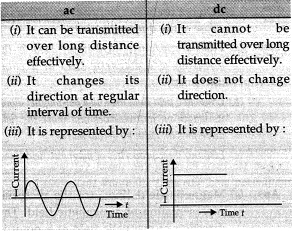
(N/A) Differences between $AC$ and $DC$:
| Feature | $AC$ | $DC$ |
| :--- | :--- | :--- |
| $(i)$ Transmission | Can be transmitted over long distances effectively. | Cannot be transmitted over long distances effectively. |
| $(ii)$ Direction | Changes its direction at regular intervals of time. | Does not change its direction. |
| $(iii)$ Representation | Represented by a sinusoidal wave. | Represented by a straight line parallel to the time axis. |
$(b)$
- The frequency of $AC$ supply in India is $50 \, Hz$.
- The potential difference between the neutral and live wire in a domestic circuit is $220 \, V$ to $240 \, V$ (standard is $220 \, V$).
- Since the frequency is $50 \, Hz$,the current completes $50$ cycles per second. In each cycle,the current changes direction twice. Therefore,the $AC$ changes its direction $50 \times 2 = 100$ times in one second.
0 likes
View Solution45
Medium
Explain what is short circuiting and overloading in an electric supply.
Solution
(N/A) Short circuiting is the connection between two points in a circuit across which the resistance is very low. As a result,most of the current bypasses part of the circuit and flows between these two points. Short circuiting occurs when the live wire comes in direct contact with the neutral wire,such that a zero-resistance path is provided to the current. The current then does not pass through the appliance,but a heavy current passes through the wires of the circuit.
Overloading: Every circuit is designed to carry a pre-determined amount of power. When the power demand in the circuit exceeds the pre-determined capacity,the circuit is said to be overloaded.
Overloading: Every circuit is designed to carry a pre-determined amount of power. When the power demand in the circuit exceeds the pre-determined capacity,the circuit is said to be overloaded.
0 likes
View Solution46
Medium
Explain with the help of a figure the ring system of wiring in domestic wiring.
Solution
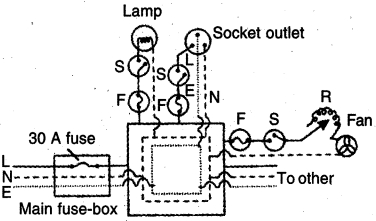
(N/A) The ring system is as shown in the figure.
It consists of a ring-circuit. Wires starting from the main fuse-box run around all the main rooms of the house and then return to the fuse-box again.
The fuse-box contains a fuse with a rating of about $30\, A$.
$A$ separate connection is taken from the live wire of the ring for each appliance.
The terminal of the appliance is connected to the live wire through a separate fuse and a switch.
If the fuse of one appliance blows,it does not affect the other appliances.
For each appliance,the wires used for connection should have the proper current-carrying capacity.
0 likes
View Solution47
Medium
What are the safety measures to be taken while dealing with household electricity?
Solution
(N/A) Electricity is an essential and convenient source of energy in our daily lives,but it can be hazardous if not handled correctly. The following safety measures should be observed:
$(i)$ Use high-quality wires with appropriate amperage and proper insulation.
$(ii)$ Cover all exposed wires and joints with insulating tape.
$(iii)$ Ensure all connections at plugs,switches,and sockets are tight.
$(iv)$ Replace any defective plugs,switches,or sockets immediately.
$(v)$ Never touch any part of an electrical circuit without wearing rubber shoes or rubber gloves.
$(vi)$ Use a fuse or $MCB$ (Miniature Circuit Breaker) of the correct rating and material.
$(vii)$ All electrical appliances must be properly earthed.
$(viii)$ Always connect switches and fuses to the live wire.
$(ix)$ Turn off the main switch in the event of a short circuit or fire.
$(x)$ Never use water to extinguish a fire caused by electricity.
0 likes
View Solution48
Medium
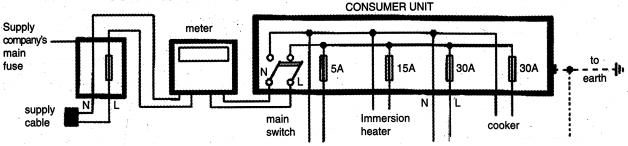
$(a)$ Draw a schematic labelled diagram of a domestic wiring circuit which includes $(i)$ a main fuse,$(ii)$ a power meter,$(iii)$ one light point,and $(iv)$ a power plug.
$(b)$ Why is it necessary to connect an earth wire to electric appliances having metallic covers?
$(b)$ Why is it necessary to connect an earth wire to electric appliances having metallic covers?
Solution
(N/A) The schematic diagram of a domestic wiring circuit is provided in the image.
$(b)$ It is necessary to connect an earth wire to electrical appliances having metallic covers to protect us from the harmful effects of electric shock. In the event of any leakage of current or any other electrical defect,the earth wire provides a low-resistance path to the ground,thereby carrying the excess current to the earth and preventing the user from receiving a shock.
$(b)$ It is necessary to connect an earth wire to electrical appliances having metallic covers to protect us from the harmful effects of electric shock. In the event of any leakage of current or any other electrical defect,the earth wire provides a low-resistance path to the ground,thereby carrying the excess current to the earth and preventing the user from receiving a shock.
0 likes
View Solution49
Medium
$(a)$ What is the function of an earth wire in electrical instruments? Why is it necessary to earth the metallic electric appliances?
$(b)$ Explain what is short-circuiting and overloading in an electric supply.
$(c)$ What is the usual capacity of the fuse wire in the line to feed:
$(i)$ lights and fans?
$(ii)$ appliances of $2 \,kW$ or more power?
$(b)$ Explain what is short-circuiting and overloading in an electric supply.
$(c)$ What is the usual capacity of the fuse wire in the line to feed:
$(i)$ lights and fans?
$(ii)$ appliances of $2 \,kW$ or more power?
Solution
(N/A) The earth wire provides a low-resistance path for the current to flow to the ground in case of any leakage,preventing electric shock to the user. It is necessary to earth metallic appliances to protect the user from accidental electric shocks if the live wire touches the metallic casing.
$(b)$ Short-circuiting: This occurs when the live wire comes into direct contact with the neutral wire,causing a sudden,massive increase in current due to zero resistance in the path.
Overloading: This occurs when too many electrical appliances are connected to a single socket or circuit,drawing current beyond the capacity of the wires,which can lead to overheating.
$(c)$ $(i)$ For lights and fans,the fuse capacity is $5 \,A$.
$(ii)$ For appliances of $2 \,kW$ or more,the fuse capacity is $15 \,A$.
0 likes
View Solution50
Medium
$(a)$ When do we state that an electrical appliance is earthed? Mention the function of the earth wire in electric lines. Why is it necessary to earth electric appliances having a metallic body?
$(b)$ Explain what is short-circuiting and overloading in an electric supply.
$(b)$ Explain what is short-circuiting and overloading in an electric supply.
Solution
(N/A) An electrical appliance is said to be earthed when its metallic body is connected to a metal wire which is buried deep inside the earth. The function of the earth wire is to provide a low-resistance path for the current to flow into the ground in case of a leakage,thereby preventing electric shocks. It is necessary to earth appliances with metallic bodies because if a live wire touches the metal casing,the current flows to the earth instead of passing through the user,thus ensuring safety.
$(b)$ $(i)$ Short-circuiting: This occurs when the live wire and the neutral wire come into direct contact with each other,leading to a sudden surge in current.
$(ii)$ Overloading: This occurs when too many electrical appliances are connected to a single socket or circuit,exceeding the rated capacity of the wires,which can cause overheating.
0 likes
View SolutionMagnetic Effects of Electric Current — Domestic Electric Circuits · Frequently Asked Questions
1Are these Magnetic Effects of Electric Current questions useful for JEE and NEET?
Yes. All questions in this section are mapped to JEE Main and NEET exam patterns. Previous year questions from JEE Main, NEET, GUJCET and state-level exams are included with full solutions.
2Can I switch to Hindi or Gujarati for these questions?
Yes. Use the language tabs in the hero section or the sidebar to view the same questions and solutions in English, Hindi or Gujarati.
3How do I generate a question paper from this subtopic?
Use the Vedclass Exam Paper Generator — select the chapter and subtopic, set difficulty, and generate Sets A, B, C, D automatically. First 3 chapters of every subject are free.
Vedclass Products
For Students
Vedclass Test Series
Mock tests in real JEE/NEET style with performance analysis. 5-day free trial.
Start Free TrialFor Teachers
Exam Paper Generator
Generate Set A/B/C/D papers from this chapter in 2 minutes. 3 chapters free.
Try FreeFor Institutes
Online Exam Module
Live online exams with unlimited students, 360° analytics & white-label branding.
See DemoFor Teachers & Institutes
Generate a Magnetic Effects of Electric Current Exam Paper in 2 Minutes
Select subtopic & difficulty — Sets A, B, C, D auto-generated with No Repeat logic.
First 3 chapters of every subject are free — no payment required.