
A English
Domestic Electric Circuits Questions in English
Class 10 Science · Magnetic Effects of Electric Current · Domestic Electric Circuits
68+
Questions
English
Language
100%
With Solutions
Showing 18 of 68 questions in English
51
Medium
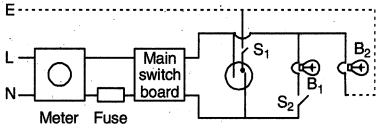
$(i)$ The given figure shows a domestic electric circuit. Study this circuit carefully. List any two errors in the circuit and justify your answer.
$(ii)$ Give one difference between the wires used in the element of an electric heater and in a fuse:
$(iii)$ List two advantages of parallel connection over series connection.
$(ii)$ Give one difference between the wires used in the element of an electric heater and in a fuse:
$(iii)$ List two advantages of parallel connection over series connection.
Solution
(N/A) $(i)$ Two errors are:
$(a)$ The fuse is incorrectly connected to the neutral wire $(N)$; it must be connected to the live wire $(L)$ to ensure safety by breaking the circuit during a fault.
$(b)$ Bulb $B_{2}$ is not connected to the neutral wire,meaning the circuit for $B_{2}$ is incomplete and it will not glow.
$(ii)$ The element of an electric heater is made of a material with a high melting point (like nichrome) to withstand high temperatures without melting. In contrast,a fuse wire is made of a material with a low melting point so that it melts and breaks the circuit when excessive current flows.
$(iii)$ Two advantages of parallel connection over series connection are:
$(a)$ Each appliance receives the same potential difference (voltage) as the power supply.
$(b)$ Each appliance has a separate switch,allowing it to be turned $ON$ or $OFF$ independently without affecting other appliances.
0 likes
View Solution52
Medium
$(i)$ Write the values of the following physical quantities in connection with domestic power supply in our country: $(a)$ potential difference between live wire and neutral wire.
$(b)$ frequency of $AC$.
$(ii)$ Explain the role of the following as safety measure in domestic electric appliances/circuits:
$(a)$ earth wire
$(b)$ fuse.
$(b)$ frequency of $AC$.
$(ii)$ Explain the role of the following as safety measure in domestic electric appliances/circuits:
$(a)$ earth wire
$(b)$ fuse.
Solution
(N/A) $(i)$
$(a) 220 \ V$
$(b) 50 \ Hz$
$(ii)$
$(a)$ Earth wire: The earth wire is a thick metal wire connected to a metal plate buried deep into the earth. It is used as a safety measure for appliances with a metallic body,$e.g.$,toasters,etc. The metallic body is connected to the earth wire,which provides a low-resistance conducting path for the current. It ensures that any leakage of current in the metallic body keeps its potential equal to that of the earth,preventing the user from getting a severe electric shock if touched.
$(b)$ Fuse: It is a piece of wire made of an alloy with a low melting point. If a current larger than the specified value flows through the circuit,the temperature of the fuse wire increases and it melts. This breaks the circuit and prevents the flow of an excessively high electric current in the device. In this way,a fuse of proper rating protects the appliance and the circuit from damage.
0 likes
View Solution53
EasyMCQ
Normally,a red colour cable is used for the live wire in domestic electrical circuits.
A
True
B
False
Solution
(A) In domestic electrical circuits,the standard colour coding for wires is as follows:
$1$. The $Live$ wire is red.
$2$. The $Neutral$ wire is black.
$3$. The $Earth$ wire is green.
Therefore,the statement is $True$.
$1$. The $Live$ wire is red.
$2$. The $Neutral$ wire is black.
$3$. The $Earth$ wire is green.
Therefore,the statement is $True$.
0 likes
View Solution54
EasyMCQ
All the distribution circuits for domestic purposes are parallel connections.
A
True
B
False
Solution
(A) In domestic electrical circuits,all appliances are connected in parallel.
This is because parallel circuits ensure that each appliance receives the same voltage ($220 \ V$ in India) regardless of the number of appliances connected.
Additionally,if one appliance fails or is switched off,it does not affect the operation of other appliances,and each appliance can be controlled by its own individual switch.
0 likes
View Solution55
EasyMCQ
Earthing of electrical appliances is very important.
A
True
B
False
Solution
(A) Earthing is a safety measure used to protect users from electric shocks. It involves connecting the metallic body of an electrical appliance to the ground through a wire. If there is any leakage of current in the appliance,the current flows directly to the earth instead of passing through the user's body,thereby preventing a fatal electric shock.
0 likes
View Solution56
Medium
In a household electric circuit,different appliances are connected in parallel to one another. Give two reasons for this. An electrician puts a fuse of rating $5 \, A$ in that part of a domestic electrical circuit in which an electrical heater of rating $1.5 \, kW, 220 \, V$ is operating. What is likely to happen in this case and why? What change,if any,needs to be made?
Solution
(D) Reasons for parallel connection:
$(i)$ Each appliance receives the same potential difference (voltage) as the supply source.
$(ii)$ If one appliance fails or is switched off,the others continue to operate independently.
$(b)$ Calculation:
Given: Fuse rating $= 5 \, A$,Power $(P) = 1.5 \, kW = 1500 \, W$,Voltage $(V) = 220 \, V$.
Using the formula $I = \frac{P}{V}$:
$I = \frac{1500}{220} \approx 6.82 \, A$.
Since the current required by the heater $(6.82 \, A)$ is greater than the fuse rating $(5 \, A)$,the fuse will melt (blow off) and the circuit will break.
$(c)$ Required change:
$A$ fuse with a higher rating,typically $10 \, A$,should be installed to accommodate the current drawn by the heater.
0 likes
View Solution57
EasyMCQ
How are electrical appliances connected to the main line in our homes?
A
Parallel
B
Series
C
Series and parallel
D
None of the above
Solution
(A) In domestic electrical circuits,all appliances are connected in parallel to the main line.
This is because,in a parallel connection,each appliance receives the same voltage as the source.
Furthermore,if one appliance stops working or is switched off,it does not affect the operation of other appliances.
Additionally,each appliance can be operated independently with its own switch.
This is because,in a parallel connection,each appliance receives the same voltage as the source.
Furthermore,if one appliance stops working or is switched off,it does not affect the operation of other appliances.
Additionally,each appliance can be operated independently with its own switch.
0 likes
View Solution58
EasyMCQ
The magnitude of an $AC$ voltage used in India is $......$ and its frequency is $......$.
A
$110 \ V, 60 \ Hz$
B
$110 \ V, 50 \ Hz$
C
$220 \ V, 50 \ Hz$
D
$220 \ V, 60 \ Hz$
Solution
(C) In India,the standard domestic power supply provided by the electricity grid is an alternating current $(AC)$ with a root mean square $(RMS)$ voltage magnitude of $220 \ V$.
The frequency of this alternating current is standardized at $50 \ Hz$,which means the current changes its direction $100$ times per second (completing $50$ cycles per second).
Therefore,the correct values are $220 \ V$ and $50 \ Hz$.
The frequency of this alternating current is standardized at $50 \ Hz$,which means the current changes its direction $100$ times per second (completing $50$ cycles per second).
Therefore,the correct values are $220 \ V$ and $50 \ Hz$.
0 likes
View Solution59
EasyMCQ
Traditionally,which coloured insulation on wire is used for earthing?
A
Red
B
Black
C
Green
D
White
Solution
(C) In domestic electrical circuits,different colours of insulation are used for wires to distinguish them.
$1$. The live wire is typically red.
$2$. The neutral wire is typically black.
$3$. The earth wire is traditionally green or yellow-green.
Therefore,green insulation is used for earthing to ensure safety by providing a low-resistance path for leakage current.
$1$. The live wire is typically red.
$2$. The neutral wire is typically black.
$3$. The earth wire is traditionally green or yellow-green.
Therefore,green insulation is used for earthing to ensure safety by providing a low-resistance path for leakage current.
0 likes
View Solution60
EasyMCQ
How many times does an $AC$ electric current with the frequency $50\, Hz$ change its direction in one second?
A
$25$
B
$50$
C
$100$
D
$200$
Solution
(C) The frequency of an $AC$ current is defined as the number of complete cycles per second.
One complete cycle consists of two alternations (or half-cycles) where the current flows in one direction and then in the opposite direction.
Therefore,in one complete cycle,the current changes its direction twice.
Given that the frequency is $50\, Hz$,there are $50$ complete cycles in one second.
Total number of direction changes $= 50 \times 2 = 100$ times per second.
0 likes
View Solution61
EasyMCQ
Which of the following is used in a fire alarm?
A
Electric motor
B
Electric generator
C
Electric bell
D
Dynamo
Solution
(C) fire alarm system typically utilizes an electric bell as an output device to produce a loud sound when a fire is detected. The electric bell operates on the principle of the magnetic effect of electric current. When the circuit is closed by a sensor (like a heat or smoke detector),current flows through the electromagnet,which attracts the hammer to strike the gong,creating a continuous alarm sound.
0 likes
View Solution62
EasyMCQ
The magnitude of an $AC$ voltage used in other countries like America $(USA)$ is $.........$ and its frequency is $.......$.
A
$220\;V, 60\;Hz$
B
$110\;V, 60\;Hz$
C
$220\;V, 50\;Hz$
D
$110\;V, 50\;Hz$
Solution
(B) In the United States of America $(USA)$,the standard domestic electrical power supply is provided at a voltage magnitude of $110\;V$ and a frequency of $60\;Hz$.
In contrast,many other countries,including India,use a standard voltage of $220\;V$ to $240\;V$ with a frequency of $50\;Hz$.
Therefore,the correct option is $B$.
In contrast,many other countries,including India,use a standard voltage of $220\;V$ to $240\;V$ with a frequency of $50\;Hz$.
Therefore,the correct option is $B$.
0 likes
View Solution63
EasyMCQ
In domestic electrical wiring,what is the red-colored insulated wire used for?
A
Live
B
Neutral
C
Earthing
D
Negative
Solution
(A) In domestic electrical circuits,standard color coding is used for safety and identification.
$1$. The $Red$ wire is used for the $Live$ (or $Phase$) connection,which carries the current from the power supply.
$2$. The $Black$ wire is used for the $Neutral$ connection.
$3$. The $Green$ or $Yellow$ wire is used for $Earthing$ (grounding) to prevent electric shocks.
Therefore,the red-colored insulated wire is used for the $Live$ connection.
0 likes
View Solution64
EasyMCQ
In domestic electrical wiring,which color of insulation is typically used for the neutral wire?
A
Red
B
Black
C
Green
D
White
Solution
(B) According to the standard color coding for domestic electrical wiring in India:
$1$. The $Live$ wire is typically red.
$2$. The $Neutral$ wire is typically black.
$3$. The $Earth$ wire is typically green.
Therefore,the correct color for the neutral wire is black.
$1$. The $Live$ wire is typically red.
$2$. The $Neutral$ wire is typically black.
$3$. The $Earth$ wire is typically green.
Therefore,the correct color for the neutral wire is black.
0 likes
View Solution65
EasyMCQ
Appliances with higher power ratings are connected to which ampere line (in $A$)?
A
$5$
B
$6$
C
$10$
D
$15$
Solution
(D) In domestic electrical circuits,two types of circuits are used: one with a $5A$ current rating for appliances with lower power consumption (like bulbs,fans,and televisions) and another with a $15A$ current rating for appliances with higher power consumption (like air conditioners,refrigerators,and electric irons).
Therefore,appliances with higher power ratings are connected to the $15A$ line.
Therefore,appliances with higher power ratings are connected to the $15A$ line.
0 likes
View Solution66
EasyMCQ
Which of the following appliances cannot be connected in a $15\, A$ current line?
A
Air conditioner machine
B
$TV$
C
Tubelight
D
Electric fan
Solution
(B, C, D) In domestic electrical circuits,two types of circuits are used: a $5\, A$ circuit for low-power appliances and a $15\, A$ circuit for high-power appliances.
Appliances like $TV$,tubelights,and electric fans consume very little power and are designed to operate on a $5\, A$ circuit.
Connecting these low-power devices to a $15\, A$ line is unnecessary and potentially unsafe if the circuit protection is not properly matched.
An air conditioner is a high-power appliance that requires a $15\, A$ circuit.
Therefore,$TV$,tubelight,and electric fan are not typically connected to a $15\, A$ line,but among the given options,the question implies identifying appliances that do not require such high current capacity. Since $TV$,tubelight,and electric fan all fall into this category,the question is slightly ambiguous; however,in standard practice,$TV$,tubelight,and fan are all $5\, A$ appliances.
0 likes
View Solution67
EasyMCQ
Connecting too many appliances to a single circuit often leads to an increase in electric current. What is this phenomenon called?
A
Earthing
B
Overloading
C
Short-circuiting
D
Dropage
Solution
(B) When too many electrical appliances are connected to a single circuit,the total current drawn from the source exceeds the capacity of the wires. This excessive flow of current causes the wires to heat up significantly,which can lead to damage or fire. This phenomenon is known as $Overloading$.
0 likes
View Solution68
EasyMCQ
In an electric circuit,a fuse is used because $......$
A
it increases the voltage
B
it increases the current
C
it saves the electric energy
D
it protects the electrical appliances from damage
Solution
(D) An electric fuse is a safety device used in electrical circuits.
It consists of a wire made of a material with a low melting point.
When an excessive amount of current flows through the circuit due to short-circuiting or overloading,the fuse wire heats up and melts.
This breaks the circuit,thereby preventing the flow of current to the appliances.
Thus,it protects the electrical appliances from damage caused by high current surges.
0 likes
View SolutionMagnetic Effects of Electric Current — Domestic Electric Circuits · Frequently Asked Questions
1Are these Magnetic Effects of Electric Current questions useful for JEE and NEET?
Yes. All questions in this section are mapped to JEE Main and NEET exam patterns. Previous year questions from JEE Main, NEET, GUJCET and state-level exams are included with full solutions.
2Can I switch to Hindi or Gujarati for these questions?
Yes. Use the language tabs in the hero section or the sidebar to view the same questions and solutions in English, Hindi or Gujarati.
3How do I generate a question paper from this subtopic?
Use the Vedclass Exam Paper Generator — select the chapter and subtopic, set difficulty, and generate Sets A, B, C, D automatically. First 3 chapters of every subject are free.
Vedclass Products
For Students
Vedclass Test Series
Mock tests in real JEE/NEET style with performance analysis. 5-day free trial.
Start Free TrialFor Teachers
Exam Paper Generator
Generate Set A/B/C/D papers from this chapter in 2 minutes. 3 chapters free.
Try FreeFor Institutes
Online Exam Module
Live online exams with unlimited students, 360° analytics & white-label branding.
See DemoFor Teachers & Institutes
Generate a Magnetic Effects of Electric Current Exam Paper in 2 Minutes
Select subtopic & difficulty — Sets A, B, C, D auto-generated with No Repeat logic.
First 3 chapters of every subject are free — no payment required.