
A English
Force on a Current-carrying Conductor in a Magnetic Field Questions in English
Class 10 Science · Magnetic Effects of Electric Current · Force on a Current-carrying Conductor in a Magnetic Field
51+
Questions
English
Language
100%
With Solutions
Showing 50 of 51 questions in English
1
MediumMCQ
Which of the following properties of a proton can change while it moves freely in a magnetic field?
A
mass
B
speed
C
velocity
D
velocity and momentum
Solution
(D) When a proton moves in a magnetic field,it experiences a magnetic force given by $F = q(v \times B)$.
This force acts perpendicular to the direction of motion,which causes the proton to follow a circular path.
Since the direction of motion changes continuously in a circular path,the velocity of the proton changes.
Because momentum is defined as $p = mv$ and velocity changes,the momentum also changes.
However,the speed (magnitude of velocity) and mass remain constant because the magnetic force does no work on the particle.
0 likes
View Solution2
Medium
In the activity,how do we think the displacement of rod $AB$ will be affected if:
$(i)$ current in rod $AB$ is increased;
$(ii)$ a stronger horse-shoe magnet is used; and
$(iii)$ length of the rod $AB$ is increased?
$(i)$ current in rod $AB$ is increased;
$(ii)$ a stronger horse-shoe magnet is used; and
$(iii)$ length of the rod $AB$ is increased?
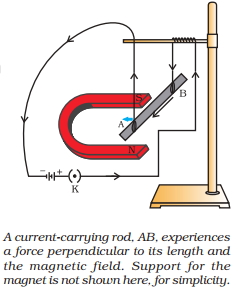
Solution
(N/A) current-carrying conductor placed in a magnetic field experiences a magnetic force. The magnitude of this force is given by $F = BIl \sin \theta$,where $B$ is the magnetic field strength,$I$ is the current,and $l$ is the length of the conductor.
$(i)$ If the current $(I)$ in rod $AB$ is increased,the magnetic force $F$ increases,leading to a greater displacement of the rod.
$(ii)$ If a stronger horse-shoe magnet is used,the magnetic field strength $(B)$ increases,which increases the magnetic force $F$,resulting in a greater displacement of the rod.
$(iii)$ If the length $(l)$ of the rod $AB$ is increased,the magnetic force $F$ increases,which also leads to a greater displacement of the rod.
0 likes
View Solution3
MediumMCQ
$A$ positively-charged particle (alpha-particle) projected towards west is deflected towards north by a magnetic field. The direction of magnetic field is
A
towards east
B
upward
C
downward
D
towards south
Solution
(B) The direction of the magnetic field can be determined by the $Fleming's$ left-hand rule.
According to this rule,if we arrange the thumb,the middle finger,and the forefinger of the left hand at right angles to each other,then the thumb points towards the direction of the magnetic force,the middle finger gives the direction of current,and the forefinger points in the direction of the magnetic field.
Since the direction of the positively charged alpha particle is towards the west,the direction of the current will be the same,i.e.,towards the west.
The direction of the magnetic force (deflection) is towards the north.
Applying $Fleming's$ left-hand rule: point the middle finger towards the west and the thumb towards the north; the forefinger will point in the upward direction.
Therefore,the direction of the magnetic field is upward.
0 likes
View Solution4
Medium
State Fleming's left-hand rule.
Solution
(N/A) Fleming's left-hand rule states that if we stretch the thumb,the forefinger,and the middle finger of the left hand such that they are mutually perpendicular to each other,then:
$1$. The forefinger points in the direction of the magnetic field.
$2$. The middle finger points in the direction of the current.
$3$. The thumb points in the direction of the force or motion experienced by the conductor.
$1$. The forefinger points in the direction of the magnetic field.
$2$. The middle finger points in the direction of the current.
$3$. The thumb points in the direction of the force or motion experienced by the conductor.
0 likes
View Solution5
MediumMCQ
What is the role of the split ring in an electric motor?
A
To increase the speed of the motor
B
To act as a commutator
C
To provide a magnetic field
D
To supply electricity to the coil
Solution
(B) The split ring in an electric motor acts as a commutator.
It reverses the direction of the current flowing through the coil after every half rotation.
Due to this reversal of the current,the force acting on the coil remains in the same direction,allowing the coil to continue rotating in the same direction.
It reverses the direction of the current flowing through the coil after every half rotation.
Due to this reversal of the current,the force acting on the coil remains in the same direction,allowing the coil to continue rotating in the same direction.
0 likes
View Solution6
EasyMCQ
When is the force experienced by a current-carrying conductor placed in a magnetic field largest?
A
When the current is parallel to the magnetic field.
B
When the current is perpendicular to the magnetic field.
C
When the current is at an angle of $45^{\circ}$ to the magnetic field.
D
When the current is at an angle of $60^{\circ}$ to the magnetic field.
Solution
(B) The force $F$ on a current-carrying conductor in a magnetic field is given by the formula $F = BIl \sin(\theta)$,where $B$ is the magnetic field strength,$I$ is the current,$l$ is the length of the conductor,and $\theta$ is the angle between the direction of the current and the magnetic field.
Since the maximum value of $\sin(\theta)$ is $1$ (which occurs when $\theta = 90^{\circ}$),the force is largest when the direction of the current is perpendicular to the direction of the magnetic field.
Since the maximum value of $\sin(\theta)$ is $1$ (which occurs when $\theta = 90^{\circ}$),the force is largest when the direction of the current is perpendicular to the direction of the magnetic field.
0 likes
View Solution7
Medium
Imagine that you are sitting in a chamber with your back to one wall. An electron beam,moving horizontally from the back wall towards the front wall,is deflected by a strong magnetic field to your right side. What is the direction of the magnetic field?
Solution
(DOWNWARD) The direction of the magnetic field is determined using Fleming's left-hand rule.
According to this rule,if the forefinger points in the direction of the magnetic field,the middle finger in the direction of the current,then the thumb points in the direction of the force (deflection).
$1$. The electron beam moves from the back wall to the front wall. Since electrons are negatively charged,the direction of the conventional current is from the front wall to the back wall.
$2$. The force (deflection) is directed towards your right side.
$3$. Applying Fleming's left-hand rule: Point your middle finger towards the back wall (direction of current) and your thumb towards your right (direction of force). Your forefinger will then point downwards.
Therefore,the direction of the magnetic field is downward.
0 likes
View Solution8
Medium
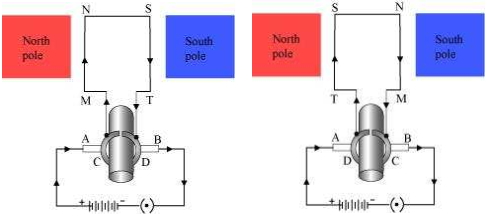
Draw a labelled diagram of an electric motor. Explain its principle and working. What is the function of a split ring in an electric motor?
Solution
(N/A) An electric motor converts electrical energy into mechanical energy.
It works on the principle of the magnetic effect of current. $A$ current-carrying coil rotates in a magnetic field. The following figure shows a simple electric motor.
When a current is allowed to flow through the coil $MNST$ by closing the switch,the coil starts rotating anti-clockwise. This happens because a downward force acts on length $MN$ and at the same time,an upward force acts on length $ST$. As a result,the coil rotates anti-clockwise.
Current in the length $MN$ flows from $M$ to $N$ and the magnetic field acts from left to right,normal to length $MN$. Therefore,according to Fleming's left-hand rule,a downward force acts on the length $MN$. Similarly,current in the length $ST$ flows from $S$ to $T$ and the magnetic field acts from left to right,normal to the flow of current. Therefore,an upward force acts on the length $ST$. These two forces cause the coil to rotate anti-clockwise. After half a rotation,the position of $MN$ and $ST$ interchange. The half-ring $D$ comes in contact with brush $A$ and half-ring $C$ comes in contact with brush $B$. Hence,the direction of current in the coil $MNST$ gets reversed.
The current flows through the coil in the direction $TSNM$. The reversal of current through the coil $MNST$ repeats after each half rotation. As a result,the coil rotates unidirectionally. The split rings help to reverse the direction of current in the circuit. These are called the commutator.
0 likes
View Solution9
DifficultMCQ
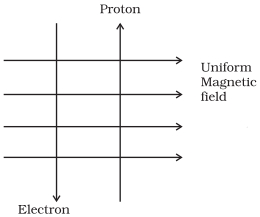
$A$ uniform magnetic field exists in the plane of paper pointing from left to right as shown in Figure. In the field,an electron and a proton move as shown. The electron and the proton experience:
A
forces both pointing into the plane of paper
B
forces both pointing out of the plane of paper
C
forces pointing into the plane of paper and out of the plane of paper,respectively
D
force pointing opposite and along the direction of the uniform magnetic field respectively
Solution
(C) According to Fleming's Left-Hand Rule,the direction of the force on a moving charge in a magnetic field is determined by the orientation of the magnetic field,the direction of the current (or motion of positive charge),and the force.
For the proton (positive charge moving upwards),the magnetic field is to the right. Using the left-hand rule,the force points into the plane of the paper.
For the electron (negative charge moving downwards),the direction of the conventional current is upwards. Since the magnetic field is to the right,the force on the electron points out of the plane of the paper.
Therefore,the proton experiences a force into the plane,and the electron experiences a force out of the plane.
0 likes
View Solution10
EasyMCQ
To convert an $AC$ generator into a $DC$ generator,
A
a stronger magnetic field has to be used.
B
slip rings and brushes must be used.
C
a split-ring type commutator must be used.
D
a rectangular wire loop has to be used.
Solution
(C) An $AC$ generator uses slip rings to maintain a continuous connection with the rotating coil,which results in an alternating current output.
To convert this into a $DC$ generator,the slip rings must be replaced with a split-ring type commutator.
The split-ring commutator acts as a reversing switch that reverses the direction of the current in the external circuit every time the coil passes the vertical position,ensuring that the current flows in only one direction in the external circuit.
0 likes
View Solution11
EasyMCQ
What is the role of the two conducting stationary brushes in a simple electric motor?
A
To rotate the coil
B
To reverse the direction of current
C
To provide a sliding contact with the split rings to conduct current into the coil
D
To increase the magnetic field strength
Solution
(C) In a simple electric motor,the two conducting stationary brushes (usually made of carbon) are used to maintain a sliding contact with the split rings (commutator).
These brushes are connected to the external battery circuit.
As the split rings rotate with the coil,the brushes remain stationary and allow the electric current to flow continuously from the external source into the rotating coil without tangling the wires.
These brushes are connected to the external battery circuit.
As the split rings rotate with the coil,the brushes remain stationary and allow the electric current to flow continuously from the external source into the rotating coil without tangling the wires.
0 likes
View Solution12
Medium
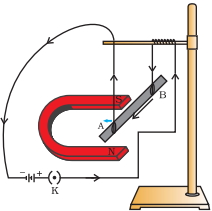
Describe the activity that shows that a current-carrying conductor experiences a force perpendicular to its length and the external magnetic field. How does Fleming's left-hand rule help us to find the direction of the force acting on the current-carrying conductor?
Solution
(N/A) Activity: Take a small aluminum rod $AB$ suspended horizontally from a stand using two connecting wires. Place a strong horseshoe magnet in such a way that the rod lies between the two poles with the magnetic field directed upwards. Connect the rod $AB$ in series with a battery,a key,and a rheostat. When current is passed through the rod from $B$ to $A$,the rod is observed to get displaced. This displacement shows that a force is acting on the current-carrying conductor when it is placed in a magnetic field. The direction of this force is perpendicular to both the length of the conductor and the magnetic field.
Fleming's Left-Hand Rule: According to this rule,stretch the thumb,forefinger,and middle finger of your left hand such that they are mutually perpendicular. If the forefinger points in the direction of the magnetic field and the middle finger points in the direction of the current,then the thumb will point in the direction of the motion or the force acting on the conductor.
Fleming's Left-Hand Rule: According to this rule,stretch the thumb,forefinger,and middle finger of your left hand such that they are mutually perpendicular. If the forefinger points in the direction of the magnetic field and the middle finger points in the direction of the current,then the thumb will point in the direction of the motion or the force acting on the conductor.
0 likes
View Solution13
Medium
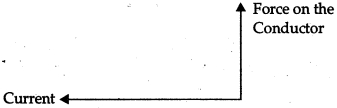
State the direction of the magnetic field in the following case:
Solution
(N/A) To determine the direction of the magnetic field,we use Fleming's Left-Hand Rule.
According to Fleming's Left-Hand Rule,if we stretch the thumb,forefinger,and middle finger of our left hand such that they are mutually perpendicular to each other,then:
$1$. The forefinger points in the direction of the magnetic field.
$2$. The middle finger points in the direction of the current.
$3$. The thumb points in the direction of the force on the conductor.
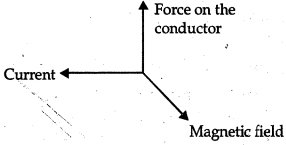
In the given figure,the current is directed towards the left and the force on the conductor is directed upwards.
By applying Fleming's Left-Hand Rule,we find that the magnetic field is directed out of the page (towards the observer).
0 likes
View Solution14
EasyMCQ
Name the rule used to find the direction of force on a current-carrying conductor placed in a magnetic field.
A
Fleming's left-hand rule
B
Fleming's right-hand rule
C
Right-hand thumb rule
D
Maxwell's corkscrew rule
Solution
(A) The rule used to determine the direction of the force acting on a current-carrying conductor placed in a magnetic field is $Fleming's \text{ left-hand rule}$. According to this rule, if we stretch the thumb, forefinger, and middle finger of our left hand such that they are mutually perpendicular to each other, then the forefinger points in the direction of the magnetic field, the middle finger points in the direction of the current, and the thumb gives the direction of the force or motion of the conductor.
0 likes
View Solution15
EasyMCQ
Name the factors on which the force acting on a current-carrying conductor placed in a magnetic field depends.
A
Current through the conductor
B
Strength of the magnetic field
C
Length of the conductor
D
All of the above
Solution
(D) The force $(F)$ acting on a current-carrying conductor placed in a magnetic field is given by the formula $F = BIl \sin \theta$.
Therefore,the factors are:
$(i)$ The current $(I)$ flowing through the conductor.
$(ii)$ The strength of the magnetic field $(B)$.
$(iii)$ The length of the conductor $(l)$.
$(iv)$ The angle $(\theta)$ between the direction of the current and the direction of the magnetic field.
Therefore,the factors are:
$(i)$ The current $(I)$ flowing through the conductor.
$(ii)$ The strength of the magnetic field $(B)$.
$(iii)$ The length of the conductor $(l)$.
$(iv)$ The angle $(\theta)$ between the direction of the current and the direction of the magnetic field.
0 likes
View Solution16
EasyMCQ
State the rule which you use to find the direction of induced current or state Fleming's right-hand rule.
A
Fleming's Left-Hand Rule
B
Fleming's Right-Hand Rule
C
Right-Hand Thumb Rule
D
Maxwell's Corkscrew Rule
Solution
(B) Fleming's right-hand rule states that if you stretch the thumb,forefinger,and middle finger of your right hand such that they are mutually perpendicular to each other,then the thumb points in the direction of the motion of the conductor relative to the magnetic field,the forefinger points in the direction of the magnetic field,and the middle finger points in the direction of the induced current.
0 likes
View Solution17
Easy
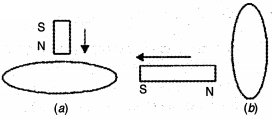
Give the direction of induced current in the following figure:
Solution
(N/A) According to Lenz's Law,the induced current will oppose the motion of the magnet. As the North pole $(N)$ of the magnet moves towards the coil,the coil will develop a North pole on its upper face to repel it. Therefore,the direction of the induced current,as seen from the top,will be anticlockwise.
$(b)$ As the North pole $(N)$ of the magnet moves towards the coil,the face of the coil facing the magnet will act as a North pole to oppose the motion. Looking from the right-hand side (where the magnet is approaching),the current will appear to flow in a clockwise direction.
$(b)$ As the North pole $(N)$ of the magnet moves towards the coil,the face of the coil facing the magnet will act as a North pole to oppose the motion. Looking from the right-hand side (where the magnet is approaching),the current will appear to flow in a clockwise direction.
0 likes
View Solution18
EasyMCQ
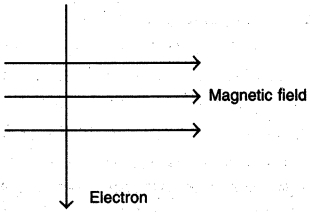
An electron enters a magnetic field at right angles to it as shown in the figure. The direction of force acting on the electron will be:
A
to the right
B
to the left
C
out of the page
D
into the page
Solution
(D) According to Fleming's left-hand rule,the direction of the force on a moving charge is determined by the orientation of the magnetic field and the direction of the conventional current.
Since the electron is a negatively charged particle moving downwards,the direction of the conventional current is upwards.
The magnetic field is directed towards the right.
Applying Fleming's left-hand rule: point the index finger in the direction of the magnetic field (right),and the middle finger in the direction of the current (upwards). The thumb will point into the page.
Therefore,the force acting on the electron is directed into the page.
0 likes
View Solution19
EasyMCQ
When is the force experienced by a current-carrying conductor placed in a magnetic field the largest?
A
When the current flows parallel to the magnetic field.
B
When the current flows at an angle of $45^{\circ}$ to the magnetic field.
C
When the current flows perpendicular to the magnetic field.
D
When the current flows at an angle of $30^{\circ}$ to the magnetic field.
Solution
(C) The force $F$ experienced by a current-carrying conductor of length $l$ carrying current $I$ in a magnetic field $B$ is given by the formula $F = BIl \sin(\theta)$,where $\theta$ is the angle between the direction of the current and the magnetic field.
Since the maximum value of $\sin(\theta)$ is $1$ (which occurs when $\theta = 90^{\circ}$),the force is largest when the current flows perpendicular to the applied magnetic field.
Since the maximum value of $\sin(\theta)$ is $1$ (which occurs when $\theta = 90^{\circ}$),the force is largest when the current flows perpendicular to the applied magnetic field.
0 likes
View Solution20
EasyMCQ
Mention the angle between a current-carrying conductor and a magnetic field for which the force experienced by this conductor is maximum. (in $^{\circ}$)
A
$0$
B
$45$
C
$90$
D
$180$
Solution
(C) The force $F$ experienced by a current-carrying conductor of length $l$ carrying current $I$ placed in a magnetic field $B$ is given by the formula $F = BIl \sin(\theta)$,where $\theta$ is the angle between the direction of the current and the magnetic field.
Since the value of $\sin(\theta)$ is maximum $(1)$ when $\theta = 90^{\circ}$,the force experienced by the conductor is largest when the conductor is placed perpendicular to the magnetic field,i.e.,at an angle of $90^{\circ}$.
Since the value of $\sin(\theta)$ is maximum $(1)$ when $\theta = 90^{\circ}$,the force experienced by the conductor is largest when the conductor is placed perpendicular to the magnetic field,i.e.,at an angle of $90^{\circ}$.
0 likes
View Solution21
EasyMCQ
What does the thumb indicate in Fleming's right-hand rule?
A
Direction of induced current
B
Direction of magnetic field
C
Direction of motion of the conductor
D
Direction of force
Solution
(C) Fleming's right-hand rule is used to determine the direction of the induced current in a conductor moving in a magnetic field.
According to this rule,if you stretch the thumb,forefinger,and middle finger of your right hand such that they are mutually perpendicular to each other,then:
$1$. The forefinger points in the direction of the magnetic field.
$2$. The thumb points in the direction of the motion of the conductor.
$3$. The middle finger points in the direction of the induced current.
Therefore,the thumb indicates the direction of motion of the conductor.
0 likes
View Solution22
Medium
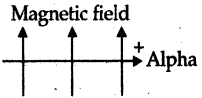
An alpha particle (positively charged particle) enters a magnetic field at a right angle to it,as shown in the figure. Explain the direction of the force acting on the alpha particle with the help of a relevant rule.
Solution
(N/A) According to Fleming's left-hand rule,if the forefinger points in the direction of the magnetic field and the central finger points in the direction of the current (the direction of motion of the positively charged alpha particle),then the thumb points in the direction of the force acting on the particle.
In this case,the magnetic field is directed upwards and the alpha particle is moving towards the right. Applying Fleming's left-hand rule,the force acting on the alpha particle will be directed out of the plane of the paper (perpendicular to the plane of the paper and towards the observer).
In this case,the magnetic field is directed upwards and the alpha particle is moving towards the right. Applying Fleming's left-hand rule,the force acting on the alpha particle will be directed out of the plane of the paper (perpendicular to the plane of the paper and towards the observer).
0 likes
View Solution23
Difficult
Why does a magnetic needle deflect when brought close to a current carrying conductor? Explain the rule to find the direction of force on a current carrying conductor.
Solution
(N/A) When a magnetic needle is brought near a current-carrying conductor,it deflects because the magnetic field produced by the current-carrying conductor exerts a magnetic force on the needle.
The direction of the force experienced by a current-carrying conductor placed in a magnetic field is determined by Fleming's Left-Hand Rule. According to this rule,stretch the thumb,forefinger,and middle finger of your left hand such that they are mutually perpendicular to each other. If the forefinger points in the direction of the magnetic field and the middle finger points in the direction of the current,then the thumb will point in the direction of the force (or motion) experienced by the conductor.
The direction of the force experienced by a current-carrying conductor placed in a magnetic field is determined by Fleming's Left-Hand Rule. According to this rule,stretch the thumb,forefinger,and middle finger of your left hand such that they are mutually perpendicular to each other. If the forefinger points in the direction of the magnetic field and the middle finger points in the direction of the current,then the thumb will point in the direction of the force (or motion) experienced by the conductor.
0 likes
View Solution24
EasyMCQ
On what factors does the force experienced by a current-carrying conductor placed in a uniform magnetic field depend?
A
Strength of the magnetic field
B
Strength of the electric current
C
Length of the conductor
D
All of the above
Solution
(D) The force $F$ experienced by a current-carrying conductor of length $l$ carrying current $I$ placed in a uniform magnetic field $B$ is given by the formula $F = BIl \sin(\theta)$.
Based on this formula, the force depends on the following factors:
$(i)$ The strength of the magnetic field $(B)$.
$(ii)$ The strength of the electric current $(I)$.
$(iii)$ The length of the conductor $(l)$.
$(iv)$ The angle $(\theta)$ between the direction of the current and the direction of the magnetic field.
0 likes
View Solution25
Medium
State the characteristics of magnetic force.
Solution
(N/A) The following are the characteristics of magnetic force:
$(i)$ Magnetic force acts only on moving charges and not on stationary charges.
$(ii)$ No magnetic force acts on a charge if it is moving parallel or anti-parallel to the direction of the magnetic field.
$(iii)$ The direction of magnetic force is perpendicular to both $(a)$ the velocity vector of the charge and $(b)$ the magnetic field vector.
$(iv)$ The magnitude of magnetic force $(F)$ depends on the charge $(q)$,velocity $(v)$,and the strength $(B)$ of the magnetic field; i.e.,$F = qvB \sin \theta$,where $\theta$ is the angle between velocity and magnetic field.
$(v)$ The magnetic force $(F)$ acting on a current-carrying conductor of length $(L)$ placed in a magnetic field $(B)$ is given by $F = BIL \sin \theta$,where $I$ is the current flowing through the conductor.
0 likes
View Solution26
EasyMCQ
Two long parallel wires are hanging freely. If they are connected to a battery $(i)$ in series and $(ii)$ in parallel,what would be the effect on their positions?
A
They will attract in both cases.
B
They will repel in both cases.
C
They will repel in series and attract in parallel.
D
They will attract in series and repel in parallel.
Solution
(C) $(i)$ In series: When connected in series,the current flows through the wires in opposite directions relative to each other. According to the laws of electromagnetism,parallel wires carrying current in opposite directions exert a repulsive force on each other. Therefore,they will move apart.
$(ii)$ In parallel: When connected in parallel,the current flows through both wires in the same direction. Parallel wires carrying current in the same direction exert an attractive force on each other. Therefore,they will move towards each other.
$(ii)$ In parallel: When connected in parallel,the current flows through both wires in the same direction. Parallel wires carrying current in the same direction exert an attractive force on each other. Therefore,they will move towards each other.
0 likes
View Solution27
Medium
Why does a current-carrying conductor experience a force when it is placed in a magnetic field? State Fleming's left-hand rule.
Solution
(N/A) current-carrying conductor experiences a force when placed in a magnetic field due to the interaction between the magnetic field produced by the current flowing through the conductor and the external magnetic field in which it is placed.
Statement of Fleming's left-hand rule:
Stretch the thumb,forefinger,and middle finger of your left hand such that they are mutually perpendicular to each other. If the forefinger points in the direction of the magnetic field and the middle finger points in the direction of the current,then the thumb will point in the direction of the force acting on the conductor. An example of a device based on this principle is the electric motor.
0 likes
View Solution28
Medium
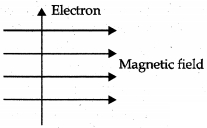
An electron enters a uniform magnetic field at right angles to it as shown in the figure below. In which direction will this electron move? State the rule applied by you in finding the direction of motion of the electron.
Solution
(N/A) The electron will move perpendicular to the plane of the paper and downwards.
Explanation:
$1$. The direction of the magnetic field is towards the right.
$2$. The electron is moving upwards. Since the current is defined as the flow of positive charges,the direction of conventional current is opposite to the direction of the electron's motion,i.e.,downwards.
$3$. Applying Fleming's Left-Hand Rule: Stretch the thumb,forefinger,and middle finger of the left hand such that they are mutually perpendicular. If the forefinger points in the direction of the magnetic field (right) and the middle finger points in the direction of the current (downwards),then the thumb points in the direction of the force acting on the electron.
$4$. According to this rule,the force on the electron acts perpendicular to the plane of the paper and downwards.
0 likes
View Solution29
Medium
$A$ student,while studying the force experienced by a current-carrying conductor in a magnetic field,records the following observations:
$(i)$ The force experienced by the conductor increases as the current is increased.
$(ii)$ The force experienced by the conductor decreases as the strength of the magnetic field is increased.
Which of the two observations is correct and why?
$(i)$ The force experienced by the conductor increases as the current is increased.
$(ii)$ The force experienced by the conductor decreases as the strength of the magnetic field is increased.
Which of the two observations is correct and why?
Solution
(A) Observation $(i)$ is correct.
The force $(F)$ experienced by a current-carrying conductor placed in a magnetic field is given by the formula $F = BIl \sin \theta$,where $B$ is the magnetic field strength,$I$ is the current,and $l$ is the length of the conductor.
According to this relationship,the force is directly proportional to the current $(I)$ flowing through the conductor. Therefore,as the current increases,the force experienced by the conductor also increases.
Observation $(ii)$ is incorrect because the force is also directly proportional to the magnetic field strength $(B)$. Thus,increasing the magnetic field strength would increase the force,not decrease it.
0 likes
View Solution30
Medium
Name and state the rule to determine the direction of a force experienced by a current-carrying straight conductor placed in a magnetic field which is perpendicular to it. Name a device that uses a current-carrying conductor and a magnetic field.
Solution
(N/A) The rule used to determine the direction of the force is $Fleming's \text{ left-hand rule}$.
Statement: Stretch the thumb,forefinger,and middle finger of your left hand such that they are mutually perpendicular to each other. If the forefinger points in the direction of the magnetic field and the middle finger points in the direction of the current,then the thumb will point in the direction of the force acting on the conductor.
$A$ device that uses a current-carrying conductor and a magnetic field is an $electric \text{ motor}$.
0 likes
View Solution31
Medium
$A$ uniform magnetic field is directed vertically upwards. In which direction should an $\alpha$-particle (which is a positively charged particle) be projected in this field so that it is deflected southwards? Name and state the rule used to find the direction in this case.
Solution
(EAST) The $\alpha$-particle is a positively charged particle. According to Fleming's Left-Hand Rule,the force $(F)$ on a moving charge is perpendicular to both the magnetic field $(B)$ and the velocity $(v)$ of the charge.
Given: Magnetic field $(B)$ is vertically upwards. Force $(F)$ is towards the south.
Using Fleming's Left-Hand Rule: If the forefinger points upwards (magnetic field) and the thumb points south (force),the middle finger will point towards the east.
Therefore,the $\alpha$-particle should be projected towards the east.
Fleming's Left-Hand Rule states: Stretch the thumb,forefinger,and middle finger of your left hand such that they are mutually perpendicular. If the forefinger points in the direction of the magnetic field and the middle finger points in the direction of the current (or motion of positive charge),then the thumb points in the direction of the force acting on the particle.
0 likes
View Solution32
Easy
Why does a current-carrying conductor kept in a magnetic field experience a force? On what factors does the direction of this force depend? Name and state the rule used for the determination of the direction of this force.
Solution
(N/A) current-carrying conductor produces its own magnetic field around it. When this field interacts with an external magnetic field,it experiences a mechanical force.
The direction of this force depends on two factors:
$1$. The direction of the electric current flowing through the conductor.
$2$. The direction of the external magnetic field.
The rule used to determine the direction of this force is $Fleming's \text{ } Left-Hand \text{ } Rule$.
Statement of $Fleming's \text{ } Left-Hand \text{ } Rule$: Stretch the thumb,forefinger,and middle finger of your left hand such that they are mutually perpendicular to each other. If the forefinger points in the direction of the magnetic field,the middle finger points in the direction of the current,then the thumb will point in the direction of the force (or motion) acting on the conductor.
0 likes
View Solution33
Medium
Under what condition does a current-carrying conductor kept in a magnetic field experience maximum force? On what other factors does the magnitude of this force depend? Name and state the rule used for the determination of the direction of this force.
Solution
(N/A) current-carrying conductor experiences maximum force when it is placed perpendicular to the direction of the magnetic field.
The magnitude of this force depends on the following factors:
$(i)$ The strength of the magnetic field $(B)$.
$(ii)$ The magnitude of the current flowing through the conductor $(I)$.
$(iii)$ The length of the conductor $(L)$ placed within the magnetic field.
The rule used to determine the direction of this force is Fleming's Left-Hand Rule.
Statement of Fleming's Left-Hand Rule: Stretch the thumb,forefinger,and middle finger of your left hand such that they are mutually perpendicular to each other. If the forefinger points in the direction of the magnetic field and the middle finger points in the direction of the current,then the thumb will point in the direction of the force acting on the conductor.
0 likes
View Solution34
Medium
$(a)$ Name two electrical appliances of daily use in which an electric motor is used.
$(b)$ Name and state the principle on which an electric motor works.
$(b)$ Name and state the principle on which an electric motor works.
Solution
(N/A) Electric motors are commonly used in appliances such as electric fans,washing machines,and mixers.
$(b)$ An electric motor works on the principle that a current-carrying conductor placed in a magnetic field experiences a mechanical force.
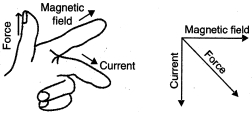
Fleming's Left-Hand Rule: If we stretch the thumb,forefinger,and middle finger of our left hand such that they are mutually perpendicular to each other,then the forefinger points in the direction of the magnetic field,the middle finger points in the direction of the current,and the thumb gives the direction of the force acting on the conductor.
0 likes
View Solution35
Difficult
Describe an experiment to demonstrate the force acting on a current-carrying conductor placed in a magnetic field.
Solution
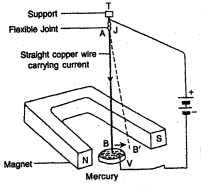
(N/A) thick,copper wire $AB$ is suspended vertically from a support $T$ by means of a flexible joint $J.$ The lower end $B$ of this wire is free to move between the poles of a $U$-shaped magnet $M.$ The lower end $B$ of the wire just touches the surface of mercury kept in a shallow vessel $V$ so that it can move when a force acts on it. The positive terminal of a battery is connected to end $A$ of the wire. The circuit is completed by dipping another wire from the negative terminal of the battery into the mercury in the vessel. We know that mercury is a liquid which is a good conductor of electricity,so the circuit is completed.
On pressing the switch,a current flows in the wire $AB$ in the vertically downward direction. The wire $AB$ is pushed in the forward direction (towards south) and its lower end $B$ reaches the position $B',$ so that the wire comes to the new position $AB',$ as shown by the dotted line in the figure. When the lower end $B$ of the hanging wire comes forward to $B',$ its contact with the mercury surface is broken,due to which the circuit breaks and the current stops flowing in the wire $AB.$
Since no current flows in the wire,no force acts on the wire in this position and it falls back to its original position. As soon as the wire falls back,its lower end again touches the mercury surface,current starts flowing in the wire,and it is pushed again. This reaction is repeated as long as the current is passed in wire $AB.$ It may be noted that the current-carrying wire is pushed forward because a force is exerted on it by the magnetic field of the $U$-shaped magnet. From this experiment,we conclude that when a current-carrying conductor is placed in a magnetic field,a mechanical force is exerted on the conductor which makes it move.
0 likes
View Solution36
Medium
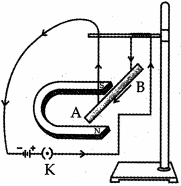
$(a)$ Describe an experiment with a diagram to show that force is exerted on a current-carrying conductor when placed perpendicular in a magnetic field.
$(b)$ How will this force change if the current in the conductor is increased?
$(c)$ Name a device that uses the above principle.
$(b)$ How will this force change if the current in the conductor is increased?
$(c)$ Name a device that uses the above principle.
Solution
(N/A) Experiment: Take a small aluminum rod $AB$ suspended horizontally from a stand by two connecting wires. Place a strong horseshoe magnet in such a way that the rod lies between the two poles with the magnetic field directed vertically upwards. Connect the ends of the rod in series with a battery,a key,and a rheostat. When current is passed through the rod from $B$ to $A$,the rod gets displaced. This displacement shows that a force is exerted on the current-carrying conductor when placed in a magnetic field.
$(b)$ The force acting on the conductor is directly proportional to the current flowing through it $(F \propto I)$. Therefore,if the current in the conductor is increased,the force acting on it will also increase,resulting in a larger displacement of the rod.
$(c)$ An electric motor is a device that works on this principle.
0 likes
View Solution37
EasyMCQ
The direction of induced potential difference (induced current) is given by:
A
Cork screw rule
B
Right hand thumb rule
C
Fleming's left hand rule
D
Fleming's right hand rule
Solution
(D) The direction of the induced current in a conductor moving in a magnetic field is determined by Fleming's right-hand rule.
According to this rule,if you stretch the thumb,forefinger,and middle finger of your right hand such that they are mutually perpendicular to each other,then:
$1$. The thumb points in the direction of the motion of the conductor.
$2$. The forefinger points in the direction of the magnetic field.
$3$. The middle finger points in the direction of the induced current (or induced potential difference).
0 likes
View Solution38
EasyMCQ
In order to find the force experienced by a current-carrying conductor,we can use Maxwell's corkscrew rule.
A
True
B
False
Solution
(B) The statement is $False$.
Maxwell's corkscrew rule (also known as the Right-Hand Grip Rule) is used to determine the direction of the magnetic field produced by a current-carrying conductor.
To find the force experienced by a current-carrying conductor placed in a magnetic field,we use Fleming's Left-Hand Rule.
Maxwell's corkscrew rule (also known as the Right-Hand Grip Rule) is used to determine the direction of the magnetic field produced by a current-carrying conductor.
To find the force experienced by a current-carrying conductor placed in a magnetic field,we use Fleming's Left-Hand Rule.
0 likes
View Solution39
EasyMCQ
Which is the direction of magnetic force acting on a current-carrying wire placed in a magnetic field?
A
Along the magnetic field
B
Along the electric current
C
Perpendicular to both the magnetic field and the electric current
D
Opposite to the magnetic field
Solution
(C) The magnetic force $(F)$ acting on a current-carrying conductor of length $(l)$ carrying current $(I)$ placed in a magnetic field $(B)$ is given by the vector product: $F = I(l \times B)$.
According to the right-hand rule or Fleming's left-hand rule,the direction of the magnetic force is always perpendicular to the plane containing both the direction of the electric current and the direction of the magnetic field.
Therefore,the force is perpendicular to both the magnetic field and the electric current.
0 likes
View Solution40
EasyMCQ
How is a current-carrying wire placed in a magnetic field so that the magnetic field does not act on it?
A
Parallel to the magnetic field
B
Perpendicular to the magnetic field
C
At an angle of $45^{\circ}$ with the magnetic field
D
At an angle of $120^{\circ}$ with the magnetic field
Solution
(A) The magnetic force $F$ acting on a current-carrying wire of length $L$ carrying current $I$ in a magnetic field $B$ is given by the formula: $F = I L B \sin(\theta)$,where $\theta$ is the angle between the direction of the current and the magnetic field.
For the magnetic force to be zero $(F = 0)$,the value of $\sin(\theta)$ must be zero.
This occurs when $\theta = 0^{\circ}$ or $\theta = 180^{\circ}$.
Therefore,when the current-carrying wire is placed parallel to the magnetic field,the magnetic field does not exert any force on it.
For the magnetic force to be zero $(F = 0)$,the value of $\sin(\theta)$ must be zero.
This occurs when $\theta = 0^{\circ}$ or $\theta = 180^{\circ}$.
Therefore,when the current-carrying wire is placed parallel to the magnetic field,the magnetic field does not exert any force on it.
0 likes
View Solution41
EasyMCQ
Which instrument is used to convert electrical energy into mechanical energy?
A
Electric generator
B
Electric motor
C
Electric iron
D
Electric oven
Solution
(B) An $Electric \text{ } motor$ is a device that converts electrical energy into mechanical energy.
It works on the principle of the magnetic effect of electric current, where a current-carrying coil placed in a magnetic field experiences a force that causes it to rotate.
In contrast, an $Electric \text{ } generator$ converts mechanical energy into electrical energy.
$Electric \text{ } iron$ and $Electric \text{ } oven$ convert electrical energy into heat energy.
0 likes
View Solution42
EasyMCQ
Which rule is used to determine the direction of induced current in a circuit?
A
Fleming's Left-Hand Rule
B
Fleming's Right-Hand Rule
C
Right-Hand Thumb Rule
D
Ampere's Rule
Solution
(B) Fleming's Right-Hand Rule is used to determine the direction of the induced current in a conductor moving in a magnetic field.
According to this rule,if you stretch the thumb,forefinger,and middle finger of your right hand such that they are mutually perpendicular to each other,then the thumb points in the direction of the motion of the conductor,the forefinger points in the direction of the magnetic field,and the middle finger points in the direction of the induced current.
According to this rule,if you stretch the thumb,forefinger,and middle finger of your right hand such that they are mutually perpendicular to each other,then the thumb points in the direction of the motion of the conductor,the forefinger points in the direction of the magnetic field,and the middle finger points in the direction of the induced current.
0 likes
View Solution43
EasyMCQ
When a light,straight conducting wire is suspended perpendicular to a strong magnetic field and an electric current is passed through it,the magnetic force acting on it is proportional to which of the following?
A
Electric current
B
Length of the wire in the magnetic field
C
Magnetic field of the magnet
D
All of the above
Solution
(D) The magnetic force $F$ acting on a current-carrying conductor placed in a magnetic field is given by the formula $F = I L B \sin(\theta)$.
Here,$I$ is the electric current,$L$ is the length of the conductor within the magnetic field,$B$ is the magnetic field strength,and $\theta$ is the angle between the current direction and the magnetic field.
Since the wire is placed perpendicular to the magnetic field,$\theta = 90^\circ$,and $\sin(90^\circ) = 1$.
Therefore,the force $F = I L B$.
This shows that the magnetic force is directly proportional to the electric current $(I)$,the length of the wire $(L)$,and the magnetic field strength $(B)$.
Thus,all the given options are correct.
0 likes
View Solution44
EasyMCQ
The direction of the magnetic force acting on a current-carrying wire placed in a strong magnetic field can be determined by which rule?
A
Fleming's Left-Hand Rule
B
Fleming's Right-Hand Rule
C
Right-Hand Thumb Rule
D
Faraday's Law
Solution
(A) When a current-carrying conductor is placed in a magnetic field,it experiences a magnetic force.
According to Fleming's Left-Hand Rule,if we stretch the thumb,forefinger,and middle finger of our left hand such that they are mutually perpendicular to each other,then the forefinger points in the direction of the magnetic field,the middle finger points in the direction of the current,and the thumb gives the direction of the force acting on the conductor.
Therefore,Fleming's Left-Hand Rule is used to determine the direction of the magnetic force.
0 likes
View Solution45
EasyMCQ
Who first observed that a current-carrying wire experiences a force when placed in a strong magnetic field?
A
Volta
B
Faraday
C
Oersted
D
Ampere
Solution
(D) The phenomenon that a current-carrying conductor experiences a force when placed in a magnetic field was first observed by $Andre-Marie$ $Ampere$.
He demonstrated that magnetic fields exert forces on moving charges,which results in a mechanical force on the conductor carrying the current.
He demonstrated that magnetic fields exert forces on moving charges,which results in a mechanical force on the conductor carrying the current.
0 likes
View Solution46
EasyMCQ
When the direction of electric current in a conductor is perpendicular to the direction of the magnetic field,what is the magnitude of the force acting on the conductor?
A
Maximum
B
Minimum
C
Zero
D
Moderate
Solution
(A) The force $F$ acting on a current-carrying conductor placed in a magnetic field is given by the formula $F = BIl \sin(\theta)$,where $B$ is the magnetic field strength,$I$ is the current,$l$ is the length of the conductor,and $\theta$ is the angle between the direction of the current and the magnetic field.
When the direction of the current is perpendicular to the magnetic field,the angle $\theta = 90^\circ$.
Since $\sin(90^\circ) = 1$,the force becomes $F = BIl(1) = BIl$.
This value represents the maximum force that can act on the conductor.
When the direction of the current is perpendicular to the magnetic field,the angle $\theta = 90^\circ$.
Since $\sin(90^\circ) = 1$,the force becomes $F = BIl(1) = BIl$.
This value represents the maximum force that can act on the conductor.
0 likes
View Solution47
EasyMCQ
On which principle does an electric motor work?
A
Conversion of electrical energy into mechanical energy
B
Conversion of mechanical energy into electrical energy
C
Electromagnetic induction
D
Conversion of electrical energy into heat energy
Solution
(A) An electric motor is a device that converts electrical energy into mechanical energy.
It works on the principle that when a rectangular coil carrying current is placed in a magnetic field,it experiences a magnetic force,which causes the coil to rotate.
It works on the principle that when a rectangular coil carrying current is placed in a magnetic field,it experiences a magnetic force,which causes the coil to rotate.
0 likes
View Solution48
EasyMCQ
In an electric motor,a loop with many turns is arranged on an axis. What is it called?
A
Commutator
B
Armature
C
Generator
D
Battery
Solution
(B) In an electric motor,a large number of turns of insulated copper wire wound on a soft iron core is called an $Armature$.
This $Armature$ is placed on an axis and rotates within a magnetic field when current flows through it.
This $Armature$ is placed on an axis and rotates within a magnetic field when current flows through it.
0 likes
View Solution49
EasyMCQ
According to Fleming's Left-Hand Rule,what does the thumb indicate?
A
Direction of magnetic force
B
Direction of electric current
C
Direction of magnetic field
D
None of the above
Solution
(A) Fleming's Left-Hand Rule is used to determine the direction of the force acting on a current-carrying conductor placed in a magnetic field.
According to this rule,if we stretch the thumb,forefinger,and middle finger of the left hand such that they are mutually perpendicular to each other:
$1$. The forefinger points in the direction of the magnetic field.
$2$. The middle finger points in the direction of the current.
$3$. The thumb points in the direction of the force (or motion) acting on the conductor.
Therefore,the thumb indicates the direction of the magnetic force.
0 likes
View Solution50
EasyMCQ
In an electric motor,the direction of current in the loop reverses after every $........$ rotation.
A
half
B
one full
C
two
D
one-fourth
Solution
(A) In a $DC$ electric motor,a split-ring commutator is used to reverse the direction of the current flowing through the coil after every half rotation.
This reversal of current ensures that the force acting on the coil continues to push it in the same direction,allowing the motor to rotate continuously.
Therefore,the correct answer is half rotation.
This reversal of current ensures that the force acting on the coil continues to push it in the same direction,allowing the motor to rotate continuously.
Therefore,the correct answer is half rotation.
0 likes
View SolutionMagnetic Effects of Electric Current — Force on a Current-carrying Conductor in a Magnetic Field · Frequently Asked Questions
1Are these Magnetic Effects of Electric Current questions useful for JEE and NEET?
Yes. All questions in this section are mapped to JEE Main and NEET exam patterns. Previous year questions from JEE Main, NEET, GUJCET and state-level exams are included with full solutions.
2Can I switch to Hindi or Gujarati for these questions?
Yes. Use the language tabs in the hero section or the sidebar to view the same questions and solutions in English, Hindi or Gujarati.
3How do I generate a question paper from this subtopic?
Use the Vedclass Exam Paper Generator — select the chapter and subtopic, set difficulty, and generate Sets A, B, C, D automatically. First 3 chapters of every subject are free.
Vedclass Products
For Students
Vedclass Test Series
Mock tests in real JEE/NEET style with performance analysis. 5-day free trial.
Start Free TrialFor Teachers
Exam Paper Generator
Generate Set A/B/C/D papers from this chapter in 2 minutes. 3 chapters free.
Try FreeFor Institutes
Online Exam Module
Live online exams with unlimited students, 360° analytics & white-label branding.
See DemoFor Teachers & Institutes
Generate a Magnetic Effects of Electric Current Exam Paper in 2 Minutes
Select subtopic & difficulty — Sets A, B, C, D auto-generated with No Repeat logic.
First 3 chapters of every subject are free — no payment required.