
A English
Atmospheric Refraction Questions in English
Class 10 Science · The Human Eye and the Colourful World · Atmospheric Refraction
16+
Questions
English
Language
100%
With Solutions
Showing 16 of 16 questions in English
1
MediumMCQ
Why do stars twinkle?
A
Due to reflection of light by the atmosphere.
B
Due to atmospheric refraction of light.
C
Due to dispersion of light by the atmosphere.
D
Due to scattering of light by the atmosphere.
Solution
(B) Stars emit their own light and they appear to twinkle due to the atmospheric refraction of light.
Stars are located at a very large distance from the Earth,so they act as point sources of light.
As the light from a star enters the Earth's atmosphere,it undergoes continuous refraction due to the changing density of air at different altitudes.
This varying refraction causes the apparent position and brightness of the star to fluctuate.
When more light reaches our eyes,the star appears brighter,and when less light reaches our eyes,it appears dimmer,creating the twinkling effect.
0 likes
View Solution2
Easy
Explain why the planets do not twinkle.
Solution
(N/A) Planets do not twinkle because they appear larger in size than the stars as they are relatively closer to the Earth.
Planets can be considered as a collection of a large number of point-sized sources of light.
The different parts of these planets produce either brighter or dimmer effects in such a way that the average of the brighter and dimmer effects is zero.
Hence,the twinkling effects of the planets are nullified and they do not twinkle.
0 likes
View Solution3
MediumMCQ
The twinkling of stars is due to atmospheric:
A
dispersion of light by water droplets
B
refraction of light by different layers of varying refractive indices
C
scattering of light by dust particles
D
internal reflection of light by clouds
Solution
(B) The twinkling of stars is caused by the atmospheric refraction of starlight.
As starlight enters the Earth's atmosphere,it undergoes continuous refraction due to the presence of various layers of air with varying densities and refractive indices.
These layers are in constant motion due to changing temperature and air currents,which causes the path of the light to fluctuate.
As a result,the apparent position of the star shifts slightly,and the amount of light entering the eye varies,leading to the twinkling effect.
0 likes
View Solution4
EasyMCQ
Is the position of a star as seen by us its true position? Justify your answer.
A
Yes,it is the true position.
B
No,it is not the true position.
C
It depends on the time of the day.
D
It is the true position only during the night.
Solution
(B) No,the position of a star as seen by us is not its true position.
This occurs because the light coming from the stars undergoes atmospheric refraction.
The Earth's atmosphere consists of layers with varying densities and gradually changing refractive indices.
As starlight enters the atmosphere,it bends continuously towards the normal due to these changes in refractive index.
Consequently,the star appears to be at a higher position than its actual location.
0 likes
View Solution5
Medium
How does atmospheric refraction take place? Why do stars twinkle,but planets do not?
Solution
(N/A) Atmospheric refraction occurs due to the gradual change in the refractive index of the Earth's atmosphere. As light from a star enters the atmosphere,it undergoes continuous refraction as it passes through layers of varying density and temperature,causing the star's apparent position to fluctuate and its brightness to change,which we perceive as twinkling.
Planets do not twinkle because they are much closer to the Earth than stars. They appear as extended sources of light rather than point sources. $A$ planet can be considered as a collection of a large number of point-sized sources of light. The total variation in the amount of light entering our eye from all these individual point-sized sources will average out to zero,thereby nullifying the twinkling effect.
Planets do not twinkle because they are much closer to the Earth than stars. They appear as extended sources of light rather than point sources. $A$ planet can be considered as a collection of a large number of point-sized sources of light. The total variation in the amount of light entering our eye from all these individual point-sized sources will average out to zero,thereby nullifying the twinkling effect.
0 likes
View Solution6
EasyMCQ
What is the twinkling of stars due to?
A
Reflection of light
B
Refraction of light
C
Dispersion of light
D
Scattering of light
Solution
(B) The twinkling of stars is primarily due to the atmospheric refraction of starlight. As starlight enters the Earth's atmosphere,it undergoes continuous refraction due to the changing refractive index of the different layers of the atmosphere. This causes the apparent position of the star to fluctuate slightly and its brightness to change,resulting in the twinkling effect.
0 likes
View Solution7
Medium
Explain why stars twinkle while planets do not.
Solution
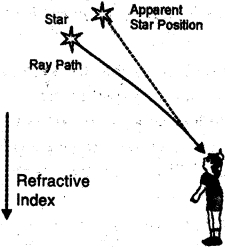
(N/A) The twinkling of a star is due to atmospheric refraction of starlight. As starlight enters the Earth's atmosphere,it undergoes continuous refraction before reaching the observer. This refraction occurs in a medium with a gradually changing refractive index. Because the atmosphere bends starlight towards the normal,the apparent position of the star is slightly different from its actual position. When viewed near the horizon,the star appears slightly higher than its actual position.
Furthermore,this apparent position is not stationary but keeps changing slightly because the physical conditions of the Earth's atmosphere are dynamic. Since stars are extremely distant,they act as point-sized sources of light. As the path of light rays from the star varies slightly,the apparent position fluctuates,and the amount of starlight entering the eye flickers. This causes the star to appear brighter at one moment and fainter at another,which is the twinkling effect.
Planets are much closer to the Earth and are seen as extended sources of light. If we consider a planet as a collection of a large number of point-sized sources,the total variation in the amount of light entering our eye from all these individual sources averages out to zero,thereby nullifying the twinkling effect.
0 likes
View Solution8
Medium
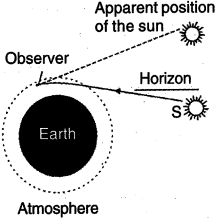
$(a)$ With the help of a suitable diagram,explain why the Sun is visible to us two minutes before the actual sunrise and two minutes after the actual sunset.
$(b)$ Name the phenomenon responsible for the apparent flattening of the Sun's disc at sunrise and sunset.
$(b)$ Name the phenomenon responsible for the apparent flattening of the Sun's disc at sunrise and sunset.
Solution
(N/A) The Sun is visible to us about two minutes before the actual sunrise and about two minutes after the actual sunset because of atmospheric refraction.
By actual sunrise,we mean the actual crossing of the horizon by the Sun.
As light from the Sun enters the Earth's atmosphere,it undergoes refraction due to the varying density of air layers.
This causes the light rays to bend towards the normal,making the Sun appear slightly higher than its actual position when it is just below the horizon.
The time difference between the actual sunset and the apparent sunset is about two minutes.
$(b)$ The phenomenon responsible for the apparent flattening of the Sun's disc at sunrise and sunset is also atmospheric refraction.
0 likes
View Solution9
Medium
$(a)$ If a person wears a lens of power $-6\, D$ for distant vision and for correcting his near vision he needs a lens of $+2\, D$. Determine the focal length of the lenses in both the cases.
$(b)$ Give reasons for the following natural phenomena:
$(i)$ Stars twinkle.
$(ii)$ Planets do not twinkle.
$(iii)$ Stars appear raised in the sky.
$(b)$ Give reasons for the following natural phenomena:
$(i)$ Stars twinkle.
$(ii)$ Planets do not twinkle.
$(iii)$ Stars appear raised in the sky.
Solution
(A) $(i)$ Focal length for distant vision: $f = \frac{1}{P} = \frac{1}{-6} = -0.1667\, m = -16.67\, cm$.
$(ii)$ Focal length for near vision: $f = \frac{1}{P} = \frac{1}{2} = +0.5\, m = +50\, cm$.
$(b)$ $(i)$ Stars twinkle due to atmospheric refraction. The Earth's atmosphere has layers of varying densities and temperatures,causing the refractive index to change continuously. Light from distant stars (point sources) undergoes continuous refraction,causing the apparent position and intensity of the star to fluctuate,which we perceive as twinkling.
$(ii)$ Planets are much closer to Earth than stars and appear as extended sources of light rather than point sources. $A$ planet can be considered as a collection of a large number of point-sized sources. The total variation in the amount of light entering our eye from all these point-sized sources averages out to zero,resulting in a steady light,so they do not twinkle.
$(iii)$ Stars appear raised due to atmospheric refraction. As starlight enters the Earth's atmosphere,it travels from a rarer medium to a denser medium,bending towards the normal at each layer. This continuous bending makes the star appear at a higher position than its actual location.
0 likes
View Solution10
Medium
$(a)$ How does refraction take place in the atmosphere? Why do stars twinkle but not the planets?
$(b)$ State any two effects of atmospheric refraction on the sun as observed from the Earth.
$(b)$ State any two effects of atmospheric refraction on the sun as observed from the Earth.
Solution
(A-D) Atmospheric refraction is the change in the direction of propagation of light rays as they travel through the atmosphere due to variations in the density of different air layers. The Earth's atmosphere is not uniform; it is optically and molecularly denser near the surface and becomes rarer at higher altitudes,causing the velocity of light to change from layer to layer. Factors such as varying concentrations of gas molecules,dust particles,and temperature differences (hot air is optically rarer than cold air) create layers of different optical densities,leading to refraction.
Stars appear to twinkle because light from distant stars passes through these varying layers of the atmosphere. Fluctuations in the atmosphere cause the amount of starlight reaching the eye to vary,making the star appear alternately bright and dim,which results in the twinkling effect.
Planets are much closer to the Earth and appear as extended sources rather than point sources. The high intensity of light from planets means that slight atmospheric refraction does not cause significant changes in their perceived brightness,so they do not twinkle.
$(b)$ Two effects of atmospheric refraction on the Sun as observed from the Earth are:
$1$. Advance sunrise: The Sun is visible about $2$ minutes before the actual sunrise.
$2$. Delayed sunset: The Sun remains visible for about $2$ minutes after the actual sunset.
0 likes
View Solution11
EasyMCQ
Which optical phenomenon is responsible for the twinkling of stars?
A
Atmospheric reflection
B
Atmospheric refraction
C
Reflection
D
Total internal reflection
Solution
(B) The twinkling of stars is due to atmospheric refraction of starlight.
As starlight enters the Earth's atmosphere,it undergoes continuous refraction due to the changing refractive index of different layers of air.
These layers have varying temperatures and densities,causing the light to bend as it passes through them.
This continuous bending of light causes the apparent position of the star to fluctuate slightly,and the amount of light reaching the eye varies,resulting in the twinkling effect.
0 likes
View Solution12
EasyMCQ
What is the time difference between the actual sunset and the apparent sunset?
A
$2$ seconds
B
$20$ seconds
C
$2$ minutes
D
$20$ minutes
Solution
(C) Due to atmospheric refraction,the Sun is visible to us about $2$ minutes before the actual sunrise and about $2$ minutes after the actual sunset.
As the light from the Sun enters the Earth's atmosphere,it bends due to the varying refractive indices of the air layers.
This bending causes the Sun to appear slightly higher than its actual position,leading to an apparent delay in sunset by approximately $2$ minutes.
As the light from the Sun enters the Earth's atmosphere,it bends due to the varying refractive indices of the air layers.
This bending causes the Sun to appear slightly higher than its actual position,leading to an apparent delay in sunset by approximately $2$ minutes.
0 likes
View Solution13
EasyMCQ
Which optical phenomenon is responsible for the early sunrise and delayed sunset?
A
Atmospheric reflection
B
Dispersion of light
C
Atmospheric refraction
D
Total internal reflection
Solution
(C) The sun appears to rise about $2$ minutes before the actual sunrise and sets about $2$ minutes after the actual sunset due to atmospheric refraction.
As sunlight enters the Earth's atmosphere,it passes through layers of air with varying densities.
This causes the light rays to bend (refract) towards the normal.
Due to this bending,the sun appears to be at a higher position in the sky than it actually is,causing the observer to see the sun before it crosses the horizon.
0 likes
View Solution14
EasyMCQ
Due to atmospheric refraction of light,the Sun appears to rise $................$ its actual sunrise.
A
two minutes later
B
four minutes later
C
two minutes earlier
D
four minutes earlier
Solution
(C) Atmospheric refraction causes the light from the Sun to bend as it passes through the Earth's atmosphere.
When the Sun is slightly below the horizon,the light rays from it travel from a rarer medium to a denser medium and bend towards the normal.
Due to this bending,the Sun appears to be above the horizon even when it is actually below it.
This phenomenon causes the Sun to appear about $2$ minutes earlier than the actual sunrise.
0 likes
View Solution15
EasyMCQ
Due to atmospheric refraction, the sun is visible about $2$ minutes before the actual sunrise and about $2$ minutes after the actual sunset. By how much time is the day lengthened due to this phenomenon?
A
$2$ minutes
B
$3$ minutes
C
$4$ minutes
D
$10$ minutes
Solution
(C) Atmospheric refraction causes the sun to appear above the horizon even when it is slightly below it.
This phenomenon results in the sun being visible approximately $2$ minutes before the actual sunrise and $2$ minutes after the actual sunset.
Therefore, the total increase in the duration of the day is $2 \text{ minutes} + 2 \text{ minutes} = 4 \text{ minutes}$.
This phenomenon results in the sun being visible approximately $2$ minutes before the actual sunrise and $2$ minutes after the actual sunset.
Therefore, the total increase in the duration of the day is $2 \text{ minutes} + 2 \text{ minutes} = 4 \text{ minutes}$.
0 likes
View Solution16
EasyMCQ
Which optical phenomenon is responsible for the formation of a mirage?
A
Reflection only
B
Refraction only
C
Refraction and total internal reflection
D
Total internal reflection only
Solution
(C) mirage is an optical illusion observed in deserts or on hot roads.
It occurs due to the variation in the refractive index of air layers near the ground.
As the ground heats up,the air layers near the surface become less dense (rarer) compared to the layers above.
Light rays from a distant object travel from a denser medium to a rarer medium and undergo continuous refraction,bending away from the normal.
When the angle of incidence exceeds the critical angle,the light rays undergo total internal reflection,creating an inverted image of the object,which appears as a mirage.
0 likes
View SolutionThe Human Eye and the Colourful World — Atmospheric Refraction · Frequently Asked Questions
1Are these The Human Eye and the Colourful World questions useful for JEE and NEET?
Yes. All questions in this section are mapped to JEE Main and NEET exam patterns. Previous year questions from JEE Main, NEET, GUJCET and state-level exams are included with full solutions.
2Can I switch to Hindi or Gujarati for these questions?
Yes. Use the language tabs in the hero section or the sidebar to view the same questions and solutions in English, Hindi or Gujarati.
3How do I generate a question paper from this subtopic?
Use the Vedclass Exam Paper Generator — select the chapter and subtopic, set difficulty, and generate Sets A, B, C, D automatically. First 3 chapters of every subject are free.
Vedclass Products
For Students
Vedclass Test Series
Mock tests in real JEE/NEET style with performance analysis. 5-day free trial.
Start Free TrialFor Teachers
Exam Paper Generator
Generate Set A/B/C/D papers from this chapter in 2 minutes. 3 chapters free.
Try FreeFor Institutes
Online Exam Module
Live online exams with unlimited students, 360° analytics & white-label branding.
See DemoFor Teachers & Institutes
Generate a The Human Eye and the Colourful World Exam Paper in 2 Minutes
Select subtopic & difficulty — Sets A, B, C, D auto-generated with No Repeat logic.
First 3 chapters of every subject are free — no payment required.