
A English
Mix Examples - The Human Eye and the Colourful World Questions in English
Class 10 Science · The Human Eye and the Colourful World · Mix Examples - The Human Eye and the Colourful World
18+
Questions
English
Language
100%
With Solutions
Showing 18 of 18 questions in English
1
Medium
Account for the following:
$(a)$ Part of the human eye that helps in changing the focal length of the eye lens.
$(b)$ The condition resulting due to the eye lens becoming cloudy.
$(c)$ The factors on which the colour of the scattered white light depends.
$(d)$ The range of vision of a normal eye.
$(e)$ The sky appears dark to the astronauts in space.
Solution
(N/A) Ciliary muscles help in changing the focal length of the eye lens.
$(b)$ Cataract: The crystalline lens of the eye is made of proteins arranged in a regular pattern,which makes the lens transparent. When a group of these protein molecules clump together in a region,they make the region opaque. Gradually,this membrane grows,and the whole lens becomes opaque.
$(c)$ The colour of scattered light depends on the size of the scattering particles (air molecules,dust particles,and pollutants) in the atmosphere.
$(d)$ From $25 \ cm$ to infinity.
$(e)$ There is no atmosphere in space,hence there are no air molecules to scatter sunlight,making the sky appear dark.
0 likes
View Solution2
Medium
$(a)$ State the reasons which lead to hypermetropia. With the help of suitable diagrams,explain this defect of vision and its correction.
$(b)$ Draw a diagram of an experimental arrangement for observing the scattering of light in a colloidal solution. Name the two chemicals used in this activity.
$(b)$ Draw a diagram of an experimental arrangement for observing the scattering of light in a colloidal solution. Name the two chemicals used in this activity.
Solution
(N/A) Hypermetropia,also known as farsightedness,is a vision defect where a person can see distant objects clearly but cannot see nearby objects distinctly. This happens because the near point of the eye has shifted further away than the normal $25 \ cm$.
Reasons for hypermetropia:
$1$. The eyeball has become too short.
$2$. The focal length of the eye lens has become too large.
Correction: This defect is corrected by using a convex lens of suitable focal length,which converges the light rays before they enter the eye,allowing the image to form on the retina.
$(b)$ The experimental arrangement for observing the Tyndall effect (scattering of light) involves passing a strong beam of light through a colloidal solution (e.g.,sodium thiosulphate solution). The two chemicals used are:
$1$. Sodium thiosulphate $(Na_2S_2O_3)$
$2$. Concentrated sulphuric acid $(H_2SO_4)$
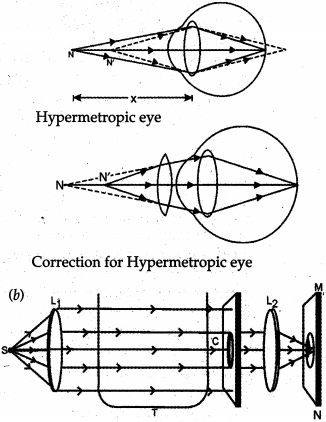
0 likes
View Solution3
EasyMCQ
What is the type of the final image,as compared to the object,in the compound microscope?
A
Real,inverted and enlarged
B
Real,inverted and diminished
C
Virtual,inverted and diminished
D
Virtual,erect and enlarged
Solution
(A) In a compound microscope,the objective lens forms a real,inverted,and enlarged image of the object.
This image acts as an object for the eyepiece (ocular lens).
The eyepiece acts as a simple magnifier and forms a virtual,erect (with respect to the intermediate image),and further enlarged image.
Since the intermediate image was inverted,the final image appears inverted with respect to the original object.
Therefore,the final image formed by a compound microscope is virtual,inverted,and enlarged compared to the original object.
0 likes
View Solution4
EasyMCQ
In an astronomical telescope,how is the focal length of the objective lens compared to the focal length of the eyepiece?
A
Larger
B
Smaller
C
Equal
D
Very small
Solution
(A) In an astronomical telescope,the objective lens is designed to collect as much light as possible from distant objects,which requires a large aperture and a large focal length $(f_o)$.
Conversely,the eyepiece is used as a magnifying glass to view the image formed by the objective lens,which requires a short focal length $(f_e)$.
Therefore,for high magnification $(M = -f_o / f_e)$,the focal length of the objective lens is much larger than the focal length of the eyepiece $(f_o > f_e)$.
0 likes
View Solution5
EasyMCQ
Which of the following colors are primary colors?
A
Red,Blue,Yellow
B
Red,Green,Purple
C
Yellow,Green,Blue
D
Red,Green,Blue
Solution
(D) In the context of light and color vision,the primary colors are Red,Green,and Blue $(RGB)$.
These colors are considered primary because they cannot be created by mixing other colors,and they can be combined in various intensities to produce a wide spectrum of other colors.
Therefore,the correct option is $D$.
These colors are considered primary because they cannot be created by mixing other colors,and they can be combined in various intensities to produce a wide spectrum of other colors.
Therefore,the correct option is $D$.
0 likes
View Solution6
EasyMCQ
Which of the following are the primary colours of light?
A
Yellow,Green and Maroon
B
Maroon,Yellow and Cyan
C
Blue,Green and Red
D
Red,Green and Yellow
Solution
(C) The primary colours of light are $Red$,$Green$,and $Blue$ $(RGB)$.
These colours are considered primary because they cannot be created by mixing other colours of light,but when combined in various intensities,they can produce a wide range of colours,including white light.
These colours are considered primary because they cannot be created by mixing other colours of light,but when combined in various intensities,they can produce a wide range of colours,including white light.
0 likes
View Solution7
EasyMCQ
What is the method of obtaining various colors by mixing primary colors in appropriate proportions called?
A
Additive color mixing
B
Superposition method
C
Subtractive color mixing
D
Division method
Solution
(A) The process of creating a wide range of colors by combining primary colors (such as Red, Green, and Blue) in different proportions is known as $Additive$ $\text{color mixing}$.
In this method, light of different wavelengths is added together to produce new colors.
For example, mixing Red and Green light produces Yellow light.
Therefore, the correct option is $A$.
In this method, light of different wavelengths is added together to produce new colors.
For example, mixing Red and Green light produces Yellow light.
Therefore, the correct option is $A$.
0 likes
View Solution8
EasyMCQ
What are the colors obtained by mixing primary colors called?
A
Primary pigments
B
Complementary colors
C
Secondary colors
D
Compound colors
Solution
(C) The colors obtained by mixing primary colors (such as Red,Green,and Blue in the context of light) are known as secondary colors.
When primary colors are combined in different proportions,they produce a wide range of secondary colors.
For example,mixing Red and Green light produces Yellow,Green and Blue produces Cyan,and Red and Blue produces Magenta.
When primary colors are combined in different proportions,they produce a wide range of secondary colors.
For example,mixing Red and Green light produces Yellow,Green and Blue produces Cyan,and Red and Blue produces Magenta.
0 likes
View Solution9
EasyMCQ
Which of the following colors is not a primary color?
A
Blue
B
Green
C
Red
D
Yellow
Solution
(D) In the context of additive color mixing (light),the primary colors are $Red$,$Green$,and $Blue$ $(RGB)$.
These colors are considered primary because they cannot be created by mixing other colors,and they can be combined in various intensities to produce a wide range of other colors.
$Yellow$ is a secondary color formed by mixing $Red$ and $Green$ light.
Therefore,$Yellow$ is not a primary color.
These colors are considered primary because they cannot be created by mixing other colors,and they can be combined in various intensities to produce a wide range of other colors.
$Yellow$ is a secondary color formed by mixing $Red$ and $Green$ light.
Therefore,$Yellow$ is not a primary color.
0 likes
View Solution10
EasyMCQ
Which two colors of light combine to form the color maroon?
A
Blue and Green
B
Blue and Red
C
Red and Green
D
Blue and Yellow
Solution
(B) The color maroon is a dark shade of red. In the context of additive color mixing (light),maroon is produced by combining red light with a smaller proportion of blue light. Therefore,the combination of red and blue light results in the formation of maroon.
0 likes
View Solution11
EasyMCQ
When red and green light overlap,what color does that region appear?
A
Yellow
B
Blue
C
Maroon
D
Cyan
Solution
(A) According to the additive color mixing theory of light,the primary colors of light are Red,Green,and Blue $(RGB)$.
When red light and green light are mixed or overlap,they produce yellow light.
Therefore,the region where red and green light overlap appears yellow.
When red light and green light are mixed or overlap,they produce yellow light.
Therefore,the region where red and green light overlap appears yellow.
0 likes
View Solution12
EasyMCQ
The peacock blue color is formed by the superposition of which two colors of light?
A
Blue and Red
B
Blue and Green
C
Red and Green
D
Blue and Yellow
Solution
(B) The color known as peacock blue or cyan is a secondary color formed by the additive mixing of two primary colors of light: blue and green. In the context of light,the superposition of blue and green light waves results in the perception of peacock blue.
0 likes
View Solution13
EasyMCQ
Which two colors of light combine to form the color yellow?
A
Green and Red
B
Red and Blue
C
Green and Blue
D
Red,Blue,and Green
Solution
(A) In the additive color mixing model ($RGB$ model),light colors combine to form new colors. When red light and green light are mixed together,they produce yellow light. This is a fundamental principle of light addition.
0 likes
View Solution14
EasyMCQ
What color does the region appear when red,green,and blue light overlap?
A
Black
B
Cyan
C
Green
D
White
Solution
(D) When light of the three primary colors—red,green,and blue—overlap in equal intensity,they combine to form white light. This is a fundamental principle of additive color mixing in physics.
0 likes
View Solution15
EasyMCQ
What are the two colors of light called whose mixture produces white light?
A
Primary colors
B
Primary pigments
C
Composite colors
D
Complementary colors
Solution
(D) When two colors of light are mixed to produce white light,they are known as complementary colors. Examples include blue and yellow light,or red and cyan light. These pairs are called complementary because they complete the spectrum required to perceive white light.
0 likes
View Solution16
EasyMCQ
What color of light is produced when blue and yellow light are superimposed?
A
Green
B
Red
C
Black
D
White
Solution
(D) When blue and yellow light are superimposed,they are complementary colors in the context of additive color mixing. The combination of blue and yellow light results in white light. This is a fundamental principle in color theory where specific pairs of colors,when combined,produce white light.
0 likes
View Solution17
EasyMCQ
Which of the following is not a primary color of light?
A
Yellow
B
Maroon
C
Cyan
D
Magenta
Solution
(B) The primary colors of light are Red,Green,and Blue $(RGB)$.
These colors are considered primary because they cannot be created by mixing other colors of light,and they can be combined in various intensities to produce a wide range of colors.
Yellow,Cyan,and Magenta are secondary colors of light.
Maroon is a dark brownish-red color and is not a primary color of light.
0 likes
View Solution18
EasyMCQ
Pigments are mixed by the $......$ method to produce various colors.
A
Additive mixing
B
Subtractive mixing
C
Multiplicative mixing
D
Division
Solution
(B) The process of mixing pigments to create different colors is known as $Subtractive$ $mixing$.
In this method,pigments absorb (subtract) specific wavelengths of light from white light,reflecting only the remaining colors to our eyes.
This is the principle used in painting,printing,and color photography.
In this method,pigments absorb (subtract) specific wavelengths of light from white light,reflecting only the remaining colors to our eyes.
This is the principle used in painting,printing,and color photography.
0 likes
View SolutionThe Human Eye and the Colourful World — Mix Examples - The Human Eye and the Colourful World · Frequently Asked Questions
1Are these The Human Eye and the Colourful World questions useful for JEE and NEET?
Yes. All questions in this section are mapped to JEE Main and NEET exam patterns. Previous year questions from JEE Main, NEET, GUJCET and state-level exams are included with full solutions.
2Can I switch to Hindi or Gujarati for these questions?
Yes. Use the language tabs in the hero section or the sidebar to view the same questions and solutions in English, Hindi or Gujarati.
3How do I generate a question paper from this subtopic?
Use the Vedclass Exam Paper Generator — select the chapter and subtopic, set difficulty, and generate Sets A, B, C, D automatically. First 3 chapters of every subject are free.
Vedclass Products
For Students
Vedclass Test Series
Mock tests in real JEE/NEET style with performance analysis. 5-day free trial.
Start Free TrialFor Teachers
Exam Paper Generator
Generate Set A/B/C/D papers from this chapter in 2 minutes. 3 chapters free.
Try FreeFor Institutes
Online Exam Module
Live online exams with unlimited students, 360° analytics & white-label branding.
See DemoFor Teachers & Institutes
Generate a The Human Eye and the Colourful World Exam Paper in 2 Minutes
Select subtopic & difficulty — Sets A, B, C, D auto-generated with No Repeat logic.
First 3 chapters of every subject are free — no payment required.