
A English
Scattering of Light Questions in English
Class 10 Science · The Human Eye and the Colourful World · Scattering of Light
46+
Questions
English
Language
100%
With Solutions
Showing 46 of 46 questions in English
1
EasyMCQ
Why does the Sun appear reddish early in the morning?
A
Due to the reflection of light from the atmosphere.
B
Due to the scattering of shorter wavelengths of light by atmospheric particles.
C
Due to the absorption of red light by the atmosphere.
D
Due to the refraction of light through the atmosphere.
Solution
(B) During sunrise,the light rays from the Sun travel a greater distance through the Earth's atmosphere to reach our eyes.
In this journey,light with shorter wavelengths (like blue and violet) is scattered away by atmospheric particles.
Only light with longer wavelengths,such as red,can reach our eyes without being scattered significantly.
Therefore,the Sun appears reddish early in the morning.
In this journey,light with shorter wavelengths (like blue and violet) is scattered away by atmospheric particles.
Only light with longer wavelengths,such as red,can reach our eyes without being scattered significantly.
Therefore,the Sun appears reddish early in the morning.
0 likes
View Solution2
EasyMCQ
At noon,the sun appears white because:
A
red colour is scattered the most
B
all the colours of the white light are scattered away
C
blue colour is scattered the most
D
light is least scattered
Solution
(D) At noon,the sun is overhead,and the light from the sun travels a relatively shorter distance through the Earth's atmosphere to reach the observer.
Because the distance is short,only a small amount of blue and violet light is scattered.
As a result,all the colours of the white light reach the observer's eye in almost equal proportions,making the sun appear white.
Because the distance is short,only a small amount of blue and violet light is scattered.
As a result,all the colours of the white light reach the observer's eye in almost equal proportions,making the sun appear white.
0 likes
View Solution3
MediumMCQ
The clear sky appears blue because
A
blue light gets absorbed in the atmosphere
B
ultraviolet radiations are absorbed in the atmosphere
C
violet and blue lights get scattered more than lights of all other colours by the atmosphere
D
light of all other colours is scattered more than the violet and blue colour lights by the atmosphere
Solution
(C) The phenomenon responsible for the blue colour of the sky is Rayleigh scattering.
According to Rayleigh's law of scattering,the intensity of scattered light is inversely proportional to the fourth power of its wavelength $(I \propto 1/\lambda^4)$.
Since violet and blue light have shorter wavelengths compared to other colours in the visible spectrum,they are scattered much more strongly by the fine particles and molecules present in the Earth's atmosphere.
As a result,when sunlight enters the atmosphere,these shorter wavelengths reach our eyes from all directions,making the sky appear blue.
0 likes
View Solution4
MediumMCQ
The danger signals installed at the top of tall buildings are red in colour. These can be easily seen from a distance because among all other colours, the red light
A
is scattered the least by smoke or fog
B
is scattered the most by smoke or fog
C
is absorbed the most by smoke or fog
D
moves fastest in air
Solution
(A) According to Rayleigh's law of scattering, the intensity of scattered light is inversely proportional to the fourth power of its wavelength $(I \propto 1/\lambda^4)$.
Since red light has the longest wavelength in the visible spectrum, it undergoes the least scattering by atmospheric particles like smoke or fog.
Because it is scattered the least, red light can travel longer distances without being dispersed, making it clearly visible from far away.
Therefore, the correct option is $A$.
0 likes
View Solution5
EasyMCQ
Which of the following phenomena contributes significantly to the reddish appearance of the sun at sunrise or sunset?
A
Dispersion of light
B
Scattering of light
C
Total internal reflection of light
D
Reflection of light from the earth
Solution
(B) At sunrise or sunset,the sun is near the horizon.
Light from the sun has to travel a much larger distance through the atmosphere to reach the observer.
During this journey,most of the blue and shorter wavelengths of light are scattered away by the atmospheric particles.
Only the light of longer wavelengths,such as red,is able to reach our eyes.
Therefore,the sun appears reddish at sunrise or sunset due to the scattering of light.
0 likes
View Solution6
MediumMCQ
The bluish colour of water in deep sea is due to
A
the presence of algae and other plants found in water
B
reflection of sky in water
C
scattering of light
D
absorption of light by the sea
Solution
(C) The bluish colour of water in the deep sea is primarily due to the scattering of light.
When sunlight enters the water,the water molecules and other suspended particles scatter the light.
According to Rayleigh scattering,shorter wavelengths (like blue and violet) are scattered more strongly than longer wavelengths (like red).
As the light penetrates deeper into the sea,the longer wavelengths are absorbed by the water,while the blue light is scattered back towards our eyes,giving the deep sea its characteristic blue appearance.
0 likes
View Solution7
EasyMCQ
Why is the colour of the clear sky blue?
A
Due to reflection of light by the atmosphere.
B
Due to scattering of light by atmospheric particles.
C
Due to refraction of light by the atmosphere.
D
Due to dispersion of light by water droplets.
Solution
(B) The molecules of air and other fine particles in the atmosphere have a size smaller than the wavelength of visible light. These particles are more effective in scattering light of shorter wavelengths at the blue end of the spectrum than light of longer wavelengths at the red end. As blue light has a shorter wavelength,it gets scattered the maximum by the atmospheric particles,which makes the sky appear blue to our eyes.
0 likes
View Solution8
Medium
What is the difference in the colours of the Sun observed during sunrise/sunset and at noon? Provide an explanation for each.
Solution
(N/A) During sunrise and sunset,the Sun appears reddish,whereas at noon,the Sun appears white.
$1$. At noon,the Sun is overhead,and light travels a relatively shorter distance through the Earth's atmosphere. Consequently,only a small amount of blue and shorter wavelengths are scattered,causing the Sun to appear white.
$2$. During sunrise and sunset,the Sun is near the horizon. Light must travel a much longer distance through the atmosphere to reach the observer. Most of the blue light and shorter wavelengths are scattered away by atmospheric particles,leaving only the longer wavelengths,such as red,to reach our eyes,making the Sun appear reddish.
0 likes
View Solution9
Medium
How can we explain the reddish appearance of the Sun at sunrise or sunset? Why does it not appear red at noon?
Solution
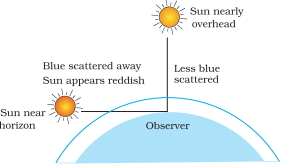
(N/A) At sunrise or sunset,the Sun is near the horizon. The light from the Sun has to travel a larger distance through the Earth's atmosphere to reach the observer. During this journey,most of the blue and shorter wavelengths of light are scattered away by the atmospheric particles. Therefore,only the light of longer wavelengths,such as red,reaches our eyes,making the Sun appear reddish.
At noon,the Sun is overhead,and the light travels a relatively shorter distance through the atmosphere. Consequently,only a small amount of blue and violet light is scattered,and the Sun appears white or slightly yellowish.
At noon,the Sun is overhead,and the light travels a relatively shorter distance through the atmosphere. Consequently,only a small amount of blue and violet light is scattered,and the Sun appears white or slightly yellowish.
0 likes
View Solution10
MediumMCQ
Why does the sky appear dark instead of blue to an astronaut?
A
Due to the absence of scattering of light in space.
B
Due to the presence of high-intensity radiation.
C
Due to the reflection of light from the moon.
D
Due to the absorption of light by the spacecraft.
Solution
(A) The sky appears dark instead of blue to an astronaut because there is no atmosphere in outer space to scatter sunlight.
Since there are no gas molecules or particles to scatter the light,no scattered light reaches the eyes of the astronauts.
Consequently,the sky appears black or dark to them.
Since there are no gas molecules or particles to scatter the light,no scattered light reaches the eyes of the astronauts.
Consequently,the sky appears black or dark to them.
0 likes
View Solution11
EasyMCQ
On what factor does the colour of the scattered light depend?
A
Size of the scattering particles
B
Intensity of the incident light
C
Distance of the source of light
D
Refractive index of the medium
Solution
(A) The colour of the scattered light depends on the size of the scattering particles.
According to Rayleigh scattering,the intensity of scattered light is inversely proportional to the fourth power of its wavelength $(I \propto 1/\lambda^4)$.
Very fine particles scatter mainly blue light of shorter wavelengths,while larger particles scatter light of longer wavelengths.
According to Rayleigh scattering,the intensity of scattered light is inversely proportional to the fourth power of its wavelength $(I \propto 1/\lambda^4)$.
Very fine particles scatter mainly blue light of shorter wavelengths,while larger particles scatter light of longer wavelengths.
0 likes
View Solution12
EasyMCQ
What would have been the colour of the earth's sky if there were no atmosphere?
A
Blue
B
Red
C
White
D
Dark/Black
Solution
(D) If there were no atmosphere,there would be no scattering of sunlight.
Since the blue colour of the sky is due to the scattering of sunlight by atmospheric particles,in the absence of an atmosphere,no scattering would occur.
Consequently,the sky would appear dark or black to an observer on Earth.
Since the blue colour of the sky is due to the scattering of sunlight by atmospheric particles,in the absence of an atmosphere,no scattering would occur.
Consequently,the sky would appear dark or black to an observer on Earth.
0 likes
View Solution13
EasyMCQ
Why does the sky appear dark to passengers flying at high altitudes?
A
Scattering of light is more intense.
B
Atmosphere is absent at high altitudes.
C
Light travels faster at high altitudes.
D
The sun is not visible at high altitudes.
Solution
(B) At high altitudes,the atmosphere is very thin or practically absent.
Because there are no air molecules or dust particles to scatter the sunlight,no light reaches the eyes of the passengers through the process of scattering.
Therefore,the sky appears dark instead of blue.
Because there are no air molecules or dust particles to scatter the sunlight,no light reaches the eyes of the passengers through the process of scattering.
Therefore,the sky appears dark instead of blue.
0 likes
View Solution14
Easy
Mention the factor on which scattering of light depends. Why does the sky appear dark in space?
Solution
(N/A) The scattering of light depends on the size of the particles present in the atmosphere. Particles like smoke,tiny water droplets,suspended dust particles,and air molecules scatter light of different wavelengths.
In space,there is no atmosphere,which means there are no air molecules or other particles to scatter sunlight.
Since no light is scattered towards the observer's eyes in space,the sky appears dark.
In space,there is no atmosphere,which means there are no air molecules or other particles to scatter sunlight.
Since no light is scattered towards the observer's eyes in space,the sky appears dark.
0 likes
View Solution15
Easy
What is Tyndall effect?
Solution
(N/A) The Earth's atmosphere is a heterogeneous mixture of minute particles. These particles include smoke,tiny water droplets,suspended particles of dust,and molecules of air. When a beam of light strikes such fine particles,the path of the beam becomes visible. The light reaches us after being scattered by these particles. The phenomenon of scattering of light by colloidal particles is called the Tyndall effect.
0 likes
View Solution16
Easy
Why is the colour of the sky blue?
Solution
(N/A) The molecules of air and other fine particles in the atmosphere have a size smaller than the wavelength of visible light.
These particles are more effective at scattering light of shorter wavelengths (at the blue end of the spectrum) than light of longer wavelengths (at the red end).
The red light has a wavelength about $1.8$ times greater than blue light.
Thus,when sunlight passes through the atmosphere,the fine particles in the air scatter the blue colour (shorter wavelengths) more strongly than the red colour.
The scattered blue light enters our eyes,making the sky appear blue.
0 likes
View Solution17
Medium
$(a)$ What will be the colour of the sky in the absence of an atmosphere?
$(b)$ Why are traffic light signals (or danger signals) of red colour?
$(b)$ Why are traffic light signals (or danger signals) of red colour?
Solution
(N/A) In the absence of an atmosphere, there is no scattering of sunlight by air molecules or dust particles. Consequently, no light reaches the observer's eye from the sky, making it appear dark.
$(b)$ According to Rayleigh scattering, the intensity of scattered light is inversely proportional to the fourth power of its wavelength $(I \propto 1/\lambda^4)$. Red light has the longest wavelength in the visible spectrum, meaning it undergoes the least scattering. This allows red light to travel longer distances without being significantly dispersed, making it clearly visible even from a distance through fog, smoke, or dust.
$(b)$ According to Rayleigh scattering, the intensity of scattered light is inversely proportional to the fourth power of its wavelength $(I \propto 1/\lambda^4)$. Red light has the longest wavelength in the visible spectrum, meaning it undergoes the least scattering. This allows red light to travel longer distances without being significantly dispersed, making it clearly visible even from a distance through fog, smoke, or dust.
0 likes
View Solution18
EasyMCQ
Why does the sky appear dark and black to an astronaut instead of blue?
A
Due to the absence of light in space.
B
Due to the absence of atmosphere to scatter light.
C
Due to the reflection of light by the moon.
D
Due to the high speed of the spacecraft.
Solution
(B) The sky appears blue on Earth because the atmosphere contains gas molecules and particles that scatter sunlight (Rayleigh scattering).
In outer space,there is no atmosphere to scatter light.
Since there is no scattered light reaching the eyes of an astronaut,the sky appears dark and black.
In outer space,there is no atmosphere to scatter light.
Since there is no scattered light reaching the eyes of an astronaut,the sky appears dark and black.
0 likes
View Solution19
Easy
Explain why,when the sun is overhead at noon,it appears white?
Solution
(N/A) When the sun is overhead at noon,the light coming from the sun travels a relatively shorter distance through the atmosphere to reach us.
As a result,only a small portion of the blue component of the white light is scattered,while most of the light reaches the observer.
Since the light reaching us from the overhead sun contains almost all its component colours in the correct proportion,the sun appears white.
As a result,only a small portion of the blue component of the white light is scattered,while most of the light reaches the observer.
Since the light reaching us from the overhead sun contains almost all its component colours in the correct proportion,the sun appears white.
0 likes
View Solution20
Medium
$(a)$ How does the sky appear from the surface of the moon?
$(b)$ What is the cause of the blue colour of the ocean?
$(b)$ What is the cause of the blue colour of the ocean?
Solution
(N/A) The sky appears dark from the surface of the moon because there is no atmosphere to scatter sunlight.
$(b)$ The water molecules of the ocean scatter blue light more strongly than light of other colours due to the phenomenon of scattering. Consequently,the ocean appears bluish.
$(b)$ The water molecules of the ocean scatter blue light more strongly than light of other colours due to the phenomenon of scattering. Consequently,the ocean appears bluish.
0 likes
View Solution21
Medium
Why does the clear sky appear blue? How would the sky appear in the absence of Earth's atmosphere?
Solution
(N/A) The blue colour of the sky is due to the scattering of sunlight by the molecules of gases present in the Earth's atmosphere. According to Rayleigh's law of scattering, the intensity of scattered light is inversely proportional to the fourth power of its wavelength $(I \propto 1/\lambda^4)$. Since blue light has a shorter wavelength compared to other colours in the visible spectrum, it is scattered more strongly by the atmospheric particles. In the absence of an atmosphere, there would be no particles to scatter the sunlight. Consequently, no light would reach our eyes from the sky, and it would appear black.
0 likes
View Solution22
MediumMCQ
Why do we observe differences in the colours of the sun during sunrise,sunset,and noon?
A
Due to reflection of light
B
Due to scattering of light
C
Due to refraction of light
D
Due to dispersion of light
Solution
(B) The difference in the colour of the sun is due to the scattering of light.
At noon,the sun is overhead,and the light travels a shorter distance through the atmosphere,resulting in less scattering,so the sun appears white.
During sunrise and sunset,the sun is near the horizon,and the light travels a longer distance through the atmosphere.
Most of the blue light and shorter wavelengths are scattered away by atmospheric particles.
Therefore,the light that reaches our eyes consists mainly of longer wavelengths (red/orange),giving the sun a reddish appearance.
0 likes
View Solution23
Medium
What is meant by scattering of light? Use this phenomenon to explain why the clear sky appears blue or the sun appears reddish at sunrise.
Solution
(N/A) $(i)$ Scattering of light: It is the phenomenon of the redirection of light in different directions by the particles (such as atoms,molecules,dust,or smoke) present in the atmosphere.
$(ii)$ Why the sky appears blue: The fine particles in the atmosphere have a size smaller than the wavelength of visible light. These particles scatter light of shorter wavelengths (like blue and violet) much more strongly than light of longer wavelengths (like red). Since blue light has a shorter wavelength,it is scattered the most,which is why the sky appears blue to our eyes.
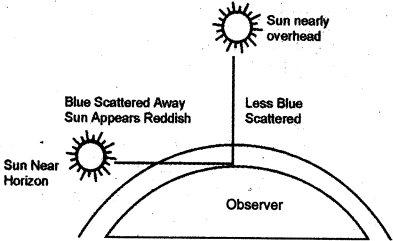
$(iii)$ Why the sun appears reddish at sunrise: At sunrise,the sun is near the horizon. Sunlight has to travel through a much thicker layer of the atmosphere to reach the observer. During this long journey,most of the blue and shorter wavelength light is scattered away by the atmospheric particles. Only the light of longer wavelengths,such as red,reaches our eyes,which is why the sun appears reddish at sunrise.
0 likes
View Solution24
Medium
With the help of scattering of light,explain the reason for the difference in colours of the Sun as it appears during sunrise/sunset and noon.
Solution
(N/A) The Sun appears reddish at sunrise and sunset,while it appears white at noon when it is overhead.
At sunrise and sunset,the light from the Sun travels through a thicker layer of the atmosphere. The blue light,having a shorter wavelength,is scattered away by the atmospheric particles,while the red light,having a longer wavelength,reaches our eyes.
At noon,the Sun is overhead,and the light travels a relatively shorter distance through the atmosphere. Consequently,only a small amount of blue and violet light is scattered,allowing the Sun to appear white as the majority of the light reaches our eyes.
0 likes
View Solution25
Medium
$(a)$ Explain the phenomenon of scattering of light. State the factor on which the colour of scattered light depends.
$(b)$ List any two natural phenomena based on the scattering of light.
$(b)$ List any two natural phenomena based on the scattering of light.
Solution
(N/A) Scattering of light is the phenomenon where light rays change their direction upon striking obstacles such as atoms,molecules,dust particles,or water droplets. The colour of the scattered light depends on the size of the scattering particles. Very fine particles scatter mainly blue light of shorter wavelengths,while larger particles scatter light of longer wavelengths.
$(b)$ Two natural phenomena based on the scattering of light are:
$(i)$ The blue colour of the sky.
$(ii)$ The reddish appearance of the Sun at sunrise and sunset.
$(b)$ Two natural phenomena based on the scattering of light are:
$(i)$ The blue colour of the sky.
$(ii)$ The reddish appearance of the Sun at sunrise and sunset.
0 likes
View Solution26
Medium
What is meant by scattering of light? Mention the factor on which it depends. Explain why the colour of the clear sky is blue? An astronaut in space finds the sky to be dark. Explain the reason for this observation.
Solution
(N/A) $(i)$ Scattering of light is the phenomenon in which light rays deviate from their straight path upon striking small particles such as dust,air molecules,or other impurities in the atmosphere.
$(ii)$ The extent of scattering depends primarily on the size of the particles. Very fine particles scatter mainly blue light of shorter wavelengths,while larger particles scatter light of longer wavelengths.
$(iii)$ As sunlight passes through the atmosphere,the fine particles in the air scatter the blue component of white light more strongly than the red component due to its shorter wavelength. This scattered blue light reaches our eyes,making the sky appear blue.
$(iv)$ In space,there is no atmosphere and therefore no particles (like air molecules or dust) to scatter sunlight. Since no light reaches the astronaut's eyes from the sky,it appears dark.
0 likes
View Solution27
Medium
$(a)$ Explain why the colour of a clear sky appears blue during the day with the help of a diagram.
$(b)$ Explain why the Sun looks reddish at the time of sunrise and sunset.
$(b)$ Explain why the Sun looks reddish at the time of sunrise and sunset.
Solution
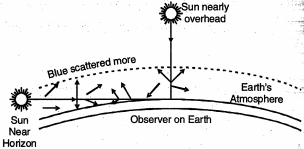
(N/A) The Earth's atmosphere contains air molecules and other fine particles. These particles are smaller in size than the wavelength of visible light. According to Rayleigh scattering, the amount of scattering is inversely proportional to the fourth power of the wavelength $(I \propto 1/\lambda^4)$. Since blue light has a shorter wavelength compared to red light, it is scattered much more strongly by the atmospheric particles in all directions. When this scattered blue light enters our eyes, the sky appears blue.
$(b)$ At the time of sunrise or sunset, the Sun is near the horizon. Sunlight has to travel through a much thicker layer of the Earth's atmosphere to reach the observer. During this long journey, most of the blue and shorter wavelength light is scattered away by atmospheric particles. Only the light with the longest wavelength, which is red light, is able to reach the observer's eyes without being scattered significantly. Therefore, the Sun appears reddish at sunrise and sunset.
$(b)$ At the time of sunrise or sunset, the Sun is near the horizon. Sunlight has to travel through a much thicker layer of the Earth's atmosphere to reach the observer. During this long journey, most of the blue and shorter wavelength light is scattered away by atmospheric particles. Only the light with the longest wavelength, which is red light, is able to reach the observer's eyes without being scattered significantly. Therefore, the Sun appears reddish at sunrise and sunset.
0 likes
View Solution28
MediumMCQ
Reddish appearance of the sun at sunrise or sunset is significantly due to
A
dispersion of light
B
total internal reflection of light
C
reflection of light from the earth
D
scattering of light
Solution
(D) At sunrise or sunset,the sun is near the horizon.
Light from the sun has to travel a larger distance through the atmosphere of the Earth to reach our eyes.
During this journey,most of the blue and shorter wavelengths of light are scattered away by the atmospheric particles.
Only the light of longer wavelengths,such as red,is able to reach our eyes.
Therefore,the sun appears reddish at sunrise or sunset due to the scattering of light.
0 likes
View Solution29
MediumMCQ
At noon,the sun appears white because:
A
blue colour is scattered the most.
B
all the colours of the white light are scattered away.
C
red colour is scattered the most.
D
light is least scattered.
Solution
(D) At noon,the sun is overhead,and the light from the sun has to travel a relatively shorter distance through the Earth's atmosphere to reach the observer.
Because the distance is short,only a small amount of blue and violet light is scattered.
Since most of the light reaches the observer without significant scattering,the sun appears white to us.
Because the distance is short,only a small amount of blue and violet light is scattered.
Since most of the light reaches the observer without significant scattering,the sun appears white to us.
0 likes
View Solution30
EasyMCQ
Which color is produced by mixing blue and red?
A
Green
B
Maroon
C
Magenta
D
Yellow
Solution
(C) When mixing primary colors of light,red and blue combine to produce magenta. This is a standard result in the additive color model used in physics and optics.
0 likes
View Solution31
EasyMCQ
When white light is incident on a blue pigment,which colors of light are reflected?
A
Yellow,orange,green
B
Violet,green,blue
C
Violet,yellow,green
D
Yellow,green,blue
Solution
(B) pigment appears blue because it absorbs all other colors of the visible spectrum except blue.
When white light (which consists of $VIBGYOR$) falls on a blue pigment,the pigment absorbs colors like red,orange,yellow,and green.
It reflects the blue light back to our eyes.
However,in the context of pigments and color mixing,a blue pigment often reflects a range of wavelengths in the blue-green region.
Among the given options,the combination that best describes the reflected light from a blue pigment is violet,green,and blue,as these are closer to the blue end of the spectrum.
0 likes
View Solution32
EasyMCQ
Which phenomenon of light is responsible for the Tyndall effect?
A
Reflection
B
Refraction
C
Scattering
D
Dispersion
Solution
(C) The Tyndall effect is the phenomenon in which the particles in a colloid or a fine suspension scatter the beams of light that are directed at them.
This scattering of light by colloidal particles is known as the Tyndall effect.
Therefore,the correct phenomenon responsible for the Tyndall effect is scattering.
This scattering of light by colloidal particles is known as the Tyndall effect.
Therefore,the correct phenomenon responsible for the Tyndall effect is scattering.
0 likes
View Solution33
EasyMCQ
Which color of light is scattered the most due to the atmosphere?
A
Blue
B
Yellow
C
Green
D
Red
Solution
(A) According to Rayleigh scattering, the intensity of scattered light is inversely proportional to the fourth power of its wavelength $(I \propto 1/\lambda^4)$.
Since blue light has a shorter wavelength compared to red, yellow, and green light, it undergoes the maximum scattering by the particles present in the atmosphere.
Therefore, the correct option is $A$.
Since blue light has a shorter wavelength compared to red, yellow, and green light, it undergoes the maximum scattering by the particles present in the atmosphere.
Therefore, the correct option is $A$.
0 likes
View Solution34
EasyMCQ
What color does a red rose appear when green light is incident upon it?
A
Red
B
Green
C
White
D
Black
Solution
(D) An object appears to be a certain color because it reflects that specific color of light and absorbs all other colors.
$A$ red rose appears red because it reflects red light and absorbs all other colors of the visible spectrum.
When green light is incident on a red rose,the rose absorbs the green light and reflects almost nothing.
Since no light is reflected back to our eyes,the rose appears black.
$A$ red rose appears red because it reflects red light and absorbs all other colors of the visible spectrum.
When green light is incident on a red rose,the rose absorbs the green light and reflects almost nothing.
Since no light is reflected back to our eyes,the rose appears black.
0 likes
View Solution35
EasyMCQ
When white light is incident on an object and it reflects all its constituent colors,what color does it appear to be?
A
White
B
Red
C
Black
D
Blue
Solution
(A) White light is composed of seven colors $(VIBGYOR)$. When an object reflects all the constituent colors of white light,it does not absorb any of them. Since all colors are reflected back to our eyes,the object appears white. If an object absorbs all colors,it appears black.
0 likes
View Solution36
EasyMCQ
When white light is incident on an object and it absorbs all the component colors and reflects none of them,what color does the object appear to be?
A
White
B
Red
C
Blue
D
Black
Solution
(D) The color of an object is determined by the light it reflects to our eyes.
When white light (which consists of $7$ colors) falls on an object,the object absorbs some colors and reflects others.
The reflected light reaches our eyes,and our brain perceives the object as having that specific color.
If an object absorbs all the component colors of white light and reflects none of them,no light reaches our eyes from the object.
Therefore,the object appears black.
0 likes
View Solution37
EasyMCQ
When white light is incident on a yellow pigment,which colors of light are reflected?
A
Green,Orange,Yellow
B
Green,Blue,Violet
C
Blue,Orange,Yellow
D
Red,Blue,Indigo
Solution
(A) yellow pigment appears yellow because it absorbs blue light and reflects red and green light. When white light (which consists of $VIBGYOR$) falls on a yellow pigment,the blue component is absorbed,while the red and green components are reflected. The combination of red and green light is perceived by our eyes as yellow. Therefore,the reflected light consists of red and green wavelengths.
0 likes
View Solution38
EasyMCQ
When blue and yellow pigments are mixed and white light is incident on the mixture,which color of light is reflected?
A
Only green
B
Only blue
C
Only yellow
D
Blue and red
Solution
(A) When blue and yellow pigments are mixed,they act as subtractive color filters.
Blue pigment absorbs all colors except blue,and yellow pigment absorbs all colors except yellow (which reflects red and green).
When mixed,the blue pigment absorbs red and green,while the yellow pigment absorbs blue.
The only color that is not absorbed by either pigment is green,which is reflected back to the observer's eye.
Therefore,the mixture appears green.
0 likes
View Solution39
EasyMCQ
When white light is incident on a yellow pigment,which color of light is not reflected?
A
Yellow
B
Orange
C
Green
D
Blue
Solution
(D) yellow pigment appears yellow because it absorbs blue light and reflects red and green light (which combine to form yellow). Therefore,blue light is the color that is not reflected by the yellow pigment.
0 likes
View Solution40
EasyMCQ
What happens when white light is incident on a white object?
A
All colors of light are reflected.
B
Black color is reflected.
C
All colors of light are absorbed.
D
Red and violet colors are absorbed.
Solution
(A) white object appears white because it does not absorb any specific color of the visible spectrum.
When white light (which consists of all colors of the visible spectrum) falls on a white object,it reflects all the constituent colors equally.
Since all colors are reflected back to our eyes,the object is perceived as white.
When white light (which consists of all colors of the visible spectrum) falls on a white object,it reflects all the constituent colors equally.
Since all colors are reflected back to our eyes,the object is perceived as white.
0 likes
View Solution41
EasyMCQ
If the size of the scattering particles is extremely fine, which color of light do they scatter?
A
Red
B
White
C
Blue
D
Green
Solution
(C) According to Rayleigh scattering, the intensity of scattered light is inversely proportional to the fourth power of its wavelength $ (I \propto 1/\lambda^4) $.
Extremely fine particles scatter light of shorter wavelengths more effectively.
Among the given options, blue light has a shorter wavelength compared to red, green, and white light (which is a mixture).
Therefore, fine particles scatter blue light the most.
Extremely fine particles scatter light of shorter wavelengths more effectively.
Among the given options, blue light has a shorter wavelength compared to red, green, and white light (which is a mixture).
Therefore, fine particles scatter blue light the most.
0 likes
View Solution42
EasyMCQ
If the size of the scattering particles is large,which color of light do they scatter?
A
Red
B
Blue
C
Violet
D
White
Solution
(D) According to the theory of scattering of light,the size of the scattering particles determines the wavelength of the light scattered.
If the particles are very fine,they scatter mainly blue light of shorter wavelengths.
However,if the size of the scattering particles is large,they scatter light of longer wavelengths,which appears white to our eyes.
Therefore,large particles scatter all wavelengths of visible light almost equally,resulting in the scattering of white light.
0 likes
View Solution43
MediumMCQ
How many times is the wavelength of red light compared to the wavelength of blue light?
A
$1.5$
B
$1.8$
C
$2.0$
D
$4.0$
Solution
(B) The wavelength of red light is approximately $700 \, \text{nm}$ $(620-750 \, \text{nm})$.
The wavelength of blue light is approximately $400 \, \text{nm}$ $(400-450 \, \text{nm})$.
The ratio of the wavelength of red light to blue light is $\frac{700 \, \text{nm}}{400 \, \text{nm}} = 1.75 \approx 1.8$.
Therefore, the wavelength of red light is approximately $1.8$ times the wavelength of blue light.
0 likes
View Solution44
EasyMCQ
Which color of light undergoes the least scattering due to the atmosphere?
A
Blue
B
Green
C
Violet
D
Red
Solution
(D) According to Rayleigh's law of scattering, the intensity of scattered light is inversely proportional to the fourth power of its wavelength $(I \propto 1/\lambda^4)$.
Since red light has the longest wavelength in the visible spectrum, it undergoes the least scattering compared to other colors.
Therefore, red light can travel longer distances without being scattered significantly, which is why it is used for danger signals.
Since red light has the longest wavelength in the visible spectrum, it undergoes the least scattering compared to other colors.
Therefore, red light can travel longer distances without being scattered significantly, which is why it is used for danger signals.
0 likes
View Solution45
EasyMCQ
Which phenomenon is responsible for the blue color of the clear sky?
A
Refraction of light
B
Reflection of light
C
Scattering of light
D
Dispersion of light
Solution
(C) The blue color of the clear sky is due to the $Scattering$ of light by the atmosphere.
As sunlight enters the Earth's atmosphere,the fine particles in the air scatter the shorter wavelengths (blue and violet) more strongly than the longer wavelengths (red).
Since the human eye is more sensitive to blue light,the sky appears blue to us.
As sunlight enters the Earth's atmosphere,the fine particles in the air scatter the shorter wavelengths (blue and violet) more strongly than the longer wavelengths (red).
Since the human eye is more sensitive to blue light,the sky appears blue to us.
0 likes
View Solution46
EasyMCQ
Which phenomenon is responsible for the reddish appearance of the Sun at sunrise and sunset?
A
Refraction of light
B
Scattering of light
C
Dispersion of light
D
Total internal reflection of light
Solution
(B) At sunrise and sunset,the Sun is near the horizon. The light from the Sun has to travel a longer distance through the Earth's atmosphere to reach the observer. During this journey,most of the shorter wavelengths (blue and violet) are scattered away by the atmospheric particles. Only the longer wavelengths,such as red,are able to reach the observer's eyes. Therefore,the Sun appears reddish during these times. This phenomenon is known as the scattering of light.
0 likes
View SolutionThe Human Eye and the Colourful World — Scattering of Light · Frequently Asked Questions
1Are these The Human Eye and the Colourful World questions useful for JEE and NEET?
Yes. All questions in this section are mapped to JEE Main and NEET exam patterns. Previous year questions from JEE Main, NEET, GUJCET and state-level exams are included with full solutions.
2Can I switch to Hindi or Gujarati for these questions?
Yes. Use the language tabs in the hero section or the sidebar to view the same questions and solutions in English, Hindi or Gujarati.
3How do I generate a question paper from this subtopic?
Use the Vedclass Exam Paper Generator — select the chapter and subtopic, set difficulty, and generate Sets A, B, C, D automatically. First 3 chapters of every subject are free.
Vedclass Products
For Students
Vedclass Test Series
Mock tests in real JEE/NEET style with performance analysis. 5-day free trial.
Start Free TrialFor Teachers
Exam Paper Generator
Generate Set A/B/C/D papers from this chapter in 2 minutes. 3 chapters free.
Try FreeFor Institutes
Online Exam Module
Live online exams with unlimited students, 360° analytics & white-label branding.
See DemoFor Teachers & Institutes
Generate a The Human Eye and the Colourful World Exam Paper in 2 Minutes
Select subtopic & difficulty — Sets A, B, C, D auto-generated with No Repeat logic.
First 3 chapters of every subject are free — no payment required.