
A English
Basic Terms and Definitions Questions in English
Class 9 Mathematics · Lines and Angles · Basic Terms and Definitions
15+
Questions
English
Language
100%
With Solutions
Showing 15 of 15 questions in English
1
Medium
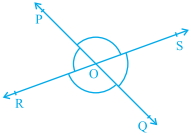
In the figure,lines $PQ$ and $RS$ intersect each other at point $O$. If $\angle POR : \angle ROQ = 5 : 7,$ find all the angles.
Solution
(N/A) Since $PQ$ is a straight line,the sum of angles forming a linear pair is $180^o$.
$\angle POR + \angle ROQ = 180^o$ (Linear pair axiom)
Given that $\angle POR : \angle ROQ = 5 : 7$.
Let $\angle POR = 5x$ and $\angle ROQ = 7x$.
Substituting these into the equation:
$5x + 7x = 180^o$
$12x = 180^o$
$x = 15^o$
Therefore,$\angle POR = 5 \times 15^o = 75^o$ and $\angle ROQ = 7 \times 15^o = 105^o$.
Since $PQ$ and $RS$ are intersecting lines,vertically opposite angles are equal:
$\angle POS = \angle ROQ = 105^o$
$\angle SOQ = \angle POR = 75^o$
Thus,the angles are $75^o, 105^o, 75^o,$ and $105^o$.
4 likes
View Solution2
MediumMCQ
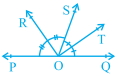
In the figure,ray $OS$ stands on a line $POQ$. Ray $OR$ and ray $OT$ are angle bisectors of $\angle POS$ and $\angle SOQ$,respectively. If $\angle POS = x$,find $\angle ROT$. (in $^o$)
A
$45$
B
$90$
C
$360$
D
$180$
Solution
(B) Ray $OS$ stands on the line $POQ$.
Therefore,$\angle POS + \angle SOQ = 180^o$ (Linear pair axiom).
Given that $\angle POS = x$.
Therefore,$x + \angle SOQ = 180^o$,which implies $\angle SOQ = 180^o - x$.
Now,ray $OR$ bisects $\angle POS$,therefore $\angle ROS = \frac{1}{2} \times \angle POS = \frac{x}{2}$.
Similarly,ray $OT$ bisects $\angle SOQ$,therefore $\angle SOT = \frac{1}{2} \times \angle SOQ = \frac{1}{2} \times (180^o - x) = 90^o - \frac{x}{2}$.
Now,$\angle ROT = \angle ROS + \angle SOT$.
Substituting the values,$\angle ROT = \frac{x}{2} + 90^o - \frac{x}{2} = 90^o$.
1 likes
View Solution3
Medium
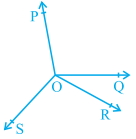
In the figure,$OP$,$OQ$,$OR$,and $OS$ are four rays. Prove that $\angle POQ + \angle QOR + \angle SOR + \angle POS = 360^o$.
Solution
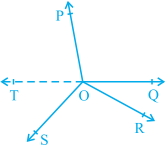
(N/A) To prove this,we need to produce any of the rays $OP$,$OQ$,$OR$,or $OS$ backwards to a point. Let us produce ray $OQ$ backwards to a point $T$ such that $TOQ$ is a straight line.
Now,ray $OP$ stands on line $TOQ$.
Therefore,$\angle TOP + \angle POQ = 180^o$ ........ $(1)$ (Linear pair axiom)
Similarly,ray $OS$ stands on line $TOQ$.
Therefore,$\angle TOS + \angle SOQ = 180^o$ ........ $(2)$
But,$\angle SOQ = \angle SOR + \angle QOR$.
Substituting this into $(2)$,we get:
$\angle TOS + \angle SOR + \angle QOR = 180^o$ ........ $(3)$
Now,adding $(1)$ and $(3)$,we get:
$\angle TOP + \angle POQ + \angle TOS + \angle SOR + \angle QOR = 360^o$ ........ $(4)$
Since $\angle TOP + \angle TOS = \angle POS$,equation $(4)$ becomes:
$\angle POQ + \angle QOR + \angle SOR + \angle POS = 360^o$.
0 likes
View Solution4
MediumMCQ
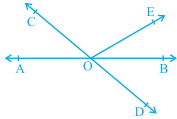
In the figure,lines $AB$ and $CD$ intersect at $O$. If $\angle AOC + \angle BOE = 70^o$ and $\angle BOD = 40^o$,find $\angle BOE$ and reflex $\angle COE$.
A
$30^o, 150^o$
B
$90^o, 270^o$
C
$70^o, 270^o$
D
$30^o, 250^o$
Solution
(D) Since $AB$ is a straight line,the sum of angles on one side of the line at point $O$ is $180^o$.
$\therefore \angle AOC + \angle COE + \angle BOE = 180^o$
Rearranging the terms,we get:
$(\angle AOC + \angle BOE) + \angle COE = 180^o$
Given that $\angle AOC + \angle BOE = 70^o$,substituting this value:
$70^o + \angle COE = 180^o$
$\angle COE = 180^o - 70^o = 110^o$
Reflex $\angle COE = 360^o - \angle COE = 360^o - 110^o = 250^o$
Since lines $AB$ and $CD$ intersect at $O$,vertically opposite angles are equal:
$\angle AOC = \angle BOD$
Given $\angle BOD = 40^o$,therefore $\angle AOC = 40^o$.
Using the given equation $\angle AOC + \angle BOE = 70^o$:
$40^o + \angle BOE = 70^o$
$\angle BOE = 70^o - 40^o = 30^o$
Thus,$\angle BOE = 30^o$ and reflex $\angle COE = 250^o$.
5 likes
View Solution5
Easy
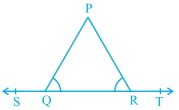
In the figure,if $\angle PQR = \angle PRQ$,then prove that $\angle PQS = \angle PRT$.
Solution
(N/A) Since $ST$ is a straight line,
$\therefore \angle PQS + \angle PQR = 180^\circ$ ........... $(1)$
Similarly,$\angle PRT + \angle PRQ = 180^\circ$ ........... $(2)$
From $(1)$ and $(2)$,we have
$\angle PQS + \angle PQR = \angle PRT + \angle PRQ$
But $\angle PQR = \angle PRQ$ [Given]
$\therefore \angle PQS = \angle PRT$
$\therefore \angle PQS + \angle PQR = 180^\circ$ ........... $(1)$
Similarly,$\angle PRT + \angle PRQ = 180^\circ$ ........... $(2)$
From $(1)$ and $(2)$,we have
$\angle PQS + \angle PQR = \angle PRT + \angle PRQ$
But $\angle PQR = \angle PRQ$ [Given]
$\therefore \angle PQS = \angle PRT$
0 likes
View Solution6
Medium
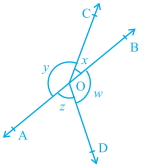
In the figure,if $x+y=w+z$,then prove that $AOB$ is a line.
Solution
(N/A) The sum of all the angles around a point is $360^\circ$.
Therefore,$x+y+z+w=360^\circ$.
We are given that $x+y=w+z$.
Substituting $(w+z)$ with $(x+y)$,we get:
$(x+y)+(x+y)=360^\circ$
$2(x+y)=360^\circ$
$x+y = \frac{360^\circ}{2} = 180^\circ$.
Since the sum of the adjacent angles $x$ and $y$ is $180^\circ$,they form a linear pair.
Therefore,$AOB$ is a straight line.
1 likes
View Solution7
Medium
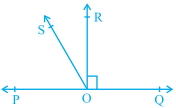
In the figure,$POQ$ is a line. Ray $OR$ is perpendicular to line $PQ$. $OS$ is another ray lying between rays $OP$ and $OR$. Prove that $\angle ROS = \frac{1}{2}(\angle QOS - \angle POS)$.
Solution
(N/A) $POQ$ is a straight line. [Given]
$\therefore \angle POS + \angle ROS + \angle ROQ = 180^o$
But $OR \perp PQ$,therefore $\angle ROQ = 90^o$.
Substituting $\angle ROQ = 90^o$ in the equation:
$\angle POS + \angle ROS + 90^o = 180^o$
$\Rightarrow \angle POS + \angle ROS = 90^o$ --- $(1)$
Now,we have $\angle QOS = \angle ROQ + \angle ROS$
Since $\angle ROQ = 90^o$,we have:
$\angle QOS = 90^o + \angle ROS$
$\Rightarrow 90^o = \angle QOS - \angle ROS$ --- $(2)$
From $(1)$ and $(2)$,we have:
$\angle POS + \angle ROS = \angle QOS - \angle ROS$
$\Rightarrow \angle ROS + \angle ROS = \angle QOS - \angle POS$
$\Rightarrow 2 \angle ROS = \angle QOS - \angle POS$
$\therefore \angle ROS = \frac{1}{2}(\angle QOS - \angle POS)$
0 likes
View Solution8
DifficultMCQ
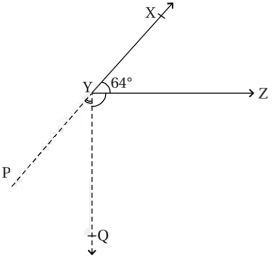
It is given that $\angle XYZ = 64^o$ and $XY$ is produced to point $P$. If ray $YQ$ bisects $\angle ZYP$,find $\angle XYQ$ and reflex $\angle QYP$. (in $^o$)
A
$302$
B
$126$
C
$180$
D
$175$
Solution
(A) $XYP$ is a straight line.
Therefore,$\angle XYZ + \angle ZYQ + \angle QYP = 180^o$.
Since $64^o + \angle ZYQ + \angle QYP = 180^o$ and $YQ$ bisects $\angle ZYP$,we have $\angle ZYQ = \angle QYP$.
Thus,$64^o + 2 \angle QYP = 180^o$.
$2 \angle QYP = 180^o - 64^o = 116^o$.
$\angle QYP = 58^o$.
Reflex $\angle QYP = 360^o - 58^o = 302^o$.
Now,$\angle XYQ = \angle XYZ + \angle ZYQ = 64^o + 58^o = 122^o$.
2 likes
View Solution9
MediumMCQ
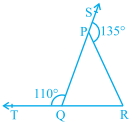
In the figure,sides $QP$ and $RQ$ of $\Delta PQR$ are produced to points $S$ and $T$ respectively. If $\angle SPR = 135^o$ and $\angle PQT = 110^o$,find $\angle PRQ$. (in $^o$)
A
$65$
B
$75$
C
$85$
D
$95$
Solution
(A) Since $TQR$ is a straight line,
$\therefore \angle TQP + \angle PQR = 180^o$ [Linear pair axiom]
$\Rightarrow 110^o + \angle PQR = 180^o$
$\Rightarrow \angle PQR = 180^o - 110^o = 70^o$
Now,for $\Delta PQR$,the side $QP$ is produced to $S$.
Therefore,$\angle SPR$ is an exterior angle of $\Delta PQR$.
By the exterior angle property,the exterior angle is equal to the sum of the two interior opposite angles.
$\therefore \angle SPR = \angle PQR + \angle PRQ$
$135^o = 70^o + \angle PRQ$
$\Rightarrow \angle PRQ = 135^o - 70^o$
$\Rightarrow \angle PRQ = 65^o$
0 likes
View Solution10
Easy
Let $OA, OB, OC$ and $OD$ be rays in the anticlockwise direction such that $\angle AOB = 100^{\circ}, \angle COD = 100^{\circ}, \angle BOC = 82^{\circ}$ and $\angle AOD = 78^{\circ}$. Is it true to say that $AOC$ and $BOD$ are lines?
Solution
(NONE) line is formed if the sum of adjacent angles around a point is $180^{\circ}$.
For $AOC$ to be a line,the sum of angles $\angle AOB + \angle BOC$ must be $180^{\circ}$.
Given $\angle AOB = 100^{\circ}$ and $\angle BOC = 82^{\circ}$,their sum is $100^{\circ} + 82^{\circ} = 182^{\circ}$.
Since $182^{\circ} \neq 180^{\circ}$,$AOC$ is not a straight line.
Similarly,for $BOD$ to be a line,the sum of angles $\angle BOC + \angle COD$ must be $180^{\circ}$.
Given $\angle BOC = 82^{\circ}$ and $\angle COD = 100^{\circ}$,their sum is $82^{\circ} + 100^{\circ} = 182^{\circ}$.
Since $182^{\circ} \neq 180^{\circ}$,$BOD$ is also not a straight line.
0 likes
View Solution11
EasyMCQ
$A$ part [or portion] of a line with two end points is called a $\ldots \ldots \ldots$
A
Line
B
Ray
C
Line segment
D
Point
Solution
(C) line is a collection of points that extends infinitely in both directions. $A$ part of a line that has two distinct end points is known as a line segment. Therefore,the correct answer is a line segment.
0 likes
View Solution12
EasyMCQ
$A$ part of a line with one end point is called a $\ldots \ldots \ldots .$
A
Line segment
B
Ray
C
Line
D
Point
Solution
(B) line is a straight path that extends infinitely in both directions. $A$ line segment is a part of a line with two end points. $A$ ray is a part of a line that starts at one point (the end point) and extends infinitely in one direction. Therefore,a part of a line with one end point is called a ray.
0 likes
View Solution13
EasyMCQ
$A$ straight angle has measure......... (in $^{\circ}$)
A
$50$
B
$80$
C
$90$
D
$180$
Solution
(D) An angle whose measure is exactly $180^{\circ}$ is called a straight angle. This angle represents a straight line.
0 likes
View Solution14
EasyMCQ
An angle whose measure is $90^{\circ}$ is called a $\ldots \ldots \ldots$
A
Acute angle
B
Right angle
C
Obtuse angle
D
Straight angle
Solution
(B) An angle that measures exactly $90^{\circ}$ is defined as a right angle. Therefore,the correct answer is a right angle.
0 likes
View Solution15
EasyMCQ
An angle which is greater than $180^{\circ}$ but less than $360^{\circ}$ is called a $\ldots \ldots \ldots .$.
A
Acute angle
B
Obtuse angle
C
Reflex angle
D
Straight angle
Solution
(C) An angle whose measure is greater than $180^{\circ}$ and less than $360^{\circ}$ is known as a reflex angle.
0 likes
View SolutionLines and Angles — Basic Terms and Definitions · Frequently Asked Questions
1Are these Lines and Angles questions useful for JEE and NEET?
Yes. All questions in this section are mapped to JEE Main and NEET exam patterns. Previous year questions from JEE Main, NEET, GUJCET and state-level exams are included with full solutions.
2Can I switch to Hindi or Gujarati for these questions?
Yes. Use the language tabs in the hero section or the sidebar to view the same questions and solutions in English, Hindi or Gujarati.
3How do I generate a question paper from this subtopic?
Use the Vedclass Exam Paper Generator — select the chapter and subtopic, set difficulty, and generate Sets A, B, C, D automatically. First 3 chapters of every subject are free.
Vedclass Products
For Students
Vedclass Test Series
Mock tests in real JEE/NEET style with performance analysis. 5-day free trial.
Start Free TrialFor Teachers
Exam Paper Generator
Generate Set A/B/C/D papers from this chapter in 2 minutes. 3 chapters free.
Try FreeFor Institutes
Online Exam Module
Live online exams with unlimited students, 360° analytics & white-label branding.
See DemoFor Teachers & Institutes
Generate a Lines and Angles Exam Paper in 2 Minutes
Select subtopic & difficulty — Sets A, B, C, D auto-generated with No Repeat logic.
First 3 chapters of every subject are free — no payment required.