
A English
Intersecting and Non-intersecting Lines Questions in English
Class 9 Mathematics · Lines and Angles · Intersecting and Non-intersecting Lines
4+
Questions
English
Language
100%
With Solutions
Showing 4 of 4 questions in English
1
MediumMCQ
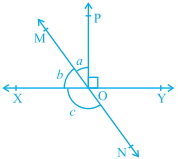
In the figure,lines $XY$ and $MN$ intersect at $O$. If $\angle POY = 90^o$ and $a: b = 2: 3$,find $c$. (in $^o$)
A
$126$
B
$145$
C
$136$
D
$120$
Solution
(A) $XOY$ is a straight line.
Therefore,$\angle b + \angle a + \angle POY = 180^o$ (Linear pair axiom).
Given that $\angle POY = 90^o$,so $\angle b + \angle a + 90^o = 180^o$,which implies $\angle b + \angle a = 90^o$.
Given $a: b = 2: 3$,let $a = 2x$ and $b = 3x$.
Then $2x + 3x = 90^o$,so $5x = 90^o$,which gives $x = 18^o$.
Thus,$\angle a = 2 \times 18^o = 36^o$ and $\angle b = 3 \times 18^o = 54^o$.
Since lines $XY$ and $MN$ intersect at $O$,$\angle XON$ and $\angle MOY$ are vertically opposite angles,and $\angle XOM$ and $\angle NOY$ are vertically opposite angles.
Here,$\angle c = \angle XOM = \angle a + \angle POY$ is not correct based on the figure. Looking at the figure,$\angle c = \angle XON$.
Since $XOY$ is a straight line,$\angle XON + \angle NOY = 180^o$.
Also,$\angle NOY = \angle b = 54^o$ (vertically opposite angles).
Therefore,$\angle c = 180^o - 54^o = 126^o$.
1 likes
View Solution2
Easy
If one of the angles formed by two intersecting lines is a right angle,what can you say about the other three angles? Give reason for your answer.
Solution
(D) Let two lines $AB$ and $CD$ intersect at point $O$. Let $\angle AOC = 90^\circ$.
Since $AB$ is a straight line,$\angle AOC + \angle BOC = 180^\circ$ (Linear pair axiom).
$90^\circ + \angle BOC = 180^\circ \implies \angle BOC = 90^\circ$.
Similarly,$\angle AOC + \angle AOD = 180^\circ$ (Linear pair axiom).
$90^\circ + \angle AOD = 180^\circ \implies \angle AOD = 90^\circ$.
Finally,$\angle AOD + \angle BOD = 180^\circ$ (Linear pair axiom).
$90^\circ + \angle BOD = 180^\circ \implies \angle BOD = 90^\circ$.
Therefore,all other three angles are also right angles $(90^\circ)$.
0 likes
View Solution3
Medium
Prove that two lines that are respectively perpendicular to two intersecting lines intersect each other.
Solution
(N/A) Let $l$ and $m$ be two intersecting lines. Let line $n$ be perpendicular to $l$ $(n \perp l)$ and line $p$ be perpendicular to $m$ $(p \perp m)$.
To prove: Lines $n$ and $p$ intersect each other.
Proof: Assume for the sake of contradiction that lines $n$ and $p$ are parallel to each other $(n \parallel p)$.
Since $n \perp l$ and $n \parallel p$,it follows that $p \perp l$ (because lines perpendicular to the same line are parallel,or conversely,a line perpendicular to one of two parallel lines is perpendicular to the other).
We are given that $p \perp m$. Thus,we have $p \perp l$ and $p \perp m$.
This implies that $l \parallel m$ (since both are perpendicular to the same line $p$).
However,this contradicts the given information that $l$ and $m$ are intersecting lines.
Therefore,our assumption that $n \parallel p$ must be false.
Hence,lines $n$ and $p$ must intersect each other.
0 likes
View Solution4
MediumMCQ
Lines $AB$ and $CD$ intersect at $P$. If $\angle APC = 2x + 30^{\circ}$ and $\angle BPD = 4x - 20^{\circ}$,then find $x$,$\angle APC$,and $\angle BPD$.
A
$x = 25, \angle APC = 80^{\circ}, \angle BPD = 80^{\circ}$
B
$x = 20, \angle APC = 70^{\circ}, \angle BPD = 60^{\circ}$
C
$x = 30, \angle APC = 90^{\circ}, \angle BPD = 100^{\circ}$
D
$x = 25, \angle APC = 70^{\circ}, \angle BPD = 90^{\circ}$
Solution
(A) When two lines intersect,the vertically opposite angles are equal.
Since lines $AB$ and $CD$ intersect at $P$,$\angle APC$ and $\angle BPD$ are vertically opposite angles.
Therefore,$\angle APC = \angle BPD$.
Substituting the given expressions: $2x + 30^{\circ} = 4x - 20^{\circ}$.
Rearranging the terms: $30^{\circ} + 20^{\circ} = 4x - 2x$.
$50^{\circ} = 2x$,which gives $x = 25^{\circ}$.
Now,calculate the angles:
$\angle APC = 2(25) + 30 = 50 + 30 = 80^{\circ}$.
$\angle BPD = 4(25) - 20 = 100 - 20 = 80^{\circ}$.
Thus,$x = 25$,$\angle APC = 80^{\circ}$,and $\angle BPD = 80^{\circ}$.
0 likes
View SolutionLines and Angles — Intersecting and Non-intersecting Lines · Frequently Asked Questions
1Are these Lines and Angles questions useful for JEE and NEET?
Yes. All questions in this section are mapped to JEE Main and NEET exam patterns. Previous year questions from JEE Main, NEET, GUJCET and state-level exams are included with full solutions.
2Can I switch to Hindi or Gujarati for these questions?
Yes. Use the language tabs in the hero section or the sidebar to view the same questions and solutions in English, Hindi or Gujarati.
3How do I generate a question paper from this subtopic?
Use the Vedclass Exam Paper Generator — select the chapter and subtopic, set difficulty, and generate Sets A, B, C, D automatically. First 3 chapters of every subject are free.
Vedclass Products
For Students
Vedclass Test Series
Mock tests in real JEE/NEET style with performance analysis. 5-day free trial.
Start Free TrialFor Teachers
Exam Paper Generator
Generate Set A/B/C/D papers from this chapter in 2 minutes. 3 chapters free.
Try FreeFor Institutes
Online Exam Module
Live online exams with unlimited students, 360° analytics & white-label branding.
See DemoFor Teachers & Institutes
Generate a Lines and Angles Exam Paper in 2 Minutes
Select subtopic & difficulty — Sets A, B, C, D auto-generated with No Repeat logic.
First 3 chapters of every subject are free — no payment required.