
A English
Surface Area of a Sphere Questions in English
Class 9 Mathematics · Surface Areas and Volumes · Surface Area of a Sphere
37+
Questions
English
Language
100%
With Solutions
Showing 37 of 37 questions in English
1
EasyMCQ
The radius of a hemispherical balloon increases from $6\,cm$ to $12\,cm$ as air is being pumped into it. The ratio of the surface areas of the balloon in the two cases is
A
$2:3$
B
$1:3$
C
$1:4$
D
$2:1$
Solution
(C) The balloon is hemispherical in shape.
The surface area of a hemispherical balloon with radius $r$ is given by the formula $S = 3\pi r^2$.
Let $r_1 = 6\,cm$ and $r_2 = 12\,cm$ be the radii in the two cases.
The ratio of the surface areas is $\frac{S_1}{S_2} = \frac{3\pi r_1^2}{3\pi r_2^2} = \frac{r_1^2}{r_2^2}$.
Substituting the values,we get $\frac{S_1}{S_2} = \frac{6^2}{12^2} = \frac{36}{144} = \frac{1}{4}$.
Therefore,the ratio of the surface areas of the two balloons is $1:4$.
0 likes
View Solution2
EasyMCQ
Find the surface area of a sphere of radius $7 \, cm$. (in $, cm^{2}$)
A
$616$
B
$757$
C
$645$
D
$630$
Solution
(A) The surface area of a sphere is given by the formula $4 \pi r^{2}$.
Given the radius $r = 7 \, cm$.
Substituting the value of $r$ in the formula:
Surface Area $= 4 \times \frac{22}{7} \times (7 \, cm)^{2}$
$= 4 \times \frac{22}{7} \times 49 \, cm^{2}$
$= 4 \times 22 \times 7 \, cm^{2}$
$= 88 \times 7 \, cm^{2}$
$= 616 \, cm^{2}$.
Given the radius $r = 7 \, cm$.
Substituting the value of $r$ in the formula:
Surface Area $= 4 \times \frac{22}{7} \times (7 \, cm)^{2}$
$= 4 \times \frac{22}{7} \times 49 \, cm^{2}$
$= 4 \times 22 \times 7 \, cm^{2}$
$= 88 \times 7 \, cm^{2}$
$= 616 \, cm^{2}$.
0 likes
View Solution3
EasyMCQ
The hollow sphere,in which the circus motorcyclist performs his stunts,has a diameter of $7 \,m$. Find the area available to the motorcyclist for riding. (in $,m^2$)
A
$987$
B
$964$
C
$154$
D
$524$
Solution
(C) The diameter of the hollow sphere is $d = 7 \,m$.
The radius $r$ of the sphere is given by $r = \frac{d}{2} = \frac{7}{2} = 3.5 \,m$.
The area available to the motorcyclist for riding is the surface area of the sphere,which is calculated using the formula $A = 4 \pi r^2$.
Substituting the values:
$A = 4 \times \frac{22}{7} \times 3.5 \times 3.5$
$A = 4 \times \frac{22}{7} \times \frac{7}{2} \times \frac{7}{2}$
$A = 4 \times 22 \times \frac{7}{4}$
$A = 22 \times 7 = 154 \,m^2$.
Thus,the area available for riding is $154 \,m^2$.
0 likes
View Solution4
MediumMCQ
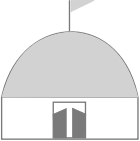
$A$ hemispherical dome of a building needs to be painted. If the circumference of the base of the dome is $17.6 \, m$,find the cost of painting it,given the cost of painting is $Rs. 5$ per $100 \, cm^2$.
A
$Rs. 30000$
B
$Rs. 24958$
C
$Rs. 24000$
D
$Rs. 24640$
Solution
(D) Since only the rounded surface of the dome is to be painted,we need to find the curved surface area of the hemisphere.
Circumference of the base of the dome $= 17.6 \, m$.
Let the radius be $r$. Then,$2\pi r = 17.6$.
$r = \frac{17.6}{2 \times \pi} = \frac{17.6 \times 7}{2 \times 22} = 0.8 \times 3.5 = 2.8 \, m$.
Curved surface area of the hemisphere $= 2\pi r^2 = 2 \times \frac{22}{7} \times 2.8 \times 2.8 = 49.28 \, m^2$.
Cost of painting $100 \, cm^2 = Rs. 5$.
Since $1 \, m^2 = 10000 \, cm^2$,the cost of painting $1 \, m^2 = \frac{5}{100} \times 10000 = Rs. 500$.
Total cost of painting $= 49.28 \times 500 = Rs. 24640$.
0 likes
View Solution5
EasyMCQ
Find the surface area of a sphere of radius $10.5 \, cm$.
Assume $\pi = \frac{22}{7}$. (in $, cm^{2}$)
Assume $\pi = \frac{22}{7}$. (in $, cm^{2}$)
A
$1386$
B
$1006$
C
$1300$
D
$9686$
Solution
(A) The radius $(r)$ of the sphere is $10.5 \, cm$.
The formula for the surface area of a sphere is $4 \pi r^{2}$.
Substituting the given values:
Surface area $= 4 \times \frac{22}{7} \times (10.5)^{2} \, cm^{2}$
$= 4 \times \frac{22}{7} \times 10.5 \times 10.5 \, cm^{2}$
$= 4 \times 22 \times 1.5 \times 10.5 \, cm^{2}$
$= 88 \times 15.75 \, cm^{2}$
$= 1386 \, cm^{2}$
Therefore,the surface area of the sphere is $1386 \, cm^{2}$.
0 likes
View Solution6
EasyMCQ
Find the surface area of a sphere of radius $5.6 \, cm$.
Assume $\pi = \frac{22}{7}$. (in $, cm^{2}$)
Assume $\pi = \frac{22}{7}$. (in $, cm^{2}$)
A
$3265.24$
B
$394.24$
C
$850.24$
D
$300.24$
Solution
(B) The radius $(r)$ of the sphere is $5.6 \, cm$.
The formula for the surface area of a sphere is $4 \pi r^{2}$.
Substituting the given values:
Surface area $= 4 \times \frac{22}{7} \times (5.6)^{2} \, cm^{2}$
$= 4 \times \frac{22}{7} \times 5.6 \times 5.6 \, cm^{2}$
$= 4 \times 22 \times 0.8 \times 5.6 \, cm^{2}$
$= 88 \times 4.48 \, cm^{2}$
$= 394.24 \, cm^{2}$.
Therefore,the surface area of the sphere is $394.24 \, cm^{2}$.
0 likes
View Solution7
EasyMCQ
Find the surface area of a sphere of radius $14 \, cm$.
Assume $\pi = \frac{22}{7}$. (in $, cm^2$)
Assume $\pi = \frac{22}{7}$. (in $, cm^2$)
A
$4464$
B
$21004$
C
$2464$
D
$2469$
Solution
(C) The radius $(r)$ of the sphere is $14 \, cm$.
The formula for the surface area of a sphere is $4 \pi r^2$.
Substituting the given values:
Surface area $= 4 \times \frac{22}{7} \times (14)^2 \, cm^2$
$= 4 \times \frac{22}{7} \times 14 \times 14 \, cm^2$
$= 4 \times 22 \times 2 \times 14 \, cm^2$
$= 88 \times 28 \, cm^2$
$= 2464 \, cm^2$.
Therefore,the surface area of the sphere is $2464 \, cm^2$.
0 likes
View Solution8
EasyMCQ
Find the surface area of a sphere of diameter $14 \, cm$.
Assume $\pi = \frac{22}{7}$. (in $, cm^2$)
Assume $\pi = \frac{22}{7}$. (in $, cm^2$)
A
$706$
B
$536$
C
$600$
D
$616$
Solution
(D) The radius $(r)$ of the sphere is given by:
$r = \frac{\text{Diameter}}{2} = \frac{14 \, cm}{2} = 7 \, cm$.
The formula for the surface area of a sphere is $4 \pi r^2$.
Substituting the values:
Surface Area $= 4 \times \frac{22}{7} \times (7 \, cm)^2$
$= 4 \times \frac{22}{7} \times 49 \, cm^2$
$= 4 \times 22 \times 7 \, cm^2$
$= 88 \times 7 \, cm^2$
$= 616 \, cm^2$.
Therefore,the surface area of the sphere is $616 \, cm^2$.
0 likes
View Solution9
EasyMCQ
Find the surface area of a sphere of diameter $21 \, cm$. Assume $\pi = \frac{22}{7}$. (in $, cm^{2}$)
A
$1386$
B
$1006$
C
$1300$
D
$1315$
Solution
(A) Given,diameter of the sphere $d = 21 \, cm$.
Radius $(r) = \frac{d}{2} = \frac{21}{2} \, cm = 10.5 \, cm$.
The surface area of a sphere is given by the formula $4 \pi r^{2}$.
Substituting the values: $\text{Surface Area} = 4 \times \frac{22}{7} \times (10.5)^{2} \, cm^{2}$.
$= 4 \times \frac{22}{7} \times 10.5 \times 10.5 \, cm^{2}$.
$= 4 \times \frac{22}{7} \times \frac{21}{2} \times \frac{21}{2} \, cm^{2}$.
$= 22 \times 3 \times 21 \, cm^{2} = 1386 \, cm^{2}$.
Thus,the surface area of the sphere is $1386 \, cm^{2}$.
0 likes
View Solution10
EasyMCQ
Find the surface area of a sphere with a diameter of $3.5 \, cm$. Assume $\pi = \frac{22}{7}$. (in $, cm^2$)
A
$40.5$
B
$38.5$
C
$96.5$
D
$49.5$
Solution
(B) Given: Diameter $(d) = 3.5 \, cm$.
Radius $(r) = \frac{d}{2} = \frac{3.5}{2} = 1.75 \, cm$.
The surface area of a sphere is given by the formula: $A = 4 \pi r^2$.
Substituting the values: $A = 4 \times \frac{22}{7} \times (1.75)^2$.
$A = 4 \times \frac{22}{7} \times 1.75 \times 1.75$.
$A = 4 \times \frac{22}{7} \times \frac{7}{4} \times 1.75$.
$A = 22 \times 1.75 = 38.5 \, cm^2$.
Thus,the surface area of the sphere is $38.5 \, cm^2$.
0 likes
View Solution11
MediumMCQ
The radius of a spherical balloon increases from $7 \, cm$ to $14 \, cm$ as air is being pumped into it. Find the ratio of surface areas of the balloon in the two cases.
A
$1:7$
B
$1:5$
C
$1:6$
D
$1:4$
Solution
(D) The initial radius $(r_1)$ of the spherical balloon is $7 \, cm$.
The final radius $(r_2)$ of the spherical balloon after pumping air is $14 \, cm$.
The surface area of a sphere is given by the formula $A = 4 \pi r^2$.
The ratio of the surface areas is given by $\frac{A_1}{A_2} = \frac{4 \pi r_1^2}{4 \pi r_2^2} = \left( \frac{r_1}{r_2} \right)^2$.
Substituting the values,we get $\left( \frac{7}{14} \right)^2 = \left( \frac{1}{2} \right)^2 = \frac{1}{4}$.
Therefore,the ratio of the surface areas is $1:4$.
1 likes
View Solution12
MediumMCQ
Find the radius of a sphere whose surface area is $154 \, cm^2$. (in $, cm$)
A
$5.6$
B
$3.5$
C
$3.0$
D
$6.5$
Solution
(B) Let the radius of the sphere be $r \, cm$.
The surface area of a sphere is given by the formula $4 \pi r^2$.
Given that the surface area is $154 \, cm^2$,we have:
$4 \pi r^2 = 154$
Substituting $\pi = \frac{22}{7}$:
$4 \times \frac{22}{7} \times r^2 = 154$
Solving for $r^2$:
$r^2 = \frac{154 \times 7}{4 \times 22}$
$r^2 = \frac{7 \times 7}{4} = \left(\frac{7}{2}\right)^2$
Taking the square root of both sides:
$r = \frac{7}{2} = 3.5 \, cm$
Thus,the radius of the sphere is $3.5 \, cm$.
0 likes
View Solution13
MediumMCQ
The diameter of the moon is approximately one-fourth of the diameter of the earth. Find the ratio of their surface areas.
A
$1:19$
B
$1:18$
C
$1:16$
D
$1:17$
Solution
(C) Let the radius of the earth be $R$.
Since the diameter of the moon is one-fourth of the diameter of the earth,the radius of the moon will also be one-fourth of the radius of the earth.
Therefore,the radius of the moon $= \frac{R}{4}$.
The surface area of a sphere is given by the formula $A = 4 \pi r^2$.
Surface area of the earth $= 4 \pi R^2$.
Surface area of the moon $= 4 \pi \left( \frac{R}{4} \right)^2 = 4 \pi \left( \frac{R^2}{16} \right) = \frac{\pi R^2}{4}$.
The ratio of the surface area of the moon to the surface area of the earth is:
$\frac{\text{Surface area of the moon}}{\text{Surface area of the earth}} = \frac{\frac{\pi R^2}{4}}{4 \pi R^2} = \frac{1}{4 \times 4} = \frac{1}{16}$.
Thus,the ratio of their surface areas is $1:16$.
0 likes
View Solution14
MediumMCQ
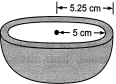
$A$ hemispherical bowl is made of steel,$0.25 \, cm$ thick. The inner radius of the bowl is $5 \, cm$. Find the outer curved surface area of the bowl. (in $, cm^2$)
A
$170.96$
B
$153.29$
C
$160.25$
D
$173.25$
Solution
(D) Inner radius $(r) = 5 \, cm$
Thickness $= 0.25 \, cm$
Outer radius $(R) = r + \text{thickness} = 5 + 0.25 = 5.25 \, cm$
The outer curved surface area of a hemispherical bowl is given by the formula $2 \pi R^2$.
Outer curved surface area $= 2 \times \frac{22}{7} \times (5.25)^2 \, cm^2$
$= 2 \times \frac{22}{7} \times 5.25 \times 5.25 \, cm^2$
$= 2 \times \frac{22}{7} \times \frac{525}{100} \times \frac{525}{100} \, cm^2$
$= 2 \times 22 \times \frac{75}{100} \times 5.25 \, cm^2$
$= 44 \times 0.75 \times 5.25 \, cm^2$
$= 173.25 \, cm^2$
0 likes
View Solution15
MediumMCQ
The diameter of a sphere is decreased by $25\%$. By what per cent does its curved surface area decrease (in $\%$)?
A
$43.75$
B
$50$
C
$56.25$
D
$25$
Solution
(A) Let the initial diameter of the sphere be $D_1$. Then the initial radius $r_1 = D_1 / 2$.
The initial curved surface area $A_1 = 4 \pi r_1^2$.
When the diameter is decreased by $25\%$,the new diameter $D_2 = D_1 - 0.25 D_1 = 0.75 D_1$.
The new radius $r_2 = D_2 / 2 = 0.75 (D_1 / 2) = 0.75 r_1$.
The new curved surface area $A_2 = 4 \pi r_2^2 = 4 \pi (0.75 r_1)^2 = 4 \pi (0.5625 r_1^2) = 0.5625 A_1$.
The decrease in surface area is $A_1 - A_2 = A_1 - 0.5625 A_1 = 0.4375 A_1$.
The percentage decrease is $((A_1 - A_2) / A_1) \times 100\% = 0.4375 \times 100\% = 43.75\%$.
0 likes
View Solution16
EasyMCQ
The radius of a sphere is $14 \, cm$. Find its surface area (in $cm^2$).
A
$1233$
B
$2433$
C
$3521$
D
$2464$
Solution
(D) Given,the radius of the sphere $(r) = 14 \, cm$.
The formula for the surface area of a sphere is $A = 4 \pi r^2$.
Substituting the value of $r = 14 \, cm$ and $\pi = \frac{22}{7}$:
$A = 4 \times \frac{22}{7} \times 14 \times 14 \, cm^2$
$A = 4 \times 22 \times 2 \times 14 \, cm^2$
$A = 88 \times 28 \, cm^2$
$A = 2464 \, cm^2$.
Thus,the surface area of the sphere is $2464 \, cm^2$.
0 likes
View Solution17
MediumMCQ
The radius of a sphere is $3.5\, cm$. Find the cost of plating gold on its surface at the rate of ₹ $150$ per $cm^{2}$. (in ₹)
A
$23000$
B
$23100$
C
$22200$
D
$125000$
Solution
(B) Given,the radius of the sphere $(r) = 3.5\, cm = \frac{7}{2}\, cm$.
The surface area of a sphere is given by the formula $A = 4\pi r^{2}$.
Substituting the values:
$A = 4 \times \frac{22}{7} \times \left(\frac{7}{2}\right)^{2}$
$A = 4 \times \frac{22}{7} \times \frac{49}{4} = 22 \times 7 = 154\, cm^{2}$.
The cost of plating gold is ₹ $150$ per $cm^{2}$.
Total cost = $\text{Surface area} \times \text{Rate}$
Total cost = $154 \times 150 = 23,100$.
Therefore,the cost of plating gold on its surface is ₹ $23,100$.
0 likes
View Solution18
MediumMCQ
The ratio of the radii of a sphere and a hemisphere is $3:2$. Find the ratio of the surface area of the sphere to the total surface area of the hemisphere.
A
$2:1$
B
$4:1$
C
$3:1$
D
$5:3$
Solution
(C) Let the radius of the sphere be $r_1$ and the radius of the hemisphere be $r_2$.
Given that the ratio of their radii is $r_1 : r_2 = 3 : 2$,so $\frac{r_1}{r_2} = \frac{3}{2}$.
The surface area of a sphere is $4 \pi r_1^2$.
The total surface area of a hemisphere is $3 \pi r_2^2$.
Now,the ratio of the surface area of the sphere to the total surface area of the hemisphere is:
$\frac{4 \pi r_1^2}{3 \pi r_2^2} = \frac{4}{3} \times \left(\frac{r_1}{r_2}\right)^2$
$= \frac{4}{3} \times \left(\frac{3}{2}\right)^2$
$= \frac{4}{3} \times \frac{9}{4}$
$= \frac{3}{1}$
Therefore,the required ratio is $3:1$.
0 likes
View Solution19
EasyMCQ
Find the surface area of a sphere of radius $30 \, cm$ $(\pi = 3.14)$ (in $cm^2$).
A
$22304$
B
$12304$
C
$11304$
D
$10304$
Solution
(C) The surface area of a sphere is given by the formula $A = 4 \pi r^2$.
Given radius $r = 30 \, cm$ and $\pi = 3.14$.
Substituting the values into the formula:
$A = 4 \times 3.14 \times (30)^2$
$A = 4 \times 3.14 \times 900$
$A = 12.56 \times 900$
$A = 11304 \, cm^2$.
Given radius $r = 30 \, cm$ and $\pi = 3.14$.
Substituting the values into the formula:
$A = 4 \times 3.14 \times (30)^2$
$A = 4 \times 3.14 \times 900$
$A = 12.56 \times 900$
$A = 11304 \, cm^2$.
0 likes
View Solution20
EasyMCQ
Find the surface area of a sphere of radius $50\, cm$ $(\pi = 3.14)$ (in $cm^2$).
A
$31400$
B
$32400$
C
$33500$
D
$21400$
Solution
(A) The formula for the surface area of a sphere is $A = 4\pi r^2$.
Given,radius $r = 50\, cm$ and $\pi = 3.14$.
Substituting the values into the formula:
$A = 4 \times 3.14 \times (50)^2$
$A = 4 \times 3.14 \times 2500$
$A = 12.56 \times 2500$
$A = 31400\, cm^2$.
Given,radius $r = 50\, cm$ and $\pi = 3.14$.
Substituting the values into the formula:
$A = 4 \times 3.14 \times (50)^2$
$A = 4 \times 3.14 \times 2500$
$A = 12.56 \times 2500$
$A = 31400\, cm^2$.
0 likes
View Solution21
EasyMCQ
Find the surface area of a sphere of radius $1.25 \, m$ $(\pi = 3.14)$ (in $m^2$).
A
$18.625$
B
$19.625$
C
$17.625$
D
$18.825$
Solution
(B) The surface area of a sphere is given by the formula $A = 4 \pi r^2$.
Given radius $r = 1.25 \, m$ and $\pi = 3.14$.
Substituting the values into the formula:
$A = 4 \times 3.14 \times (1.25)^2$
$A = 4 \times 3.14 \times 1.5625$
$A = 12.56 \times 1.5625$
$A = 19.625 \, m^2$.
Therefore,the correct option is $B$.
Given radius $r = 1.25 \, m$ and $\pi = 3.14$.
Substituting the values into the formula:
$A = 4 \times 3.14 \times (1.25)^2$
$A = 4 \times 3.14 \times 1.5625$
$A = 12.56 \times 1.5625$
$A = 19.625 \, m^2$.
Therefore,the correct option is $B$.
0 likes
View Solution22
EasyMCQ
Find the surface area of a sphere with a diameter of $21\, cm$ (in $cm^2$).
A
$1286$
B
$1250$
C
$1386$
D
$2521$
Solution
(C) Given,the diameter of the sphere $d = 21\, cm$.
Therefore,the radius $r = \frac{d}{2} = \frac{21}{2} = 10.5\, cm$.
The surface area of a sphere is given by the formula $A = 4\pi r^2$.
Substituting the values,we get $A = 4 \times \frac{22}{7} \times (10.5)^2$.
$A = 4 \times \frac{22}{7} \times 10.5 \times 10.5$.
$A = 4 \times 22 \times 1.5 \times 10.5$.
$A = 88 \times 15.75 = 1386\, cm^2$.
0 likes
View Solution23
EasyMCQ
Find the surface area of a sphere of diameter $49\, cm$ (in $cm^2$).
A
$6500$
B
$7686$
C
$8546$
D
$7546$
Solution
(D) The diameter of the sphere is $d = 49\, cm$.
Therefore,the radius $r = d / 2 = 49 / 2 = 24.5\, cm$.
The formula for the surface area of a sphere is $A = 4 \pi r^2$.
Substituting the values,we get $A = 4 \times (22 / 7) \times (49 / 2) \times (49 / 2)$.
$A = 4 \times (22 / 7) \times (2401 / 4)$.
$A = (22 / 7) \times 2401$.
$A = 22 \times 343 = 7546\, cm^2$.
0 likes
View Solution24
EasyMCQ
Find the surface area of a sphere of diameter $3.5\,m$ (in $m^2$).
A
$38.5$
B
$48.5$
C
$38$
D
$30.5$
Solution
(A) Given,diameter of the sphere $d = 3.5\,m$.
Radius $r = \frac{d}{2} = \frac{3.5}{2} = 1.75\,m$.
The surface area of a sphere is given by the formula $A = 4\pi r^2$.
Substituting the values,$A = 4 \times \frac{22}{7} \times (1.75)^2$.
$A = 4 \times \frac{22}{7} \times 1.75 \times 1.75$.
$A = 4 \times 22 \times 0.25 \times 1.75$.
$A = 88 \times 0.4375 = 38.5\,m^2$.
0 likes
View Solution25
EasyMCQ
Find the curved surface area and the total surface area of a hemisphere with a radius of $14\, cm$.
A
$1232\, cm^{2}, 1848\, cm^{2}$
B
$1848\, cm^{2}, 1232\, cm^{2}$
C
$616\, cm^{2}, 1848\, cm^{2}$
D
$1232\, cm^{2}, 924\, cm^{2}$
Solution
(A) Given radius $r = 14\, cm$.
$1$. The curved surface area $(CSA)$ of a hemisphere is given by the formula $2\pi r^{2}$.
$CSA = 2 \times \frac{22}{7} \times 14 \times 14 = 2 \times 22 \times 2 \times 14 = 1232\, cm^{2}$.
$2$. The total surface area $(TSA)$ of a hemisphere is given by the formula $3\pi r^{2}$.
$TSA = 3 \times \frac{22}{7} \times 14 \times 14 = 3 \times 22 \times 2 \times 14 = 1848\, cm^{2}$.
Thus,the curved surface area is $1232\, cm^{2}$ and the total surface area is $1848\, cm^{2}$.
0 likes
View Solution26
Easy
Find the curved surface area and the total surface area of a hemisphere with a radius of $17.5 \, cm$.
Solution
(N/A) Given,radius $r = 17.5 \, cm = \frac{35}{2} \, cm$.
Curved Surface Area of a hemisphere = $2\pi r^2$.
$= 2 \times \frac{22}{7} \times \frac{35}{2} \times \frac{35}{2} = 11 \times 5 \times 35 = 1925 \, cm^2$.
Total Surface Area of a hemisphere = $3\pi r^2$.
$= 3 \times \frac{22}{7} \times \frac{35}{2} \times \frac{35}{2} = 3 \times 11 \times 5 \times \frac{35}{2} = 165 \times 17.5 = 2887.5 \, cm^2$.
0 likes
View Solution27
EasyMCQ
The surface area of a sphere is $7850 \, cm^2$. Find its radius in $cm$. (Use $\pi = 3.14$)
A
$25$
B
$35$
C
$50$
D
$45.5$
Solution
(A) The formula for the surface area of a sphere is $A = 4 \pi r^2$.
Given that $A = 7850 \, cm^2$ and $\pi = 3.14$,we substitute these values into the formula:
$7850 = 4 \times 3.14 \times r^2$
$7850 = 12.56 \times r^2$
$r^2 = \frac{7850}{12.56}$
$r^2 = 625$
$r = \sqrt{625} = 25 \, cm$.
Therefore,the radius of the sphere is $25 \, cm$.
Given that $A = 7850 \, cm^2$ and $\pi = 3.14$,we substitute these values into the formula:
$7850 = 4 \times 3.14 \times r^2$
$7850 = 12.56 \times r^2$
$r^2 = \frac{7850}{12.56}$
$r^2 = 625$
$r = \sqrt{625} = 25 \, cm$.
Therefore,the radius of the sphere is $25 \, cm$.
0 likes
View Solution28
MediumMCQ
$A$ hemispherical metallic bowl is made of steel,$0.2 \, cm$ thick. The inner radius of the bowl is $4 \, cm$. Find the outer curved surface area of the bowl (in $cm^2$).
A
$220$
B
$110.88$
C
$320.44$
D
$156.78$
Solution
(B) Given: Inner radius $(r)$ = $4 \, cm$,Thickness $(t)$ = $0.2 \, cm$.
The outer radius $(R)$ = $r + t = 4 + 0.2 = 4.2 \, cm$.
The formula for the curved surface area of a hemisphere is $2 \pi R^2$.
Outer curved surface area = $2 \times \frac{22}{7} \times (4.2)^2$.
$= 2 \times \frac{22}{7} \times 4.2 \times 4.2$.
$= 2 \times 22 \times 0.6 \times 4.2$.
$= 44 \times 2.52 = 110.88 \, cm^2$.
0 likes
View Solution29
MediumMCQ
The radius of a sphere is decreased by $20 \% .$ By what per cent does its curved surface area decrease (in $\%$)?
A
$26$
B
$16$
C
$36$
D
$24$
Solution
(C) Let the initial radius of the sphere be $r_1 = r$.
The initial surface area is $A_1 = 4 \pi r^2$.
The radius is decreased by $20 \%$,so the new radius $r_2 = r - 0.20r = 0.8r$.
The new surface area is $A_2 = 4 \pi (0.8r)^2 = 4 \pi (0.64r^2) = 0.64(4 \pi r^2) = 0.64 A_1$.
The decrease in surface area is $A_1 - A_2 = A_1 - 0.64 A_1 = 0.36 A_1$.
The percentage decrease is $\frac{0.36 A_1}{A_1} \times 100 \% = 36 \%$.
0 likes
View Solution30
DifficultMCQ
The radii of three out of four spheres are $33 \, cm$,$44 \, cm$,and $48 \, cm$ respectively. If the surface area of the fourth sphere is equal to the sum of the surface areas of the first three spheres,find the radius of the fourth sphere (in $cm$).
A
$43$
B
$33$
C
$53$
D
$73$
Solution
(D) The surface area of a sphere is given by the formula $S = 4 \pi r^2$.
Let the radii of the three spheres be $r_1 = 33 \, cm$,$r_2 = 44 \, cm$,and $r_3 = 48 \, cm$.
Let the radius of the fourth sphere be $R$.
According to the problem,the surface area of the fourth sphere is equal to the sum of the surface areas of the first three spheres:
$4 \pi R^2 = 4 \pi r_1^2 + 4 \pi r_2^2 + 4 \pi r_3^2$
Dividing both sides by $4 \pi$,we get:
$R^2 = r_1^2 + r_2^2 + r_3^2$
$R^2 = (33)^2 + (44)^2 + (48)^2$
$R^2 = 1089 + 1936 + 2304$
$R^2 = 5329$
Taking the square root of both sides:
$R = \sqrt{5329} = 73 \, cm$.
Thus,the radius of the fourth sphere is $73 \, cm$.
0 likes
View Solution31
MediumMCQ
The surface area of a sphere and the curved surface area of a hemisphere are equal. Find the ratio of their radii.
A
$2: \sqrt{2}$
B
$1: \sqrt{2}$
C
$3: \sqrt{2}$
D
$4: \sqrt{3}$
Solution
(B) Let the radius of the sphere be $r_1$ and the radius of the hemisphere be $r_2$.
The surface area of a sphere is given by $4\pi r_1^2$.
The curved surface area of a hemisphere is given by $2\pi r_2^2$.
According to the problem,the surface areas are equal:
$4\pi r_1^2 = 2\pi r_2^2$
Dividing both sides by $2\pi$,we get:
$2r_1^2 = r_2^2$
Taking the square root on both sides:
$\sqrt{2}r_1 = r_2$
Therefore,the ratio of their radii is:
$\frac{r_1}{r_2} = \frac{1}{\sqrt{2}}$
Thus,the ratio is $1: \sqrt{2}$.
0 likes
View Solution32
MediumMCQ
The curved surface area of a hemisphere is $306 \, cm^{2}$. Then its total surface area is $\dots \dots \dots cm^{2}$.
A
$459$
B
$612$
C
$509$
D
$1224$
Solution
(A) The curved surface area $(CSA)$ of a hemisphere is given by the formula $CSA = 2\pi r^{2}$.
Given,$2\pi r^{2} = 306 \, cm^{2}$.
The total surface area $(TSA)$ of a hemisphere is given by the formula $TSA = 3\pi r^{2}$.
We can express $TSA$ in terms of $CSA$ as: $TSA = \frac{3}{2} \times (2\pi r^{2})$.
Substituting the given value: $TSA = \frac{3}{2} \times 306$.
$TSA = 3 \times 153 = 459 \, cm^{2}$.
Therefore,the total surface area is $459 \, cm^{2}$.
0 likes
View Solution33
EasyMCQ
Curved surface area of a hemisphere $= \ldots \ldots \ldots$
A
$2 \pi r^{3}$
B
$2 \pi r^{2}$
C
$r^{2}$
D
$\pi r^{2}$
Solution
(B) hemisphere is half of a sphere. The total surface area of a sphere is $4 \pi r^{2}$.
Therefore,the curved surface area of a hemisphere is half of the surface area of a sphere.
Curved surface area of a hemisphere $= \frac{1}{2} \times 4 \pi r^{2} = 2 \pi r^{2}$.
Therefore,the curved surface area of a hemisphere is half of the surface area of a sphere.
Curved surface area of a hemisphere $= \frac{1}{2} \times 4 \pi r^{2} = 2 \pi r^{2}$.
0 likes
View Solution34
EasyMCQ
Surface area of a sphere $= \ldots \ldots.$
A
$ \pi r^{2} $
B
$ 2 \pi r^{3} $
C
$ 4 \pi r^{2} $
D
$ 3 \pi r^{2} $
Solution
(C) The surface area of a sphere with radius $r$ is given by the formula $A = 4 \pi r^{2}$.
Thus,the correct option is $C$.
Thus,the correct option is $C$.
0 likes
View Solution35
EasyMCQ
Total surface area of a hemisphere $= \dots$
A
$3 \pi r^{3}$
B
$\pi r^{2}$
C
$3 \pi r^{2}$
D
$2 \pi r^{2}$
Solution
(C) hemisphere is half of a sphere. The curved surface area of a hemisphere is $2 \pi r^{2}$.
The base of the hemisphere is a circle with an area of $\pi r^{2}$.
Therefore,the total surface area of a hemisphere is the sum of the curved surface area and the base area:
$\text{Total Surface Area} = 2 \pi r^{2} + \pi r^{2} = 3 \pi r^{2}$.
The base of the hemisphere is a circle with an area of $\pi r^{2}$.
Therefore,the total surface area of a hemisphere is the sum of the curved surface area and the base area:
$\text{Total Surface Area} = 2 \pi r^{2} + \pi r^{2} = 3 \pi r^{2}$.
0 likes
View Solution36
EasyMCQ
The diameter of a solid sphere is $14 \, cm$. Find its surface area in $cm^2$.
A
$852$
B
$540$
C
$616$
D
$516$
Solution
(C) Given: Diameter of the sphere $(d)$ = $14 \, cm$.
Radius of the sphere $(r)$ = $d / 2 = 14 / 2 = 7 \, cm$.
The formula for the surface area of a sphere is $A = 4 \pi r^2$.
Substituting the values: $A = 4 \times (22 / 7) \times (7)^2$.
$A = 4 \times (22 / 7) \times 49$.
$A = 4 \times 22 \times 7$.
$A = 88 \times 7 = 616 \, cm^2$.
Radius of the sphere $(r)$ = $d / 2 = 14 / 2 = 7 \, cm$.
The formula for the surface area of a sphere is $A = 4 \pi r^2$.
Substituting the values: $A = 4 \times (22 / 7) \times (7)^2$.
$A = 4 \times (22 / 7) \times 49$.
$A = 4 \times 22 \times 7$.
$A = 88 \times 7 = 616 \, cm^2$.
0 likes
View Solution37
EasyMCQ
The surface area of a sphere is $2464 \, cm^2$. Find its diameter in $cm$.
A
$35$
B
$26$
C
$28$
D
$27$
Solution
(C) The surface area of a sphere is given by the formula $A = 4 \pi r^2$,where $r$ is the radius.
Given $A = 2464 \, cm^2$ and taking $\pi = \frac{22}{7}$:
$4 \times \frac{22}{7} \times r^2 = 2464$
$r^2 = \frac{2464 \times 7}{4 \times 22}$
$r^2 = \frac{2464 \times 7}{88}$
$r^2 = 28 \times 7 = 196$
$r = \sqrt{196} = 14 \, cm$
The diameter $d = 2r = 2 \times 14 = 28 \, cm$.
Given $A = 2464 \, cm^2$ and taking $\pi = \frac{22}{7}$:
$4 \times \frac{22}{7} \times r^2 = 2464$
$r^2 = \frac{2464 \times 7}{4 \times 22}$
$r^2 = \frac{2464 \times 7}{88}$
$r^2 = 28 \times 7 = 196$
$r = \sqrt{196} = 14 \, cm$
The diameter $d = 2r = 2 \times 14 = 28 \, cm$.
0 likes
View SolutionSurface Areas and Volumes — Surface Area of a Sphere · Frequently Asked Questions
1Are these Surface Areas and Volumes questions useful for JEE and NEET?
Yes. All questions in this section are mapped to JEE Main and NEET exam patterns. Previous year questions from JEE Main, NEET, GUJCET and state-level exams are included with full solutions.
2Can I switch to Hindi or Gujarati for these questions?
Yes. Use the language tabs in the hero section or the sidebar to view the same questions and solutions in English, Hindi or Gujarati.
3How do I generate a question paper from this subtopic?
Use the Vedclass Exam Paper Generator — select the chapter and subtopic, set difficulty, and generate Sets A, B, C, D automatically. First 3 chapters of every subject are free.
Vedclass Products
For Students
Vedclass Test Series
Mock tests in real JEE/NEET style with performance analysis. 5-day free trial.
Start Free TrialFor Teachers
Exam Paper Generator
Generate Set A/B/C/D papers from this chapter in 2 minutes. 3 chapters free.
Try FreeFor Institutes
Online Exam Module
Live online exams with unlimited students, 360° analytics & white-label branding.
See DemoFor Teachers & Institutes
Generate a Surface Areas and Volumes Exam Paper in 2 Minutes
Select subtopic & difficulty — Sets A, B, C, D auto-generated with No Repeat logic.
First 3 chapters of every subject are free — no payment required.