
A English
Volume of a Sphere Questions in English
Class 9 Mathematics · Surface Areas and Volumes · Volume of a Sphere
30+
Questions
English
Language
100%
With Solutions
Showing 30 of 30 questions in English
1
EasyMCQ
The radius of a sphere is $2r$,then its volume will be
A
$\frac{4}{3} \pi r^{3}$
B
$\frac{32}{3} \pi r^{3}$
C
$\frac{8 \pi r^{3}}{3}$
D
$4 \pi r^{3}$
Solution
(B) The formula for the volume of a sphere with radius $R$ is $V = \frac{4}{3} \pi R^{3}$.
Given that the radius of the sphere is $R = 2r$.
Substituting this value into the formula:
$V = \frac{4}{3} \pi (2r)^{3}$
$V = \frac{4}{3} \pi (8r^{3})$
$V = \frac{32}{3} \pi r^{3}$
Given that the radius of the sphere is $R = 2r$.
Substituting this value into the formula:
$V = \frac{4}{3} \pi (2r)^{3}$
$V = \frac{4}{3} \pi (8r^{3})$
$V = \frac{32}{3} \pi r^{3}$
0 likes
View Solution2
Easy
Write True or False and justify your answer: The volume of a sphere is equal to two-thirds of the volume of a cylinder whose height and diameter are equal to the diameter of the sphere.
Solution
(A) Let the radius of the sphere be $r$.
Given that the height and diameter of the cylinder are equal to the diameter of the sphere.
Since the diameter of the sphere is $2r$,the height of the cylinder $h = 2r$ and the diameter of the cylinder is $2r$.
Therefore,the radius of the cylinder is $r$.
Volume of the sphere $= \frac{4}{3} \pi r^3$.
Volume of the cylinder $= \pi r^2 h = \pi r^2 (2r) = 2 \pi r^3$.
Two-thirds of the volume of the cylinder $= \frac{2}{3} \times (2 \pi r^3) = \frac{4}{3} \pi r^3$.
Since the volume of the sphere is equal to $\frac{4}{3} \pi r^3$,the statement is True.
0 likes
View Solution3
Medium
The radius of a sphere is increased by $10 \%$. Prove that the volume will be increased by $33.1 \%$ approximately.
Solution
(N/A) The volume of a sphere $V = \frac{4}{3} \pi r^{3}$.
Let the initial radius be $r$. If the radius is increased by $10 \%$,the new radius $r'$ becomes $r + 0.1r = 1.1r$.
The new volume $V'$ is given by $V' = \frac{4}{3} \pi (r')^{3} = \frac{4}{3} \pi (1.1r)^{3}$.
Calculating $(1.1)^{3} = 1.331$,so $V' = 1.331 \times (\frac{4}{3} \pi r^{3}) = 1.331V$.
The increase in volume is $\Delta V = V' - V = 1.331V - V = 0.331V$.
The percentage increase in volume is $\frac{\Delta V}{V} \times 100 = \frac{0.331V}{V} \times 100 = 33.1 \%$.
Thus,the volume increases by $33.1 \%$.
0 likes
View Solution4
MediumMCQ
Metal spheres,each of radius $2 \, cm$,are packed into a rectangular box of internal dimensions $16 \, cm \times 8 \, cm \times 8 \, cm$. When $16$ spheres are packed,the box is filled with preservative liquid. Find the volume of this liquid. Give your answer to the nearest integer. [Use $\pi = 3.14$] (in $cm^3$)
A
$480$
B
$488$
C
$562$
D
$866$
Solution
(B) The internal volume of the rectangular box is calculated as: $V_{\text{box}} = 16 \, cm \times 8 \, cm \times 8 \, cm = 1024 \, cm^3$.
The volume of a single sphere with radius $r = 2 \, cm$ is given by the formula $V_{\text{sphere}} = \frac{4}{3} \pi r^3$.
Substituting the values: $V_{\text{sphere}} = \frac{4}{3} \times 3.14 \times (2)^3 = \frac{4}{3} \times 3.14 \times 8 = \frac{100.48}{3} \approx 33.4933 \, cm^3$.
The total volume occupied by $16$ such spheres is: $V_{\text{total spheres}} = 16 \times 33.4933 = 535.8933 \, cm^3$.
The volume of the preservative liquid is the remaining space in the box: $V_{\text{liquid}} = V_{\text{box}} - V_{\text{total spheres}} = 1024 - 535.8933 = 488.1067 \, cm^3$.
Rounding to the nearest integer,we get $488 \, cm^3$.
0 likes
View Solution5
MediumMCQ
Find the amount of water displaced by a solid spherical ball of diameter $4.2 \, cm$,when it is completely immersed in water. (in $, cm^3$)
A
$28.808$
B
$38.746$
C
$37.813$
D
$38.808$
Solution
(D) The amount of water displaced by a solid spherical ball is equal to the volume of the solid spherical ball.
The diameter of the ball is $d = 4.2 \, cm$,so the radius is $r = \frac{d}{2} = \frac{4.2}{2} = 2.1 \, cm$.
The volume of a sphere is given by the formula $V = \frac{4}{3} \pi r^3$.
Substituting the values: $V = \frac{4}{3} \times \frac{22}{7} \times (2.1)^3$.
$V = \frac{4}{3} \times \frac{22}{7} \times 2.1 \times 2.1 \times 2.1$.
$V = 4 \times \frac{22}{7} \times 0.7 \times 2.1 \times 2.1$.
$V = 4 \times 22 \times 0.1 \times 2.1 \times 2.1 = 88 \times 0.1 \times 4.41 = 8.8 \times 4.41 = 38.808 \, cm^3$.
Thus,the amount of water displaced is $38.808 \, cm^3$.
0 likes
View Solution6
MediumMCQ
Two solid spheres made of the same metal have weights $5920 \, g$ and $740 \, g$ respectively. Determine the radius of the larger sphere,if the diameter of the smaller one is $5 \, cm$. (in $cm$)
A
$9$
B
$10$
C
$7$
D
$5$
Solution
(D) Since both spheres are made of the same metal,their density $\rho$ is the same.
Weight $W = \text{Volume} \times \text{Density} \times g = \frac{4}{3} \pi r^3 \rho g$.
Therefore,the ratio of the weights is equal to the ratio of the volumes: $\frac{W_1}{W_2} = \frac{r_1^3}{r_2^3}$.
Given $W_1 = 5920 \, g$,$W_2 = 740 \, g$,and diameter of the smaller sphere $d_2 = 5 \, cm$,so $r_2 = 2.5 \, cm$.
$\frac{5920}{740} = \frac{r_1^3}{(2.5)^3}$.
$8 = \frac{r_1^3}{15.625}$.
$r_1^3 = 8 \times 15.625 = 125$.
$r_1 = \sqrt[3]{125} = 5 \, cm$.
0 likes
View Solution7
MediumMCQ
$A$ shopkeeper has one spherical laddoo of radius $5 \, cm$. With the same amount of material,how many laddoos of radius $2.5 \, cm$ can be made?
A
$4$
B
$2$
C
$8$
D
$12$
Solution
(C) The volume of a sphere is given by the formula $V = \frac{4}{3} \pi r^3$.
Let the radius of the large laddoo be $R = 5 \, cm$ and the radius of the smaller laddoos be $r = 2.5 \, cm$.
Since the total amount of material remains the same,the total volume of the smaller laddoos must equal the volume of the large laddoo.
Let $n$ be the number of smaller laddoos.
$n \times (\frac{4}{3} \pi r^3) = \frac{4}{3} \pi R^3$
$n = \frac{R^3}{r^3} = (\frac{R}{r})^3$
$n = (\frac{5}{2.5})^3 = (2)^3 = 8$.
Therefore,$8$ laddoos of radius $2.5 \, cm$ can be made.
0 likes
View Solution8
MediumMCQ
The water for a factory is stored in a hemispherical tank whose internal diameter is $14\, m$. The tank contains $50$ kilolitres of water. Water is pumped into the tank to fill it to its capacity. Calculate the volume of water pumped into the tank. (in $, m^{3}$)
A
$416.86$
B
$467.78$
C
$668.66$
D
$688.46$
Solution
(C) Internal diameter of the hemispherical tank $= 14\, m$.
Internal radius $(r)$ of the hemispherical tank $= 14\, m / 2 = 7\, m$.
Volume of the hemispherical tank $= \frac{2}{3} \pi r^{3} = \frac{2}{3} \times \frac{22}{7} \times (7)^{3} = \frac{2}{3} \times 22 \times 49 = \frac{2156}{3} \approx 718.66\, m^{3}$.
The tank already contains $50$ kilolitres of water. Since $1\, m^{3} = 1000$ litres,$50$ kilolitres $= 50,000$ litres $= 50\, m^{3}$.
Volume of water to be pumped into the tank $= \text{Total capacity} - \text{Existing volume} = 718.66\, m^{3} - 50\, m^{3} = 668.66\, m^{3}$.
0 likes
View Solution9
EasyMCQ
Find the volume of a sphere of radius $11.2 \, cm$. (in $, cm^3$)
A
$5887.32$
B
$5000.32$
C
$5857.30$
D
$457.32$
Solution
(A) The formula for the volume of a sphere is $V = \frac{4}{3} \pi r^3$.
Given the radius $r = 11.2 \, cm$.
Substituting the values,we get:
$V = \frac{4}{3} \times \frac{22}{7} \times (11.2)^3 \, cm^3$
$V = \frac{4}{3} \times \frac{22}{7} \times 1404.928 \, cm^3$
$V = \frac{123633.664}{21} \, cm^3$
$V \approx 5887.32 \, cm^3$.
Given the radius $r = 11.2 \, cm$.
Substituting the values,we get:
$V = \frac{4}{3} \times \frac{22}{7} \times (11.2)^3 \, cm^3$
$V = \frac{4}{3} \times \frac{22}{7} \times 1404.928 \, cm^3$
$V = \frac{123633.664}{21} \, cm^3$
$V \approx 5887.32 \, cm^3$.
0 likes
View Solution10
MediumMCQ
$A$ shot-put is a metallic sphere of radius $4.9 \, cm$. If the density of the metal is $7.8 \, g/cm^3$,find the mass of the shot-put. (in $, kg$)
A
$9.85$
B
$3.85$
C
$5.85$
D
$7.85$
Solution
(B) The shot-put is a solid sphere. The mass of the sphere is calculated by multiplying its volume by its density.
Step $1$: Calculate the volume of the sphere.
The formula for the volume of a sphere is $V = \frac{4}{3} \pi r^3$.
Given $r = 4.9 \, cm$,we have:
$V = \frac{4}{3} \times \frac{22}{7} \times (4.9)^3$
$V = \frac{4}{3} \times \frac{22}{7} \times 4.9 \times 4.9 \times 4.9$
$V = \frac{4}{3} \times 22 \times 0.7 \times 4.9 \times 4.9$
$V \approx 493.0 \, cm^3$.
Step $2$: Calculate the mass of the shot-put.
Mass = Volume $\times$ Density
Mass = $493.0 \, cm^3 \times 7.8 \, g/cm^3$
Mass = $3845.4 \, g$.
Step $3$: Convert the mass into kilograms.
Since $1 \, kg = 1000 \, g$,
Mass = $\frac{3845.4}{1000} \, kg \approx 3.85 \, kg$.
1 likes
View Solution11
EasyMCQ
$A$ hemispherical bowl has a radius of $3.5\, cm$. What would be the volume of water it would contain (in $, cm^{3}$)?
A
$89.83$
B
$94.8$
C
$96.8$
D
$92.8$
Solution
(A) The volume of a hemispherical bowl is given by the formula $V = \frac{2}{3} \pi r^{3}$.
Given the radius $r = 3.5\, cm = \frac{7}{2}\, cm$.
Substituting the values:
$V = \frac{2}{3} \times \frac{22}{7} \times (\frac{7}{2})^{3}$
$V = \frac{2}{3} \times \frac{22}{7} \times \frac{7}{2} \times \frac{7}{2} \times \frac{7}{2}$
$V = \frac{1}{3} \times 11 \times \frac{49}{2} = \frac{539}{6} \approx 89.83\, cm^{3}$.
0 likes
View Solution12
EasyMCQ
Find the volume of a sphere whose radius is $7 \, cm$. Assume $\pi = \frac{22}{7}$.
A
$1337 \frac{1}{3} \, cm^3$
B
$1737 \frac{1}{3} \, cm^3$
C
$1207 \frac{1}{3} \, cm^3$
D
$1437 \frac{1}{3} \, cm^3$
Solution
(D) Given,radius $(r) = 7 \, cm$.
The formula for the volume of a sphere is $V = \frac{4}{3} \pi r^3$.
Substituting the given values:
$V = \frac{4}{3} \times \frac{22}{7} \times (7)^3 \, cm^3$
$V = \frac{4}{3} \times \frac{22}{7} \times 7 \times 7 \times 7 \, cm^3$
$V = \frac{4 \times 22 \times 7 \times 7}{3} \, cm^3$
$V = \frac{4312}{3} \, cm^3$
Converting the improper fraction to a mixed fraction:
$V = 1437 \frac{1}{3} \, cm^3$.
Thus,the required volume is $1437 \frac{1}{3} \, cm^3$.
0 likes
View Solution13
EasyMCQ
Find the volume of a sphere whose radius is $0.63 \, m$. Assume $\pi = \frac{22}{7}$. (in $, m^3$)
A
$1.05$
B
$1.20$
C
$2.05$
D
$5.05$
Solution
(A) Given,radius $(r) = 0.63 \, m$.
The formula for the volume of a sphere is $V = \frac{4}{3} \pi r^3$.
Substituting the values:
$V = \frac{4}{3} \times \frac{22}{7} \times (0.63)^3 \, m^3$
$V = \frac{4}{3} \times \frac{22}{7} \times \frac{63}{100} \times \frac{63}{100} \times \frac{63}{100} \, m^3$
$V = 4 \times 22 \times \frac{1}{3} \times \frac{1}{7} \times \frac{63 \times 63 \times 63}{1000000} \, m^3$
$V = 4 \times 22 \times \frac{1}{21} \times \frac{250047}{1000000} \, m^3$
$V = 88 \times \frac{11907}{1000000} \, m^3$
$V = \frac{1047816}{1000000} \, m^3 = 1.047816 \, m^3$.
Rounding to two decimal places,the volume is approximately $1.05 \, m^3$.
0 likes
View Solution14
MediumMCQ
Find the amount of water displaced by a solid spherical ball of diameter $28 \, cm$.
A
$11895 \frac{2}{3} \, cm^3$
B
$11498 \frac{2}{3} \, cm^3$
C
$10098 \frac{2}{3} \, cm^3$
D
$24498 \frac{2}{3} \, cm^3$
Solution
(B) The amount of water displaced by a solid object is equal to the volume of the object.
Diameter of the ball $= 28 \, cm$.
Radius of the ball $(r) = \frac{28}{2} \, cm = 14 \, cm$.
Volume of the spherical ball $= \frac{4}{3} \pi r^3$.
Volume $= \frac{4}{3} \times \frac{22}{7} \times (14)^3 \, cm^3$.
Volume $= \frac{4}{3} \times \frac{22}{7} \times 14 \times 14 \times 14 \, cm^3$.
Volume $= \frac{4 \times 22 \times 2 \times 14 \times 14}{3} \, cm^3 = \frac{34496}{3} \, cm^3$.
Converting to mixed fraction: $34496 \div 3 = 11498$ with a remainder of $2$.
So,Volume $= 11498 \frac{2}{3} \, cm^3$.
Thus,the amount of water displaced is $11498 \frac{2}{3} \, cm^3$.
0 likes
View Solution15
MediumMCQ
Find the amount of water displaced by a solid spherical ball of diameter $0.21 \, m$. (in $, m^3$)
A
$5.63651$
B
$9.90051$
C
$0.004851$
D
$0.985651$
Solution
(C) The amount of water displaced by a solid object is equal to its volume.
Diameter of the solid spherical ball $= 0.21 \, m$.
Radius $(r) = \frac{0.21}{2} \, m = \frac{21}{200} \, m$.
Volume of a sphere $= \frac{4}{3} \pi r^3$.
Volume $= \frac{4}{3} \times \frac{22}{7} \times \left( \frac{21}{200} \right)^3 \, m^3$.
Volume $= \frac{4}{3} \times \frac{22}{7} \times \frac{21}{200} \times \frac{21}{200} \times \frac{21}{200} \, m^3$.
Volume $= \frac{4 \times 22 \times 21 \times 21 \times 21}{3 \times 7 \times 200 \times 200 \times 200} \, m^3$.
Volume $= \frac{4 \times 22 \times 3 \times 21 \times 21}{3 \times 8000000} \, m^3 = \frac{88 \times 441}{8000000} \, m^3 = \frac{38808}{8000000} \, m^3 = 0.004851 \, m^3$.
0 likes
View Solution16
MediumMCQ
The diameter of a metallic ball is $4.2\, cm$. What is the mass of the ball,if the density of the metal is $8.9\, g/cm^3$ (in $, g$)?
A
$965.39$
B
$855.39$
C
$745.39$
D
$345.39$
Solution
(D) Given: Diameter of the metallic ball $= 4.2\, cm$.
Radius $(r) = \frac{4.2}{2}\, cm = 2.1\, cm$.
Volume of the spherical ball $= \frac{4}{3} \pi r^3$.
Volume $= \frac{4}{3} \times \frac{22}{7} \times (2.1)^3\, cm^3 = \frac{4}{3} \times \frac{22}{7} \times 2.1 \times 2.1 \times 2.1\, cm^3$.
Volume $= 4 \times 22 \times 0.1 \times 2.1 \times 2.1\, cm^3 = 38.808\, cm^3$.
Density of the metal $= 8.9\, g/cm^3$.
Mass of the ball $= \text{Density} \times \text{Volume} = 8.9\, g/cm^3 \times 38.808\, cm^3$.
Mass $= 345.3912\, g \approx 345.39\, g$.
Thus,the mass of the ball is $345.39\, g$ (approx.).
0 likes
View Solution17
DifficultMCQ
The diameter of the moon is approximately one-fourth of the diameter of the earth. What fraction of the volume of the earth is the volume of the moon?
A
$\frac{1}{64}$
B
$\frac{1}{89}$
C
$\frac{1}{55}$
D
$\frac{1}{44}$
Solution
(A) Let the radius of the earth be $R$ and the radius of the moon be $r$.
Given that the diameter of the moon is $\frac{1}{4}$ of the diameter of the earth,it follows that the radius of the moon is $\frac{1}{4}$ of the radius of the earth,i.e.,$r = \frac{R}{4}$.
The volume of a sphere is given by the formula $V = \frac{4}{3} \pi r^3$.
Volume of the earth $(V_E)$ $= \frac{4}{3} \pi R^3$.
Volume of the moon $(V_M)$ $= \frac{4}{3} \pi r^3 = \frac{4}{3} \pi \left(\frac{R}{4}\right)^3 = \frac{4}{3} \pi \left(\frac{R^3}{64}\right) = \frac{1}{64} \left(\frac{4}{3} \pi R^3\right)$.
Therefore,$V_M = \frac{1}{64} V_E$.
The fraction of the volume of the earth that is the volume of the moon is $\frac{V_M}{V_E} = \frac{1}{64}$.
0 likes
View Solution18
DifficultMCQ
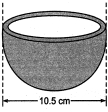
How many litres of milk can a hemispherical bowl of diameter $10.5\, cm$ hold (in $, l$)?
A
$0.404$
B
$0.303$
C
$0.505$
D
$0.606$
Solution
(B) Diameter of the hemisphere $= 10.5\, cm$.
Radius of the hemisphere $(r) = \frac{10.5}{2}\, cm = 5.25\, cm$.
Volume of the hemispherical bowl $= \frac{2}{3} \pi r^3$.
Volume $= \frac{2}{3} \times \frac{22}{7} \times (5.25)^3\, cm^3$.
Volume $= \frac{2}{3} \times \frac{22}{7} \times 5.25 \times 5.25 \times 5.25\, cm^3 = 303.1875\, cm^3$.
Since $1000\, cm^3 = 1\, l$,the capacity in litres is $\frac{303.1875}{1000}\, l = 0.3031875\, l$.
Rounding to three decimal places,the capacity is approximately $0.303\, l$.
0 likes
View Solution19
MediumMCQ
Twenty-seven solid iron spheres,each of radius $r$ and surface area $S$,are melted to form a single sphere with surface area $S^{\prime}$. Find the radius $r^{\prime}$ of the new sphere. (in $r$)
A
$6$
B
$5$
C
$3$
D
$4$
Solution
(C) Let the radius of each small sphere be $r$ and the radius of the new large sphere be $r^{\prime}$.
The volume of one small sphere is given by $V = \frac{4}{3} \pi r^{3}$.
The total volume of $27$ small spheres is $27 \times \frac{4}{3} \pi r^{3}$.
When these are melted to form a new sphere of radius $r^{\prime}$,the volume of the new sphere is $\frac{4}{3} \pi (r^{\prime})^{3}$.
Since the volume remains constant during melting and recasting,we have:
$\frac{4}{3} \pi (r^{\prime})^{3} = 27 \times \frac{4}{3} \pi r^{3}$
Dividing both sides by $\frac{4}{3} \pi$,we get:
$(r^{\prime})^{3} = 27 r^{3}$
Taking the cube root on both sides:
$r^{\prime} = \sqrt[3]{27 r^{3}} = 3r$.
Thus,the radius of the new sphere is $3r$.
0 likes
View Solution20
EasyMCQ
Twenty-seven solid iron spheres,each of radius $r$ and surface area $S$,are melted to form a single sphere with surface area $S'$. Find the ratio of $S$ to $S'$.
A
$1: 6$
B
$1: 7$
C
$1: 8$
D
$1: 9$
Solution
(D) Let the radius of each small sphere be $r$ and the radius of the new large sphere be $R$.
Given that $27$ small spheres are melted to form one large sphere,the volume remains conserved.
Volume of $27$ small spheres $= 27 \times (\frac{4}{3} \pi r^3)$.
Volume of the large sphere $= \frac{4}{3} \pi R^3$.
Equating the volumes: $27 \times \frac{4}{3} \pi r^3 = \frac{4}{3} \pi R^3$.
$27 r^3 = R^3$,which implies $R = 3r$.
The surface area of a small sphere is $S = 4 \pi r^2$.
The surface area of the large sphere is $S' = 4 \pi R^2 = 4 \pi (3r)^2 = 4 \pi (9r^2) = 36 \pi r^2$.
Now,the ratio $S : S' = \frac{4 \pi r^2}{36 \pi r^2} = \frac{1}{9}$.
Thus,the ratio is $1: 9$.
1 likes
View Solution21
EasyMCQ
$A$ capsule of medicine is in the shape of a sphere of diameter $3.5 \, mm$. How much medicine (in $mm^3$) is needed to fill this capsule (in $, mm^3$)?
A
$22.46$
B
$44.46$
C
$66.46$
D
$55.46$
Solution
(A) The diameter of the spherical capsule is $d = 3.5 \, mm$.
The radius $r$ of the capsule is given by $r = \frac{d}{2} = \frac{3.5}{2} = 1.75 \, mm$.
The volume $V$ of a sphere is given by the formula $V = \frac{4}{3} \pi r^3$.
Substituting the values,we get:
$V = \frac{4}{3} \times \frac{22}{7} \times (1.75)^3 \, mm^3$
$V = \frac{4}{3} \times \frac{22}{7} \times \left(\frac{7}{4}\right)^3 \, mm^3$
$V = \frac{4}{3} \times \frac{22}{7} \times \frac{7 \times 7 \times 7}{4 \times 4 \times 4} \, mm^3$
$V = \frac{22 \times 7 \times 7}{3 \times 4 \times 4} \, mm^3 = \frac{1078}{48} \, mm^3 \approx 22.4583 \, mm^3$.
Rounding to two decimal places,the volume is approximately $22.46 \, mm^3$.
0 likes
View Solution22
EasyMCQ
Find the volume of a sphere of radius $2.1 \, cm$. (in $cm^3$)
A
$14.858$
B
$84.412$
C
$38.808$
D
$48.808$
Solution
(C) For a given sphere,the radius $(r) = 2.1 \, cm = \frac{21}{10} \, cm$.
The formula for the volume of a sphere is $V = \frac{4}{3} \pi r^3$.
Substituting the values:
$V = \frac{4}{3} \times \frac{22}{7} \times \left(\frac{21}{10}\right)^3 \, cm^3$
$V = \frac{4}{3} \times \frac{22}{7} \times \frac{21}{10} \times \frac{21}{10} \times \frac{21}{10} \, cm^3$
$V = 4 \times 22 \times \frac{1}{1} \times \frac{1}{1} \times \frac{0.1}{1} \times 2.1 \times 2.1 \, cm^3$ (simplifying $3 \times 7 = 21$ with one $21$ in the numerator)
$V = 88 \times 0.1 \times 4.41 \, cm^3$
$V = 8.8 \times 4.41 \, cm^3 = 38.808 \, cm^3$.
0 likes
View Solution23
EasyMCQ
Find the volume of a hemisphere with a diameter of $12 \, cm$. (Use $\pi = 3.14$) (in $cm^3$) (in $.16$)
A
$123$
B
$632$
C
$952$
D
$452$
Solution
(D) For a given hemisphere:
Radius $(r) = \frac{\text{diameter}}{2} = \frac{12}{2} = 6 \, cm$.
Volume of the hemisphere $= \frac{2}{3} \pi r^3$.
Substituting the values:
Volume $= \frac{2}{3} \times 3.14 \times (6)^3 \, cm^3$.
Volume $= \frac{2}{3} \times 3.14 \times 216 \, cm^3$.
Volume $= 2 \times 3.14 \times 72 \, cm^3$.
Volume $= 452.16 \, cm^3$.
0 likes
View Solution24
DifficultMCQ
The radii of three metal spheres are $3 \,cm, 4 \,cm$ and $5 \,cm$ respectively. They are melted into a single solid sphere. Find the radius of the new solid sphere (in $cm$).
A
$3$
B
$4$
C
$5$
D
$6$
Solution
(D) The volume of a sphere is given by the formula $V = \frac{4}{3} \pi r^3$.
Let the radii of the three spheres be $r_1 = 3 \,cm, r_2 = 4 \,cm$,and $r_3 = 5 \,cm$.
The total volume of the three spheres is $V_{total} = \frac{4}{3} \pi (r_1^3 + r_2^3 + r_3^3)$.
$V_{total} = \frac{4}{3} \pi (3^3 + 4^3 + 5^3) = \frac{4}{3} \pi (27 + 64 + 125) = \frac{4}{3} \pi (216)$.
Let the radius of the new sphere be $R$. Its volume is $V_{new} = \frac{4}{3} \pi R^3$.
Since the volume remains conserved,$V_{new} = V_{total}$.
$\frac{4}{3} \pi R^3 = \frac{4}{3} \pi (216)$.
$R^3 = 216$.
$R = \sqrt[3]{216} = 6 \,cm$.
0 likes
View Solution25
DifficultMCQ
$A$ metallic ball of radius $9 \,cm$ is melted and recast into three metallic balls. If the radii of two balls are $1 \,cm$ and $6 \,cm$,find the radius of the third ball (in $cm$).
A
$1$
B
$8$
C
$16$
D
$64$
Solution
(B) The volume of a sphere is given by the formula $V = \frac{4}{3} \pi r^3$.
Let the radius of the original ball be $R = 9 \,cm$.
Let the radii of the three smaller balls be $r_1 = 1 \,cm$,$r_2 = 6 \,cm$,and $r_3$ (the unknown radius).
Since the volume remains conserved during melting and recasting,the volume of the original ball equals the sum of the volumes of the three smaller balls:
$\frac{4}{3} \pi R^3 = \frac{4}{3} \pi r_1^3 + \frac{4}{3} \pi r_2^3 + \frac{4}{3} \pi r_3^3$
Dividing both sides by $\frac{4}{3} \pi$,we get:
$R^3 = r_1^3 + r_2^3 + r_3^3$
Substituting the given values:
$9^3 = 1^3 + 6^3 + r_3^3$
$729 = 1 + 216 + r_3^3$
$729 = 217 + r_3^3$
$r_3^3 = 729 - 217$
$r_3^3 = 512$
Taking the cube root on both sides:
$r_3 = \sqrt[3]{512} = 8 \,cm$.
Thus,the radius of the third ball is $8 \,cm$.
0 likes
View Solution26
MediumMCQ
Two solid spheres made of the same metal have weights $5920\, g$ and $740\, g$ respectively. Determine the radius of the larger sphere,if the diameter of the smaller one is $5\, cm$. (in $cm$)
A
$2$
B
$3$
C
$4$
D
$5$
Solution
(D) Since the spheres are made of the same metal,their density $\rho$ is constant. The weight $W$ of a sphere is given by $W = \text{Volume} \times \text{Density} = \frac{4}{3} \pi r^3 \rho$.
Thus,the ratio of weights is equal to the ratio of the cubes of their radii: $\frac{W_1}{W_2} = \frac{r_1^3}{r_2^3}$.
Given $W_1 = 5920\, g$ and $W_2 = 740\, g$,we have $\frac{5920}{740} = \frac{r_1^3}{r_2^3}$.
Simplifying the ratio: $8 = \frac{r_1^3}{r_2^3}$,which implies $\frac{r_1}{r_2} = \sqrt[3]{8} = 2$.
The diameter of the smaller sphere is $5\, cm$,so its radius $r_2 = \frac{5}{2} = 2.5\, cm$.
Therefore,the radius of the larger sphere is $r_1 = 2 \times r_2 = 2 \times 2.5 = 5\, cm$.
0 likes
View Solution27
EasyMCQ
State whether the following statement is true or false:
The ratio of the surface areas of two spheres is $81: 49$. Then,the ratio of their volumes is $729: 343$.
The ratio of the surface areas of two spheres is $81: 49$. Then,the ratio of their volumes is $729: 343$.
A
True
B
False
Solution
(A) Let the radii of the two spheres be $r_1$ and $r_2$.
The surface area of a sphere is given by $A = 4\pi r^2$.
The ratio of the surface areas is $\frac{4\pi r_1^2}{4\pi r_2^2} = \frac{r_1^2}{r_2^2} = \frac{81}{49}$.
Taking the square root of both sides,we get $\frac{r_1}{r_2} = \sqrt{\frac{81}{49}} = \frac{9}{7}$.
The volume of a sphere is given by $V = \frac{4}{3}\pi r^3$.
The ratio of the volumes is $\frac{\frac{4}{3}\pi r_1^3}{\frac{4}{3}\pi r_2^3} = \frac{r_1^3}{r_2^3} = \left(\frac{r_1}{r_2}\right)^3$.
Substituting the ratio of radii,we get $\left(\frac{9}{7}\right)^3 = \frac{9^3}{7^3} = \frac{729}{343}$.
Thus,the statement is True.
0 likes
View Solution28
EasyMCQ
The volume of a sphere is $4500 \pi \text{ cm}^3$,then its diameter is $\dots \text{ cm}$.
A
$15$
B
$12$
C
$30$
D
$24$
Solution
(C) The volume of a sphere is given by the formula $V = \frac{4}{3} \pi r^3$.
Given $V = 4500 \pi \text{ cm}^3$,we have:
$\frac{4}{3} \pi r^3 = 4500 \pi$
$r^3 = 4500 \times \frac{3}{4}$
$r^3 = 1125 \times 3 = 3375$
$r = \sqrt[3]{3375} = 15 \text{ cm}$.
The diameter $d$ is $2r = 2 \times 15 = 30 \text{ cm}$.
Given $V = 4500 \pi \text{ cm}^3$,we have:
$\frac{4}{3} \pi r^3 = 4500 \pi$
$r^3 = 4500 \times \frac{3}{4}$
$r^3 = 1125 \times 3 = 3375$
$r = \sqrt[3]{3375} = 15 \text{ cm}$.
The diameter $d$ is $2r = 2 \times 15 = 30 \text{ cm}$.
0 likes
View Solution29
EasyMCQ
The diameters of two spheres are in the ratio $3: 5$. What is the ratio of their volumes?
A
$3: 5$
B
$25: 9$
C
$9: 25$
D
$27: 125$
Solution
(D) Let the diameters of the two spheres be $d_1$ and $d_2$. Given that $d_1 : d_2 = 3 : 5$.
Since the radius $r = d/2$,the ratio of their radii $r_1 : r_2$ is also $3 : 5$.
The volume of a sphere is given by $V = \frac{4}{3} \pi r^3$.
The ratio of the volumes of the two spheres is $\frac{V_1}{V_2} = \frac{\frac{4}{3} \pi r_1^3}{\frac{4}{3} \pi r_2^3} = \left( \frac{r_1}{r_2} \right)^3$.
Substituting the given ratio,we get $\left( \frac{3}{5} \right)^3 = \frac{27}{125}$.
Therefore,the ratio of their volumes is $27 : 125$.
0 likes
View Solution30
EasyMCQ
Find the volume of a sphere with radius $2.1 \, m$ (in $m^{3}$).
A
$38.808$
B
$37.708$
C
$28.208$
D
$45.845$
Solution
(A) The volume $V$ of a sphere is given by the formula $V = \frac{4}{3} \pi r^{3}$.
Given,radius $r = 2.1 \, m$.
Substituting the value of $r$ in the formula:
$V = \frac{4}{3} \times \frac{22}{7} \times (2.1)^{3}$
$V = \frac{4}{3} \times \frac{22}{7} \times 2.1 \times 2.1 \times 2.1$
$V = 4 \times 22 \times 0.1 \times 2.1 \times 2.1$
$V = 88 \times 0.1 \times 4.41$
$V = 8.8 \times 4.41 = 38.808 \, m^{3}$.
0 likes
View SolutionSurface Areas and Volumes — Volume of a Sphere · Frequently Asked Questions
1Are these Surface Areas and Volumes questions useful for JEE and NEET?
Yes. All questions in this section are mapped to JEE Main and NEET exam patterns. Previous year questions from JEE Main, NEET, GUJCET and state-level exams are included with full solutions.
2Can I switch to Hindi or Gujarati for these questions?
Yes. Use the language tabs in the hero section or the sidebar to view the same questions and solutions in English, Hindi or Gujarati.
3How do I generate a question paper from this subtopic?
Use the Vedclass Exam Paper Generator — select the chapter and subtopic, set difficulty, and generate Sets A, B, C, D automatically. First 3 chapters of every subject are free.
Vedclass Products
For Students
Vedclass Test Series
Mock tests in real JEE/NEET style with performance analysis. 5-day free trial.
Start Free TrialFor Teachers
Exam Paper Generator
Generate Set A/B/C/D papers from this chapter in 2 minutes. 3 chapters free.
Try FreeFor Institutes
Online Exam Module
Live online exams with unlimited students, 360° analytics & white-label branding.
See DemoFor Teachers & Institutes
Generate a Surface Areas and Volumes Exam Paper in 2 Minutes
Select subtopic & difficulty — Sets A, B, C, D auto-generated with No Repeat logic.
First 3 chapters of every subject are free — no payment required.