
A English
Laws of Chemical Combination Questions in English
Class 9 Science · ATOMS AND MOLECULES · Laws of Chemical Combination
21+
Questions
English
Language
100%
With Solutions
Showing 21 of 21 questions in English
1
Medium
In a reaction,$5.3 \, g$ of sodium carbonate reacted with $6 \, g$ of acetic acid. The products were $2.2 \, g$ of carbon dioxide,$0.9 \, g$ of water,and $8.2 \, g$ of sodium acetate. Show that these observations are in agreement with the law of conservation of mass.
$\text{Sodium carbonate} + \text{Acetic acid} \to \text{Sodium acetate} + \text{Carbon dioxide} + \text{Water}$
$\text{Sodium carbonate} + \text{Acetic acid} \to \text{Sodium acetate} + \text{Carbon dioxide} + \text{Water}$
Solution
(A) The Law of Conservation of Mass states that mass can neither be created nor destroyed during a chemical reaction.
This means that the total mass of the reactants must be equal to the total mass of the products.
Step $1$: Calculate the total mass of the reactants $(LHS)$:
$\text{Mass of reactants} = \text{Mass of sodium carbonate} + \text{Mass of acetic acid} = 5.3 \, g + 6 \, g = 11.3 \, g$.
Step $2$: Calculate the total mass of the products $(RHS)$:
$\text{Mass of products} = \text{Mass of sodium acetate} + \text{Mass of carbon dioxide} + \text{Mass of water} = 8.2 \, g + 2.2 \, g + 0.9 \, g = 11.3 \, g$.
Step $3$: Compare $LHS$ and $RHS$:
Since $LHS = RHS = 11.3 \, g$,the total mass remains conserved.
Therefore,these observations are in agreement with the law of conservation of mass.
0 likes
View Solution2
EasyMCQ
Hydrogen and oxygen combine in the ratio of $1:8$ by mass to form water. What mass of oxygen gas would be required to react completely with $3 \,g$ of hydrogen gas (in $,g$)?
A
$18$
B
$24$
C
$9$
D
$36$
Solution
(B) The 'Law of Constant Proportions' states that the elements in a chemical compound are always present in a definite proportion by mass.
According to the given ratio,$1 \,g$ of hydrogen gas combines with $8 \,g$ of oxygen gas to form water.
Therefore,to react completely with $3 \,g$ of hydrogen gas,the required mass of oxygen gas is:
$3 \times 8 \,g = 24 \,g$.
Thus,$24 \,g$ of oxygen gas is required.
According to the given ratio,$1 \,g$ of hydrogen gas combines with $8 \,g$ of oxygen gas to form water.
Therefore,to react completely with $3 \,g$ of hydrogen gas,the required mass of oxygen gas is:
$3 \times 8 \,g = 24 \,g$.
Thus,$24 \,g$ of oxygen gas is required.
0 likes
View Solution3
EasyMCQ
Which postulate of Dalton's atomic theory is the result of the law of conservation of mass?
A
Atoms are indivisible particles,which cannot be created or destroyed in a chemical reaction.
B
All atoms of a given element have identical properties,including identical mass.
C
Atoms combine in the ratio of small whole numbers to form compounds.
D
The relative number and kinds of atoms are constant in a given compound.
Solution
(A) The postulate of Dalton's atomic theory that is the result of the law of conservation of mass is: 'Atoms are indivisible particles,which cannot be created or destroyed in a chemical reaction.'
This law states that mass can neither be created nor destroyed in a chemical reaction,which directly aligns with the idea that the total number of atoms remains constant before and after the reaction.
This law states that mass can neither be created nor destroyed in a chemical reaction,which directly aligns with the idea that the total number of atoms remains constant before and after the reaction.
0 likes
View Solution4
EasyMCQ
Which postulate of Dalton's atomic theory can explain the law of definite proportions?
A
Atoms are indivisible particles.
B
The relative number and kinds of atoms are constant in a given compound.
C
Atoms of a given element have identical mass and chemical properties.
D
Atoms can neither be created nor destroyed in a chemical reaction.
Solution
(B) The postulate of Dalton's atomic theory that explains the 'law of definite proportions' is:
'The relative number and kinds of atoms are constant in a given compound.'
This means that in any chemical compound,the elements are always present in a fixed ratio by mass,which is a direct consequence of the fixed ratio of the number of atoms of different elements forming the compound.
'The relative number and kinds of atoms are constant in a given compound.'
This means that in any chemical compound,the elements are always present in a fixed ratio by mass,which is a direct consequence of the fixed ratio of the number of atoms of different elements forming the compound.
0 likes
View Solution5
DifficultMCQ
When $3.00 \,g$ of carbon is burnt in $8.00 \,g$ of oxygen,$11.00 \,g$ of carbon dioxide is produced. What mass of carbon dioxide will be formed when $3.00 \,g$ of carbon is burnt in $50.00 \,g$ of oxygen? Which law of chemical combination will govern your answer?
A
$11.00 \,g$ of $CO_2$,Law of Constant Proportions
B
$11.00 \,g$ of $CO_2$,Law of Conservation of Mass
C
$183.33 \,g$ of $CO_2$,Law of Multiple Proportions
D
$53.00 \,g$ of $CO_2$,Law of Constant Proportions
Solution
(A) First,we determine the mass ratio of carbon and oxygen in carbon dioxide $(CO_2)$.
The atomic mass of carbon is $12 \,u$ and oxygen is $16 \,u$. In $CO_2$,the ratio of carbon to oxygen is $12 : (2 \times 16) = 12 : 32$,which simplifies to $3 : 8$.
This means that $3.00 \,g$ of carbon requires exactly $8.00 \,g$ of oxygen to react completely to form $11.00 \,g$ of $CO_2$.
When $3.00 \,g$ of carbon is provided with $50.00 \,g$ of oxygen,only $8.00 \,g$ of oxygen will react with the carbon,and the remaining $42.00 \,g$ of oxygen will remain unreacted.
Therefore,the mass of $CO_2$ formed remains $11.00 \,g$.
This result is governed by the 'Law of Constant Proportions',which states that in a chemical substance,the elements are always present in definite proportions by mass.
0 likes
View Solution6
MediumMCQ
Dalton's atomic theory successfully explained:
$(i)$ Law of conservation of mass
$(ii)$ Law of constant composition
$(iii)$ Law of radioactivity
$(iv)$ Law of multiple proportions
$(i)$ Law of conservation of mass
$(ii)$ Law of constant composition
$(iii)$ Law of radioactivity
$(iv)$ Law of multiple proportions
A
$(i), (ii)$ and $(iii)$
B
$(i), (iii)$ and $(iv)$
C
$(ii), (iii)$ and $(iv)$
D
$(i), (ii)$ and $(iv)$
Solution
(D) Dalton's atomic theory was based on the laws of chemical combination.
It successfully explained the $Law$ $of$ $conservation$ $of$ $mass$,the $Law$ $of$ $constant$ $composition$ (or definite proportions),and the $Law$ $of$ $multiple$ $proportions$.
However,Dalton's theory did not explain the $Law$ $of$ $radioactivity$,as radioactivity involves the decay of atomic nuclei,which was not known at the time of Dalton.
Therefore,the correct statements are $(i), (ii),$ and $(iv)$.
0 likes
View Solution7
Medium
State the law of constant proportions.
Solution
(N/A) The law of constant proportions states that in a chemical substance,the elements are always present in definite proportions by mass. This means that a pure chemical compound is always made up of the same elements combined together in the same fixed ratio of mass,regardless of the source from which it is obtained or the method of its preparation.
0 likes
View Solution8
EasyMCQ
Who proposed the laws of chemical combination?
A
John Dalton
B
Antoine $L$. Lavoisier and Joseph $L$. Proust
C
Dmitri Mendeleev
D
Robert Boyle
Solution
(B) The laws of chemical combination were established by Antoine $L.$ Lavoisier and Joseph $L.$ Proust.
Antoine $L.$ Lavoisier is known as the 'Father of Modern Chemistry' and proposed the Law of Conservation of Mass.
Joseph $L.$ Proust proposed the Law of Definite Proportions.
Antoine $L.$ Lavoisier is known as the 'Father of Modern Chemistry' and proposed the Law of Conservation of Mass.
Joseph $L.$ Proust proposed the Law of Definite Proportions.
0 likes
View Solution9
Medium
$(a)$ What is the law of constant proportions? Explain with the help of an example.
$(b)$ Which postulate of Dalton's atomic theory is in agreement with this law?
$(b)$ Which postulate of Dalton's atomic theory is in agreement with this law?
Solution
(N/A) The law of constant proportions states that in a chemical substance, the elements are always present in definite proportions by mass.
Example: In water $(H_2O)$, the ratio of the mass of hydrogen to the mass of oxygen is always $1:8$, regardless of the source of water.
$(b)$ The postulate of Dalton's atomic theory that is in agreement with this law is: "The relative number and kinds of atoms are constant in a given compound."
Example: In water $(H_2O)$, the ratio of the mass of hydrogen to the mass of oxygen is always $1:8$, regardless of the source of water.
$(b)$ The postulate of Dalton's atomic theory that is in agreement with this law is: "The relative number and kinds of atoms are constant in a given compound."
0 likes
View Solution10
Medium
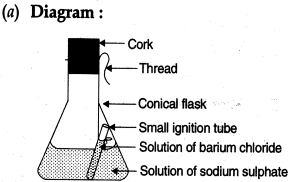
With a labelled diagram,describe an activity to demonstrate the law of conservation of mass.
Solution
(N/A) The law of conservation of mass states that mass can neither be created nor destroyed in a chemical reaction.
Activity:
$1$. Prepare separate solutions of $X$ and $Y$ in water. Take a little amount of $X$ solution in a conical flask and some $Y$ solution in a small ignition tube.
$2$. Hang the ignition tube in the flask carefully by a thread. Put a cork on the flask.
$3$. Weigh the flask with its contents on a balance.
$4$. Now,tilt and swirl the flask so that the solutions $X$ and $Y$ get mixed.
$5$. Weigh the flask again.
Observation:
It is observed that the mass of the flask and its contents remains the same before and after the reaction,demonstrating that mass is conserved.
Example:
Reaction between Barium Chloride $(BaCl_2)$ and Sodium Sulphate $(Na_2SO_4)$:
$BaCl_2(aq) + Na_2SO_4(aq) \rightarrow BaSO_4(s) + 2NaCl(aq)$
0 likes
View Solution11
EasyMCQ
What formed the basis for John Dalton to formulate Dalton's atomic theory?
A
Law of Conservation of Mass
B
Law of Definite Proportions
C
Both $(A)$ and $(B)$
D
None of the above
Solution
(C) John Dalton's atomic theory was primarily based on the laws of chemical combination, specifically the $Law$ $of$ $Conservation$ $of$ $Mass$ and the $Law$ $of$ $Definite$ $Proportions$.
These laws provided the empirical evidence needed to propose that matter is composed of indivisible particles called atoms, which combine in fixed ratios to form compounds.
These laws provided the empirical evidence needed to propose that matter is composed of indivisible particles called atoms, which combine in fixed ratios to form compounds.
0 likes
View Solution12
Medium
As per the law of definite proportion,carbon and oxygen combine in the ratio of $3:8$. Compute the mass of oxygen gas that would be required to react completely with $15\,g$ of carbon.
Solution
(D) According to the law of definite proportion,carbon and oxygen combine in a fixed mass ratio of $3:8$.
This means that $3\,g$ of carbon reacts completely with $8\,g$ of oxygen.
Therefore,$1\,g$ of carbon reacts with $\frac{8}{3}\,g$ of oxygen.
For $15\,g$ of carbon,the mass of oxygen required is $\frac{8}{3} \times 15\,g = 8 \times 5\,g = 40\,g$.
Thus,$40\,g$ of oxygen gas is required to react completely with $15\,g$ of carbon.
0 likes
View Solution13
Medium
Give two examples to show that the law of conservation of mass applies to physical changes also.
Solution
(N/A) The law of conservation of mass states that mass can neither be created nor destroyed in a system. This law holds true for physical changes as well,where the total mass of the substance remains constant before and after the physical transformation.
Examples:
$(i)$ Melting of wax: When a piece of wax melts,the mass of the solid wax is equal to the mass of the liquid wax formed.
$(ii)$ Melting of ice: When $100 \ g$ of ice melts into water,the mass of the resulting water is exactly $100 \ g$.
Examples:
$(i)$ Melting of wax: When a piece of wax melts,the mass of the solid wax is equal to the mass of the liquid wax formed.
$(ii)$ Melting of ice: When $100 \ g$ of ice melts into water,the mass of the resulting water is exactly $100 \ g$.
0 likes
View Solution14
Medium
Name the international organization that approves the names of elements. Give an example with an explanation to show that the Law of Conservation of Mass applies to physical changes as well.
Solution
(N/A) The international organization that approves the names of elements is the International Union of Pure and Applied Chemistry $(IUPAC)$.
$(b)$ The melting of ice into water is a physical change. To demonstrate the Law of Conservation of Mass,take a piece of ice in a small flask,cork it,and weigh it (let this be $W_{\text{ice}} \text{ g}$). Heat the flask gently so that the ice (solid) melts into water (liquid). Weigh the flask again (let this be $W_{\text{water}} \text{ g}$). It is observed that there is no change in the total mass of the system.
i.e.,$W_{\text{ice}} = W_{\text{water}}$
$\text{Ice (solid)} \xrightarrow{\text{Heat}} \text{Water (liquid)}$
This process represents a physical change. Since the mass remains constant before and after the change,it proves that the Law of Conservation of Mass holds true for physical changes.
0 likes
View Solution15
Medium
$(a)$ State the law of conservation of mass.
$(b)$ What mass of silver nitrate will react with $5.85 \, g$ of sodium chloride to produce $14.35 \, g$ of silver chloride and $8.5 \, g$ of sodium nitrate,if the law of conservation of mass is true?
$(b)$ What mass of silver nitrate will react with $5.85 \, g$ of sodium chloride to produce $14.35 \, g$ of silver chloride and $8.5 \, g$ of sodium nitrate,if the law of conservation of mass is true?
Solution
(17 G) The law of conservation of mass states that mass can neither be created nor destroyed in a chemical reaction.
$(b)$ The balanced chemical equation is:
$AgNO_{3}(aq) + NaCl(aq) \rightarrow AgCl(s) + NaNO_{3}(aq)$
According to the law of conservation of mass:
Total mass of reactants = Total mass of products
Let the mass of $AgNO_{3}$ be $x$.
Mass of reactants = $x + 5.85 \, g$
Mass of products = $14.35 \, g + 8.5 \, g = 22.85 \, g$
Equating the two:
$x + 5.85 \, g = 22.85 \, g$
$x = 22.85 \, g - 5.85 \, g$
$x = 17 \, g$
Therefore,$17 \, g$ of silver nitrate will react.
0 likes
View Solution16
MediumMCQ
In a compound such as water,the ratio of the mass of hydrogen to the mass of oxygen is always
A
$2: 8$
B
$1: 8$
C
$1: 16$
D
$2: 16$
Solution
(B) In water,$(H_2O)$,hydrogen and oxygen are always present in a fixed ratio by mass.
The atomic mass of hydrogen is $1 \text{ u}$ and the atomic mass of oxygen is $16 \text{ u}$.
In one molecule of water $(H_2O)$,there are $2$ atoms of hydrogen and $1$ atom of oxygen.
Total mass of hydrogen $= 2 \times 1 = 2 \text{ u}$.
Total mass of oxygen $= 1 \times 16 = 16 \text{ u}$.
The ratio of the mass of hydrogen to the mass of oxygen is $2: 16$,which simplifies to $1: 8$.
0 likes
View Solution17
MediumMCQ
Dalton's atomic theory successfully explained which of the following laws?
$(i)$ Law of conservation of mass
$(ii)$ Law of constant composition
$(iii)$ Law of radioactivity
$(iv)$ Law of multiple proportion
$(i)$ Law of conservation of mass
$(ii)$ Law of constant composition
$(iii)$ Law of radioactivity
$(iv)$ Law of multiple proportion
A
$(i), (ii)$ and $(iii)$
B
$(i), (iii)$ and $(iv)$
C
$(i), (ii)$ and $(iv)$
D
$(ii), (iii)$ and $(iv)$
Solution
(C) Dalton's atomic theory was proposed to explain the fundamental laws of chemical combination.
$(i)$ Law of conservation of mass: Dalton's theory states that atoms can neither be created nor destroyed in a chemical reaction,which explains this law.
$(ii)$ Law of constant composition (or definite proportions): The theory states that the relative number and kinds of atoms are constant in a given compound,which explains this law.
$(iii)$ Law of radioactivity: This law relates to nuclear physics and the instability of atomic nuclei,which was not part of Dalton's atomic theory.
$(iv)$ Law of multiple proportion: Dalton's theory explains this law by stating that atoms combine in simple whole-number ratios to form compounds.
Therefore,Dalton's theory successfully explained $(i), (ii),$ and $(iv)$.
0 likes
View Solution18
Easy
State whether the following statement is true or false:
Atoms combine in the ratio of small whole numbers to form compounds.
Atoms combine in the ratio of small whole numbers to form compounds.
Solution
(A) The statement is $True$.
According to Dalton's Atomic Theory,atoms of different elements combine in small whole number ratios to form compounds. This is also known as the Law of Multiple Proportions or the Law of Definite Proportions.
According to Dalton's Atomic Theory,atoms of different elements combine in small whole number ratios to form compounds. This is also known as the Law of Multiple Proportions or the Law of Definite Proportions.
0 likes
View Solution19
Easy
State whether the following statement is true or false:
In water,the ratio of the mass of hydrogen to the mass of oxygen is always $1:8$,regardless of the source of water.
In water,the ratio of the mass of hydrogen to the mass of oxygen is always $1:8$,regardless of the source of water.
Solution
(TRUE) The statement is True.
According to the Law of Constant Proportions,a chemical compound always consists of the same elements combined in the same fixed proportion by mass,irrespective of the source from which it is obtained.
In a water molecule $(H_2O)$,the atomic mass of hydrogen is $1 \text{ u}$ and oxygen is $16 \text{ u}$.
Since there are two hydrogen atoms,the total mass of hydrogen is $2 \times 1 = 2 \text{ u}$.
The mass of one oxygen atom is $16 \text{ u}$.
The ratio of the mass of hydrogen to the mass of oxygen is $2:16$,which simplifies to $1:8$.
0 likes
View Solution20
Easy
State whether the following statement is true or false:
In a chemical substance,the elements are always present in varying proportions by mass.
In a chemical substance,the elements are always present in varying proportions by mass.
Solution
(FALSE) The statement is False.
According to the Law of Constant Proportions (also known as the Law of Definite Proportions),in a chemical substance,the elements are always present in definite proportions by mass,regardless of the source or method of preparation of the substance.
According to the Law of Constant Proportions (also known as the Law of Definite Proportions),in a chemical substance,the elements are always present in definite proportions by mass,regardless of the source or method of preparation of the substance.
0 likes
View Solution21
Easy
State whether the following statement is true or false:
The relative number and kinds of atoms are varying in a given compound.
The relative number and kinds of atoms are varying in a given compound.
Solution
(FALSE) False.
According to the Law of Constant Proportions,a chemical compound always consists of the same elements combined together in the same fixed proportion by mass. Therefore,the relative number and kinds of atoms in a given compound are constant,not varying.
According to the Law of Constant Proportions,a chemical compound always consists of the same elements combined together in the same fixed proportion by mass. Therefore,the relative number and kinds of atoms in a given compound are constant,not varying.
0 likes
View SolutionATOMS AND MOLECULES — Laws of Chemical Combination · Frequently Asked Questions
1Are these ATOMS AND MOLECULES questions useful for JEE and NEET?
Yes. All questions in this section are mapped to JEE Main and NEET exam patterns. Previous year questions from JEE Main, NEET, GUJCET and state-level exams are included with full solutions.
2Can I switch to Hindi or Gujarati for these questions?
Yes. Use the language tabs in the hero section or the sidebar to view the same questions and solutions in English, Hindi or Gujarati.
3How do I generate a question paper from this subtopic?
Use the Vedclass Exam Paper Generator — select the chapter and subtopic, set difficulty, and generate Sets A, B, C, D automatically. First 3 chapters of every subject are free.
Vedclass Products
For Students
Vedclass Test Series
Mock tests in real JEE/NEET style with performance analysis. 5-day free trial.
Start Free TrialFor Teachers
Exam Paper Generator
Generate Set A/B/C/D papers from this chapter in 2 minutes. 3 chapters free.
Try FreeFor Institutes
Online Exam Module
Live online exams with unlimited students, 360° analytics & white-label branding.
See DemoFor Teachers & Institutes
Generate a ATOMS AND MOLECULES Exam Paper in 2 Minutes
Select subtopic & difficulty — Sets A, B, C, D auto-generated with No Repeat logic.
First 3 chapters of every subject are free — no payment required.