
A English
Mix Examples - ATOMS AND MOLECULES Questions in English
Class 9 Science · ATOMS AND MOLECULES · Mix Examples - ATOMS AND MOLECULES
28+
Questions
English
Language
100%
With Solutions
Showing 28 of 28 questions in English
1
MediumMCQ
$A$ $0.24 \, g$ sample of a compound of oxygen and boron was found by analysis to contain $0.096 \, g$ of boron and $0.144 \, g$ of oxygen. Calculate the percentage composition of the compound by weight.
A
$O = 60\%, B = 40\%$
B
$O = 40\%, B = 60\%$
C
$O = 70\%, B = 30\%$
D
$O = 35\%, B = 65\%$
Solution
(A) Mass of the compound $= 0.24 \, g$
Mass of boron $= 0.096 \, g$
Mass of oxygen $= 0.144 \, g$
Percentage of boron $= \frac{\text{Mass of boron}}{\text{Mass of compound}} \times 100$
$= \frac{0.096 \, g}{0.24 \, g} \times 100 = 40\%$
Percentage of oxygen $= \frac{\text{Mass of oxygen}}{\text{Mass of compound}} \times 100$
$= \frac{0.144 \, g}{0.24 \, g} \times 100 = 60\%$
Alternative method:
Percentage of oxygen $= 100\% - \text{Percentage of boron}$
$= 100\% - 40\% = 60\%$
0 likes
View Solution2
DifficultMCQ
$3.42 \, g$ of sucrose are dissolved in $18 \, g$ of water in a beaker. The number of oxygen atoms in the solution are
A
$6.68 \times 10^{23}$
B
$6.09 \times 10^{22}$
C
$6.022 \times 10^{23}$
D
$6.022 \times 10^{21}$
Solution
(A) The formula for the number of moles is: $\text{moles} = \frac{\text{mass}}{\text{molar mass}}$.
The molar mass of sucrose $(C_{12}H_{22}O_{11})$ is $342 \, g/mol$.
The number of moles of sucrose $= \frac{3.42 \, g}{342 \, g/mol} = 0.01 \, mol$.
Each molecule of sucrose contains $11$ oxygen atoms.
Therefore,the number of oxygen atoms from sucrose $= 0.01 \times 11 \times N_A = 0.11 \, N_A$.
The molar mass of water $(H_2O)$ is $18 \, g/mol$.
The number of moles of water $= \frac{18 \, g}{18 \, g/mol} = 1 \, mol$.
Each molecule of water contains $1$ oxygen atom.
Therefore,the number of oxygen atoms from water $= 1 \times 1 \times N_A = 1 \, N_A$.
Total number of oxygen atoms $= 0.11 \, N_A + 1 \, N_A = 1.11 \, N_A$.
Using $N_A = 6.022 \times 10^{23}$,the total number of oxygen atoms $= 1.11 \times 6.022 \times 10^{23} = 6.68442 \times 10^{23} \approx 6.68 \times 10^{23}$.
0 likes
View Solution3
MediumMCQ
The mass of one steel screw is $4.11 \, g$. Find the mass of one mole of these steel screws. Compare this value with the mass of the Earth $(5.98 \times 10^{24} \, kg)$. Which one of the two is heavier and by how many times?
A
$2400$
B
$4800$
C
$1200$
D
$600$
Solution
(A) The mass of one mole of screws is calculated by multiplying the mass of one screw by Avogadro's number $(N_A = 6.022 \times 10^{23})$.
Mass of $1 \text{ mole of screws} = 4.11 \, g \times 6.022 \times 10^{23} \approx 2.475 \times 10^{24} \, g$.
Converting this to kilograms: $2.475 \times 10^{24} \, g = 2.475 \times 10^{21} \, kg$.
Now,compare this with the mass of the Earth $(5.98 \times 10^{24} \, kg)$:
Ratio $= \frac{\text{Mass of the Earth}}{\text{Mass of 1 mole of screws}} = \frac{5.98 \times 10^{24} \, kg}{2.475 \times 10^{21} \, kg} \approx 2.416 \times 10^3 \approx 2400$.
Thus,the Earth is approximately $2400$ times heavier than one mole of steel screws.
0 likes
View Solution4
Medium
Fill in the missing data in the Table.
| Species property | $H_2O$ | $CO_2$ | $Na$ atom | $MgCl_2$ |
| No. of moles | $2$ | - | - | $0.5$ |
| No. of particles | - | $3.011 \times 10^{23}$ | - | - |
| Mass | $36 \, g$ | - | $115 \, g$ | - |
Solution
(N/A) To solve this, we use the relations: $\text{Number of particles} = \text{moles} \times 6.022 \times 10^{23}$ and $\text{Mass} = \text{moles} \times \text{Molar mass}$.
$1$. For $CO_2$: Given particles = $3.011 \times 10^{23}$. Moles = $(3.011 \times 10^{23}) / (6.022 \times 10^{23}) = 0.5 \, \text{mol}$. Mass = $0.5 \times 44 \, \text{g/mol} = 22 \, \text{g}$.
$2$. For $Na$ atom: Given mass = $115 \, \text{g}$. Molar mass of $Na = 23 \, \text{g/mol}$. Moles = $115 / 23 = 5 \, \text{mol}$. Particles = $5 \times 6.022 \times 10^{23} = 3.011 \times 10^{24}$.
$3$. For $MgCl_2$: Given moles = $0.5$. Molar mass = $24 + (2 \times 35.5) = 95 \, \text{g/mol}$. Mass = $0.5 \times 95 = 47.5 \, \text{g}$. Particles = $0.5 \times 6.022 \times 10^{23} = 3.011 \times 10^{23}$.
$4$. For $H_2O$: Given moles = $2$. Particles = $2 \times 6.022 \times 10^{23} = 1.2044 \times 10^{24}$.
0 likes
View Solution5
Medium
Fill in the blanks:
$(a)$ In a chemical reaction,the sum of the masses of the reactants and products remains unchanged. This is called ...............
$(b)$ $A$ group of atoms carrying a fixed charge on them is called ...............
$(c)$ The formula unit mass of $Ca_3(PO_4)_2$ is ...............
$(d)$ The formula of sodium carbonate is ............... and that of ammonium sulphate is ...............
Solution
(N/A) Law of conservation of mass.
$(b)$ Polyatomic ion.
$(c)$ The formula unit mass of $Ca_3(PO_4)_2$ is calculated as: $(3 \times 40) + 2 \times (31 + 4 \times 16) = 120 + 2 \times (31 + 64) = 120 + 2 \times 95 = 120 + 190 = 310 \text{ u}$.
$(d)$ The formula of sodium carbonate is $Na_2CO_3$ and the formula of ammonium sulphate is $(NH_4)_2SO_4$.
0 likes
View Solution6
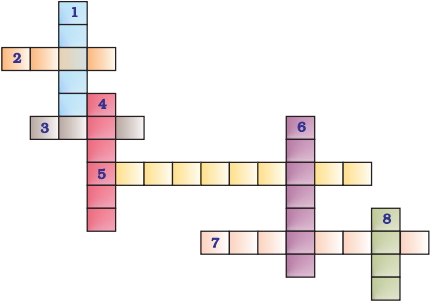
Complete the following crossword puzzle by using the names of the chemical elements based on the data provided in the table.
| Across | Down |
|---|---|
| $2$. The element used by Rutherford during his $\alpha$-scattering experiment. | $1$. $A$ white lustrous metal used for making ornaments and which tends to get tarnished black in the presence of moist air. |
| $3$. An element which forms rust on exposure to moist air. | $4$. Both brass and bronze are alloys of this element. |
| $5$. $A$ very reactive non-metal stored under water. | $6$. The metal which exists in the liquid state at room temperature. |
| $7$. Zinc metal when treated with dilute hydrochloric acid produces a gas of this element which when tested with a burning splinter produces a pop sound. | $8$. An element with the symbol $Pb$. |
Solution
(N/A) The completed crossword puzzle corresponds to the following elements:
$(1)$ Silver
$(2)$ Gold
$(3)$ Iron
$(4)$ Copper
$(5)$ Phosphorus
$(6)$ Mercury
$(7)$ Hydrogen
$(8)$ Lead
$(1)$ Silver
$(2)$ Gold
$(3)$ Iron
$(4)$ Copper
$(5)$ Phosphorus
$(6)$ Mercury
$(7)$ Hydrogen
$(8)$ Lead

1 likes
View Solution7
Medium
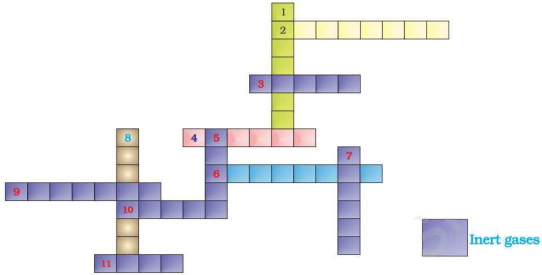
$(a)$ In this crossword puzzle (Fig),names of $11$ elements are hidden. Symbols of these are given below. Complete the puzzle.
$1. Cl$
$2. H$
$3. Ar$
$4. O$
$5. Xe$
$6. N$
$7. He$
$8. F$
$9. Kr$
$10. Rn$
$11. Ne$
$(b)$ Identify the total number of inert gases,their names,and symbols from this crossword puzzle.
$1. Cl$
$2. H$
$3. Ar$
$4. O$
$5. Xe$
$6. N$
$7. He$
$8. F$
$9. Kr$
$10. Rn$
$11. Ne$
$(b)$ Identify the total number of inert gases,their names,and symbols from this crossword puzzle.
Solution
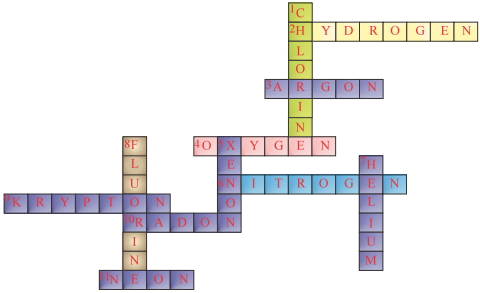
(A) The completed crossword puzzle reveals the names of the $11$ elements: Chlorine $(Cl)$,Hydrogen $(H)$,Argon $(Ar)$,Oxygen $(O)$,Xenon $(Xe)$,Nitrogen $(N)$,Helium $(He)$,Fluorine $(F)$,Krypton $(Kr)$,Radon $(Rn)$,and Neon $(Ne)$.
$(b)$ Inert gases (Noble gases) are elements that have a stable electron configuration. From the given crossword,there are $6$ inert gases present: Helium $(He)$,Neon $(Ne)$,Argon $(Ar)$,Krypton $(Kr)$,Xenon $(Xe)$,and Radon $(Rn)$.
$(b)$ Inert gases (Noble gases) are elements that have a stable electron configuration. From the given crossword,there are $6$ inert gases present: Helium $(He)$,Neon $(Ne)$,Argon $(Ar)$,Krypton $(Kr)$,Xenon $(Xe)$,and Radon $(Rn)$.
0 likes
View Solution8
Medium
Write the chemical formulae for the following substances and calculate the molecular mass for each one of them:
$(a)$ Caustic potash
$(b)$ Baking soda
$(c)$ Limestone
$(d)$ Caustic soda
$(e)$ Ethanol
$(f)$ Common salt
$(a)$ Caustic potash
$(b)$ Baking soda
$(c)$ Limestone
$(d)$ Caustic soda
$(e)$ Ethanol
$(f)$ Common salt
Solution
(N/A) Caustic potash: $KOH$
Molecular mass: $39 + 16 + 1 = 56 \, g \, mol^{-1}$
$(b)$ Baking soda: $NaHCO_3$
Molecular mass: $23 + 1 + 12 + (3 \times 16) = 84 \, g \, mol^{-1}$
$(c)$ Limestone: $CaCO_3$
Molecular mass: $40 + 12 + (3 \times 16) = 100 \, g \, mol^{-1}$
$(d)$ Caustic soda: $NaOH$
Molecular mass: $23 + 16 + 1 = 40 \, g \, mol^{-1}$
$(e)$ Ethanol: $C_2H_5OH$
Molecular mass: $(2 \times 12) + (6 \times 1) + 16 = 46 \, g \, mol^{-1}$
$(f)$ Common salt: $NaCl$
Molecular mass: $23 + 35.5 = 58.5 \, g \, mol^{-1}$
0 likes
View Solution9
Easy
What is meant by the following?
$(i)$ Molar mass
$(ii)$ Valency
$(i)$ Molar mass
$(ii)$ Valency
Solution
(N/A) $(i)$ Molar mass: The mass of one mole of a substance in grams is called its molar mass.
$(ii)$ Valency: The combining capacity of an atom of an element is known as its valency. It represents the number of electrons an atom needs to lose,gain,or share to achieve a stable electronic configuration.
$(ii)$ Valency: The combining capacity of an atom of an element is known as its valency. It represents the number of electrons an atom needs to lose,gain,or share to achieve a stable electronic configuration.
0 likes
View Solution10
Medium
Differentiate between:
$(i)$ Molar mass and Avogadro's constant.
$(ii)$ Molecular mass and formula unit mass.
$(i)$ Molar mass and Avogadro's constant.
$(ii)$ Molecular mass and formula unit mass.
Solution
(N/A)
| $(i)$ Molar mass | Avogadro's constant |
|---|---|
| It is the mass of one mole of a substance expressed in grams $(g/mol)$. | It is the number of particles (atoms,molecules,or ions) present in one mole of a substance,equal to $6.022 \times 10^{23} \text{ mol}^{-1}$. |
| $(ii)$ Molecular mass | Formula unit mass |
| It is the sum of the atomic masses of all atoms present in a molecule of a covalent compound. | It is the sum of the atomic masses of all atoms in a formula unit of an ionic compound. |
0 likes
View Solution11
Easy
$(a)$ Write the chemical formula of sodium sulphate.
$(b)$ Name one element each that forms a diatomic and a tetraatomic molecule.
$(b)$ Name one element each that forms a diatomic and a tetraatomic molecule.
Solution
(N/A) The chemical formula of sodium sulphate is $Na_{2}SO_{4}$.
$(b)$ $A$ diatomic molecule consists of two atoms of the same element. Examples include Oxygen $(O_{2})$,Hydrogen $(H_{2})$,or Nitrogen $(N_{2})$. Any one of these can be cited.
$A$ tetraatomic molecule consists of four atoms of the same element. Phosphorus $(P_{4})$ is a common example of a tetraatomic molecule.
0 likes
View Solution12
EasyMCQ
State the postulate of Dalton's atomic theory which led to the law of conservation of mass. Calculate the molecular mass of water.
A
Atoms are indivisible particles.
B
Atoms can neither be created nor destroyed in a chemical reaction.
C
Atoms of a given element have identical properties.
D
Atoms combine in the ratio of small whole numbers.
Solution
(B) The postulate of Dalton's atomic theory that led to the law of conservation of mass is: $Atoms$ can neither be created nor destroyed in a chemical reaction.
To calculate the molecular mass of water $(H_2O)$:
Atomic mass of $H = 1 \text{ u}$
Atomic mass of $O = 16 \text{ u}$
Molecular mass of $H_2O = (2 \times \text{atomic mass of } H) + (1 \times \text{atomic mass of } O)$
$= (2 \times 1) + (1 \times 16) = 2 + 16 = 18 \text{ u}$.
To calculate the molecular mass of water $(H_2O)$:
Atomic mass of $H = 1 \text{ u}$
Atomic mass of $O = 16 \text{ u}$
Molecular mass of $H_2O = (2 \times \text{atomic mass of } H) + (1 \times \text{atomic mass of } O)$
$= (2 \times 1) + (1 \times 16) = 2 + 16 = 18 \text{ u}$.
0 likes
View Solution13
Medium
Calculate the number of particles in each of the following:
$(a)$ $48 \,g$ of $Mg$
$(b)$ $8 \,g$ of $O_2$
$(c)$ $0.1$ mole of carbon (Atomic mass $Mg = 24 \,u, O = 16 \,u, C = 12 \,u$,Avogadro constant $= 6.022 \times 10^{23}$)
$(a)$ $48 \,g$ of $Mg$
$(b)$ $8 \,g$ of $O_2$
$(c)$ $0.1$ mole of carbon (Atomic mass $Mg = 24 \,u, O = 16 \,u, C = 12 \,u$,Avogadro constant $= 6.022 \times 10^{23}$)
Solution
(N/A) The number of atoms $= \frac{\text{Given mass}}{\text{Molar mass}} \times \text{Avogadro constant}$
$\Rightarrow N = \frac{m}{M} \times N_A = \frac{48}{24} \times 6.022 \times 10^{23} = 2 \times 6.022 \times 10^{23} = 12.044 \times 10^{23} \text{ atoms}$.
$(b)$ The number of molecules $= \frac{\text{Given mass}}{\text{Molar mass}} \times \text{Avogadro constant}$
$\Rightarrow N = \frac{8}{32} \times 6.022 \times 10^{23} = 0.25 \times 6.022 \times 10^{23} = 1.5055 \times 10^{23} \text{ molecules}$.
$(c)$ The number of particles (atoms) $= \text{Number of moles} \times \text{Avogadro constant}$
$\Rightarrow N = 0.1 \times 6.022 \times 10^{23} = 6.022 \times 10^{22} \text{ atoms}$.
0 likes
View Solution14
Medium
Verify by calculating that:
$(a)$ $5$ moles of $CO_2$ has a higher mass than $5$ moles of $H_2O$.
$(b)$ $120 \, g$ of calcium and $120 \, g$ of magnesium elements have a mole ratio of $3:5$.
$(a)$ $5$ moles of $CO_2$ has a higher mass than $5$ moles of $H_2O$.
$(b)$ $120 \, g$ of calcium and $120 \, g$ of magnesium elements have a mole ratio of $3:5$.
Solution
(N/A) The molar mass of $CO_2$ is $44 \, g/mol$ and the molar mass of $H_2O$ is $18 \, g/mol$.
Mass of $5$ moles of $CO_2 = 5 \times 44 = 220 \, g$.
Mass of $5$ moles of $H_2O = 5 \times 18 = 90 \, g$.
Since $220 \, g > 90 \, g$, it is verified that $5$ moles of $CO_2$ has a higher mass.
$(b)$ Molar mass of $Ca = 40 \, g/mol$ and $Mg = 24 \, g/mol$.
Moles of $120 \, g$ of $Ca = 120 / 40 = 3 \, moles$.
Moles of $120 \, g$ of $Mg = 120 / 24 = 5 \, moles$.
Therefore, the mole ratio of $Ca$ to $Mg = 3:5$.
0 likes
View Solution15
Medium
$(a)$ Calculate the mass of $0.5$ mole of oxygen atoms.
$(b)$ Calculate the number of molecules of glucose present in its $90 \ g$ (molecular mass of glucose is $180 \ u$). (Avogadro constant $= 6.022 \times 10^{23} \ mol^{-1}$)
$(c)$ Calculate the number of moles of water in $2 \ g$ of water.
(Atomic mass of $H = 1 \ u, O = 16 \ u$)
$(b)$ Calculate the number of molecules of glucose present in its $90 \ g$ (molecular mass of glucose is $180 \ u$). (Avogadro constant $= 6.022 \times 10^{23} \ mol^{-1}$)
$(c)$ Calculate the number of moles of water in $2 \ g$ of water.
(Atomic mass of $H = 1 \ u, O = 16 \ u$)
Solution
(N/A) Mass $=$ Molar mass $\times$ Number of moles
$m = M \times n$
$m = 16 \ g/mol \times 0.5 \ mol = 8 \ g$
$(b)$ Number of moles $(n) = \frac{\text{Given mass } (m)}{\text{Molar mass } (M)}$
$n = \frac{90 \ g}{180 \ g/mol} = 0.5 \ mol$
Since $1 \ mol$ contains $6.022 \times 10^{23}$ molecules,
Therefore,$0.5 \ mol$ will contain $0.5 \times 6.022 \times 10^{23} = 3.011 \times 10^{23}$ molecules.
$(c)$ Number of moles $(n) = \frac{\text{Given mass } (m)}{\text{Molar mass } (M)}$
Given mass of water $= 2 \ g$,Molar mass of water $(H_2O) = (2 \times 1) + 16 = 18 \ g/mol$
$n = \frac{2}{18} = \frac{1}{9} \approx 0.11 \ mol$
0 likes
View Solution16
Medium
$(a)$ Calculate the percentage of oxygen in $H_{2}O_{2}$.
$(b)$ Calculate the number of moles in $56 \, g$ of nitrogen gas $(N_{2})$.
$(c)$ Calculate the mass of $0.50$ moles of $Ca$ atoms.
$(d)$ Find out the number of particles in:
$(i)$ $5$ moles of methane gas $(CH_{4})$
$(ii)$ $92 \, g$ of sodium $(Na)$
(Atomic masses: $H=1, O=16, N=14, Ca=40, Na=23$)
$(b)$ Calculate the number of moles in $56 \, g$ of nitrogen gas $(N_{2})$.
$(c)$ Calculate the mass of $0.50$ moles of $Ca$ atoms.
$(d)$ Find out the number of particles in:
$(i)$ $5$ moles of methane gas $(CH_{4})$
$(ii)$ $92 \, g$ of sodium $(Na)$
(Atomic masses: $H=1, O=16, N=14, Ca=40, Na=23$)
Solution
(N/A) Molar mass of $H_{2}O_{2} = (2 \times 1) + (2 \times 16) = 34 \, g/mol$. Percentage of oxygen $= (32 / 34) \times 100 = 94.12 \%$.
$(b)$ Molar mass of $N_{2} = 2 \times 14 = 28 \, g/mol$. Number of moles $= 56 \, g / 28 \, g/mol = 2 \, moles$.
$(c)$ Mass of $Ca = \text{moles} \times \text{atomic mass} = 0.50 \times 40 = 20 \, g$.
$(d)(i)$ Number of molecules $= \text{moles} \times N_{A} = 5 \times 6.022 \times 10^{23} = 30.110 \times 10^{23}$ particles.
$(d)(ii)$ Number of atoms $= (\text{given mass} / \text{atomic mass}) \times N_{A} = (92 / 23) \times 6.022 \times 10^{23} = 4 \times 6.022 \times 10^{23} = 24.088 \times 10^{23}$ particles.
0 likes
View Solution17
Medium
$(a)$ What do the following formulae stand for:
$(i)$ $2O$
$(ii)$ $O_{2}$
$(iii)$ $O_{3}$
$(iv)$ $H_{2}O$
$(b)$ Give the chemical formulae of the following compounds:
$(i)$ Potassium carbonate
$(ii)$ Calcium chloride
$(c)$ Calculate the formula unit mass of $Al_{2}(SO_{4})_{3}$.
(Given atomic mass of $Al = 27 \, u, S = 32 \, u, O = 16 \, u$)
$(i)$ $2O$
$(ii)$ $O_{2}$
$(iii)$ $O_{3}$
$(iv)$ $H_{2}O$
$(b)$ Give the chemical formulae of the following compounds:
$(i)$ Potassium carbonate
$(ii)$ Calcium chloride
$(c)$ Calculate the formula unit mass of $Al_{2}(SO_{4})_{3}$.
(Given atomic mass of $Al = 27 \, u, S = 32 \, u, O = 16 \, u$)
Solution
(N/A) $(i)$ $2O$ represents two separate atoms of oxygen.
$(ii)$ $O_{2}$ represents one molecule of diatomic oxygen.
$(iii)$ $O_{3}$ represents one molecule of triatomic oxygen (ozone).
$(iv)$ $H_{2}O$ represents one molecule of water, consisting of two atoms of hydrogen and one atom of oxygen.
$(b)$ $(i)$ Potassium carbonate: $K_{2}CO_{3}$
$(ii)$ Calcium chloride: $CaCl_{2}$
$(c)$ Formula unit mass of $Al_{2}(SO_{4})_{3}$:
$= (2 \times \text{atomic mass of } Al) + (3 \times \text{atomic mass of } S) + (12 \times \text{atomic mass of } O)$
$= (2 \times 27) + (3 \times 32) + (12 \times 16)$
$= 54 + 96 + 192 = 342 \, u$.
0 likes
View Solution18
Medium
$(a)$ Write the chemical symbols of two elements:
$(i)$ which are formed from the first letter of the element's name.
$(ii)$ whose name has been taken from the names of the elements in Latin.
$(b)$ Define Avogadro's constant and molar mass. How are they related to one mole of an atom,molecule,or ion?
$(i)$ which are formed from the first letter of the element's name.
$(ii)$ whose name has been taken from the names of the elements in Latin.
$(b)$ Define Avogadro's constant and molar mass. How are they related to one mole of an atom,molecule,or ion?
Solution
(N/A) $(a) (i)$ Examples include Carbon $(C)$ and Nitrogen $(N)$.
$(ii)$ Examples include Sodium ($Na$,from Natrium) and Iron ($Fe$,from Ferrum).
$(b)$ Avogadro's constant: The value $6.022 \times 10^{23}$ is defined as Avogadro's constant $(N_A)$. It represents the number of particles (atoms,molecules,or ions) present in one mole of any substance.
Molar mass: The mass of $1$ mole of a substance in grams is called its molar mass.
Relationship: One mole of any species (atoms,molecules,or ions) contains $6.022 \times 10^{23}$ number of particles,and its mass is equal to its relative atomic or molecular mass expressed in grams.
| $1$ mole of particles | Number of particles = $6.022 \times 10^{23}$ | Mass = Molar mass in grams |
0 likes
View Solution19
Medium
$(a)$ Define polyatomic ions. Write an example.
$(b)$ Calculate the formula unit mass of $CaCO_{3}$. (Atomic mass of $C = 12 \ u, Ca = 40 \ u, O = 16 \ u$)
$(c)$ Calculate the molecular mass of the following:
$(i)$ $HNO_{3}$
$(ii)$ $CH_{3}COOH$
(Atomic mass of $H = 1 \ u, N = 14 \ u, O = 16 \ u, C = 12 \ u$)
$(b)$ Calculate the formula unit mass of $CaCO_{3}$. (Atomic mass of $C = 12 \ u, Ca = 40 \ u, O = 16 \ u$)
$(c)$ Calculate the molecular mass of the following:
$(i)$ $HNO_{3}$
$(ii)$ $CH_{3}COOH$
(Atomic mass of $H = 1 \ u, N = 14 \ u, O = 16 \ u, C = 12 \ u$)
Solution
(N/A) group of atoms carrying a charge is known as a polyatomic ion.
Example: $NH_{4}^{+}, PO_{4}^{3-}, SO_{4}^{2-}$.
$(b)$ Formula unit mass of $CaCO_{3} = (1 \times \text{Atomic mass of } Ca) + (1 \times \text{Atomic mass of } C) + (3 \times \text{Atomic mass of } O)$
$= 40 \ u + 12 \ u + (3 \times 16 \ u) = 40 + 12 + 48 = 100 \ u$.
$(c)$ $(i)$ Molecular mass of $HNO_{3} = (1 \times \text{Atomic mass of } H) + (1 \times \text{Atomic mass of } N) + (3 \times \text{Atomic mass of } O)$
$= 1 \ u + 14 \ u + (3 \times 16 \ u) = 1 + 14 + 48 = 63 \ u$.
$(ii)$ Molecular mass of $CH_{3}COOH = (2 \times \text{Atomic mass of } C) + (4 \times \text{Atomic mass of } H) + (2 \times \text{Atomic mass of } O)$
$= (2 \times 12 \ u) + (4 \times 1 \ u) + (2 \times 16 \ u) = 24 + 4 + 32 = 60 \ u$.
0 likes
View Solution20
Medium
Give three differences between an atom and a molecule.
Solution
(N/A)
| Atom | Molecule |
|---|---|
| $(i)$ An atom is the smallest particle of an element that takes part in a chemical reaction. | $(i)$ $A$ molecule is the smallest particle of an element or a compound that is capable of independent existence. |
| $(ii)$ An atom is usually not stable by itself. | $(ii)$ $A$ molecule is usually stable by itself. |
| $(iii)$ Similar atoms can combine in varying numbers to form different molecules with different properties. e.g.,$O_2$ and $O_3$. | $(iii)$ When similar molecules combine in any number,the nature of the substance remains the same. e.g.,$5$ water molecules combined with $50$ water molecules still represent water. |
0 likes
View Solution21
Medium
$(a)$ What are molecules? Using examples, differentiate between the molecules of an element and a compound.
$(b)$ Derive the chemical formulae of the molecules formed between the following ions:
$(i)$ $Al^{3+}$ and $SO_{4}^{2-}$
$(ii)$ $Ba^{2+}$ and $NO_{3}^{-}$
$(b)$ Derive the chemical formulae of the molecules formed between the following ions:
$(i)$ $Al^{3+}$ and $SO_{4}^{2-}$
$(ii)$ $Ba^{2+}$ and $NO_{3}^{-}$
Solution
(N/A) molecule is defined as the smallest particle of an element or a compound that is capable of independent existence and exhibits all the properties of that substance.
The molecule of an element is constituted by the same type of atoms, e.g., $O_{2}$, while the molecule of a compound is constituted by different types of atoms, e.g., $CO_{2}$.
$(b)$ To derive the chemical formula, we cross the valencies of the ions:
$(i)$ For $Al^{3+}$ and $SO_{4}^{2-}$:
$(ii)$ For $Ba^{2+}$ and $NO_{3}^{-}$:
The molecule of an element is constituted by the same type of atoms, e.g., $O_{2}$, while the molecule of a compound is constituted by different types of atoms, e.g., $CO_{2}$.
$(b)$ To derive the chemical formula, we cross the valencies of the ions:
$(i)$ For $Al^{3+}$ and $SO_{4}^{2-}$:
| Symbol | $Al$ | $SO_{4}$ |
| Charge | $3+$ | $2-$ |
| Formula | $Al_{2}(SO_{4})_{3}$ | |
$(ii)$ For $Ba^{2+}$ and $NO_{3}^{-}$:
| Symbol | $Ba$ | $NO_{3}$ |
| Charge | $2+$ | $1-$ |
| Formula | $Ba(NO_{3})_{2}$ | |
0 likes
View Solution22
Medium
$(a)$ $A$ sample of vitamin $C$ is known to contain $2.58 \times 10^{24}$ oxygen atoms. How many moles of oxygen atoms are present in the sample?
$(b)$ Write one word for the following:
$(i)$ In a balanced chemical equation,the sum of the masses of reactants and products remains unchanged.
$(ii)$ $A$ group of atoms carrying a fixed charge on them.
$(c)$ Write chemical formulae of the following compounds:
$(i)$ Sodium phosphate
$(ii)$ Ammonium carbonate
Solution
(N/A) Since $6.022 \times 10^{23}$ oxygen atoms are present in $1$ mole of oxygen atoms,the number of moles in $2.58 \times 10^{24}$ oxygen atoms is calculated as:
$\text{Moles} = \frac{2.58 \times 10^{24}}{6.022 \times 10^{23}} \approx 4.284 \text{ moles}$.
$(b)$ $(i)$ Law of conservation of mass.
$(ii)$ Polyatomic ion.
$(c)$ $(i)$ The formula for Sodium phosphate is $Na_{3}PO_{4}$.
$(ii)$ The formula for Ammonium carbonate is $(NH_{4})_{2}CO_{3}$.
$\text{Moles} = \frac{2.58 \times 10^{24}}{6.022 \times 10^{23}} \approx 4.284 \text{ moles}$.
$(b)$ $(i)$ Law of conservation of mass.
$(ii)$ Polyatomic ion.
$(c)$ $(i)$ The formula for Sodium phosphate is $Na_{3}PO_{4}$.
$(ii)$ The formula for Ammonium carbonate is $(NH_{4})_{2}CO_{3}$.
0 likes
View Solution23
Difficult
Calculate the mass of:
$(a)$ $1$ atom of carbon
$(b)$ $0.02$ mole of sodium
$(c)$ $1$ molecule of water.
$(a)$ $1$ atom of carbon
$(b)$ $0.02$ mole of sodium
$(c)$ $1$ molecule of water.
Solution
$(a)$ We know that,$1$ mole of carbon atoms $= 12 \text{ g}$.
Also,$1$ mole of carbon atoms $= 6.022 \times 10^{23}$ atoms.
Therefore,the mass of $1$ atom of carbon $= \frac{12 \text{ g}}{6.022 \times 10^{23}} \approx 1.99 \times 10^{-23} \text{ g}$.
$(b)$ We know that,$1$ mole of sodium atoms $= 23 \text{ g}$.
Therefore,the mass of $0.02$ mole of sodium $= 0.02 \times 23 \text{ g} = 0.46 \text{ g}$.
$(c)$ The molar mass of $H_{2}O = (2 \times 1) + 16 = 18 \text{ g/mol}$.
Since $1$ mole of $H_{2}O$ contains $6.022 \times 10^{23}$ molecules,the mass of $1$ molecule of $H_{2}O = \frac{18 \text{ g}}{6.022 \times 10^{23}} \approx 2.99 \times 10^{-23} \text{ g}$.
0 likes
View Solution24
Medium
Calculate the number of atoms in:
$(a)$ $16 \, g$ of oxygen $(O_2)$ molecules
$(b)$ $0.1 \, mole$ of carbon atoms.
$(a)$ $16 \, g$ of oxygen $(O_2)$ molecules
$(b)$ $0.1 \, mole$ of carbon atoms.
Solution
$(a)$ We know that $1$ molecule of $O_2$ contains $2$ oxygen atoms.
$1 \, mole$ of $O_2 = 32 \, g$.
$32 \, g$ of $O_2 = 1 \, mole = 6.022 \times 10^{23}$ oxygen molecules.
$16 \, g$ of $O_2 = \frac{1 \, mole}{32 \, g} \times 16 \, g = 0.5 \, mole$.
Number of $O_2$ molecules in $0.5 \, mole = 0.5 \times 6.022 \times 10^{23} = 3.011 \times 10^{23}$ molecules.
Since $1$ molecule of $O_2$ contains $2$ atoms,the number of oxygen atoms $= 3.011 \times 10^{23} \times 2 = 6.022 \times 10^{23}$ atoms.
$(b)$ $1 \, mole$ of carbon atoms contains $6.022 \times 10^{23}$ atoms.
Therefore,$0.1 \, mole$ of carbon atoms contains $= 0.1 \times 6.022 \times 10^{23} = 6.022 \times 10^{22}$ atoms.
0 likes
View Solution25
Difficult
$(a)$ Calculate the number of moles in $112 \, g$ of iron.
$(b)$ Calculate the mass of $0.5$ mole of sugar $(C_{12}H_{22}O_{11})$.
$(c)$ Calculate the number of atoms in $8 \, g$ of oxygen $(O_2)$ molecules.
(Atomic mass of $Fe = 56 \, u, C = 12 \, u, H = 1 \, u, O = 16 \, u, N_A = 6.022 \times 10^{23} \, mol^{-1}$)
$(b)$ Calculate the mass of $0.5$ mole of sugar $(C_{12}H_{22}O_{11})$.
$(c)$ Calculate the number of atoms in $8 \, g$ of oxygen $(O_2)$ molecules.
(Atomic mass of $Fe = 56 \, u, C = 12 \, u, H = 1 \, u, O = 16 \, u, N_A = 6.022 \times 10^{23} \, mol^{-1}$)
Solution
(N/A) Gram atomic mass of $Fe = 56 \, g/mol$.
Number of moles $= \frac{\text{Given mass}}{\text{Molar mass}} = \frac{112 \, g}{56 \, g/mol} = 2 \, moles$.
$(b)$ Molecular mass of sugar $(C_{12}H_{22}O_{11}) = (12 \times 12) + (22 \times 1) + (11 \times 16) = 144 + 22 + 176 = 342 \, u$.
Mass of $0.5 \, mole = 0.5 \, mol \times 342 \, g/mol = 171 \, g$.
$(c)$ Molar mass of $O_2 = 32 \, g/mol$.
Number of moles in $8 \, g$ of $O_2 = \frac{8 \, g}{32 \, g/mol} = 0.25 \, moles$.
Number of molecules $= 0.25 \times 6.022 \times 10^{23} = 1.5055 \times 10^{23} \, molecules$.
Since $1$ molecule of $O_2$ contains $2$ atoms, total atoms $= 2 \times 1.5055 \times 10^{23} = 3.011 \times 10^{23} \, atoms$.
0 likes
View Solution26
MediumMCQ
Which of the following correctly represents $360 \, g$ of water?
$(i)$ $2$ moles of $H_2O$
$(ii)$ $20$ moles of water
$(iii)$ $6.022 \times 10^{23}$ molecules of water
$(iv)$ $1.2044 \times 10^{25}$ molecules of water
$(i)$ $2$ moles of $H_2O$
$(ii)$ $20$ moles of water
$(iii)$ $6.022 \times 10^{23}$ molecules of water
$(iv)$ $1.2044 \times 10^{25}$ molecules of water
A
$(i)$
B
$(ii)$ and $(iv)$
C
$(i)$ and $(iv)$
D
$(ii)$ and $(iii)$
Solution
(B) The molar mass of water $(H_2O)$ is calculated as: $(2 \times 1) + 16 = 18 \, g/mol$.
To find the number of moles in $360 \, g$ of water,we use the formula: $\text{Number of moles} = \frac{\text{Given mass}}{\text{Molar mass}} = \frac{360 \, g}{18 \, g/mol} = 20 \, \text{moles}$.
Thus,statement $(ii)$ is correct.
To find the number of molecules,we multiply the number of moles by Avogadro's constant $(N_A = 6.022 \times 10^{23} \, \text{molecules/mol})$:
$\text{Number of molecules} = 20 \times 6.022 \times 10^{23} = 1.2044 \times 10^{25} \, \text{molecules}$.
Thus,statement $(iv)$ is also correct.
Therefore,the correct representation is $(ii)$ and $(iv)$.
0 likes
View Solution27
EasyMCQ
$A$ molecule can be defined as the
A
All of these are correct.
B
$A$ group of two or more atoms that are chemically bonded together.
C
$A$ smallest particle of an element or a compound that is capable of an independent existence and shows all the properties of that substance.
D
Substance which is formed by the combination of atoms of the same element or of different elements.
Solution
(A) molecule is defined as the smallest particle of an element or a compound that is capable of an independent existence and exhibits all the properties of that substance.
It consists of two or more atoms that are chemically bonded together.
These atoms can be of the same element (e.g.,$O_2$) or different elements (e.g.,$H_2O$).
Therefore,all the given statements correctly describe a molecule.
It consists of two or more atoms that are chemically bonded together.
These atoms can be of the same element (e.g.,$O_2$) or different elements (e.g.,$H_2O$).
Therefore,all the given statements correctly describe a molecule.
0 likes
View Solution28
MediumMCQ
Carbon-containing molecules present in all life forms include:
A
Proteins,carbohydrates,fats,nucleic acids,and vitamins
B
Nucleic acids,carbon dioxide,carbonates,and hydrogen carbonates
C
Carbon dioxide,carbonates,and hydrogen carbonates
D
Hormones,carbohydrates,carbonates,and hydrogen carbonates
Solution
(A) All living organisms are composed of organic molecules that form the structural and functional basis of life.
These essential biomolecules include proteins,carbohydrates,fats (lipids),nucleic acids ($DNA$ and $RNA$),and vitamins.
While carbon dioxide,carbonates,and hydrogen carbonates are carbon-containing compounds,they are generally considered inorganic and are not the fundamental building blocks of life forms in the same way as organic macromolecules.
Therefore,the correct group of carbon-containing molecules found in all life forms is proteins,carbohydrates,fats,nucleic acids,and vitamins.
0 likes
View SolutionATOMS AND MOLECULES — Mix Examples - ATOMS AND MOLECULES · Frequently Asked Questions
1Are these ATOMS AND MOLECULES questions useful for JEE and NEET?
Yes. All questions in this section are mapped to JEE Main and NEET exam patterns. Previous year questions from JEE Main, NEET, GUJCET and state-level exams are included with full solutions.
2Can I switch to Hindi or Gujarati for these questions?
Yes. Use the language tabs in the hero section or the sidebar to view the same questions and solutions in English, Hindi or Gujarati.
3How do I generate a question paper from this subtopic?
Use the Vedclass Exam Paper Generator — select the chapter and subtopic, set difficulty, and generate Sets A, B, C, D automatically. First 3 chapters of every subject are free.
Vedclass Products
For Students
Vedclass Test Series
Mock tests in real JEE/NEET style with performance analysis. 5-day free trial.
Start Free TrialFor Teachers
Exam Paper Generator
Generate Set A/B/C/D papers from this chapter in 2 minutes. 3 chapters free.
Try FreeFor Institutes
Online Exam Module
Live online exams with unlimited students, 360° analytics & white-label branding.
See DemoFor Teachers & Institutes
Generate a ATOMS AND MOLECULES Exam Paper in 2 Minutes
Select subtopic & difficulty — Sets A, B, C, D auto-generated with No Repeat logic.
First 3 chapters of every subject are free — no payment required.