
A English
Writing Chemical Formulae Questions in English
Class 9 Science · ATOMS AND MOLECULES · Writing Chemical Formulae
33+
Questions
English
Language
100%
With Solutions
Showing 33 of 33 questions in English
1
Easy
Write down the chemical formulae of:
$(i)$ Sodium oxide
$(ii)$ Aluminium chloride
$(iii)$ Sodium sulphide
$(iv)$ Magnesium hydroxide
$(i)$ Sodium oxide
$(ii)$ Aluminium chloride
$(iii)$ Sodium sulphide
$(iv)$ Magnesium hydroxide
Solution
(N/A) To write the chemical formulae,we use the valencies of the constituent ions:
$(i)$ Sodium $(Na^+)$ has a valency of $1$,and Oxide $(O^{2-})$ has a valency of $2$. By criss-crossing the valencies,we get $Na_2O$.
$(ii)$ Aluminium $(Al^{3+})$ has a valency of $3$,and Chloride $(Cl^-)$ has a valency of $1$. By criss-crossing the valencies,we get $AlCl_3$.
$(iii)$ Sodium $(Na^+)$ has a valency of $1$,and Sulphide $(S^{2-})$ has a valency of $2$. By criss-crossing the valencies,we get $Na_2S$.
$(iv)$ Magnesium $(Mg^{2+})$ has a valency of $2$,and Hydroxide $(OH^-)$ has a valency of $1$. By criss-crossing the valencies,we get $Mg(OH)_2$.
0 likes
View Solution2
Medium
Write down the names of compounds represented by the following formulae:
$(i) Al_{2}(SO_{4})_{3}$
$(ii) CaCl_{2}$
$(iii) K_{2}SO_{4}$
$(iv) KNO_{3}$
$(v) CaCO_{3}$
$(i) Al_{2}(SO_{4})_{3}$
$(ii) CaCl_{2}$
$(iii) K_{2}SO_{4}$
$(iv) KNO_{3}$
$(v) CaCO_{3}$
Solution
(N/A) $(i) Al_{2}(SO_{4})_{3}$ is Aluminium sulphate.
$(ii) CaCl_{2}$ is Calcium chloride.
$(iii) K_{2}SO_{4}$ is Potassium sulphate.
$(iv) KNO_{3}$ is Potassium nitrate.
$(v) CaCO_{3}$ is Calcium carbonate.
$(ii) CaCl_{2}$ is Calcium chloride.
$(iii) K_{2}SO_{4}$ is Potassium sulphate.
$(iv) KNO_{3}$ is Potassium nitrate.
$(v) CaCO_{3}$ is Calcium carbonate.
0 likes
View Solution3
Medium
What is meant by the term chemical formula?
Solution
(N/A) chemical formula of a compound (or element) is the symbolic representation of its composition. It represents:
$(i)$ The number and kind of atoms present per molecule of the compound.
$(ii)$ One mole of the compound.
$(iii)$ The molar mass of the compound.
$(i)$ The number and kind of atoms present per molecule of the compound.
$(ii)$ One mole of the compound.
$(iii)$ The molar mass of the compound.
0 likes
View Solution4
Medium
Write the chemical formulae of the following:
$(i)$ Magnesium chloride
$(ii)$ Calcium oxide
$(iii)$ Copper nitrate
$(iv)$ Aluminium chloride
$(v)$ Calcium carbonate.
$(i)$ Magnesium chloride
$(ii)$ Calcium oxide
$(iii)$ Copper nitrate
$(iv)$ Aluminium chloride
$(v)$ Calcium carbonate.
Solution
(N/A) $(i)$ Magnesium has a valency of $+2$ and chloride has $-1$. By criss-cross method,the formula is $MgCl_2$.
$(ii)$ Calcium has a valency of $+2$ and oxide has $-2$. The ratio is $1:1$,so the formula is $CaO$.
$(iii)$ Copper $(II)$ has a valency of $+2$ and nitrate has $-1$. By criss-cross method,the formula is $Cu(NO_3)_2$.
$(iv)$ Aluminium has a valency of $+3$ and chloride has $-1$. By criss-cross method,the formula is $AlCl_3$.
$(v)$ Calcium has a valency of $+2$ and carbonate has $-2$. The ratio is $1:1$,so the formula is $CaCO_3$.
0 likes
View Solution5
Medium
Give the names of the elements present in the following compounds:
$(a)$ Quick lime
$(b)$ Hydrogen bromide
$(c)$ Baking powder
$(d)$ Potassium sulphate
$(a)$ Quick lime
$(b)$ Hydrogen bromide
$(c)$ Baking powder
$(d)$ Potassium sulphate
Solution
(N/A) Quick lime is Calcium oxide $(CaO)$. The elements present are Calcium $(Ca)$ and Oxygen $(O)$.
$(b)$ Hydrogen bromide is $(HBr)$. The elements present are Hydrogen $(H)$ and Bromine $(Br)$.
$(c)$ Baking powder is Sodium hydrogen carbonate $(NaHCO_3)$. The elements present are Sodium $(Na)$,Hydrogen $(H)$,Carbon $(C)$,and Oxygen $(O)$.
$(d)$ Potassium sulphate is $(K_2SO_4)$. The elements present are Potassium $(K)$,Sulphur $(S)$,and Oxygen $(O)$.
0 likes
View Solution6
MediumMCQ
Which of the following represents a correct chemical formula? Name it.
A
$CaCl$
B
$NaSO_4$
C
$BiPO_4$
D
$NaS$
Solution
(C) The correct chemical formula is $BiPO_4$ (Bismuth phosphate).
In $BiPO_4$,Bismuth $(Bi^{3+})$ and Phosphate $(PO_4^{3-})$ are both trivalent,so they combine in a $1:1$ ratio.
In option $(A)$,Calcium $(Ca^{2+})$ is bivalent and Chlorine $(Cl^-)$ is monovalent,so the correct formula should be $CaCl_2$.
In option $(B)$,Sodium $(Na^+)$ is monovalent and Sulphate $(SO_4^{2-})$ is bivalent,so the correct formula should be $Na_2SO_4$.
In option $(D)$,Sodium $(Na^+)$ is monovalent and Sulphur $(S^{2-})$ is bivalent,so the correct formula should be $Na_2S$.
0 likes
View Solution7
Medium
Write the molecular formulae for the following compounds:
$(a)$ Copper $(II)$ bromide
$(b)$ Aluminium $(III)$ nitrate
$(c)$ Calcium $(II)$ phosphate
$(d)$ Iron $(III)$ sulphide
$(e)$ Mercury $(II)$ chloride
$(f)$ Magnesium $(II)$ acetate
$(a)$ Copper $(II)$ bromide
$(b)$ Aluminium $(III)$ nitrate
$(c)$ Calcium $(II)$ phosphate
$(d)$ Iron $(III)$ sulphide
$(e)$ Mercury $(II)$ chloride
$(f)$ Magnesium $(II)$ acetate
Solution
(N/A) Copper $(II)$ bromide: The valency of $Cu$ is $2$ and $Br$ is $1$. Thus,the formula is $CuBr_2$.
$(b)$ Aluminium $(III)$ nitrate: The valency of $Al$ is $3$ and $NO_3$ is $1$. Thus,the formula is $Al(NO_3)_3$.
$(c)$ Calcium $(II)$ phosphate: The valency of $Ca$ is $2$ and $PO_4$ is $3$. Thus,the formula is $Ca_3(PO_4)_2$.
$(d)$ Iron $(III)$ sulphide: The valency of $Fe$ is $3$ and $S$ is $2$. Thus,the formula is $Fe_2S_3$.
$(e)$ Mercury $(II)$ chloride: The valency of $Hg$ is $2$ and $Cl$ is $1$. Thus,the formula is $HgCl_2$.
$(f)$ Magnesium $(II)$ acetate: The valency of $Mg$ is $2$ and $CH_3COO$ is $1$. Thus,the formula is $Mg(CH_3COO)_2$.
0 likes
View Solution8
Medium
Write the molecular formulae of all the compounds that can be formed by the combination of the following ions: $Cu^{2+}, Na^{+}, Fe^{3+}, Cl^{-}, SO_{4}^{2-}, PO_{4}^{3-}$.
Solution
(N/A) To form neutral compounds,the total positive charge must equal the total negative charge.
$1$. For $Cu^{2+}$:
- With $Cl^{-}$: $CuCl_{2}$
- With $SO_{4}^{2-}$: $CuSO_{4}$
- With $PO_{4}^{3-}$: $Cu_{3}(PO_{4})_{2}$
$2$. For $Na^{+}$:
- With $Cl^{-}$: $NaCl$
- With $SO_{4}^{2-}$: $Na_{2}SO_{4}$
- With $PO_{4}^{3-}$: $Na_{3}PO_{4}$
$3$. For $Fe^{3+}$:
- With $Cl^{-}$: $FeCl_{3}$
- With $SO_{4}^{2-}$: $Fe_{2}(SO_{4})_{3}$
- With $PO_{4}^{3-}$: $FePO_{4}$
0 likes
View Solution9
Medium
Give the formulae of the compounds formed from the following sets of elements:
$(a)$ Calcium and fluorine
$(b)$ Hydrogen and sulphur
$(c)$ Nitrogen and hydrogen
$(d)$ Carbon and chlorine
$(e)$ Sodium and oxygen
$(f)$ Carbon and oxygen
$(a)$ Calcium and fluorine
$(b)$ Hydrogen and sulphur
$(c)$ Nitrogen and hydrogen
$(d)$ Carbon and chlorine
$(e)$ Sodium and oxygen
$(f)$ Carbon and oxygen
Solution
(N/A) To determine the chemical formula,we use the valency of each element:
$(a)$ Calcium $(Ca^{2+})$ and Fluorine $(F^{-})$: The formula is $CaF_{2}$.
$(b)$ Hydrogen $(H^{+})$ and Sulphur $(S^{2-})$: The formula is $H_{2}S$.
$(c)$ Nitrogen $(N^{3-})$ and Hydrogen $(H^{+})$: The formula is $NH_{3}$.
$(d)$ Carbon $(C^{4+})$ and Chlorine $(Cl^{-})$: The formula is $CCl_{4}$.
$(e)$ Sodium $(Na^{+})$ and Oxygen $(O^{2-})$: The formula is $Na_{2}O$.
$(f)$ Carbon $(C^{4+})$ and Oxygen $(O^{2-})$: Carbon can form $CO$ (Carbon monoxide) and $CO_{2}$ (Carbon dioxide) depending on the conditions.
0 likes
View Solution10
Medium
Which of the following symbols of elements are incorrect? Give their correct symbols:
$(a)$ Cobalt $CO$
$(b)$ Carbon $c$
$(c)$ Aluminium $AL$
$(d)$ Helium $He$
$(e)$ Sodium $So$
$(a)$ Cobalt $CO$
$(b)$ Carbon $c$
$(c)$ Aluminium $AL$
$(d)$ Helium $He$
$(e)$ Sodium $So$
Solution
(A, B, C, E) Incorrect,the correct symbol of cobalt is $Co$. The first letter must be capitalized and the second letter must be lowercase.
$(b)$ Incorrect,the correct symbol of carbon is $C$. Symbols consisting of a single letter must be capitalized.
$(c)$ Incorrect,the correct symbol of aluminium is $Al$. The first letter must be capitalized and the second letter must be lowercase.
$(d)$ Correct,the symbol for helium is $He$.
$(e)$ Incorrect,the correct symbol of sodium is $Na$. The symbol is derived from its Latin name,$Natrium$.
0 likes
View Solution11
Medium
Give the chemical formulae for the following compounds and compute the ratio by mass of the combining elements in each one of them:
$(a)$ Ammonia
$(b)$ Carbon monoxide
$(c)$ Hydrogen chloride
$(d)$ Aluminium fluoride
$(e)$ Magnesium sulphide
$(a)$ Ammonia
$(b)$ Carbon monoxide
$(c)$ Hydrogen chloride
$(d)$ Aluminium fluoride
$(e)$ Magnesium sulphide
Solution
(N/A) To find the ratio by mass,we divide the total mass of each element in the formula by the atomic mass of the elements.
$(a)$ Ammonia $(NH_3)$: Atomic masses are $N=14$,$H=1$. Ratio $N:H = 14 : (3 \times 1) = 14:3$.
$(b)$ Carbon monoxide $(CO)$: Atomic masses are $C=12$,$O=16$. Ratio $C:O = 12:16 = 3:4$.
$(c)$ Hydrogen chloride $(HCl)$: Atomic masses are $H=1$,$Cl=35.5$. Ratio $H:Cl = 1:35.5 = 2:71$.
$(d)$ Aluminium fluoride $(AlF_3)$: Atomic masses are $Al=27$,$F=19$. Ratio $Al:F = 27 : (3 \times 19) = 27:57 = 9:19$.
$(e)$ Magnesium sulphide $(MgS)$: Atomic masses are $Mg=24$,$S=32$. Ratio $Mg:S = 24:32 = 3:4$.
0 likes
View Solution12
Medium
Find the ratio by mass of the combining elements in the following compounds. (You may use Appendix $-III$)
$(a)$ $CaCO_{3}$ $(b)$ $MgCl_{2}$
$(c)$ $H_{2}SO_{4}$ $(d)$ $C_{2}H_{5}OH$
$(e)$ $NH_{3}$ $(f)$ $Ca(OH)_{2}$
$(a)$ $CaCO_{3}$ $(b)$ $MgCl_{2}$
$(c)$ $H_{2}SO_{4}$ $(d)$ $C_{2}H_{5}OH$
$(e)$ $NH_{3}$ $(f)$ $Ca(OH)_{2}$
Solution
(N/A) $Ca : C : O_{3} = 40 : 12 : (16 \times 3) = 40 : 12 : 48 = 10 : 3 : 12$
$(b)$ $Mg : Cl_{2} = 24 : (35.5 \times 2) = 24 : 71$
$(c)$ $H_{2} : S : O_{4} = (1 \times 2) : 32 : (16 \times 4) = 2 : 32 : 64 = 1 : 16 : 32$
$(d)$ $C_{2} : H_{6} : O = (12 \times 2) : (1 \times 6) : 16 = 24 : 6 : 16 = 12 : 3 : 8$
$(e)$ $N : H_{3} = 14 : (1 \times 3) = 14 : 3$
$(f)$ $Ca : O_{2} : H_{2} = 40 : (16 \times 2) : (1 \times 2) = 40 : 32 : 2 = 20 : 16 : 1$
0 likes
View Solution13
MediumMCQ
The chemical formula of the oxide of an element $X$ is $X_2O_5$. Write the chemical formula of its chloride.
A
$XCl_3$
B
$XCl_5$
C
$X_2Cl_5$
D
$XCl_2$
Solution
(B) $1$. In the oxide $X_2O_5$,the valency of oxygen is $2$.
$2$. Let the valency of element $X$ be $v$.
$3$. According to the criss-cross method for $X_2O_5$,the valency of $X$ is $5$ (since $2 \times v = 5 \times 2$,so $v = 5$).
$4$. Chlorine $(Cl)$ has a valency of $1$.
$5$. To write the formula of the chloride of $X$,we place the valency of $X$ $(5)$ under $Cl$ and the valency of $Cl$ $(1)$ under $X$.
$6$. Thus,the chemical formula is $X_1Cl_5$,which is written as $XCl_5$.
0 likes
View Solution14
Difficult
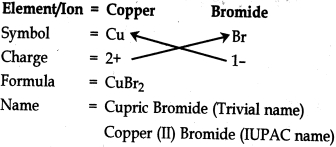
Derive the molecular formula for Copper $(II)$ Bromide.
Solution
(N/A) To derive the molecular formula for Copper $(II)$ Bromide,follow these steps:
$1$. Identify the symbols of the elements involved: Copper is represented by $Cu$ and Bromide is represented by $Br$.
$2$. Determine the valency or charge of each ion: Copper $(II)$ indicates a charge of $+2$ $(Cu^{2+})$,and Bromide has a charge of $-1$ $(Br^-)$.
$3$. Use the criss-cross method to balance the charges: The charge of Copper $(2)$ becomes the subscript for Bromide,and the charge of Bromide $(1)$ becomes the subscript for Copper.
$4$. Write the formula: By crossing the charges,we get $Cu_1Br_2$,which is written as $CuBr_2$.
0 likes
View Solution15
Medium
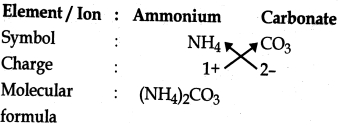
Derive the molecular formula for Ammonium carbonate.
Solution
(N/A) To derive the molecular formula for Ammonium carbonate,we follow these steps:
$1$. Identify the ions and their respective charges:
- Ammonium ion: $NH_4^+$ (charge = $+1$)
- Carbonate ion: $CO_3^{2-}$ (charge = $-2$)
$2$. Write the symbols and their charges side-by-side:
- Symbol: $NH_4$ and $CO_3$
- Charge: $+1$ and $-2$
$3$. Use the criss-cross method to balance the charges:
- The charge of the Ammonium ion $(+1)$ becomes the subscript for the Carbonate ion.
- The charge of the Carbonate ion $(-2)$ becomes the subscript for the Ammonium ion.
$4$. Combine them to form the neutral compound:
- Since we need two Ammonium ions to balance one Carbonate ion,the formula is $(NH_4)_2CO_3$.
0 likes
View Solution16
Medium
What is a molecular formula? State with an example what information can be derived from a molecular formula.
Solution
(N/A) molecular formula represents the actual number of atoms of each element present in one molecule of a compound.
For example,the molecular formula of aluminium sulphate is $Al_{2}(SO_{4})_{3}$. It provides the following information:
$(i)$ The compound is composed of three different types of atoms: aluminium $(Al)$,sulphur $(S)$,and oxygen $(O)$.
$(ii)$ There are a total of $17$ atoms in one molecule ($2$ atoms of $Al$,$3$ atoms of $S$,and $12$ atoms of $O$).
$(iii)$ The valency of aluminium $(Al^{3+})$ is $3$,while the valency of the sulphate ion $(SO_{4}^{2-})$ is $2$.
0 likes
View Solution17
Medium
Write the chemical formulae and names of the compounds formed by the combination of:
$(i)$ $Fe^{3+}$ and $SO_{4}^{2-}$
$(ii)$ $NH_{4}^{+}$ and $CO_{3}^{2-}$
$(i)$ $Fe^{3+}$ and $SO_{4}^{2-}$
$(ii)$ $NH_{4}^{+}$ and $CO_{3}^{2-}$
Solution
(N/A) To write the chemical formula,we use the criss-cross method where the valency of one ion becomes the subscript of the other.
$(i)$ For $Fe^{3+}$ and $SO_{4}^{2-}$:
- The valency of $Fe$ is $3$ and $SO_{4}$ is $2$.
- By crossing the valencies,we get $Fe_{2}(SO_{4})_{3}$.
- The name of the compound is Iron$(III)$ sulphate.
$(ii)$ For $NH_{4}^{+}$ and $CO_{3}^{2-}$:
- The valency of $NH_{4}$ is $1$ and $CO_{3}$ is $2$.
- By crossing the valencies,we get $(NH_{4})_{2}CO_{3}$.
- The name of the compound is Ammonium carbonate.
0 likes
View Solution18
Difficult
Write the chemical formulae for the following compounds and find the ratio by mass of the combining elements in each one of them.
$(N=14 \ u, H=1 \ u, C=12 \ u, O=16 \ u, S=32 \ u)$
$(a)$ Methane
$(b)$ Carbon dioxide
$(c)$ Hydrogen sulphide
$(N=14 \ u, H=1 \ u, C=12 \ u, O=16 \ u, S=32 \ u)$
$(a)$ Methane
$(b)$ Carbon dioxide
$(c)$ Hydrogen sulphide
Solution
(A) Methane: Formula is $CH_{4}$. The ratio by mass of $C:H$ is $12:(4 \times 1) = 12:4 = 3:1$.
$(b)$ Carbon dioxide: Formula is $CO_{2}$. The ratio by mass of $C:O$ is $12:(2 \times 16) = 12:32 = 3:8$.
$(c)$ Hydrogen sulphide: Formula is $H_{2}S$. The ratio by mass of $H:S$ is $(2 \times 1):32 = 2:32 = 1:16$.
$(b)$ Carbon dioxide: Formula is $CO_{2}$. The ratio by mass of $C:O$ is $12:(2 \times 16) = 12:32 = 3:8$.
$(c)$ Hydrogen sulphide: Formula is $H_{2}S$. The ratio by mass of $H:S$ is $(2 \times 1):32 = 2:32 = 1:16$.
0 likes
View Solution19
Medium
Write the chemical formulae of the compounds formed by the following ions:
$(a)$ $Mg^{2+}$ and $S^{2-}$
$(b)$ $Cu^{2+}$ and $OH^-$
$(c)$ $Al^{3+}$ and $Br^-$
Name the compounds formed in each case.
$(a)$ $Mg^{2+}$ and $S^{2-}$
$(b)$ $Cu^{2+}$ and $OH^-$
$(c)$ $Al^{3+}$ and $Br^-$
Name the compounds formed in each case.
Solution
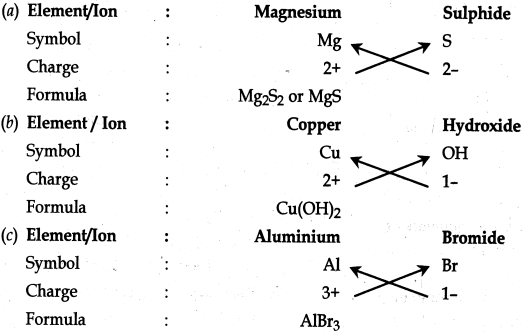
(N/A) To write the chemical formula,we use the criss-cross method where the valency of one ion becomes the subscript of the other.
$(a)$ For $Mg^{2+}$ and $S^{2-}$:
- The charges are $+2$ and $-2$. Since the magnitudes are equal,they cancel out to form a $1:1$ ratio.
- Chemical Formula: $MgS$
- Name: Magnesium sulphide
$(b)$ For $Cu^{2+}$ and $OH^-$:
- The valency of $Cu$ is $2$ and $OH$ is $1$. By criss-crossing,we get $Cu(OH)_2$.
- Chemical Formula: $Cu(OH)_2$
- Name: Copper$(II)$ hydroxide
$(c)$ For $Al^{3+}$ and $Br^-$:
- The valency of $Al$ is $3$ and $Br$ is $1$. By criss-crossing,we get $AlBr_3$.
- Chemical Formula: $AlBr_3$
- Name: Aluminium bromide
0 likes
View Solution20
DifficultMCQ
Nitrogen and hydrogen combine in the ratio $14:3$ by mass to form an ammonia molecule. Find the formula of the ammonia molecule by calculating the molar ratio. (Given atomic mass of $N = 14 \ u, H = 1 \ u$)
A
$NH_2$
B
$NH_3$
C
$N_2H_3$
D
$NH_4$
Solution
(B) To find the formula of ammonia,we calculate the molar ratio of the constituent elements:
The ratio of the number of atoms of $N$ to $H$ is $1:3$.
Therefore,the formula of ammonia is $NH_3$.
| Element | Mass Ratio / Atomic Mass = Molar Ratio |
|---|---|
| $N$ | $14 / 14 = 1$ |
| $H$ | $3 / 1 = 3$ |
The ratio of the number of atoms of $N$ to $H$ is $1:3$.
Therefore,the formula of ammonia is $NH_3$.
0 likes
View Solution21
Medium
State three rules for writing the chemical formulae.
Solution
(N/A) $(1)$ The valencies or charges on the ions must be balanced.
$(2)$ When a compound consists of a metal and a non-metal,the name or symbol of the metal is written first.
$(3)$ In compounds formed with polyatomic ions,the ion is enclosed in a bracket before writing the number to indicate the ratio. In case the number of the polyatomic ion is one,the bracket is not required.
0 likes
View Solution22
Medium
$(a)$ The ratio of hydrogen and oxygen in water is $1:8$ by mass. Find out their ratio by number of atoms in one molecule of water.
(Atomic mass: $H=1 \ u, O=16 \ u)$
$(b)$ Write the formulae of the following compounds:
$(i)$ Ammonium sulphate
$(ii)$ Magnesium chloride
(Given: Ammonium $= NH_{4}^{+}$,Sulphate $= SO_{4}^{2-}$,Magnesium $= Mg^{2+}$,Chloride $= Cl^{-}$)
(Atomic mass: $H=1 \ u, O=16 \ u)$
$(b)$ Write the formulae of the following compounds:
$(i)$ Ammonium sulphate
$(ii)$ Magnesium chloride
(Given: Ammonium $= NH_{4}^{+}$,Sulphate $= SO_{4}^{2-}$,Magnesium $= Mg^{2+}$,Chloride $= Cl^{-}$)
Solution
(D) To find the ratio by number of atoms,we divide the mass ratio by the atomic mass of each element:
Dividing by the smallest value $(0.5)$:
$H = 1 / 0.5 = 2$
$O = 0.5 / 0.5 = 1$
Thus,the ratio of the number of atoms of $H$ to $O$ is $2:1$.
$(b)$ $(i)$ Ammonium sulphate: The valency of $NH_{4}^{+}$ is $+1$ and $SO_{4}^{2-}$ is $-2$. By criss-cross method,the formula is $(NH_{4})_{2}SO_{4}$.
$(ii)$ Magnesium chloride: The valency of $Mg^{2+}$ is $+2$ and $Cl^{-}$ is $-1$. By criss-cross method,the formula is $MgCl_{2}$.
| Element | Ratio by mass / Atomic mass |
|---|---|
| $H$ | $1 / 1 = 1$ |
| $O$ | $8 / 16 = 0.5$ |
Dividing by the smallest value $(0.5)$:
$H = 1 / 0.5 = 2$
$O = 0.5 / 0.5 = 1$
Thus,the ratio of the number of atoms of $H$ to $O$ is $2:1$.
$(b)$ $(i)$ Ammonium sulphate: The valency of $NH_{4}^{+}$ is $+1$ and $SO_{4}^{2-}$ is $-2$. By criss-cross method,the formula is $(NH_{4})_{2}SO_{4}$.
$(ii)$ Magnesium chloride: The valency of $Mg^{2+}$ is $+2$ and $Cl^{-}$ is $-1$. By criss-cross method,the formula is $MgCl_{2}$.
0 likes
View Solution23
MediumMCQ
The chemical formula of the chloride of a metal $M$ is $MCl$. Write the chemical formula of its oxide,bicarbonate,and sulphide.
A
Oxide: $M_2O$,Bicarbonate: $MHCO_3$,Sulphide: $M_2S$
B
Oxide: $MO$,Bicarbonate: $M(HCO_3)_2$,Sulphide: $MS$
C
Oxide: $M_2O_3$,Bicarbonate: $MHCO_3$,Sulphide: $M_2S_3$
D
Oxide: $MO_2$,Bicarbonate: $M(HCO_3)_4$,Sulphide: $MS_2$
Solution
(A) Given that the formula of the metal chloride is $MCl$,the valency of metal $M$ is $+1$ because the valency of chlorine $(Cl)$ is $-1$.
$1$. Oxide: The valency of oxygen $(O)$ is $-2$. By criss-cross method,the formula is $M_2O$.
$2$. Bicarbonate: The valency of the bicarbonate ion $(HCO_3)$ is $-1$. Combining $M^{+1}$ and $HCO_3^{-1}$,the formula is $MHCO_3$.
$3$. Sulphide: The valency of sulphur $(S)$ is $-2$. By criss-cross method,the formula is $M_2S$.
0 likes
View Solution24
Medium
Write the names of the compounds represented by the following chemical formulae:
$(i)$ $NaBr$
$(ii)$ $Al_{2}O_{3}$
$(iii)$ $Zn(NO_{3})_{2}$
$(iv)$ $HCl$
$(v)$ $NaCl$
$(vi)$ $CaCO_{3}$
$(i)$ $NaBr$
$(ii)$ $Al_{2}O_{3}$
$(iii)$ $Zn(NO_{3})_{2}$
$(iv)$ $HCl$
$(v)$ $NaCl$
$(vi)$ $CaCO_{3}$
Solution
(N/A) $(i)$ $NaBr$: Sodium bromide
$(ii)$ $Al_{2}O_{3}$: Aluminium oxide
$(iii)$ $Zn(NO_{3})_{2}$: Zinc nitrate
$(iv)$ $HCl$: Hydrogen chloride
$(v)$ $NaCl$: Sodium chloride
$(vi)$ $CaCO_{3}$: Calcium carbonate
$(ii)$ $Al_{2}O_{3}$: Aluminium oxide
$(iii)$ $Zn(NO_{3})_{2}$: Zinc nitrate
$(iv)$ $HCl$: Hydrogen chloride
$(v)$ $NaCl$: Sodium chloride
$(vi)$ $CaCO_{3}$: Calcium carbonate
0 likes
View Solution25
EasyMCQ
Interpret the number of moles of oxygen atoms in $PO_{4}^{3-}$ ion.
A
$1$
B
$2$
C
$3$
D
$4$
Solution
(D) The chemical formula of the phosphate ion is $PO_{4}^{3-}$.
In one mole of $PO_{4}^{3-}$ ion,there is $1$ mole of phosphorus atom and $4$ moles of oxygen atoms.
Therefore,the number of moles of oxygen atoms present in $PO_{4}^{3-}$ is $4$.
In one mole of $PO_{4}^{3-}$ ion,there is $1$ mole of phosphorus atom and $4$ moles of oxygen atoms.
Therefore,the number of moles of oxygen atoms present in $PO_{4}^{3-}$ is $4$.
0 likes
View Solution26
Medium
Write the names of the following compounds:
$(a)$ $NiS$
$(b)$ $Mg(NO_3)_2$
$(c)$ $Na_2SO_4$
$(d)$ $Al(NO_3)_3$
$(e)$ $K_3PO_4$
$(f)$ $Ca_3N_2$
$(a)$ $NiS$
$(b)$ $Mg(NO_3)_2$
$(c)$ $Na_2SO_4$
$(d)$ $Al(NO_3)_3$
$(e)$ $K_3PO_4$
$(f)$ $Ca_3N_2$
Solution
(N/A) Nickel sulphide
$(b)$ Magnesium nitrate
$(c)$ Sodium sulphate
$(d)$ Aluminium nitrate
$(e)$ Potassium phosphate
$(f)$ Calcium nitride
$(b)$ Magnesium nitrate
$(c)$ Sodium sulphate
$(d)$ Aluminium nitrate
$(e)$ Potassium phosphate
$(f)$ Calcium nitride
0 likes
View Solution27
Medium
Write the chemical names of the following compounds:
$(a)$ $K_{2}SO_{4}$
$(b)$ $Mg_{3}(PO_{4})_{2}$
$(c)$ $NH_{4}Cl$
$(d)$ $ZnS$
$(e)$ $Na_{3}N$
$(f)$ $AgBr$
$(a)$ $K_{2}SO_{4}$
$(b)$ $Mg_{3}(PO_{4})_{2}$
$(c)$ $NH_{4}Cl$
$(d)$ $ZnS$
$(e)$ $Na_{3}N$
$(f)$ $AgBr$
Solution
(N/A) $K_{2}SO_{4}$ is Potassium sulphate.
$(b)$ $Mg_{3}(PO_{4})_{2}$ is Magnesium phosphate.
$(c)$ $NH_{4}Cl$ is Ammonium chloride.
$(d)$ $ZnS$ is Zinc sulphide.
$(e)$ $Na_{3}N$ is Sodium nitride.
$(f)$ $AgBr$ is Silver bromide.
$(b)$ $Mg_{3}(PO_{4})_{2}$ is Magnesium phosphate.
$(c)$ $NH_{4}Cl$ is Ammonium chloride.
$(d)$ $ZnS$ is Zinc sulphide.
$(e)$ $Na_{3}N$ is Sodium nitride.
$(f)$ $AgBr$ is Silver bromide.
0 likes
View Solution28
EasyMCQ
The symbols of calcium,carbon,and copper are
A
$Ca, C, Cu$
B
$Ca, C, Co$
C
$Ca, C, Cr$
D
$Ca, Cr, Cu$
Solution
(A) The chemical symbol for calcium is $Ca$.
The chemical symbol for carbon is $C$.
The chemical symbol for copper is $Cu$.
Therefore,the correct sequence of symbols for calcium,carbon,and copper is $Ca, C, Cu$.
The chemical symbol for carbon is $C$.
The chemical symbol for copper is $Cu$.
Therefore,the correct sequence of symbols for calcium,carbon,and copper is $Ca, C, Cu$.
0 likes
View Solution29
EasyMCQ
The molecular formula of aluminium sulphate is
A
$AlSO_{4}$
B
$Al_{3}(SO_{4})_{2}$
C
$Al_{2}(SO_{4})_{3}$
D
$Al_{2}(SO_{4})_{4}$
Solution
(C) To determine the molecular formula of aluminium sulphate,we look at the valencies of the constituent ions:
$1$. Aluminium $(Al)$ has a valency of $+3$.
$2$. The sulphate ion $(SO_{4})$ has a valency of $-2$.
$3$. To form a neutral compound,the total positive charge must equal the total negative charge.
$4$. By crossing the valencies,we get $Al_{2}(SO_{4})_{3}$.
Thus,the correct formula is $Al_{2}(SO_{4})_{3}$.
0 likes
View Solution30
Easy
State whether the following statement is true or false:
The chemical formulae of cupric oxide and cuprous oxide are $CuO$ and $Cu_{2}O$ respectively.
The chemical formulae of cupric oxide and cuprous oxide are $CuO$ and $Cu_{2}O$ respectively.
Solution
(TRUE) The statement is True.
In cupric oxide,copper exhibits a valency of $+2$,and oxygen exhibits a valency of $-2$. By crossing the valencies,we get $Cu_{2}O_{2}$,which simplifies to $CuO$.
In cuprous oxide,copper exhibits a valency of $+1$,and oxygen exhibits a valency of $-2$. By crossing the valencies,we get $Cu_{2}O$.
In cupric oxide,copper exhibits a valency of $+2$,and oxygen exhibits a valency of $-2$. By crossing the valencies,we get $Cu_{2}O_{2}$,which simplifies to $CuO$.
In cuprous oxide,copper exhibits a valency of $+1$,and oxygen exhibits a valency of $-2$. By crossing the valencies,we get $Cu_{2}O$.
0 likes
View Solution31
Medium
What is the valency of $(a)$ aluminium in aluminium sulphate,and $(b)$ sodium in sodium sulphate?
Solution
(N/A) The chemical formula for aluminium sulphate is $Al_{2}(SO_{4})_{3}$. In this compound,the valency of aluminium $(Al)$ is $3$.
The chemical formula for sodium sulphate is $Na_{2}SO_{4}$. In this compound,the valency of sodium $(Na)$ is $1$.
The chemical formula for sodium sulphate is $Na_{2}SO_{4}$. In this compound,the valency of sodium $(Na)$ is $1$.
0 likes
View Solution32
Medium
Dalton was the first scientist to use symbols for elements. Chemical symbols act as a vocabulary of chemical language. Chemical symbols are used to describe chemical changes with clarity and precision. Chemical symbols help in identifying specific elements. Chemical symbols also represent an atom of a particular element. Chemical symbols also signify the atomic mass of an element.
$(a)$ How do symbols help in identifying specific elements?
$(b)$ How do we use symbols in daily life for our convenience?
$(c)$ What values do you find in using symbols?
$(a)$ How do symbols help in identifying specific elements?
$(b)$ How do we use symbols in daily life for our convenience?
$(c)$ What values do you find in using symbols?
Solution
(N/A) Each element has a unique symbol that distinguishes it from other elements. For example,the symbol for sodium is $Na$,mercury is $Hg$,and sulphur is $S$.
$(b)$ In daily life,symbols provide convenience and safety. For instance,road signs help drivers navigate safely to their destinations. Symbols on clothing labels provide instructions on how to handle and wash fabrics,ensuring their longevity.
$(c)$ The values associated with using symbols include time-saving,enhanced safety,convenience,easy guidance,a systematic approach,and the ability to convey messages effectively without causing disturbances in workplaces.
0 likes
View Solution33
Medium
Chemical formula of a compound is a symbolic representation of its composition. We should know the following points to write the chemical formulae of chemical compounds:
$(i)$ Symbols of the combining elements.
$(ii)$ Valency of the combining elements.
In order to know the valency,we must calculate the valence electrons present in the atoms.
The electrons present in the outermost shell or valence shell are called valence electrons. The number of electrons in the atoms of some elements are given below. The elements which have one valency are called monovalent.
$(a)$ What is a chemical formula?
$(b)$ Which main points we must know to write the chemical formula of compounds?
$(c)$ Which values do we find associated with the use of formula for various things in daily life?
Solution
(A) chemical formula of a compound is a symbolic representation of its composition.
$(b)$ To write the chemical formula of compounds,we must know the symbols of the combining elements and the valency of the combining elements.
$(c)$ The use of formulas is not confined only to chemistry. The use of various formulas and ideas helps us in finding solutions to many complicated problems in daily life. It helps in saving time,money,and energy. It brings simplicity to our work,and by following similar lines or suggestions provided by others,we find an easy,systematic,and valuable approach to overcome the challenges of life.
0 likes
View SolutionATOMS AND MOLECULES — Writing Chemical Formulae · Frequently Asked Questions
1Are these ATOMS AND MOLECULES questions useful for JEE and NEET?
Yes. All questions in this section are mapped to JEE Main and NEET exam patterns. Previous year questions from JEE Main, NEET, GUJCET and state-level exams are included with full solutions.
2Can I switch to Hindi or Gujarati for these questions?
Yes. Use the language tabs in the hero section or the sidebar to view the same questions and solutions in English, Hindi or Gujarati.
3How do I generate a question paper from this subtopic?
Use the Vedclass Exam Paper Generator — select the chapter and subtopic, set difficulty, and generate Sets A, B, C, D automatically. First 3 chapters of every subject are free.
Vedclass Products
For Students
Vedclass Test Series
Mock tests in real JEE/NEET style with performance analysis. 5-day free trial.
Start Free TrialFor Teachers
Exam Paper Generator
Generate Set A/B/C/D papers from this chapter in 2 minutes. 3 chapters free.
Try FreeFor Institutes
Online Exam Module
Live online exams with unlimited students, 360° analytics & white-label branding.
See DemoFor Teachers & Institutes
Generate a ATOMS AND MOLECULES Exam Paper in 2 Minutes
Select subtopic & difficulty — Sets A, B, C, D auto-generated with No Repeat logic.
First 3 chapters of every subject are free — no payment required.