
A English
Animalia Questions in English
Class 9 Science · DIVERSITY IN LIVING ORGANISMS · Animalia
106+
Questions
English
Language
100%
With Solutions
Showing 50 of 106 questions in English
1
Difficult
How do poriferan animals differ from coelenterate animals?
Solution
(N/A)
| Porifera | Coelenterata |
|---|---|
| They are mostly marine, non-motile, and found attached to rocks. | They are aquatic, mostly marine, and can be sessile or free-swimming. |
| They exhibit a cellular level of organization. | They exhibit a tissue level of organization. |
| The body has pores (ostia) and a central cavity called spongocoel. | The body has a central gastrovascular cavity with a single opening called the hypostome. |
| Examples: $Spongilla$, $Euplectella$, $Sycon$. | Examples: $Hydra$, $Sea \text{ } anemone$, $Corals$. |
0 likes
View Solution2
DifficultMCQ
How do annelid animals differ from arthropods?
A
Annelids have an open circulatory system, while arthropods have a closed one.
B
Annelids have a closed circulatory system, while arthropods have an open one.
C
Annelids have jointed appendages, while arthropods do not.
D
Annelids have an exoskeleton, while arthropods have a soft body.
Solution
(B) The primary differences between annelids and arthropods are as follows:
| $1$. Annelids possess a closed circulatory system, whereas arthropods possess an open circulatory system. | $2$. The body of annelids is divided into many identical segments (metamerism), while the body of arthropods is divided into a few specialized segments (tagmatization). |
0 likes
View Solution3
DifficultMCQ
What are the differences between amphibians and reptiles?
A
Amphibians are terrestrial,while reptiles are aquatic.
B
Amphibians have scales,while reptiles do not.
C
Amphibians have a dual mode of life,while reptiles are completely terrestrial.
D
Amphibians lay eggs on land,while reptiles lay eggs in water.
Solution
(C)
| Amphibian | Reptiles |
| They have a dual mode of life (aquatic and terrestrial). | They are completely terrestrial. |
| Skin is moist and scales are absent. | Skin is dry and covered with scales. |
| They lay eggs in water. | They lay eggs on land. |
| Examples include frogs,toads,and salamanders. | Examples include lizards,snakes,turtles,and chameleons. |
0 likes
View Solution4
Medium
What are the differences between animals belonging to the $Aves$ group and those in the $Mammalia$ group?
Solution
(N/A)
| $Aves$ | $Mammalia$ |
|---|---|
| $Aves$ possess feathers and a beak. | $Mammals$ do not have feathers and lack a beak. |
| They are oviparous (egg-laying). | They are mostly viviparous (give birth to young),though some are oviparous. |
| They have pneumatic (hollow) bones to aid in flight. | They possess mammary glands to nourish their young. |
0 likes
View Solution5
Difficult
Explain how animals in Vertebrata are classified into further subgroups.
Solution
(A) Animals in Vertebrata are classified into five main classes:
$(i)$ Class Pisces: This class includes fish such as $Scoliodon$,tuna,rohu,shark,etc. These animals are aquatic. They possess adaptive features like a streamlined body,a tail for movement,and gills for respiration.
$(ii)$ Class Amphibia: This includes frogs,toads,and salamanders. They have a dual mode of life. In the larval stage,they respire through gills,while in the adult stage,respiration occurs through lungs or skin. They lay eggs in water.
$(iii)$ Class Reptilia: This includes reptiles like lizards,snakes,and turtles. They typically creep or crawl on land. Their body is covered with dry,cornified skin to prevent water loss,and they lay eggs on land.
$(iv)$ Class Aves: This includes all birds such as sparrows,pigeons,and crows. Most possess feathers. Their forelimbs are modified into wings for flight,while hind limbs are adapted for walking and clasping. They lay eggs.
$(v)$ Class Mammalia: This includes animals that possess milk-producing (mammary) glands to nourish their young. Some lay eggs,while others give birth to live young. Their skin features hair,sweat glands,and oil glands to regulate body temperature.
0 likes
View Solution6
EasyMCQ
Which one is a true fish?
A
Jellyfish
B
Starfish
C
Silverfish
D
Dogfish
Solution
(D) true fish belongs to the class $Pisces$ (or $Chondrichthyes$/$Osteichthyes$).
$Dogfish$ $(Scoliodon)$ is a cartilaginous fish belonging to the class $Chondrichthyes$.
$Jellyfish$ is a member of the phylum $Cnidaria$ (or $Coelenterata$).
$Starfish$ is an echinoderm belonging to the phylum $Echinodermata$.
$Silverfish$ is an insect belonging to the phylum $Arthropoda$.
Therefore,$Dogfish$ is the only true fish among the given options.
0 likes
View Solution7
EasyMCQ
Which among the following phyla is exclusively marine?
A
Echinodermata
B
Porifera
C
Mollusca
D
Pisces
Solution
(A) The phylum $Echinodermata$ consists of organisms that are exclusively marine.
$Porifera$ (sponges) are mostly marine but some species are found in freshwater.
$Mollusca$ includes both marine and freshwater species.
$Pisces$ (fishes) are found in both marine and freshwater environments.
$Porifera$ (sponges) are mostly marine but some species are found in freshwater.
$Mollusca$ includes both marine and freshwater species.
$Pisces$ (fishes) are found in both marine and freshwater environments.
0 likes
View Solution8
MediumMCQ
Which among the following have an open circulatory system?
$(i)$ Arthropoda
$(ii)$ Mollusca
$(iii)$ Annelida
$(iv)$ Coelenterata
$(i)$ Arthropoda
$(ii)$ Mollusca
$(iii)$ Annelida
$(iv)$ Coelenterata
A
$(iii)$ and $(iv)$
B
$(i)$ and $(ii)$
C
$(i)$ and $(iii)$
D
$(ii)$ and $(iv)$
Solution
(B) An open circulatory system is a type of circulatory system where blood is pumped into body cavities,where tissues are surrounded by the blood.
$(i)$ Arthropoda: Most arthropods (e.g.,insects,crustaceans) possess an open circulatory system.
$(ii)$ Mollusca: Most molluscs (except cephalopods like octopus) possess an open circulatory system.
$(iii)$ Annelida: Annelids possess a closed circulatory system.
$(iv)$ Coelenterata: These organisms lack a specialized circulatory system as they rely on diffusion for transport.
Therefore,$(i)$ and $(ii)$ have an open circulatory system.
0 likes
View Solution9
EasyMCQ
In which group of animals is the coelom filled with blood?
A
Nematoda
B
Annelida
C
Arthropoda
D
Echinodermata
Solution
(C) In $Arthropoda$, the body cavity is a $haemocoel$, which is a blood-filled cavity. The blood flows freely within this cavity, bathing the internal organs directly. This is characteristic of an open circulatory system.
0 likes
View Solution10
EasyMCQ
Which one is the most striking or common character of the vertebrates?
A
Presence of notochord
B
Presence of triploblastic condition
C
Presence of gill pouches
D
Presence of coelom
Solution
(A) The presence of a notochord is the defining and most striking characteristic of all vertebrates at some stage in their life cycle. While triploblastic condition,gill pouches,and coelom are also found in many non-vertebrate organisms,the notochord is unique to the phylum Chordata,to which all vertebrates belong.
0 likes
View Solution11
MediumMCQ
Which among the following have scales?
$(i)$ Amphibians
$(ii)$ Pisces
$(iii)$ Reptiles
$(iv)$ Mammals
$(i)$ Amphibians
$(ii)$ Pisces
$(iii)$ Reptiles
$(iv)$ Mammals
A
$(i)$ and $(iii)$
B
$(ii)$ and $(iii)$
C
$(iii)$ and $(iv)$
D
$(i)$ and $(ii)$
Solution
(B) The presence of scales is a characteristic feature of certain vertebrate classes.
$(i)$ Amphibians: Their skin is moist and lacks scales.
$(ii)$ Pisces (Fishes): Most fishes have an exoskeleton of scales.
$(iii)$ Reptiles: Their skin is dry and covered with scales.
$(iv)$ Mammals: Their skin is covered with hair,not scales.
Therefore,both Pisces and Reptiles possess scales. The correct option is $(ii)$ and $(iii)$.
0 likes
View Solution12
MediumMCQ
Find out the false statement.
A
$A$. Aves are warm-blooded,egg-laying,and have a four-chambered heart.
B
$B$. Aves have a feather-covered body,forelimbs are modified as wings,and they breathe through lungs.
C
$C$. Fishes,amphibians,and reptiles are oviparous.
D
$D$. Most of the mammals are viviparous.
Solution
(C) The statement '$C$' is false because not all fishes,amphibians,and reptiles are oviparous.
Some fishes (e.g.,sharks) and some reptiles (e.g.,certain snakes) are viviparous.
Amphibians generally exhibit external fertilization,and while many are oviparous,the classification is not universally applicable to all members of these groups as strictly oviparous.
Some fishes (e.g.,sharks) and some reptiles (e.g.,certain snakes) are viviparous.
Amphibians generally exhibit external fertilization,and while many are oviparous,the classification is not universally applicable to all members of these groups as strictly oviparous.
0 likes
View Solution13
EasyMCQ
Identify a member of the phylum Porifera.
A
Spongilla
B
Euglena
C
Penicillium
D
Hydra
Solution
(A) $Spongilla$ is a freshwater sponge that belongs to the phylum $Porifera$.
$Euglena$ is a unicellular protist belonging to the kingdom $Protista$.
$Penicillium$ is a type of fungus belonging to the kingdom $Fungi$.
$Hydra$ is a freshwater organism belonging to the phylum $Coelenterata$ (also known as $Cnidaria$).
$Euglena$ is a unicellular protist belonging to the kingdom $Protista$.
$Penicillium$ is a type of fungus belonging to the kingdom $Fungi$.
$Hydra$ is a freshwater organism belonging to the phylum $Coelenterata$ (also known as $Cnidaria$).
0 likes
View Solution14
EasyMCQ
Which of the following is not an aquatic animal?
A
Hydra
B
Filaria
C
Corals
D
Jelly fish
Solution
(B) Filaria is a disease caused by the parasitic worm $Wuchereria$ $bancrofti$. It is not an animal itself,but rather a medical condition. In contrast,$Hydra$,$Corals$,and $Jelly$ $fish$ are all aquatic animals belonging to the phylum $Cnidaria$.
0 likes
View Solution15
EasyMCQ
Amphibians do not have the following:
A
Three-chambered heart
B
Gills or lungs
C
Scales
D
Mucus glands
Solution
(C) Amphibians possess a three-chambered heart consisting of two atria and one ventricle.
They respire through lungs in their adult stage and through gills during their larval (tadpole) stage.
Their skin is moist and contains mucus glands to prevent desiccation.
Unlike reptiles,amphibians lack scales on their skin,which is why they are often referred to as having 'naked' skin.
They respire through lungs in their adult stage and through gills during their larval (tadpole) stage.
Their skin is moist and contains mucus glands to prevent desiccation.
Unlike reptiles,amphibians lack scales on their skin,which is why they are often referred to as having 'naked' skin.
0 likes
View Solution16
MediumMCQ
Which of the following is not a characteristic feature of Protochordata?
A
Presence of notochord
B
Jointed legs
C
Bilateral symmetry and coelom
D
Presence of circulatory system
Solution
(B) Protochordates are marine animals that possess a notochord at some stage of their life cycle. They exhibit bilateral symmetry,are triploblastic,and have a coelom. However,jointed legs are a characteristic feature of the phylum $Arthropoda$,which belongs to the kingdom $Animalia$ but is distinct from the phylum $Chordata$ (which includes Protochordata). Therefore,jointed legs are not a feature of Protochordata.
0 likes
View Solution17
EasyMCQ
The locomotory organs of $Echinodermata$ are:
A
jointed legs
B
muscular feet
C
tube feet
D
parapodia
Solution
(C) The phylum $Echinodermata$ is characterized by the presence of a water vascular system. The locomotory organs in these organisms are known as $tube feet$ (or $podia$). These structures are used for locomotion, capturing food, and respiration.
0 likes
View Solution18
EasyMCQ
Corals are
A
Poriferans attached to some solid support
B
Cnidarians,that are solitary living
C
Poriferans present at the sea bed
D
Cnidarians that live in colonies
Solution
(D) Corals belong to the phylum $Cnidaria$ (also known as $Coelenterata$). They are marine invertebrates that typically live in large colonies. These colonies secrete calcium carbonate to form hard,protective skeletons,which eventually build up to form coral reefs.
0 likes
View Solution19
EasyMCQ
Two-chambered heart occurs in
A
crocodiles
B
fish
C
aves
D
amphibians
Solution
(B) two-chambered heart consists of one atrium and one ventricle. This type of heart is characteristic of fish,where deoxygenated blood is pumped to the gills for oxygenation and then distributed to the rest of the body. In contrast,amphibians have a three-chambered heart,while crocodiles and aves (birds) possess a four-chambered heart.
0 likes
View Solution20
EasyMCQ
The skeleton is made entirely of cartilage in:
A
Rohu
B
Tuna
C
Sharks
D
None of these
Solution
(C) Sharks belong to the class $Chondrichthyes$,which are cartilaginous fish,meaning their endoskeleton is composed entirely of cartilage. In contrast,$Rohu$ and $Tuna$ belong to the class $Osteichthyes$,which are bony fish.
0 likes
View Solution21
MediumMCQ
Which of the following is not an Annelid?
A
Nereis
B
Earthworm
C
Leech
D
Urchins
Solution
(D) Annelids are characterized by metameric segmentation. $Nereis$,Earthworm,and Leech are members of the phylum Annelida. Sea urchins belong to the phylum Echinodermata,not Annelida.
0 likes
View Solution22
EasyMCQ
Hard calcium carbonate structures are used as a skeleton by
A
Nematoda
B
Protochordata
C
Arthropoda
D
Echinodermata
Solution
(D) The members of the phylum $Echinodermata$ (such as starfish and sea urchins) possess an endoskeleton made of calcareous ossicles,which are hard structures composed of calcium carbonate. These structures provide support and protection to the organism.
0 likes
View Solution23
EasyMCQ
Differentiation in segmental fashion occurs in
A
Leech
B
Starfish
C
Snails
D
Ascaris
Solution
(A) The phenomenon of metameric segmentation,where the body is divided into repeating segments,is a characteristic feature of the phylum $Annelida$.
Leech $(Hirudinaria)$ belongs to the phylum $Annelida$,and therefore,it exhibits differentiation in a segmental fashion.
Starfish belongs to $Echinodermata$,Snails belong to $Mollusca$,and $Ascaris$ belongs to $Aschelminthes$ (or $Nematoda$),none of which exhibit true metameric segmentation.
Leech $(Hirudinaria)$ belongs to the phylum $Annelida$,and therefore,it exhibits differentiation in a segmental fashion.
Starfish belongs to $Echinodermata$,Snails belong to $Mollusca$,and $Ascaris$ belongs to $Aschelminthes$ (or $Nematoda$),none of which exhibit true metameric segmentation.
0 likes
View Solution24
MediumMCQ
Meena and Hari observed an animal in their garden. Hari called it an insect while Meena said it was an earthworm. Choose the character from the following which confirms that it is an insect.
A
Bilateral symmetrical body
B
Cylindrical body
C
Body with jointed legs
D
Body with little segmentation
Solution
(C) The presence of jointed legs is a defining characteristic of the phylum $Arthropoda$.
Since insects belong to the class $Insecta$ under the phylum $Arthropoda$,the presence of jointed legs confirms that the animal is an insect.
Since insects belong to the class $Insecta$ under the phylum $Arthropoda$,the presence of jointed legs confirms that the animal is an insect.
0 likes
View Solution25
Medium
Classify the following organisms based on the absence/presence of a true coelom (i.e., acoelomate, pseudocoelomate, and coelomate): $Spongilla$, $Sea \text{ } anemone$, $Planaria$, $Liver \text{ } fluke$, $Wuchereria$, $Ascaris$, $Nereis$, $Earthworm$, $Scorpion$, $Birds$, $Fishes$, $Horse$.
Solution
(N/A) $Spongilla$ - Acoelomate
$Sea \text{ } anemone$ - Acoelomate
$Planaria$ - Acoelomate
$Liver \text{ } fluke$ - Acoelomate
$Wuchereria$ - Pseudocoelomate
$Ascaris$ - Pseudocoelomate
$Nereis$ - Coelomate
$Earthworm$ - Coelomate
$Scorpion$ - Coelomate
$Birds$, $Fishes$, and $Horse$ - Coelomate
$Sea \text{ } anemone$ - Acoelomate
$Planaria$ - Acoelomate
$Liver \text{ } fluke$ - Acoelomate
$Wuchereria$ - Pseudocoelomate
$Ascaris$ - Pseudocoelomate
$Nereis$ - Coelomate
$Earthworm$ - Coelomate
$Scorpion$ - Coelomate
$Birds$, $Fishes$, and $Horse$ - Coelomate
0 likes
View Solution26
Medium
The endoskeleton of fishes is made up of cartilage or bone. Classify the following fishes as cartilaginous or bony: Torpedo,Sting ray,Dog fish,Rohu,Angler fish,Exocoetus.
Solution
(N/A) The classification of the given fishes based on their endoskeleton is as follows:
$1$. $Torpedo$ (Electric ray): Cartilaginous fish (Chondrichthyes).
$2$. $Sting$ $ray$: Cartilaginous fish (Chondrichthyes).
$3$. $Dog$ $fish$ $(Scoliodon)$: Cartilaginous fish (Chondrichthyes).
$4$. $Rohu$ ($Labeo$ $rohita$): Bony fish (Osteichthyes).
$5$. $Angler$ $fish$: Bony fish (Osteichthyes).
$6$. $Exocoetus$ (Flying fish): Bony fish (Osteichthyes).
0 likes
View Solution27
Medium
Classify the following animals based on the number of chambers in their heart: Rohu,Scoliodon,Frog,Salamander,Flying lizard,King Cobra,Crocodile,Ostrich,Pigeon,Bat,Whale.
Solution
(N/A) The classification based on the number of heart chambers is as follows:
$1$. $2$-chambered heart: Rohu,Scoliodon.
$2$. $3$-chambered heart: Frog,Salamander,Flying lizard,King Cobra.
$3$. $4$-chambered heart: Crocodile,Ostrich,Pigeon,Bat,Whale.
$1$. $2$-chambered heart: Rohu,Scoliodon.
$2$. $3$-chambered heart: Frog,Salamander,Flying lizard,King Cobra.
$3$. $4$-chambered heart: Crocodile,Ostrich,Pigeon,Bat,Whale.
0 likes
View Solution28
Easy
Classify the following animals into cold-blooded and warm-blooded categories: Rohu,Scoliodon,Flying lizard,King Cobra,Frog,Salamander,Ostrich,Pigeon,Bat,Crocodile,and Whale.
Solution
(N/A) Animals are classified based on their ability to regulate body temperature:
$1$. Cold-blooded (Poikilothermic) animals: These animals cannot maintain a constant body temperature and their body temperature changes with the environment. These include: Rohu (Fish),Scoliodon (Dogfish),Frog (Amphibian),Salamander (Amphibian),Flying lizard (Reptile),King Cobra (Reptile),and Crocodile (Reptile).
$2$. Warm-blooded (Homeothermic) animals: These animals maintain a constant body temperature regardless of the environment. These include: Ostrich (Bird),Pigeon (Bird),Bat (Mammal),and Whale (Mammal).
0 likes
View Solution29
Easy
Name two egg-laying mammals.
Solution
(N/A) The two egg-laying mammals,also known as monotremes,are:
$(i)$ Platypus (Ornithorhynchus anatinus)
$(ii)$ Echidna (Tachyglossidae family,also known as spiny anteaters)
$(i)$ Platypus (Ornithorhynchus anatinus)
$(ii)$ Echidna (Tachyglossidae family,also known as spiny anteaters)
0 likes
View Solution30
Medium
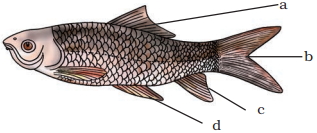
Label $a, b, c$ and $d$ given in the figure. Give the function of $(b)$.
Solution
(N/A) Dorsal fin
$(b)$ Caudal fin
$(c)$ Pelvic fin
$(d)$ Pectoral fin
Function of Caudal fin: The Caudal fin (tail fin) acts as a rudder and helps the fish in steering,balancing,and providing propulsion for streamlined movement in water.
$(b)$ Caudal fin
$(c)$ Pelvic fin
$(d)$ Pectoral fin
Function of Caudal fin: The Caudal fin (tail fin) acts as a rudder and helps the fish in steering,balancing,and providing propulsion for streamlined movement in water.
0 likes
View Solution31
Medium
You are given leech,Nereis,Scolopendra,prawn,and scorpion; all have a segmented body organization. Will you classify them in one group? If no,give the important characters based on which you will separate these organisms into different groups.
Solution
(N/A) No,all these organisms do not belong to the same group.
$1$. Leech and Nereis belong to the phylum $Annelida$ because they exhibit metameric segmentation,meaning their body is divided into many segments internally by septa.
$2$. Scolopendra,prawn,and scorpion belong to the phylum $Arthropoda$ because they possess jointed appendages,a chitinous exoskeleton,and an open circulatory system.
0 likes
View Solution32
Medium
List out some common features in cat,rat and bat.
Solution
(N/A) Bat,rat,and cat belong to the class $Mammalia$ and share the following common features:
$(a)$ All possess a notochord at some stage of their life cycle.
$(b)$ All are warm-blooded (homeothermic) animals.
$(c)$ All have a four-chambered heart.
$(d)$ All have skin covered with hair and possess sweat and oil glands.
$(a)$ All possess a notochord at some stage of their life cycle.
$(b)$ All are warm-blooded (homeothermic) animals.
$(c)$ All have a four-chambered heart.
$(d)$ All have skin covered with hair and possess sweat and oil glands.
0 likes
View Solution33
DifficultMCQ
Why do we classify both snakes and turtles in the same class?
A
They are both aquatic animals.
B
They both have a four-chambered heart.
C
They both belong to the class Reptilia.
D
They both give birth to young ones.
Solution
(C) Snakes and turtles are both classified under the class $Reptilia$ because they share several key characteristics:
$(1)$ They are cold-blooded (poikilothermic) animals.
$(2)$ Their skin is dry and covered with scales or scutes.
$(3)$ They breathe exclusively through lungs.
$(4)$ They typically possess a three-chambered heart (except for crocodiles).
$(5)$ They are oviparous,meaning they lay eggs with a tough,leathery,or calcareous covering on land.
0 likes
View Solution34
EasyMCQ
What is haemocoel?
A
$A$ body cavity filled with blood
B
$A$ type of respiratory organ
C
$A$ specialized excretory structure
D
$A$ muscular tissue layer
Solution
(A) The body cavity in certain invertebrates,such as arthropods and molluscs,which is filled with haemolymph (blood) is known as haemocoel.
In these organisms,the circulatory system is open,meaning blood does not remain confined within blood vessels but flows into these open spaces to bathe the tissues directly.
In these organisms,the circulatory system is open,meaning blood does not remain confined within blood vessels but flows into these open spaces to bathe the tissues directly.
0 likes
View Solution35
EasyMCQ
Which group of animals have haemocoel?
A
Annelida and Arthropoda
B
Arthropoda and Mollusca
C
Mollusca and Echinodermata
D
Platyhelminthes and Nematoda
Solution
(B) The haemocoel is a body cavity filled with blood,which is a characteristic feature of the phyla Arthropoda and Mollusca. In these animals,the circulatory system is open,meaning blood flows through the body cavity (haemocoel) rather than being confined entirely within blood vessels.
0 likes
View Solution36
EasyMCQ
How many chambers are present in the heart of fishes and frogs?
A
Fishes: $2$,Frogs: $3$
B
Fishes: $3$,Frogs: $2$
C
Fishes: $2$,Frogs: $4$
D
Fishes: $4$,Frogs: $3$
Solution
(A) The heart of fishes consists of $2$ chambers,which include one atrium and one ventricle.
In contrast,the heart of frogs consists of $3$ chambers,which include two atria and one ventricle.
In contrast,the heart of frogs consists of $3$ chambers,which include two atria and one ventricle.
0 likes
View Solution37
Easy
State the phylum to which liver fluke and Planaria belong.
Solution
(N/A) Liver fluke (Fasciola hepatica) and Planaria belong to the phylum Platyhelminthes. These organisms are commonly known as flatworms because their bodies are dorsoventrally flattened.
0 likes
View Solution38
EasyMCQ
Name the phylum to which Leech and Earthworm belong.
A
Arthropoda
B
Annelida
C
Mollusca
D
Platyhelminthes
Solution
(B) Leech (Hirudinaria) and Earthworm (Pheretima) belong to the phylum $Annelida$.
These organisms are characterized by a segmented body,which is a key feature of the phylum $Annelida$.
These organisms are characterized by a segmented body,which is a key feature of the phylum $Annelida$.
0 likes
View Solution39
Easy
Echinoderms have a system that they use for moving around. Name the system. What is their skeleton made-up of?
Solution
(N/A) Echinoderms possess a unique water-driven system known as the $Water$ $Vascular$ $System$,which is primarily used for locomotion,capturing food,and respiration.
Their endoskeleton is composed of hard,calcareous structures made of $Calcium$ $Carbonate$ $(CaCO_3)$ plates or ossicles.
Their endoskeleton is composed of hard,calcareous structures made of $Calcium$ $Carbonate$ $(CaCO_3)$ plates or ossicles.
0 likes
View Solution40
Easy
What do you understand by the term $diploblastic$? Give one example of an organism that is $diploblastic$.
Solution
(N/A) The term $diploblastic$ refers to organisms whose body cells are arranged in two embryonic layers: an external $ectoderm$ and an internal $endoderm$.
Between these two layers,an undifferentiated layer called $mesoglea$ is present.
Example: $Hydra$ (belonging to the phylum $Cnidaria$).
Between these two layers,an undifferentiated layer called $mesoglea$ is present.
Example: $Hydra$ (belonging to the phylum $Cnidaria$).
0 likes
View Solution41
Medium
Differentiate between the following (any one point):
$(a)$ Diploblastic and triploblastic animals
$(b)$ Warm-blooded and cold-blooded animals
$(a)$ Diploblastic and triploblastic animals
$(b)$ Warm-blooded and cold-blooded animals
Solution
(N/A) Diploblastic animals are those whose body is made up of two germinal layers (ectoderm and endoderm),whereas triploblastic animals have three germinal layers (ectoderm,mesoderm,and endoderm).
$(b)$ Warm-blooded animals (homeotherms) can maintain a constant internal body temperature regardless of the external environment,whereas cold-blooded animals (poikilotherms) change their body temperature according to the fluctuations in the environmental temperature.
$(b)$ Warm-blooded animals (homeotherms) can maintain a constant internal body temperature regardless of the external environment,whereas cold-blooded animals (poikilotherms) change their body temperature according to the fluctuations in the environmental temperature.
0 likes
View Solution42
Medium
What is a notochord? What is its function?
Solution
(N/A) notochord is a long,rod-like support structure (the term 'chord' means string) that runs along the back of an animal's body.
It serves to separate the nervous tissue from the gut.
Its primary function is to provide a site for muscle attachment,which facilitates ease of movement for the organism.
It serves to separate the nervous tissue from the gut.
Its primary function is to provide a site for muscle attachment,which facilitates ease of movement for the organism.
0 likes
View Solution43
Easy
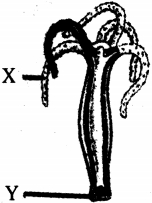
Label $X$ and $Y$ in the given diagram of Hydra.
Solution
(N/A) $X$ represents the tentacles,which are used for capturing prey and locomotion.
$Y$ represents the basal disc (or foot),which is used for attachment to a substrate.
$Y$ represents the basal disc (or foot),which is used for attachment to a substrate.
0 likes
View Solution44
Medium
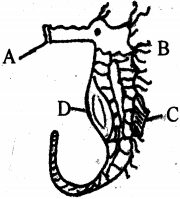
Identify and write the names of the parts labeled as $A, B, C$ and $D$ in the given figure of a seahorse in your answer book.
Solution
(N/A) $A -$ Mouth
$B -$ Dorsal fin
$C -$ Pectoral fin
$D -$ Brood pouch (This is where the male carries the eggs until they hatch.)
$B -$ Dorsal fin
$C -$ Pectoral fin
$D -$ Brood pouch (This is where the male carries the eggs until they hatch.)
0 likes
View Solution45
Medium
$(a)$ State two characteristic features of nematodes.
$(b)$ Identify the phylum with the help of the following features:
$(i)$ Spiny-skinned,radially symmetrical,and have tube feet.
$(ii)$ Triploblastic,worm-like,having a segmented body.
$(b)$ Identify the phylum with the help of the following features:
$(i)$ Spiny-skinned,radially symmetrical,and have tube feet.
$(ii)$ Triploblastic,worm-like,having a segmented body.
Solution
(N/A) Characteristic features of nematodes:
$(i)$ Nematodes have a cylindrical,bilaterally symmetrical,and triploblastic body.
$(ii)$ They are often parasitic and can cause diseases in plants and animals.
$(b)$ $(i)$ The phylum is $Echinodermata$. These organisms possess a spiny skin (calcareous ossicles),radial symmetry in adults,and a water vascular system with tube feet for locomotion.
$(ii)$ The phylum is $Annelida$. These organisms are triploblastic,coelomate,and exhibit true segmentation (metamerism) in their worm-like bodies.
0 likes
View Solution46
MediumMCQ
Why are bats not placed in birds?
A
Bats have hair on their body.
B
Bats have mammary glands.
C
Bats give birth to young ones.
D
All of the above.
Solution
(D) Bats are not classified as birds because:
$(i)$ They lack feathers,which are a characteristic feature of birds.
$(ii)$ They possess mammary glands,which is a defining characteristic of mammals.
$(iii)$ They give birth to live young ones rather than laying eggs.
$(iv)$ Their body is covered with hair instead of feathers.
$(i)$ They lack feathers,which are a characteristic feature of birds.
$(ii)$ They possess mammary glands,which is a defining characteristic of mammals.
$(iii)$ They give birth to live young ones rather than laying eggs.
$(iv)$ Their body is covered with hair instead of feathers.
0 likes
View Solution47
MediumMCQ
Identify the phylum for the following characteristics given:
$(a)$ Organisms with jointed appendages.
$(b)$ Organisms are generally flatworms.
$(c)$ Body is segmented.
$(d)$ Skin of organisms is full of spikes.
$(a)$ Organisms with jointed appendages.
$(b)$ Organisms are generally flatworms.
$(c)$ Body is segmented.
$(d)$ Skin of organisms is full of spikes.
A
Arthropoda,Platyhelminthes,Annelida,Echinodermata
B
Platyhelminthes,Arthropoda,Annelida,Echinodermata
C
Annelida,Platyhelminthes,Arthropoda,Echinodermata
D
Echinodermata,Arthropoda,Annelida,Platyhelminthes
Solution
(A) Arthropoda: These organisms possess jointed appendages,which is a characteristic feature of this phylum.
$(b)$ Platyhelminthes: These organisms are commonly known as flatworms due to their dorso-ventrally flattened bodies.
$(c)$ Annelida: These organisms exhibit true segmentation or metamerism in their body structure.
$(d)$ Echinodermata: These organisms have a spiny-skinned body surface,which is a diagnostic feature of this phylum.
0 likes
View Solution48
Medium
$(a)$ Give a difference between lizards and snakes.
$(b)$ Name the type of nutrition in fungi.
$(b)$ Name the type of nutrition in fungi.
Solution
(N/A) Lizards: They possess two pairs of pentadactyl limbs.
Snakes: Pentadactyl limbs are absent.
$(b)$ Fungi exhibit a saprophytic mode of nutrition,where they absorb nutrients from dead and decaying organic matter.
Snakes: Pentadactyl limbs are absent.
$(b)$ Fungi exhibit a saprophytic mode of nutrition,where they absorb nutrients from dead and decaying organic matter.
0 likes
View Solution49
Easy
Write two characteristic features of the phylum to which Ascaris belongs. Name the parasitic worm that causes elephantiasis.
Solution
(N/A) The phylum to which Ascaris belongs is Nematoda (or Aschelminthes).
Two characteristic features of this phylum are:
$1$. The body is cylindrical in shape and circular in cross-section.
$2$. They are pseudocoelomate,meaning they possess a false body cavity.
The parasitic worm that causes elephantiasis (filariasis) is Wuchereria bancrofti (commonly known as the Filarial worm).
0 likes
View Solution50
Easy
State the type of body cavity found in Platyhelminthes. Write whether they are parasitic or free-living.
Solution
(N/A) Platyhelminthes are acoelomate,meaning they lack a true body cavity (coelom).
They exhibit both lifestyles: many species are parasitic (e.g.,Tapeworms,Liver flukes),while some are free-living (e.g.,Planaria).
They exhibit both lifestyles: many species are parasitic (e.g.,Tapeworms,Liver flukes),while some are free-living (e.g.,Planaria).
0 likes
View SolutionDIVERSITY IN LIVING ORGANISMS — Animalia · Frequently Asked Questions
1Are these DIVERSITY IN LIVING ORGANISMS questions useful for JEE and NEET?
Yes. All questions in this section are mapped to JEE Main and NEET exam patterns. Previous year questions from JEE Main, NEET, GUJCET and state-level exams are included with full solutions.
2Can I switch to Hindi or Gujarati for these questions?
Yes. Use the language tabs in the hero section or the sidebar to view the same questions and solutions in English, Hindi or Gujarati.
3How do I generate a question paper from this subtopic?
Use the Vedclass Exam Paper Generator — select the chapter and subtopic, set difficulty, and generate Sets A, B, C, D automatically. First 3 chapters of every subject are free.
Vedclass Products
For Students
Vedclass Test Series
Mock tests in real JEE/NEET style with performance analysis. 5-day free trial.
Start Free TrialFor Teachers
Exam Paper Generator
Generate Set A/B/C/D papers from this chapter in 2 minutes. 3 chapters free.
Try FreeFor Institutes
Online Exam Module
Live online exams with unlimited students, 360° analytics & white-label branding.
See DemoFor Teachers & Institutes
Generate a DIVERSITY IN LIVING ORGANISMS Exam Paper in 2 Minutes
Select subtopic & difficulty — Sets A, B, C, D auto-generated with No Repeat logic.
First 3 chapters of every subject are free — no payment required.