
A English
The Five Kingdom Classification Questions in English
Class 9 Science · DIVERSITY IN LIVING ORGANISMS · The Five Kingdom Classification
31+
Questions
English
Language
100%
With Solutions
Showing 31 of 31 questions in English
1
EasyMCQ
What is the criterion for classification of organisms as belonging to kingdom Monera or Protista?
A
Cell wall composition
B
Mode of nutrition
C
Cellular structure (prokaryotic vs eukaryotic)
D
Presence of locomotion organs
Solution
(C) The primary criterion for classifying organisms into Kingdom $Monera$ or Kingdom $Protista$ is their cellular structure.
Organisms in Kingdom $Monera$ are unicellular and prokaryotic,meaning they lack a well-defined nucleus and membrane-bound organelles.
Organisms in Kingdom $Protista$ are unicellular and eukaryotic,meaning they possess a well-defined nucleus and membrane-bound organelles.
Organisms in Kingdom $Monera$ are unicellular and prokaryotic,meaning they lack a well-defined nucleus and membrane-bound organelles.
Organisms in Kingdom $Protista$ are unicellular and eukaryotic,meaning they possess a well-defined nucleus and membrane-bound organelles.
0 likes
View Solution2
EasyMCQ
In which kingdom will you place an organism which is single-celled,eukaryotic,and photosynthetic?
A
Monera
B
Protista
C
Fungi
D
Plantae
Solution
(B) The organism described is single-celled,eukaryotic,and photosynthetic.
According to the five-kingdom classification system,these characteristics are defining features of the Kingdom Protista.
Specifically,unicellular photosynthetic eukaryotes like diatoms,dinoflagellates,and euglenoids are classified under Kingdom Protista.
According to the five-kingdom classification system,these characteristics are defining features of the Kingdom Protista.
Specifically,unicellular photosynthetic eukaryotes like diatoms,dinoflagellates,and euglenoids are classified under Kingdom Protista.
0 likes
View Solution3
Difficult
Explain the basis for grouping organisms into five kingdoms.
Solution
(N/A) The basis for grouping organisms into five kingdoms are:
$1$. Complexity of cell structure: Organisms are classified based on whether they are $Prokaryotic$ (lacking a defined nucleus) or $Eukaryotic$ (having a well-defined nucleus).
$2$. Body organization: Organisms are categorized as $Unicellular$ (single-celled) or $Multicellular$ (many-celled),which significantly impacts their physiological complexity.
$3$. Presence or absence of cell wall: The presence of a rigid cell wall is a key feature used to distinguish between plants,fungi,and certain protists versus animals.
$4$. Mode of nutrition: Organisms are classified based on how they obtain food,primarily into $Autotrophic$ (synthesizing their own food,e.g.,plants) and $Heterotrophic$ (obtaining food from external sources,e.g.,animals and fungi).
0 likes
View Solution4
MediumMCQ
The cell wall of which of these is not made up of cellulose?
A
Bacteria
B
Hydrilla
C
Mango tree
D
Cactus
Solution
(A) The cell walls of plants like $Hydrilla$,$Mango$ $tree$,and $Cactus$ are primarily composed of cellulose. In contrast,the cell wall of $Bacteria$ is composed of $peptidoglycan$ (also known as $murein$).
0 likes
View Solution5
MediumMCQ
Find out the incorrect sentence.
A
Monerans have a well-defined nucleus.
B
$Whittaker$ considered cell structure,mode,and source of nutrition for classifying the organisms into five kingdoms.
C
Both $Monera$ and $Protista$ may be autotrophic and heterotrophic.
D
$Protista$ includes unicellular eukaryotic organisms.
Solution
(A) $Monerans$ are prokaryotes,which means they do not possess a well-defined nucleus. Their genetic material is not enclosed within a nuclear membrane. Therefore,the statement that $Monerans$ have a well-defined nucleus is incorrect.
0 likes
View Solution6
MediumMCQ
Organisms without a nucleus and cell organelles belong to:
$(i)$ Fungi
$(ii)$ Protista
$(iii)$ Cyanobacteria
$(iv)$ Archaebacteria
$(i)$ Fungi
$(ii)$ Protista
$(iii)$ Cyanobacteria
$(iv)$ Archaebacteria
A
$(i)$ and $(ii)$
B
$(ii)$ and $(iii)$
C
$(i)$ and $(iv)$
D
$(iii)$ and $(iv)$
Solution
(D) Organisms that lack a defined nucleus and membrane-bound cell organelles are classified as prokaryotes.
According to the five-kingdom classification,prokaryotes are placed under the Kingdom Monera.
Cyanobacteria (blue-green algae) and Archaebacteria are both members of the Kingdom Monera.
Fungi and Protista are eukaryotes,meaning they possess a well-defined nucleus and membrane-bound organelles.
Therefore,the correct group is $(iii)$ and $(iv)$.
0 likes
View Solution7
EasyMCQ
Real organs are absent in
A
Mollusca
B
Arthropoda
C
Coelenterata
D
Echinodermata
Solution
(C) Coelenterates exhibit a tissue level of organization,meaning their body is composed of specialized cells organized into tissues but lacks complex organ systems. Therefore,real organs are absent in them.
0 likes
View Solution8
MediumMCQ
$5$-Kingdom classification was given by:
A
Morgan
B
Linnaeus
C
$R$. Whittaker
D
Haeckel
Solution
(C) The $5$-Kingdom classification system was proposed by $R. H. Whittaker$ in $1969$.
This system classifies organisms into $5$ kingdoms: $Monera$,$Protista$,$Fungi$,$Plantae$,and $Animalia$.
This classification is based on criteria such as cell structure,body organization,mode of nutrition,and phylogenetic relationships.
This system classifies organisms into $5$ kingdoms: $Monera$,$Protista$,$Fungi$,$Plantae$,and $Animalia$.
This classification is based on criteria such as cell structure,body organization,mode of nutrition,and phylogenetic relationships.
0 likes
View Solution9
MediumMCQ
$A$ well-defined nucleus is absent in
A
Blue-green algae
B
Diatoms
C
Algae
D
Yeast
Solution
(A) Blue-green algae (Cyanobacteria) belong to the kingdom $Monera$. Organisms in this kingdom are prokaryotes,which means they lack a membrane-bound,well-defined nucleus and other membrane-bound organelles. In contrast,diatoms,algae,and yeast are eukaryotes and possess a well-defined nucleus.
0 likes
View Solution10
EasyMCQ
Who proposed the five-kingdom system of classification?
A
Carl Linnaeus
B
$R$.$H$. Whittaker
C
Ernst Haeckel
D
Aristotle
Solution
(B) The five-kingdom system of classification was proposed by $R.H.$ Whittaker in $1969$.
He classified organisms into five kingdoms: $Monera$,$Protista$,$Fungi$,$Plantae$,and $Animalia$.
This classification is based on cell structure,body organization,mode of nutrition,and phylogenetic relationships.
He classified organisms into five kingdoms: $Monera$,$Protista$,$Fungi$,$Plantae$,and $Animalia$.
This classification is based on cell structure,body organization,mode of nutrition,and phylogenetic relationships.
0 likes
View Solution11
Medium
Enlist four main features of organisms placed in the kingdom Protista.
Solution
(N/A) They are unicellular and primarily aquatic organisms.
$(b)$ They possess a typical eukaryotic cell structure with membrane-bound organelles and a well-defined nucleus.
$(c)$ Locomotion is facilitated by structures such as cilia,flagella,or pseudopodia.
$(d)$ Reproduction occurs through both asexual (e.g.,binary fission) and sexual (e.g.,syngamy) methods.
0 likes
View Solution12
Medium
$(a)$ What are saprophytes?
$(b)$ Name the kingdom to which they belong.
$(c)$ What is the cell wall of fungi made-up of?
$(b)$ Name the kingdom to which they belong.
$(c)$ What is the cell wall of fungi made-up of?
Solution
(N/A) Saprophytes are organisms that obtain their nutrition from dead and decaying organic matter.
$(b)$ They belong to the Kingdom $Fungi$.
$(c)$ The cell wall of fungi is composed of a complex sugar called $chitin$.
$(b)$ They belong to the Kingdom $Fungi$.
$(c)$ The cell wall of fungi is composed of a complex sugar called $chitin$.
0 likes
View Solution13
Easy
How are fungi similar and dissimilar to plants?
Solution
(N/A) Similarities: Both fungi and plants possess a rigid cell wall,which provides structural support to the organism.
Dissimilarities: Fungi are heterotrophic,meaning they obtain nutrients by absorbing organic matter from their environment,often acting as saprophytes or parasites. In contrast,plants are autotrophic,containing chlorophyll,which allows them to synthesize their own food through the process of photosynthesis.
Dissimilarities: Fungi are heterotrophic,meaning they obtain nutrients by absorbing organic matter from their environment,often acting as saprophytes or parasites. In contrast,plants are autotrophic,containing chlorophyll,which allows them to synthesize their own food through the process of photosynthesis.
0 likes
View Solution14
Medium
Mention any one characteristic feature of saprophytes.
Solution
(N/A) Saprophytes use decaying organic material as their source of food.
Many saprophytes have the capacity to become multicellular organisms at certain stages in their lives.
They possess cell walls made of a tough,complex sugar called chitin.
Some species exhibit symbiotic behavior.
Many saprophytes have the capacity to become multicellular organisms at certain stages in their lives.
They possess cell walls made of a tough,complex sugar called chitin.
Some species exhibit symbiotic behavior.
0 likes
View Solution15
Easy
The cell wall of fungi is made up of chitin.
$(i)$ What is the chemical nature of chitin?
$(ii)$ What is the mode of nutrition in fungi?
$(i)$ What is the chemical nature of chitin?
$(ii)$ What is the mode of nutrition in fungi?
Solution
(N/A) $(i)$ Chitin is a complex polysaccharide,specifically a nitrogen-containing derivative of glucose known as $N$-acetylglucosamine.
$(ii)$ Fungi exhibit a saprophytic mode of nutrition,where they absorb dissolved organic nutrients from dead and decaying matter by secreting digestive enzymes.
$(ii)$ Fungi exhibit a saprophytic mode of nutrition,where they absorb dissolved organic nutrients from dead and decaying matter by secreting digestive enzymes.
0 likes
View Solution16
Medium
Classify organisms of kingdom $Protista$ on the following basis and give an example of each:
$(a)$ Based on structure for locomotion.
$(b)$ Based on mode of nutrition.
$(a)$ Based on structure for locomotion.
$(b)$ Based on mode of nutrition.
Solution
(N/A) Based on the structure for locomotion:
$(i)$ Organisms having pseudopodia,e.g.,$Amoeba$.
$(ii)$ Organisms having hair-like cilia,e.g.,$Paramecium$.
$(iii)$ Organisms having whip-like flagella,e.g.,$Euglena$.
$(b)$ Based on the mode of nutrition:
$(i)$ Autotrophic: $Chlamydomonas$.
$(ii)$ Heterotrophic: $Oomycetes$ (or $Amoeba$ as a holozoic heterotroph).
0 likes
View Solution17
Medium
Study the figure and answer the following questions:
$(a)$ Label $A$ and $B$.
$(b)$ Identify the organism and its kingdom.
$(c)$ Name two organisms (other than the one shown here) belonging to the same kingdom.
$(a)$ Label $A$ and $B$.
$(b)$ Identify the organism and its kingdom.
$(c)$ Name two organisms (other than the one shown here) belonging to the same kingdom.
Solution
(N/A) Label $A$ represents Resting spores (Akinetes).
Label $B$ represents Heterocyst.
$(b)$ The organism shown is $Anabaena$ and it belongs to the kingdom $Monera$.
$(c)$ Two other organisms belonging to the kingdom $Monera$ are $Bacteria$ and $Mycoplasma$.
Label $B$ represents Heterocyst.
$(b)$ The organism shown is $Anabaena$ and it belongs to the kingdom $Monera$.
$(c)$ Two other organisms belonging to the kingdom $Monera$ are $Bacteria$ and $Mycoplasma$.
0 likes
View Solution18
Medium
Classify the following organisms into their respective kingdoms as per Whittaker's five kingdom classification:
$Amoeba$,$Euglena$,Birds,Herbs,Cats,$Lactobacillus$.
$Amoeba$,$Euglena$,Birds,Herbs,Cats,$Lactobacillus$.
Solution
(N/A) $Amoeba$ belongs to Kingdom Protista.
$Euglena$ belongs to Kingdom Protista.
Birds belong to Kingdom Animalia.
Herbs belong to Kingdom Plantae.
Cats belong to Kingdom Animalia.
$Lactobacillus$ belongs to Kingdom Monera.
$Euglena$ belongs to Kingdom Protista.
Birds belong to Kingdom Animalia.
Herbs belong to Kingdom Plantae.
Cats belong to Kingdom Animalia.
$Lactobacillus$ belongs to Kingdom Monera.
0 likes
View Solution19
Difficult
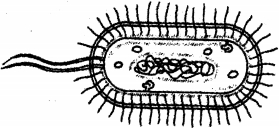
Bacteria and Cyanobacteria are included under kingdom Monera. Explain in detail the structure of $E.$ Coli bacteria. What kind of body design does it have? State its mode of nutrition.
Solution
(N/A) Structure of $E$. Coli bacterium:
$1$. Cell Envelope: $E$. Coli is a prokaryotic organism. Its cell envelope consists of an outer capsule,a cell wall,and a plasma membrane,which provide protection and structural integrity.
$2$. Genetic Material: It lacks a well-defined nucleus. Its genetic material,which is a single circular $DNA$ molecule,is located in a region called the nucleoid.
$3$. Appendages: The surface of the cell has hair-like structures called fimbriae or pili for attachment,and one or more long,whip-like structures called flagella for locomotion.
$4$. Cytoplasm: The cytoplasm contains ribosomes for protein synthesis and various inclusions.
Body Design: It has a simple,unicellular,prokaryotic body design. It is rod-shaped (bacillus).
Mode of Nutrition: $E$. Coli is heterotrophic,specifically a chemoheterotroph,as it obtains nutrients from organic matter in its environment.
0 likes
View Solution20
Medium
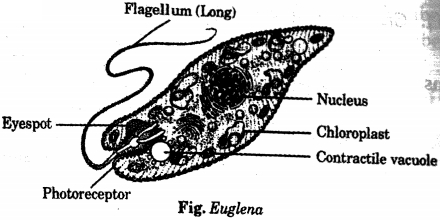
Draw a diagram of $Euglena$ and label the following parts:
Flagellum,photoreceptor,eyespot,chloroplast,nucleus,contractile vacuole.
Flagellum,photoreceptor,eyespot,chloroplast,nucleus,contractile vacuole.
Solution
(N/A) The diagram of $Euglena$ shows its characteristic spindle-shaped body.
Key structures include:
$1$. $Flagellum$: $A$ long,whip-like structure used for locomotion.
$2$. $Photoreceptor$: $A$ light-sensitive region located near the base of the flagellum.
$3$. $Eyespot$ $(Stigma)$: $A$ pigmented organelle that helps the organism detect light direction.
$4$. $Chloroplast$: Green,disc-shaped organelles responsible for photosynthesis.
$5$. $Nucleus$: The central control center containing genetic material.
$6$. $Contractile$ $vacuole$: An organelle involved in osmoregulation by expelling excess water.
0 likes
View Solution21
Medium
What is the difference between algae and fungi?
Solution
| $ALGAE$ | $FUNGI$ |
|---|---|
| $(i)$ Algae are autotrophic. | $(i)$ Fungi are heterotrophic. |
| $(ii)$ Most of the algae are aquatic. | $(ii)$ Most of the fungi are terrestrial. |
| $(iii)$ The cell wall is made up of cellulose. | $(iii)$ The cell wall is made up of chitin. |
| $(iv)$ Algae contain starch as a stored food material. | $(iv)$ Fungi contain glycogen and oil as a stored food material. |
0 likes
View Solution22
Medium
To which group do the following organisms belong and give one reason for each:
$(a)$ Cyanobacteria
$(b)$ Euglena
$(c)$ Ulothrix
$(a)$ Cyanobacteria
$(b)$ Euglena
$(c)$ Ulothrix
Solution
(N/A) Cyanobacteria belongs to the kingdom $Monera$. The reason is that they are prokaryotic organisms and do not have a well-defined nucleus or membrane-bound cell organelles.
$(b)$ Euglena belongs to the kingdom $Protista$. The reason is that they are unicellular,eukaryotic organisms that possess chloroplasts for photosynthesis.
$(c)$ Ulothrix belongs to the kingdom $Plantae$ (specifically the division $Thallophyta$). The reason is that their body is not well-differentiated into roots,stems,and leaves; they are multicellular,eukaryotic,filamentous,and photosynthetic.
0 likes
View Solution23
Easy
Write true or false for the following statement:
The chlorophyll in photosynthetic prokaryotic bacteria is associated with membranous vesicles but not with plastids.
The chlorophyll in photosynthetic prokaryotic bacteria is associated with membranous vesicles but not with plastids.
Solution
(TRUE) True.
Photosynthetic prokaryotic bacteria (such as cyanobacteria) do not possess membrane-bound organelles like plastids (chloroplasts). Instead,the chlorophyll pigments are associated with membranous vesicles or lamellae that are extensions of the plasma membrane,which allow them to perform photosynthesis.
Photosynthetic prokaryotic bacteria (such as cyanobacteria) do not possess membrane-bound organelles like plastids (chloroplasts). Instead,the chlorophyll pigments are associated with membranous vesicles or lamellae that are extensions of the plasma membrane,which allow them to perform photosynthesis.
0 likes
View Solution24
Medium
List three characteristics of kingdom $Monera$.
Solution
(N/A) $1.$ The organisms are prokaryotic,meaning they lack a well-defined nucleus and membrane-bound organelles.
$2.$ The cell wall is present in most members and is made up of peptidoglycan,though it is absent in some (e.g.,Mycoplasma).
$3.$ The mode of nutrition is diverse,ranging from autotrophic (photosynthetic or chemosynthetic) to heterotrophic (saprophytic or parasitic).
Examples include $Bacteria$ and $Blue-green$ algae (Cyanobacteria).
0 likes
View Solution25
Medium
$X, Y$ and $Z$ are living organisms.
$(a)$ Identify the group to which they belong on the basis of following features:
$(i)$ $X -$ Microscopic,unicellular,prokaryotic.
$(ii)$ $Y -$ Microscopic,unicellular,eukaryotic and shows locomotion with the help of pseudopodia/flagella.
$(iii)$ $Z -$ Multicellular,filamentous,eukaryotic,autotrophic and aquatic.
$(b)$ Which amongst the above is most advanced?
$(c)$ Name one organism each belonging to the groups of $X, Y$ and $Z$.
Solution
(N/A) $(i)$ $X$ belongs to Kingdom Monera because it is unicellular and prokaryotic.
$(ii)$ $Y$ belongs to Kingdom Protista because it is unicellular,eukaryotic,and exhibits locomotion via pseudopodia or flagella.
$(iii)$ $Z$ belongs to Kingdom Plantae (specifically the division Thallophyta) because it is multicellular,eukaryotic,autotrophic,and aquatic.
$(b)$ Among the groups identified,$Z$ (Plantae) is the most advanced as it consists of complex,multicellular,autotrophic organisms compared to the unicellular Monera and Protista.
$(c)$ Examples:
$X -$ Bacteria (e.g.,$Escherichia \ coli$)
$Y -$ Amoeba or Euglena
$Z -$ Spirogyra
0 likes
View Solution26
Difficult
Fungi are heterotrophic eukaryotic organisms and have a cell wall made of chitin. Name five cell organelles that are present in the fungal cell. Also,state two structural differences between a plant cell and a fungal cell. Which life form occurs due to the association of cells of fungi and algae?
Solution
(N/A) Five cell organelles present in a fungal cell are:
$(i)$ Nucleus
$(ii)$ Mitochondria
$(iii)$ Ribosome
$(iv)$ Endoplasmic reticulum
$(v)$ Golgi bodies
Two structural differences between a plant cell and a fungal cell are:
$(i)$ The cell wall of a plant cell is made up of cellulose,whereas the cell wall of a fungal cell is made up of chitin.
$(ii)$ Plant cells contain chloroplasts for photosynthesis,whereas fungal cells do not have chloroplasts.
The life form that occurs due to the symbiotic association between fungi and algae is called a lichen.
0 likes
View Solution27
EasyMCQ
Hair-like cilia or whip-like flagella for locomotion are present in kingdom
A
Monera
B
Protista
C
Fungi
D
Plantae
Solution
(B) Kingdom $Protista$ includes unicellular eukaryotic organisms. Many members of this kingdom,such as $Paramecium$ (which has cilia) and $Euglena$ (which has flagella),possess specialized structures like cilia or flagella for locomotion. While some bacteria (Monera) also possess flagella,the presence of both cilia and flagella as characteristic locomotory organelles is a defining feature of various groups within the kingdom $Protista$.
0 likes
View Solution28
MediumMCQ
Find out the incorrect sentence.
A
Protista includes unicellular eukaryotic organisms.
B
Monerans have a well-defined nucleus.
C
Whittaker considered cell structure,mode,and source of nutrition for classifying the organisms into five kingdoms.
D
Both Monera and Protista may be autotrophic and heterotrophic.
Solution
(B) The incorrect sentence is $B$.
Monerans (Kingdom Monera) are prokaryotic organisms,meaning they lack a well-defined nucleus and membrane-bound organelles.
Protista includes unicellular eukaryotic organisms,which do possess a well-defined nucleus.
Whittaker's five-kingdom classification system is based on cell structure,body organization,mode of nutrition,and phylogenetic relationships.
Both Monera and Protista exhibit diverse modes of nutrition,including autotrophic (e.g.,cyanobacteria in Monera,algae in Protista) and heterotrophic (e.g.,bacteria in Monera,protozoans in Protista).
0 likes
View Solution29
EasyMCQ
$5-$Kingdom classification was proposed by:
A
Morgan
B
Linnaeus
C
$R. H.$ Whittaker
D
Haeckel
Solution
(C) The $5-$Kingdom classification system was proposed by $R. H.$ Whittaker in $1969$.
This system classifies organisms into five kingdoms: Monera,Protista,Fungi,Plantae,and Animalia.
The criteria used for this classification include cell structure,body organization,mode of nutrition,and phylogenetic relationships.
This system classifies organisms into five kingdoms: Monera,Protista,Fungi,Plantae,and Animalia.
The criteria used for this classification include cell structure,body organization,mode of nutrition,and phylogenetic relationships.
0 likes
View Solution30
EasyMCQ
Well-defined nucleus is absent in
A
Blue-green algae
B
Diatoms
C
Algae
D
Yeast
Solution
(A) well-defined nucleus is a characteristic feature of eukaryotic cells.
Blue-green algae (also known as Cyanobacteria) are prokaryotic organisms.
Prokaryotic cells lack a membrane-bound nucleus and other membrane-bound organelles.
Diatoms,algae (eukaryotic),and yeast (a fungus) are all eukaryotic organisms and possess a well-defined nucleus.
Therefore,the correct answer is Blue-green algae.
0 likes
View Solution31
MediumMCQ
Organisms without a nucleus and cell organelles belong to:
$(i)$ Fungi
$(ii)$ Protista
$(iii)$ Cyanobacteria
$(iv)$ Archaebacteria
$(i)$ Fungi
$(ii)$ Protista
$(iii)$ Cyanobacteria
$(iv)$ Archaebacteria
A
$(i)$ and $(ii)$
B
$(i)$ and $(iv)$
C
$(ii)$ and $(iii)$
D
$(iii)$ and $(iv)$
Solution
(D) Organisms that lack a membrane-bound nucleus and membrane-bound cell organelles are classified as prokaryotes.
$(i)$ Fungi are eukaryotic organisms.
$(ii)$ Protista are eukaryotic organisms.
$(iii)$ Cyanobacteria are prokaryotic organisms (Kingdom Monera).
$(iv)$ Archaebacteria are prokaryotic organisms (Kingdom Monera).
Therefore,organisms $(iii)$ and $(iv)$ belong to the group of organisms without a nucleus and cell organelles.
0 likes
View SolutionDIVERSITY IN LIVING ORGANISMS — The Five Kingdom Classification · Frequently Asked Questions
1Are these DIVERSITY IN LIVING ORGANISMS questions useful for JEE and NEET?
Yes. All questions in this section are mapped to JEE Main and NEET exam patterns. Previous year questions from JEE Main, NEET, GUJCET and state-level exams are included with full solutions.
2Can I switch to Hindi or Gujarati for these questions?
Yes. Use the language tabs in the hero section or the sidebar to view the same questions and solutions in English, Hindi or Gujarati.
3How do I generate a question paper from this subtopic?
Use the Vedclass Exam Paper Generator — select the chapter and subtopic, set difficulty, and generate Sets A, B, C, D automatically. First 3 chapters of every subject are free.
Vedclass Products
For Students
Vedclass Test Series
Mock tests in real JEE/NEET style with performance analysis. 5-day free trial.
Start Free TrialFor Teachers
Exam Paper Generator
Generate Set A/B/C/D papers from this chapter in 2 minutes. 3 chapters free.
Try FreeFor Institutes
Online Exam Module
Live online exams with unlimited students, 360° analytics & white-label branding.
See DemoFor Teachers & Institutes
Generate a DIVERSITY IN LIVING ORGANISMS Exam Paper in 2 Minutes
Select subtopic & difficulty — Sets A, B, C, D auto-generated with No Repeat logic.
First 3 chapters of every subject are free — no payment required.