
A English
Plantae Questions in English
Class 9 Science · DIVERSITY IN LIVING ORGANISMS · Plantae
40+
Questions
English
Language
100%
With Solutions
Showing 40 of 40 questions in English
1
EasyMCQ
Which division among plants has the simplest organisms?
A
Thallophyta
B
Bryophyta
C
Pteridophyta
D
Gymnosperms
Solution
(A) The division $Thallophyta$ consists of the simplest plants. These organisms do not have a well-differentiated body structure,meaning their body is not differentiated into roots,stems,and leaves. They are predominantly aquatic and are commonly referred to as algae.
0 likes
View Solution2
Medium
How are pteridophytes different from the phanerogams?
Solution
(N/A)
| Pteridophyta | Phanerogams |
|---|---|
| They have inconspicuous or less differentiated reproductive organs. | They have well-developed reproductive organs. |
| They produce naked embryos called spores. | They produce seeds. |
| Examples include ferns,Marsilea,and Equisetum. | Examples include Pinus,Cycas,and fir. |
0 likes
View Solution3
Difficult
How do gymnosperms and angiosperms differ from each other?
Solution
(N/A)
| Gymnosperm | Angiosperm |
|---|---|
| They are non-flowering plants. | They are flowering plants. |
| Naked seeds not enclosed inside fruits are produced. | Seeds are enclosed inside fruits. |
| $Pinus$,$Cedar$,$fir$,$Cycas$,etc.,are examples. | $Coconut$,$palm$,$mango$,etc.,are examples. |
0 likes
View Solution4
Medium
What are the major divisions in the Kingdom Plantae? What is the basis for these divisions?
Solution
(N/A) The major divisions in Kingdom Plantae are:
$1$. Thallophyta
$2$. Bryophyta
$3$. Pteridophyta
$4$. Gymnosperms
$5$. Angiosperms
The basis for these divisions includes the following criteria:
- Whether the plant body is well-differentiated into distinct components like roots,stems,and leaves.
- Whether the plant body possesses specialized vascular tissues ($xylem$ and $phloem$) for the transport of water and nutrients.
- The ability of the plant to produce seeds.
- Whether the seeds are enclosed within fruits (ovary) or are naked.
0 likes
View Solution5
MediumMCQ
Which among the following has specialised tissue for the conduction of water?
$(i)$ Thallophyta
$(ii)$ Bryophyta
$(iii)$ Pteridophyta
$(iv)$ Gymnosperms
$(i)$ Thallophyta
$(ii)$ Bryophyta
$(iii)$ Pteridophyta
$(iv)$ Gymnosperms
A
$(i)$ and $(ii)$
B
$(iii)$ and $(iv)$
C
$(ii)$ and $(iii)$
D
$(i)$ and $(iv)$
Solution
(B) Specialised conductive tissues (xylem and phloem) are absent in Thallophyta and Bryophyta.
These tissues first appear in Pteridophyta and are also present in Gymnosperms.
Therefore,Pteridophyta and Gymnosperms possess specialised tissues for the conduction of water.
These tissues first appear in Pteridophyta and are also present in Gymnosperms.
Therefore,Pteridophyta and Gymnosperms possess specialised tissues for the conduction of water.
0 likes
View Solution6
EasyMCQ
Which among the following produce seeds?
A
Thallophyta
B
Bryophyta
C
Gymnosperms
D
Pteridophyta
Solution
(C) Plants are classified based on their ability to produce seeds.
$1$. Thallophyta,Bryophyta,and Pteridophyta are cryptogams,meaning they do not produce seeds.
$2$. Gymnosperms and Angiosperms are phanerogams,which are seed-bearing plants.
$3$. Therefore,among the given options,Gymnosperms are the only group that produces seeds.
$1$. Thallophyta,Bryophyta,and Pteridophyta are cryptogams,meaning they do not produce seeds.
$2$. Gymnosperms and Angiosperms are phanerogams,which are seed-bearing plants.
$3$. Therefore,among the given options,Gymnosperms are the only group that produces seeds.
0 likes
View Solution7
EasyMCQ
Pteridophyta do not have
A
root
B
stem
C
leaves
D
flowers
Solution
(D) Pteridophytes are vascular cryptogams,meaning they possess roots,stems,and leaves but do not produce seeds or flowers. Flowers are reproductive structures found exclusively in angiosperms (flowering plants).
0 likes
View Solution8
Easy
You are provided with the seeds of gram,wheat,rice,pumpkin,maize,and pea. Classify them into monocot and dicot seeds.
Solution
(N/A) The classification of the given seeds is as follows:
$1$. Gram: Dicot (contains two cotyledons).
$2$. Wheat: Monocot (contains one cotyledon).
$3$. Rice: Monocot (contains one cotyledon).
$4$. Pumpkin: Dicot (contains two cotyledons).
$5$. Maize: Monocot (contains one cotyledon).
$6$. Pea: Dicot (contains two cotyledons).
$1$. Gram: Dicot (contains two cotyledons).
$2$. Wheat: Monocot (contains one cotyledon).
$3$. Rice: Monocot (contains one cotyledon).
$4$. Pumpkin: Dicot (contains two cotyledons).
$5$. Maize: Monocot (contains one cotyledon).
$6$. Pea: Dicot (contains two cotyledons).
0 likes
View Solution9
EasyMCQ
Growth of $Lichens$ on barren rocks is followed by the growth of
A
ferns
B
moss
C
gymnosperms
D
algae
Solution
(B) In the process of primary succession on barren rocks,$Lichens$ are the pioneer species.
$Lichens$ secrete organic acids that help in the weathering of rocks,which leads to the formation of a thin layer of soil.
This soil provides a suitable environment for the growth of bryophytes,specifically $Mosses$.
$Mosses$ further contribute to soil formation and moisture retention,which eventually allows for the colonization of higher plants like ferns and other vegetation.
0 likes
View Solution10
Medium
State whether the following statements are True $(T)$ or False $(F)$:
$(a)$ Gymnosperms differ from Angiosperms in having covered seeds.
$(b)$ Non-flowering plants are called Cryptogamae.
$(c)$ Bryophytes have conducting tissue.
$(d)$ Funaria is a moss.
$(e)$ Compound leaves are found in many ferns.
$(f)$ Seeds contain an embryo.
$(a)$ Gymnosperms differ from Angiosperms in having covered seeds.
$(b)$ Non-flowering plants are called Cryptogamae.
$(c)$ Bryophytes have conducting tissue.
$(d)$ Funaria is a moss.
$(e)$ Compound leaves are found in many ferns.
$(f)$ Seeds contain an embryo.
Solution
(A) $F$: Gymnosperms have naked seeds,whereas Angiosperms have covered seeds.
$(b)$ $T$: Cryptogamae are plants that do not produce flowers or seeds.
$(c)$ $F$: Bryophytes lack specialized conducting tissues like xylem and phloem.
$(d)$ $T$: Funaria is a common genus of mosses.
$(e)$ $T$: Many ferns possess fronds which are compound leaves.
$(f)$ $T$: $A$ seed is a reproductive structure that contains an embryo,food supply,and a protective coat.
0 likes
View Solution11
Medium
Fill in the boxes given in the figure with appropriate characteristics or plant groups.
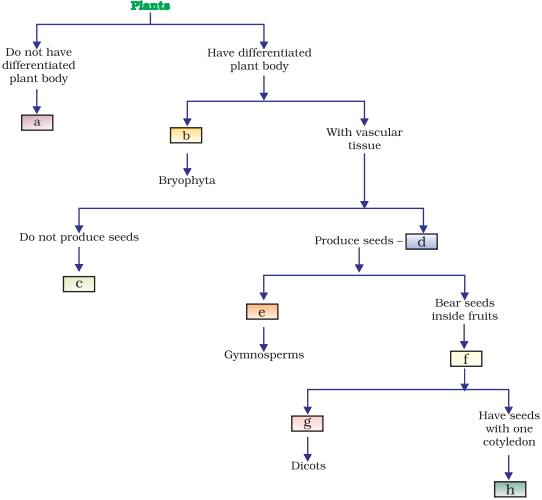
Solution
(N/A) Thallophyta
$(b)$ Without specialized vascular tissue
$(c)$ Pteridophyta
$(d)$ Phanerogams
$(e)$ Bear naked seeds
$(f)$ Angiosperms
$(g)$ Have seeds with two cotyledons
$(h)$ Monocots
$(b)$ Without specialized vascular tissue
$(c)$ Pteridophyta
$(d)$ Phanerogams
$(e)$ Bear naked seeds
$(f)$ Angiosperms
$(g)$ Have seeds with two cotyledons
$(h)$ Monocots
0 likes
View Solution12
Medium
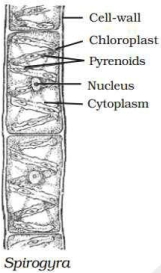
Write the names of a few thallophytes. Draw a labelled diagram of Spirogyra.
Solution
(N/A) Examples of thallophytes include: Ulothrix,Spirogyra,Cladophora,Ulva,and Chara.
The labelled diagram of Spirogyra shows the following structures:
$1$. Cell wall: The outer protective layer.
$2$. Chloroplast: The ribbon-shaped,spiral structure involved in photosynthesis.
$3$. Pyrenoids: Small bodies found within the chloroplast that store starch.
$4$. Nucleus: The central control unit of the cell.
$5$. Cytoplasm: The jelly-like substance filling the cell.
0 likes
View Solution13
Difficult
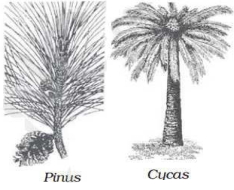
Thallophyta,Bryophyta,and Pteridophyta are called 'Cryptogams'. Gymnosperms and Angiosperms are called 'Phanerogams'. Discuss why? Draw or describe one example of a Gymnosperm.
Solution
(N/A) Thallophyta,Bryophyta,and Pteridophyta are classified as 'Cryptogams' because their reproductive organs are inconspicuous or hidden,and they do not produce seeds.
On the other hand,'Phanerogams' include Gymnosperms and Angiosperms. These plants possess well-differentiated reproductive tissues and produce seeds. In these plants,the embryo develops into a seed,which contains stored food for future growth.
An example of a Gymnosperm is $Pinus$ (Pine),which is a coniferous tree that produces seeds in cones.
0 likes
View Solution14
EasyMCQ
What is the chemical composition of the cell wall in plants and fungi,respectively?
A
Chitin and Cellulose
B
Cellulose and Chitin
C
Cellulose and Peptidoglycan
D
Pectin and Chitin
Solution
(B) In plants,the cell wall is primarily composed of cellulose,which provides structural support and rigidity to the plant cells.
In fungi,the cell wall is composed of chitin,a complex polysaccharide that is also found in the exoskeletons of arthropods.
In fungi,the cell wall is composed of chitin,a complex polysaccharide that is also found in the exoskeletons of arthropods.
0 likes
View Solution15
EasyMCQ
Where are seeds of gymnosperms formed?
A
Inside the fruit
B
On the surface of scales or leaves
C
Inside the flower
D
Within the root system
Solution
(B) Gymnosperms are known as 'naked-seeded' plants because their seeds are not enclosed within an ovary or fruit.
Instead,the seeds of gymnosperms typically develop on the surface of specialized reproductive structures known as scales or leaves,often organized into cones (strobili).
Instead,the seeds of gymnosperms typically develop on the surface of specialized reproductive structures known as scales or leaves,often organized into cones (strobili).
0 likes
View Solution16
EasyMCQ
Why are bryophytes called the amphibians of the plant kingdom?
A
They can live in both soil and water.
B
They require water for fertilization and reproduction.
C
They have a body that is differentiated into roots,stems,and leaves.
D
They are the first land plants.
Solution
(B) Bryophytes are referred to as the amphibians of the plant kingdom because,although they are terrestrial plants that live in damp and shaded areas,they require water for the process of fertilization. The male gametes (antherozoids) must swim through a film of water to reach the female gamete (egg) in the archegonium,making water essential for their life cycle.
0 likes
View Solution17
Medium
What are gymnosperms? Give two characteristics.
Solution
(N/A) Gymnosperms are a group of plants that bear naked seeds,meaning the seeds are not enclosed within a fruit.
Characteristic features:
$(i)$ They are usually perennial plants.
$(ii)$ They are typically evergreen and woody plants.
Characteristic features:
$(i)$ They are usually perennial plants.
$(ii)$ They are typically evergreen and woody plants.
0 likes
View Solution18
MediumMCQ
Thallophyta,Bryophyta and Pteridophyta are classified as Cryptogamae,whereas Gymnosperms and Angiosperms are classified as Phanerogamae. Why?
A
Because of their habitat.
B
Because of their reproductive organs.
C
Because of their vascular tissues.
D
Because of their seed production.
Solution
(B) The classification is based on the nature of reproductive organs:
$1$. Thallophytes,Bryophytes,and Pteridophytes are classified as Cryptogamae (from Greek 'kryptos' meaning hidden and 'gamos' meaning marriage) because they have inconspicuous or hidden reproductive organs and do not produce seeds.
$2$. Gymnosperms and Angiosperms are classified as Phanerogamae (from Greek 'phaneros' meaning visible) because they have well-differentiated,visible reproductive organs and produce seeds.
0 likes
View Solution19
Medium
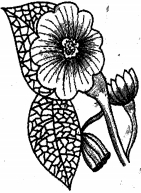
Is the given figure of an angiosperm plant a dicot or a monocot? Differentiate between dicot and monocot plants on the basis of venation in the leaf and the number of cotyledons in the seed.
Solution
(N/A) The given figure shows a plant with reticulate venation in its leaves,which is a characteristic feature of a dicot plant.
| Feature | Dicot Plant | Monocot Plant |
|---|---|---|
| Venation in leaf | Reticulate venation | Parallel venation |
| Number of cotyledons | Two cotyledons | One cotyledon |
0 likes
View Solution20
Medium
State any three differences between cryptogamae and phanerogamae.
Solution
(N/A)
| $CRYPTOGAMAE$ | $PHANEROGAMAE$ |
| $(i)$ The reproductive organs are inconspicuous or hidden. | $(i)$ The reproductive organs are well-differentiated and visible. |
| $(ii)$ They do not produce seeds. | $(ii)$ They produce seeds. |
| $(iii)$ They reproduce through spores. | $(iii)$ They reproduce through seeds containing embryos. |
0 likes
View Solution21
Medium
What is the difference between Bryophyta and Pteridophyta?
Solution
(N/A)
| $BRYOPHYTA$ | $PTERIDOPHYTA$ |
|---|---|
| $(i)$ The plant body is not differentiated into true root,stem,and leaves. | $(i)$ The plant body is differentiated into true root,stem,and leaves. |
| $(ii)$ The main plant body is gametophytic. | $(ii)$ The main plant body is sporophytic. |
| $(iii)$ They lack a true vascular system. Examples: $Riccia$,$Funaria$ (moss),etc. | $(iii)$ They are terrestrial vascular plants. Examples: $Dryopteris$ (fern),$Lycopodium$,etc. |
0 likes
View Solution22
Medium
Identify the plant bodies,which are commonly named as 'cryptogamae'. State and explain two characteristics,which are exhibited by each category of these plant bodies.
Solution
(N/A) The plant groups collectively known as 'cryptogamae' are Thallophyta,Bryophyta,and Pteridophyta.
$1$. Thallophyta: These plants have a simple,undifferentiated body structure (thallus) and lack specialized vascular tissues (xylem and phloem).
$2$. Bryophyta: These are known as amphibians of the plant kingdom; they possess a thalloid or leafy body and require water for fertilization.
$3$. Pteridophyta: These are the first terrestrial plants to possess vascular tissues (xylem and phloem) and have a well-differentiated plant body into roots,stems,and leaves.
0 likes
View Solution23
EasyMCQ
Growth of Lichens on barren rocks is followed by the growth of:
A
Gymnosperms
B
Ferns
C
Moss
D
Algae
Solution
(C) The process of ecological succession on barren rocks (lithosere) begins with the colonization of pioneer species,which are Lichens.
Lichens secrete acids that help in the weathering of rocks,leading to the formation of a thin layer of soil.
Once a thin layer of soil is formed,the environment becomes suitable for the growth of bryophytes,specifically Mosses.
Mosses further contribute to soil formation and moisture retention,eventually paving the way for larger plants like ferns and higher vegetation.
0 likes
View Solution24
Medium
State appropriate terms for the following:
$(i)$ Amphibians of the plant kingdom.
$(ii)$ Plants not having well-differentiated body design.
$(iii)$ Single-celled,eukaryotic,and photosynthetic organism.
$(i)$ Amphibians of the plant kingdom.
$(ii)$ Plants not having well-differentiated body design.
$(iii)$ Single-celled,eukaryotic,and photosynthetic organism.
Solution
(N/A) $(i)$ Bryophytes: These are known as the amphibians of the plant kingdom because they require water for fertilization despite living on land.
$(ii)$ Thallophytes: These are plants whose body is not differentiated into roots,stems,and leaves,forming a thallus-like structure.
$(iii)$ Protists (specifically algae like Chlamydomonas): These are unicellular,eukaryotic organisms that possess chloroplasts and perform photosynthesis.
$(ii)$ Thallophytes: These are plants whose body is not differentiated into roots,stems,and leaves,forming a thallus-like structure.
$(iii)$ Protists (specifically algae like Chlamydomonas): These are unicellular,eukaryotic organisms that possess chloroplasts and perform photosynthesis.
0 likes
View Solution25
Medium
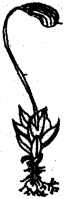
List the basic criteria for classifying the Plantae kingdom into various groups. Identify the following specimen given in the image and write its characteristic features.
Solution
(N/A) The basic criteria for classifying the Plantae kingdom are:
$(i)$ Differentiation of the plant body: Whether the plant body is well-differentiated into roots,stems,and leaves.
$(ii)$ Presence of vascular tissues: Whether the plant has specialized tissues (xylem and phloem) for the conduction of water and other substances.
$(iii)$ Ability to bear seeds: Whether the plant produces seeds and if those seeds are naked or enclosed within fruits.
The specimen shown in the image is $Funaria$ (a moss).
Its characteristic features are:
$(i)$ It belongs to the division Bryophyta.
$(ii)$ The plant body is differentiated into stem-like and leaf-like structures,but lacks true roots,stems,and leaves.
$(iii)$ It lacks specialized vascular tissues for the conduction of water and nutrients.
$(iv)$ It reproduces through spores and requires water for fertilization.
0 likes
View Solution26
Easy
State reasons for the following:
$(a)$ Bryophytes are called amphibians of the plant kingdom.
$(b)$ Gymnosperms are called so (naked-seeded plants).
$(c)$ Birds have wings and feathers.
$(a)$ Bryophytes are called amphibians of the plant kingdom.
$(b)$ Gymnosperms are called so (naked-seeded plants).
$(c)$ Birds have wings and feathers.
Solution
(N/A) Bryophytes are called amphibians of the plant kingdom because they live on land but require water for fertilization,as their male gametes are motile and need a water medium to reach the female gametes.
$(b)$ Gymnosperms are called so because the term 'Gymnosperm' is derived from Greek words 'gymnos' meaning naked and 'sperma' meaning seed. They produce seeds that are not enclosed within an ovary or fruit.
$(c)$ Birds have wings and feathers to facilitate flight. Wings provide the necessary surface area for lift,while feathers help in streamlining the body,maintaining body temperature,and providing the aerodynamic structure required for flying.
0 likes
View Solution27
Medium
$(i)$ To which division of Plantae do algae belong? Write one characteristic of the division. Give two examples.
$(ii)$ Name the group:
$(a)$ Which includes unicellular eukaryotic organisms.
$(b)$ In which the mode of nutrition is saprophytic.
$(c)$ In which seeds are not enclosed in fruit.
$(iii)$ Classify flowering plants on the basis of the number of cotyledons present in the seed.
$(ii)$ Name the group:
$(a)$ Which includes unicellular eukaryotic organisms.
$(b)$ In which the mode of nutrition is saprophytic.
$(c)$ In which seeds are not enclosed in fruit.
$(iii)$ Classify flowering plants on the basis of the number of cotyledons present in the seed.
Solution
(N/A) $(i)$ Algae belong to the division Thallophyta.
Characteristic: The plant body is not differentiated into roots,stems,and leaves (thallus-like body).
Examples: $Spirogyra$,$Chara$ (or $Ulothrix$,$Cladophora$).
$(ii)$ $(a)$ Protista,$(b)$ Fungi,$(c)$ Gymnosperms.
$(iii)$ Flowering plants (Angiosperms) are classified based on the number of cotyledons as:
$1$. Monocots: Seeds contain only $1$ cotyledon.
$2$. Dicots: Seeds contain $2$ cotyledons.
0 likes
View Solution28
Easy
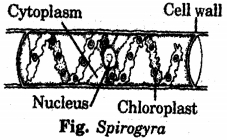
Draw the diagram of $Spirogyra$ and label the following parts:
$(a)$ Cell wall $(b)$ Pyrenoid $(c)$ Nucleus $(d)$ Chloroplast.
$(a)$ Cell wall $(b)$ Pyrenoid $(c)$ Nucleus $(d)$ Chloroplast.
Solution
(N/A) The diagram of $Spirogyra$ shows a filamentous green alga with a characteristic spiral-shaped chloroplast.
Key features to label:
$1$. Cell wall: The outermost protective layer of the cell.
$2$. Pyrenoid: Small,proteinaceous bodies embedded within the chloroplast,involved in starch storage.
$3$. Nucleus: The central organelle containing genetic material,usually suspended in the center of the cell by cytoplasmic strands.
$4$. Chloroplast: The ribbon-like,spiral structure responsible for photosynthesis.
0 likes
View Solution29
Medium
Name two plants for each of the following types:
$(i)$ Vascular cryptogams
$(ii)$ Naked seeded plants
$(iii)$ Flowering plants
$(i)$ Vascular cryptogams
$(ii)$ Naked seeded plants
$(iii)$ Flowering plants
Solution
(N/A) $(i)$ Vascular cryptogams (Pteridophytes) are plants that possess vascular tissues but do not produce seeds. Examples: $(a)$ Marsilea,$(b)$ Ferns (e.g.,Dryopteris).
$(ii)$ Naked seeded plants (Gymnosperms) are plants that produce seeds that are not enclosed within a fruit. Examples: $(a)$ Pinus,$(b)$ Cycas.
$(iii)$ Flowering plants (Angiosperms) are plants that produce seeds enclosed within fruits and have specialized reproductive structures called flowers. Examples: $(a)$ Paphiopedilum (Orchid),$(b)$ Ipomoea (Morning glory).
0 likes
View Solution30
Easy
$A$ plant specimen was found without differentiated roots.
$(a)$ Which plant structure helps in attaching this plant to the substratum?
$(b)$ To which group would you classify this plant?
$(c)$ Which plant could it be?
$(a)$ Which plant structure helps in attaching this plant to the substratum?
$(b)$ To which group would you classify this plant?
$(c)$ Which plant could it be?
Solution
(N/A) The plant structure that helps in attaching the plant to the substratum is called the $Rhizoid$ or the $Thallus$ itself.
$(b)$ This plant belongs to the group $Thallophyta$,as the plant body is not differentiated into roots,stems,and leaves.
$(c)$ This plant could be an $Alga$ (e.g.,$Spirogyra$ or $Ulothrix$).
$(b)$ This plant belongs to the group $Thallophyta$,as the plant body is not differentiated into roots,stems,and leaves.
$(c)$ This plant could be an $Alga$ (e.g.,$Spirogyra$ or $Ulothrix$).
0 likes
View Solution31
Medium
Why are angiosperms so called? In which structures do the seeds develop? Why are cotyledons considered an important part of seed?
Solution
(N/A) Angiosperms are so called because they produce seeds that are enclosed within a fruit,which develops from the ovary.
Seeds develop within the ovary,which matures into a fruit after fertilization.
Cotyledons are considered an important part of the seed because they are embryonic leaves. They often serve as a food storage organ for the developing embryo and,in many cases,emerge and become green to perform photosynthesis when the seed germinates.
0 likes
View Solution32
Medium
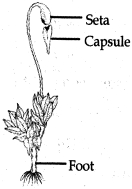
$A$ plant specimen was found with rhizoids instead of differentiated roots.
$(a)$ Identify the group to which it belongs.
$(b)$ Write any two characteristics of this group.
$(c)$ Draw the diagram of a plant belonging to this group.
$(a)$ Identify the group to which it belongs.
$(b)$ Write any two characteristics of this group.
$(c)$ Draw the diagram of a plant belonging to this group.
Solution
(N/A) Bryophyta.
$(b)$ $(i)$ They are mostly terrestrial plants.
$(ii)$ They are found in damp and shady places.
$(iii)$ The plant body is commonly differentiated into stem and leaf-like structures.
$(c)$ The diagram represents a moss plant (Funaria),which is a member of the Bryophyta group. It shows the gametophyte with leaf-like structures and rhizoids,and the sporophyte consisting of a foot,seta,and capsule.
0 likes
View Solution33
MediumMCQ
Which among the following has specialised tissue for conduction of water?
$(i)$ Thallophyta
$(ii)$ Bryophyta
$(iii)$ Pteridophyta
$(iv)$ Gymnosperms
$(i)$ Thallophyta
$(ii)$ Bryophyta
$(iii)$ Pteridophyta
$(iv)$ Gymnosperms
A
$(i)$ and $(ii)$
B
$(ii)$ and $(iii)$
C
$(iii)$ and $(iv)$
D
$(i)$ and $(iv)$
Solution
(C) Specialised tissues for the conduction of water and minerals are known as vascular tissues (xylem and phloem).
$(i)$ Thallophyta: These are simple plants without differentiated plant bodies and lack vascular tissues.
$(ii)$ Bryophyta: These are known as amphibians of the plant kingdom and lack true vascular tissues.
$(iii)$ Pteridophyta: These are the first terrestrial plants to possess vascular tissues (xylem and phloem).
$(iv)$ Gymnosperms: These are seed-bearing plants that possess well-developed vascular tissues.
Therefore,both Pteridophyta and Gymnosperms have specialised tissues for the conduction of water.
0 likes
View Solution34
EasyMCQ
Which among the following produce seeds?
A
Thallophyta
B
Bryophyta
C
Pteridophyta
D
Gymnosperms
Solution
(D) The plant kingdom is classified into various groups based on their characteristics.
$1$. Thallophyta,Bryophyta,and Pteridophyta are cryptogams,meaning they do not produce seeds and have inconspicuous reproductive organs.
$2$. Gymnosperms and Angiosperms are phanerogams,which are seed-bearing plants.
$3$. Gymnosperms produce naked seeds,while Angiosperms produce seeds enclosed within fruits.
Therefore,among the given options,Gymnosperms are the ones that produce seeds.
0 likes
View Solution35
EasyMCQ
Pteridophyta do not have
A
Flowers
B
Root
C
Stem
D
Leaves
Solution
(A) Pteridophytes are vascular cryptogams,meaning they possess xylem and phloem for the conduction of water and nutrients.
They have well-differentiated plant bodies consisting of true roots,stems,and leaves.
However,they are non-flowering plants and do not produce seeds.
Therefore,they lack flowers and seeds.
They have well-differentiated plant bodies consisting of true roots,stems,and leaves.
However,they are non-flowering plants and do not produce seeds.
Therefore,they lack flowers and seeds.
0 likes
View Solution36
Easy
State whether the following statement is true or false:
Cryptogamae means those with open reproductive organs.
Cryptogamae means those with open reproductive organs.
Solution
(FALSE) The statement is False.
Cryptogamae is derived from the Greek words 'kryptos' (hidden) and 'gamos' (marriage).
Therefore,Cryptogamae refers to plants with 'hidden' or 'inconspicuous' reproductive organs,not open ones.
Plants with visible or open reproductive organs are known as Phanerogamae.
Cryptogamae is derived from the Greek words 'kryptos' (hidden) and 'gamos' (marriage).
Therefore,Cryptogamae refers to plants with 'hidden' or 'inconspicuous' reproductive organs,not open ones.
Plants with visible or open reproductive organs are known as Phanerogamae.
0 likes
View Solution37
Easy
Write true or false for the following statement:
Plants with well-differentiated reproductive tissues that ultimately make seeds are called pteridophytes.
Plants with well-differentiated reproductive tissues that ultimately make seeds are called pteridophytes.
Solution
(FALSE) The statement is False.
Pteridophytes are plants that have well-differentiated plant bodies but do not produce seeds; they reproduce through spores.
Plants that produce seeds are classified as Phanerogams (Gymnosperms and Angiosperms),not Pteridophytes.
Pteridophytes are plants that have well-differentiated plant bodies but do not produce seeds; they reproduce through spores.
Plants that produce seeds are classified as Phanerogams (Gymnosperms and Angiosperms),not Pteridophytes.
0 likes
View Solution38
Easy
State whether the following statement is true or false:
Thallophytes are called the amphibians of the plant kingdom.
Thallophytes are called the amphibians of the plant kingdom.
Solution
(FALSE) The statement is False.
Explanation: Bryophytes are known as the amphibians of the plant kingdom because they can live in soil but are dependent on water for sexual reproduction. Thallophytes,on the other hand,are plants that do not have a well-differentiated body structure (thallus) and are primarily aquatic.
Explanation: Bryophytes are known as the amphibians of the plant kingdom because they can live in soil but are dependent on water for sexual reproduction. Thallophytes,on the other hand,are plants that do not have a well-differentiated body structure (thallus) and are primarily aquatic.
0 likes
View Solution39
Easy
State whether the following statement is true or false:
The plants of the $Angiosperm$ group bear naked seeds.
The plants of the $Angiosperm$ group bear naked seeds.
Solution
(B) The statement is $False$.
$Angiosperms$ are flowering plants in which the seeds are enclosed within fruits.
Plants that bear naked seeds (seeds not enclosed in fruits) belong to the group $Gymnosperms$.
$Angiosperms$ are flowering plants in which the seeds are enclosed within fruits.
Plants that bear naked seeds (seeds not enclosed in fruits) belong to the group $Gymnosperms$.
0 likes
View Solution40
Easy
State whether the following statement is true or false:
Gymnosperms are usually perennial,evergreen,and woody.
Gymnosperms are usually perennial,evergreen,and woody.
Solution
(TRUE) The statement is True.
Gymnosperms are plants in which the ovules are not enclosed by any ovary wall and remain exposed both before and after fertilization.
They are typically perennial (living for many years),evergreen (retaining leaves throughout the year),and woody (having stems that are hard and lignified).
Gymnosperms are plants in which the ovules are not enclosed by any ovary wall and remain exposed both before and after fertilization.
They are typically perennial (living for many years),evergreen (retaining leaves throughout the year),and woody (having stems that are hard and lignified).
0 likes
View SolutionDIVERSITY IN LIVING ORGANISMS — Plantae · Frequently Asked Questions
1Are these DIVERSITY IN LIVING ORGANISMS questions useful for JEE and NEET?
Yes. All questions in this section are mapped to JEE Main and NEET exam patterns. Previous year questions from JEE Main, NEET, GUJCET and state-level exams are included with full solutions.
2Can I switch to Hindi or Gujarati for these questions?
Yes. Use the language tabs in the hero section or the sidebar to view the same questions and solutions in English, Hindi or Gujarati.
3How do I generate a question paper from this subtopic?
Use the Vedclass Exam Paper Generator — select the chapter and subtopic, set difficulty, and generate Sets A, B, C, D automatically. First 3 chapters of every subject are free.
Vedclass Products
For Students
Vedclass Test Series
Mock tests in real JEE/NEET style with performance analysis. 5-day free trial.
Start Free TrialFor Teachers
Exam Paper Generator
Generate Set A/B/C/D papers from this chapter in 2 minutes. 3 chapters free.
Try FreeFor Institutes
Online Exam Module
Live online exams with unlimited students, 360° analytics & white-label branding.
See DemoFor Teachers & Institutes
Generate a DIVERSITY IN LIVING ORGANISMS Exam Paper in 2 Minutes
Select subtopic & difficulty — Sets A, B, C, D auto-generated with No Repeat logic.
First 3 chapters of every subject are free — no payment required.