
A English
Mix Examples - DIVERSITY IN LIVING ORGANISMS Questions in English
Class 9 Science · DIVERSITY IN LIVING ORGANISMS · Mix Examples - DIVERSITY IN LIVING ORGANISMS
21+
Questions
English
Language
100%
With Solutions
Showing 21 of 21 questions in English
1
Easy
Write true $(T)$ or false $(F)$ for the following statements:
$(a)$ Whittaker proposed five kingdom classification.
$(b)$ Monera is divided into Archaebacteria and Eubacteria.
$(c)$ Starting from Class,Species comes before the Genus.
$(d)$ Anabaena belongs to the kingdom Monera.
$(e)$ Blue green algae belongs to the kingdom Protista.
$(f)$ All prokaryotes are classified under Monera.
Solution
(A) $T$: $R$.$H$. Whittaker proposed the five-kingdom classification system in $1969$.
$(b)$ $T$: The kingdom Monera is broadly categorized into Archaebacteria and Eubacteria.
$(c)$ $F$: In the taxonomic hierarchy,the order is Class,Order,Family,Genus,Species. Thus,Genus comes before Species.
$(d)$ $T$: Anabaena is a cyanobacterium (blue-green alga),which is a prokaryote and belongs to the kingdom Monera.
$(e)$ $F$: Blue-green algae (cyanobacteria) are prokaryotic organisms and are classified under the kingdom Monera,not Protista.
$(f)$ $T$: All prokaryotic organisms,which lack a defined nucleus and membrane-bound organelles,are placed in the kingdom Monera.
0 likes
View Solution2
Easy
Fill in the blanks:
$(a)$ Fungi shows .............. mode of nutrition.
$(b)$ Cell wall of fungi is made up of ..............
$(c)$ Association between blue-green algae and fungi is called as ..............
$(d)$ Chemical nature of chitin is ..............
$(e)$ .............. has the smallest number of organisms with the maximum number of similar characters.
$(f)$ Plants without well-differentiated stem,root,and leaf are kept in ..............
$(g)$ .............. are called as amphibians of the plant kingdom.
Solution
(A-D) Fungi exhibit a saprotrophic mode of nutrition,where they obtain nutrients from decaying organic matter.
$(b)$ The cell wall of fungi is composed of a complex polysaccharide called chitin.
$(c)$ The symbiotic association between blue-green algae (or cyanobacteria) and fungi is known as lichens.
$(d)$ Chemically,chitin is a complex carbohydrate,specifically a nitrogen-containing polysaccharide ($N$-acetylglucosamine).
$(e)$ Species is the basic unit of classification and contains the smallest number of organisms with the maximum number of similar characters.
$(f)$ Plants that lack a well-differentiated body structure (stem,root,and leaf) are classified under the group Thallophyta.
$(g)$ Bryophytes are referred to as the amphibians of the plant kingdom because they require water for fertilization despite living on land.
0 likes
View Solution3
MediumMCQ
Match items of column $(A)$ with items of column $(B)$:
| Column $(A)$ | Column $(B)$ |
| $(a)$ Naked seed | $(A)$ Angiosperms |
| $(b)$ Covered seed | $(B)$ Gymnosperms |
| $(c)$ Flagella | $(C)$ Bryophytes |
| $(d)$ Marchantia | $(D)$ Euglena |
| $(e)$ Marsilea | $(E)$ Thallophyta |
| $(f)$ Cladophora | $(F)$ Pteridophyta |
| $(g)$ Penicillium | $(G)$ Fungi |
A
$(a) - B, (b) - A, (c) - D, (d) - C, (e) - F, (f) - E, (g) - G$
B
$(a) - B, (b) - C, (c) - D, (d) - A, (e) - E, (f) - F, (g) - G$
C
$(a) - G, (b) - C, (c) - E, (d) - A, (e) - D, (f) - F, (g) - B$
D
$(a) - B, (b) - A, (c) - D, (d) - G, (e) - F, (f) - E, (g) - C$
Solution
(A) The correct matches are as follows:
$(a)$ Naked seed: $(B)$ Gymnosperms (seeds are not enclosed in fruits).
$(b)$ Covered seed: $(A)$ Angiosperms (seeds are enclosed within fruits).
$(c)$ Flagella: $(D)$ Euglena (locomotory organelle).
$(d)$ Marchantia: $(C)$ Bryophytes (a type of liverwort).
$(e)$ Marsilea: $(F)$ Pteridophyta (a type of fern).
$(f)$ Cladophora: $(E)$ Thallophyta (a type of green algae).
$(g)$ Penicillium: $(G)$ Fungi (a type of fungus).
Therefore, the correct sequence is $(a) - B, (b) - A, (c) - D, (d) - C, (e) - F, (f) - E, (g) - G$.
0 likes
View Solution4
EasyMCQ
Match the items of Column $(A)$ with the items of Column $(B)$:
| Column $(A)$ | Column $(B)$ |
| $(a)$ Pore bearing animals | $(A)$ Arthropoda |
| $(b)$ Diploblastic | $(B)$ Coelenterata |
| $(c)$ Metameric segmentation | $(C)$ Porifera |
| $(d)$ Jointed legs | $(D)$ Echinodermata |
| $(e)$ Soft bodied animals | $(E)$ Mollusca |
| $(f)$ Spiny skinned animals | $(F)$ Annelida |
A
$(a) - C; (b) - A; (c) - F; (d) - B; (e) - D; (f) - E$
B
$(a) - C; (b) - B; (c) - F; (d) - A; (e) - E; (f) - D$
C
$(a) - B; (b) - C; (c) - F; (d) - E; (e) - A; (f) - D$
D
$(a) - C; (b) - D; (c) - A; (d) - F; (e) - E; (f) - B$
Solution
(B) Pore bearing animals are classified under the phylum Porifera $(C)$.
$(b)$ Diploblastic animals (having two germ layers) are characteristic of the phylum Coelenterata $(B)$.
$(c)$ Metameric segmentation is a key feature of the phylum Annelida $(F)$.
$(d)$ Jointed legs are the defining characteristic of the phylum Arthropoda $(A)$.
$(e)$ Soft-bodied animals are characteristic of the phylum Mollusca $(E)$.
$(f)$ Spiny-skinned animals belong to the phylum Echinodermata $(D)$.
Therefore, the correct matching is $(a) - C, (b) - B, (c) - F, (d) - A, (e) - E, (f) - D$.
0 likes
View Solution5
Medium
Fill in the blanks:
$(a)$ Five kingdom classification of living organisms is given by ..............
$(b)$ Basic smallest unit of classification is .............
$(c)$ Prokaryotes are grouped in Kingdom ...............
$(d)$ Paramecium is a protista because of its ...............
$(e)$ Fungi do not contain .............
$(f)$ $A$ fungus ............. can be seen without microscope.
$(g)$ Common fungi used in preparing the bread is ...............
$(h)$ Algae and fungi form symbiotic association called ...........
Solution
(N/A) Robert Whittaker
$(b)$ Species
$(c)$ Monera
$(d)$ Eukaryotic unicellular nature
$(e)$ Chlorophyll
$(f)$ Mushroom
$(g)$ Yeast
$(h)$ Lichens
$(b)$ Species
$(c)$ Monera
$(d)$ Eukaryotic unicellular nature
$(e)$ Chlorophyll
$(f)$ Mushroom
$(g)$ Yeast
$(h)$ Lichens
0 likes
View Solution6
Easy
Give examples for the following:
$(a)$ Bilateral,dorsiventral symmetry is found in ...............
$(b)$ Worms causing disease elephantiasis is ..............
$(c)$ Open circulatory system is found in ............. where coelomic cavity is filled with blood.
$(d)$ ............... are known to have pseudocoelom.
$(a)$ Bilateral,dorsiventral symmetry is found in ...............
$(b)$ Worms causing disease elephantiasis is ..............
$(c)$ Open circulatory system is found in ............. where coelomic cavity is filled with blood.
$(d)$ ............... are known to have pseudocoelom.
Solution
(A) Liver fluke (Fasciola hepatica) exhibits bilateral,dorsiventral symmetry.
$(b)$ Wuchereria bancrofti (Filarial worm) is the causative agent of elephantiasis.
$(c)$ Arthropods possess an open circulatory system where the coelomic cavity,known as the haemocoel,is filled with blood.
$(d)$ Nematodes (Roundworms) are characterized by the presence of a pseudocoelom,a body cavity that is not completely lined by mesoderm.
0 likes
View Solution7
Medium
Define the following terms and give one example of each:
$(a)$ Bilateral symmetry
$(b)$ Coelom
$(c)$ Triploblastic
$(a)$ Bilateral symmetry
$(b)$ Coelom
$(c)$ Triploblastic
Solution
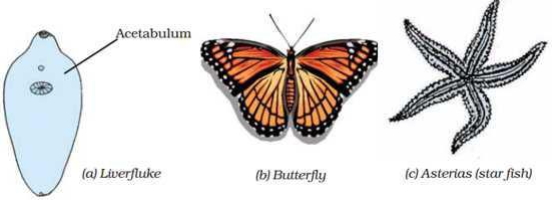
(N/A) Bilateral symmetry: It is a body plan in which the left and right halves of the body are mirror images of each other,e.g.,Liver fluke.
$(b)$ Coelom: It is the internal body cavity between the visceral organs and the body wall in which well-developed organs can be accommodated,e.g.,Butterfly.
$(c)$ Triploblastic: Animals having three germinal layers (ectoderm,mesoderm,and endoderm) from which differentiated tissues and organs can be formed are called triploblastic,e.g.,Starfish.
0 likes
View Solution8
Medium
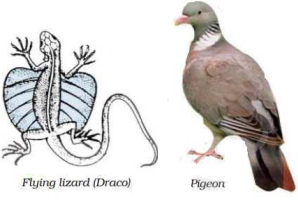
Differentiate between a flying lizard and a bird. Provide a diagram.
Solution
(N/A) The differences between a flying lizard $(Draco)$ and a bird are as follows:
$1$. Classification: Flying lizard belongs to the class $Reptilia$,while birds belong to the class $Aves$.
$2$. Body Temperature: Flying lizards are cold-blooded (poikilothermic),whereas birds are warm-blooded (homeothermic).
$3$. Body Covering: The body of a flying lizard is covered with scales,while the body of a bird is covered with feathers.
$4$. Heart Structure: Flying lizards typically have a three-chambered heart,whereas birds have a four-chambered heart.
$5$. Locomotion: Flying lizards use skin folds (patagium) for gliding,while birds have forelimbs modified into wings for true flight.
0 likes
View Solution9
EasyMCQ
What is symbiosis?
A
$A$ parasitic relationship
B
An obligatory mutually beneficial association
C
$A$ relationship where one organism benefits and the other is harmed
D
$A$ relationship where neither organism benefits
Solution
(B) Symbiosis is defined as an obligatory mutually beneficial association between two different organisms living in close physical contact. In this relationship,both organisms derive benefits from each other,which is essential for their survival.
0 likes
View Solution10
Easy
Characteristics of some organisms are given. Identify their group and give one example of each.
$(a)$ Single-celled,eukaryotic,and photosynthetic.
$(b)$ The body is divided into segments,may be unisexual or hermaphrodite.
$(a)$ Single-celled,eukaryotic,and photosynthetic.
$(b)$ The body is divided into segments,may be unisexual or hermaphrodite.
Solution
(N/A) The group is Kingdom Protista. These are unicellular eukaryotic organisms that can perform photosynthesis. Example: $Euglena$.
$(b)$ The group is Phylum Annelida. These organisms have a segmented body (metamerism) and can be either unisexual or hermaphrodite. Example: $Earthworm$ $(Pheretima)$.
$(b)$ The group is Phylum Annelida. These organisms have a segmented body (metamerism) and can be either unisexual or hermaphrodite. Example: $Earthworm$ $(Pheretima)$.
0 likes
View Solution11
Medium
Give one example of each:
$(a)$ Reptile which has a four-chambered heart.
$(b)$ Egg-laying mammal.
$(c)$ Parasitic Platyhelminthes.
$(d)$ Division among plants which has the simplest organisms.
$(a)$ Reptile which has a four-chambered heart.
$(b)$ Egg-laying mammal.
$(c)$ Parasitic Platyhelminthes.
$(d)$ Division among plants which has the simplest organisms.
Solution
(N/A) Crocodile: Most reptiles have a three-chambered heart,but the crocodile is an exception with a four-chambered heart.
$(b)$ Platypus: Also known as the duck-billed platypus,it is a monotreme that lays eggs instead of giving birth to live young.
$(c)$ Tapeworm: These are flatworms that live as parasites in the intestines of other animals.
$(d)$ Thallophyta: This division includes plants like algae that have a simple,undifferentiated body structure (thallus).
0 likes
View Solution12
MediumMCQ
Identify the animal and plant groups having:
$(a)$ Animals without tissues,body bearing pores.
$(b)$ Plant body differentiated into roots,stems and leaves but do not produce seeds.
$(c)$ Body dorsoventrally flattened without coelom.
$(d)$ Segmented worms with true body cavity with extensive organ differentiation.
$(a)$ Animals without tissues,body bearing pores.
$(b)$ Plant body differentiated into roots,stems and leaves but do not produce seeds.
$(c)$ Body dorsoventrally flattened without coelom.
$(d)$ Segmented worms with true body cavity with extensive organ differentiation.
A
Porifera,Pteridophyta,Platyhelminthes,Annelida
B
Cnidaria,Bryophyta,Nematoda,Arthropoda
C
Ctenophora,Thallophyta,Annelida,Mollusca
D
Echinodermata,Gymnosperms,Platyhelminthes,Chordata
Solution
(A) Porifera: These are multicellular organisms without true tissues and possess numerous pores (ostia) on their body.
$(b)$ Pteridophyta: These plants have a well-differentiated body into roots,stems,and leaves but are cryptogams,meaning they do not produce seeds.
$(c)$ Platyhelminthes: These are commonly known as flatworms,characterized by a dorsoventrally flattened body and the absence of a coelom (acoelomate).
$(d)$ Annelida: These are segmented worms that possess a true coelom (body cavity) and show a high degree of organ differentiation.
0 likes
View Solution13
Medium
Pick the odd one out and justify your choice by giving reasons:
$(a)$ Moss,Fern,Pinus,Spirogyra.
$(b)$ Sea Cucumber,Octopus,Feather Star,Starfish.
$(a)$ Moss,Fern,Pinus,Spirogyra.
$(b)$ Sea Cucumber,Octopus,Feather Star,Starfish.
Solution
(A-D) $Pinus$ is the odd one out because it is a phanerogam (seed-bearing plant),whereas the others (Moss,Fern,and $Spirogyra$) are cryptogams (non-seed-bearing plants).
$(b)$ Octopus is the odd one out because it belongs to the phylum $Mollusca$,whereas the others (Sea Cucumber,Feather Star,and Starfish) belong to the phylum $Echinodermata$.
$(b)$ Octopus is the odd one out because it belongs to the phylum $Mollusca$,whereas the others (Sea Cucumber,Feather Star,and Starfish) belong to the phylum $Echinodermata$.
0 likes
View Solution14
Medium
Write one difference for each of the following pairs:
$(i)$ Thallophyta and Bryophyta
$(ii)$ Nematoda and Annelida
$(iii)$ Amphibia and Reptilia
$(i)$ Thallophyta and Bryophyta
$(ii)$ Nematoda and Annelida
$(iii)$ Amphibia and Reptilia
Solution
(N/A) The differences are as follows:
$1$. Thallophyta and Bryophyta:
$2$. Nematoda and Annelida:
$3$. Amphibia and Reptilia:
$1$. Thallophyta and Bryophyta:
| $Thallophyta$ | $Bryophyta$ |
| The plant body is not differentiated into root,stem,and leaves. | The plant body is differentiated to form stem and leaf-like structures. |
$2$. Nematoda and Annelida:
| $Nematoda$ | $Annelida$ |
| Pseudocoelom is present; the body is round and unsegmented. | True coelom is present; the body is segmented. |
$3$. Amphibia and Reptilia:
| $Amphibia$ | $Reptilia$ |
| They can live on both land and in water; they breathe through lungs,gills,or skin. | They are mostly terrestrial; they breathe through lungs. |
0 likes
View Solution15
Medium
On the basis of the following features,identify the group and give one example of each:
$(i)$ Presence of notochord at some stage of life.
$(ii)$ Unicellular,microscopic,and eukaryotic.
$(iii)$ Seeds are enclosed in fruits.
$(i)$ Presence of notochord at some stage of life.
$(ii)$ Unicellular,microscopic,and eukaryotic.
$(iii)$ Seeds are enclosed in fruits.
Solution
(N/A) $(i)$ Protochordata,e.g.,$Balanoglossus$.
$(ii)$ Protista,e.g.,$Amoeba$ or $Euglena$.
$(iii)$ Angiospermae,e.g.,China rose,mustard,or any flowering plant.
$(ii)$ Protista,e.g.,$Amoeba$ or $Euglena$.
$(iii)$ Angiospermae,e.g.,China rose,mustard,or any flowering plant.
0 likes
View Solution16
Easy
State reasons for the following:
$(a)$ Protists have appendages like cilia or flagella.
$(b)$ Angiosperms are called so.
$(c)$ Fish have scales on their body.
$(a)$ Protists have appendages like cilia or flagella.
$(b)$ Angiosperms are called so.
$(c)$ Fish have scales on their body.
Solution
(N/A) Protists possess appendages like cilia or flagella primarily for locomotion,allowing them to move from one place to another in their aquatic environment.
$(b)$ The term Angiosperms is derived from the Greek words 'angio' meaning 'covered' and 'sperma' meaning 'seed'. They are called so because their seeds are enclosed within fruits.
$(c)$ Fish have scales on their body to provide protection,reduce friction while swimming,and prevent their skin from damage or decay due to constant exposure to water.
0 likes
View Solution17
Difficult
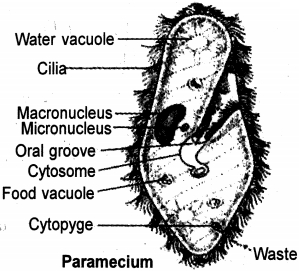
Draw the structure of Paramecium and label any six parts on it. List any two similarities and two differences between Amoeba and Paramecium.
Solution
(N/A) The structure of Paramecium includes parts such as Cilia,Macronucleus,Micronucleus,Oral groove,Cytostome,Food vacuole,and Cytopyge.
| Similarities between Amoeba and Paramecium | Differences between Amoeba and Paramecium |
|---|---|
| $(i)$ Both are unicellular eukaryotic organisms. | $(i)$ Amoeba has one nucleus,while Paramecium has two nuclei (macronucleus and micronucleus). |
| (ii) Both contain food vacuoles for digestion. | (ii) Amoeba moves with the help of pseudopodia,whereas Paramecium moves with the help of cilia. |
0 likes
View Solution18
Medium
Give the appropriate term for each of the following:
$(a)$ Complex sugar that makes the fungal cell wall
$(b)$ Exposed seeds
$(c)$ Blue-green algae
$(d)$ Basic unit of classification
$(e)$ Group of unicellular eukaryotic organisms
$(a)$ Complex sugar that makes the fungal cell wall
$(b)$ Exposed seeds
$(c)$ Blue-green algae
$(d)$ Basic unit of classification
$(e)$ Group of unicellular eukaryotic organisms
Solution
(N/A) Chitin: It is a complex polysaccharide that provides structural support to the fungal cell wall.
$(b)$ Gymnosperms: These are plants that produce seeds that are not enclosed within an ovary or fruit.
$(c)$ Cyanobacteria: These are photosynthetic prokaryotes commonly known as blue-green algae.
$(d)$ Species: It is the fundamental or basic unit of biological classification.
$(e)$ Protista: This kingdom consists of unicellular eukaryotic organisms.
0 likes
View Solution19
Easy
Associate the following features with the groups in which they first appeared:
$(a)$ Vascular tissues
$(b)$ Notochord
$(c)$ Seeds inside fruits
$(a)$ Vascular tissues
$(b)$ Notochord
$(c)$ Seeds inside fruits
Solution
(A) Vascular tissues $-$ Pteridophyta: These are the first land plants to possess specialized vascular tissues ($xylem$ and $phloem$) for the conduction of water and nutrients.
$(b)$ Notochord $-$ Protochordata: The notochord is a flexible,rod-like structure that provides skeletal support and first appears in the group Protochordata.
$(c)$ Seeds inside fruits $-$ Angiosperms: Angiosperms are flowering plants where seeds are enclosed within fruits,which is a defining characteristic of this group.
0 likes
View Solution20
Medium
Associate the following features with appropriate organisms and their kingdom [in $(ii)$ and $(iv)$],division [in $(i)$] and phylum [in $(iii)$ and $(v)$].
$(i)$ Presence of pyrenoids
$(ii)$ Presence of heterocysts
$(iii)$ Presence of genital papillae and anus
$(iv)$ Presence of chloroplast and flagella
$(v)$ Presence of palp and parapodia
$(i)$ Presence of pyrenoids
$(ii)$ Presence of heterocysts
$(iii)$ Presence of genital papillae and anus
$(iv)$ Presence of chloroplast and flagella
$(v)$ Presence of palp and parapodia
Solution
(N/A)
| Feature | Organism and Kingdom/Division/Phylum |
| $(i)$ Presence of pyrenoids | $Spirogyra$,$Ulothrix$ (Division: Thallophyta) |
| $(ii)$ Presence of heterocysts | $Anabaena$ (Kingdom: Monera) |
| $(iii)$ Presence of genital papillae and anus | Earthworm (Phylum: Annelida) |
| $(iv)$ Presence of chloroplast and flagella | $Euglena$ (Kingdom: Protista) |
| $(v)$ Presence of palp and parapodia | $Nereis$ (Phylum: Annelida) |
0 likes
View Solution21
Medium
Give reasons:
$(a)$ Animals of phylum Platyhelminthes are called flatworms.
$(b)$ Bryophytes are called amphibians of the plant kingdom.
$(c)$ Fungi are called saprophytes.
$(d)$ Bacteria and tapeworms are very different in their body design.
$(e)$ Plants like Pinus and deodar are called gymnosperms.
$(a)$ Animals of phylum Platyhelminthes are called flatworms.
$(b)$ Bryophytes are called amphibians of the plant kingdom.
$(c)$ Fungi are called saprophytes.
$(d)$ Bacteria and tapeworms are very different in their body design.
$(e)$ Plants like Pinus and deodar are called gymnosperms.
Solution
(N/A) They are called flatworms because their body is dorsiventrally flattened,meaning they are flattened from the top to the bottom.
$(b)$ Bryophytes are called amphibians of the plant kingdom because they live on land but require water for the process of fertilisation,as their male gametes need water to reach the female gametes.
$(c)$ Fungi are called saprophytes because they obtain their nutrition from dead and decaying organic matter by secreting digestive enzymes outside their body and absorbing the resulting soluble nutrients.
$(d)$ Bacteria are unicellular prokaryotic organisms with a simple cellular structure,whereas tapeworms are multicellular eukaryotic organisms with complex organ-system level body organization,reflecting different evolutionary paths and adaptations.
$(e)$ Plants like Pinus and deodar are called gymnosperms because they bear naked seeds that are not enclosed within a fruit.
0 likes
View SolutionDIVERSITY IN LIVING ORGANISMS — Mix Examples - DIVERSITY IN LIVING ORGANISMS · Frequently Asked Questions
1Are these DIVERSITY IN LIVING ORGANISMS questions useful for JEE and NEET?
Yes. All questions in this section are mapped to JEE Main and NEET exam patterns. Previous year questions from JEE Main, NEET, GUJCET and state-level exams are included with full solutions.
2Can I switch to Hindi or Gujarati for these questions?
Yes. Use the language tabs in the hero section or the sidebar to view the same questions and solutions in English, Hindi or Gujarati.
3How do I generate a question paper from this subtopic?
Use the Vedclass Exam Paper Generator — select the chapter and subtopic, set difficulty, and generate Sets A, B, C, D automatically. First 3 chapters of every subject are free.
Vedclass Products
For Students
Vedclass Test Series
Mock tests in real JEE/NEET style with performance analysis. 5-day free trial.
Start Free TrialFor Teachers
Exam Paper Generator
Generate Set A/B/C/D papers from this chapter in 2 minutes. 3 chapters free.
Try FreeFor Institutes
Online Exam Module
Live online exams with unlimited students, 360° analytics & white-label branding.
See DemoFor Teachers & Institutes
Generate a DIVERSITY IN LIVING ORGANISMS Exam Paper in 2 Minutes
Select subtopic & difficulty — Sets A, B, C, D auto-generated with No Repeat logic.
First 3 chapters of every subject are free — no payment required.