
अ Hindi
Mix Examples - DIVERSITY IN LIVING ORGANISMS Questions in Hindi
Class 9 Science · DIVERSITY IN LIVING ORGANISMS · Mix Examples - DIVERSITY IN LIVING ORGANISMS
21+
Questions
Hindi
Language
100%
With Solutions
Showing 21 of 21 questions in Hindi
1
Easy
निम्नलिखित कथनों के लिए सत्य $(T)$ या असत्य $(F)$ लिखें:
$(a)$ व्हिटेकर ने पाँच जगत वर्गीकरण प्रस्तावित किया था।
$(b)$ मोनेरा को आर्किबैक्टीरिया और यूबैक्टीरिया में विभाजित किया गया है।
$(c)$ वर्ग (Class) से शुरू करते हुए,जाति (Species) वंश (Genus) से पहले आती है।
$(d)$ एनाबेना (Anabaena) मोनेरा जगत से संबंधित है।
$(e)$ नील-हरित शैवाल (Blue green algae) प्रोटिस्टा जगत से संबंधित है।
$(f)$ सभी प्रोकैरियोट्स को मोनेरा के अंतर्गत वर्गीकृत किया गया है।
Solution
(A) $T$: आर.एच. व्हिटेकर ने $1969$ में पाँच जगत वर्गीकरण प्रणाली प्रस्तावित की थी।
$(b)$ $T$: मोनेरा जगत को मुख्य रूप से आर्किबैक्टीरिया और यूबैक्टीरिया में वर्गीकृत किया गया है।
$(c)$ $F$: वर्गीकरण पदानुक्रम में,क्रम इस प्रकार है: वर्ग,गण,कुल,वंश,जाति। अतः,वंश जाति से पहले आता है।
$(d)$ $T$: एनाबेना एक साइनोबैक्टीरिया (नील-हरित शैवाल) है,जो एक प्रोकैरियोट है और मोनेरा जगत में आता है।
$(e)$ $F$: नील-हरित शैवाल (साइनोबैक्टीरिया) प्रोकैरियोटिक जीव हैं और इन्हें मोनेरा जगत में वर्गीकृत किया गया है,न कि प्रोटिस्टा में।
$(f)$ $T$: सभी प्रोकैरियोटिक जीव,जिनमें सुस्पष्ट केंद्रक और झिल्ली-बद्ध कोशिकांगों का अभाव होता है,उन्हें मोनेरा जगत में रखा गया है।
0 likes
View Solution2
Easy
रिक्त स्थानों की पूर्ति कीजिए:
$(a)$ कवक .............. प्रकार का पोषण दर्शाते हैं।
$(b)$ कवक की कोशिका भित्ति .............. की बनी होती है।
$(c)$ नील-हरित शैवाल और कवक के बीच के संबंध को .............. कहा जाता है।
$(d)$ काइटिन की रासायनिक प्रकृति .............. है।
$(e)$ .............. में जीवों की संख्या सबसे कम होती है और समान लक्षणों की संख्या सबसे अधिक होती है।
$(f)$ जिन पौधों में तना,जड़ और पत्ती स्पष्ट रूप से विभेदित नहीं होते हैं,उन्हें .............. में रखा जाता है।
$(g)$ .............. को पादप जगत का उभयचर कहा जाता है।
Solution
(A-D) कवक मृतोपजीवी (saprotrophic) पोषण विधि दर्शाते हैं,जिसमें वे सड़े-गले कार्बनिक पदार्थों से पोषण प्राप्त करते हैं।
$(b)$ कवक की कोशिका भित्ति काइटिन (chitin) नामक एक जटिल पॉलीसैकराइड से बनी होती है।
$(c)$ नील-हरित शैवाल और कवक के बीच के सहजीवी संबंध को लाइकेन (lichens) कहा जाता है।
$(d)$ रासायनिक रूप से,काइटिन एक जटिल कार्बोहाइड्रेट (carbohydrate) है,जो एक नाइट्रोजन युक्त पॉलीसैकराइड ($N$-acetylglucosamine) है।
$(e)$ जाति (species) वर्गीकरण की सबसे छोटी इकाई है और इसमें जीवों की संख्या सबसे कम होती है,जिनमें अधिकतम समान लक्षण पाए जाते हैं।
$(f)$ जिन पौधों में शरीर की संरचना स्पष्ट रूप से विभेदित (तना,जड़ और पत्ती) नहीं होती है,उन्हें थैलोफाइटा (thallophyta) समूह में रखा जाता है।
$(g)$ ब्रायोफाइट्स (bryophytes) को पादप जगत का उभयचर कहा जाता है क्योंकि वे जमीन पर रहने के बावजूद निषेचन के लिए पानी पर निर्भर रहते हैं।
0 likes
View Solution3
MediumMCQ
स्तंभ $(A)$ की वस्तुओं का मिलान स्तंभ $(B)$ की वस्तुओं से कीजिए:
| स्तंभ $(A)$ | स्तंभ $(B)$ |
| $(a)$ नग्न बीज | $(A)$ आवृतबीजी |
| $(b)$ ढके हुए बीज | $(B)$ अनावृतबीजी |
| $(c)$ कशाभ (Flagella) | $(C)$ ब्रायोफाइटा |
| $(d)$ मार्केन्शिया | $(D)$ यूग्लीना |
| $(e)$ मार्सिलिया | $(E)$ थैलोफाइटा |
| $(f)$ क्लैडोफोरा | $(F)$ टेरिडोफाइटा |
| $(g)$ पेनिसिलियम | $(G)$ कवक |
A
$(a) - B, (b) - A, (c) - D, (d) - C, (e) - F, (f) - E, (g) - G$
B
$(a) - B, (b) - C, (c) - D, (d) - A, (e) - E, (f) - F, (g) - G$
C
$(a) - G, (b) - C, (c) - E, (d) - A, (e) - D, (f) - F, (g) - B$
D
$(a) - B, (b) - A, (c) - D, (d) - G, (e) - F, (f) - E, (g) - C$
Solution
(A) सही मिलान इस प्रकार हैं:
$(a)$ नग्न बीज: $(B)$ अनावृतबीजी (बीज फलों के अंदर बंद नहीं होते हैं)।
$(b)$ ढके हुए बीज: $(A)$ आवृतबीजी (बीज फलों के अंदर सुरक्षित होते हैं)।
$(c)$ कशाभ: $(D)$ यूग्लीना (प्रचलन अंग)।
$(d)$ मार्केन्शिया: $(C)$ ब्रायोफाइटा (एक प्रकार का लिवरवर्ट)।
$(e)$ मार्सिलिया: $(F)$ टेरिडोफाइटा (एक प्रकार का फर्न)।
$(f)$ क्लैडोफोरा: $(E)$ थैलोफाइटा (एक प्रकार का शैवाल)।
$(g)$ पेनिसिलियम: $(G)$ कवक (एक प्रकार का कवक)।
अतः, सही क्रम $(a) - B, (b) - A, (c) - D, (d) - C, (e) - F, (f) - E, (g) - G$ है।
0 likes
View Solution4
EasyMCQ
स्तंभ $(A)$ की वस्तुओं का मिलान स्तंभ $(B)$ की वस्तुओं से कीजिए:
| स्तंभ $(A)$ | स्तंभ $(B)$ |
| $(a)$ छिद्रयुक्त प्राणी | $(A)$ आर्थ्रोपोडा |
| $(b)$ द्विस्तरीय (Diploblastic) | $(B)$ सीलेन्ट्रेटा |
| $(c)$ खंडीभवन (Metameric segmentation) | $(C)$ पोरीफेरा |
| $(d)$ संधिपाद (Jointed legs) | $(D)$ इकाइनोडर्मेटा |
| $(e)$ मृदु शरीर वाले प्राणी | $(E)$ मोलस्का |
| $(f)$ शूलयुक्त त्वचा वाले प्राणी | $(F)$ एनेलिडा |
A
$(a) - C; (b) - A; (c) - F; (d) - B; (e) - D; (f) - E$
B
$(a) - C; (b) - B; (c) - F; (d) - A; (e) - E; (f) - D$
C
$(a) - B; (b) - C; (c) - F; (d) - E; (e) - A; (f) - D$
D
$(a) - C; (b) - D; (c) - A; (d) - F; (e) - E; (f) - B$
Solution
(B) छिद्रयुक्त प्राणी पोरीफेरा $(C)$ संघ के अंतर्गत आते हैं।
$(b)$ द्विस्तरीय प्राणी (दो जनन स्तर वाले) सीलेन्ट्रेटा $(B)$ संघ की विशेषता है।
$(c)$ खंडीभवन (Metameric segmentation) एनेलिडा $(F)$ संघ का मुख्य लक्षण है।
$(d)$ संधिपाद (Jointed legs) आर्थ्रोपोडा $(A)$ संघ की मुख्य विशेषता है।
$(e)$ मृदु शरीर वाले प्राणी मोलस्का $(E)$ संघ के अंतर्गत आते हैं।
$(f)$ शूलयुक्त त्वचा वाले प्राणी इकाइनोडर्मेटा $(D)$ संघ के अंतर्गत आते हैं।
अतः, सही मिलान $(a) - C, (b) - B, (c) - F, (d) - A, (e) - E, (f) - D$ है।
0 likes
View Solution5
Medium
रिक्त स्थानों की पूर्ति कीजिए:
$(a)$ सजीवों का पाँच जगत वर्गीकरण ............. द्वारा दिया गया था।
$(b)$ वर्गीकरण की आधारभूत सबसे छोटी इकाई ............. है।
$(c)$ प्रोकैरियोट्स को ............. जगत में रखा गया है।
$(d)$ पैरामीशियम एक प्रोटिस्टा है क्योंकि यह ............. है।
$(e)$ कवक में ............. नहीं होता है।
$(f)$ एक कवक ............. को बिना सूक्ष्मदर्शी के देखा जा सकता है।
$(g)$ ब्रेड बनाने में उपयोग होने वाला सामान्य कवक ............. है।
$(h)$ शैवाल और कवक सहजीवी संबंध बनाते हैं जिसे ............. कहते हैं।
Solution
(N/A) रॉबर्ट व्हिटेकर
$(b)$ जाति (Species)
$(c)$ मोनेरा
$(d)$ यूकैरियोटिक एककोशिकीय जीव
$(e)$ क्लोरोफिल (पर्णहरित)
$(f)$ मशरूम
$(g)$ यीस्ट
$(h)$ लाइकेन
$(b)$ जाति (Species)
$(c)$ मोनेरा
$(d)$ यूकैरियोटिक एककोशिकीय जीव
$(e)$ क्लोरोफिल (पर्णहरित)
$(f)$ मशरूम
$(g)$ यीस्ट
$(h)$ लाइकेन
0 likes
View Solution6
Easy
निम्नलिखित के लिए उदाहरण दीजिए:
$(a)$ द्विपार्श्व,पृष्ठाधर सममिति ............... में पाई जाती है।
$(b)$ फाइलेरिया (हाथीपांव) रोग उत्पन्न करने वाले कृमि ............... हैं।
$(c)$ खुला परिसंचरण तंत्र ............... में पाया जाता है जहाँ देहगुहा रक्त से भरी होती है।
$(d)$ ............... में कूटदेहगुहा (pseudocoelom) पाई जाती है।
$(a)$ द्विपार्श्व,पृष्ठाधर सममिति ............... में पाई जाती है।
$(b)$ फाइलेरिया (हाथीपांव) रोग उत्पन्न करने वाले कृमि ............... हैं।
$(c)$ खुला परिसंचरण तंत्र ............... में पाया जाता है जहाँ देहगुहा रक्त से भरी होती है।
$(d)$ ............... में कूटदेहगुहा (pseudocoelom) पाई जाती है।
Solution
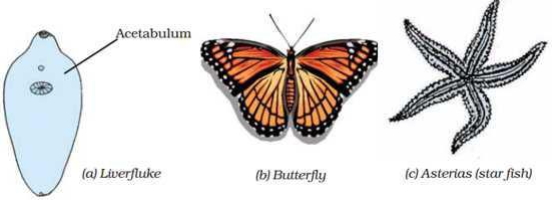
(A) लिवर फ्लूक (Liver fluke) द्विपार्श्व और पृष्ठाधर सममिति प्रदर्शित करता है।
$(b)$ वुचेरेरिया बैन्क्रोफ्टी (Wuchereria bancrofti) (फाइलेरियल कृमि) हाथीपांव रोग का कारक है।
$(c)$ आर्थ्रोपोड्स (Arthropods) में खुला परिसंचरण तंत्र पाया जाता है,जहाँ देहगुहा,जिसे हीमोसील कहा जाता है,रक्त से भरी होती है।
$(d)$ निमेटोड्स (Nematodes) (गोलकृमि) में कूटदेहगुहा (pseudocoelom) पाई जाती है,जो एक ऐसी देहगुहा है जो पूरी तरह से मध्यजनस्तर (mesoderm) द्वारा आस्तरित नहीं होती है।
0 likes
View Solution7
Medium
निम्नलिखित शब्दों को परिभाषित कीजिए और प्रत्येक का एक उदाहरण दीजिए:
$(a)$ द्विपार्श्व सममिति (Bilateral symmetry)
$(b)$ देहगुहा (Coelom)
$(c)$ त्रिकोरकी (Triploblastic)
$(a)$ द्विपार्श्व सममिति (Bilateral symmetry)
$(b)$ देहगुहा (Coelom)
$(c)$ त्रिकोरकी (Triploblastic)
Solution
(N/A) द्विपार्श्व सममिति: यह एक ऐसी शारीरिक संरचना है जिसमें शरीर के बाएं और दाएं भाग एक-दूसरे के दर्पण प्रतिबिंब होते हैं,उदाहरण के लिए,लिवर फ्लूक (Liver fluke)।
$(b)$ देहगुहा: यह शरीर के भीतर की वह गुहा है जो आंतरिक अंगों और शरीर की दीवार के बीच स्थित होती है,जिसमें सुविकसित अंग समाहित हो सकते हैं,उदाहरण के लिए,तितली।
$(c)$ त्रिकोरकी: जिन जंतुओं में तीन जनन स्तर (बाह्यत्वचा,मध्यत्वचा और अंतस्त्वचा) होते हैं,जिनसे विभेदित ऊतकों और अंगों का निर्माण हो सकता है,उन्हें त्रिकोरकी कहा जाता है,उदाहरण के लिए,स्टारफिश।
0 likes
View Solution8
Medium
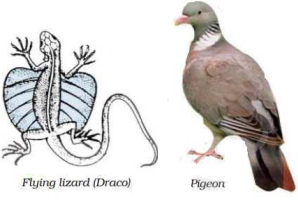
उड़ने वाली छिपकली और पक्षी के बीच अंतर स्पष्ट कीजिए। चित्र बनाइए।
Solution
(N/A) उड़ने वाली छिपकली $(Draco)$ और पक्षी के बीच अंतर निम्नलिखित हैं:
$1$. वर्गीकरण: उड़ने वाली छिपकली सरीसृप $(Reptilia)$ वर्ग से संबंधित है,जबकि पक्षी $Aves$ वर्ग से संबंधित हैं।
$2$. शरीर का तापमान: उड़ने वाली छिपकली शीत-रक्त वाली (असमतापी) होती है,जबकि पक्षी गर्म-रक्त वाले (समतापी) होते हैं।
$3$. शरीर का आवरण: उड़ने वाली छिपकली का शरीर शल्कों (scales) से ढका होता है,जबकि पक्षी का शरीर पंखों से ढका होता है।
$4$. हृदय की संरचना: उड़ने वाली छिपकली में आमतौर पर तीन कक्षीय हृदय होता है,जबकि पक्षियों में चार कक्षीय हृदय होता है।
$5$. प्रचलन: उड़ने वाली छिपकली हवा में ग्लाइड करने के लिए त्वचा की परतों (patagium) का उपयोग करती है,जबकि पक्षियों में अग्रपाद पंखों में रूपांतरित हो जाते हैं जो उड़ने में मदद करते हैं।
0 likes
View Solution9
EasyMCQ
सहजीवन (Symbiosis) क्या है?
A
एक परजीवी संबंध
B
एक अनिवार्य पारस्परिक लाभकारी संबंध
C
एक ऐसा संबंध जिसमें एक जीव को लाभ होता है और दूसरे को नुकसान
D
एक ऐसा संबंध जिसमें किसी भी जीव को लाभ नहीं होता
Solution
(B) सहजीवन (Symbiosis) को दो अलग-अलग जीवों के बीच एक अनिवार्य पारस्परिक लाभकारी संबंध के रूप में परिभाषित किया गया है जो निकट शारीरिक संपर्क में रहते हैं। इस संबंध में,दोनों जीव एक-दूसरे से लाभ प्राप्त करते हैं,जो उनके अस्तित्व के लिए आवश्यक है।
0 likes
View Solution10
Easy
कुछ जीवों की विशेषताएँ दी गई हैं। उनके समूह की पहचान करें और प्रत्येक का एक उदाहरण दें।
$(a)$ एककोशिकीय,सुकेंद्रकी (eukaryotic) और प्रकाश संश्लेषी।
$(b)$ शरीर खंडों में विभाजित होता है,एकलिंगी या उभयलिंगी हो सकते हैं।
$(a)$ एककोशिकीय,सुकेंद्रकी (eukaryotic) और प्रकाश संश्लेषी।
$(b)$ शरीर खंडों में विभाजित होता है,एकलिंगी या उभयलिंगी हो सकते हैं।
Solution
(N/A) यह समूह जगत प्रोटिस्टा (Protista) है। ये एककोशिकीय सुकेंद्रकी जीव हैं जो प्रकाश संश्लेषण कर सकते हैं। उदाहरण: $Euglena$।
$(b)$ यह समूह संघ एनेलिडा (Annelida) है। इन जीवों का शरीर खंडित (metamerism) होता है और ये एकलिंगी या उभयलिंगी हो सकते हैं। उदाहरण: केंचुआ $(Pheretima)$।
$(b)$ यह समूह संघ एनेलिडा (Annelida) है। इन जीवों का शरीर खंडित (metamerism) होता है और ये एकलिंगी या उभयलिंगी हो सकते हैं। उदाहरण: केंचुआ $(Pheretima)$।
0 likes
View Solution11
Medium
प्रत्येक का एक उदाहरण दीजिए:
$(a)$ सरीसृप जिसका हृदय चार कक्षीय होता है।
$(b)$ अंडा देने वाला स्तनधारी।
$(c)$ परजीवी प्लेटीहेल्मिन्थिस।
$(d)$ पौधों का वह वर्ग जिसमें सबसे सरल जीव होते हैं।
$(a)$ सरीसृप जिसका हृदय चार कक्षीय होता है।
$(b)$ अंडा देने वाला स्तनधारी।
$(c)$ परजीवी प्लेटीहेल्मिन्थिस।
$(d)$ पौधों का वह वर्ग जिसमें सबसे सरल जीव होते हैं।
Solution
(N/A) मगरमच्छ: अधिकांश सरीसृपों में तीन कक्षीय हृदय होता है,लेकिन मगरमच्छ एक अपवाद है जिसका हृदय चार कक्षीय होता है।
$(b)$ प्लैटिपस: इसे डक-बिल्ड प्लैटिपस के रूप में भी जाना जाता है,यह एक मोनोट्रीम है जो जीवित बच्चों को जन्म देने के बजाय अंडे देता है।
$(c)$ फीताकृमि (टेपवर्म): ये चपटे कृमि होते हैं जो अन्य जानवरों की आंतों में परजीवी के रूप में रहते हैं।
$(d)$ थैलोफाइटा: इस वर्ग में शैवाल जैसे पौधे शामिल हैं जिनकी शारीरिक संरचना बहुत सरल और अविभेदित (थैलस) होती है।
0 likes
View Solution12
MediumMCQ
निम्नलिखित लक्षणों वाले जंतु और पादप समूहों की पहचान कीजिए:
$(a)$ ऊतकविहीन जंतु,शरीर पर छिद्र युक्त।
$(b)$ पादप शरीर जड़,तने और पत्तियों में विभेदित लेकिन बीज उत्पन्न नहीं करते।
$(c)$ शरीर पृष्ठाधर रूप से चपटा और देहगुहाविहीन।
$(d)$ वास्तविक देहगुहा और व्यापक अंग विभेदन वाले खंडित कृमि।
$(a)$ ऊतकविहीन जंतु,शरीर पर छिद्र युक्त।
$(b)$ पादप शरीर जड़,तने और पत्तियों में विभेदित लेकिन बीज उत्पन्न नहीं करते।
$(c)$ शरीर पृष्ठाधर रूप से चपटा और देहगुहाविहीन।
$(d)$ वास्तविक देहगुहा और व्यापक अंग विभेदन वाले खंडित कृमि।
A
पोरिफेरा,टेरिडोफाइटा,प्लेटीहेल्मिन्थीस,एनेलिडा
B
नाइडरिया,ब्रायोफाइटा,निमेटोडा,आर्थ्रोपोडा
C
टीनोफोरा,थैलोफाइटा,एनेलिडा,मोलस्का
D
इकाइनोडर्मेटा,अनावृतबीजी,प्लेटीहेल्मिन्थीस,कोर्डेटा
Solution
(A) पोरिफेरा: ये बहुकोशिकीय जीव हैं जिनमें वास्तविक ऊतकों का अभाव होता है और इनके शरीर पर असंख्य छिद्र (ऑस्टिया) होते हैं।
$(b)$ टेरिडोफाइटा: इन पौधों का शरीर जड़,तने और पत्तियों में स्पष्ट रूप से विभेदित होता है लेकिन ये अपुष्पोद्भिद (Cryptogamae) होते हैं,अर्थात ये बीज उत्पन्न नहीं करते हैं।
$(c)$ प्लेटीहेल्मिन्थीस: इन्हें सामान्यतः चपटे कृमि कहा जाता है,जिनका शरीर पृष्ठाधर रूप से चपटा होता है और इनमें देहगुहा (coelom) का अभाव होता है।
$(d)$ एनेलिडा: ये खंडित कृमि हैं जिनमें वास्तविक देहगुहा पाई जाती है और इनमें अंगों का उच्च स्तरीय विभेदन देखने को मिलता है।
0 likes
View Solution13
Medium
विषम को चुनिए और कारण देकर अपने विकल्प का औचित्य सिद्ध कीजिए:
$(a)$ मॉस (Moss),फर्न (Fern),पाइनस (Pinus),स्पाइरोगाइरा (Spirogyra).
$(b)$ सी कुकुंबर (Sea Cucumber),ऑक्टोपस (Octopus),फेदर स्टार (Feather Star),स्टारफिश (Starfish).
$(a)$ मॉस (Moss),फर्न (Fern),पाइनस (Pinus),स्पाइरोगाइरा (Spirogyra).
$(b)$ सी कुकुंबर (Sea Cucumber),ऑक्टोपस (Octopus),फेदर स्टार (Feather Star),स्टारफिश (Starfish).
Solution
(A-D) $Pinus$ विषम है क्योंकि यह एक फेनेरोगैम (बीज उत्पन्न करने वाला पौधा) है,जबकि अन्य (मॉस,फर्न और स्पाइरोगाइरा) क्रिप्टोगैम (बीज रहित पौधे) हैं।
$(b)$ ऑक्टोपस विषम है क्योंकि यह $Mollusca$ संघ का प्राणी है,जबकि अन्य (सी कुकुंबर,फेदर स्टार और स्टारफिश) $Echinodermata$ संघ के प्राणी हैं।
$(b)$ ऑक्टोपस विषम है क्योंकि यह $Mollusca$ संघ का प्राणी है,जबकि अन्य (सी कुकुंबर,फेदर स्टार और स्टारफिश) $Echinodermata$ संघ के प्राणी हैं।
0 likes
View Solution14
Medium
निम्नलिखित प्रत्येक जोड़ी के लिए एक अंतर लिखिए:
$(i)$ थैलोफाइटा और ब्रायोफाइटा
$(ii)$ निमेटोडा और एनेलिडा
$(iii)$ एम्फीबिया (उभयचर) और रेप्टिलिया (सरीसृप)
$(i)$ थैलोफाइटा और ब्रायोफाइटा
$(ii)$ निमेटोडा और एनेलिडा
$(iii)$ एम्फीबिया (उभयचर) और रेप्टिलिया (सरीसृप)
Solution
(N/A) अंतर निम्नलिखित हैं:
$1$. थैलोफाइटा और ब्रायोफाइटा:
$2$. निमेटोडा और एनेलिडा:
$3$. एम्फीबिया और रेप्टिलिया:
$1$. थैलोफाइटा और ब्रायोफाइटा:
| $Thallophyta$ | $Bryophyta$ |
| पादप शरीर जड़,तने और पत्तियों में विभाजित नहीं होता है। | पादप शरीर तने और पत्ती जैसी संरचनाओं में विभेदित होता है। |
$2$. निमेटोडा और एनेलिडा:
| $Nematoda$ | $Annelida$ |
| कूटगुहा (Pseudocoelom) उपस्थित होती है; शरीर गोल और अखंडित होता है। | वास्तविक देहगुहा (True coelom) उपस्थित होती है; शरीर खंडित होता है। |
$3$. एम्फीबिया और रेप्टिलिया:
| $Amphibia$ | $Reptilia$ |
| ये जल और थल दोनों पर रह सकते हैं; ये फेफड़ों,गलफड़ों या त्वचा द्वारा श्वसन करते हैं। | ये मुख्य रूप से स्थलीय होते हैं; ये फेफड़ों द्वारा श्वसन करते हैं। |
0 likes
View Solution15
Medium
निम्नलिखित विशेषताओं के आधार पर,समूह की पहचान करें और प्रत्येक का एक उदाहरण दें:
$(i)$ जीवन के किसी चरण में नोटोकॉर्ड (notochord) की उपस्थिति।
$(ii)$ एककोशिकीय,सूक्ष्मदर्शी और सुकेंद्रकी (eukaryotic)।
$(iii)$ बीज फलों के भीतर बंद होते हैं।
$(i)$ जीवन के किसी चरण में नोटोकॉर्ड (notochord) की उपस्थिति।
$(ii)$ एककोशिकीय,सूक्ष्मदर्शी और सुकेंद्रकी (eukaryotic)।
$(iii)$ बीज फलों के भीतर बंद होते हैं।
Solution
(N/A) $(i)$ प्रोटोकॉर्डेटा (Protochordata),उदा. $Balanoglossus$।
$(ii)$ प्रोटिस्टा (Protista),उदा. $Amoeba$ या $Euglena$।
$(iii)$ आवृतबीजी (Angiospermae),उदा. गुड़हल,सरसों या कोई भी पुष्पी पादप।
$(ii)$ प्रोटिस्टा (Protista),उदा. $Amoeba$ या $Euglena$।
$(iii)$ आवृतबीजी (Angiospermae),उदा. गुड़हल,सरसों या कोई भी पुष्पी पादप।
0 likes
View Solution16
Easy
निम्नलिखित के लिए कारण बताइए:
$(a)$ प्रोटिस्टा में सिलिया या फ्लैजेला जैसे उपांग होते हैं।
$(b)$ आवृतबीजी (Angiosperms) को ऐसा क्यों कहा जाता है?
$(c)$ मछलियों के शरीर पर शल्क (scales) होते हैं।
$(a)$ प्रोटिस्टा में सिलिया या फ्लैजेला जैसे उपांग होते हैं।
$(b)$ आवृतबीजी (Angiosperms) को ऐसा क्यों कहा जाता है?
$(c)$ मछलियों के शरीर पर शल्क (scales) होते हैं।
Solution
(N/A) प्रोटिस्टा में सिलिया या फ्लैजेला जैसे उपांग मुख्य रूप से प्रचलन (locomotion) के लिए होते हैं,जो उन्हें उनके जलीय वातावरण में एक स्थान से दूसरे स्थान पर जाने में मदद करते हैं।
$(b)$ 'Angiosperms' शब्द ग्रीक शब्दों 'angio' जिसका अर्थ 'ढका हुआ' और 'sperma' जिसका अर्थ 'बीज' है,से लिया गया है। इन्हें आवृतबीजी इसलिए कहा जाता है क्योंकि इनके बीज फलों के भीतर ढके हुए होते हैं।
$(c)$ मछलियों के शरीर पर शल्क होते हैं जो उन्हें सुरक्षा प्रदान करते हैं,तैरते समय घर्षण को कम करते हैं और लगातार पानी के संपर्क में रहने के कारण उनकी त्वचा को नुकसान या सड़ने से बचाते हैं।
0 likes
View Solution17
Difficult
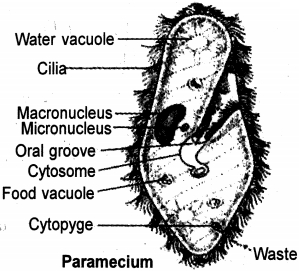
पैरामीशियम की संरचना बनाइए और उस पर किन्हीं छह भागों को नामांकित कीजिए। अमीबा और पैरामीशियम के बीच किन्हीं दो समानताओं और दो अंतरों को सूचीबद्ध कीजिए।
Solution
(N/A) पैरामीशियम की संरचना में सिलिया (पक्ष्माभ),मैक्रोन्यूक्लियस (गुरु केंद्रक),माइक्रोन्यूक्लियस (लघु केंद्रक),ओरल ग्रूव (मुख खांच),साइटोस्टोम (कोशिका मुख),खाद्य रिक्तिका और साइटोपाइज (कोशिका गुदा) जैसे भाग शामिल होते हैं।
| अमीबा और पैरामीशियम के बीच समानताएं | अमीबा और पैरामीशियम के बीच अंतर |
|---|---|
| $(i)$ दोनों एककोशिकीय यूकैरियोटिक जीव हैं। | $(i)$ अमीबा में एक केंद्रक होता है,जबकि पैरामीशियम में दो केंद्रक (गुरु केंद्रक और लघु केंद्रक) होते हैं। |
| (ii) दोनों में पाचन के लिए खाद्य रिक्तिकाएं होती हैं। | (ii) अमीबा कूटपाद (pseudopodia) की मदद से गति करता है,जबकि पैरामीशियम सिलिया (पक्ष्माभ) की मदद से गति करता है। |
0 likes
View Solution18
Medium
निम्नलिखित में से प्रत्येक के लिए उपयुक्त शब्द दें:
$(a)$ जटिल शर्करा जो कवक की कोशिका भित्ति बनाती है
$(b)$ अनावृत बीज
$(c)$ नील-हरित शैवाल (Blue-green algae)
$(d)$ वर्गीकरण की आधारभूत इकाई
$(e)$ एककोशिकीय सुकेंद्रकी (eukaryotic) जीवों का समूह
$(a)$ जटिल शर्करा जो कवक की कोशिका भित्ति बनाती है
$(b)$ अनावृत बीज
$(c)$ नील-हरित शैवाल (Blue-green algae)
$(d)$ वर्गीकरण की आधारभूत इकाई
$(e)$ एककोशिकीय सुकेंद्रकी (eukaryotic) जीवों का समूह
Solution
(N/A) काइटिन (Chitin): यह एक जटिल पॉलीसैकराइड है जो कवक की कोशिका भित्ति को संरचनात्मक आधार प्रदान करता है।
$(b)$ अनावृतबीजी (Gymnosperms): ये वे पौधे हैं जो ऐसे बीज उत्पन्न करते हैं जो अंडाशय या फल के भीतर बंद नहीं होते हैं।
$(c)$ साइनोबैक्टीरिया (Cyanobacteria): ये प्रकाश संश्लेषी प्रोकैरियोट हैं जिन्हें आमतौर पर नील-हरित शैवाल के रूप में जाना जाता है।
$(d)$ जाति (Species): यह जैविक वर्गीकरण की आधारभूत या मौलिक इकाई है।
$(e)$ प्रोटिस्टा (Protista): इस जगत में एककोशिकीय सुकेंद्रकी (eukaryotic) जीव शामिल हैं।
0 likes
View Solution19
Easy
निम्नलिखित विशेषताओं को उन समूहों के साथ सुमेलित कीजिए जिनमें वे पहली बार दिखाई दिए:
$(a)$ संवहनी ऊतक
$(b)$ पृष्ठरज्जु (Notochord)
$(c)$ फलों के अंदर बीज
$(a)$ संवहनी ऊतक
$(b)$ पृष्ठरज्जु (Notochord)
$(c)$ फलों के अंदर बीज
Solution
(A) संवहनी ऊतक $-$ टेरिडोफाइटा (Pteridophyta): ये पहले स्थलीय पौधे हैं जिनमें जल और पोषक तत्वों के संवहन के लिए विशेष संवहनी ऊतक ($xylem$ और $phloem$) पाए जाते हैं।
$(b)$ पृष्ठरज्जु (Notochord) $-$ प्रोटोकॉर्डेटा (Protochordata): पृष्ठरज्जु एक लचीली,छड़ जैसी संरचना है जो कंकाल संबंधी सहायता प्रदान करती है और यह सबसे पहले प्रोटोकॉर्डेटा समूह में दिखाई देती है।
$(c)$ फलों के अंदर बीज $-$ आवृतबीजी (Angiosperms): आवृतबीजी वे पुष्पी पौधे हैं जिनमें बीज फलों के अंदर बंद होते हैं,जो इस समूह की एक परिभाषित विशेषता है।
0 likes
View Solution20
Medium
निम्नलिखित विशेषताओं को उपयुक्त जीवों और उनके जगत [$(ii)$ और $(iv)$ में],प्रभाग [$(i)$ में] और संघ [$(iii)$ और $(v)$ में] के साथ सुमेलित कीजिए।
$(i)$ पाइरेनॉइड्स की उपस्थिति
$(ii)$ हेटरोसिस्ट की उपस्थिति
$(iii)$ जनन पैपिला और गुदा की उपस्थिति
$(iv)$ क्लोरोप्लास्ट और कशाभ की उपस्थिति
$(v)$ पाल्प और पैरापोडिया की उपस्थिति
$(i)$ पाइरेनॉइड्स की उपस्थिति
$(ii)$ हेटरोसिस्ट की उपस्थिति
$(iii)$ जनन पैपिला और गुदा की उपस्थिति
$(iv)$ क्लोरोप्लास्ट और कशाभ की उपस्थिति
$(v)$ पाल्प और पैरापोडिया की उपस्थिति
Solution
(N/A)
| विशेषता | जीव और जगत/प्रभाग/संघ |
| $(i)$ पाइरेनॉइड्स की उपस्थिति | $Spirogyra$,$Ulothrix$ (प्रभाग: थैलोफाइटा) |
| $(ii)$ हेटरोसिस्ट की उपस्थिति | $Anabaena$ (जगत: मोनेरा) |
| $(iii)$ जनन पैपिला और गुदा की उपस्थिति | केंचुआ (संघ: एनेलिडा) |
| $(iv)$ क्लोरोप्लास्ट और कशाभ की उपस्थिति | $Euglena$ (जगत: प्रोटिस्टा) |
| $(v)$ पाल्प और पैरापोडिया की उपस्थिति | $Nereis$ (संघ: एनेलिडा) |
0 likes
View Solution21
Medium
कारण बताइए:
$(a)$ प्लेटीहेल्मिन्थीस संघ के जंतुओं को चपटे कृमि (flatworms) कहा जाता है।
$(b)$ ब्रायोफाइट्स को पादप जगत का उभयचर कहा जाता है।
$(c)$ कवक को मृतोपजीवी (saprophytes) कहा जाता है।
$(d)$ बैक्टीरिया और फीताकृमि (tapeworms) की शारीरिक संरचना बहुत अलग होती है।
$(e)$ पाइनस और देवदार जैसे पौधों को अनावृतबीजी (gymnosperms) कहा जाता है।
Solution
(N/A) इन्हें चपटे कृमि इसलिए कहा जाता है क्योंकि इनका शरीर पृष्ठाधर रूप से चपटा होता है,अर्थात वे ऊपर से नीचे तक चपटे होते हैं।
$(b)$ ब्रायोफाइट्स को पादप जगत का उभयचर कहा जाता है क्योंकि वे भूमि पर रहते हैं लेकिन निषेचन की प्रक्रिया के लिए उन्हें पानी की आवश्यकता होती है,क्योंकि उनके नर युग्मकों को मादा युग्मकों तक पहुँचने के लिए पानी की आवश्यकता होती है।
$(c)$ कवक को मृतोपजीवी कहा जाता है क्योंकि वे मृत और सड़ने वाले कार्बनिक पदार्थों से अपना पोषण प्राप्त करते हैं,जिसमें वे अपने शरीर के बाहर पाचक एंजाइमों का स्राव करते हैं और घुलनशील पोषक तत्वों को अवशोषित करते हैं।
$(d)$ बैक्टीरिया एककोशिकीय प्रोकैरियोटिक जीव हैं जिनकी कोशिकीय संरचना सरल होती है,जबकि फीताकृमि बहुकोशिकीय यूकेरियोटिक जीव हैं जिनमें अंग-तंत्र स्तर का जटिल शारीरिक संगठन होता है,जो उनके अलग-अलग विकासवादी रास्तों और अनुकूलनों को दर्शाता है।
$(e)$ पाइनस और देवदार जैसे पौधों को अनावृतबीजी कहा जाता है क्योंकि वे नग्न बीज धारण करते हैं जो फल के अंदर बंद नहीं होते हैं।
0 likes
View SolutionDIVERSITY IN LIVING ORGANISMS — Mix Examples - DIVERSITY IN LIVING ORGANISMS · Frequently Asked Questions
1Are these DIVERSITY IN LIVING ORGANISMS questions useful for JEE and NEET?
Yes. All questions in this section are mapped to JEE Main and NEET exam patterns. Previous year questions from JEE Main, NEET, GUJCET and state-level exams are included with full solutions.
2Can I switch to Hindi or Gujarati for these questions?
Yes. Use the language tabs in the hero section or the sidebar to view the same questions and solutions in English, Hindi or Gujarati.
3How do I generate a question paper from this subtopic?
Use the Vedclass Exam Paper Generator — select the chapter and subtopic, set difficulty, and generate Sets A, B, C, D automatically. First 3 chapters of every subject are free.
Vedclass Products
For Students
Vedclass Test Series
Mock tests in real JEE/NEET style with performance analysis. 5-day free trial.
Start Free TrialFor Teachers
Exam Paper Generator
Generate Set A/B/C/D papers from this chapter in 2 minutes. 3 chapters free.
Try FreeFor Institutes
Online Exam Module
Live online exams with unlimited students, 360° analytics & white-label branding.
See DemoFor Teachers & Institutes
Generate a DIVERSITY IN LIVING ORGANISMS Exam Paper in 2 Minutes
Select subtopic & difficulty — Sets A, B, C, D auto-generated with No Repeat logic.
First 3 chapters of every subject are free — no payment required.