
A English
Mix Examples - FORCE AND LAWS OF MOTION Questions in English
Class 9 Science · FORCE AND LAWS OF MOTION · Mix Examples - FORCE AND LAWS OF MOTION
71+
Questions
English
Language
100%
With Solutions
Showing 21 of 71 questions in English
51
Medium
$(a)$ State Newton's second law of motion and show that the first law of motion can be mathematically derived from the mathematical expression for the second law of motion.
$(b)$ A stone dropped from a window reaches the ground in $0.5 \, s$ (given $g = 10 \, m \, s^{-2}$):
$(i)$ Calculate the speed just before it hits the ground.
$(ii)$ What is the average speed during $0.5 \, s$?
$(iii)$ Calculate the height of the window from the ground.
$(b)$ A stone dropped from a window reaches the ground in $0.5 \, s$ (given $g = 10 \, m \, s^{-2}$):
$(i)$ Calculate the speed just before it hits the ground.
$(ii)$ What is the average speed during $0.5 \, s$?
$(iii)$ Calculate the height of the window from the ground.
Solution
(N/A) The second law of motion states that, "The rate of change of momentum of an object is directly proportional to the applied unbalanced force and it takes place in the direction of the force." The mathematical expression is $F = ma$.
Since $a = \frac{v-u}{t}$, we have $F = m \frac{v-u}{t}$, which implies $Ft = mv - mu$.
If the external force $F = 0$, then $mv - mu = 0$, which means $mv = mu$, or $v = u$. This implies that if no external force acts on an object, its velocity remains constant (uniform motion). If $u = 0$, then $v = 0$, meaning the object remains at rest. This is the definition of Newton's first law of motion.
$(b)$ Given: $u = 0 \, m \, s^{-1}$, $t = 0.5 \, s$, $g = 10 \, m \, s^{-2}$.
$(i)$ Using $v = u + gt$: $v = 0 + 10 \times 0.5 = 5 \, m \, s^{-1}$.
$(ii)$ Average speed = $\frac{v + u}{2} = \frac{5 + 0}{2} = 2.5 \, m \, s^{-1}$.
$(iii)$ Using $h = ut + \frac{1}{2}gt^2$: $h = 0 + \frac{1}{2} \times 10 \times (0.5)^2 = 5 \times 0.25 = 1.25 \, m$.
0 likes
View Solution52
Easy
$(i)$ Name the property of bodies to resist a change in their velocity.
$(ii)$ What is the relationship between force and acceleration?
$(iii)$ What name is given to the product of mass and velocity of a body?
$(iv)$ Which physical quantity corresponds to the rate of change of momentum?
$(v)$ Name the principle on which a rocket works.
$(ii)$ What is the relationship between force and acceleration?
$(iii)$ What name is given to the product of mass and velocity of a body?
$(iv)$ Which physical quantity corresponds to the rate of change of momentum?
$(v)$ Name the principle on which a rocket works.
Solution
(N/A) $(i)$ The property of bodies to resist a change in their state of rest or motion is called Inertia.
$(ii)$ According to Newton's second law of motion,the relationship is $F = ma$,where $F$ is force,$m$ is mass,and $a$ is acceleration.
$(iii)$ The product of mass and velocity of a body is called Momentum $(p = mv)$.
$(iv)$ The rate of change of momentum is equal to the applied Force.
$(v)$ $A$ rocket works on the principle of Newton's third law of motion and the law of conservation of linear momentum.
0 likes
View Solution53
Medium
$(a)$ Two objects of masses $100\, g$ and $200\, g$ are moving along the same line and direction with velocities $2\, m s^{-1}$ and $1\, m s^{-1}$ respectively. They collide and after the collision,the first object moves at a velocity of $1.67\, m s^{-1}$. Determine the velocity of the second object.
$(b)$ If a man jumps out from a boat,the boat moves backwards. Why?
$(b)$ If a man jumps out from a boat,the boat moves backwards. Why?
Solution
(N/A) Given: $m_1 = 100\, g = 0.1\, kg$,$m_2 = 200\, g = 0.2\, kg$,$u_1 = 2\, m s^{-1}$,$u_2 = 1\, m s^{-1}$,$v_1 = 1.67\, m s^{-1}$.
Using the law of conservation of linear momentum: $m_1 u_1 + m_2 u_2 = m_1 v_1 + m_2 v_2$.
Substituting the values: $(0.1 \times 2) + (0.2 \times 1) = (0.1 \times 1.67) + (0.2 \times v_2)$.
$0.2 + 0.2 = 0.167 + 0.2 v_2$.
$0.4 = 0.167 + 0.2 v_2$.
$0.2 v_2 = 0.4 - 0.167 = 0.233$.
$v_2 = 0.233 / 0.2 = 1.165\, m s^{-1}$.
$(b)$ This phenomenon is based on Newton's third law of motion and the law of conservation of momentum. When the man jumps forward,he exerts a force on the boat in the backward direction. Since the boat is floating in water and is not fixed,it moves backwards to conserve the total momentum of the system.
0 likes
View Solution54
Medium
$(a)$ State Newton's third law of motion and give two examples to illustrate the law.
$(b)$ Calculate the force required to produce:
$(i)$ an acceleration of $2.5 \, m s^{-2}$ in a body of $4 \, kg$.
$(ii)$ an acceleration of $3 \, m s^{-2}$ in a body of $10 \, kg$.
$(b)$ Calculate the force required to produce:
$(i)$ an acceleration of $2.5 \, m s^{-2}$ in a body of $4 \, kg$.
$(ii)$ an acceleration of $3 \, m s^{-2}$ in a body of $10 \, kg$.
Solution
(N/A) Newton's third law of motion states that, "To every action, there is always an equal and opposite reaction."
Examples:
$(i)$ Walking: When a person walks, they push the ground backward with their foot (action). The ground exerts an equal and opposite force on the foot (reaction), which pushes the person forward.
$(ii)$ Recoil of a boat: When a person jumps out of a boat, they push the boat backward (action). The boat exerts an equal and opposite force on the person, pushing them forward, while the boat moves backward (reaction).
$(b)$ Using the formula $F = m \times a$:
$(i)$ Given $m = 4 \, kg$ and $a = 2.5 \, m s^{-2}$.
$F = 4 \, kg \times 2.5 \, m s^{-2} = 10 \, N$.
$(ii)$ Given $m = 10 \, kg$ and $a = 3 \, m s^{-2}$.
$F = 10 \, kg \times 3 \, m s^{-2} = 30 \, N$.
0 likes
View Solution55
Medium
$(a)$ Define momentum. Write its $SI$ unit.
$(b)$ $A$ car and a truck have the same momentum. Whose velocity is more and why?
$(c)$ $A$ bullet of mass $20 \ g$ moving with a speed of $500 \ m s^{-1}$ strikes a wooden block of mass $1 \ kg$ and gets embedded in it. Find the speed with which the block moves along with the bullet.
$(b)$ $A$ car and a truck have the same momentum. Whose velocity is more and why?
$(c)$ $A$ bullet of mass $20 \ g$ moving with a speed of $500 \ m s^{-1}$ strikes a wooden block of mass $1 \ kg$ and gets embedded in it. Find the speed with which the block moves along with the bullet.
Solution
(N/A) Momentum is defined as the product of mass and velocity of an object. Its $SI$ unit is $kg \ m s^{-1}$.
$(b)$ The formula for momentum is $p = m v$. Since the momentum $p$ is the same for both,$m_{T} v_{T} = m_{C} v_{C}$. Because the mass of the truck $m_{T}$ is greater than the mass of the car $m_{C}$,the velocity of the car $v_{C}$ must be greater than the velocity of the truck $v_{T}$ to maintain the same momentum.
$(c)$ Given: Mass of bullet $m_{1} = 20 \ g = 0.02 \ kg$,initial velocity $u_{1} = 500 \ m s^{-1}$. Mass of block $m_{2} = 1 \ kg$,initial velocity $u_{2} = 0 \ m s^{-1}$.
Applying the law of conservation of momentum: $m_{1} u_{1} + m_{2} u_{2} = (m_{1} + m_{2}) v$.
$(0.02 \times 500) + (1 \times 0) = (0.02 + 1) v$.
$10 = 1.02 \times v$.
$v = 10 / 1.02 \approx 9.8 \ m s^{-1}$.
0 likes
View Solution56
Medium
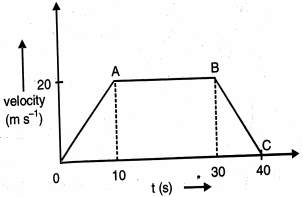
For a $2 \ kg$ mass,the $v-t$ graph is given. Find the force experienced by the mass in $OA$,$AB$,and $BC$.
Solution
(N/A) The force experienced by a mass is given by Newton's second law of motion,$F = ma$,where $a$ is the acceleration calculated from the slope of the $v-t$ graph.
$1$. For portion $OA$:
Acceleration $a = \frac{v_f - v_i}{t_f - t_i} = \frac{20 - 0}{10 - 0} = 2 \ m \ s^{-2}$.
Force $F = ma = 2 \ kg \times 2 \ m \ s^{-2} = 4 \ N$.
$2$. For portion $AB$:
The velocity is constant,so acceleration $a = 0 \ m \ s^{-2}$.
Force $F = ma = 2 \ kg \times 0 \ m \ s^{-2} = 0 \ N$.
$3$. For portion $BC$:
Acceleration $a = \frac{v_f - v_i}{t_f - t_i} = \frac{0 - 20}{40 - 30} = -2 \ m \ s^{-2}$.
Force $F = ma = 2 \ kg \times (-2) \ m \ s^{-2} = -4 \ N$.
The negative sign indicates a retarding force.
0 likes
View Solution57
Medium
Give the magnitude and direction of the net force acting on:
$(a)$ a drop of rain falling down with a constant speed.
$(b)$ a cork of mass $10 \,g$ floating on water.
$(c)$ a kite skilfully held stationary in the sky.
$(a)$ a drop of rain falling down with a constant speed.
$(b)$ a cork of mass $10 \,g$ floating on water.
$(c)$ a kite skilfully held stationary in the sky.
Solution
(N/A) The rain drop is falling with a constant speed,which means its acceleration $a = 0$. According to Newton's second law,the net force $F = ma = m(0) = 0$. Thus,the net force is zero.
$(b)$ $A$ cork floating on water is in equilibrium. The downward gravitational force (weight) is balanced by the upward buoyant force (upthrust). Therefore,the net force acting on the cork is zero.
$(c)$ Since the kite is held stationary,its velocity is zero and its acceleration is zero. According to Newton's first law,if an object is at rest,the net external force acting on it must be zero.
0 likes
View Solution58
DifficultMCQ
$A$ truck starts from rest and rolls down a hill with constant acceleration. It travels a distance of $400 \, m$ in $20 \, s$. Find its acceleration. Find the force acting on it, if its mass is $7$ metric tons.
A
Acceleration = $2 \, m/s^2$, Force = $14000 \, N$
B
Acceleration = $1 \, m/s^2$, Force = $7000 \, N$
C
Acceleration = $4 \, m/s^2$, Force = $28000 \, N$
D
Acceleration = $0.5 \, m/s^2$, Force = $3500 \, N$
Solution
(A) Given:
Initial velocity, $u = 0 \, m/s$
Distance traveled, $S = 400 \, m$
Time taken, $t = 20 \, s$
Mass of the truck, $m = 7 \, \text{metric tons} = 7000 \, kg$
$(a)$ To find the acceleration $(a)$:
Using the second equation of motion, $S = ut + \frac{1}{2}at^2$
$400 = (0)(20) + \frac{1}{2} \times a \times (20)^2$
$400 = \frac{1}{2} \times a \times 400$
$a = \frac{400 \times 2}{400} = 2 \, m/s^2$
$(b)$ To find the force $(F)$:
Using Newton's second law of motion, $F = m \times a$
$F = 7000 \, kg \times 2 \, m/s^2 = 14000 \, N$
0 likes
View Solution59
MediumMCQ
$A$ body of mass $500 \, g$ is at rest on a frictionless surface. Calculate the distance travelled by it in $10 \, s$ when acted upon by a force of $10^{-2} \, N$. (in $, m$)
A
$0.5$
B
$1$
C
$2$
D
$5$
Solution
(B) Given: Mass $m = 500 \, g = 0.5 \, kg$,Time $t = 10 \, s$,Force $F = 10^{-2} \, N = 0.01 \, N$,and Initial velocity $u = 0 \, m/s$.
First,calculate the acceleration $a$ using Newton's second law of motion,$F = ma$:
$a = \frac{F}{m} = \frac{0.01 \, N}{0.5 \, kg} = 0.02 \, m/s^2$.
Next,use the second equation of motion to calculate the distance $S$ travelled:
$S = ut + \frac{1}{2}at^2$
$S = 0 \times 10 + \frac{1}{2} \times 0.02 \times (10)^2$
$S = 0 + 0.01 \times 100 = 1 \, m$.
Therefore,the distance travelled by the body is $1 \, m$.
0 likes
View Solution60
Medium
$A$ bullet of mass $5\, g$ travelling at a speed of $120\, m s^{-1}$ penetrates deeply into a fixed target and is brought to rest in $0.01\, s$. Calculate
$(a)$ the distance of penetration in the target
$(b)$ the average force exerted on the bullet
$(a)$ the distance of penetration in the target
$(b)$ the average force exerted on the bullet
Solution
(N/A) Given: Mass $m = 5\, g = 5 \times 10^{-3}\, kg$,Initial velocity $u = 120\, m s^{-1}$,Final velocity $v = 0\, m s^{-1}$,Time $t = 0.01\, s$.
$(a)$ First,calculate the acceleration $a$ using the equation $v = u + at$:
$0 = 120 + a \times 0.01$
$a = -\frac{120}{0.01} = -12000\, m s^{-2}$ (The negative sign indicates retardation).
Now,calculate the distance of penetration $S$ using the equation $S = ut + \frac{1}{2}at^2$:
$S = (120 \times 0.01) + \frac{1}{2} \times (-12000) \times (0.01)^2$
$S = 1.2 - 0.6 = 0.6\, m$.
$(b)$ Calculate the average force $F$ using Newton's second law $F = ma$:
$F = (5 \times 10^{-3}\, kg) \times (12000\, m s^{-2})$
$F = 60\, N$.
1 likes
View Solution61
Medium
$A$ car of mass $1000 \, kg$ moving with a velocity of $15 \, m/s$ collides with a tree and comes to rest in $5 \, s$. What will be the force exerted by the car on the tree?
Solution
(3000 N) Given:
Mass of the car $(m) = 1000 \, kg$
Initial velocity of the car $(u) = 15 \, m/s$
Final velocity of the car $(v) = 0 \, m/s$ (since it comes to rest)
Time taken $(t) = 5 \, s$
Using Newton's second law of motion,the force exerted by the tree on the car is given by:
$F = m \times a = m \times \frac{(v - u)}{t}$
Substituting the values:
$F = 1000 \times \frac{(0 - 15)}{5}$
$F = 1000 \times (-3) = -3000 \, N$
The negative sign indicates that the force exerted by the tree on the car is in the opposite direction of motion.
According to Newton's third law of motion,the force exerted by the car on the tree is equal in magnitude but opposite in direction to the force exerted by the tree on the car.
Therefore,the force exerted by the car on the tree is $3000 \, N$.
0 likes
View Solution62
MediumMCQ
$A$ machine gun can fire $50 \, g$ bullets with a velocity of $150 \, m s^{-1}$. $A$ $60 \, kg$ stone is moving towards the machine gun with a velocity of $10 \, m s^{-1}$. How many bullets must be fired from the gun to just stop the stone in its tracks?
A
$80$
B
$100$
C
$120$
D
$150$
Solution
(A) Given:
Mass of bullet $m_{B} = 50 \, g = 50 \times 10^{-3} \, kg = 0.05 \, kg$.
Velocity of bullet $v_{B} = 150 \, m s^{-1}$.
Mass of stone $m_{S} = 60 \, kg$.
Velocity of stone $v_{S} = 10 \, m s^{-1}$.
Let $n$ be the number of bullets required to stop the stone.
According to the law of conservation of momentum,the total momentum of the system must be zero to stop the stone.
$n(m_{B} v_{B}) + m_{S} v_{S} = 0$.
Taking the direction of the stone as positive,the bullets are fired in the opposite direction,so their velocity is negative relative to the stone's motion.
$n(0.05 \times 150) + 60 \times (-10) = 0$.
$n(7.5) = 600$.
$n = \frac{600}{7.5} = 80$.
Therefore,$80$ bullets must be fired to stop the stone.
0 likes
View Solution63
Difficult
$A$ constant force acts on an object of $5 \ kg$ for a period of $2 \ s$. It increases the velocity of the object from $3 \ m s^{-1}$ to $7 \ m s^{-1}$. Find the magnitude of the applied force. Now,if the force were applied for a period of $5 \ s$,what would be the final velocity of the object?
Solution
(D) Given: Mass $m = 5 \ kg$,initial velocity $u = 3 \ m s^{-1}$,final velocity $v = 7 \ m s^{-1}$,time $t = 2 \ s$.
Using Newton's second law of motion,$F = m \times a = m \times \frac{(v - u)}{t}$.
Substituting the values: $F = \frac{5 \times (7 - 3)}{2} = \frac{5 \times 4}{2} = 10 \ N$.
Now,for the second part,the force $F = 10 \ N$ is applied for $t' = 5 \ s$.
The acceleration $a = \frac{F}{m} = \frac{10}{5} = 2 \ m s^{-2}$.
Using the first equation of motion,$v' = u + a \times t'$.
$v' = 3 + (2 \times 5) = 3 + 10 = 13 \ m s^{-1}$.
0 likes
View Solution64
Medium
$A$ steam engine of mass $3 \times 10^{4} \text{ kg}$ pulls two wagons,each of mass $2 \times 10^{4} \text{ kg}$,with an acceleration of $0.2 \text{ m s}^{-2}$. Neglecting frictional forces,calculate the:
$(i)$ force exerted by the engine.
$(ii)$ force experienced by each wagon.
$(i)$ force exerted by the engine.
$(ii)$ force experienced by each wagon.
Solution
(N/A) Given:
Mass of engine $M_{E} = 3 \times 10^{4} \text{ kg}$
Mass of each wagon $M_{w} = 2 \times 10^{4} \text{ kg}$
Acceleration $a = 0.2 \text{ m s}^{-2}$
$(i)$ The total mass being pulled by the engine is $M_{total} = M_{E} + 2M_{w} = 3 \times 10^{4} + 4 \times 10^{4} = 7 \times 10^{4} \text{ kg}$.
The force exerted by the engine is $F = M_{total} \times a = (7 \times 10^{4} \text{ kg}) \times (0.2 \text{ m s}^{-2}) = 1.4 \times 10^{4} \text{ N}$.
$(ii)$ The force experienced by each wagon is the force required to accelerate that specific wagon. For one wagon,$F_{w} = M_{w} \times a = (2 \times 10^{4} \text{ kg}) \times (0.2 \text{ m s}^{-2}) = 0.4 \times 10^{4} \text{ N} = 4000 \text{ N}$.
0 likes
View Solution65
Difficult
$A$ man throws a ball of mass $0.5\, kg$ vertically upward with a velocity of $25\, m s^{-1}$. Find:
$(a)$ The initial momentum of the ball.
$(b)$ The momentum of the ball at the halfway mark of the maximum height (given $g = 10\, m s^{-2}$).
$(a)$ The initial momentum of the ball.
$(b)$ The momentum of the ball at the halfway mark of the maximum height (given $g = 10\, m s^{-2}$).
Solution
(N/A) Initial momentum is calculated as $p = m \times u = 0.5 \times 25 = 12.5\, kg\, m s^{-1}$.
$(b)$ First,find the maximum height $h$ using the equation $v^2 = u^2 - 2gh$. At maximum height,$v = 0$,so $0 = (25)^2 - 2 \times 10 \times h$,which gives $h = 625 / 20 = 31.25\, m$.
The halfway mark is $H = h / 2 = 31.25 / 2 = 15.625\, m$.
Now,find the velocity $v$ at this height using $v^2 = u^2 - 2gH$:
$v^2 = (25)^2 - 2 \times 10 \times 15.625 = 625 - 312.5 = 312.5$.
$v = \sqrt{312.5} \approx 17.68\, m s^{-1}$.
The momentum at the halfway mark is $p = m \times v = 0.5 \times 17.68 = 8.84\, kg\, m s^{-1}$.
0 likes
View Solution66
Medium
$A$ bullet of mass $5 \, g$ travelling at a speed of $120 \, m s^{-1}$ penetrates deeply into a fixed target and is brought to rest in $0.01 \, s$. Calculate: $(a)$ the distance of penetration in the target,$(b)$ the average force exerted on the bullet.
Solution
(N/A) Given: Mass $m = 5 \, g = 5 \times 10^{-3} \, kg$,initial velocity $u = 120 \, m s^{-1}$,final velocity $v = 0$,time $t = 0.01 \, s$.
$(a)$ To find the distance of penetration $(S)$,we first find the acceleration $(a)$ using the first equation of motion: $v = u + at$.
$0 = 120 + a \times 0.01$
$a = -120 / 0.01 = -12000 \, m s^{-2}$.
(The negative sign indicates retardation).
Now,using the second equation of motion: $S = ut + \frac{1}{2}at^2$.
$S = (120 \times 0.01) + \frac{1}{2} \times (-12000) \times (0.01)^2$
$S = 1.2 - 0.6 = 0.6 \, m$.
$(b)$ The average force $(F)$ exerted on the bullet is calculated using Newton's second law: $F = ma$.
$F = (5 \times 10^{-3} \, kg) \times (12000 \, m s^{-2})$
$F = 60 \, N$ (The force is retarding in nature).
0 likes
View Solution67
DifficultMCQ
$A$ man weighing $60 \ kg$ runs along the rails with a velocity of $18 \ km \ h^{-1}$ and jumps into a car of mass $1$ quintal $(100 \ kg)$ standing on the rails. Calculate the velocity with which the car will start travelling along the rails. (in $m \ s^{-1}$)
A
$1.875$
B
$2.5$
C
$3.0$
D
$1.5$
Solution
(A) Given:
Mass of man $m_{1} = 60 \ kg$
Initial velocity of man $u_{1} = 18 \ km \ h^{-1} = 18 \times (5/18) \ m \ s^{-1} = 5 \ m \ s^{-1}$
Mass of car $m_{2} = 1 \ quintal = 100 \ kg$
Initial velocity of car $u_{2} = 0 \ m \ s^{-1}$
Let $V$ be the common velocity of the car and the man after the man jumps into the car.
Applying the law of conservation of momentum:
Total momentum after jump = Total momentum before jump
$(m_{1} + m_{2}) V = m_{1} u_{1} + m_{2} u_{2}$
$(60 + 100) V = (60 \times 5) + (100 \times 0)$
$160 V = 300$
$V = 300 / 160 = 1.875 \ m \ s^{-1}$
Thus, the car will start travelling with a velocity of $1.875 \ m \ s^{-1}$.
0 likes
View Solution68
Easy
$A$ car starts from rest and rolls down a hill with constant acceleration. It travels a distance of $800 \ m$ in $10 \ s$. Find its acceleration. Also,find the force acting on it if its mass is $800 \ kg$.
Solution
(N/A) Given: Initial velocity $u = 0 \ m/s$,Distance $S = 800 \ m$,Time $t = 10 \ s$,Mass $m = 800 \ kg$.
Using the second equation of motion: $S = ut + \frac{1}{2}at^2$.
Substituting the values: $800 = (0 \times 10) + \frac{1}{2} \times a \times (10)^2$.
$800 = 0 + \frac{1}{2} \times a \times 100$.
$800 = 50a$.
$a = \frac{800}{50} = 16 \ m/s^2$.
Now,calculating the force using Newton's second law: $F = ma$.
$F = 800 \ kg \times 16 \ m/s^2 = 12800 \ N$.
0 likes
View Solution69
Medium
$A$ constant force of friction of $50 \ N$ is acting on a body of mass $200 \ kg$ moving initially with a speed of $15 \ m \ s^{-1}$. How long does the body take to stop? What distance will it cover before coming to rest?
Solution
(N/A) Given: Force $F = -50 \ N$ (retarding force),mass $m = 200 \ kg$,initial velocity $u = 15 \ m \ s^{-1}$,final velocity $v = 0 \ m \ s^{-1}$.
$1$. Calculate acceleration $(a)$:
Using Newton's second law,$F = ma$,so $a = F / m = -50 / 200 = -0.25 \ m \ s^{-2}$.
$2$. Calculate time $(t)$:
Using the first equation of motion,$v = u + at$,we get $0 = 15 + (-0.25)t$.
$0.25t = 15$,therefore $t = 15 / 0.25 = 60 \ s$.
$3$. Calculate distance $(S)$:
Using the second equation of motion,$S = ut + 1/2 at^2$.
$S = (15 \times 60) + 1/2 \times (-0.25) \times (60)^2$.
$S = 900 - 0.125 \times 3600 = 900 - 450 = 450 \ m$.
0 likes
View Solution70
EasyMCQ
$A$ sledge of mass $80 \, kg$ moves over the frozen surface of a lake with a velocity of $30 \, m s^{-1}$ and comes to rest in $5 \, s$. Find its negative acceleration and the frictional force between the lake and the sledge.
A
$-6 \, m s^{-2}, 480 \, N$
B
$-5 \, m s^{-2}, 400 \, N$
C
$-4 \, m s^{-2}, 320 \, N$
D
$-6 \, m s^{-2}, 400 \, N$
Solution
(A) Given: Mass $m = 80 \, kg$,initial velocity $u = 30 \, m s^{-1}$,final velocity $v = 0 \, m s^{-1}$,time $t = 5 \, s$.
Using the first equation of motion: $v = u + at$
$0 = 30 + a \times 5$
$5a = -30$
$a = -6 \, m s^{-2}$.
The negative acceleration (retardation) is $6 \, m s^{-2}$.
Using Newton's second law of motion,the frictional force $F = m \times a$ (magnitude):
$F = 80 \, kg \times 6 \, m s^{-2} = 480 \, N$.
Using the first equation of motion: $v = u + at$
$0 = 30 + a \times 5$
$5a = -30$
$a = -6 \, m s^{-2}$.
The negative acceleration (retardation) is $6 \, m s^{-2}$.
Using Newton's second law of motion,the frictional force $F = m \times a$ (magnitude):
$F = 80 \, kg \times 6 \, m s^{-2} = 480 \, N$.
0 likes
View Solution71
Easy
State whether the following statement is true or false:
The force of friction is smaller in solids than in liquids.
The force of friction is smaller in solids than in liquids.
Solution
(FALSE) The statement is False.
Friction is the resistance to motion between two surfaces in contact. In general,the force of friction (specifically fluid friction or drag) is significantly lower in liquids compared to the friction between two solid surfaces. Solids have higher intermolecular forces and surface irregularities that create greater resistance to motion compared to the flow characteristics of liquids.
Friction is the resistance to motion between two surfaces in contact. In general,the force of friction (specifically fluid friction or drag) is significantly lower in liquids compared to the friction between two solid surfaces. Solids have higher intermolecular forces and surface irregularities that create greater resistance to motion compared to the flow characteristics of liquids.
0 likes
View SolutionFORCE AND LAWS OF MOTION — Mix Examples - FORCE AND LAWS OF MOTION · Frequently Asked Questions
1Are these FORCE AND LAWS OF MOTION questions useful for JEE and NEET?
Yes. All questions in this section are mapped to JEE Main and NEET exam patterns. Previous year questions from JEE Main, NEET, GUJCET and state-level exams are included with full solutions.
2Can I switch to Hindi or Gujarati for these questions?
Yes. Use the language tabs in the hero section or the sidebar to view the same questions and solutions in English, Hindi or Gujarati.
3How do I generate a question paper from this subtopic?
Use the Vedclass Exam Paper Generator — select the chapter and subtopic, set difficulty, and generate Sets A, B, C, D automatically. First 3 chapters of every subject are free.
Vedclass Products
For Students
Vedclass Test Series
Mock tests in real JEE/NEET style with performance analysis. 5-day free trial.
Start Free TrialFor Teachers
Exam Paper Generator
Generate Set A/B/C/D papers from this chapter in 2 minutes. 3 chapters free.
Try FreeFor Institutes
Online Exam Module
Live online exams with unlimited students, 360° analytics & white-label branding.
See DemoFor Teachers & Institutes
Generate a FORCE AND LAWS OF MOTION Exam Paper in 2 Minutes
Select subtopic & difficulty — Sets A, B, C, D auto-generated with No Repeat logic.
First 3 chapters of every subject are free — no payment required.