
A English
Second Law of Motion Questions in English
Class 9 Science · FORCE AND LAWS OF MOTION · Second Law of Motion
58+
Questions
English
Language
100%
With Solutions
Showing 50 of 58 questions in English
1
DifficultMCQ
Two objects of masses $100 \, g$ and $200 \, g$ are moving along the same line and direction with velocities of $2 \, m \, s^{-1}$ and $1 \, m \, s^{-1}$,respectively. They collide and after the collision,the first object moves at a velocity of $1.67 \, m \, s^{-1}$. Determine the velocity (in $m/s$) of the second object.
A
$1.125$
B
$1.556$
C
$1.365$
D
$1.165$
Solution
(D) Mass of the first object,$m_1 = 100 \, g = 0.1 \, kg$.
Mass of the second object,$m_2 = 200 \, g = 0.2 \, kg$.
Velocity of $m_1$ before collision,$u_1 = 2 \, m/s$.
Velocity of $m_2$ before collision,$u_2 = 1 \, m/s$.
Velocity of $m_1$ after collision,$v_1 = 1.67 \, m/s$.
Let the velocity of $m_2$ after collision be $v_2$.
According to the law of conservation of momentum:
Total momentum before collision = Total momentum after collision
$m_1 u_1 + m_2 u_2 = m_1 v_1 + m_2 v_2$
$(0.1 \times 2) + (0.2 \times 1) = (0.1 \times 1.67) + (0.2 \times v_2)$
$0.2 + 0.2 = 0.167 + 0.2 v_2$
$0.4 = 0.167 + 0.2 v_2$
$0.2 v_2 = 0.4 - 0.167$
$0.2 v_2 = 0.233$
$v_2 = 0.233 / 0.2 = 1.165 \, m/s$.
Thus,the velocity of the second object after the collision is $1.165 \, m/s$.
0 likes
View Solution2
MediumMCQ
$A$ $8000 \,kg$ engine pulls a train of $5$ wagons,each of $2000 \,kg$,along a horizontal track. If the engine exerts a force of $40000 \,N$ and the track offers a friction force of $5000 \,N$,then calculate the acceleration (in $m/s^2$) of the train.
A
$1.454$
B
$2.645$
C
$0.965$
D
$1.944$
Solution
(D) Total mass of the train $(M)$ = Mass of engine + Mass of $5$ wagons.
Mass of engine = $8000 \,kg$.
Mass of $5$ wagons = $5 \times 2000 \,kg = 10000 \,kg$.
Total mass $(M)$ = $8000 + 10000 = 18000 \,kg$.
Net force $(F_{net})$ = Applied force - Frictional force.
$F_{net} = 40000 \,N - 5000 \,N = 35000 \,N$.
Using Newton's second law of motion,$F_{net} = M \times a$.
$a = \frac{F_{net}}{M} = \frac{35000}{18000} \,m/s^2$.
$a = 1.944 \,m/s^2$.
0 likes
View Solution3
MediumMCQ
An automobile vehicle has a mass of $1500 \, kg$. What must be the force (in $N$) between the vehicle and road if the vehicle is to be stopped with a negative acceleration of $1.7 \, m \, s^{-2}$?
A
$-2550$
B
$-5025$
C
$-5525$
D
$-2525$
Solution
(A) Mass of the automobile vehicle,$m = 1500 \, kg$.
Acceleration of the automobile,$a = -1.7 \, m \, s^{-2}$.
From Newton's second law of motion,the force $F$ is given by the product of mass and acceleration:
$F = m \times a$
$F = 1500 \, kg \times (-1.7 \, m \, s^{-2})$
$F = -2550 \, N$.
Therefore,the force between the vehicle and the road is $-2550 \, N$,acting in the direction opposite to the motion of the vehicle.
0 likes
View Solution4
EasyMCQ
What is the momentum of an object of mass $m$, moving with a velocity $v$?
A
$(mv)^2$
B
$mv$
C
$\frac{1}{2}mv^2$
D
$mv^2$
Solution
(B) The momentum of an object is defined as the product of its mass and its velocity.
Given:
Mass of the object $= m$
Velocity of the object $= v$
Therefore, Momentum $(p) = \text{Mass} \times \text{Velocity} = mv$.
Given:
Mass of the object $= m$
Velocity of the object $= v$
Therefore, Momentum $(p) = \text{Mass} \times \text{Velocity} = mv$.
0 likes
View Solution5
MediumMCQ
$A$ hockey ball of mass $200 \,g$ travelling at $10 \,m \,s^{-1}$ is struck by a hockey stick so as to return it along its original path with a velocity of $5 \,m \,s^{-1}$. Calculate the magnitude of the change in momentum of the hockey ball due to the force applied by the hockey stick.
A
$6 \,kg \,m \,s^{-1}$
B
$3 \,kg \,m \,s^{-1}$
C
$2 \,kg \,m \,s^{-1}$
D
$4 \,kg \,m \,s^{-1}$
Solution
(B) Mass of the hockey ball,$m = 200 \,g = 0.2 \,kg$.
Initial velocity of the hockey ball,$u = 10 \,m \,s^{-1}$.
Initial momentum,$p_i = m \times u = 0.2 \,kg \times 10 \,m \,s^{-1} = 2 \,kg \,m \,s^{-1}$.
Since the ball returns along its original path,the final velocity is in the opposite direction,$v = -5 \,m \,s^{-1}$.
Final momentum,$p_f = m \times v = 0.2 \,kg \times (-5 \,m \,s^{-1}) = -1 \,kg \,m \,s^{-1}$.
Change in momentum,$\Delta p = p_f - p_i = -1 \,kg \,m \,s^{-1} - 2 \,kg \,m \,s^{-1} = -3 \,kg \,m \,s^{-1}$.
The magnitude of the change in momentum is $|\Delta p| = 3 \,kg \,m \,s^{-1}$.
0 likes
View Solution6
DifficultMCQ
$A$ bullet of mass $10\, g$ travelling horizontally with a velocity of $150\, m/s$ strikes a stationary wooden block and comes to rest in $0.03\, s$. Calculate the distance of penetration of the bullet into the block. Also,calculate the magnitude of the force exerted by the wooden block on the bullet.
A
$2.75\, m, 55\, N$
B
$2.52\, m, 45\, N$
C
$2.25\, m, 50\, N$
D
$2.45\, m, 25\, N$
Solution
(C) Given:
Initial velocity of the bullet,$u = 150\, m/s$
Final velocity of the bullet,$v = 0\, m/s$ (as it comes to rest)
Time taken,$t = 0.03\, s$
Mass of the bullet,$m = 10\, g = 0.01\, kg$
Using the first equation of motion,$v = u + at$:
$0 = 150 + a(0.03)$
$a = -150 / 0.03 = -5000\, m/s^2$
Using the second equation of motion to find the distance of penetration $(s)$:
$s = ut + (1/2)at^2$
$s = (150 \times 0.03) + (1/2 \times -5000 \times (0.03)^2)$
$s = 4.5 - (2500 \times 0.0009)$
$s = 4.5 - 2.25 = 2.25\, m$
Using Newton's second law of motion to find the force $(F)$:
$F = ma$
$F = 0.01\, kg \times 5000\, m/s^2 = 50\, N$
Thus,the distance of penetration is $2.25\, m$ and the force exerted is $50\, N$.
0 likes
View Solution7
MediumMCQ
An object of mass $100 \,kg$ is accelerated uniformly from a velocity of $5 \,m \,s^{-1}$ to $8 \,m \,s^{-1}$ in $6 \,s$. Calculate the initial and final momentum of the object. Also, find the magnitude of the force exerted on the object.
A
$100 \,kg \,m \,s^{-1}$ and $200 \,kg \,m \,s^{-1}$, $30 \,N$
B
$300 \,kg \,m \,s^{-1}$ and $500 \,kg \,m \,s^{-1}$, $20 \,N$
C
$400 \,kg \,m \,s^{-1}$ and $600 \,kg \,m \,s^{-1}$, $40 \,N$
D
$500 \,kg \,m \,s^{-1}$ and $800 \,kg \,m \,s^{-1}$, $50 \,N$
Solution
(D) Initial velocity of the object, $u = 5 \,m \,s^{-1}$.
Final velocity of the object, $v = 8 \,m \,s^{-1}$.
Mass of the object, $m = 100 \,kg$.
Time taken, $t = 6 \,s$.
Initial momentum $= m \times u = 100 \times 5 = 500 \,kg \,m \,s^{-1}$.
Final momentum $= m \times v = 100 \times 8 = 800 \,kg \,m \,s^{-1}$.
Force exerted on the object, $F = \frac{mv - mu}{t}$.
$F = \frac{800 - 500}{6} = \frac{300}{6} = 50 \,N$.
Thus, the initial momentum is $500 \,kg \,m \,s^{-1}$, the final momentum is $800 \,kg \,m \,s^{-1}$, and the force exerted is $50 \,N$.
0 likes
View Solution8
MediumMCQ
$A$ hammer of mass $500 \,g$,moving at $50 \,m/s$,strikes a nail. The nail stops the hammer in a very short time of $0.01 \,s$. What is the force (in $N$) of the nail on the hammer?
A
$5000$
B
$2500$
C
$3500$
D
$4500$
Solution
(B) Mass of the hammer,$m = 500 \,g = 0.5 \,kg$.
Initial velocity of the hammer,$u = 50 \,m/s$.
Time taken by the nail to stop the hammer,$t = 0.01 \,s$.
Final velocity of the hammer,$v = 0 \,m/s$ (since the hammer comes to rest).
According to Newton's second law of motion,the force $F$ exerted on the hammer is given by $F = m \times a = m \times \frac{v - u}{t}$.
Substituting the values: $F = 0.5 \times \frac{0 - 50}{0.01} = 0.5 \times (-5000) = -2500 \,N$.
The negative sign indicates that the force exerted by the nail on the hammer is in the opposite direction of the hammer's motion.
According to Newton's third law of motion,the magnitude of the force exerted by the nail on the hammer is $2500 \,N$.
0 likes
View Solution9
EasyMCQ
Name the physical quantity which corresponds to the rate of change of momentum.
A
Force
B
Velocity
C
Acceleration
D
Work
Solution
(A) According to Newton's $Second$ $Law$ of $Motion$, the rate of change of momentum of an object is directly proportional to the applied unbalanced force in the direction of the force.
Mathematically, $F = \frac{dp}{dt}$, where $F$ is the force and $p$ is the momentum.
Therefore, the physical quantity that corresponds to the rate of change of momentum is $Force$.
Mathematically, $F = \frac{dp}{dt}$, where $F$ is the force and $p$ is the momentum.
Therefore, the physical quantity that corresponds to the rate of change of momentum is $Force$.
0 likes
View Solution10
EasyMCQ
$A$ goalkeeper in a game of football pulls his hands backwards after holding the ball shot at the goal. This enables the goalkeeper to
A
exert larger force on the ball
B
increase the rate of change of momentum
C
reduce the force exerted by the ball on hands
D
decrease the rate of change of momentum
Solution
(C) According to Newton's second law of motion,the force exerted is given by $F = \frac{\Delta p}{\Delta t}$,where $\Delta p$ is the change in momentum and $\Delta t$ is the time taken.
By pulling his hands backwards,the goalkeeper increases the time $(\Delta t)$ taken to bring the ball to rest.
Since the force is inversely proportional to time,increasing the time interval reduces the impact force exerted by the ball on the goalkeeper's hands,thereby preventing injury.
By pulling his hands backwards,the goalkeeper increases the time $(\Delta t)$ taken to bring the ball to rest.
Since the force is inversely proportional to time,increasing the time interval reduces the impact force exerted by the ball on the goalkeeper's hands,thereby preventing injury.
0 likes
View Solution11
MediumMCQ
$A$ truck of mass $M$ is moved under a force $F$. If the truck is then loaded with an object equal to the mass of the truck and the driving force is halved,then how does the acceleration change?
A
$\frac{1}{6}$
B
$\frac{3}{4}$
C
$\frac{1}{4}$
D
$\frac{2}{4}$
Solution
(C) According to Newton's second law of motion,the acceleration $a$ is given by $a = \frac{F}{m}$.
Initially,the acceleration of the truck is $a_1 = \frac{F}{M}$.
When the truck is loaded with an object of mass equal to the truck,the new mass becomes $M' = M + M = 2M$.
The driving force is halved,so the new force becomes $F' = \frac{F}{2}$.
The new acceleration $a_2$ is given by $a_2 = \frac{F'}{M'} = \frac{F/2}{2M} = \frac{F}{4M}$.
Comparing the new acceleration with the initial acceleration: $\frac{a_2}{a_1} = \frac{F/4M}{F/M} = \frac{1}{4}$.
Therefore,the acceleration becomes one-fourth of its original value.
0 likes
View Solution12
DifficultMCQ
Using the second law of motion,derive the relation between force and acceleration. $A$ bullet of $10 \, g$ strikes a sandbag at a speed of $10^3 \, m \, s^{-1}$ and gets embedded after traveling $5 \, cm$. Calculate:
$(i)$ The resistive force exerted by the sand on the bullet.
$(ii)$ The time taken by the bullet to come to rest.
$(i)$ The resistive force exerted by the sand on the bullet.
$(ii)$ The time taken by the bullet to come to rest.
A
$10^{2} \, N, 10^{-2} \, s$
B
$10^{5} \, N, 10^{-4} \, s$
C
$10^{6} \, N, 10^{-6} \, s$
D
$10^{7} \, N, 10^{-7} \, s$
Solution
(B) Derivation: According to Newton's second law,$F \propto \frac{dp}{dt}$. Since $p = mv$,$F = k \frac{d(mv)}{dt} = kma$. Taking $k=1$,we get $F = ma$.
$(i)$ Given: $m = 10 \, g = 0.01 \, kg$,$u = 10^3 \, m \, s^{-1}$,$v = 0$,$s = 5 \, cm = 0.05 \, m$.
Using $v^2 - u^2 = 2as$:
$0^2 - (10^3)^2 = 2 \cdot a \cdot 0.05$
$-10^6 = 0.1 \cdot a$
$a = -10^7 \, m \, s^{-2}$.
Resistive force $F = |ma| = 0.01 \times 10^7 = 10^5 \, N$.
$(ii)$ Using $v = u + at$:
$0 = 10^3 + (-10^7) \cdot t$
$10^7 \cdot t = 10^3$
$t = 10^{-4} \, s$.
1 likes
View Solution13
MediumMCQ
Derive the unit of force using the second law of motion. $A$ force of $5 \, N$ produces an acceleration of $8 \, m s^{-2}$ on a mass $m_1$ and an acceleration of $24 \, m s^{-2}$ on a mass $m_2$. What acceleration would the same force provide if both the masses are tied together (in $, m s^{-2}$)?
A
$4$
B
$3$
C
$6$
D
$9$
Solution
(C) According to Newton's second law of motion,$F = ma$. The $SI$ unit of force is $kg \, m s^{-2}$,which is defined as $1 \, N$.
Given:
Force $F = 5 \, N$
Acceleration $a_1 = 8 \, m s^{-2}$ for mass $m_1$
Acceleration $a_2 = 24 \, m s^{-2}$ for mass $m_2$
Calculating individual masses:
$m_1 = \frac{F}{a_1} = \frac{5}{8} \, kg$
$m_2 = \frac{F}{a_2} = \frac{5}{24} \, kg$
When both masses are tied together,the total mass $M$ is:
$M = m_1 + m_2 = \frac{5}{8} + \frac{5}{24} = \frac{15 + 5}{24} = \frac{20}{24} = \frac{5}{6} \, kg$
Acceleration $a$ produced by the same force $F$ on the combined mass $M$ is:
$a = \frac{F}{M} = \frac{5}{5/6} = 6 \, m s^{-2}$
0 likes
View Solution14
Medium
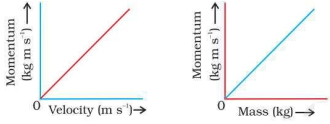
What is momentum? Write its $SI$ unit. Interpret force in terms of momentum. Represent the following graphically:
$(a)$ Momentum versus velocity when mass is fixed.
$(b)$ Momentum versus mass when velocity is constant.
$(a)$ Momentum versus velocity when mass is fixed.
$(b)$ Momentum versus mass when velocity is constant.
Solution
(N/A) Momentum is defined as the product of the mass and velocity of an object. It is a vector quantity.
Momentum $(p)$ = mass $(m)$ $\times$ velocity $(v)$
The $SI$ unit of momentum is $kg\, m\, s^{-1}$.
Force is defined as the rate of change of momentum. According to Newton's second law of motion,the force applied on an object is directly proportional to the rate of change of its momentum.
Force $(F)$ = $\frac{\Delta p}{\Delta t}$
Graphical representation:
$(a)$ Since $p = mv$,if mass $(m)$ is fixed,momentum $(p)$ is directly proportional to velocity $(v)$. The graph of momentum versus velocity is a straight line passing through the origin.
$(b)$ Since $p = mv$,if velocity $(v)$ is constant,momentum $(p)$ is directly proportional to mass $(m)$. The graph of momentum versus mass is a straight line passing through the origin.
0 likes
View Solution15
EasyMCQ
What is the force required to accelerate a $2 \, kg$ mass by $5 \, m s^{-2}$ (in $, N$)?
A
$5$
B
$10$
C
$20$
D
$2.5$
Solution
(B) According to Newton's second law of motion,the force $(F)$ is given by the product of mass $(m)$ and acceleration $(a)$.
Formula: $F = m \times a$
Given:
Mass $(m)$ = $2 \, kg$
Acceleration $(a)$ = $5 \, m s^{-2}$
Calculation:
$F = 2 \, kg \times 5 \, m s^{-2} = 10 \, N$
Therefore,the force required is $10 \, N$.
Formula: $F = m \times a$
Given:
Mass $(m)$ = $2 \, kg$
Acceleration $(a)$ = $5 \, m s^{-2}$
Calculation:
$F = 2 \, kg \times 5 \, m s^{-2} = 10 \, N$
Therefore,the force required is $10 \, N$.
0 likes
View Solution16
Easy
What is the mathematical formula and $SI$ unit of momentum?
Solution
(N/A) Momentum $(p)$ is defined as the product of mass $(m)$ and velocity $(v)$.
The mathematical formula is: $p = m \times v$.
The $SI$ unit of mass is kilogram $(kg)$ and the $SI$ unit of velocity is metre per second $(m/s)$.
Therefore,the $SI$ unit of momentum is kilogram metre per second,denoted as $kg \cdot m/s$ or $kg \cdot m \cdot s^{-1}$.
The mathematical formula is: $p = m \times v$.
The $SI$ unit of mass is kilogram $(kg)$ and the $SI$ unit of velocity is metre per second $(m/s)$.
Therefore,the $SI$ unit of momentum is kilogram metre per second,denoted as $kg \cdot m/s$ or $kg \cdot m \cdot s^{-1}$.
0 likes
View Solution17
Easy
What force would be needed to produce an acceleration of $4 \, m s^{-2}$ on a ball of mass $6 \, kg$?
Solution
(D) According to Newton's second law of motion,the force $(F)$ is the product of mass $(m)$ and acceleration $(a)$.
Formula: $F = m \times a$
Given:
Mass $(m) = 6 \, kg$
Acceleration $(a) = 4 \, m s^{-2}$
Calculation:
$F = 6 \, kg \times 4 \, m s^{-2} = 24 \, N$
Therefore,the force required is $24 \, N$.
Formula: $F = m \times a$
Given:
Mass $(m) = 6 \, kg$
Acceleration $(a) = 4 \, m s^{-2}$
Calculation:
$F = 6 \, kg \times 4 \, m s^{-2} = 24 \, N$
Therefore,the force required is $24 \, N$.
0 likes
View Solution18
Easy
State Newton's second law of motion.
Solution
(N/A) Newton's second law of motion states that the rate of change of momentum of an object is directly proportional to the applied unbalanced force in the direction of the force.
Mathematically,$F = ma$,where $F$ is the force,$m$ is the mass,and $a$ is the acceleration.
Mathematically,$F = ma$,where $F$ is the force,$m$ is the mass,and $a$ is the acceleration.
0 likes
View Solution19
EasyMCQ
What is the $SI$ unit of force?
A
Joule
B
Newton
C
Pascal
D
Watt
Solution
(B) The $SI$ unit of force is the Newton $(N)$.
It is defined as the force required to accelerate a mass of $1 \ kg$ by $1 \ m/s^2$.
It is defined as the force required to accelerate a mass of $1 \ kg$ by $1 \ m/s^2$.
0 likes
View Solution20
Easy
Name the $CGS$ unit of force. How is it related to Newton?
Solution
(N/A) The $CGS$ unit of force is the dyne.
$1 \text{ Newton (N)} = 10^5 \text{ dynes}$.
This relationship is derived from the fact that $1 \text{ N} = 1 \text{ kg} \cdot \text{m/s}^2$,and since $1 \text{ kg} = 10^3 \text{ g}$ and $1 \text{ m} = 10^2 \text{ cm}$,we get $1 \text{ N} = 10^3 \text{ g} \times 10^2 \text{ cm/s}^2 = 10^5 \text{ g} \cdot \text{cm/s}^2$,which is equal to $10^5 \text{ dynes}$.
0 likes
View Solution21
EasyMCQ
Why is glass or chinaware packed with straw?
A
To make the package look attractive
B
To increase the weight of the package
C
To increase the time of impact during a collision
D
To prevent the items from getting dirty
Solution
(C) Glass or chinaware items are fragile and prone to breaking upon impact.
When these items are packed with straw,the straw acts as a cushion.
According to Newton's Second Law of Motion,the force exerted is inversely proportional to the time taken for the change in momentum $(F = \Delta p / \Delta t)$.
By using straw,the time taken for the change in momentum is increased during any sudden jerk or collision.
As a result,the force exerted on the glass or chinaware is significantly reduced,preventing breakage.
0 likes
View Solution22
EasyMCQ
In a high jump athletic event,the athletes are made to fall on a cushioned bed. Why?
A
To increase the time of impact
B
To decrease the time of impact
C
To increase the force of impact
D
To increase the momentum
Solution
(A) According to Newton's second law of motion,the force exerted is given by $F = \frac{dp}{dt}$,where $dp$ is the change in momentum and $dt$ is the time taken.
When an athlete falls on a cushioned bed,the bed compresses,which increases the time $(dt)$ taken for the athlete to come to rest.
Since the force $(F)$ is inversely proportional to the time $(dt)$,an increase in time results in a significant decrease in the impulsive force exerted on the athlete.
This prevents the athlete from getting injured.
0 likes
View Solution23
EasyMCQ
Which would require a greater force $-$ accelerating a $1\, kg$ mass at $10\, m s^{-2}$ or a $2\, kg$ mass at $4\, m s^{-2}$?
A
Accelerating a $1\, kg$ mass at $10\, m s^{-2}$
B
Accelerating a $2\, kg$ mass at $4\, m s^{-2}$
C
Both require the same force
D
Cannot be determined
Solution
(A) We know that the force $F$ is calculated using the formula $F = m \times a$,where $m$ is mass and $a$ is acceleration.
For the first case:
$F_1 = m_1 \times a_1 = 1\, kg \times 10\, m s^{-2} = 10\, N$
For the second case:
$F_2 = m_2 \times a_2 = 2\, kg \times 4\, m s^{-2} = 8\, N$
Comparing the two forces,we find that $10\, N > 8\, N$,which means $F_1 > F_2$.
Therefore,accelerating a $1\, kg$ mass at $10\, m s^{-2}$ requires a greater force.
0 likes
View Solution24
EasyMCQ
While playing football,the goalkeeper did not get sufficient time to stop a fast ball shot towards him. Why did he hurt his hand while doing so?
A
The ball exerted a small force on his hands.
B
The momentum of the ball was reduced to zero in a very short interval of time,resulting in a large impulsive force.
C
The ball had very little mass.
D
The goalkeeper's hands were not strong enough.
Solution
(B) According to Newton's second law of motion,the force exerted is given by $F = \frac{\Delta p}{\Delta t}$,where $\Delta p$ is the change in momentum and $\Delta t$ is the time interval.
When the goalkeeper stops a fast-moving ball,the momentum of the ball changes from its initial value to zero.
Since the time interval $\Delta t$ is very small,the force $F$ exerted by the ball on the goalkeeper's hands becomes very large.
This large force causes the injury to the goalkeeper's hands.
0 likes
View Solution25
EasyMCQ
During a game of table tennis,if the ball hits a player,it does not hurt him. On the other hand,when a fast-moving cricket ball hits a spectator,it may hurt him. State the reason.
A
The cricket ball has more mass and velocity.
B
The table tennis ball has more mass.
C
The cricket ball has less momentum.
D
The spectator is more sensitive than the player.
Solution
(A) The impact of a moving object depends on its momentum,which is the product of its mass $(m)$ and velocity $(v)$,given by $p = m \times v$.
$1$. $A$ table tennis ball has a very small mass,so even at high speeds,its momentum is relatively low,causing negligible impact.
$2$. $A$ cricket ball has a significantly larger mass compared to a table tennis ball. When it moves at a high velocity,its momentum $(p = mv)$ becomes very high.
$3$. According to Newton's second law,the force exerted during an impact is proportional to the rate of change of momentum. Since the cricket ball carries much higher momentum,it exerts a larger force upon impact,which can cause injury.
0 likes
View Solution26
EasyMCQ
Which would require a greater force $-$ accelerating a $2 \ kg$ mass at $5 \ m s^{-2}$ or a $5 \ kg$ mass at $3 \ m s^{-2}$?
A
Accelerating a $2 \ kg$ mass at $5 \ m s^{-2}$
B
Accelerating a $5 \ kg$ mass at $3 \ m s^{-2}$
C
Both require the same force
D
Cannot be determined
Solution
(B) According to Newton's second law of motion,the force $F$ is given by the product of mass $m$ and acceleration $a$,i.e.,$F = m \times a$.
For the first case:
Mass $m_1 = 2 \ kg$,Acceleration $a_1 = 5 \ m s^{-2}$
Force $F_1 = 2 \ kg \times 5 \ m s^{-2} = 10 \ N$.
For the second case:
Mass $m_2 = 5 \ kg$,Acceleration $a_2 = 3 \ m s^{-2}$
Force $F_2 = 5 \ kg \times 3 \ m s^{-2} = 15 \ N$.
Comparing the two forces,$15 \ N > 10 \ N$.
Therefore,accelerating a $5 \ kg$ mass at $3 \ m s^{-2}$ requires a greater force.
0 likes
View Solution27
MediumMCQ
Find the ratio of momentum of the two bodies $A$ and $B$ of masses $m$ and $4m$ respectively,moving with the same velocity $v$.
A
$1:4$
B
$4:1$
C
$1:1$
D
$2:1$
Solution
(A) The momentum $p$ of a body is defined as the product of its mass $m$ and velocity $v$,given by the formula $p = mv$.
For body $A$ with mass $m$ and velocity $v$,the momentum is $p_A = m \times v = mv$.
For body $B$ with mass $4m$ and velocity $v$,the momentum is $p_B = 4m \times v = 4mv$.
The ratio of the momentum of body $A$ to body $B$ is $\frac{p_A}{p_B} = \frac{mv}{4mv} = \frac{1}{4}$.
Therefore,the ratio is $1:4$.
0 likes
View Solution28
Easy
$A$ player catching a moving ball moves his hand backwards. Why?
Solution
(N/A) According to Newton's second law of motion,the force exerted by the ball is given by $F = m \times a$,where $a = \frac{v - u}{t}$.
By moving his hands backwards,the player increases the time $(t)$ taken to bring the ball to rest.
Since force is inversely proportional to time $(F \propto \frac{1}{t})$,increasing the time reduces the impulsive force exerted by the ball on the player's hands.
This prevents injury and makes it easier to catch the ball.
0 likes
View Solution29
Medium
Show that the rate of change of momentum $=$ mass $\times$ acceleration.
Solution
(N/A) Let a force $F$ act on a body of mass $m$ for time $t$ and change its velocity from $u$ to $v$.
Initial momentum of the body $= mu$
Final momentum of the body $= mv$
Change in momentum of the body in time $t = mv - mu = m(v - u)$
The rate of change of momentum $= \frac{\text{Change in momentum}}{\text{Time}} = \frac{m(v - u)}{t}$
Since acceleration $a = \frac{v - u}{t}$, we substitute this into the equation.
Therefore, the rate of change of momentum $= m \times a = \text{mass} \times \text{acceleration}$.
According to Newton's second law of motion, this rate of change of momentum is equal to the applied force $F$.
0 likes
View Solution30
Medium
Prove that $1 \text{ N} = 10^{5} \text{ dynes}$.
Solution
(N/A) $1 \text{ N} = 1 \text{ kg} \times 1 \text{ m s}^{-2}$
Since $1 \text{ kg} = 1000 \text{ g}$ and $1 \text{ m} = 100 \text{ cm}$,we substitute these values:
$1 \text{ N} = 1000 \text{ g} \times 100 \text{ cm s}^{-2}$
$1 \text{ N} = 100,000 \text{ g cm s}^{-2}$
Since $1 \text{ dyne} = 1 \text{ g cm s}^{-2}$,we get:
$1 \text{ N} = 10^{5} \text{ dynes}$.
Since $1 \text{ kg} = 1000 \text{ g}$ and $1 \text{ m} = 100 \text{ cm}$,we substitute these values:
$1 \text{ N} = 1000 \text{ g} \times 100 \text{ cm s}^{-2}$
$1 \text{ N} = 100,000 \text{ g cm s}^{-2}$
Since $1 \text{ dyne} = 1 \text{ g cm s}^{-2}$,we get:
$1 \text{ N} = 10^{5} \text{ dynes}$.
0 likes
View Solution31
Medium
What would happen if a fielder stops a fast-moving ball suddenly? Justify your answer.
Solution
(N/A) When a fielder stops a fast-moving ball suddenly,the velocity of the ball decreases to $0$ in a very short interval of time.
According to Newton's second law of motion,the force applied is directly proportional to the rate of change of momentum,given by $F = \frac{m(v - u)}{t}$.
Since the time interval $(t)$ is very small,the rate of change of momentum is very high.
This requires the fielder to apply a large impulsive force to stop the ball.
Consequently,the ball exerts an equal and opposite reaction force on the fielder's hands,which may cause injury to the palm.
0 likes
View Solution32
Easy
If the time taken to bring a ball to rest from a certain velocity $v$ is reduced to half,what will be the changes in values of
$(a)$ Initial and final momentum.
$(b)$ Change of momentum.
$(c)$ Rate of change of momentum.
$(a)$ Initial and final momentum.
$(b)$ Change of momentum.
$(c)$ Rate of change of momentum.
Solution
(C) Initial momentum $p_i = mv$ and final momentum $p_f = 0$. Since $m$ and $v$ remain constant,there is no change in initial and final momentum.
$(b)$ Change of momentum $\Delta p = p_f - p_i = 0 - mv = -mv$. Since the magnitude of change depends only on initial and final states,there is no change.
$(c)$ Rate of change of momentum is given by $F = \frac{\Delta p}{t}$. If time $t$ is reduced to half $(t' = t/2)$,the new rate of change of momentum $F' = \frac{\Delta p}{t/2} = 2 \times \frac{\Delta p}{t} = 2F$. Thus,the rate of change of momentum is doubled.
0 likes
View Solution33
Medium
Calculate the ratio of momentum,when
$(i)$ velocity of an object is doubled.
$(ii)$ mass of an object is halved.
$(iii)$ both mass and velocity are increased by three times.
$(i)$ velocity of an object is doubled.
$(ii)$ mass of an object is halved.
$(iii)$ both mass and velocity are increased by three times.
Solution
(N/A) Let a body of mass $m$ be moving with velocity $v$. The initial momentum is $p_{1} = m v$.
$(i)$ When the velocity is doubled,the new velocity is $2v$. The new momentum $p_{2} = m(2v) = 2mv = 2p_{1}$. Therefore,the ratio $p_{1} : p_{2} = 1 : 2$.
$(ii)$ When the mass is halved,the new mass is $\frac{1}{2}m$. The new momentum $p_{3} = (\frac{1}{2}m)v = \frac{1}{2}mv = \frac{1}{2}p_{1}$. Therefore,the ratio $p_{1} : p_{3} = 2 : 1$.
$(iii)$ When both mass and velocity are increased by three times,the new mass is $3m$ and the new velocity is $3v$. The new momentum $p_{4} = (3m)(3v) = 9mv = 9p_{1}$. Therefore,the ratio $p_{1} : p_{4} = 1 : 9$.
0 likes
View Solution34
Medium
$A$ motor car is moving with a velocity of $108 \, km \, h^{-1}$ and it takes $4 \, s$ to stop after the brakes are applied. Find the force exerted by the brakes on the motor car if its mass along with the passengers is $1000 \, kg$.
Solution
(N/A) Mass of the car along with passengers,$m = 1000 \, kg$.
Initial velocity,$u = 108 \, km \, h^{-1} = \frac{108 \times 1000}{3600} \, m \, s^{-1} = 30 \, m \, s^{-1}$.
Final velocity,$v = 0 \, m \, s^{-1}$ (since the car stops).
Time taken,$t = 4 \, s$.
Acceleration,$a = \frac{v - u}{t} = \frac{0 - 30}{4} = -7.5 \, m \, s^{-2}$.
Force exerted by the brakes,$F = m \times a = 1000 \, kg \times (-7.5 \, m \, s^{-2}) = -7500 \, N$.
The negative sign indicates that the force is applied in the direction opposite to the motion of the car.
Therefore,the magnitude of the force exerted by the brakes is $7500 \, N$.
0 likes
View Solution35
Medium
$A$ man weighing $60 \, kg$ runs along the rails with a velocity of $18 \, km \, h^{-1}$ and jumps into a car of mass $1 \, \text{quintal} \, (100 \, kg)$ standing on the rails. Calculate the velocity with which the car will start travelling along the rails.
Solution
Mass of the man,$m_{1} = 60 \, kg$.
Initial speed of the man,$u_{1} = 18 \, km \, h^{-1} = \frac{18 \times 1000}{3600} \, m \, s^{-1} = 5 \, m \, s^{-1}$.
Mass of the car,$m_{2} = 100 \, kg$.
Initial speed of the car,$u_{2} = 0 \, m \, s^{-1}$.
Let the final velocity of the car with the man be $v$.
According to the law of conservation of momentum:
$m_{1}u_{1} + m_{2}u_{2} = (m_{1} + m_{2})v$.
Substituting the values:
$(60 \times 5) + (100 \times 0) = (60 + 100)v$.
$300 = 160v$.
$v = \frac{300}{160} \, m \, s^{-1} = 1.875 \, m \, s^{-1}$.
Converting to $km \, h^{-1}$:
$v = 1.875 \times \frac{18}{5} \, km \, h^{-1} = 6.75 \, km \, h^{-1}$.
0 likes
View Solution36
Advanced
Chetan's father wanted to buy a car. He visited many showrooms to find out the price and the specifications of various cars. In one of the showrooms,he was told by the salesman that their car had excellent brakes such that the car stops instantaneously. Chetan's father was impressed and decided to buy that car. In the evening,he discussed this with his family. Chetan told his father that such a car cannot be made and the salesman had lied to him. He told his father that he should not buy that car and,moreover,never from that showroom. He explained to his father why it is not possible. His father was convinced and promised to visit another showroom and be careful this time.
$(a)$ What might have been the explanation given by Chetan to convince his father?
$(b)$ What values do you see in Chetan?
$(a)$ What might have been the explanation given by Chetan to convince his father?
$(b)$ What values do you see in Chetan?
Solution
(N/A) The salesman's claim is scientifically impossible. If a car stops instantaneously,the time taken $(t)$ for the change in velocity is $0$. Since retardation (deceleration) is defined as $a = \frac{v - u}{t}$,if $t = 0$,the retardation becomes infinite. An infinite force would be required to produce infinite retardation,which is physically impossible.
$(b)$ Chetan demonstrates critical thinking,scientific awareness,honesty,and a sense of responsibility toward his family's well-being.
$(b)$ Chetan demonstrates critical thinking,scientific awareness,honesty,and a sense of responsibility toward his family's well-being.
0 likes
View Solution37
EasyMCQ
Which has a higher value of momentum: $A$ bullet of mass $10 \, g$ moving with a velocity of $400 \, m s^{-1}$ or a cricket ball of mass $400 \, g$ thrown with a speed of $90 \, km h^{-1}$?
A
Bullet
B
Cricket ball
C
Both have equal momentum
D
Cannot be determined
Solution
(B) $1$. Calculate the momentum of the bullet:
Mass of bullet $(m_1)$ = $10 \, g = 0.01 \, kg$
Velocity of bullet $(v_1)$ = $400 \, m s^{-1}$
Momentum $(p_1)$ = $m_1 \times v_1 = 0.01 \, kg \times 400 \, m s^{-1} = 4 \, kg \, m s^{-1}$
$2$. Calculate the momentum of the cricket ball:
Mass of cricket ball $(m_2)$ = $400 \, g = 0.4 \, kg$
Velocity of cricket ball $(v_2)$ = $90 \, km h^{-1} = 90 \times (5/18) \, m s^{-1} = 25 \, m s^{-1}$
Momentum $(p_2)$ = $m_2 \times v_2 = 0.4 \, kg \times 25 \, m s^{-1} = 10 \, kg \, m s^{-1}$
$3$. Comparison:
Since $10 \, kg \, m s^{-1} > 4 \, kg \, m s^{-1}$,the cricket ball has a higher momentum.
0 likes
View Solution38
Difficult
How would you arrive at a mathematical formula to measure force using the second law of motion?
Solution
(N/A) Let an unbalanced force $F$ act on a body of mass $m$ moving with an initial velocity $u \, m s^{-1}$. The velocity changes to $v \, m s^{-1}$ after time $t$ seconds.
Initial momentum of the body $(p_1) = m \times u = mu$.
Final momentum of the body after $t$ seconds $(p_2) = m \times v = mv$.
Change in momentum $= p_2 - p_1 = mv - mu = m(v - u)$.
Rate of change of momentum $= \frac{m(v - u)}{t}$.
According to Newton's second law of motion, the rate of change of momentum is directly proportional to the applied force $F$:
$F \propto \frac{m(v - u)}{t}$.
Since acceleration $a = \frac{v - u}{t}$, we can write:
$F \propto ma$.
$F = kma$, where $k$ is a constant of proportionality.
By defining the unit of force such that $1 \, N$ of force produces an acceleration of $1 \, m s^{-2}$ in a body of $1 \, kg$ mass, we get $k = 1$.
Therefore, the mathematical formula for force is $F = ma$.
0 likes
View Solution39
Medium
$(a)$ Define force and state three possible effects of force on an object.
$(b)$ $A$ motorcycle is moving with a velocity of $90 \, km \, h^{-1}$ and it takes $5 \, s$ to stop after the brakes are applied. Calculate the force exerted by the brakes on the motorcycle if its mass along with the rider is $200 \, kg$.
$(b)$ $A$ motorcycle is moving with a velocity of $90 \, km \, h^{-1}$ and it takes $5 \, s$ to stop after the brakes are applied. Calculate the force exerted by the brakes on the motorcycle if its mass along with the rider is $200 \, kg$.
Solution
(N/A) Force is an external agent that produces or tends to produce acceleration in an object. Three possible effects of force are:
$(i)$ It can set a stationary object into motion.
$(ii)$ It can stop a moving object.
$(iii)$ It can change the speed or direction of motion of an object.
$(b)$ Given:
Initial velocity $u = 90 \, km \, h^{-1} = 90 \times \frac{5}{18} = 25 \, m \, s^{-1}$
Final velocity $v = 0 \, m \, s^{-1}$
Time $t = 5 \, s$
Mass $m = 200 \, kg$
Using the first equation of motion $v = u + at$:
$0 = 25 + a(5)$
$5a = -25$
$a = -5 \, m \, s^{-2}$
Using Newton's second law of motion $F = ma$:
$F = 200 \times (-5) = -1000 \, N$
The magnitude of the force exerted by the brakes is $1000 \, N$ in the direction opposite to the motion.
0 likes
View Solution40
Medium
Two similar vehicles are moving with the same velocity on roads,such that one of them is loaded and the other is empty. Which of the two vehicles will require a larger force to stop it? Give reasons.
Solution
(A) The force required to stop a moving object is directly proportional to the rate of change of momentum $(F = \frac{dp}{dt} = ma)$.
Since both vehicles are moving with the same velocity $(v)$,the momentum $(p = mv)$ depends on the mass $(m)$ of the vehicle.
The loaded vehicle has a greater mass compared to the empty vehicle.
Therefore,the loaded vehicle possesses more momentum.
According to Newton's second law of motion,a larger force is required to change the momentum of an object with greater mass in the same amount of time.
Thus,the loaded vehicle will require a larger force to stop.
0 likes
View Solution41
Medium
In the following table,the mass and speed of two bodies are given. Which body has more momentum? Justify your answer.
| Body | Mass $(kg)$ | Speed $(m s^{-1})$ |
| $A$ | $1$ | $10$ |
| $B$ | $2$ | $9$ |
Solution
(B) Momentum $(p)$ is defined as the product of mass $(m)$ and velocity $(v)$,given by the formula: $p = m \times v$.
For body $A$:
Mass $(m_A)$ = $1 \ kg$
Speed $(v_A)$ = $10 \ m s^{-1}$
Momentum $(p_A)$ = $1 \ kg \times 10 \ m s^{-1} = 10 \ kg \ m s^{-1}$.
For body $B$:
Mass $(m_B)$ = $2 \ kg$
Speed $(v_B)$ = $9 \ m s^{-1}$
Momentum $(p_B)$ = $2 \ kg \times 9 \ m s^{-1} = 18 \ kg \ m s^{-1}$.
Comparing the two values,$18 \ kg \ m s^{-1} > 10 \ kg \ m s^{-1}$.
Therefore,body $B$ has more momentum.
0 likes
View Solution42
EasyMCQ
When a missile is fired from a tank,it gets a momentum of $2000 \ kg \ m \ s^{-1}$. If the velocity of the missile is $50 \ m \ s^{-1}$,what will be its mass (in $kg$)?
A
$40$
B
$50$
C
$20$
D
$100$
Solution
(A) Given: Momentum $(p)$ = $2000 \ kg \ m \ s^{-1}$,Velocity $(v)$ = $50 \ m \ s^{-1}$.
We know that momentum is the product of mass and velocity,given by the formula: $p = m \times v$.
To find the mass $(m)$,we rearrange the formula: $m = \frac{p}{v}$.
Substituting the given values: $m = \frac{2000}{50} = 40 \ kg$.
Therefore,the mass of the missile is $40 \ kg$.
We know that momentum is the product of mass and velocity,given by the formula: $p = m \times v$.
To find the mass $(m)$,we rearrange the formula: $m = \frac{p}{v}$.
Substituting the given values: $m = \frac{2000}{50} = 40 \ kg$.
Therefore,the mass of the missile is $40 \ kg$.
0 likes
View Solution43
EasyMCQ
When a force of $40\, N$ is applied on a body,it moves with an acceleration of $5\, m s^{-2}$. Calculate the mass of the body. (in $kg$)
A
$5$
B
$8$
C
$10$
D
$200$
Solution
(B) Let $m$ be the mass of the body.
Given: Force $F = 40\, N$ and acceleration $a = 5\, m s^{-2}$.
According to Newton's second law of motion,the relationship is $F = m \times a$.
Substituting the given values,we get $40 = m \times 5$.
Therefore,$m = \frac{40}{5} = 8\, kg$.
The mass of the body is $8\, kg$.
Given: Force $F = 40\, N$ and acceleration $a = 5\, m s^{-2}$.
According to Newton's second law of motion,the relationship is $F = m \times a$.
Substituting the given values,we get $40 = m \times 5$.
Therefore,$m = \frac{40}{5} = 8\, kg$.
The mass of the body is $8\, kg$.
0 likes
View Solution44
Medium
It is required to increase the velocity of a scooter of mass $80 \ kg$ from $5 \ m s^{-1}$ to $25 \ m s^{-1}$ in $2 \ s$. Calculate the force required.
Solution
(D) Given: mass $m = 80 \ kg$,initial velocity $u = 5 \ m s^{-1}$,final velocity $v = 25 \ m s^{-1}$,and time $t = 2 \ s$.
First,calculate the acceleration $a$ using the formula:
$a = \frac{v - u}{t}$
Substituting the values:
$a = \frac{25 - 5}{2} = \frac{20}{2} = 10 \ m s^{-2}$
Now,calculate the force $F$ using Newton's second law of motion:
$F = m \times a$
Substituting the values:
$F = 80 \ kg \times 10 \ m s^{-2} = 800 \ N$
Therefore,the force required is $800 \ N$.
0 likes
View Solution45
Difficult
$A$ certain force exerted for $1.2 \, s$ raises the speed of an object from $1.8 \, m s^{-1}$ to $4.2 \, m s^{-1}$. Later, the same force is applied for $2 \, s$. How much does the speed change in $2 \, s$?
Solution
(D) Given:
Time interval, $t_1 = 1.2 \, s$
Initial speed, $u_1 = 1.8 \, m s^{-1}$
Final speed, $v_1 = 4.2 \, m s^{-1}$
Using the first equation of motion, $v = u + at$, we calculate the acceleration $(a)$:
$a = \frac{v_1 - u_1}{t_1} = \frac{4.2 - 1.8}{1.2} = \frac{2.4}{1.2} = 2 \, m s^{-2}$
Since the same force is applied to the same object, the acceleration remains constant at $a = 2 \, m s^{-2}$.
For the second interval, $t_2 = 2 \, s$:
The change in speed $(\Delta v)$ is given by $\Delta v = a \times t_2$.
$\Delta v = 2 \, m s^{-2} \times 2 \, s = 4 \, m s^{-1}$.
Thus, the speed changes by $4 \, m s^{-1}$.
0 likes
View Solution46
MediumMCQ
What would be the force required to stop a car of mass $1000 \ kg$ and a loaded truck of mass $10000 \ kg$ in $2 \ s$,if they are moving with the same velocity of $5 \ m s^{-1}$?
A
$2500 \ N$ and $25000 \ N$
B
$25000 \ N$ and $2500 \ N$
C
$5000 \ N$ and $50000 \ N$
D
$50000 \ N$ and $5000 \ N$
Solution
(A) Given: Initial velocity $(u) = 5 \ m s^{-1}$,Final velocity $(v) = 0$,Time $(t) = 2 \ s$.
Using the first equation of motion,$v = u + at$:
$0 = 5 + a \times 2$
$2a = -5$
$a = -2.5 \ m s^{-2}$ (retardation).
Force required to stop the car $(m = 1000 \ kg)$:
$F_{car} = m \times a = 1000 \ kg \times (-2.5 \ m s^{-2}) = -2500 \ N$.
Force required to stop the truck $(m = 10000 \ kg)$:
$F_{truck} = m \times a = 10000 \ kg \times (-2.5 \ m s^{-2}) = -25000 \ N$.
The negative sign indicates that the force is applied in the direction opposite to the motion (retarding force).
0 likes
View Solution47
MediumMCQ
$A$ cricket ball of mass $70 \, g$,moving with a velocity of $0.5 \, m s^{-1}$ is stopped by a player in $0.5 \, s$. What is the force applied by the player to stop the ball (in $, N$)?
A
$0.07$
B
$-0.07$
C
$0.7$
D
$-0.7$
Solution
(B) Given:
Initial velocity of the ball $(u) = 0.5 \, m s^{-1}$
Final velocity of the ball $(v) = 0 \, m s^{-1}$
Time $(t) = 0.5 \, s$
Mass of the ball $(m) = 70 \, g = 0.07 \, kg$
According to Newton's second law of motion,the force $(F)$ is given by the rate of change of momentum:
$F = \frac{m(v - u)}{t}$
Substituting the values:
$F = \frac{0.07 \times (0 - 0.5)}{0.5}$
$F = \frac{0.07 \times (-0.5)}{0.5}$
$F = -0.07 \, N$
The negative sign indicates that the force applied by the player is a retarding force (opposing the motion of the ball).
0 likes
View Solution48
MediumMCQ
$A$ bullet of mass $10\, g$ is fired from a rifle. The bullet takes $0.003\, s$ to move through its barrel and leaves with a velocity of $300\, m s^{-1}$. What is the force exerted on the bullet by the rifle (in $, N$)?
A
$1000$
B
$100$
C
$10000$
D
$10$
Solution
(A) Given:
Mass of the bullet $(m) = 10\, g = 0.01\, kg$
Initial velocity of the bullet $(u) = 0\, m s^{-1}$
Final velocity of the bullet $(v) = 300\, m s^{-1}$
Time taken $(t) = 0.003\, s$
Step $1$: Calculate the acceleration $(a)$ of the bullet using the formula $a = \frac{v - u}{t}$.
$a = \frac{300 - 0}{0.003} = \frac{300}{0.003} = 100,000\, m s^{-2}$.
Step $2$: Calculate the force $(F)$ exerted on the bullet using Newton's second law of motion,$F = m \times a$.
$F = 0.01\, kg \times 100,000\, m s^{-2} = 1000\, N$.
Therefore,the force exerted on the bullet by the rifle is $1000\, N$.
0 likes
View Solution49
Medium
$A$ man pushes a box of mass $50\, kg$ with a force of $80\, N$. What will be the acceleration of the box due to this force? What would be the acceleration if the mass were doubled?
Solution
(N/A) Given: Mass $m = 50\, kg$,Force $F = 80\, N$.
Using Newton's second law of motion,$F = m \times a$,the acceleration $a$ is given by:
$a = F / m = 80 / 50 = 1.6\, m/s^2$.
If the mass is doubled,the new mass $m' = 2 \times 50 = 100\, kg$.
The new acceleration $a'$ is:
$a' = F / m' = 80 / 100 = 0.8\, m/s^2$.
Using Newton's second law of motion,$F = m \times a$,the acceleration $a$ is given by:
$a = F / m = 80 / 50 = 1.6\, m/s^2$.
If the mass is doubled,the new mass $m' = 2 \times 50 = 100\, kg$.
The new acceleration $a'$ is:
$a' = F / m' = 80 / 100 = 0.8\, m/s^2$.
0 likes
View Solution50
Medium
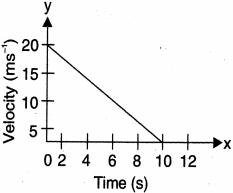
The velocity-time graph of a ball of mass $20 \ g$ moving along a straight line on a level ground is given below. How much force does the ground exert on the ball to bring it to rest?
Solution
(N/A) Given:
Mass of the ball,$m = 20 \ g = 0.02 \ kg$.
From the velocity-time graph:
Initial velocity,$u = 20 \ m \ s^{-1}$ (at $t = 0 \ s$).
Final velocity,$v = 0 \ m \ s^{-1}$ (at $t = 10 \ s$).
Time taken,$t = 10 \ s$.
Using Newton's second law of motion,the force $F$ exerted by the ground on the ball is given by:
$F = m \times a = m \times \frac{(v - u)}{t}$
Substituting the values:
$F = 0.02 \times \frac{(0 - 20)}{10}$
$F = 0.02 \times (-2) = -0.04 \ N$.
The negative sign indicates that the force exerted by the ground (frictional force) is in the direction opposite to the motion of the ball. Thus,the magnitude of the force is $0.04 \ N$.
0 likes
View SolutionFORCE AND LAWS OF MOTION — Second Law of Motion · Frequently Asked Questions
1Are these FORCE AND LAWS OF MOTION questions useful for JEE and NEET?
Yes. All questions in this section are mapped to JEE Main and NEET exam patterns. Previous year questions from JEE Main, NEET, GUJCET and state-level exams are included with full solutions.
2Can I switch to Hindi or Gujarati for these questions?
Yes. Use the language tabs in the hero section or the sidebar to view the same questions and solutions in English, Hindi or Gujarati.
3How do I generate a question paper from this subtopic?
Use the Vedclass Exam Paper Generator — select the chapter and subtopic, set difficulty, and generate Sets A, B, C, D automatically. First 3 chapters of every subject are free.
Vedclass Products
For Students
Vedclass Test Series
Mock tests in real JEE/NEET style with performance analysis. 5-day free trial.
Start Free TrialFor Teachers
Exam Paper Generator
Generate Set A/B/C/D papers from this chapter in 2 minutes. 3 chapters free.
Try FreeFor Institutes
Online Exam Module
Live online exams with unlimited students, 360° analytics & white-label branding.
See DemoFor Teachers & Institutes
Generate a FORCE AND LAWS OF MOTION Exam Paper in 2 Minutes
Select subtopic & difficulty — Sets A, B, C, D auto-generated with No Repeat logic.
First 3 chapters of every subject are free — no payment required.