
A English
Free Fall and Acceleration due to Gravity Questions in English
Class 9 Science · GRAVITATION · Free Fall and Acceleration due to Gravity
91+
Questions
English
Language
100%
With Solutions
Showing 41 of 91 questions in English
51
Difficult
Prove that if a body is thrown vertically upward,the time of ascent is equal to the time of descent.
Solution
(N/A) For upward motion:
$u = u, v = 0$
Let $t_{1}$ be the time of ascent. Using the equation of motion $v = u + at$:
$0 = u - gt_{1}$
$t_{1} = u/g$
For downward motion (descent):
The body starts from rest at the maximum height,so $u = 0$. Let $t_{2}$ be the time of descent. Using $s = ut + (1/2)at^{2}$ where $s = h$:
$h = 0 + (1/2)gt_{2}^{2} \implies t_{2} = \sqrt{2h/g}$
Since $h = u^{2}/(2g)$,substituting this gives $t_{2} = \sqrt{2(u^{2}/2g)/g} = u/g$.
Thus,$t_{1} = t_{2}$,which proves that the time of ascent is equal to the time of descent.
0 likes
View Solution52
Difficult
$A$ stone is allowed to fall from the top of a tower $100 \, m$ high and at the same time another stone is projected vertically upwards from the ground with a velocity of $25 \, m s^{-1}$. Calculate when and where the two stones will meet? (Take $g = 10 \, m s^{-2}$).
Solution
(A) Let stone $A$ fall from the top of a tower of height $h = 100 \, m$. Its initial velocity $u_1 = 0$ and acceleration $a_1 = +g = 10 \, m s^{-2}$.
Another stone $B$ is projected upwards from the ground with initial velocity $u_2 = 25 \, m s^{-1}$ and acceleration $a_2 = -g = -10 \, m s^{-2}$.
Let the two stones meet at a point $C$ at a distance $y$ below the top of the tower after time $t$. For stone $A$:
$y = u_1 t + \frac{1}{2} a_1 t^2 = 0 + \frac{1}{2} \times 10 \times t^2 = 5t^2$ ... $(1)$
For stone $B$,the distance covered from the ground is $(100 - y)$:
$100 - y = u_2 t + \frac{1}{2} a_2 t^2 = 25t - \frac{1}{2} \times 10 \times t^2 = 25t - 5t^2$ ... $(2)$
Adding equations $(1)$ and $(2)$:
$y + (100 - y) = 5t^2 + 25t - 5t^2$
$100 = 25t$
$t = 4 \, s$
Substituting $t = 4 \, s$ into equation $(1)$:
$y = 5 \times (4)^2 = 5 \times 16 = 80 \, m$.
The stones will meet after $4 \, s$ at a distance of $80 \, m$ from the top of the tower (or $20 \, m$ from the ground).
0 likes
View Solution53
MediumMCQ
Two stones $A$ and $B$ are dropped from a multi-storey building. Stone $A$ is dropped from $100 \, m$ and at the same time stone $B$ is dropped from $50 \, m$ height. Both of them reach the earth at the same time. Will they have equal velocity while reaching the ground? Calculate and find out the answer (Take $g = 10 \, m s^{-2}$).
A
Yes,they will have equal velocity.
B
No,stone $A$ will have higher velocity.
C
No,stone $B$ will have higher velocity.
D
Cannot be determined.
Solution
(B) For stone $A$ dropped from $h_1 = 100 \, m$:
Using the equation $v^2 - u^2 = 2gh$,where initial velocity $u = 0$:
$v_A^2 = 2 \times 10 \times 100 = 2000$
$v_A = \sqrt{2000} \approx 44.72 \, m s^{-1}$.
For stone $B$ dropped from $h_2 = 50 \, m$:
Using the equation $v^2 - u^2 = 2gh$,where initial velocity $u = 0$:
$v_B^2 = 2 \times 10 \times 50 = 1000$
$v_B = \sqrt{1000} \approx 31.62 \, m s^{-1}$.
Since $v_A \neq v_B$,the stones will not have equal velocities upon reaching the ground. Stone $A$ will have a higher velocity.
Using the equation $v^2 - u^2 = 2gh$,where initial velocity $u = 0$:
$v_A^2 = 2 \times 10 \times 100 = 2000$
$v_A = \sqrt{2000} \approx 44.72 \, m s^{-1}$.
For stone $B$ dropped from $h_2 = 50 \, m$:
Using the equation $v^2 - u^2 = 2gh$,where initial velocity $u = 0$:
$v_B^2 = 2 \times 10 \times 50 = 1000$
$v_B = \sqrt{1000} \approx 31.62 \, m s^{-1}$.
Since $v_A \neq v_B$,the stones will not have equal velocities upon reaching the ground. Stone $A$ will have a higher velocity.
0 likes
View Solution54
Medium
State Newton's universal law of gravitation and write an expression for it. Also,show that the acceleration due to gravity of an object is independent of its mass.
Solution
(N/A) Newton's universal law of gravitation states that every particle of matter in the universe attracts every other particle with a force that is directly proportional to the product of their masses and inversely proportional to the square of the distance between their centers.
Mathematically,the force $F$ is given by:
$F = \frac{G m_1 m_2}{r^2}$
where $G$ is the universal gravitational constant,$m_1$ and $m_2$ are the masses of the two objects,and $r$ is the distance between their centers.
To show that acceleration due to gravity $(g)$ is independent of the mass of the falling object,consider an object of mass $m$ falling towards the Earth (mass $M$,radius $R$).
The gravitational force is $F = \frac{G M m}{R^2}$.
According to Newton's second law,$F = m \times a$. Here,$a = g$,so $F = m \times g$.
Equating the two expressions: $m \times g = \frac{G M m}{R^2}$.
Canceling $m$ from both sides,we get $g = \frac{G M}{R^2}$.
Since $g$ depends only on the mass of the Earth $(M)$,the gravitational constant $(G)$,and the radius of the Earth $(R)$,it is independent of the mass $(m)$ of the falling object.
0 likes
View Solution55
Medium
Write three differences between gravitational acceleration $(g)$ and gravitational constant $(G).$
Solution
(N/A) Following are the three differences:
$(i)$ The value of $g$ is $9.8 \, m/s^2$ on the surface of the Earth,whereas the value of $G$ is $6.67 \times 10^{-11} \, N \cdot m^2/kg^2$.
$(ii)$ The value of $g$ varies from place to place,whereas the value of $G$ remains constant throughout the universe.
$(iii)$ $g$ is a vector quantity,while $G$ is a scalar quantity.
0 likes
View Solution56
Difficult
What is meant by acceleration due to gravity? Suppose a planet exists whose mass and radius both are half of that of Earth. Calculate the acceleration due to gravity on the surface of this planet.
Solution
(N/A) Acceleration due to gravity is the acceleration produced in a body when it is allowed to fall freely under the influence of gravity alone. The acceleration due to gravity $(g)$ on the surface of a planet is given by the formula $g = \frac{GM}{R^2}$,where $M$ is the mass of the planet and $R$ is its radius.
Given:
Mass of the planet $(M_P)$ = $\frac{M_E}{2}$
Radius of the planet $(R_P)$ = $\frac{R_E}{2}$
Acceleration due to gravity on Earth $(g_E)$ = $9.8 \, m/s^2$
Using the ratio:
$\frac{g_P}{g_E} = \frac{GM_P / R_P^2}{GM_E / R_E^2} = \frac{M_P}{M_E} \times (\frac{R_E}{R_P})^2$
Substituting the values:
$\frac{g_P}{g_E} = \frac{M_E / 2}{M_E} \times (\frac{R_E}{R_E / 2})^2 = \frac{1}{2} \times (2)^2 = \frac{1}{2} \times 4 = 2$
Therefore,$g_P = 2 \times g_E = 2 \times 9.8 \, m/s^2 = 19.6 \, m/s^2$.
0 likes
View Solution57
Medium
Give reason:
$(a)$ Value of '$g$' is not constant on Earth.
$(b)$ Objects with different masses take the same time to fall from a fixed height.
$(c)$ '$G$' is known as the universal gravitational constant.
$(a)$ Value of '$g$' is not constant on Earth.
$(b)$ Objects with different masses take the same time to fall from a fixed height.
$(c)$ '$G$' is known as the universal gravitational constant.
Solution
(N/A) The acceleration due to gravity is given by the expression $g = \frac{GM}{R^2}$.
This depends upon the radius of the Earth $(R)$. Since the Earth is not a perfect sphere and its radius varies from the poles to the equator,the value of $g$ is not constant everywhere. Additionally,$g$ varies with altitude and depth.
$(b)$ The acceleration due to gravity $(g)$ acting on a falling body is given by $g = \frac{GM}{R^2}$.
This expression shows that $g$ does not depend on the mass of the falling object $(m)$,but only on the mass of the planet $(M)$ and the distance from its center $(R)$. Therefore,all objects fall with the same acceleration,regardless of their mass,and take the same time to fall from a fixed height in a vacuum.
$(c)$ '$G$' is known as the universal gravitational constant because its value remains the same at all places in the universe and is independent of the nature of the medium or the bodies involved.
0 likes
View Solution58
Medium
$(a)$ What do you mean by free fall?
$(b)$ What happens to the direction of motion of objects during free fall?
$(c)$ $A$ stone is dropped from a height of $19.6 \, m$. Calculate:
$(i)$ Time taken to fall.
$(ii)$ How fast does it move at the end of this fall?
$(iii)$ Acceleration after $1 \, s$.
$(b)$ What happens to the direction of motion of objects during free fall?
$(c)$ $A$ stone is dropped from a height of $19.6 \, m$. Calculate:
$(i)$ Time taken to fall.
$(ii)$ How fast does it move at the end of this fall?
$(iii)$ Acceleration after $1 \, s$.
Solution
(N/A) Free fall is the motion of an object falling solely under the influence of gravitational force,with constant acceleration.
$(b)$ The direction of motion remains the same (vertically downwards) during free fall.
$(c)$ Given: Initial velocity $u = 0 \, m/s$,height $h = 19.6 \, m$,acceleration $g = 9.8 \, m/s^2$.
$(i)$ Using the equation of motion $h = ut + \frac{1}{2}gt^2$:
$19.6 = 0 + \frac{1}{2} \times 9.8 \times t^2$
$19.6 = 4.9 \times t^2$
$t^2 = 4$
$t = 2 \, s$.
$(ii)$ Using the equation $v = u + gt$:
$v = 0 + 9.8 \times 2$
$v = 19.6 \, m/s$.
$(iii)$ Since the object is in free fall,the acceleration is constant and equal to the acceleration due to gravity,which is $9.8 \, m/s^2$ at any time,including after $1 \, s$.
0 likes
View Solution59
Medium
An object is thrown vertically upwards and rises to a height of $10 \, m$. Calculate:
$(i)$ the velocity with which the object was thrown upward and
$(ii)$ the time taken by the object to reach the highest point.
$(i)$ the velocity with which the object was thrown upward and
$(ii)$ the time taken by the object to reach the highest point.
Solution
(A) Given:
Height of the object,$h = 10 \, m$
Final velocity at the highest point,$v = 0 \, m/s$
Acceleration due to gravity,$a = -g = -9.8 \, m/s^2$
$(i)$ Using the third equation of motion,$v^2 - u^2 = 2ah$:
$0^2 - u^2 = 2 \times (-9.8) \times 10$
$-u^2 = -196$
$u^2 = 196$
$u = 14 \, m/s$
Thus,the initial velocity is $14 \, m/s$.
$(ii)$ Using the first equation of motion,$v = u + at$:
$0 = 14 + (-9.8) \times t$
$9.8t = 14$
$t = 14 / 9.8 \approx 1.43 \, s$
Thus,the time taken to reach the highest point is approximately $1.43 \, s$.
0 likes
View Solution60
MediumMCQ
$A$ planet existed whose mass and radius were both half of the Earth. What would be the acceleration due to gravity at the surface of the planet in terms of that on the surface of the Earth?
A
$g_{e}$
B
$2g_{e}$
C
$g_{e}/2$
D
$4g_{e}$
Solution
(B) We know that the acceleration due to gravity on Earth is given by $g_{e} = \frac{GM_{e}}{R_{e}^{2}}$.
For the given planet,the mass $M_{p} = \frac{M_{e}}{2}$ and the radius $R_{p} = \frac{R_{e}}{2}$.
Substituting these values into the formula for the planet's gravity $g_{p} = \frac{GM_{p}}{R_{p}^{2}}$,we get:
$g_{p} = \frac{G(M_{e}/2)}{(R_{e}/2)^{2}} = \frac{GM_{e}/2}{R_{e}^{2}/4} = \frac{GM_{e}}{2} \times \frac{4}{R_{e}^{2}} = 2 \times \frac{GM_{e}}{R_{e}^{2}}$.
Since $\frac{GM_{e}}{R_{e}^{2}} = g_{e}$,it follows that $g_{p} = 2g_{e}$.
0 likes
View Solution61
EasyMCQ
What is the nature of motion of an object falling freely under the action of gravity?
A
Uniform motion
B
Uniformly accelerated motion
C
Non-uniformly accelerated motion
D
Constant velocity motion
Solution
(B) When an object falls freely under the action of gravity,it experiences a constant acceleration due to gravity $(g \approx 9.8 \ m/s^2)$.
Since the acceleration remains constant throughout the fall,the velocity of the object increases by an equal amount in equal intervals of time.
Therefore,the nature of the motion is uniformly accelerated motion in one dimension.
Since the acceleration remains constant throughout the fall,the velocity of the object increases by an equal amount in equal intervals of time.
Therefore,the nature of the motion is uniformly accelerated motion in one dimension.
0 likes
View Solution62
EasyMCQ
How does acceleration due to gravity depend on the mass of the planet?
A
It is inversely proportional to the mass of the planet.
B
It is directly proportional to the mass of the planet.
C
It is independent of the mass of the planet.
D
It is proportional to the square of the mass of the planet.
Solution
(B) The acceleration due to gravity $(g)$ on the surface of a planet is given by the formula $g = \frac{GM}{R^2}$,where $G$ is the universal gravitational constant,$M$ is the mass of the planet,and $R$ is the radius of the planet.
From this relation,it is clear that $g \propto M$.
Therefore,the acceleration due to gravity is directly proportional to the mass of the planet.
From this relation,it is clear that $g \propto M$.
Therefore,the acceleration due to gravity is directly proportional to the mass of the planet.
0 likes
View Solution63
Medium
Choose the correct alternative:
$(a)$ Acceleration due to gravity increases/decreases with increasing altitude.
$(b)$ Acceleration due to gravity increases/decreases with increasing depth.
$(c)$ Acceleration due to gravity is independent of the mass of the earth/mass of the body.
$(a)$ Acceleration due to gravity increases/decreases with increasing altitude.
$(b)$ Acceleration due to gravity increases/decreases with increasing depth.
$(c)$ Acceleration due to gravity is independent of the mass of the earth/mass of the body.
Solution
(A) Acceleration due to gravity decreases with increasing altitude because $g' = g(1 - 2h/R_e)$ for small heights.
$(b)$ Acceleration due to gravity decreases with increasing depth because $g' = g(1 - d/R_e)$.
$(c)$ Acceleration due to gravity is independent of the mass of the body,as $g = GM/R^2$,where $M$ is the mass of the Earth and $R$ is its radius.
$(b)$ Acceleration due to gravity decreases with increasing depth because $g' = g(1 - d/R_e)$.
$(c)$ Acceleration due to gravity is independent of the mass of the body,as $g = GM/R^2$,where $M$ is the mass of the Earth and $R$ is its radius.
0 likes
View Solution64
EasyMCQ
$A$ person can jump higher on the surface of the Moon than on the Earth. Why?
A
The Moon has a higher gravitational pull.
B
The Moon has a lower gravitational pull than the Earth.
C
The Moon has no atmosphere.
D
The Moon is smaller in size.
Solution
(B) The acceleration due to gravity on the surface of the Moon is approximately $1/6$th of that on the surface of the Earth.
Since the gravitational force is much weaker on the Moon,a person can jump $6$ times higher on the Moon compared to the Earth for the same amount of muscular effort.
Since the gravitational force is much weaker on the Moon,a person can jump $6$ times higher on the Moon compared to the Earth for the same amount of muscular effort.
0 likes
View Solution65
EasyMCQ
$A$ body weighs $63 \, N$ on the surface of the earth. What is the gravitational force on it due to the earth at a height equal to half the radius of the earth (in $, N$)? (Given: Mass of the earth $= 6 \times 10^{24} \, kg$ and radius of the earth $= 6.4 \times 10^{6} \, m$)
A
$27.35$
B
$28.00$
C
$31.50$
D
$63.00$
Solution
(A) $1$. First,calculate the mass of the body $(m)$. Given weight $W = mg = 63 \, N$. Assuming $g = 10 \, m/s^2$,$m = 63 / 10 = 6.3 \, kg$.
$2$. The distance of the body from the center of the earth $(r)$ at a height $h = R/2$ is $r = R + h = R + R/2 = 1.5R$.
$3$. Given $R = 6.4 \times 10^6 \, m$,so $r = 1.5 \times 6.4 \times 10^6 = 9.6 \times 10^6 \, m$.
$4$. The gravitational force is given by $F = \frac{GMm}{r^2}$.
$5$. Substituting the values: $F = \frac{6.67 \times 10^{-11} \times 6 \times 10^{24} \times 6.3}{(9.6 \times 10^6)^2}$.
$6$. $F = \frac{252.186 \times 10^{13}}{92.16 \times 10^{12}} = \frac{2521.86}{92.16} \approx 27.35 \, N$.
0 likes
View Solution66
Easy
The acceleration due to gravity at the moon's surface is $1.67 \, m s^{-2}$. If the radius of the moon is $1.74 \times 10^{6} \, m$,calculate the mass of the moon. (Use $G = 6.67 \times 10^{-11} \, N m^{2} kg^{-2}$)
Solution
The formula for acceleration due to gravity $(g)$ is given by $g = \frac{GM}{R^{2}}$,where $G$ is the universal gravitational constant,$M$ is the mass of the celestial body,and $R$ is its radius.
Rearranging the formula to solve for mass $(M)$,we get $M = \frac{g R^{2}}{G}$.
Given values are:
$g = 1.67 \, m s^{-2}$
$R = 1.74 \times 10^{6} \, m$
$G = 6.67 \times 10^{-11} \, N m^{2} kg^{-2}$
Substituting these values into the formula:
$M = \frac{1.67 \times (1.74 \times 10^{6})^{2}}{6.67 \times 10^{-11}}$
$M = \frac{1.67 \times 3.0276 \times 10^{12}}{6.67 \times 10^{-11}}$
$M \approx 0.758 \times 10^{23} \, kg = 7.58 \times 10^{22} \, kg$.
Thus,the mass of the moon is approximately $7.58 \times 10^{22} \, kg$.
0 likes
View Solution67
Medium
$A$ stone is dropped from the edge of a roof.
$(a)$ How long does it take to fall $4.9 \, m$?
$(b)$ How fast does it move at the end of that fall?
$(c)$ How fast does it move at the end of $7.9 \, m$?
$(d)$ What is its acceleration after $1 \, s$ and after $2 \, s$?
$(a)$ How long does it take to fall $4.9 \, m$?
$(b)$ How fast does it move at the end of that fall?
$(c)$ How fast does it move at the end of $7.9 \, m$?
$(d)$ What is its acceleration after $1 \, s$ and after $2 \, s$?
Solution
(N/A) Given: Initial velocity,$u = 0 \, m/s$.
Acceleration due to gravity,$g = 9.8 \, m/s^2$.
$(a)$ Using the equation of motion $S = ut + \frac{1}{2}at^2$:
$4.9 = 0 \times t + \frac{1}{2} \times 9.8 \times t^2$
$4.9 = 4.9 \times t^2$
$t^2 = 1 \Rightarrow t = 1 \, s$.
So,it takes $1 \, s$ to fall $4.9 \, m$.
$(b)$ Using $v^2 - u^2 = 2aS$:
$v^2 - 0^2 = 2 \times 9.8 \times 4.9$
$v^2 = 96.04$
$v = 9.8 \, m/s$.
So,the speed at the end of $4.9 \, m$ is $9.8 \, m/s$.
$(c)$ Using $v^2 - u^2 = 2aS$:
$v^2 - 0^2 = 2 \times 9.8 \times 7.9$
$v^2 = 154.84$
$v = \sqrt{154.84} \approx 12.44 \, m/s$.
So,the speed at the end of $7.9 \, m$ is $12.44 \, m/s$.
$(d)$ During free fall,the acceleration due to gravity is constant.
Acceleration after $1 \, s = 9.8 \, m/s^2$.
Acceleration after $2 \, s = 9.8 \, m/s^2$.
0 likes
View Solution68
Difficult
$A$ boy on a cliff $49\, m$ high drops a stone. One second later,he throws a second stone after the first. They both hit the ground at the same time. With what speed did he throw the second stone?
Solution
(12.1 M/S) For the first stone,we are given:
$u = 0\, m\, s^{-1}, h = 49\, m, g = 9.8\, m\, s^{-2}$
Using the equation of motion $S = ut + \frac{1}{2}at^2$,we have:
$49 = 0 \times t + \frac{1}{2} \times 9.8 \times t^2$
$t^2 = \frac{98}{9.8} = 10$
$t = \sqrt{10} \approx 3.16\, s$
So,the first stone takes $3.16\, s$ to reach the ground.
For the second stone,it is thrown $1\, s$ later but hits the ground at the same time. Therefore,the time taken by the second stone is $t_2 = 3.16 - 1 = 2.16\, s$.
Using $S = ut + \frac{1}{2}at^2$ for the second stone:
$49 = u \times 2.16 + \frac{1}{2} \times 9.8 \times (2.16)^2$
$49 = 2.16u + 4.9 \times 4.6656$
$49 = 2.16u + 22.86$
$2.16u = 49 - 22.86 = 26.14$
$u = \frac{26.14}{2.16} \approx 12.10\, m\, s^{-1}$
Thus,the second stone was thrown with a speed of $12.1\, m\, s^{-1}$.
0 likes
View Solution69
Difficult
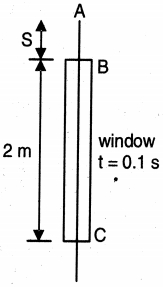
$A$ stone is dropped from the edge of a roof. It passes a window $2 \, m$ high in $0.1 \, s$. How far is the roof above the top of the window?
Solution
(19.42 M) Let the distance between the top of the window and the roof be $S$. For the journey across the window,i.e.,from $B$ to $C$:
Let the velocity at $B = u \, m/s$.
Distance travelled,$S = 2 \, m$.
Time taken,$t = 0.1 \, s$.
Acceleration,$a = g = 9.8 \, m/s^2$.
Using the equation $S = ut + \frac{1}{2}at^2$,we have:
$2 = u(0.1) + \frac{1}{2}(9.8)(0.1)^2$
$2 = 0.1u + 0.049$
$0.1u = 1.951$
$u = 19.51 \, m/s$.
Therefore,the velocity of the stone at the top of the window is $19.51 \, m/s$.
Now,for the free fall of the stone from the roof top to the top of the window,i.e.,from point $A$ to $B$:
Initial velocity $u_i = 0 \, m/s$.
Final velocity $v = 19.51 \, m/s$.
Distance covered $S = ?$.
Acceleration due to gravity $g = 9.8 \, m/s^2$.
Using $v^2 - u_i^2 = 2gS$,we have:
$(19.51)^2 - 0^2 = 2 \times 9.8 \times S$
$S = \frac{(19.51)^2}{19.6} \approx 19.42 \, m$.
0 likes
View Solution70
MediumMCQ
$A$ ball is thrown vertically upwards with a velocity $u$. Calculate the velocity with which it falls to the earth again.
A
$u$
B
$2u$
C
$u/2$
D
$0$
Solution
(A) For a ball thrown vertically upwards:
Initial velocity $= u \text{ m/s}$.
Final velocity at maximum height $= v = 0 \text{ m/s}$.
Using the equation of motion $v = u + at$,where $a = -g$ (acceleration due to gravity acting downwards):
$0 = u - gt \implies t = u/g$ (Time taken to reach maximum height).
For the return journey,the ball starts from rest at the maximum height $(u_{return} = 0)$ and falls downwards under gravity $(a = +g)$:
Using the equation $v^2 = u^2 + 2as$:
$v^2 = 0^2 + 2gH$,where $H$ is the maximum height.
From the upward journey,$H = u^2 / (2g)$.
Substituting $H$ in the return equation: $v^2 = 2g(u^2 / 2g) = u^2$.
Therefore,$v = u$.
The ball returns to the point of projection with the same velocity $u$ with which it was thrown.
0 likes
View Solution71
Easy
$A$ stone is dropped from the roof of a building. It takes $4 \, s$ to reach the ground. Find the height of the building. $(g = 9.8 \, m \, s^{-2})$
Solution
(78.4 M) Given: Initial velocity $u = 0 \, m \, s^{-1}$,time $t = 4 \, s$,and acceleration due to gravity $g = 9.8 \, m \, s^{-2}$.
Using the second equation of motion for free fall:
$h = ut + \frac{1}{2}gt^2$
Substituting the values:
$h = (0 \times 4) + \frac{1}{2} \times 9.8 \times (4)^2$
$h = 0 + 0.5 \times 9.8 \times 16$
$h = 4.9 \times 16$
$h = 78.4 \, m$
Thus,the height of the building is $78.4 \, m$.
Using the second equation of motion for free fall:
$h = ut + \frac{1}{2}gt^2$
Substituting the values:
$h = (0 \times 4) + \frac{1}{2} \times 9.8 \times (4)^2$
$h = 0 + 0.5 \times 9.8 \times 16$
$h = 4.9 \times 16$
$h = 78.4 \, m$
Thus,the height of the building is $78.4 \, m$.
0 likes
View Solution72
Medium
$A$ ball thrown up vertically returns to the thrower after $6 \, s$. Find:
$(a)$ The velocity with which it was thrown up.
$(b)$ The maximum height attained. (Take $g = 9.8 \, m s^{-2}$)
$(a)$ The velocity with which it was thrown up.
$(b)$ The maximum height attained. (Take $g = 9.8 \, m s^{-2}$)
Solution
(N/A) Given: Total time $T = 6 \, s$,final velocity at maximum height $v = 0 \, m s^{-1}$,acceleration due to gravity $g = 9.8 \, m s^{-2}$.
Since the time of ascent equals the time of descent,the time taken to reach the maximum height is $t = T / 2 = 6 / 2 = 3 \, s$.
$(a)$ Using the first equation of motion,$v = u + at$,where $a = -g$:
$0 = u + (-9.8 \times 3)$
$u = 29.4 \, m s^{-1}$.
Thus,the initial velocity is $29.4 \, m s^{-1}$.
$(b)$ Using the third equation of motion,$v^2 - u^2 = 2as$:
$0^2 - (29.4)^2 = 2 \times (-9.8) \times h$
$-864.36 = -19.6 \times h$
$h = 864.36 / 19.6 = 44.1 \, m$.
Thus,the maximum height attained is $44.1 \, m$.
0 likes
View Solution73
Medium
$A$ stone is dropped from a height of $20\, m$.
$(a)$ How long will it take to reach the ground?
$(b)$ What will be its speed when it hits the ground? $(g=10\, m s^{-2})$
$(a)$ How long will it take to reach the ground?
$(b)$ What will be its speed when it hits the ground? $(g=10\, m s^{-2})$
Solution
(N/A) Given: height $h = 20\, m$,initial velocity $u = 0$,acceleration due to gravity $g = 10\, m s^{-2}$.
Using the second equation of motion $S = ut + \frac{1}{2}at^2$,where $S = h$ and $a = g$:
$20 = 0 \times t + \frac{1}{2} \times 10 \times t^2$
$20 = 5t^2$
$t^2 = 4$
$t = 2\, s$.
So,it will take $2\, s$ to reach the ground.
$(b)$ Using the first equation of motion $v = u + at$:
$v = 0 + 10 \times 2$
$v = 20\, m s^{-1}$.
Thus,the speed when it hits the ground is $20\, m s^{-1}$.
0 likes
View Solution74
EasyMCQ
At which of the following locations is the value of $g$ maximum?
A
On the top of Mount Everest
B
On the top of Qutub Minar
C
At any place on the equator
D
$A$ camp site in Antarctica
Solution
(D) The acceleration due to gravity $g$ is given by the formula $g = \frac{GM}{R^2}$,where $G$ is the gravitational constant,$M$ is the mass of the Earth,and $R$ is the distance from the center of the Earth.
Because the Earth is not a perfect sphere but is flattened at the poles and bulges at the equator,the radius $R$ is smallest at the poles and largest at the equator.
Since $g$ is inversely proportional to the square of the radius $(g \propto \frac{1}{R^2})$,the value of $g$ is maximum where the radius $R$ is minimum.
The radius of the Earth is minimum at the poles (Antarctica is located near the South Pole).
Therefore,the value of $g$ is maximum at a camp site in Antarctica.
0 likes
View Solution75
EasyMCQ
$A$ ball is thrown vertically upward,acceleration due to gravity is:
A
in the direction same as the direction of motion
B
in the direction opposite to the direction of motion
C
increases as it comes down
D
becomes zero at the highest point
Solution
(B) When a ball is thrown vertically upward,its velocity is directed upwards.
However,the acceleration due to gravity $(g)$ always acts vertically downwards towards the center of the Earth.
Since the motion of the ball is upwards and the acceleration due to gravity is downwards,the acceleration is in the direction opposite to the direction of motion.
Therefore,the correct option is $B$.
0 likes
View Solution76
EasyMCQ
At the top of its path,a projectile:
A
has no acceleration
B
has acceleration in the upward direction
C
has acceleration in the downward direction
D
has acceleration in the horizontal direction
Solution
(C) When a projectile is at the highest point of its trajectory,its vertical velocity becomes $0 \ m/s$,but it still possesses a horizontal velocity component.
However,the acceleration due to gravity $(g)$ acts constantly on the projectile throughout its entire flight.
This acceleration is always directed vertically downwards towards the center of the Earth.
Therefore,even at the top of its path,the projectile experiences a constant downward acceleration equal to $g$.
0 likes
View Solution77
EasyMCQ
Consider Earth to be a homogeneous sphere. Scientist $A$ goes deep down in a mine and scientist $B$ goes high up in a balloon. The acceleration due to gravity as measured by:
A
$A$ goes on decreasing,$B$ goes on increasing
B
$B$ goes on decreasing,$A$ goes on increasing
C
each remains unchanged
D
each goes on decreasing
Solution
(D) The acceleration due to gravity $(g)$ at a height $(h)$ above the Earth's surface is given by $g_h = g(1 - 2h/R)$,where $R$ is the radius of the Earth. As $h$ increases,$g_h$ decreases.
Similarly,the acceleration due to gravity at a depth $(d)$ below the Earth's surface is given by $g_d = g(1 - d/R)$. As $d$ increases,$g_d$ decreases.
Therefore,for both scientist $A$ (moving deep into a mine) and scientist $B$ (moving high up in a balloon),the measured acceleration due to gravity decreases.
0 likes
View Solution78
EasyMCQ
If the earth stops rotating,the value of '$g$' at the equator will:
A
remain same
B
increase
C
decrease
D
none of these
Solution
(B) The effective acceleration due to gravity '$g'$ at the equator is given by the formula: $g' = g - R\omega^2$,where '$g$' is the acceleration due to gravity at the poles (or if the earth were stationary),'$R$' is the radius of the earth,and '$\omega$' is the angular velocity of the earth's rotation.
If the earth stops rotating,the angular velocity '$\omega$' becomes $0$.
Substituting this into the formula,we get: $g' = g - R(0)^2 = g$.
Since the original value was $g' = g - R\omega^2$ (which is less than '$g$'),the new value '$g$' is greater than the original value '$g'$ at the equator.
Therefore,the value of '$g$' at the equator will increase.
0 likes
View Solution79
EasyMCQ
The acceleration due to gravity on the surface of the Earth is:
A
$3 g$
B
$g$
C
$\frac{g}{3}$
D
$\frac{2}{3} g$
Solution
(B) The acceleration due to gravity on the surface of the Earth is defined as the standard value $g$.
By definition,the gravitational acceleration experienced by an object at the Earth's surface is denoted by the symbol $g$,which is approximately $9.8 \ m/s^2$.
Therefore,the correct option is $B$.
By definition,the gravitational acceleration experienced by an object at the Earth's surface is denoted by the symbol $g$,which is approximately $9.8 \ m/s^2$.
Therefore,the correct option is $B$.
0 likes
View Solution80
EasyMCQ
In vacuum,all freely falling objects:
A
have the same speed
B
have the same acceleration
C
have the same velocity
D
have the same force
Solution
(B) In a vacuum,there is no air resistance to oppose the motion of a falling object.
According to Newton's second law of motion,$F = ma$,and the gravitational force acting on an object is $F = mg$,where $m$ is the mass of the object and $g$ is the acceleration due to gravity.
Equating these,$ma = mg$,which simplifies to $a = g$.
Since $g$ is a constant value (approximately $9.8 \ m/s^2$ near the Earth's surface) and is independent of the mass of the object,all objects falling freely in a vacuum experience the same acceleration.
0 likes
View Solution81
DifficultMCQ
When a spaceship is two earth radii distant from the centre of the earth,its gravitational acceleration is: (in $, m s^{-2}$)
A
$19.6$
B
$9.8$
C
$2.45$
D
$4.9$
Solution
(C) The gravitational acceleration $g$ at a distance $r$ from the centre of the Earth is given by the formula $g' = \frac{GM}{r^2}$.
At the surface of the Earth,the distance $r = R$ (where $R$ is the radius of the Earth),so $g = \frac{GM}{R^2} = 9.8\, m s^{-2}$.
Given that the spaceship is at a distance $r = 2R$ from the centre of the Earth.
Substituting this into the formula: $g' = \frac{GM}{(2R)^2} = \frac{GM}{4R^2}$.
Since $g = \frac{GM}{R^2}$,we can write $g' = \frac{g}{4}$.
Substituting the value of $g = 9.8\, m s^{-2}$,we get $g' = \frac{9.8}{4} = 2.45\, m s^{-2}$.
0 likes
View Solution82
MediumMCQ
If a planet existed whose mass and radius were both half that of the Earth,the acceleration due to gravity at its surface would be: (in $, m s^{-2}$)
A
$2.45$
B
$9.8$
C
$4.9$
D
$19.6$
Solution
(D) The acceleration due to gravity $g$ on the surface of a planet is given by the formula $g = \frac{GM}{R^2}$,where $G$ is the gravitational constant,$M$ is the mass of the planet,and $R$ is its radius.
For Earth,$g_e = \frac{GM_e}{R_e^2} = 9.8 \, m s^{-2}$.
For the new planet,the mass $M_p = \frac{M_e}{2}$ and the radius $R_p = \frac{R_e}{2}$.
Substituting these values into the formula for the new planet's gravity $g_p$:
$g_p = \frac{G(M_e/2)}{(R_e/2)^2} = \frac{G M_e / 2}{R_e^2 / 4} = 2 \times \frac{GM_e}{R_e^2}$.
Since $\frac{GM_e}{R_e^2} = g_e$,we have $g_p = 2 \times g_e$.
$g_p = 2 \times 9.8 \, m s^{-2} = 19.6 \, m s^{-2}$.
0 likes
View Solution83
MediumMCQ
$A$ stone is dropped from a cliff. Its speed after it has fallen $100 \,m$ is: (in $, m s^{-1}$)
A
$44.2$
B
$9.8$
C
$19.6$
D
$98$
Solution
(A) Given:
Initial velocity $u = 0 \, m s^{-1}$ (since the stone is dropped).
Distance covered $s = 100 \, m$.
Acceleration due to gravity $g = 9.8 \, m s^{-2}$.
Using the third equation of motion: $v^2 - u^2 = 2as$.
Substituting the values: $v^2 - 0^2 = 2 \times 9.8 \times 100$.
$v^2 = 1960$.
$v = \sqrt{1960} \approx 44.27 \, m s^{-1}$.
Thus,the speed is approximately $44.2 \, m s^{-1}$.
0 likes
View Solution84
MediumMCQ
$A$ stone dropped from a certain height takes $4$ seconds to reach the ground. The height is: (in $, m$)
A
$19.6$
B
$39.2$
C
$78.4$
D
$156.8$
Solution
(C) Given:
Initial velocity $(u)$ = $0\, m/s$ (since the stone is dropped).
Time $(t)$ = $4\, s$.
Acceleration due to gravity $(g)$ = $9.8\, m/s^2$.
Using the second equation of motion:
$s = ut + \frac{1}{2}gt^2$
Substituting the values:
$h = (0 \times 4) + \frac{1}{2} \times 9.8 \times (4)^2$
$h = 0 + 4.9 \times 16$
$h = 78.4\, m$
Therefore,the height is $78.4\, m$.
0 likes
View Solution85
DifficultMCQ
$A$ soft drink bottle is dropped by a waiter from the top of a hotel whose height is $100 \, m$. It takes $T$ seconds to reach the ground. Where will it be at $T/2$ seconds?
A
$25 \, m$ from the top
B
$50 \, m$ from the top
C
$75 \, m$ from the top
D
$25 \, m$ from the bottom
Solution
(A) The initial velocity $u = 0 \, m/s$ and the acceleration due to gravity is $g$.
Using the equation of motion $s = ut + (1/2)gt^2$,for the total height $H = 100 \, m$ and time $T$:
$100 = 0 \cdot T + (1/2)gT^2 \implies 100 = (1/2)gT^2 \implies T^2 = 200/g$.
Now,let $h$ be the distance covered in time $t = T/2$:
$h = (1/2)g(T/2)^2 = (1/2)g(T^2/4) = (1/8)gT^2$.
Substituting $gT^2 = 200$ into the equation:
$h = (1/8) \cdot 200 = 25 \, m$.
Since $h$ is the distance covered from the top,the bottle will be $25 \, m$ from the top.
0 likes
View Solution86
DifficultMCQ
Two bodies,one held $1 \, m$ vertically above the other,are released simultaneously and fall freely under gravity. After $2 \, s$,the relative separation of the bodies will be: (in $, m$)
A
$1$
B
$9.8$
C
$19.6$
D
$4.9$
Solution
(A) Let the two bodies be $A$ and $B$. Body $A$ is $1 \, m$ above body $B$.
Both bodies are released simultaneously and fall freely under gravity,meaning their initial velocity $u = 0 \, m/s$ and acceleration $a = g = 9.8 \, m/s^2$ are the same for both.
The position of body $A$ at time $t$ is given by $y_A = y_{A,0} + ut + \frac{1}{2}gt^2$.
The position of body $B$ at time $t$ is given by $y_B = y_{B,0} + ut + \frac{1}{2}gt^2$.
The relative separation between the bodies at any time $t$ is given by $|y_A - y_B| = |(y_{A,0} + ut + \frac{1}{2}gt^2) - (y_{B,0} + ut + \frac{1}{2}gt^2)|$.
This simplifies to $|y_A - y_B| = |y_{A,0} - y_{B,0}|$.
Since the initial vertical separation $|y_{A,0} - y_{B,0}|$ is $1 \, m$,the relative separation remains constant at $1 \, m$ regardless of the time elapsed,as both bodies experience the same acceleration due to gravity.
0 likes
View Solution87
Easy
Write True or False for the following statement:
If a spring balance holding a heavy object is released,it will read zero weight.
If a spring balance holding a heavy object is released,it will read zero weight.
Solution
(TRUE) True. When a spring balance holding an object is released,it falls freely under the influence of gravity. In a state of free fall,both the spring balance and the object experience the same acceleration due to gravity $(g)$. Consequently,there is no net force exerted by the object on the spring of the balance,leading to a reading of zero weight.
0 likes
View Solution88
Easy
State whether the following statement is True or False:
The acceleration of a body thrown vertically upward is numerically the same as the acceleration of a body falling downward,but opposite in sign.
The acceleration of a body thrown vertically upward is numerically the same as the acceleration of a body falling downward,but opposite in sign.
Solution
(TRUE) True.
When a body is thrown vertically upward,it experiences a constant downward acceleration due to gravity $(g)$,which is approximately $9.8 \ m/s^2$.
When a body falls downward,it also experiences the same constant downward acceleration due to gravity $(g = 9.8 \ m/s^2)$.
In physics,if we take the upward direction as positive $(+)$,then the downward acceleration is represented as negative $(-g)$.
Therefore,the magnitude remains the same $(9.8 \ m/s^2)$,but the sign is opposite depending on the chosen coordinate system.
0 likes
View Solution89
Easy
State whether the following statement is True or False:
The value of $g$ is zero at the centre of the earth.
The value of $g$ is zero at the centre of the earth.
Solution
(TRUE) The statement is True.
According to the formula for acceleration due to gravity at a depth $d$ below the surface of the Earth,$g_d = g(1 - d/R)$,where $g$ is the acceleration due to gravity at the surface,$d$ is the depth,and $R$ is the radius of the Earth.
At the centre of the Earth,the depth $d$ is equal to the radius $R$ $(d = R)$.
Substituting $d = R$ into the formula,we get $g_d = g(1 - R/R) = g(1 - 1) = g(0) = 0$.
Therefore,the acceleration due to gravity $(g)$ at the centre of the Earth is zero.
0 likes
View Solution90
Easy
State whether the following statement is True or False:
The acceleration due to gravity $g$ is given by the formula $g = GM/R^2$,where symbols have their usual meanings.
The acceleration due to gravity $g$ is given by the formula $g = GM/R^2$,where symbols have their usual meanings.
Solution
(TRUE) True.
The acceleration due to gravity $g$ on the surface of a planet is defined by the formula $g = GM/R^2$,where $G$ is the universal gravitational constant,$M$ is the mass of the planet,and $R$ is the radius of the planet.
The acceleration due to gravity $g$ on the surface of a planet is defined by the formula $g = GM/R^2$,where $G$ is the universal gravitational constant,$M$ is the mass of the planet,and $R$ is the radius of the planet.
0 likes
View Solution91
MediumMCQ
How much momentum will a dumbbell of mass $10 \, kg$ transfer to the floor,if it falls from a height of $0.8 \, m$? Take acceleration due to gravity as $10 \, m s^{-2}$.
A
$20 \, kg \, m s^{-1}$
B
$40 \, kg \, m s^{-1}$
C
$80 \, kg \, m s^{-1}$
D
$100 \, kg \, m s^{-1}$
Solution
(B) Given: Mass $(m) = 10 \, kg$,Initial velocity $(u) = 0 \, m s^{-1}$,Height $(S) = 0.8 \, m$,Acceleration due to gravity $(g) = 10 \, m s^{-2}$.
Using the equation of motion $v^2 - u^2 = 2gS$:
$v^2 - (0)^2 = 2 \times 10 \times 0.8$
$v^2 = 16$
$v = 4 \, m s^{-1}$.
Momentum $(p)$ is defined as the product of mass and velocity:
$p = m \times v$
$p = 10 \, kg \times 4 \, m s^{-1} = 40 \, kg \, m s^{-1}$ (or $40 \, N s$).
Thus,the dumbbell will transfer $40 \, kg \, m s^{-1}$ of momentum to the floor.
0 likes
View SolutionGRAVITATION — Free Fall and Acceleration due to Gravity · Frequently Asked Questions
1Are these GRAVITATION questions useful for JEE and NEET?
Yes. All questions in this section are mapped to JEE Main and NEET exam patterns. Previous year questions from JEE Main, NEET, GUJCET and state-level exams are included with full solutions.
2Can I switch to Hindi or Gujarati for these questions?
Yes. Use the language tabs in the hero section or the sidebar to view the same questions and solutions in English, Hindi or Gujarati.
3How do I generate a question paper from this subtopic?
Use the Vedclass Exam Paper Generator — select the chapter and subtopic, set difficulty, and generate Sets A, B, C, D automatically. First 3 chapters of every subject are free.
Vedclass Products
For Students
Vedclass Test Series
Mock tests in real JEE/NEET style with performance analysis. 5-day free trial.
Start Free TrialFor Teachers
Exam Paper Generator
Generate Set A/B/C/D papers from this chapter in 2 minutes. 3 chapters free.
Try FreeFor Institutes
Online Exam Module
Live online exams with unlimited students, 360° analytics & white-label branding.
See DemoFor Teachers & Institutes
Generate a GRAVITATION Exam Paper in 2 Minutes
Select subtopic & difficulty — Sets A, B, C, D auto-generated with No Repeat logic.
First 3 chapters of every subject are free — no payment required.