
A English
Charged Particles in Matter Questions in English
Class 9 Science · STRUCTURE OF THE ATOM · Charged Particles in Matter
18+
Questions
English
Language
100%
With Solutions
Showing 18 of 18 questions in English
1
EasyMCQ
What are canal rays?
A
Negatively charged rays
B
Positively charged radiations
C
Neutral particles
D
Electromagnetic waves
Solution
(B) Canal rays are positively charged radiations that can pass through a perforated cathode plate.
These rays consist of positively charged particles known as protons.
They were discovered by Eugen Goldstein in $1886$.
These rays consist of positively charged particles known as protons.
They were discovered by Eugen Goldstein in $1886$.
0 likes
View Solution2
MediumMCQ
If an atom contains one electron and one proton,will it carry any charge or not?
A
Yes,it will carry a positive charge.
B
Yes,it will carry a negative charge.
C
No,it will be neutral.
D
It depends on the element.
Solution
(C) An electron is a negatively charged particle,whereas a proton is a positively charged particle.
The magnitude of their charges is equal $(1.602 \times 10^{-19} \ C)$.
Since the atom contains one electron ($-1$ charge) and one proton ($+1$ charge),the net charge is $(-1) + (+1) = 0$.
Therefore,an atom containing one electron and one proton will not carry any charge and will be a neutral atom.
The magnitude of their charges is equal $(1.602 \times 10^{-19} \ C)$.
Since the atom contains one electron ($-1$ charge) and one proton ($+1$ charge),the net charge is $(-1) + (+1) = 0$.
Therefore,an atom containing one electron and one proton will not carry any charge and will be a neutral atom.
0 likes
View Solution3
MediumMCQ
Name the three sub-atomic particles of an atom.
A
Proton,Neutron,Positron
B
Proton,Electron,Neutron
C
Electron,Neutron,Photon
D
Proton,Electron,Meson
Solution
(B) The three sub-atomic particles of an atom are:
$(i)$ Protons: Positively charged particles found in the nucleus.
$(ii)$ Electrons: Negatively charged particles revolving around the nucleus.
$(iii)$ Neutrons: Neutral particles found in the nucleus.
$(i)$ Protons: Positively charged particles found in the nucleus.
$(ii)$ Electrons: Negatively charged particles revolving around the nucleus.
$(iii)$ Neutrons: Neutral particles found in the nucleus.
0 likes
View Solution4
Medium
Compare the properties of electrons,protons,and neutrons.
Solution
(N/A) The subatomic particles,namely electrons,protons,and neutrons,differ in their charge,mass,and location within the atom as summarized below:
$1$. Electrons are the lightest particles,carrying a negative charge,and revolve around the nucleus in specific shells.
$2$. Protons are positively charged particles located inside the nucleus,contributing significantly to the atomic mass.
$3$. Neutrons are electrically neutral particles also found within the nucleus,having a mass nearly equal to that of a proton.
| Particle | Nature of Charge | Mass | Location |
|---|---|---|---|
| Electron | Negatively charged | $9.11 \times 10^{-31} \text{ kg}$ | Extra-nuclear region (orbits/shells) |
| Proton | Positively charged | $1.672 \times 10^{-27} \text{ kg}$ (approx. $1 \text{ amu}$) | Nucleus |
| Neutron | Neutral (no charge) | $1.675 \times 10^{-27} \text{ kg}$ (approx. $1 \text{ amu}$) | Nucleus |
$1$. Electrons are the lightest particles,carrying a negative charge,and revolve around the nucleus in specific shells.
$2$. Protons are positively charged particles located inside the nucleus,contributing significantly to the atomic mass.
$3$. Neutrons are electrically neutral particles also found within the nucleus,having a mass nearly equal to that of a proton.
0 likes
View Solution5
Compare all the proposed models of an atom given in this chapter.
Solution
(N/A)
| Thomson's model | Rutherford's model | Bohr's model |
|---|---|---|
| An atom consists of a positively charged sphere and the electrons are embedded in it. | An atom consists of a positively charged center called the nucleus. The mass of the atom is contributed mainly by the nucleus. | Bohr agreed with almost all points as said by Rutherford except regarding the revolution of electrons,for which he added that there are only certain orbits known as discrete orbits inside the atom in which electrons revolve around the nucleus. |
| The negative and positive charges are equal in magnitude. As a result,the atom is electrically neutral. | The size of the nucleus is very small as compared to the size of the atom. | While revolving in its discrete orbits,the electrons do not radiate energy. |
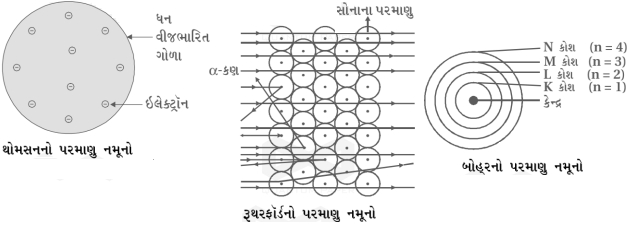
0 likes
View Solution6
MediumMCQ
The difference in the mass of $100 \, mol$ each of sodium atoms and sodium ions is $5.48002 \, g$. Compute the mass of an electron.
A
$6.2 \times 10^{-31} \, kg$
B
$5.8 \times 10^{-31} \, kg$
C
$9.1 \times 10^{-31} \, kg$
D
$1.8 \times 10^{-28} \, kg$
Solution
(C) sodium atom $(Na)$ and a sodium ion $(Na^+)$ differ by exactly one electron.
For $100 \, mol$ of sodium atoms and $100 \, mol$ of sodium ions, the difference in mass is due to $100 \, mol$ of electrons.
Given, mass of $100 \, mol$ of electrons $= 5.48002 \, g$.
Mass of $1 \, mol$ of electrons $= \frac{5.48002}{100} \, g = 0.0548002 \, g$.
Since $1 \, mol$ contains $6.022 \times 10^{23}$ electrons (Avogadro's number), the mass of one electron is calculated as:
Mass of one electron $= \frac{0.0548002 \, g}{6.022 \times 10^{23}} \approx 9.108 \times 10^{-26} \, g$.
Wait, recalculating: $0.0548002 / 6.022 \approx 0.0091 \times 10^{-23} = 9.1 \times 10^{-26} \, g$ is incorrect. Let's re-evaluate: $5.48002 \, g / 100 = 0.0548002 \, g$. Dividing by $6.022 \times 10^{23}$ gives $9.1 \times 10^{-26} \, g$. Converting to $kg$: $9.1 \times 10^{-29} \, kg$.
Correction: The standard mass of an electron is $9.1 \times 10^{-31} \, kg$. The provided value $5.48002 \, g$ for $100 \, mol$ is consistent with $9.1 \times 10^{-31} \, kg$ because $100 \times 6.022 \times 10^{23} \times 9.1 \times 10^{-31} \, kg = 5.48002 \times 10^{-2} \, kg = 5.48002 \, g$.
0 likes
View Solution7
EasyMCQ
Which of the following statements is always correct?
A
An atom has an equal number of electrons and protons.
B
An atom has an equal number of electrons and neutrons.
C
An atom has an equal number of protons and neutrons.
D
An atom has an equal number of electrons,protons,and neutrons.
Solution
(A) An atom is electrically neutral because it contains an equal number of positively charged protons and negatively charged electrons. While the number of neutrons can vary (leading to isotopes),the number of protons and electrons must be equal for the atom to remain neutral.
0 likes
View Solution8
EasyMCQ
Electrons possess a negative charge,and protons possess a positive charge. An atom contains both,but why does it have no net charge?
A
The number of protons is zero.
B
The number of electrons is zero.
C
The negative and positive charges are equal in magnitude and cancel each other out.
D
The atom does not contain any subatomic particles.
Solution
(C) An atom consists of protons,neutrons,and electrons.
Protons carry a positive charge,while electrons carry a negative charge.
In a neutral atom,the number of protons is equal to the number of electrons.
Since the magnitude of the positive charge of a proton is exactly equal to the magnitude of the negative charge of an electron,they cancel each other out.
Therefore,the atom as a whole is electrically neutral.
0 likes
View Solution9
Easy
$J. Chadwick$ discovered a subatomic particle which has no charge and has a mass nearly equal to that of a proton. Name the particle and give its location in the atom.
Solution
(N/A) The particle discovered by $J. Chadwick$ is the neutron.
It is located in the nucleus of the atom along with protons.
It is located in the nucleus of the atom along with protons.
0 likes
View Solution10
EasyMCQ
Who discovered the neutron?
A
Rutherford
B
Thomson
C
Bohr
D
Chadwick
Solution
(D) The neutron was discovered by James Chadwick in $1932$. He bombarded beryllium atoms with alpha particles,which resulted in the emission of neutral particles that he identified as neutrons.
0 likes
View Solution11
Medium
$(i)$ Name the scientist who discovered neutrons.
$(ii)$ State the charge and mass of a neutron.
$(iii)$ Where is a neutron located in an atom?
$(ii)$ State the charge and mass of a neutron.
$(iii)$ Where is a neutron located in an atom?
Solution
(N/A) $(i)$ The scientist who discovered neutrons is $J. Chadwick$.
$(ii)$ $A$ neutron has no electric charge (it is neutral) and its mass is approximately $1.67 \times 10^{-27} \text{ kg}$, which is nearly equal to the mass of a proton.
$(iii)$ Neutrons are located inside the nucleus of an atom along with protons.
$(ii)$ $A$ neutron has no electric charge (it is neutral) and its mass is approximately $1.67 \times 10^{-27} \text{ kg}$, which is nearly equal to the mass of a proton.
$(iii)$ Neutrons are located inside the nucleus of an atom along with protons.
0 likes
View Solution12
Medium
$(a)$ What are canal rays? Who discovered them? What is the charge and mass of canal rays?
$(b)$ How are the canal rays different from electrons in terms of charge and mass?
$(b)$ How are the canal rays different from electrons in terms of charge and mass?
Solution
(N/A) Canal rays are positively charged radiations produced in a gas discharge tube. They were discovered by $E. \text{ Goldstein}$. The charge of canal rays is positive,and their mass is approximately equal to the mass of a proton $(1 \text{ atomic mass unit})$.
$(b)$ Canal rays are positively charged,whereas electrons are negatively charged. The mass of an electron is extremely small,approximately $1/1837$ (or often approximated as $1/2000$) of the mass of a proton (canal ray).
$(b)$ Canal rays are positively charged,whereas electrons are negatively charged. The mass of an electron is extremely small,approximately $1/1837$ (or often approximated as $1/2000$) of the mass of a proton (canal ray).
0 likes
View Solution13
Medium
List three differences between electron, proton, and neutron.
Solution
(N/A)
| Feature | Electron, Proton, and Neutron Differences |
|---|---|
| $1.$ Charge | Electron has a negative charge, Proton has a positive charge, and Neutron has no charge. |
| $2.$ Location | Electron is present in orbits around the nucleus, whereas both Proton and Neutron are present inside the nucleus. |
| $3.$ Mass | The mass of an electron is negligible ($\frac{1}{2000}$ times that of a proton), while the mass of both proton and neutron is approximately $1$ atomic mass unit $(amu)$. |
0 likes
View Solution14
Easy
Write the charge and mass of an electron.
Solution
(N/A) The charge of an electron is $-1.602 \times 10^{-19} \text{ C}$.
The mass of an electron is approximately $9.109 \times 10^{-31} \text{ kg}$,which is about $\frac{1}{1837}$ (often approximated as $\frac{1}{2000}$) times the mass of a proton.
The mass of an electron is approximately $9.109 \times 10^{-31} \text{ kg}$,which is about $\frac{1}{1837}$ (often approximated as $\frac{1}{2000}$) times the mass of a proton.
0 likes
View Solution15
EasyMCQ
Which of the following statements is always correct?
A
An atom has an equal number of electrons and neutrons.
B
An atom has an equal number of protons and neutrons.
C
An atom has an equal number of electrons and protons.
D
An atom has an equal number of electrons,protons,and neutrons.
Solution
(C) In a neutral atom,the number of negatively charged electrons is always equal to the number of positively charged protons in the nucleus. This balance ensures that the atom remains electrically neutral. While the number of neutrons can vary (leading to isotopes),the equality between electrons and protons is a fundamental property of any neutral atom.
0 likes
View Solution16
EasyMCQ
The charge on an electron is equal to
A
$1.6 \times 10^{-23} \text{ C}$ of $-ve$ charge
B
$1.6 \times 10^{-22} \text{ C}$ of $-ve$ charge
C
$2.6 \times 10^{-19} \text{ C}$ of $-ve$ charge
D
$1.6 \times 10^{-19} \text{ C}$ of $-ve$ charge
Solution
(D) The fundamental charge of an electron is a constant value in physics and chemistry.
It is experimentally determined to be approximately $1.602 \times 10^{-19} \text{ C}$.
Since an electron is a negatively charged subatomic particle,its charge is represented as $-1.6 \times 10^{-19} \text{ C}$.
Therefore,the correct option is $D$.
It is experimentally determined to be approximately $1.602 \times 10^{-19} \text{ C}$.
Since an electron is a negatively charged subatomic particle,its charge is represented as $-1.6 \times 10^{-19} \text{ C}$.
Therefore,the correct option is $D$.
0 likes
View Solution17
EasyMCQ
The presence of protons and neutrons at the center of the atom was suggested by:
A
Protons by $J. Chadwick$ and neutrons by $E. Goldstein$
B
Protons by $E. Goldstein$ and neutrons by $J. Chadwick$
C
Protons by $E. Goldstein$ and neutrons by $J.J. Thomson$
D
Protons by $J. Chadwick$ and neutrons by $J.J. Thomson$
Solution
(B) The proton was discovered by $E. Goldstein$ in $1886$ through his canal ray experiments.
The neutron was discovered by $J. Chadwick$ in $1932$ when he bombarded beryllium with alpha particles.
Therefore,the correct association is that protons were identified by $E. Goldstein$ and neutrons by $J. Chadwick$.
The neutron was discovered by $J. Chadwick$ in $1932$ when he bombarded beryllium with alpha particles.
Therefore,the correct association is that protons were identified by $E. Goldstein$ and neutrons by $J. Chadwick$.
0 likes
View Solution18
Medium
After combing his hair,Sameer kept the comb on the table where some pieces of paper were lying. He observed that the plastic comb attracted small pieces of paper. He was surprised to see this and asked his teacher about it. His teacher explained to Sameer that matter contains charged particles and that an electrically charged object can attract an uncharged object. Specifically,upon rubbing with dry hair,a comb acquires an electric charge,which then attracts the pieces of paper.
$(a)$ Give any other practical application of this.
$(b)$ What kind of qualities are shown by Sameer?
$(a)$ Give any other practical application of this.
$(b)$ What kind of qualities are shown by Sameer?
Solution
(A) Rubbing a glass rod with a silk cloth. When a glass rod is rubbed with a silk cloth,the rod acquires an electric charge. When this charged glass rod is brought near an inflated balloon,it attracts the balloon.
$(b)$ The qualities shown by Sameer are:
$(i)$ Curious/Resourceful
$(ii)$ Keen observer
$(iii)$ Respectful towards teachers
$(b)$ The qualities shown by Sameer are:
$(i)$ Curious/Resourceful
$(ii)$ Keen observer
$(iii)$ Respectful towards teachers
0 likes
View SolutionSTRUCTURE OF THE ATOM — Charged Particles in Matter · Frequently Asked Questions
1Are these STRUCTURE OF THE ATOM questions useful for JEE and NEET?
Yes. All questions in this section are mapped to JEE Main and NEET exam patterns. Previous year questions from JEE Main, NEET, GUJCET and state-level exams are included with full solutions.
2Can I switch to Hindi or Gujarati for these questions?
Yes. Use the language tabs in the hero section or the sidebar to view the same questions and solutions in English, Hindi or Gujarati.
3How do I generate a question paper from this subtopic?
Use the Vedclass Exam Paper Generator — select the chapter and subtopic, set difficulty, and generate Sets A, B, C, D automatically. First 3 chapters of every subject are free.
Vedclass Products
For Students
Vedclass Test Series
Mock tests in real JEE/NEET style with performance analysis. 5-day free trial.
Start Free TrialFor Teachers
Exam Paper Generator
Generate Set A/B/C/D papers from this chapter in 2 minutes. 3 chapters free.
Try FreeFor Institutes
Online Exam Module
Live online exams with unlimited students, 360° analytics & white-label branding.
See DemoFor Teachers & Institutes
Generate a STRUCTURE OF THE ATOM Exam Paper in 2 Minutes
Select subtopic & difficulty — Sets A, B, C, D auto-generated with No Repeat logic.
First 3 chapters of every subject are free — no payment required.