
A English
Mix Examples - STRUCTURE OF THE ATOM Questions in English
Class 9 Science · STRUCTURE OF THE ATOM · Mix Examples - STRUCTURE OF THE ATOM
17+
Questions
English
Language
100%
With Solutions
Showing 17 of 17 questions in English
1
MediumMCQ
For the following statements,write $T$ for True and $F$ for False.
$(a)$ $J$.$J$. Thomson proposed that the nucleus of an atom contains only nucleons.
$(b)$ $A$ neutron is formed by an electron and a proton combining together. Therefore,it is neutral.
$(c)$ The mass of an electron is about $\frac{1}{2000}$ times that of a proton.
$(d)$ An isotope of iodine is used for making tincture iodine,which is used as a medicine.
A
$(a)-(T); (b)-(F); (c)-(T); (d)-(F)$
B
$(a)-(F); (b)-(T); (c)-(T); (d)-(F)$
C
$(a)-(F); (b)-(F); (c)-(T); (d)-(F)$
D
$(a)-(T); (b)-(F); (c)-(F); (d)-(T)$
Solution
(C) False: $J$.$J$. Thomson proposed the plum pudding model,not the existence of a nucleus containing nucleons; the nucleus was discovered by Ernest Rutherford.
$(b)$ False: $A$ neutron is a fundamental subatomic particle and is not formed by the combination of an electron and a proton.
$(c)$ True: The mass of an electron is approximately $\frac{1}{1837}$ to $\frac{1}{2000}$ times the mass of a proton.
$(d)$ False: Tincture of iodine is a solution of iodine in alcohol,not specifically an isotope of iodine.
0 likes
View Solution2
MediumMCQ
Identify the $Mg^{2+}$ ion from the figures,where $n$ and $p$ represent the number of neutrons and protons,respectively.
A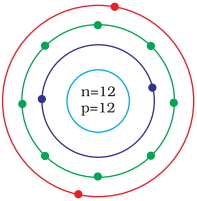
B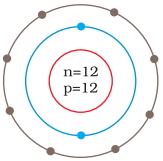
C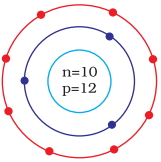
D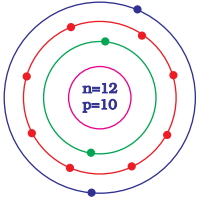
Solution
(C) The atomic number of Magnesium $(Mg)$ is $12$,which means it has $12$ protons $(p=12)$.
The electronic configuration of a neutral $Mg$ atom is $2, 8, 2$.
When $Mg$ forms a $Mg^{2+}$ ion,it loses $2$ electrons from its outermost shell,resulting in an electronic configuration of $2, 8$ (a total of $10$ electrons).
Therefore,the $Mg^{2+}$ ion must have $p=12$ and $10$ electrons in its shells.
Looking at the provided figures:
- Figure $C$ shows $p=12$ and $10$ electrons (arranged as $2$ in the inner shell and $8$ in the outer shell).
Thus,figure $C$ represents the $Mg^{2+}$ ion.
0 likes
View Solution3
Medium
What information do you get from the figure about the atomic number,mass number,and valency of atoms $X$,$Y$,and $Z$? Give your answer in a tabular form.
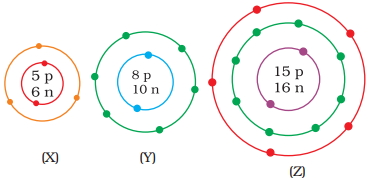
Solution
(N/A) The atomic number is equal to the number of protons. The mass number is the sum of protons and neutrons. The valency is determined by the number of electrons in the outermost shell (valence shell).
| Atom | Atomic No. | Mass No. | Valency |
|---|---|---|---|
| $X$ | $5$ | $11$ | $3$ |
| $Y$ | $8$ | $18$ | $2$ |
| $Z$ | $15$ | $31$ | $3$ |
0 likes
View Solution4
Medium
Match the names of the scientists given in column $A$ with their contributions towards the understanding of the atomic structure as given in column $B$.
| Column $A$ | Column $B$ |
| $(a)$ Ernest Rutherford | $(i)$ Indivisibility of atoms |
| $(b)$ $J$.$J$. Thomson | $(ii)$ Stationary orbits |
| $(c)$ Dalton | $(iii)$ Concept of nucleus |
| $(d)$ Neils Bohr | $(iv)$ Discovery of electrons |
| $(e)$ James Chadwick | $(v)$ Atomic number |
| $(f)$ $E$. Goldstein | $(vi)$ Neutron |
| $(g)$ Mosley | $(vii)$ Canal rays |
Solution
(A) $(a)-(iii)$: Ernest Rutherford proposed the nuclear model of the atom, introducing the concept of the nucleus.
$(b)-(iv)$: $J$.$J$. Thomson discovered the electron through his cathode ray experiments.
$(c)-(i)$: John Dalton proposed the atomic theory, which stated that atoms are indivisible.
$(d)-(ii)$: Neils Bohr proposed that electrons revolve in discrete stationary orbits around the nucleus.
$(e)-(vi)$: James Chadwick discovered the neutron.
$(f)-(vii)$: $E$. Goldstein discovered canal rays (protons) in a discharge tube.
$(g)-(v)$: Henry Moseley discovered the concept of atomic number.
0 likes
View Solution5
Medium
Fill in the blanks in the following statements:
$(a)$ Rutherford's $\alpha$-particle scattering experiment led to the discovery of the ............
$(b)$ Isotopes have same ............ but different .............
$(c)$ Neon and chlorine have atomic numbers $10$ and $17$ respectively. Their valencies will be ............ and ............. respectively.
$(d)$ The electronic configuration of silicon is .......... and that of sulphur is ...........
Solution
(N/A) The experiment led to the discovery of the atomic nucleus.
$(b)$ Isotopes are atoms of the same element having the same atomic number but different mass numbers.
$(c)$ Neon $(Z=10)$ has an electronic configuration of $2, 8$,so its valency is $0$. Chlorine $(Z=17)$ has an electronic configuration of $2, 8, 7$,so it needs $1$ electron to complete its octet,making its valency $1$.
$(d)$ Silicon $(Z=14)$ has an electronic configuration of $2, 8, 4$. Sulphur $(Z=16)$ has an electronic configuration of $2, 8, 6$.
0 likes
View Solution6
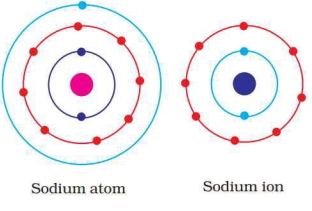
Show diagrammatically the electron distributions in a sodium atom and a sodium ion and also give their atomic number.
Solution
(N/A) Since the atomic number of a sodium atom is $11$,it has $11$ electrons.
$A$ positively charged sodium ion $(Na^+)$ is formed by the removal of one electron from a sodium atom.
So,a sodium ion has $11 - 1 = 10$ electrons in it.
Thus,the electronic distribution of a sodium ion will be $2, 8$.
The atomic number of an element is equal to the number of protons in its atom.
Since a sodium atom and a sodium ion contain the same number of protons,the atomic number of both is $11$.
0 likes
View Solution7
Medium
$(a)$ An atom is considered electrically neutral. Explain.
$(b)$ State the valency of Helium.
$(c)$ If an atom has an atomic mass of $4$ and $2$ protons in its nucleus,how many neutrons does it have?
$(b)$ State the valency of Helium.
$(c)$ If an atom has an atomic mass of $4$ and $2$ protons in its nucleus,how many neutrons does it have?
Solution
(N/A) An atom is considered electrically neutral because it contains an equal number of positively charged protons and negatively charged electrons,which cancel out each other's charge.
$(b)$ The valency of Helium is $0$ because its outermost shell is completely filled (it has a stable duplet configuration).
$(c)$ The formula for atomic mass is: $\text{Atomic mass} = \text{Number of protons} + \text{Number of neutrons}$.
Given: $\text{Atomic mass} = 4$,$\text{Number of protons} = 2$.
Substituting the values: $4 = 2 + \text{Number of neutrons}$.
Therefore,$\text{Number of neutrons} = 4 - 2 = 2$.
0 likes
View Solution8
Difficult
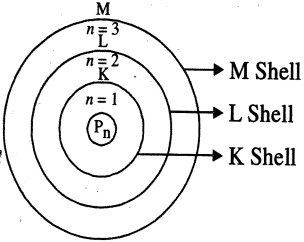
$(a)$ Describe the main features of Bohr's model of an atom. Draw a neat and labelled diagram of energy levels.
$(b)$ Which of the following pairs are isotopes and which are isobars?
$(i)$ $_{26}^{58} A, _{28}^{58} B$
$(ii)$ $_{35}^{79} X, _{35}^{80} Y$
$(c)$ Elements $A$ and $B$ have atomic numbers $18$ and $16$ respectively. Which of these two would be more reactive and why?
$(b)$ Which of the following pairs are isotopes and which are isobars?
$(i)$ $_{26}^{58} A, _{28}^{58} B$
$(ii)$ $_{35}^{79} X, _{35}^{80} Y$
$(c)$ Elements $A$ and $B$ have atomic numbers $18$ and $16$ respectively. Which of these two would be more reactive and why?
Solution
(N/A) Features of Bohr's Model of an Atom:
$(i)$ Electrons revolve in discrete orbits,which are associated with a fixed amount of energy. These are called energy levels or shells,designated as $K, L, M, N, ...$
$(ii)$ While revolving in these discrete orbits,electrons do not radiate energy.
$(iii)$ The energy of an orbit increases as its distance from the nucleus increases. The orbit closest to the nucleus has the lowest energy.
$(iv)$ When energy is supplied to an electron,it jumps to a higher energy level. When it returns to a lower energy level,it emits energy in the form of radiation.
$(b)$ $(i)$ $_{26}^{58} A$ and $_{28}^{58} B$ are isobars because they have the same mass number $(58)$ but different atomic numbers ($26$ and $28$).
$(ii)$ $_{35}^{79} X$ and $_{35}^{80} Y$ are isotopes because they have the same atomic number $(35)$ but different mass numbers ($79$ and $80$).
$(c)$ Element $B$ (atomic number $16$) is more reactive than element $A$ (atomic number $18$). The electronic configuration of $A$ is $2, 8, 8$,which is a stable octet (noble gas configuration). The electronic configuration of $B$ is $2, 8, 6$,which requires two more electrons to complete its octet,making it chemically reactive.
0 likes
View Solution9
Medium
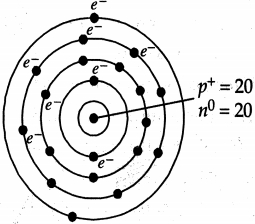
$(a)$ Calculate the number of electrons,protons,and neutrons in an atom of an element with atomic number $20$ and mass number $40$. Write the electronic configuration and draw the structure of the atom.
$(b)$ An atom has complete $K$ and $L$ shells. Is this an atom of a metal,non-metal,or noble gas? Justify.
$(b)$ An atom has complete $K$ and $L$ shells. Is this an atom of a metal,non-metal,or noble gas? Justify.
Solution
(N/A) For an element with atomic number $Z = 20$ and mass number $A = 40$:
Number of protons $= Z = 20$
Number of electrons $= Z = 20$
Number of neutrons $= A - Z = 40 - 20 = 20$
Electronic configuration: $K=2, L=8, M=8, N=2$.
The structure of the atom consists of a nucleus containing $20$ protons and $20$ neutrons,surrounded by four shells $(K, L, M, N)$ containing $2, 8, 8,$ and $2$ electrons respectively.
$(b)$ An atom with complete $K$ and $L$ shells has an electronic configuration of $2, 8$. The total number of electrons is $10$,which corresponds to the element Neon $(Ne)$. Since its outermost shell ($L$-shell) is completely filled (octet is complete),it is chemically inert and is classified as a noble gas.
0 likes
View Solution10
EasyMCQ
Which of the following species have $18$ electrons? $Ca^{2+}, K^{+}, Na, Cl^{-}, Ar$. Also,state the reason why the chemical properties of all isotopes of an element are similar.
A
$Ca^{2+}, K^{+}, Cl^{-}, Ar$
B
$K^{+}, Na, Cl^{-}, Ar$
C
$Ca^{2+}, Na, Cl^{-}, Ar$
D
$Ca^{2+}, K^{+}, Na, Cl^{-}$
Solution
(A) $1$. To find the number of electrons:
- $Ca$ (atomic number $20$) has $20$ electrons. $Ca^{2+}$ has $20 - 2 = 18$ electrons.
- $K$ (atomic number $19$) has $19$ electrons. $K^{+}$ has $19 - 1 = 18$ electrons.
- $Na$ (atomic number $11$) has $11$ electrons.
- $Cl$ (atomic number $17$) has $17$ electrons. $Cl^{-}$ has $17 + 1 = 18$ electrons.
- $Ar$ (atomic number $18$) has $18$ electrons.
Thus,$Ca^{2+}, K^{+}, Cl^{-},$ and $Ar$ have $18$ electrons.
$2$. Isotopes of an element have the same atomic number,which means they have the same number of protons and electrons. Since chemical properties are determined by the electronic configuration (specifically valence electrons),all isotopes of an element exhibit similar chemical properties.
0 likes
View Solution11
Medium
Give reasons for the following:
$(a)$ Isotopes of an element are chemically similar.
$(b)$ An atom is electrically neutral.
$(c)$ Noble gases show least reactivity.
$(d)$ Nucleus of an atom is heavy and positively charged.
$(e)$ Ions are more stable than atoms.
$(a)$ Isotopes of an element are chemically similar.
$(b)$ An atom is electrically neutral.
$(c)$ Noble gases show least reactivity.
$(d)$ Nucleus of an atom is heavy and positively charged.
$(e)$ Ions are more stable than atoms.
Solution
(N/A) Isotopes of an element have the same atomic number and electronic configuration. Since chemical properties are determined by electronic configuration,isotopes exhibit similar chemical behavior.
$(b)$ An atom contains an equal number of protons (positively charged) and electrons (negatively charged). The opposite charges cancel each other out,making the atom electrically neutral.
$(c)$ Noble gases have a complete outermost shell (stable octet or duplet configuration),which makes them chemically inert or least reactive.
$(d)$ The nucleus contains protons and neutrons. Protons are positively charged,and since both protons and neutrons have significant mass compared to electrons,the nucleus is heavy and positively charged.
$(e)$ Ions are more stable because they have achieved a complete valence shell (stable octet or duplet),similar to the configuration of noble gases.
0 likes
View Solution12
Medium
Give reasons:
$(a)$ Mass number of an atom excludes the mass of an electron.
$(b)$ The nucleus of an atom is charged.
$(c)$ The alpha particle scattering experiment was possible by using gold foil only and not by foil of any other metal.
$(a)$ Mass number of an atom excludes the mass of an electron.
$(b)$ The nucleus of an atom is charged.
$(c)$ The alpha particle scattering experiment was possible by using gold foil only and not by foil of any other metal.
Solution
(N/A) Electrons have negligible mass; therefore,the mass of an atom is practically determined by the protons and neutrons present in the nucleus.
$(b)$ The nucleus is positively charged because it consists of positively charged protons.
$(c)$ The gold foil was used because it is highly malleable and could be made extremely thin,approximately $1000$ atoms thick,which was necessary for the alpha particles to pass through with minimal interference.
0 likes
View Solution13
Medium
Give reasons for the following:
$(a)$ In potassium and calcium,the filling of electrons in the $N$-shell starts after the $M$-shell has acquired $8$ electrons,although the $M$-shell can accommodate up to $18$ electrons. Why?
$(b)$ There is a difference between mass number and atomic mass.
$(a)$ In potassium and calcium,the filling of electrons in the $N$-shell starts after the $M$-shell has acquired $8$ electrons,although the $M$-shell can accommodate up to $18$ electrons. Why?
$(b)$ There is a difference between mass number and atomic mass.
Solution
(N/A) As the atomic number increases,the energy difference between successive shells decreases. Consequently,the $M$ and $N$ energy shells come close enough to overlap. Due to this,electrons begin entering the $N$-shell once the $M$-shell has acquired $8$ electrons. However,once the $N$-shell acquires $2$ electrons,the $M$-shell shifts to a relatively lower energy level,allowing further electrons to enter and complete the $M$-shell.
$(b)$ The mass number is always a whole number because it represents the sum of protons and neutrons,which are discrete particles. In contrast,atomic mass is typically not a whole number because it is a relative mass calculated by comparing the average mass of an atom to $1/12$th the mass of a $C-12$ atom. For most practical purposes,atomic mass is approximated as equal to the mass number.
$(b)$ The mass number is always a whole number because it represents the sum of protons and neutrons,which are discrete particles. In contrast,atomic mass is typically not a whole number because it is a relative mass calculated by comparing the average mass of an atom to $1/12$th the mass of a $C-12$ atom. For most practical purposes,atomic mass is approximated as equal to the mass number.
0 likes
View Solution14
Medium
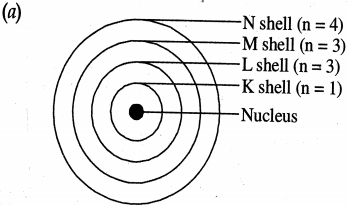
$(a) (i)$ Name the scientist who proposed this model of the atom.
$(ii)$ Write the three postulates of this model.
$(iii)$ How many maximum electrons can be accommodated in the $M$ orbit?
$(b)$ What are canal rays? Give the characteristics of canal rays.
$(ii)$ Write the three postulates of this model.
$(iii)$ How many maximum electrons can be accommodated in the $M$ orbit?
$(b)$ What are canal rays? Give the characteristics of canal rays.
Solution
(N/A) $(a) (i)$ This is Neils Bohr's model of the atom.
$(ii)$ Postulates of Bohr's model:
$1$. $A$ positively charged nucleus is present in the centre of the atom.
$2$. Electrons revolve around the nucleus in fixed circular paths called shells or orbits,which are named as $K, L, M, N, \dots$ or $1, 2, 3, 4$.
$3$. Shells are also called energy levels as each shell is associated with a fixed amount of energy. Electrons do not lose or gain energy while revolving in a specific shell.
$(iii)$ The maximum number of electrons in a shell is given by the formula $2n^2$. For the $M$ shell,$n = 3$,so the maximum number of electrons is $2(3)^2 = 2 \times 9 = 18$.
$(b)$ Canal rays are positively charged radiations which consist of positively charged particles. They were discovered by $E. \text{ Goldstein}$.
Characteristics of canal rays:
$1$. They consist of positively charged particles.
$2$. They travel in a straight line.
$3$. They have a charge equal in magnitude but opposite in sign to that of an electron.
0 likes
View Solution15
Medium
Answer the following in one line or one word:
$(a)$ Who discovered the neutron?
$(b)$ On the basis of Thomson's model of an atom,explain how the atom is neutral as a whole.
$(c)$ What is the maximum number of electrons that can be accommodated in the outermost shell of an atom?
$(d)$ What term is assigned to the atoms of different elements having the same atomic mass but different atomic numbers?
$(e)$ How many neutrons are present in a hydrogen atom?
Solution
(N/A) The neutron was discovered by James Chadwick.
$(b)$ According to Thomson's model of an atom,the negative and positive charges are equal in magnitude,which makes the atom electrically neutral as a whole.
$(c)$ The maximum number of electrons that can be accommodated in the outermost shell is $8$.
$(d)$ Atoms of different elements having the same atomic mass but different atomic numbers are called isobars.
$(e)$ $A$ hydrogen atom contains $0$ neutrons.
0 likes
View Solution16
Medium
Give a brief account of the development of the presently accepted model of the atom with the contributions made by different scientists. Write two features of this atomic model.
Solution
(N/A) The development of the atomic model progressed through several stages:
$1$. Thomson's Model: $J$.$J$. Thomson proposed that an atom consists of a positively charged sphere with negatively charged electrons embedded in it,similar to seeds in a watermelon. The total positive and negative charges are equal.
$2$. Rutherford's Model: Ernest Rutherford proposed that an atom has a tiny,positively charged central nucleus containing almost all the mass. Electrons revolve around this nucleus in circular paths.
$3$. Bohr's Model: Niels Bohr refined the model by proposing that electrons revolve in discrete,stable orbits without radiating energy.
Features of the presently accepted model (Bohr-Rutherford model):
$(i)$ The atom has a small,dense,positively charged nucleus at the center where the entire mass is concentrated.
$(ii)$ Electrons revolve around the nucleus in specific,well-defined circular orbits called discrete energy levels or shells,and they do not lose energy while moving in these orbits.
0 likes
View Solution17
MediumMCQ
Atomic models have been improved over the years. Arrange the following atomic models in their chronological order:
$(i)$ Rutherford's atomic model
$(ii)$ Thomson's atomic model
$(iii)$ Bohr's atomic model
$(i)$ Rutherford's atomic model
$(ii)$ Thomson's atomic model
$(iii)$ Bohr's atomic model
A
$(i), (ii)$ and $(iii)$
B
$(ii), (iii)$ and $(i)$
C
$(ii), (i)$ and $(iii)$
D
$(iii), (ii)$ and $(i)$
Solution
(C) The chronological order of the development of atomic models is as follows:
$1$. Thomson's atomic model was proposed in $1904$.
$2$. Rutherford's atomic model was proposed in $1911$.
$3$. Bohr's atomic model was proposed in $1913$.
Therefore,the correct chronological order is $(ii), (i)$ and $(iii)$.
$1$. Thomson's atomic model was proposed in $1904$.
$2$. Rutherford's atomic model was proposed in $1911$.
$3$. Bohr's atomic model was proposed in $1913$.
Therefore,the correct chronological order is $(ii), (i)$ and $(iii)$.
0 likes
View SolutionSTRUCTURE OF THE ATOM — Mix Examples - STRUCTURE OF THE ATOM · Frequently Asked Questions
1Are these STRUCTURE OF THE ATOM questions useful for JEE and NEET?
Yes. All questions in this section are mapped to JEE Main and NEET exam patterns. Previous year questions from JEE Main, NEET, GUJCET and state-level exams are included with full solutions.
2Can I switch to Hindi or Gujarati for these questions?
Yes. Use the language tabs in the hero section or the sidebar to view the same questions and solutions in English, Hindi or Gujarati.
3How do I generate a question paper from this subtopic?
Use the Vedclass Exam Paper Generator — select the chapter and subtopic, set difficulty, and generate Sets A, B, C, D automatically. First 3 chapters of every subject are free.
Vedclass Products
For Students
Vedclass Test Series
Mock tests in real JEE/NEET style with performance analysis. 5-day free trial.
Start Free TrialFor Teachers
Exam Paper Generator
Generate Set A/B/C/D papers from this chapter in 2 minutes. 3 chapters free.
Try FreeFor Institutes
Online Exam Module
Live online exams with unlimited students, 360° analytics & white-label branding.
See DemoFor Teachers & Institutes
Generate a STRUCTURE OF THE ATOM Exam Paper in 2 Minutes
Select subtopic & difficulty — Sets A, B, C, D auto-generated with No Repeat logic.
First 3 chapters of every subject are free — no payment required.