
A English
Distribution of Electrons and Valency Questions in English
Class 9 Science · STRUCTURE OF THE ATOM · Distribution of Electrons and Valency
47+
Questions
English
Language
100%
With Solutions
Showing 47 of 47 questions in English
1
Difficult
Write the distribution of electrons in carbon and sodium atoms.
Solution
The total number of electrons in a carbon atom is $6$. The distribution of electrons in a carbon atom is given by:
First orbit or $K$-shell $= 2$ electrons
Second orbit or $L$-shell $= 4$ electrons
Thus,the electron distribution in a carbon atom is $2, 4$.
The total number of electrons in a sodium atom is $11$. The distribution of electrons in a sodium atom is given by:
First orbit or $K$-shell $= 2$ electrons
Second orbit or $L$-shell $= 8$ electrons
Third orbit or $M$-shell $= 1$ electron
Thus,the electron distribution in a sodium atom is $2, 8, 1$.
First orbit or $K$-shell $= 2$ electrons
Second orbit or $L$-shell $= 4$ electrons
Thus,the electron distribution in a carbon atom is $2, 4$.
The total number of electrons in a sodium atom is $11$. The distribution of electrons in a sodium atom is given by:
First orbit or $K$-shell $= 2$ electrons
Second orbit or $L$-shell $= 8$ electrons
Third orbit or $M$-shell $= 1$ electron
Thus,the electron distribution in a sodium atom is $2, 8, 1$.
0 likes
View Solution2
EasyMCQ
If $K$ and $L$ shells of an atom are full,then what would be the total number of electrons in the atom?
A
$8$
B
$10$
C
$6$
D
$2$
Solution
(B) The maximum capacity of the $K$ shell is $2$ electrons.
The maximum capacity of the $L$ shell is $8$ electrons.
If both shells are full,the total number of electrons is the sum of the electrons in both shells.
Total electrons $= 2 + 8 = 10$ electrons.
The maximum capacity of the $L$ shell is $8$ electrons.
If both shells are full,the total number of electrons is the sum of the electrons in both shells.
Total electrons $= 2 + 8 = 10$ electrons.
0 likes
View Solution3
Difficult
Find the valency of chlorine,sulphur,and magnesium.
Solution
(N/A) If the number of electrons in the outermost shell of an atom is less than or equal to $4$,the valency is equal to the number of valence electrons.
If the number of electrons in the outermost shell is greater than $4$,the valency is determined by subtracting the number of valence electrons from $8$.
The electronic configurations are:
Chlorine $(Z=17)$: $2, 8, 7$
Sulphur $(Z=16)$: $2, 8, 6$
Magnesium $(Z=12)$: $2, 8, 2$
For Chlorine: The outermost shell has $7$ electrons. Since $7 > 4$,valency $= 8 - 7 = 1$.
For Sulphur: The outermost shell has $6$ electrons. Since $6 > 4$,valency $= 8 - 6 = 2$.
For Magnesium: The outermost shell has $2$ electrons. Since $2 \leq 4$,valency $= 2$.
0 likes
View Solution4
Medium
Summarize the rules for writing the distribution of electrons in various shells for the first eighteen elements.
Solution
(N/A) The rules for writing the distribution of electrons in various shells for the first eighteen elements are as follows:
$\rightarrow$ If $n$ represents the number of the orbit or energy level,then $2n^2$ gives the maximum number of electrons that can be accommodated in a given orbit or energy level.
Thus:
- The first orbit or $K$-shell can have a maximum of $2(1)^2 = 2$ electrons.
- The second orbit or $L$-shell can have a maximum of $2(2)^2 = 8$ electrons.
- The third orbit or $M$-shell can have a maximum of $2(3)^2 = 18$ electrons.
$\rightarrow$ The outermost orbit of an atom can accommodate a maximum of $8$ electrons.
$\rightarrow$ Electrons are filled in a step-wise manner in different orbits,starting from the innermost shell. Electrons do not occupy a higher energy shell until the inner shells are completely filled.
0 likes
View Solution5
Medium
Define valency by taking examples of silicon and oxygen.
Solution
(N/A) The valency of an element is defined as the combining capacity of that element.
The valency of an element is determined by the number of valence electrons present in the outermost shell of its atom.
$1$. Valency of Silicon: The atomic number of silicon is $14$. Its electronic configuration is $2, 8, 4$. Since it has $4$ valence electrons,it shares these electrons to complete its octet. Therefore,the valency of silicon is $4$.
$2$. Valency of Oxygen: The atomic number of oxygen is $8$. Its electronic configuration is $2, 6$. To complete its octet,it needs $2$ more electrons. Therefore,the valency of oxygen is $2$.
0 likes
View Solution6
Easy
$Na^{+}$ has completely filled $K$ and $L$ shells. Explain.
Solution
(N/A) The atomic number of sodium $(Na)$ is $11$.
In a neutral sodium atom,there are $11$ electrons,and its electronic configuration is $2, 8, 1$.
When a sodium atom loses one electron to form a sodium ion $(Na^{+})$,it is left with $10$ electrons.
The distribution of these $10$ electrons in the shells is as follows:
- $K$-shell: $2$ electrons
- $L$-shell: $8$ electrons
Since the maximum capacity of the $K$-shell is $2$ and the $L$-shell is $8$,both shells are completely filled in $Na^{+}$.
0 likes
View Solution7
MediumMCQ
If $Z = 3$,what would be the valency of the element? Also,name the element.
A
hydrogen
B
beryllium
C
helium
D
lithium
Solution
(D) By $Z = 3$,we mean that the atomic number of the element is $3$.
Its electronic configuration is $2, 1$.
Since the outermost shell has only $1$ electron,the element needs to lose $1$ electron to achieve a stable configuration.
Therefore,the valency of the element is $1$.
The element with atomic number $Z = 3$ is lithium.
Its electronic configuration is $2, 1$.
Since the outermost shell has only $1$ electron,the element needs to lose $1$ electron to achieve a stable configuration.
Therefore,the valency of the element is $1$.
The element with atomic number $Z = 3$ is lithium.
0 likes
View Solution8
MediumMCQ
Number of valence electrons in $Cl^-$ ion are :
A
$8$
B
$16$
C
$17$
D
$18$
Solution
(A) The atomic number of Chlorine $(Cl)$ is $17$.
Electronic configuration of $Cl$ atom: $1s^2 2s^2 2p^6 3s^2 3p^5$.
The number of valence electrons in a neutral $Cl$ atom is $7$ (electrons in the $3rd$ shell).
The $Cl^-$ ion is formed by gaining one electron into its valence shell.
Therefore,the number of valence electrons in $Cl^-$ ion = $7 + 1 = 8$.
0 likes
View Solution9
MediumMCQ
Which one of the following is the correct electronic configuration of sodium?
A
$2, 8$
B
$2, 8, 1$
C
$2, 1, 8$
D
$8, 2, 1$
Solution
(B) The atomic number of sodium $(Na)$ is $11$.
According to the Bohr-Bury scheme,electrons are filled in shells $(K, L, M, N, ...)$ with a maximum capacity of $2n^2$ electrons per shell.
For sodium $(Z = 11)$:
$K$-shell: $2$ electrons
$L$-shell: $8$ electrons
$M$-shell: $1$ electron
Therefore,the electronic configuration is $2, 8, 1$.
According to the Bohr-Bury scheme,electrons are filled in shells $(K, L, M, N, ...)$ with a maximum capacity of $2n^2$ electrons per shell.
For sodium $(Z = 11)$:
$K$-shell: $2$ electrons
$L$-shell: $8$ electrons
$M$-shell: $1$ electron
Therefore,the electronic configuration is $2, 8, 1$.
0 likes
View Solution10
MediumMCQ
Which of the following correctly represents the electronic distribution in the $Mg$ atom?
A
$2, 8, 2$
B
$3, 8, 1$
C
$1, 8, 3$
D
$8, 2, 2$
Solution
(A) The atomic number of Magnesium $(Mg)$ is $12$.
According to the Bohr-Bury scheme,the maximum number of electrons that can be accommodated in a shell is given by the formula $2n^2$,where $n$ is the orbit number.
The first shell ($K$-shell,$n=1$) can hold a maximum of $2(1)^2 = 2$ electrons.
The second shell ($L$-shell,$n=2$) can hold a maximum of $2(2)^2 = 8$ electrons.
The remaining electrons go into the third shell ($M$-shell,$n=3$).
For $Mg$ $(Z=12)$,the distribution is $2$ in the $K$-shell,$8$ in the $L$-shell,and $2$ in the $M$-shell.
Thus,the electronic configuration is $2, 8, 2$.
0 likes
View Solution11
EasyMCQ
Elements with valency $1$ are
A
always metals
B
always metalloids
C
always non-metals
D
either metals or non-metals
Solution
(D) Elements with a valency of $1$ can be metals or non-metals.
For example,Sodium $(Na)$ is a metal with a valency of $1$,while Chlorine $(Cl)$ is a non-metal with a valency of $1$.
Therefore,elements with valency $1$ can be either metals or non-metals.
For example,Sodium $(Na)$ is a metal with a valency of $1$,while Chlorine $(Cl)$ is a non-metal with a valency of $1$.
Therefore,elements with valency $1$ can be either metals or non-metals.
0 likes
View Solution12
EasyMCQ
An atom with $3$ protons and $4$ neutrons will have a valency of
A
$3$
B
$1$
C
$7$
D
$4$
Solution
(B) The number of protons in an atom is equal to its atomic number. Here,the atomic number is $3$,which corresponds to the element Lithium $(Li)$.
Since the atom is neutral,the number of electrons is equal to the number of protons,which is $3$.
The electronic configuration of this atom is $2, 1$.
Since the number of electrons in the outermost shell (valence shell) is $1$,the atom will lose $1$ electron to achieve a stable octet configuration.
Therefore,the valency of the atom is $1$.
0 likes
View Solution13
EasyMCQ
The electron distribution in an aluminium atom is
A
$8, 2, 3$
B
$2, 8, 2$
C
$2, 8, 3$
D
$2, 3, 8$
Solution
(C) The atomic number of aluminium $(Al)$ is $13$.
According to the Bohr-Bury scheme,the maximum number of electrons that can be accommodated in a shell is given by the formula $2n^2$,where $n$ is the orbit number.
For the first shell $(n=1)$,the capacity is $2(1)^2 = 2$ electrons.
For the second shell $(n=2)$,the capacity is $2(2)^2 = 8$ electrons.
For the third shell $(n=3)$,the remaining electrons are placed. Since $13 - 2 - 8 = 3$,the third shell contains $3$ electrons.
Thus,the electron distribution is $2, 8, 3$. Therefore,option $(C)$ is correct.
0 likes
View Solution14
Easy
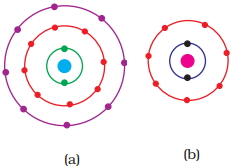
Find out the valency of the atoms represented by the Fig. $(a)$ and $(b)$.
Solution
(N/A) In Fig. $(a)$,the atom has $2$ electrons in the first shell,$8$ in the second,and $8$ in the third shell. Since the outermost shell is completely filled (octet rule),the valency is $0$.
In Fig. $(b)$,the atom has $2$ electrons in the first shell and $7$ in the second shell. To complete its octet,it needs $1$ electron,therefore its valency is $1$.
In Fig. $(b)$,the atom has $2$ electrons in the first shell and $7$ in the second shell. To complete its octet,it needs $1$ electron,therefore its valency is $1$.
0 likes
View Solution15
EasyMCQ
One electron is present in the outermost shell of the atom of an element $X$. What would be the nature and value of charge on the ion formed if this electron is removed from the outermost shell?
A
Negative charge $(-1)$
B
Positive charge $(+1)$
C
Positive charge $(+2)$
D
Neutral $(0)$
Solution
(B) When an atom loses an electron,it loses a negative charge,resulting in an excess of protons relative to electrons.
Since the element $X$ has one electron in its outermost shell,it will lose this single electron to achieve a stable octet configuration.
By losing one electron,the atom gains a net positive charge of $+1$.
Therefore,the nature of the charge is positive and the value is $+1$.
Since the element $X$ has one electron in its outermost shell,it will lose this single electron to achieve a stable octet configuration.
By losing one electron,the atom gains a net positive charge of $+1$.
Therefore,the nature of the charge is positive and the value is $+1$.
0 likes
View Solution16
EasyMCQ
Write down the electron distribution of chlorine atom. How many electrons are there in the $L$ shell? (Atomic number of chlorine is $17$).
A
$8$
B
$7$
C
$2$
D
$5$
Solution
(A) The atomic number of chlorine is $17$.
According to the Bohr-Bury scheme,the electrons are distributed in shells as follows:
$K$ shell $(n=1)$: $2$ electrons
$L$ shell $(n=2)$: $8$ electrons
$M$ shell $(n=3)$: $7$ electrons
Thus,the electron distribution is $2, 8, 7$.
The $L$ shell contains $8$ electrons.
According to the Bohr-Bury scheme,the electrons are distributed in shells as follows:
$K$ shell $(n=1)$: $2$ electrons
$L$ shell $(n=2)$: $8$ electrons
$M$ shell $(n=3)$: $7$ electrons
Thus,the electron distribution is $2, 8, 7$.
The $L$ shell contains $8$ electrons.
0 likes
View Solution17
MediumMCQ
In the atom of an element $X$,$6$ electrons are present in the outermost shell. If it acquires noble gas configuration by accepting the requisite number of electrons,what would be the charge on the ion so formed?
A
$-1$
B
$-2$
C
$2$
D
$1$
Solution
(B) The outermost shell of an atom requires $8$ electrons to achieve a stable noble gas configuration (octet rule).
Since the element $X$ has $6$ electrons in its outermost shell,it needs to gain $8 - 6 = 2$ electrons to complete its octet.
When an atom gains electrons,it becomes a negatively charged ion (anion).
Since it gains $2$ electrons,the charge on the resulting ion will be $-2$.
Since the element $X$ has $6$ electrons in its outermost shell,it needs to gain $8 - 6 = 2$ electrons to complete its octet.
When an atom gains electrons,it becomes a negatively charged ion (anion).
Since it gains $2$ electrons,the charge on the resulting ion will be $-2$.
0 likes
View Solution18
Easy
$A$ helium atom has $2$ electrons in its valence shell,but its valency is not $2$. Explain.
Solution
(N/A) The helium atom has $2$ electrons in its outermost shell,which represents a complete duplet. Since its outermost shell is already full and stable,it does not need to lose,gain,or share electrons to achieve stability. Therefore,its valency is $0$.
0 likes
View Solution19
Easy
An element $X$ has a mass number $4$ and atomic number $2$. What is the valency of this element?
Solution
(0) The atomic number of element $X$ is $2$.
This means it has $2$ electrons in its $K$ shell.
Since the $K$ shell can hold a maximum of $2$ electrons,it is completely filled.
Therefore,the element is stable and does not need to gain,lose,or share electrons.
Hence,the valency of this element is $0$.
This means it has $2$ electrons in its $K$ shell.
Since the $K$ shell can hold a maximum of $2$ electrons,it is completely filled.
Therefore,the element is stable and does not need to gain,lose,or share electrons.
Hence,the valency of this element is $0$.
0 likes
View Solution20
EasyMCQ
Why do Helium,Neon and Argon have a zero valency?
A
They are highly reactive.
B
They have a stable electronic configuration with a completely filled valence shell.
C
They have an incomplete valence shell.
D
They readily lose electrons.
Solution
(B) Helium has $2$ electrons in its only energy shell (duplet),while Neon and Argon have $8$ electrons in their valence shells (octet).
Since these elements have the maximum number of electrons in their outermost shells,their valence shells are completely filled.
This stable electronic configuration means they have no tendency to gain,lose,or share electrons with other elements.
Therefore,their combining capacity,or valency,is equal to $0$.
0 likes
View Solution21
Easy
Helium atom has $2$ electrons in its valence shell,but its valency is not $2$. Explain.
Solution
(N/A) The Helium atom has only one shell ($K$-shell),which has a maximum capacity of accommodating $2$ electrons. Since this shell is completely filled,the atom is stable and does not have a tendency to gain,lose,or share electrons with other atoms. Therefore,the valency of Helium is $0$.
0 likes
View Solution22
MediumMCQ
The atomic numbers of three elements $A, B$ and $C$ are $9, 10$ and $13$ respectively. Which of them will form a cation?
A
$A$
B
$B$
C
$C$
D
None of these
Solution
(C) The electronic configuration of the elements is as follows:
Element $A$ (atomic number $9$): $2, 7$. It needs $1$ electron to complete its octet,so it forms an anion.
Element $B$ (atomic number $10$): $2, 8$. It has a complete octet and is a noble gas,so it is inert.
Element $C$ (atomic number $13$): $2, 8, 3$. It has $3$ valence electrons. Metals tend to lose their valence electrons to achieve a stable octet configuration,thereby forming a cation ($+$ve ion).
Therefore,element $C$ will form a cation by losing $3$ electrons: $C (2, 8, 3) \rightarrow C^{3+} (2, 8) + 3e^-$.
0 likes
View Solution23
Easy
$A$ helium atom has two electrons in its valence shell,but its valency is not two. Explain.
Solution
(N/A) The valence shell of a helium atom is the $K$-shell,which can hold a maximum of $2$ electrons. Since the $K$-shell is completely filled with $2$ electrons,the atom is stable and does not need to gain,lose,or share electrons to achieve a stable configuration. Therefore,its combining capacity or valency is $0$.
0 likes
View Solution24
Easy
What do you understand by an octet of electrons in the valence shell?
Solution
(N/A) An octet of electrons in the valence shell refers to the presence of $8$ electrons in the outermost shell of an atom. Atoms with $8$ electrons in their valence shell (except for Helium,which has $2$) are considered to have a stable electronic configuration,similar to noble gases. This state is known as the octet rule,which explains why atoms tend to gain,lose,or share electrons to achieve stability.
0 likes
View Solution25
MediumMCQ
An atom of an element has full $K$ and $L$ shells and has $5$ electrons in its $M$ shell. What is its atomic number?
A
$13$
B
$15$
C
$17$
D
$10$
Solution
(B) The electronic configuration of the atom is determined by the number of electrons in each shell.
According to the Bohr-Bury scheme,the maximum capacity of the $K$ shell is $2$ electrons and the $L$ shell is $8$ electrons.
Given that the $K$ and $L$ shells are full,they contain $2$ and $8$ electrons respectively.
The $M$ shell contains $5$ electrons.
Therefore,the total number of electrons = $2 + 8 + 5 = 15$.
Since the atomic number is equal to the number of electrons in a neutral atom,the atomic number is $15$.
0 likes
View Solution26
EasyMCQ
Name any two noble gases.
A
Helium and Neon
B
Argon and Krypton
C
Helium and Argon
D
Neon and Xenon
Solution
(C) Noble gases are the elements belonging to Group $18$ of the periodic table. They are characterized by having a stable electronic configuration with a complete valence shell.
Two examples of noble gases are Helium $(He)$ and Argon $(Ar)$.
Two examples of noble gases are Helium $(He)$ and Argon $(Ar)$.
0 likes
View Solution27
Medium
Which of the two elements given below would be chemically more reactive: $X$ of atomic number $18$ or element $Z$ of atomic number $16$? And why?
Solution
(B) Element $Z$,having atomic number $16$,is chemically more reactive than element $X$ of atomic number $18$.
$1$. The electronic configuration of element $X$ (atomic number $18$) is $2, 8, 8$. Its outermost shell is completely filled,meaning it has a stable octet configuration. Therefore,it is chemically inert (a noble gas).
$2$. The electronic configuration of element $Z$ (atomic number $16$) is $2, 8, 6$. Its outermost shell contains $6$ electrons. To achieve a stable octet,it needs to gain $2$ electrons. Because its valence shell is incomplete,it is chemically reactive.
0 likes
View Solution28
MediumMCQ
$A, B$ and $C$ are three metals with atomic numbers $4, 11$ and $13$ respectively. Arrange the metals in the increasing order of their valency.
A
$A < B < C$
B
$B < A < C$
C
$C < A < B$
D
$A < C < B$
Solution
(B) The electronic configuration of metal $A$ (atomic number $4$) is $2, 2$. Its valency is $2$.
The electronic configuration of metal $B$ (atomic number $11$) is $2, 8, 1$. Its valency is $1$.
The electronic configuration of metal $C$ (atomic number $13$) is $2, 8, 3$. Its valency is $3$.
Comparing the valencies: $B (1) < A (2) < C (3)$.
Therefore,the increasing order of their valency is $B < A < C$.
0 likes
View Solution29
Easy
The number of electrons in the outermost '$L$' shell of an atom is $5$.
$(a)$ Write its electronic configuration.
$(b)$ What is its valency and why?
$(a)$ Write its electronic configuration.
$(b)$ What is its valency and why?
Solution
(N/A) The electronic configuration is $2, 5$.
$(b)$ Its valency is $3$. This is because the atom has $5$ electrons in its outermost shell and requires $3$ more electrons to complete its octet (achieve a stable configuration of $8$ electrons).
$(b)$ Its valency is $3$. This is because the atom has $5$ electrons in its outermost shell and requires $3$ more electrons to complete its octet (achieve a stable configuration of $8$ electrons).
0 likes
View Solution30
Easy
The electronic configuration of an element $X$ is $2, 8, 2$.
$(a)$ Find the number of electrons present in the atom of element $X$.
$(b)$ Write the atomic number.
$(c)$ Is this element $X$ a metal or a non-metal?
$(d)$ Find out the valency of the element $X$.
$(a)$ Find the number of electrons present in the atom of element $X$.
$(b)$ Write the atomic number.
$(c)$ Is this element $X$ a metal or a non-metal?
$(d)$ Find out the valency of the element $X$.
Solution
(A) The total number of electrons is the sum of electrons in each shell: $2 + 8 + 2 = 12$ electrons.
$(b)$ The atomic number of a neutral atom is equal to the total number of electrons. Therefore,the atomic number is $12$.
$(c)$ Since the element has $2$ electrons in its outermost shell,it tends to lose these electrons to achieve a stable octet configuration. Elements that lose electrons to form positive ions are classified as metals. Thus,$X$ is a metal.
$(d)$ The valency is determined by the number of electrons in the outermost shell. Since $X$ has $2$ valence electrons,it loses $2$ electrons to complete its octet. Therefore,the valency of $X$ is $+2$.
0 likes
View Solution31
Easy
Which of the $Na^+$ and $He$ has completely filled $K$ and $L$ shells? Give a reason to support your answer.
Solution
(A) $Na^+$ has completely filled $K$ and $L$ shells.
$Na$ atom has an atomic number of $11$,with an electronic configuration of $(2, 8, 1)$.
When $Na$ loses one electron from its outermost $M$ shell to form $Na^+$,its electronic configuration becomes $(2, 8)$.
Here,the $K$ shell contains $2$ electrons and the $L$ shell contains $8$ electrons,both of which are completely filled.
In contrast,$He$ (atomic number $2$) has only the $K$ shell,which contains $2$ electrons,and it does not possess an $L$ shell.
0 likes
View Solution32
Medium
State three rules suggested by Bohr and Bury for the distribution of electrons into different orbits (shells) of an atom.
Solution
(N/A) $(i)$ The maximum number of electrons present in a shell is given by the formula $2n^2$,where $n$ is the orbit number or energy level index $(1, 2, 3, ...)$.
$(ii)$ The outermost shell of an atom can accommodate a maximum of $8$ electrons.
$(iii)$ Electrons are not accommodated in a given shell unless the inner shells are completely filled; that is,the shells are filled in a stepwise manner.
$(ii)$ The outermost shell of an atom can accommodate a maximum of $8$ electrons.
$(iii)$ Electrons are not accommodated in a given shell unless the inner shells are completely filled; that is,the shells are filled in a stepwise manner.
0 likes
View Solution33
Medium
$(a)$ Explain Bohr$-$Bury rules for the distribution of electrons into different shells.
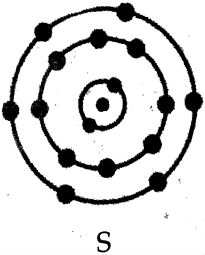
$(b)$ Write the electronic configuration of an atom of sulphur. Also,draw a schematic diagram of its atom showing the distribution of electrons in its shells.
$(b)$ Write the electronic configuration of an atom of sulphur. Also,draw a schematic diagram of its atom showing the distribution of electrons in its shells.
Solution
(N/A) Bohr$-$Bury Rules:
$(i)$ The maximum number of electrons present in a shell is given by the formula $2n^2$,where $n$ is the orbit number or shell number.
$(ii)$ The maximum number of electrons that can be accommodated in the outermost orbit is $8$.
$(iii)$ Electrons are not accommodated in a given shell unless the inner shells are filled. The shells are filled in a step-wise manner.
$(b)$ The atomic number of sulphur $(S)$ is $16$. Its electronic configuration is $2, 8, 6$.
Schematic diagram of the sulphur atom:
The atom has a nucleus at the center,with $2$ electrons in the $K$-shell,$8$ electrons in the $L$-shell,and $6$ electrons in the $M$-shell.
0 likes
View Solution34
Medium
$(a)$ Explain the Bohr$-$Bury rules for the distribution of electrons into different shells.
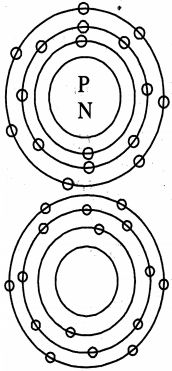
$(b)$ Draw the electronic structure of element $X$ with atomic number $17$ and element $Y$ with atomic number $16$.
$(b)$ Draw the electronic structure of element $X$ with atomic number $17$ and element $Y$ with atomic number $16$.
Solution
(N/A) Bohr$-$Bury Rules:
$(i)$ The maximum number of electrons present in a shell is given by the formula $2n^2$,where $n$ is the shell number.
$(ii)$ The maximum number of electrons that can be accommodated in the outermost orbit is $8$.
$(iii)$ Electrons are not accommodated in a given shell unless the inner shells are filled.
$(b)$ Electronic structure:
$(i)$ For element $X$ (Atomic number $17$): Electronic configuration is $2, 8, 7$. It has $2$ electrons in the $K$ shell,$8$ in the $L$ shell,and $7$ in the $M$ shell.
$(ii)$ For element $Y$ (Atomic number $16$): Electronic configuration is $2, 8, 6$. It has $2$ electrons in the $K$ shell,$8$ in the $L$ shell,and $6$ in the $M$ shell.
0 likes
View Solution35
Medium
Sulphur dioxide $(SO_{2})$ is a colourless,pungent-smelling gas and is a major air pollutant.
$(a)$ Write the electronic configuration of its constituent elements,sulphur and oxygen.
(Given: $_{16}^{32}S, _{8}^{16}O)$
$(b)$ Write the valency of sulphur and oxygen.
$(c)$ Are sulphur and oxygen isotopes of the same element? Explain your answer.
$(a)$ Write the electronic configuration of its constituent elements,sulphur and oxygen.
(Given: $_{16}^{32}S, _{8}^{16}O)$
$(b)$ Write the valency of sulphur and oxygen.
$(c)$ Are sulphur and oxygen isotopes of the same element? Explain your answer.
Solution
(N/A) The electronic configuration is determined by the atomic number $(Z)$:
Sulphur $(S)$: Atomic number $Z = 16$. Electronic configuration: $2, 8, 6$.
Oxygen $(O)$: Atomic number $Z = 8$. Electronic configuration: $2, 6$.
$(b)$ Valency is the combining capacity of an element.
For Oxygen $(O)$: It needs $2$ electrons to complete its octet,so its valency is $2$.
For Sulphur $(S)$: It needs $2$ electrons to complete its octet,so its valency is $2$.
$(c)$ No,they are not isotopes. Isotopes are atoms of the same element having the same atomic number but different mass numbers. Since sulphur and oxygen have different atomic numbers ($16$ and $8$ respectively),they are different elements.
0 likes
View Solution36
Medium
$(a)$ Name the three subatomic particles of an atom.
$(b)$ An atom of an element has $5$ electrons in the $L$ shell.
$(i)$ What is the atomic number of the element?
$(ii)$ State its valency.
$(iii)$ Identify the element and write its name.
$(b)$ An atom of an element has $5$ electrons in the $L$ shell.
$(i)$ What is the atomic number of the element?
$(ii)$ State its valency.
$(iii)$ Identify the element and write its name.
Solution
(D) The three subatomic particles of an atom are electrons,protons,and neutrons.
$(b) (i)$ The $K$ shell is the first shell and can hold $2$ electrons. The $L$ shell is the second shell and has $5$ electrons. Therefore,the total number of electrons is $2 + 5 = 7$. Since the atom is neutral,the atomic number is equal to the number of electrons,which is $7$.
$(ii)$ The valency is determined by the number of electrons required to complete the octet. Since there are $5$ electrons in the outermost shell ($L$ shell),it needs $3$ more electrons to complete the octet. Thus,its valency is $3$ (or $-3$ as it gains $3$ electrons).
$(iii)$ The element with atomic number $7$ is Nitrogen $(N)$.
0 likes
View Solution37
Medium
$(a)$ Which of the following electronic configurations are not possible? Give reasons.
$(i)$ $X: 2, 8, 4$
$(ii)$ $Y: 3, 8, 2$
$(iii)$ $Z: 2, 8, 9$
$(b)$ Write electronic configurations of the following elements and predict their valencies:
Fluorine: $9$,Aluminium: $13$,Argon: $18$
$(i)$ $X: 2, 8, 4$
$(ii)$ $Y: 3, 8, 2$
$(iii)$ $Z: 2, 8, 9$
$(b)$ Write electronic configurations of the following elements and predict their valencies:
Fluorine: $9$,Aluminium: $13$,Argon: $18$
Solution
(A) Electronic configurations $Y: 3, 8, 2$ and $Z: 2, 8, 9$ are not possible. According to the Bohr-Bury scheme,the first shell ($K$-shell) can hold a maximum of $2$ electrons,and the outermost shell of an atom can hold a maximum of $8$ electrons.
$(b)$ The electronic configurations and valencies are as follows:
$(b)$ The electronic configurations and valencies are as follows:
| Element | Electronic Configuration $(K, L, M)$ | Valency |
|---|---|---|
| Fluorine $(9)$ | $2, 7$ | $1$ |
| Aluminium $(13)$ | $2, 8, 3$ | $3$ |
| Argon $(18)$ | $2, 8, 8$ | $0$ |
0 likes
View Solution38
Easy
State whether the following statement is true or false:
Sodium shows valency of $Na^+$ and $Na^{2+}$.
Sodium shows valency of $Na^+$ and $Na^{2+}$.
Solution
(FALSE) The statement is False.
Sodium $(Na)$ has an atomic number of $11$. Its electronic configuration is $2, 8, 1$. To achieve a stable octet,it loses one electron to form a sodium ion with a charge of $+1$ $(Na^+)$. It does not lose two electrons to form $Na^{2+}$ because the energy required to remove the second electron from the stable inner shell is extremely high.
Sodium $(Na)$ has an atomic number of $11$. Its electronic configuration is $2, 8, 1$. To achieve a stable octet,it loses one electron to form a sodium ion with a charge of $+1$ $(Na^+)$. It does not lose two electrons to form $Na^{2+}$ because the energy required to remove the second electron from the stable inner shell is extremely high.
0 likes
View Solution39
Easy
State whether the following statement is true or false:
The elements having a valency of $1$ are called monovalent.
The elements having a valency of $1$ are called monovalent.
Solution
(TRUE) The statement is True.
Valency is defined as the combining capacity of an element.
Elements that have a valency of $1$ are referred to as monovalent elements (e.g.,$Na$,$Cl$,$H$).
Elements with a valency of $2$ are called divalent,and those with a valency of $3$ are called trivalent.
Valency is defined as the combining capacity of an element.
Elements that have a valency of $1$ are referred to as monovalent elements (e.g.,$Na$,$Cl$,$H$).
Elements with a valency of $2$ are called divalent,and those with a valency of $3$ are called trivalent.
0 likes
View Solution40
EasyMCQ
Identify the most stable atom from the following. Also give a reason for your answer.
$Na_{11}^{23}, Cl_{17}^{35}, Al_{13}^{27}, Ar_{18}^{40}$
$Na_{11}^{23}, Cl_{17}^{35}, Al_{13}^{27}, Ar_{18}^{40}$
A
$Na_{11}^{23}$
B
$Cl_{17}^{35}$
C
$Al_{13}^{27}$
D
$Ar_{18}^{40}$
Solution
(D) The electronic configuration of the given atoms is as follows:
$Na (11): 2, 8, 1$
$Cl (17): 2, 8, 7$
$Al (13): 2, 8, 3$
$Ar (18): 2, 8, 8$
$Ar_{18}^{40}$ is the most stable atom because its outermost shell is completely filled with $8$ electrons,achieving a stable octet configuration.
$Na (11): 2, 8, 1$
$Cl (17): 2, 8, 7$
$Al (13): 2, 8, 3$
$Ar (18): 2, 8, 8$
$Ar_{18}^{40}$ is the most stable atom because its outermost shell is completely filled with $8$ electrons,achieving a stable octet configuration.
0 likes
View Solution41
MediumMCQ
Find out the valency of an element $X$ having atomic number $16$.
A
$1$
B
$2$
C
$3$
D
$4$
Solution
(B) Element $= X$
Atomic number $= 16$
Electronic configuration $= 2, 8, 6$
Since the outermost shell has $6$ electrons,the element needs $2$ more electrons to complete its octet.
Valency $= 8 - 6 = 2$.
Atomic number $= 16$
Electronic configuration $= 2, 8, 6$
Since the outermost shell has $6$ electrons,the element needs $2$ more electrons to complete its octet.
Valency $= 8 - 6 = 2$.
0 likes
View Solution42
Medium
Define the term valency. How is valency different from valence electrons? Find the valency of oxygen and fluorine.
Solution
(N/A) Valency: The combining capacity of an atom of an element is known as its valency.
Difference from valence electrons: Valency is the combining capacity of an atom,whereas valence electrons are the number of electrons present in the outermost shell of an atom.
Valency of $O$ and $F$: The atomic number of oxygen $(O)$ is $8$,and its electronic configuration is $2, 6$. It needs to gain $2$ electrons to complete its octet,so its valency is $2$.
The atomic number of fluorine $(F)$ is $9$,and its electronic configuration is $2, 7$. It needs to gain $1$ electron to complete its octet,so its valency is $1$.
0 likes
View Solution43
EasyMCQ
The number of valence electrons in $Cl^{-}$ ion are
A
$7$
B
$1$
C
$6$
D
$8$
Solution
(D) The atomic number of chlorine $(Cl)$ is $17$.
Its electronic configuration is $2, 8, 7$.
This means it has $7$ valence electrons in its neutral state.
When it forms a chloride ion $(Cl^{-})$,it gains one electron to complete its octet.
The electronic configuration of $Cl^{-}$ becomes $2, 8, 8$.
Therefore,the number of valence electrons in the $Cl^{-}$ ion is $8$.
0 likes
View Solution44
EasyMCQ
Elements with valency $1$ are
A
always metals
B
always metalloids
C
either metals or non-metals
D
always non-metals
Solution
(C) Valency is the combining capacity of an element.
Elements with a valency of $1$ can be metals or non-metals.
For example,Sodium $(Na)$ is a metal with a valency of $1$ (it loses $1$ electron).
Chlorine $(Cl)$ is a non-metal with a valency of $1$ (it gains $1$ electron).
Therefore,elements with valency $1$ can be either metals or non-metals.
Elements with a valency of $1$ can be metals or non-metals.
For example,Sodium $(Na)$ is a metal with a valency of $1$ (it loses $1$ electron).
Chlorine $(Cl)$ is a non-metal with a valency of $1$ (it gains $1$ electron).
Therefore,elements with valency $1$ can be either metals or non-metals.
0 likes
View Solution45
EasyMCQ
An atom with $3$ protons and $4$ neutrons will have a valency of:
A
$1$
B
$3$
C
$7$
D
$4$
Solution
(A) The number of protons in an atom determines its atomic number $(Z)$.
Here,the number of protons is $3$,so the atomic number is $3$.
The electronic configuration of an atom with atomic number $3$ is $2, 1$.
Since the atom has $1$ electron in its outermost shell,it will lose this electron to achieve a stable octet configuration.
Therefore,the valency of the atom is $1$.
0 likes
View Solution46
EasyMCQ
The electron distribution in an aluminium atom is
A
$2, 8, 2$
B
$2, 8, 3$
C
$8, 2, 3$
D
$2, 3, 8$
Solution
(B) The atomic number of aluminium $(Al)$ is $13$.
According to the Bohr-Bury scheme,the maximum number of electrons that can be accommodated in a shell is given by the formula $2n^2$,where $n$ is the shell number.
For the $K$ shell $(n=1)$,the capacity is $2(1)^2 = 2$ electrons.
For the $L$ shell $(n=2)$,the capacity is $2(2)^2 = 8$ electrons.
The remaining electrons go to the $M$ shell $(n=3)$.
For $13$ electrons,the distribution is $2$ in the $K$ shell,$8$ in the $L$ shell,and $3$ in the $M$ shell.
Therefore,the electron distribution is $2, 8, 3$.
0 likes
View Solution47
Easy
State whether the following statement is true or false:
An atom of each element has a definite combining capacity,called its valency.
An atom of each element has a definite combining capacity,called its valency.
Solution
(TRUE) True.
Valency is defined as the combining capacity of an atom of an element. It represents the number of electrons an atom needs to lose,gain,or share to achieve a stable electronic configuration (usually an octet in its outermost shell).
Valency is defined as the combining capacity of an atom of an element. It represents the number of electrons an atom needs to lose,gain,or share to achieve a stable electronic configuration (usually an octet in its outermost shell).
0 likes
View SolutionSTRUCTURE OF THE ATOM — Distribution of Electrons and Valency · Frequently Asked Questions
1Are these STRUCTURE OF THE ATOM questions useful for JEE and NEET?
Yes. All questions in this section are mapped to JEE Main and NEET exam patterns. Previous year questions from JEE Main, NEET, GUJCET and state-level exams are included with full solutions.
2Can I switch to Hindi or Gujarati for these questions?
Yes. Use the language tabs in the hero section or the sidebar to view the same questions and solutions in English, Hindi or Gujarati.
3How do I generate a question paper from this subtopic?
Use the Vedclass Exam Paper Generator — select the chapter and subtopic, set difficulty, and generate Sets A, B, C, D automatically. First 3 chapters of every subject are free.
Vedclass Products
For Students
Vedclass Test Series
Mock tests in real JEE/NEET style with performance analysis. 5-day free trial.
Start Free TrialFor Teachers
Exam Paper Generator
Generate Set A/B/C/D papers from this chapter in 2 minutes. 3 chapters free.
Try FreeFor Institutes
Online Exam Module
Live online exams with unlimited students, 360° analytics & white-label branding.
See DemoFor Teachers & Institutes
Generate a STRUCTURE OF THE ATOM Exam Paper in 2 Minutes
Select subtopic & difficulty — Sets A, B, C, D auto-generated with No Repeat logic.
First 3 chapters of every subject are free — no payment required.