
A English
Thomson's and Rutherford's Models of an Atom Questions in English
Class 9 Science · STRUCTURE OF THE ATOM · Thomson's and Rutherford's Models of an Atom
37+
Questions
English
Language
100%
With Solutions
Showing 37 of 37 questions in English
1
Easy
On the basis of Thomson's model of an atom,explain how the atom is neutral as a whole.
Solution
(N/A) According to Thomson's model of the atom,an atom consists of both negative and positive charges that are equal in number and magnitude.
Since the total positive charge is exactly balanced by the total negative charge,the atom as a whole is electrically neutral.
Since the total positive charge is exactly balanced by the total negative charge,the atom as a whole is electrically neutral.
0 likes
View Solution2
EasyMCQ
On the basis of Rutherford's model of an atom,which subatomic particle is present in the nucleus of an atom?
A
Electron
B
Proton
C
Neutron
D
Positron
Solution
(B) According to Rutherford's alpha-particle scattering experiment,the entire positive charge and most of the mass of the atom are concentrated in a very small region called the nucleus.
Since the positive charge in the nucleus is due to protons,it is concluded that protons are present in the nucleus of an atom.
Since the positive charge in the nucleus is due to protons,it is concluded that protons are present in the nucleus of an atom.
0 likes
View Solution3
MediumMCQ
What do you think would be the observation if the $\alpha$-particle scattering experiment is carried out using a foil of a metal other than gold?
A
The results would be completely different.
B
There would be no change in the observations if the foil is as thin as the gold foil.
C
The $\alpha$-particles would pass through without any deflection.
D
The $\alpha$-particles would be absorbed by the metal.
Solution
(B) If the $\alpha$-particle scattering experiment is carried out using a foil of any metal that is as thin as the gold foil used by Rutherford,there would be no significant change in the observations.
This is because the fundamental structure of the atom (a small,positively charged nucleus at the center) is common to all elements.
However,most other metals are not as malleable as gold,making it extremely difficult to obtain a foil of comparable thickness.
If a thicker foil is used,more $\alpha$-particles would be scattered or bounce back due to multiple collisions,making it difficult to determine the precise location and nature of the positive mass within the atom with the same level of certainty as in Rutherford's original experiment.
0 likes
View Solution4
Medium
What are the limitations of $J$.$J$. Thomson's model of the atom?
Solution
(N/A) The limitations of $J$.$J$. Thomson's model of the atom are:
$\rightarrow$ It could not explain the results of the alpha-particle scattering experiment performed by Rutherford.
$\rightarrow$ It did not have any experimental support or evidence to prove the arrangement of subatomic particles.
$\rightarrow$ It could not explain the results of the alpha-particle scattering experiment performed by Rutherford.
$\rightarrow$ It did not have any experimental support or evidence to prove the arrangement of subatomic particles.
0 likes
View Solution5
MediumMCQ
What are the limitations of Rutherford's model of the atom?
A
It could not explain the stability of the atom.
B
It could not explain the electronic structure of atoms.
C
It could not explain the line spectrum of atoms.
D
All of the above.
Solution
(D) The limitations of Rutherford's model of the atom are as follows:
$1$. Stability of the atom: According to classical electromagnetic theory,an accelerating charged particle (like an electron) should continuously lose energy in the form of radiation. As the electron loses energy,its orbit should shrink,and it should eventually spiral into the nucleus,making the atom unstable. However,atoms are stable.
$2$. Electronic structure: Rutherford's model did not specify the arrangement of electrons in orbits or their energy levels.
$3$. Line spectrum: It failed to explain the origin of the discrete line spectra observed for hydrogen and other atoms.
0 likes
View Solution6
EasyMCQ
Rutherford's alpha-particle scattering experiment was responsible for the discovery of
A
Proton
B
Electron
C
Atomic nucleus
D
Neutron
Solution
(C) Rutherford's alpha-particle scattering experiment involved bombarding a thin gold foil with alpha particles.
He observed that most of the alpha particles passed straight through the foil,but a small fraction were deflected at large angles,and some even bounced back.
This led to the conclusion that the positive charge and most of the mass of the atom are concentrated in a very small,dense region at the center,which he named the atomic nucleus.
0 likes
View Solution7
EasyMCQ
Rutherford's alpha $(\alpha)$ particles scattering experiment resulted in the discovery of:
A
Electron
B
Nucleus in the atom
C
Proton
D
Atomic mass
Solution
(B) Rutherford's alpha particle scattering experiment showed that most of the alpha particles passed straight through the gold foil,but a very small fraction was deflected by large angles,and some even bounced back. This observation led to the conclusion that the positive charge and most of the mass of the atom are concentrated in a very small,dense region at the center,which was named the nucleus.
0 likes
View Solution8
MediumMCQ
Which of the following statements about Rutherford's model of the atom are correct?
$(i)$ Considered the nucleus as positively charged.
$(ii)$ Established that the $\alpha$-particles are four times as heavy as a hydrogen atom.
$(iii)$ Can be compared to the solar system.
$(iv)$ Was in agreement with Thomson's model.
$(i)$ Considered the nucleus as positively charged.
$(ii)$ Established that the $\alpha$-particles are four times as heavy as a hydrogen atom.
$(iii)$ Can be compared to the solar system.
$(iv)$ Was in agreement with Thomson's model.
A
$(i)$ and $(iii)$
B
$(ii)$ and $(iii)$
C
$(i)$ and $(iv)$
D
Only $(i)$
Solution
(A) Rutherford's model of the atom proposed that the positive charge and most of the mass of the atom were densely concentrated in a very small region called the nucleus,which is positively charged $(i)$.
He compared the model to the solar system,where the nucleus acts like the Sun and electrons act like planets revolving around it $(iii)$.
While $\alpha$-particles are indeed four times as heavy as a hydrogen atom,this was a property of the particles used in the experiment,not a specific postulate of the model itself $(ii)$.
Rutherford's model contradicted Thomson's model because Thomson's model suggested a uniform distribution of positive charge,whereas Rutherford's model proved it was concentrated in the center $(iv)$.
0 likes
View Solution9
MediumMCQ
In the Thomson's model of atom,which of the following statements are correct?
$(i)$ The mass of the atom is assumed to be uniformly distributed over the atom.
$(ii)$ The positive charge is assumed to be uniformly distributed over the atom.
$(iii)$ The electrons are uniformly distributed in the positively charged sphere.
$(iv)$ The electrons attract each other to stabilize the atom.
A
$(i)$ and $(iv)$
B
$(i)$ and $(iii)$
C
$(i)$,$(ii)$ and $(iii)$
D
$(i)$,$(iii)$ and $(iv)$
Solution
(C) Thomson's model of the atom,often called the 'plum pudding' model,proposes that:
$1$. The atom consists of a positively charged sphere with electrons embedded in it.
$2$. The mass of the atom is considered to be uniformly distributed throughout the atom.
$3$. The positive charge is also considered to be uniformly distributed throughout the atom.
$4$. The electrons are embedded in this positive sphere like seeds in a watermelon or plums in a pudding,meaning they are uniformly distributed.
$5$. Statement $(iv)$ is incorrect because the model suggests that the positive charge balances the negative charge of the electrons to stabilize the atom,not that electrons attract each other.
Therefore,statements $(i)$,$(ii)$,and $(iii)$ are correct.
0 likes
View Solution10
EasyMCQ
Rutherford's $\alpha$-particle scattering experiment showed that:
$(i)$ electrons have negative charge
$(ii)$ the mass and positive charge of the atom is concentrated in the nucleus
$(iii)$ neutron exists in the nucleus
$(iv)$ most of the space in the atom is empty
Which of the above statements are correct?
$(i)$ electrons have negative charge
$(ii)$ the mass and positive charge of the atom is concentrated in the nucleus
$(iii)$ neutron exists in the nucleus
$(iv)$ most of the space in the atom is empty
Which of the above statements are correct?
A
$(i)$ and $(iii)$
B
$(iii)$ and $(iv)$
C
$(i)$ and $(iv)$
D
$(ii)$ and $(iv)$
Solution
(D) Rutherford's $\alpha$-particle scattering experiment led to the following conclusions:
$1$. Most of the $\alpha$-particles passed straight through the gold foil,which indicated that most of the space inside the atom is empty (Statement $iv$ is correct).
$2$. $A$ small fraction of $\alpha$-particles were deflected by small angles,indicating the presence of a positively charged center called the nucleus.
$3$. $A$ very few $\alpha$-particles rebounded,which showed that the entire mass and positive charge of the atom are concentrated in a very small volume called the nucleus (Statement $ii$ is correct).
$4$. The experiment did not provide information about the negative charge of electrons or the existence of neutrons.
Therefore,statements $(ii)$ and $(iv)$ are correct.
0 likes
View Solution11
EasyMCQ
The first model of an atom was given by
A
$J$.$J$. Thomson
B
$E$. Goldstein
C
Rutherford
D
$N$. Bohr
Solution
(A) The first model of an atom was proposed by $J.J. Thomson$ in $1904$. This model is known as the $Plum$ $Pudding$ model or $Watermelon$ model. According to this model,an atom consists of a positively charged sphere with electrons embedded in it,similar to seeds in a watermelon.
0 likes
View Solution12
MediumMCQ
Atomic models have been improved over the years. Arrange the following atomic models in their chronological order:
$(i)$ Rutherford's atomic model
$(ii)$ Thomson's atomic model
$(iii)$ Bohr's atomic model
$(i)$ Rutherford's atomic model
$(ii)$ Thomson's atomic model
$(iii)$ Bohr's atomic model
A
$(i), (ii)$ and $(iii)$
B
$(ii), (i)$ and $(iii)$
C
$(ii), (iii)$ and $(i)$
D
$(iii), (ii)$ and $(i)$
Solution
(B) The chronological order of the development of atomic models is as follows:
$1$. Thomson's atomic model (also known as the Plum Pudding model) was proposed in $1904$.
$2$. Rutherford's atomic model (based on the alpha-particle scattering experiment) was proposed in $1911$.
$3$. Bohr's atomic model (which introduced quantized orbits) was proposed in $1913$.
Therefore,the correct chronological order is $(ii), (i), (iii)$.
0 likes
View Solution13
EasyMCQ
Why did Rutherford select a gold foil in his $\alpha$-ray scattering experiment?
A
Gold is a noble metal.
B
Gold is highly malleable,allowing for an extremely thin sheet.
C
Gold is a good conductor of electricity.
D
Gold is easily available.
Solution
(B) Gold is highly malleable,which means it can be beaten into very thin sheets.
In his $\alpha$-ray scattering experiment,Rutherford required a target material that was as thin as possible to ensure that the $\alpha$-particles would pass through with minimal interference from multiple atomic layers.
Therefore,gold was the ideal choice because it could be hammered into a foil of approximately $1000$ atoms in thickness.
0 likes
View Solution14
DifficultMCQ
The ratio of the radii of a hydrogen atom and its nucleus is $\sim 10^5$. Assuming the atom and the nucleus to be spherical,
$(i)$ What will be the ratio of their sizes (volumes)?
$(ii)$ If the atom is represented by the planet Earth $(R_e = 6.4 \times 10^6 \, m)$,estimate the size of the nucleus.
$(i)$ What will be the ratio of their sizes (volumes)?
$(ii)$ If the atom is represented by the planet Earth $(R_e = 6.4 \times 10^6 \, m)$,estimate the size of the nucleus.
A
$10^{13}, 34 \, m$
B
$10^{15}, 64 \, m$
C
$10^{16}, 34 \, m$
D
$10^{19}, 24 \, m$
Solution
(B) $(i)$ The volume of a sphere is given by $V = \frac{4}{3} \pi r^3$.
Let $R$ be the radius of the atom and $r$ be the radius of the nucleus.
Given the ratio $\frac{R}{r} = 10^5$,we have $R = 10^5 r$.
The ratio of their volumes is $\frac{V_{atom}}{V_{nucleus}} = \frac{\frac{4}{3} \pi R^3}{\frac{4}{3} \pi r^3} = \left( \frac{R}{r} \right)^3$.
Substituting the value,we get $(10^5)^3 = 10^{15}$.
$(ii)$ If the atom is represented by the Earth,then $R_{atom} = R_e = 6.4 \times 10^6 \, m$.
Since $r_{nucleus} = \frac{R_{atom}}{10^5}$,we have $r_{nucleus} = \frac{6.4 \times 10^6 \, m}{10^5} = 6.4 \times 10^1 \, m = 64 \, m$.
0 likes
View Solution15
Medium
Enlist the conclusions drawn by Rutherford from his $\alpha -$ ray scattering experiment.
Solution
(N/A) Rutherford concluded from the $\alpha -$ particle scattering experiment that:
$(i)$ Most of the space inside the atom is empty because most of the $\alpha -$ particles passed through the gold foil without getting deflected.
$(ii)$ Very few particles were deflected from their path,indicating that the positive charge of the atom occupies very little space.
$(iii)$ $A$ very small fraction of $\alpha -$ particles were deflected by $180^o$,indicating that all the positive charge and mass of the gold atom were concentrated in a very small volume within the atom.
From the data,he also calculated that the radius of the nucleus is about $10^5$ times smaller than the radius of the atom.
0 likes
View Solution16
Medium
In what way is the Rutherford's atomic model different from that of Thomson's atomic model?
Solution
(N/A) Rutherford proposed a model in which electrons revolve around the nucleus in well-defined orbits. There is a positively charged centre in an atom called the nucleus. He also proposed that the size of the nucleus is very small as compared to the size of the atom and nearly all the mass of an atom is centred in the nucleus.
Whereas,Thomson proposed the model of an atom to be similar to a Christmas pudding. The electrons are studded like currants in a positively charged sphere like Christmas pudding and the mass of the atom was supposed to be uniformly distributed.
Whereas,Thomson proposed the model of an atom to be similar to a Christmas pudding. The electrons are studded like currants in a positively charged sphere like Christmas pudding and the mass of the atom was supposed to be uniformly distributed.
0 likes
View Solution17
EasyMCQ
What were the drawbacks of Rutherford's model of an atom?
A
It could not explain the stability of the atom.
B
It suggested that electrons revolve in fixed orbits.
C
It failed to explain the existence of the nucleus.
D
It proposed that atoms are neutral.
Solution
(A) According to classical electromagnetic theory,any charged particle moving in a circular orbit would undergo acceleration and radiate energy.
As the electron revolves,it would continuously lose energy.
Due to this loss of energy,the electron would spiral inward and eventually fall into the nucleus.
If this were true,the atom would be highly unstable,and matter as we know it would not exist.
As the electron revolves,it would continuously lose energy.
Due to this loss of energy,the electron would spiral inward and eventually fall into the nucleus.
If this were true,the atom would be highly unstable,and matter as we know it would not exist.
0 likes
View Solution18
DifficultMCQ
In the Gold foil experiment of Geiger and Marsden,which paved the way for Rutherford's model of an atom,$\sim 1.00\%$ of the $\alpha$-particles were found to deflect at angles $> 50^o$. If one mole of $\alpha$-particles were bombarded on the gold foil,compute the number of $\alpha$-particles that would deflect at angles less than $50^o$.
A
$7.73 \times 10^{23}$
B
$5.51 \times 10^{23}$
C
$5.96 \times 10^{23}$
D
$4.95 \times 10^{23}$
Solution
(C) The percentage of $\alpha$-particles deflected at angles greater than $50^o$ is $1\%$.
Therefore,the percentage of $\alpha$-particles deflected at angles less than $50^o$ is $100\% - 1\% = 99\%$.
One mole of $\alpha$-particles contains $6.022 \times 10^{23}$ particles (Avogadro's number).
The number of $\alpha$-particles that deflect at angles less than $50^o$ is calculated as:
$\text{Number} = \frac{99}{100} \times 6.022 \times 10^{23}$
$\text{Number} = 0.99 \times 6.022 \times 10^{23}$
$\text{Number} = 5.96178 \times 10^{23} \approx 5.96 \times 10^{23}$ particles.
0 likes
View Solution19
Easy
State two main postulates of Thomson's model of an atom.
Solution
(N/A) Thomson's model of an atom is based on the following two postulates:
$(i)$ An atom consists of a positively charged sphere in which the electrons are embedded,similar to seeds in a watermelon or plums in a pudding.
$(ii)$ The negative and positive charges are equal in magnitude. Therefore,the atom as a whole is electrically neutral.
$(i)$ An atom consists of a positively charged sphere in which the electrons are embedded,similar to seeds in a watermelon or plums in a pudding.
$(ii)$ The negative and positive charges are equal in magnitude. Therefore,the atom as a whole is electrically neutral.
0 likes
View Solution20
MediumMCQ
How did Rutherford prove that positively charged particles are present in the nucleus of an atom?
A
By observing the deflection of alpha particles.
B
By observing the scattering of alpha particles.
C
By observing that some alpha particles bounced back.
D
By observing the emission of electrons.
Solution
(C) Rutherford performed the $\alpha$-particle scattering experiment by bombarding a thin gold foil with high-energy $\alpha$-particles.
He observed that while most $\alpha$-particles passed straight through the foil,a very small fraction was deflected at large angles,and some were even bounced back by $180^{\circ}$.
Since $\alpha$-particles are positively charged,their repulsion and deflection by the central part of the atom (the nucleus) indicated that the nucleus contains a concentrated positive charge.
0 likes
View Solution21
Medium
Write three observations of Rutherford's alpha particles scattering experiment.
Solution
(N/A) In the alpha particles scattering experiment,Rutherford bombarded a thin gold foil with fast moving alpha particles and observed that:
$(i)$ Most of the $\alpha$-particles passed straight through the gold foil.
$(ii)$ Some of the $\alpha$-particles were deflected by the foil through small angles.
$(iii)$ One out of every $12,000$ particles appeared to rebound.
$(i)$ Most of the $\alpha$-particles passed straight through the gold foil.
$(ii)$ Some of the $\alpha$-particles were deflected by the foil through small angles.
$(iii)$ One out of every $12,000$ particles appeared to rebound.
0 likes
View Solution22
Medium
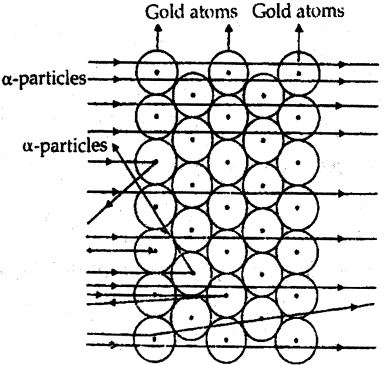
With the help of a labelled diagram,describe in brief the Rutherford's alpha particle scattering experiment. Write any three important conclusions drawn from the experiment.
Solution
(N/A) Rutherford performed an experiment by bombarding a very thin gold foil with high-energy $\alpha$-particles. The observations were as follows:
$(i)$ Most of the fast-moving $\alpha$-particles passed straight through the gold foil without any deflection.
$(ii)$ Some of the $\alpha$-particles were deflected by the foil by small angles.
$(iii)$ Out of every $12000$ particles,one appeared to rebound (deflected by $180^{\circ}$).
Based on these observations,the following conclusions were drawn:
$(i)$ There is a positively charged center in an atom called the nucleus. Nearly all the mass of an atom resides in the nucleus.
$(ii)$ The electrons revolve around the nucleus in well-defined circular orbits.
$(iii)$ The size of the nucleus is very small compared to the total size of the atom.
0 likes
View Solution23
Medium
State three features of the nuclear model of an atom put forward by Rutherford.
Solution
(N/A) $(i)$ There is a positively charged center in an atom called the nucleus. Nearly all the mass of an atom resides in the nucleus.
$(ii)$ The electrons revolve around the nucleus in well-defined orbits.
$(iii)$ The size of the nucleus is very small as compared to the size of the atom.
$(ii)$ The electrons revolve around the nucleus in well-defined orbits.
$(iii)$ The size of the nucleus is very small as compared to the size of the atom.
0 likes
View Solution24
Medium
Rutherford designed an experiment to determine the structure of an atom. Answer the following in relation to this experiment:
$(a)$ Name the element he selected for this purpose.
$(b)$ Which subatomic particle was used by him?
$(c)$ What was the drawback of Rutherford's model of the atom?
$(a)$ Name the element he selected for this purpose.
$(b)$ Which subatomic particle was used by him?
$(c)$ What was the drawback of Rutherford's model of the atom?
Solution
(N/A) Rutherford selected gold for his experiment because it is highly malleable and can be beaten into a very thin foil.
$(b)$ He used $\alpha$-particles,which are doubly charged helium ions $(He^{2+})$.
$(c)$ The major drawback of Rutherford's model was that it could not explain the stability of the atom. According to classical electromagnetic theory,an accelerating charged particle should emit energy; thus,electrons revolving around the nucleus should lose energy and eventually fall into the nucleus,making the atom unstable.
0 likes
View Solution25
Medium
$(a)$ Explain why did Rutherford select a gold foil in his alpha scattering experiments?
$(b)$ What observations in $\alpha$-scattering experiment led Rutherford to make the following conclusions?
$(i)$ Most of the space in an atom is empty.
$(ii)$ Nucleus is positively charged.
$(c)$ Mention any two drawbacks of Rutherford's model.
$(b)$ What observations in $\alpha$-scattering experiment led Rutherford to make the following conclusions?
$(i)$ Most of the space in an atom is empty.
$(ii)$ Nucleus is positively charged.
$(c)$ Mention any two drawbacks of Rutherford's model.
Solution
(A) Rutherford selected a gold foil because he required a layer that was as thin as possible. This gold foil was approximately $1000$ atoms thick.
$(b)$ $(i)$ Since most of the alpha particles passed through the gold foil without any deviation,it indicates that they did not encounter any obstruction in their path. This implies that most of the space inside an atom is empty.
$(ii)$ $A$ very small fraction of alpha particles were deflected by small angles,and some even rebounded. Since alpha particles are positively charged,this deflection suggests that they were repelled by a concentrated,positively charged center within the atom,which is the nucleus.
$(c)$ The two main drawbacks of Rutherford's model are:
$1$. According to classical electromagnetic theory,any charged particle undergoing acceleration in a circular orbit would continuously radiate energy. Consequently,the revolving electron would lose energy and eventually spiral into the nucleus,making the atom unstable.
$2$. The model could not explain the electronic structure of the atom or how electrons are distributed around the nucleus to maintain stability.
0 likes
View Solution26
Medium
$(a)$ Why are anode rays called canal rays?
$(b)$ Mention two postulates of $J. J.$ Thomson's model.
$(c)$ Compare the properties of protons and electrons.
$(b)$ Mention two postulates of $J. J.$ Thomson's model.
$(c)$ Compare the properties of protons and electrons.
Solution
(N/A) The anode rays produced at the anode of the discharge tube are called canal rays because they pass through the holes (canals) of the cathode.
$(b)$ $(i)$ An atom consists of a positively charged sphere, and electrons are embedded in it.
$(ii)$ The negative and positive charges are equal in magnitude, making the atom electrically neutral.
$(c)$ Comparison of protons and electrons:
$(b)$ $(i)$ An atom consists of a positively charged sphere, and electrons are embedded in it.
$(ii)$ The negative and positive charges are equal in magnitude, making the atom electrically neutral.
$(c)$ Comparison of protons and electrons:
| $S.No.$ | Protons | Electrons |
| $(i)$ | Positively charged. | Negatively charged. |
| $(ii)$ | Mass is approximately $1 \, u$ (equal to $H$ atom). | Mass is negligible ($1/1840$ times that of a proton). |
0 likes
View Solution27
Medium
$(a)$ Write two drawbacks of Rutherford's model of an atom.
$(b)$ State Bohr's postulates to overcome the drawbacks of Rutherford's model.
$(b)$ State Bohr's postulates to overcome the drawbacks of Rutherford's model.
Solution
(N/A) $(i)$ The major drawback of Rutherford's model was its inability to explain the stability of an atom. According to classical electromagnetic theory,any charged particle in a circular orbit would undergo acceleration and radiate energy. Thus,the revolving electron would continuously lose energy and eventually spiral into the nucleus,making the atom unstable.
$(ii)$ It could not explain the electronic structure of atoms or the origin of line spectra.
$(b)$ Bohr's postulates to overcome these drawbacks:
$(i)$ Electrons revolve around the nucleus only in certain special orbits known as discrete or stationary orbits.
$(ii)$ While revolving in these discrete orbits,the electrons do not radiate energy.
0 likes
View Solution28
Medium
$(a)$ Why did Rutherford choose gold and not any other lighter element (such as aluminium) for his experiment? Explain your answer giving two reasons.
$(b)$ Write the name and symbol of the particle chosen by Rutherford for bombardment against the gold foil in his experiment.
$(b)$ Write the name and symbol of the particle chosen by Rutherford for bombardment against the gold foil in his experiment.
Solution
(N/A) Rutherford chose gold for his experiment for the following two reasons:
$1$. Gold is highly malleable,which allowed him to obtain an extremely thin foil (approximately $1000$ atoms thick). $A$ thinner foil minimizes the probability of multiple scattering events,ensuring that the observed deflections are primarily due to single interactions with the nucleus.
$2$. Gold has a high atomic mass (high atomic number $Z = 79$),which provides a large,dense,and positively charged nucleus. This makes the electrostatic repulsion between the incident alpha particles and the gold nuclei significant,leading to observable and measurable deflections.
$(b)$ The particle chosen by Rutherford for bombardment was the alpha particle. Its symbol is $\alpha$ (or $^4_2He^{2+}$).
0 likes
View Solution29
Medium
Write the conclusions drawn by Rutherford for the following observations during his $\alpha$-scattering experiment:
$(a)$ Most of the alpha particles passed straight through the gold foil.
$(b)$ Some alpha particles got deflected from their path.
$(c)$ $A$ very small fraction of alpha particles got deflected by $180^{\circ}$.
$(a)$ Most of the alpha particles passed straight through the gold foil.
$(b)$ Some alpha particles got deflected from their path.
$(c)$ $A$ very small fraction of alpha particles got deflected by $180^{\circ}$.
Solution
(N/A) Most of the space inside the atom is empty.
$(b)$ It indicates that the positive charge of the atom occupies a very little space.
$(c)$ All the positive charge and mass of the gold atom were concentrated in a very small volume within the atom,which was later named as the nucleus.
$(b)$ It indicates that the positive charge of the atom occupies a very little space.
$(c)$ All the positive charge and mass of the gold atom were concentrated in a very small volume within the atom,which was later named as the nucleus.
0 likes
View Solution30
Medium
Give the salient features of Rutherford's nuclear model of the atom.
Solution
(N/A) Rutherford conducted an alpha-particle scattering experiment and proposed a model of the atom known as Rutherford's nuclear model. The salient features of this model are as follows:
$(i)$ The atom contains a central part called the nucleus,which is surrounded by electrons.
$(ii)$ The nucleus of an atom is positively charged.
$(iii)$ The size of the nucleus is very small compared to the total size of the atom.
$(iv)$ The mass of an atom is mainly concentrated within its nucleus.
$(v)$ The atom as a whole is electrically neutral,i.e.,the number of protons inside the nucleus of an atom and the number of electrons surrounding it are equal.
$(vi)$ The nucleus is dense and hard,and most of the space within the atom is hollow.
$(vii)$ To explain why electrons do not fall into the nucleus due to electrostatic attraction,Rutherford proposed that electrons are not stationary but revolve around the nucleus in circular orbits. The force of attraction is balanced by the centrifugal force generated due to the revolution of electrons.
Rutherford's nuclear model is similar to our solar system,where the nucleus acts like the Sun and the electrons act like the planets.
0 likes
View Solution31
Medium
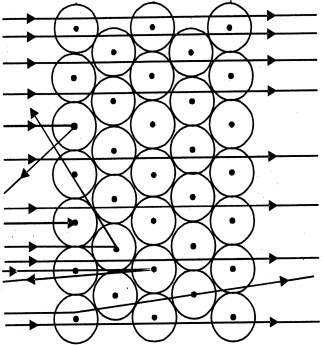
$(a)$ Which popular experiment is shown in the figure?
$(b)$ List three observations of this experiment.
$(c)$ State conclusions drawn from each observation of this experiment.
$(d)$ State the model of atom suggested on the basis of the above experiment.
$(b)$ List three observations of this experiment.
$(c)$ State conclusions drawn from each observation of this experiment.
$(d)$ State the model of atom suggested on the basis of the above experiment.
Solution
(N/A) This figure shows the scattering of $\alpha$-particles by a gold foil (Rutherford's $\alpha$-particle scattering experiment).
$(b)$ Observations:
$(i)$ Most of the $\alpha$-particles passed straight through the gold foil.
$(ii)$ Some of the $\alpha$-particles were deflected by the foil by small angles.
$(iii)$ One out of every $12000$ particles appeared to rebound.
$(c)$ Conclusions:
$(i)$ Most of the space inside the atom is empty.
$(ii)$ The positive charge of the atom occupies very little space.
$(iii)$ All the positive charge and mass of the atom is concentrated in a very small volume within the atom.
$(d)$ Rutherford's Model of the atom:
$(i)$ There is a positively charged center in an atom called the nucleus,which contains the whole mass of the atom.
$(ii)$ The electrons revolve around the nucleus in well-defined orbits.
$(iii)$ The size of the nucleus is very small as compared to the size of the atom.
0 likes
View Solution32
EasyMCQ
In the Thomson's model of atom,which of the following statements are correct?
$(i)$ The mass of the atom is assumed to be uniformly distributed over the atom.
$(ii)$ The positive charge is assumed to be uniformly distributed over the atom.
$(iii)$ The electrons are uniformly distributed in the positively charged sphere.
$(iv)$ The electrons attract each other to stabilize the atom.
$(i)$ The mass of the atom is assumed to be uniformly distributed over the atom.
$(ii)$ The positive charge is assumed to be uniformly distributed over the atom.
$(iii)$ The electrons are uniformly distributed in the positively charged sphere.
$(iv)$ The electrons attract each other to stabilize the atom.
A
$(i)$ and $(iii)$
B
$(i)$ and $(iv)$
C
$(i), (ii)$ and $(iii)$
D
$(i), (iii)$ and $(iv)$
Solution
(C) According to Thomson's model of the atom:
$1$. The atom consists of a positively charged sphere in which the mass is assumed to be uniformly distributed.
$2$. The positive charge is also assumed to be uniformly distributed throughout this sphere.
$3$. Electrons are embedded in this sphere of positive charge to make the atom electrically neutral.
$4$. Statements $(i), (ii),$ and $(iii)$ correctly describe these postulates.
$5$. Statement $(iv)$ is incorrect because electrons do not attract each other to stabilize the atom; rather,the electrostatic attraction between the positive sphere and the negative electrons provides stability.
Therefore,the correct statements are $(i), (ii),$ and $(iii)$.
0 likes
View Solution33
MediumMCQ
Rutherford's $\alpha-$ particle scattering experiment showed that
$(i)$ Electrons have negative charge
$(ii)$ The mass and positive charge of the atom is concentrated in the nucleus
$(iii)$ Neutron exists in the nucleus
$(iv)$ Most of the space in atom is empty
Which of the above statements are correct?
$(i)$ Electrons have negative charge
$(ii)$ The mass and positive charge of the atom is concentrated in the nucleus
$(iii)$ Neutron exists in the nucleus
$(iv)$ Most of the space in atom is empty
Which of the above statements are correct?
A
$(i)$ and $(iii)$
B
$(i)$ and $(iv)$
C
$(iii)$ and $(iv)$
D
$(ii)$ and $(iv)$
Solution
(D) Rutherford's $\alpha-$ particle scattering experiment led to the following conclusions:
$1$. Most of the $\alpha-$ particles passed straight through the gold foil,indicating that most of the space inside the atom is empty.
$2$. $A$ small fraction of $\alpha-$ particles were deflected by small angles,indicating the presence of a positively charged center called the nucleus.
$3$. $A$ very small fraction of $\alpha-$ particles rebounded,indicating that the entire mass and positive charge of the atom are concentrated in a very small volume called the nucleus.
Statements $(ii)$ and $(iv)$ are direct conclusions of this experiment. Statement $(i)$ was known from $J$.$J$. Thomson's work,and statement $(iii)$ was discovered later by James Chadwick. Therefore,the correct option is $(ii)$ and $(iv)$.
0 likes
View Solution34
EasyMCQ
The first model of an atom was given by
A
$N. Bohr$
B
$E. Goldstein$
C
Rutherford
D
$J. J. Thomson$
Solution
(D) $J. J. Thomson$ proposed the first model of an atom in $1904$,which is known as the 'Plum Pudding' model or 'Watermelon' model.
According to this model,an atom consists of a positively charged sphere with electrons embedded in it,similar to seeds in a watermelon.
According to this model,an atom consists of a positively charged sphere with electrons embedded in it,similar to seeds in a watermelon.
0 likes
View Solution35
MediumMCQ
Which of the following statements about Rutherford's model of the atom are correct?
A
$(i)$ and $(iii)$
B
$(ii)$ and $(iii)$
C
$(i)$ and $(iv)$
D
only $(i)$
Solution
(A) Rutherford's model of the atom proposed that:
$(i)$ The positive charge and most of the mass of the atom are concentrated in a small central region called the nucleus.
$(ii)$ $\alpha$-particles are helium nuclei $(He^{2+})$,which have a mass of $4 \ u$,making them four times as heavy as a hydrogen atom $(1 \ u)$.
$(iii)$ Electrons revolve around the nucleus in circular paths,similar to how planets revolve around the Sun,hence it is often compared to the solar system.
$(iv)$ It contradicted Thomson's model,as Thomson's model suggested a uniform distribution of positive charge,whereas Rutherford's model proposed a concentrated nucleus.
Therefore,statements $(i)$,$(ii)$,and $(iii)$ are correct. Since the option $(i)$ and $(iii)$ is provided as the best fit among the choices,the correct answer is $A$.
0 likes
View Solution36
EasyMCQ
The presence of electrons outside the nucleus and the nucleus at the centre of the atom was suggested by:
A
Electrons by $J.J.$ Thomson and nucleus by $E.$ Rutherford
B
Electrons by $J.J.$ Thomson and nucleus by $E.$ Goldstein
C
Electrons by $J.N.$ Lockyer and nucleus by $E.$ Rutherford
D
Electrons by $E.$ Rutherford and nucleus by $J.J.$ Thomson
Solution
(A) $J.J.$ Thomson discovered the electron through his cathode ray tube experiments and proposed that they are part of the atom.
Later,$E.$ Rutherford performed the alpha-particle scattering experiment,which led to the discovery of a small,dense,positively charged center called the nucleus.
He suggested that electrons revolve outside this nucleus.
Later,$E.$ Rutherford performed the alpha-particle scattering experiment,which led to the discovery of a small,dense,positively charged center called the nucleus.
He suggested that electrons revolve outside this nucleus.
0 likes
View Solution37
Medium
During class,Ravi's teacher was teaching about Thomson's model of an atom,stating that an atom is electrically neutral,i.e.,it contains equal positive and negative charges,and that an atom consists of a sphere of positive charge in which electrons are embedded like plums in a pudding. Ravi wondered how his teacher related Thomson's model of an atom to a plum pudding,and he imagined that just as dry fruits are embedded in a Christmas pudding,electrons are embedded in a sphere of positive charge.
$(a)$ According to you,what kind of qualities does Ravi possess?
$(b)$ What are the limitations of Thomson's model?
$(a)$ According to you,what kind of qualities does Ravi possess?
$(b)$ What are the limitations of Thomson's model?
Solution
(N/A) Ravi possesses the following qualities:
$(i)$ Imaginative: He visualizes abstract concepts.
$(ii)$ Creative: He relates scientific models to real-life examples.
$(iii)$ Curious: He seeks to understand the logic behind analogies.
$(b)$ The limitations of Thomson's model are:
$(i)$ It failed to explain how the positive and negative charges are arranged within an atom so close to each other without neutralizing one another.
$(ii)$ It could not explain the results of experiments performed by other scientists,such as Rutherford's alpha-particle scattering experiment.
0 likes
View SolutionSTRUCTURE OF THE ATOM — Thomson's and Rutherford's Models of an Atom · Frequently Asked Questions
1Are these STRUCTURE OF THE ATOM questions useful for JEE and NEET?
Yes. All questions in this section are mapped to JEE Main and NEET exam patterns. Previous year questions from JEE Main, NEET, GUJCET and state-level exams are included with full solutions.
2Can I switch to Hindi or Gujarati for these questions?
Yes. Use the language tabs in the hero section or the sidebar to view the same questions and solutions in English, Hindi or Gujarati.
3How do I generate a question paper from this subtopic?
Use the Vedclass Exam Paper Generator — select the chapter and subtopic, set difficulty, and generate Sets A, B, C, D automatically. First 3 chapters of every subject are free.
Vedclass Products
For Students
Vedclass Test Series
Mock tests in real JEE/NEET style with performance analysis. 5-day free trial.
Start Free TrialFor Teachers
Exam Paper Generator
Generate Set A/B/C/D papers from this chapter in 2 minutes. 3 chapters free.
Try FreeFor Institutes
Online Exam Module
Live online exams with unlimited students, 360° analytics & white-label branding.
See DemoFor Teachers & Institutes
Generate a STRUCTURE OF THE ATOM Exam Paper in 2 Minutes
Select subtopic & difficulty — Sets A, B, C, D auto-generated with No Repeat logic.
First 3 chapters of every subject are free — no payment required.