
A English
Cell Organelles Questions in English
Class 9 Science · THE FUNDAMENTAL UNIT OF LIFE · Cell Organelles
120+
Questions
English
Language
100%
With Solutions
Showing 50 of 120 questions in English
1
EasyMCQ
Can you name the two organelles we have studied that contain their own genetic material?
A
Mitochondria and Lysosomes
B
Mitochondria and Plastids
C
Plastids and Ribosomes
D
Nucleus and Mitochondria
Solution
(B) The two organelles that contain their own genetic material $(DNA)$ and ribosomes are $Mitochondria$ and $Plastids$. These organelles are considered semi-autonomous because they can synthesize some of their own proteins.
0 likes
View Solution2
Difficult
Why are lysosomes known as suicide bags?
Solution
(N/A) Lysosomes contain very powerful hydrolytic enzymes that are capable of breaking down organic matter.
When a cell gets damaged or its metabolic processes are disturbed,lysosomes may burst,and these enzymes digest their own cell.
Because of this self-digesting action,lysosomes are known as the 'suicide bags' of the cell.
When a cell gets damaged or its metabolic processes are disturbed,lysosomes may burst,and these enzymes digest their own cell.
Because of this self-digesting action,lysosomes are known as the 'suicide bags' of the cell.
0 likes
View Solution3
EasyMCQ
Where are proteins synthesised inside the cell?
A
Mitochondria
B
Ribosomes
C
Lysosomes
D
Golgi apparatus
Solution
(B) Ribosomes are the sites of protein synthesis within the cell. They are small,granular structures found either floating freely in the cytoplasm or attached to the surface of the Rough Endoplasmic Reticulum $(RER)$.
0 likes
View Solution4
DifficultMCQ
What would happen to the life of a cell if there was no Golgi apparatus?
A
The cell would continue to function normally.
B
The cell would be unable to package and dispatch proteins.
C
The cell would produce more energy.
D
The cell would increase its rate of division.
Solution
(B) Effect of absence of Golgi apparatus on the life of a cell:
$(i)$ The packaging and dispatching of various proteins to different targets inside and outside the cell will be severely affected.
$(ii)$ Cellular products cannot be stored,modified,or sorted properly.
$(iii)$ The formation of lysosomes will be inhibited. This leads to the accumulation of worn-out and dead cell organelles within the cell,which may eventually cause cell death.
0 likes
View Solution5
Easy
Which organelle is known as the powerhouse of the cell? Why?
Solution
(N/A) The organelle $Mitochondria$ is known as the powerhouse of the cell.
This is because the process of cellular respiration takes place within the mitochondria to generate energy in the form of $ATP$ ($Adenosine$ $Triphosphate$).
This energy is essential for carrying out various chemical activities required for the life of the cell.
This is because the process of cellular respiration takes place within the mitochondria to generate energy in the form of $ATP$ ($Adenosine$ $Triphosphate$).
This energy is essential for carrying out various chemical activities required for the life of the cell.
0 likes
View Solution6
MediumMCQ
Where do the lipids and proteins constituting the cell membrane get synthesized?
A
Smooth endoplasmic reticulum and Rough endoplasmic reticulum
B
Golgi apparatus and Lysosomes
C
Mitochondria and Chloroplast
D
Nucleus and Ribosomes
Solution
(A) The lipids constituting the cell membrane are synthesized in the smooth endoplasmic reticulum $(SER)$.
Membrane proteins are synthesized by the ribosomes attached to the rough endoplasmic reticulum $(RER)$.
These components are then transported to the cell membrane to facilitate membrane biogenesis.
Membrane proteins are synthesized by the ribosomes attached to the rough endoplasmic reticulum $(RER)$.
These components are then transported to the cell membrane to facilitate membrane biogenesis.
0 likes
View Solution7
EasyMCQ
How does an Amoeba obtain its food?
A
By forming a permanent mouth
B
By using pseudopodia to engulf food
C
By absorbing nutrients through the cell wall
D
By using cilia to sweep food into the cell
Solution
(B) Amoeba obtains its food through a process called phagocytosis (a type of endocytosis).
When food particles come near the Amoeba,it extends its cell membrane to form finger-like projections known as pseudopodia (false feet).
These pseudopodia surround the food particle and fuse together to form a food vacuole.
Inside the food vacuole,complex substances are broken down into simpler ones,which then diffuse into the cytoplasm.
0 likes
View Solution8
MediumMCQ
Which of these options are not a function of Ribosomes?
$(i)$ It helps in the manufacture of protein molecules.
$(ii)$ It helps in the manufacture of enzymes.
$(iii)$ It helps in the manufacture of hormones.
$(iv)$ It helps in the manufacture of starch molecules.
$(i)$ It helps in the manufacture of protein molecules.
$(ii)$ It helps in the manufacture of enzymes.
$(iii)$ It helps in the manufacture of hormones.
$(iv)$ It helps in the manufacture of starch molecules.
A
$(i)$ and $(ii)$
B
$(ii)$ and $(iii)$
C
$(iii)$ and $(i)$
D
$(iii)$ and $(iv)$
Solution
(D) Ribosomes are the sites of protein synthesis in the cell.
Since enzymes are primarily proteinaceous in nature,ribosomes are involved in their synthesis.
However,most hormones are either steroids (lipids) or proteins. While some protein-based hormones are synthesized by ribosomes,many hormones are not. More importantly,starch is a carbohydrate (polysaccharide) synthesized by plastids (like amyloplasts) in plants,not by ribosomes.
Therefore,$(iii)$ and $(iv)$ are not considered primary functions of ribosomes in the context of general cellular biology.
0 likes
View Solution9
EasyMCQ
Which of these is not related to the endoplasmic reticulum?
A
It can be the site of energy generation
B
It transports materials between various regions in the cytoplasm
C
It behaves as a transport channel for proteins between the nucleus and the cytoplasm
D
It can be the site for some biochemical activities of the cell
Solution
(A) The endoplasmic reticulum $(ER)$ is involved in the synthesis,folding,modification,and transport of proteins and lipids. It does not generate energy. Energy generation in the form of $ATP$ is the primary function of mitochondria,which are known as the powerhouses of the cell.
0 likes
View Solution10
EasyMCQ
Which of the following cell organelles is covered by a single membrane?
A
Mitochondria
B
Plastid
C
Lysosome
D
Nucleus
Solution
(C) Step $1$: Identify the membrane structure of the given organelles.
Step $2$: $Mitochondria$ and $Plastids$ are double-membrane bound organelles.
Step $3$: The $Nucleus$ is a double-membrane bound organelle.
Step $4$: $Lysosomes$ are single-membrane bound organelles.
Therefore, the correct option is $C$.
Step $2$: $Mitochondria$ and $Plastids$ are double-membrane bound organelles.
Step $3$: The $Nucleus$ is a double-membrane bound organelle.
Step $4$: $Lysosomes$ are single-membrane bound organelles.
Therefore, the correct option is $C$.
0 likes
View Solution11
MediumMCQ
Find out the correct sentence.
A
Rough endoplasmic reticulum and smooth endoplasmic reticulum produce lipid and protein respectively.
B
Enzymes packed in Lysosomes are made through $RER$ (rough endoplasmic reticulum).
C
Endoplasmic reticulum is related with the destruction of plasma membrane.
D
Nucleoid is present inside the nucleoplasm of eukaryotic nucleus.
Solution
(B) $RER$ (Rough Endoplasmic Reticulum) has ribosomes on its surface,which are responsible for protein synthesis. Since lysosomal enzymes are proteins,they are synthesized by $RER$. Thus,option $b$ is correct.
Option $a$ is incorrect because $RER$ produces proteins and $SER$ (Smooth Endoplasmic Reticulum) produces lipids.
Option $c$ is incorrect because the endoplasmic reticulum is involved in the synthesis of membrane components,not their destruction.
Option $d$ is incorrect because a nucleoid is the undefined nuclear region found in prokaryotes,not in the nucleoplasm of eukaryotic nuclei.
0 likes
View Solution12
MediumMCQ
Which cell organelle plays a crucial role in detoxifying many poisons and drugs in a cell?
A
Golgi apparatus
B
Lysosomes
C
Smooth endoplasmic reticulum
D
Vacuoles
Solution
(C) In the liver cells of vertebrates,the $SER$ (Smooth Endoplasmic Reticulum) plays a crucial role in detoxifying many poisons and drugs. The enzymes present in the $SER$ membrane help in the metabolic breakdown of toxic substances,thereby protecting the cell.
0 likes
View Solution13
EasyMCQ
The proteins and lipids,essential for building the cell membrane,are manufactured by
A
mitochondria
B
golgi apparatus
C
plasma membrane
D
endoplasmic reticulum
Solution
(D) The endoplasmic reticulum $(ER)$ is responsible for the synthesis of both proteins and lipids.
Specifically,the Rough Endoplasmic Reticulum $(RER)$ contains ribosomes on its surface and is primarily involved in protein synthesis.
The Smooth Endoplasmic Reticulum $(SER)$ lacks ribosomes and is primarily involved in the synthesis of lipids.
These molecules are then used for membrane biogenesis,which is the process of building the cell membrane.
0 likes
View Solution14
EasyMCQ
The cell organelle involved in forming complex sugars from simple sugars is:
A
endoplasmic reticulum
B
golgi apparatus
C
plastids
D
ribosomes
Solution
(B) The $Golgi$ apparatus is the cell organelle responsible for the modification,packaging,and transport of proteins and lipids. It is also involved in the synthesis of complex sugars from simple sugars.
0 likes
View Solution15
MediumMCQ
Which of the following is not a function of a vacuole?
A
Storage
B
Providing turgidity and rigidity to the cell
C
Locomotion
D
Waste excretion
Solution
(C) Vacuoles are membrane-bound organelles found in the cytoplasm of plant and animal cells.
They perform various functions such as storage of nutrients,water,and waste products.
In plant cells,they provide turgidity and rigidity by maintaining cell pressure.
Locomotion is not a function of vacuoles; it is typically carried out by specialized structures like cilia,flagella,or pseudopodia.
They perform various functions such as storage of nutrients,water,and waste products.
In plant cells,they provide turgidity and rigidity by maintaining cell pressure.
Locomotion is not a function of vacuoles; it is typically carried out by specialized structures like cilia,flagella,or pseudopodia.
0 likes
View Solution16
MediumMCQ
Silver nitrate solution is used to study:
A
endoplasmic reticulum
B
golgi apparatus
C
nucleus
D
mitochondria
Solution
(B) Camillo Golgi developed a staining technique known as the 'black reaction',which involved the use of silver nitrate.
This technique allowed for the visualization and detailed study of the Golgi apparatus and individual nerve cell structures.
This technique allowed for the visualization and detailed study of the Golgi apparatus and individual nerve cell structures.
0 likes
View Solution17
EasyMCQ
Which organelle,other than the nucleus,contains $DNA$?
A
Endoplasmic reticulum
B
Golgi apparatus
C
Mitochondria
D
Lysosome
Solution
(C) Mitochondria and chloroplasts are semi-autonomous organelles that contain their own $DNA$ and ribosomes. Because they possess their own $DNA$,they have the capability of self-replication,independent of the nuclear $DNA$.
0 likes
View Solution18
EasyMCQ
The kitchen of the cell is:
A
mitochondria
B
endoplasmic reticulum
C
golgi apparatus
D
chloroplast
Solution
(D) In plant cells,food is synthesized through the process of photosynthesis,which occurs within specialized organelles called chloroplasts. Because they are the sites of food production,chloroplasts are referred to as the kitchen of the cell.
7 likes
View Solution19
EasyMCQ
Lipid molecules in the cell are synthesized by:
A
Smooth endoplasmic reticulum
B
Rough endoplasmic reticulum
C
Golgi apparatus
D
Plastids
Solution
(A) The smooth endoplasmic reticulum $(SER)$ is responsible for the synthesis of lipids,including steroids and phospholipids,within the cell. In contrast,the rough endoplasmic reticulum $(RER)$ is primarily involved in protein synthesis due to the presence of ribosomes on its surface.
0 likes
View Solution20
EasyMCQ
The only cell organelle seen in prokaryotic cells is
A
mitochondria
B
lysosomes
C
plastids
D
ribosomes
Solution
(D) Prokaryotic cells lack membrane-bound organelles such as mitochondria,lysosomes,and plastids.
Ribosomes are the only organelles present in prokaryotic cells,which are non-membrane-bound and are responsible for protein synthesis.
Ribosomes are the only organelles present in prokaryotic cells,which are non-membrane-bound and are responsible for protein synthesis.
0 likes
View Solution21
EasyMCQ
Which of the following cell organelles lacks a cell membrane?
A
Ribosome
B
Golgi apparatus
C
Chloroplast
D
Nucleus
Solution
(A) Ribosomes are non-membrane-bound organelles found in both prokaryotic and eukaryotic cells. They are composed of ribosomal $RNA$ $(rRNA)$ and proteins. In contrast,organelles like the Golgi apparatus,chloroplasts,and the nucleus are membrane-bound structures.
0 likes
View Solution22
EasyMCQ
Lysosomes arise from:
A
Endoplasmic reticulum
B
Nucleus
C
Golgi apparatus
D
Mitochondria
Solution
(C) Lysosomes are membrane-bound cell organelles that contain digestive enzymes. They are formed by the process of packaging in the Golgi apparatus. The enzymes within lysosomes are synthesized by the rough endoplasmic reticulum,transported to the Golgi apparatus for modification and sorting,and then pinched off as vesicles to form lysosomes.
0 likes
View Solution23
MediumMCQ
Why are lysosomes known as 'suicide-bags' of a cell?
A
They contain powerful digestive enzymes.
B
They help in the removal of waste materials.
C
They burst and digest their own cell when it gets damaged.
D
They provide energy to the cell.
Solution
(C) Lysosomes are known as 'suicide-bags' because they contain powerful digestive enzymes. When the cell gets damaged or its metabolism is disturbed,lysosomes may burst,and the released enzymes digest their own cell.
0 likes
View Solution24
Easy
Name any cell organelle which is non-membranous.
Solution
(N/A) non-membranous cell organelle is a structure within the cell that is not enclosed by a lipid bilayer membrane. The most prominent example of a non-membranous organelle is the $Ribosome$. Other examples include the $Centrosome$ and $Cytoskeleton$.
0 likes
View Solution25
MediumMCQ
Bacteria do not have chloroplasts,but some bacteria are photoautotrophic in nature and perform photosynthesis. Which part of the bacterial cell performs this?
A
Chromatophore
B
Mesosome
C
Nucleoid
D
Ribosome
Solution
(A) In photoautotrophic bacteria,photosynthesis occurs in specialized structures called chromatophores.
These are small,membrane-bound vesicles or lamellae that are extensions of the plasma membrane.
These structures contain photosynthetic pigments (like bacteriochlorophyll) that trap solar energy to synthesize food.
These are small,membrane-bound vesicles or lamellae that are extensions of the plasma membrane.
These structures contain photosynthetic pigments (like bacteriochlorophyll) that trap solar energy to synthesize food.
0 likes
View Solution26
Easy
Write the name of different plant parts in which chromoplast,chloroplast,and leucoplast are present.
Solution
(N/A) $Chromoplast$: Found in colored parts of plants such as flowers and fruits.
$Chloroplast$: Found in green parts of plants such as leaves.
$Leucoplast$: Found in non-colored parts of plants such as roots,tubers,and seeds.
$Chloroplast$: Found in green parts of plants such as leaves.
$Leucoplast$: Found in non-colored parts of plants such as roots,tubers,and seeds.
0 likes
View Solution27
Medium
Name the organelles which show the analogy written as under:
$(a)$ Transporting channels of the cell ..........
$(b)$ Power house of the cell ............
$(c)$ Packaging and dispatching unit of the cell ...........
$(d)$ Digestive bag of the cell ...........
$(e)$ Storage sacs of the cell ...........
$(f)$ Kitchen of the cell .............
$(g)$ Control room of the cell ..........
Solution
(A) Endoplasmic reticulum: It acts as a transport system for materials between various regions of the cytoplasm or between the cytoplasm and the nucleus.
$(b)$ Mitochondria: It produces energy in the form of $ATP$ (Adenosine Triphosphate),hence known as the power house.
$(c)$ Golgi body: It is involved in the packaging and dispatching of proteins and lipids synthesized in the cell.
$(d)$ Lysosome: It contains powerful digestive enzymes capable of breaking down all organic material,hence called the digestive bag or suicide bag.
$(e)$ Vacuole: These are storage sacs for solid or liquid contents.
$(f)$ Chloroplast: It contains chlorophyll,which is essential for photosynthesis,thus acting as the kitchen of the cell.
$(g)$ Nucleus: It contains the genetic material $(DNA)$ and regulates all cellular activities,acting as the control room.
2 likes
View Solution28
MediumMCQ
How does Amoeba obtain its food?
A
By forming pseudopodia
B
By using cilia
C
By using flagella
D
By using tentacles
Solution
(A) Amoeba obtains its food by forming temporary finger-like extensions of the cell surface known as pseudopodia.
These pseudopodia surround the food particle and fuse over it.
This process results in the formation of a food vacuole inside the cell,where complex substances are broken down into simpler ones.
This process of engulfing food by Amoeba is known as endocytosis.
These pseudopodia surround the food particle and fuse over it.
This process results in the formation of a food vacuole inside the cell,where complex substances are broken down into simpler ones.
This process of engulfing food by Amoeba is known as endocytosis.
0 likes
View Solution29
EasyMCQ
Name the two organelles in a plant cell that contain their own genetic material and ribosomes.
A
Mitochondria and Vacuoles
B
Mitochondria and Plastids
C
Nucleus and Ribosomes
D
Plastids and Lysosomes
Solution
(B) The two organelles in a plant cell that possess their own genetic material $(DNA)$ and ribosomes are mitochondria and plastids.
These organelles are considered semi-autonomous because they can synthesize some of their own proteins and replicate independently of the cell nucleus.
These organelles are considered semi-autonomous because they can synthesize some of their own proteins and replicate independently of the cell nucleus.
0 likes
View Solution30
EasyMCQ
Why are lysosomes also known as 'scavengers of the cells'?
A
They produce energy.
B
They contain digestive enzymes that break down waste materials.
C
They store genetic material.
D
They synthesize proteins.
Solution
(B) Lysosomes contain powerful digestive enzymes that are capable of breaking down complex organic molecules,worn-out cell organelles,and foreign materials like bacteria or viruses that enter the cell.
By digesting these waste materials and cellular debris,they keep the cell clean.
Because of this cleaning function,lysosomes are commonly referred to as the 'scavengers of the cells' or 'suicide bags'.
By digesting these waste materials and cellular debris,they keep the cell clean.
Because of this cleaning function,lysosomes are commonly referred to as the 'scavengers of the cells' or 'suicide bags'.
0 likes
View Solution31
MediumMCQ
Which cell organelle controls most of the activities of the cell?
A
Mitochondria
B
Nucleus
C
Ribosome
D
Lysosome
Solution
(B) The $Nucleus$ is known as the control center of the cell. It contains the genetic material $(DNA)$ which regulates cellular activities such as metabolism, protein synthesis, and cell division by controlling gene expression.
0 likes
View Solution32
Medium
Which kind of plastid is more common in:
$(a)$ Roots of the plant
$(b)$ Leaves of the plant
$(c)$ Flowers and fruits
$(a)$ Roots of the plant
$(b)$ Leaves of the plant
$(c)$ Flowers and fruits
Solution
(A) Leucoplasts are colorless plastids primarily found in the roots of plants,where they store nutrients like starch,oils,and proteins.
$(b)$ Chloroplasts are green-colored plastids containing chlorophyll,which are abundant in the leaves of plants to facilitate photosynthesis.
$(c)$ Chromoplasts are colored plastids (containing pigments like carotene and xanthophyll) that provide red,orange,or yellow colors to flowers and fruits.
$(b)$ Chloroplasts are green-colored plastids containing chlorophyll,which are abundant in the leaves of plants to facilitate photosynthesis.
$(c)$ Chromoplasts are colored plastids (containing pigments like carotene and xanthophyll) that provide red,orange,or yellow colors to flowers and fruits.
0 likes
View Solution33
EasyMCQ
Why do plant cells possess large-sized vacuoles?
A
To store water and nutrients
B
To provide turgidity and rigidity to the cell
C
To perform photosynthesis
D
Both $A$ and $B$
Solution
(D) Plant cells possess large-sized vacuoles for the following reasons:
$1$. They store many important substances,including nutrients,water,and waste products.
$2$. They contain cell sap,which exerts turgor pressure against the cell wall,providing turgidity and structural rigidity to the plant cell.
$1$. They store many important substances,including nutrients,water,and waste products.
$2$. They contain cell sap,which exerts turgor pressure against the cell wall,providing turgidity and structural rigidity to the plant cell.
0 likes
View Solution34
Medium
Draw a neat labelled diagram of an animal cell.
Solution
(N/A) An animal cell is a eukaryotic cell that lacks a cell wall and contains various membrane-bound organelles. Key components include:
$1$. Plasma membrane: The outer boundary of the cell.
$2$. Nucleus: The control center containing genetic material.
$3$. Cytoplasm: The jelly-like substance filling the cell.
$4$. Mitochondria: The powerhouse of the cell.
$5$. Endoplasmic Reticulum (Rough and Smooth): Involved in protein and lipid synthesis.
$6$. Golgi apparatus: Responsible for packaging and modifying proteins.
$7$. Lysosomes: Known as the suicide bags of the cell.
$8$. Ribosomes: Sites of protein synthesis.
$9$. Centrioles: Involved in cell division.
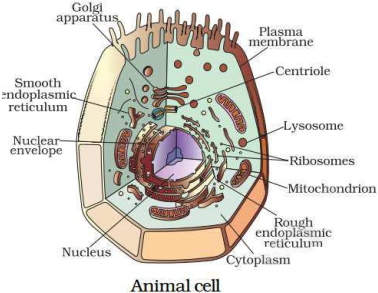
0 likes
View Solution35
Medium
Draw a well-labelled diagram of an eukaryotic nucleus. How is it different from a nucleoid?
Solution
(N/A) The eukaryotic nucleus is a membrane-bound organelle that contains the cell's genetic material. It consists of a nuclear envelope,nucleolus,chromatin,and nuclear pores. $A$ nucleoid,on the other hand,is an irregularly shaped region within a prokaryotic cell that contains all or most of the genetic material.
| Nucleus | Nucleoid |
|---|---|
| $(i)$ Nuclear membrane is present. | $(i)$ Nuclear membrane is absent. |
| $(ii)$ Nucleolus is present. | $(ii)$ Nucleolus is absent. |
| $(iii)$ Genetic material is enclosed within the nuclear envelope. | $(iii)$ Genetic material is not contained in any membrane-bound structure. |
| $(iv)$ Found in eukaryotic cells. | $(iv)$ Found in prokaryotic cells. |
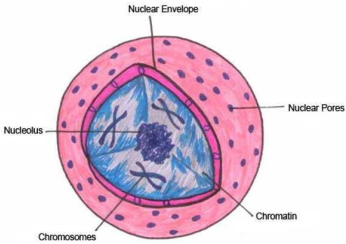
0 likes
View Solution36
Easy
Differentiate between rough and smooth endoplasmic reticulum. How is endoplasmic reticulum important for membrane biogenesis?
Solution
(N/A) The ribosomes, which are present in all active cells, are the sites of protein synthesis. Endoplasmic reticulum helps in transporting these proteins to various places. The smooth endoplasmic reticulum helps in the manufacture of fat and lipids, which, along with proteins, help in building the cell membrane, a process known as membrane biogenesis.
| Smooth Endoplasmic Reticulum $(SER)$ | Rough Endoplasmic Reticulum $(RER)$ |
| $SER$ does not have ribosomal particles on its surface, hence it looks smooth. It helps in the manufacture of lipids and fat molecules. | $RER$ has particles of ribosomes on its surface. Ribosomes are the sites of protein synthesis. |
2 likes
View Solution37
Medium
In brief,state what happens when:
$(a)$ dry apricots are left for some time in pure water and later transferred to a sugar solution?
$(b)$ a Red Blood Cell $(RBC)$ is kept in a concentrated saline solution?
$(c)$ the plasma membrane of a cell breaks down?
$(d)$ Rhoeo leaves are boiled in water first and then a drop of sugar syrup is put on them?
$(e)$ the Golgi apparatus is removed from the cell?
Solution
(N/A) Initially,the dry apricots swell due to endosmosis (water enters the cells). When transferred to a sugar solution,they shrink due to exosmosis (water leaves the cells).
$(b)$ The $RBC$ will lose water to the surrounding hypertonic environment through osmosis,causing the cell to shrink (crenation).
$(c)$ The cell will lose its integrity and die,as the plasma membrane is essential for regulating the movement of substances in and out of the cell.
$(d)$ Boiling kills the cells of the Rhoeo leaves. Since the cells are dead,they cannot perform plasmolysis,and therefore,no change will be observed when sugar syrup is added.
$(e)$ The Golgi apparatus is responsible for packaging and modifying proteins and lipids. If it is removed,all vesicle formation,packaging,and secretion processes within the cell will stop.
0 likes
View Solution38
Easy
Draw a neat diagram of a plant cell and label any three parts which differentiate it from an animal cell.
Solution
(N/A) The three parts that differentiate a plant cell from an animal cell are as follows:
$1$. Cell Wall: It is a rigid outer covering present only in plant cells,providing structural support and protection.
$2$. Chloroplast: These are plastids containing chlorophyll,which are responsible for photosynthesis and are absent in animal cells.
$3$. Large Central Vacuole: Plant cells typically contain a large,permanent central vacuole that occupies most of the cell volume,whereas animal cells have either no vacuoles or very small,temporary ones.
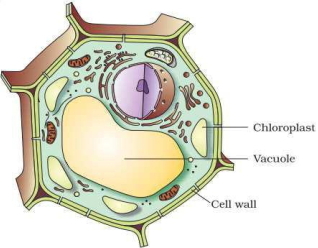
0 likes
View Solution39
Easy
Name an organelle which maintains the turgidity and rigidity of mature plant cells.
Solution
(N/A) The organelle responsible for maintaining the turgidity and rigidity of mature plant cells is the $Vacuole$. In plant cells, large central vacuoles occupy up to $90\%$ of the cell volume. The cell sap contained within the vacuole exerts pressure against the cell wall, known as turgor pressure, which provides structural support and rigidity to the plant.
0 likes
View Solution40
EasyMCQ
Which part of the cell is called the brain of the cell?
A
Mitochondria
B
Nucleus
C
Ribosome
D
Lysosome
Solution
(B) The $Nucleus$ is called the brain of the cell because it contains the genetic material $(DNA)$ and controls all the metabolic activities and cellular functions of the cell.
0 likes
View Solution41
EasyMCQ
Which plastid would you expect to be present in $(i)$ Papaya and $(ii)$ Grass?
A
Chromoplasts,Chloroplasts
B
Chloroplasts,Chromoplasts
C
Leucoplasts,Chloroplasts
D
Chromoplasts,Leucoplasts
Solution
(A) $(i)$ Papaya contains chromoplasts,which are colored plastids (other than green) that provide yellow,orange,or red pigments to fruits.
$(ii)$ Grass contains chloroplasts,which are green-colored plastids containing chlorophyll,essential for photosynthesis.
$(ii)$ Grass contains chloroplasts,which are green-colored plastids containing chlorophyll,essential for photosynthesis.
0 likes
View Solution42
EasyMCQ
Name the cell organelle which is generally small-sized in animal cells and large in plant cells.
A
Mitochondria
B
Vacuoles
C
Lysosomes
D
Golgi apparatus
Solution
(B) The cell organelle that is generally small-sized in animal cells and large in plant cells is the $Vacuole$.
In plant cells, $Vacuoles$ are large, membrane-bound sacs that can occupy up to $90\%$ of the cell volume, providing turgidity and rigidity to the cell.
In animal cells, if present, $Vacuoles$ are either absent or very small in size.
In plant cells, $Vacuoles$ are large, membrane-bound sacs that can occupy up to $90\%$ of the cell volume, providing turgidity and rigidity to the cell.
In animal cells, if present, $Vacuoles$ are either absent or very small in size.
0 likes
View Solution43
EasyMCQ
Name the nucleic acids present in the cell.
A
$DNA$ and Protein
B
$RNA$ and $DNA$
C
Protein and $RNA$
D
$DNA$ and Carbohydrates
Solution
(B) The two primary types of nucleic acids found in a cell are $DNA$ (Deoxyribonucleic acid) and $RNA$ (Ribonucleic acid).
$DNA$ serves as the genetic material that stores hereditary information.
$RNA$ is primarily involved in protein synthesis and gene expression.
$DNA$ serves as the genetic material that stores hereditary information.
$RNA$ is primarily involved in protein synthesis and gene expression.
0 likes
View Solution44
EasyMCQ
What is the main function of a vacuole?
A
Storage of proteins
B
Maintenance of cell turgidity and storage of substances
C
Protein synthesis
D
Lipid synthesis
Solution
(B) Vacuoles are membrane-bound organelles found in the cytoplasm of cells.
In plant cells,they are large and occupy a significant portion of the cell volume,providing turgidity and rigidity to the cell by maintaining internal pressure.
They also serve as storage sacs for various substances,including water,nutrients,and waste products.
In plant cells,they are large and occupy a significant portion of the cell volume,providing turgidity and rigidity to the cell by maintaining internal pressure.
They also serve as storage sacs for various substances,including water,nutrients,and waste products.
0 likes
View Solution45
Easy
Name two double membraned cell organelles.
Solution
(N/A) The two cell organelles that possess a double membrane are the $Chloroplast$ and the $Mitochondria$. These organelles are unique because they contain their own $DNA$ and ribosomes,which supports the endosymbiotic theory.
0 likes
View Solution46
EasyMCQ
Name the cell organelles which are without a membrane.
A
Mitochondria
B
Ribosomes
C
Lysosomes
D
Golgi apparatus
Solution
(B) The cell organelles that lack a membrane are known as non-membrane-bound organelles.
Ribosomes are the primary example of such organelles,as they are composed of $RNA$ and proteins and are not enclosed by any lipid bilayer membrane.
Centrosomes are another example of non-membrane-bound organelles found in animal cells.
Ribosomes are the primary example of such organelles,as they are composed of $RNA$ and proteins and are not enclosed by any lipid bilayer membrane.
Centrosomes are another example of non-membrane-bound organelles found in animal cells.
0 likes
View Solution47
EasyMCQ
Name the single membrane-bound cell organelle which is found in an animal cell.
A
Lysosome
B
Mitochondria
C
Nucleus
D
Chloroplast
Solution
(A) The $Lysosome$ is a single membrane-bound cell organelle found in animal cells. It contains powerful digestive enzymes that help in the breakdown of waste materials and foreign substances within the cell.
0 likes
View Solution48
EasyMCQ
What is the role of smooth endoplasmic reticulum in the liver cells of vertebrate animals?
A
Protein synthesis
B
Detoxification of drugs and poisons
C
Lipid synthesis
D
Storage of calcium ions
Solution
(B) In the liver cells of vertebrate animals,the smooth endoplasmic reticulum $(SER)$ plays a crucial role in the detoxification of many poisons and drugs.
0 likes
View Solution49
EasyMCQ
Which type of animal cell lacks both mitochondria and endoplasmic reticulum?
A
Mature mammalian red blood cells
B
White blood cells
C
Liver cells
D
Muscle cells
Solution
(A) Mature mammalian $RBCs$ (Red Blood Cells) lack both mitochondria and endoplasmic reticulum.
This adaptation allows them to carry more hemoglobin,thereby increasing their oxygen-carrying capacity.
They rely on anaerobic respiration for their energy requirements.
This adaptation allows them to carry more hemoglobin,thereby increasing their oxygen-carrying capacity.
They rely on anaerobic respiration for their energy requirements.
0 likes
View Solution50
EasyMCQ
Why is the mitochondrion called the 'powerhouse of the cell'?
A
It produces proteins.
B
It generates energy in the form of $ATP$.
C
It stores genetic material.
D
It helps in waste disposal.
Solution
(B) The mitochondrion is known as the 'powerhouse of the cell' because it is the site of cellular respiration.
During this process,it oxidizes nutrients (food) to release energy.
This energy is stored and released in the form of $Adenosine$ $Triphosphate$ $(ATP)$,which is the energy currency of the cell.
During this process,it oxidizes nutrients (food) to release energy.
This energy is stored and released in the form of $Adenosine$ $Triphosphate$ $(ATP)$,which is the energy currency of the cell.
0 likes
View SolutionTHE FUNDAMENTAL UNIT OF LIFE — Cell Organelles · Frequently Asked Questions
1Are these THE FUNDAMENTAL UNIT OF LIFE questions useful for JEE and NEET?
Yes. All questions in this section are mapped to JEE Main and NEET exam patterns. Previous year questions from JEE Main, NEET, GUJCET and state-level exams are included with full solutions.
2Can I switch to Hindi or Gujarati for these questions?
Yes. Use the language tabs in the hero section or the sidebar to view the same questions and solutions in English, Hindi or Gujarati.
3How do I generate a question paper from this subtopic?
Use the Vedclass Exam Paper Generator — select the chapter and subtopic, set difficulty, and generate Sets A, B, C, D automatically. First 3 chapters of every subject are free.
Vedclass Products
For Students
Vedclass Test Series
Mock tests in real JEE/NEET style with performance analysis. 5-day free trial.
Start Free TrialFor Teachers
Exam Paper Generator
Generate Set A/B/C/D papers from this chapter in 2 minutes. 3 chapters free.
Try FreeFor Institutes
Online Exam Module
Live online exams with unlimited students, 360° analytics & white-label branding.
See DemoFor Teachers & Institutes
Generate a THE FUNDAMENTAL UNIT OF LIFE Exam Paper in 2 Minutes
Select subtopic & difficulty — Sets A, B, C, D auto-generated with No Repeat logic.
First 3 chapters of every subject are free — no payment required.