
A English
Animal Tissues Questions in English
Class 9 Science · TISSUES · Animal Tissues
98+
Questions
English
Language
100%
With Solutions
Showing 50 of 98 questions in English
1
MediumMCQ
Name the tissue responsible for movement in our body.
A
Epithelial tissue
B
Connective tissue
C
Muscular tissue
D
Nervous tissue
Solution
(C) Muscular tissue is responsible for movement in our body. It consists of specialized cells called muscle fibers that have the ability to contract and relax,which facilitates body movement and locomotion.
0 likes
View Solution2
EasyMCQ
What does a neuron look like?
A
It has a cell body,a single long axon,and many short,branched dendrites.
B
It is a spherical cell with no extensions.
C
It consists of only a long axon without any cell body.
D
It is a cluster of many cell bodies without any nerve fibers.
Solution
(A) neuron consists of a cell body (cyton) containing a nucleus and cytoplasm.
It has two types of extensions: axons and dendrites.
Each neuron has a single long process called the axon and many short,branched processes called dendrites.
Many nerve fibers are bound together by connective tissue to form a nerve.
It has two types of extensions: axons and dendrites.
Each neuron has a single long process called the axon and many short,branched processes called dendrites.
Many nerve fibers are bound together by connective tissue to form a nerve.
0 likes
View Solution3
Medium
Give three features of cardiac muscles.
Solution
(N/A) The features of cardiac muscles are as follows:
$1.$ These are involuntary muscles that exhibit rhythmic contraction and relaxation throughout life.
$2.$ The cells are cylindrical,branched,and uninucleate,possessing faint cross-striations.
$3.$ These muscles do not get fatigued under normal physiological conditions.
$1.$ These are involuntary muscles that exhibit rhythmic contraction and relaxation throughout life.
$2.$ The cells are cylindrical,branched,and uninucleate,possessing faint cross-striations.
$3.$ These muscles do not get fatigued under normal physiological conditions.
0 likes
View Solution4
Medium
What are the functions of areolar tissue?
Solution
(N/A) Functions of areolar tissue :
$1.$ It fills the space inside the organs,thus acts as a packing tissue between the organs.
$2.$ It supports many delicate organs in the body.
$3.$ It plays a role in the repair of tissues.
$1.$ It fills the space inside the organs,thus acts as a packing tissue between the organs.
$2.$ It supports many delicate organs in the body.
$3.$ It plays a role in the repair of tissues.
0 likes
View Solution5
Difficult
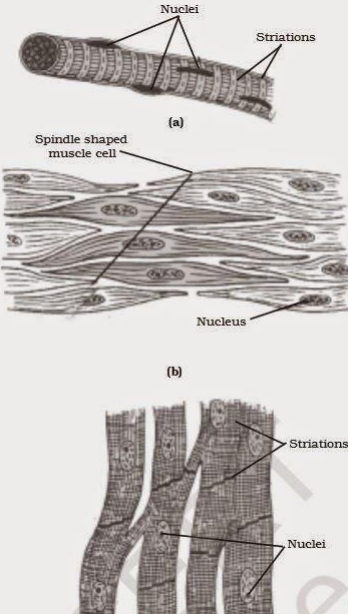
Diagrammatically show the difference between the three types of muscle fibres.
Solution
(N/A) The three types of muscle fibres are:
$1.$ Striated muscle: These are cylindrical,unbranched,and multinucleated cells with alternating light and dark bands (striations).
$2.$ Smooth muscle: These are spindle-shaped,uninucleated cells that lack striations and are found in the walls of internal organs.
$3.$ Cardiac muscle: These are cylindrical,branched,and uninucleated cells with faint striations,found exclusively in the heart.
0 likes
View Solution6
MediumMCQ
What is the specific function of the cardiac muscle?
A
To facilitate voluntary movement of limbs.
B
To bring about rhythmic contraction and relaxation of the heart.
C
To store energy in the form of fat.
D
To provide structural support to the skeletal system.
Solution
(B) The uninucleated,striated,tubular,and branched muscles that form the wall of the heart are known as cardiac muscles.
They serve to bring about rhythmic contraction and relaxation of the heart to allow the pumping of blood throughout life.
Since these muscles contract without any nerve stimulation or conscious control,they are involuntary in nature.
They serve to bring about rhythmic contraction and relaxation of the heart to allow the pumping of blood throughout life.
Since these muscles contract without any nerve stimulation or conscious control,they are involuntary in nature.
0 likes
View Solution7
Difficult
Differentiate between striated,unstriated,and cardiac muscles on the basis of their structure and site/location in the body.
Solution
(N/A) The differences between the three types of muscles are as follows:
$1$. Striated (Skeletal) Muscles: These are cylindrical,unbranched,and multinucleated cells with light and dark bands (striations). They are attached to bones and are responsible for voluntary movements.
$2$. Unstriated (Smooth) Muscles: These are spindle-shaped,uninucleated,and lack striations. They are found in the walls of internal organs like the stomach,intestines,and blood vessels,and are responsible for involuntary movements.
$3$. Cardiac Muscles: These are cylindrical,branched,and uninucleated cells with faint striations. They are found exclusively in the walls of the heart and are responsible for the rhythmic contraction and relaxation of the heart throughout life.
0 likes
View Solution8
Medium
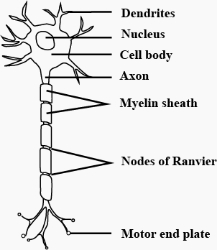
Draw a labelled diagram of a neuron.
Solution
(N/A) neuron (nerve cell) consists of three main parts: the cell body (cyton),dendrites,and the axon.
$1$. Cell body (Cyton): It contains the nucleus and cytoplasm. It is the metabolic center of the neuron.
$2$. Dendrites: These are short,branched extensions that receive signals from other neurons or sensory receptors.
$3$. Axon: It is a long,slender projection that conducts electrical impulses away from the cell body.
Key structures include the myelin sheath (insulating layer),nodes of Ranvier (gaps in the myelin sheath),and the motor end plate (synaptic terminal) which transmits signals to the next cell.
0 likes
View Solution9
EasyMCQ
The intestine absorbs digested food materials. Which type of epithelial cells are responsible for this?
A
Columnar epithelium
B
Stratified squamous epithelium
C
Spindle fibres
D
Cuboidal epithelium
Solution
(A) The intestine is lined with columnar epithelium,which is specialized for absorption and secretion.
Stratified squamous epithelium is found in the skin and provides protection against wear and tear.
Cuboidal epithelium is typically found in ducts of glands and kidney tubules,providing structural support and secretion.
Spindle fibres are part of the cytoskeleton involved in cell division,not a type of epithelial tissue.
0 likes
View Solution10
MediumMCQ
$A$ person met with an accident in which two long bones of the hand were dislocated. Which among the following may be the possible reason?
A
Tendon break
B
Ligament break
C
Break of skeletal muscle
D
Areolar tissue break
Solution
(B) Ligaments are specialized connective tissues that connect one bone to another bone at joints. When a person meets with an accident,the excessive force can cause these ligaments to tear or break. Since ligaments provide stability to the joints,their rupture leads to the displacement of bones from their normal position,which is known as dislocation.
0 likes
View Solution11
MediumMCQ
While doing work and running,you move your organs like hands,legs etc. Which among the following is correct?
A
Smooth muscles contract and pull the ligament to move the bones
B
Smooth muscles contract and pull the tendons to move the bones
C
Skeletal muscles contract and pull the tendon to move the bones
D
Skeletal muscles contract and pull the ligament to move the bones
Solution
(C) Skeletal muscles are responsible for voluntary movement,and therefore,movement in limbs like hands and legs is facilitated by the contraction or relaxation of skeletal muscles.
$A$ tendon is a fibrous connective tissue that attaches a muscle to a bone.
When skeletal muscles contract,they pull on the tendons,which in turn pull the bones to create movement.
Therefore,option $C$ is correct.
$A$ tendon is a fibrous connective tissue that attaches a muscle to a bone.
When skeletal muscles contract,they pull on the tendons,which in turn pull the bones to create movement.
Therefore,option $C$ is correct.
0 likes
View Solution12
MediumMCQ
Which muscles act involuntarily?
$(i)$ Striated muscles
$(ii)$ Smooth muscles
$(iii)$ Cardiac muscles
$(iv)$ Skeletal muscles
$(i)$ Striated muscles
$(ii)$ Smooth muscles
$(iii)$ Cardiac muscles
$(iv)$ Skeletal muscles
A
$(i)$ and $(ii)$
B
$(i)$ and $(iv)$
C
$(iii)$ and $(iv)$
D
$(ii)$ and $(iii)$
Solution
(D) Muscles can be classified based on their control as voluntary or involuntary.
Skeletal muscles are voluntary muscles because their movement is under our conscious control. They are also known as striated muscles due to their striped appearance.
Smooth muscles are involuntary muscles found in the walls of internal organs,and their movement is not under conscious control.
Cardiac muscles are involuntary muscles found in the heart,responsible for rhythmic contractions.
Therefore,both smooth muscles $(ii)$ and cardiac muscles $(iii)$ act involuntarily.
0 likes
View Solution13
MediumMCQ
Select the incorrect sentence.
A
Blood has a matrix containing proteins,salts,and hormones.
B
Two bones are connected with ligaments.
C
Tendons are non-fibrous tissue and fragile.
D
Cartilage is a form of connective tissue.
Solution
(C) Tendons are fibrous connective tissues that are very strong and have limited flexibility,not fragile. Therefore,the statement that tendons are non-fibrous and fragile is incorrect.
0 likes
View Solution14
MediumMCQ
Cartilage is not found in
A
nose
B
ear
C
larynx
D
kidney
Solution
(D) Cartilage is a type of specialized connective tissue. It is found in the nose,ear,larynx,and trachea. The kidney is an organ composed primarily of epithelial tissues and nephrons,not cartilage.
0 likes
View Solution15
EasyMCQ
Fats are stored in the human body in which of the following?
A
Adipose tissue
B
Cuboidal epithelium
C
Bones
D
Cartilage
Solution
(A) Adipose tissue is a specialized type of connective tissue that functions primarily to store fat. It consists of adipocytes,which are cells specialized for the storage of lipids. These tissues are found beneath the skin,around internal organs,and in the bone marrow,providing insulation and energy reserves for the body.
0 likes
View Solution16
MediumMCQ
Bone matrix is rich in
A
fluoride and calcium
B
calcium and phosphorus
C
calcium and potassium
D
phosphorus and potassium
Solution
(B) Bone is a connective tissue that provides a structural framework to the body. The bone cells (osteocytes) are embedded in a hard,non-pliable matrix. This matrix is primarily composed of calcium and phosphorus salts,which provide strength and rigidity to the bones.
0 likes
View Solution17
MediumMCQ
Contractile proteins are found in
A
bones
B
blood
C
muscles
D
cartilage
Solution
(C) Muscles possess the unique ability to contract and relax,which allows for movement. This property is due to the presence of specialized contractile proteins,primarily $Actin$ and $Myosin$,within the muscle fibers. Therefore,contractile proteins are found in muscles.
0 likes
View Solution18
EasyMCQ
Voluntary muscles are found in
A
alimentary canal
B
bronchi of lungs
C
iris of the eye
D
limbs
Solution
(D) Voluntary muscles,also known as skeletal muscles,are attached to bones and are under our conscious control.
They are responsible for the movement of body parts like arms and legs.
The muscles in the alimentary canal,bronchi of lungs,and iris of the eye are involuntary muscles,meaning they are not under our conscious control.
They are responsible for the movement of body parts like arms and legs.
The muscles in the alimentary canal,bronchi of lungs,and iris of the eye are involuntary muscles,meaning they are not under our conscious control.
0 likes
View Solution19
DifficultMCQ
Nervous tissue is not found in
A
tendons
B
spinal cord
C
brain
D
nerves
Solution
(A) Nervous tissue is primarily composed of neurons and neuroglia, which are responsible for the transmission and processing of electrical signals. The $brain$, $spinal cord$, and $nerves$ are the primary components of the nervous system and are rich in nervous tissue. $Tendons$, on the other hand, are a type of dense regular connective tissue that connects muscles to bones. Therefore, nervous tissue is not found in tendons.
0 likes
View Solution20
EasyMCQ
Nerve cell does not contain
A
axon
B
tendons
C
nerve endings
D
dendrites
Solution
(B) nerve cell,also known as a neuron,is the fundamental unit of the nervous system. It consists of a cell body (cyton),dendrites,and an axon with nerve endings. Tendons are a type of dense regular connective tissue that connects muscle to bone. Therefore,tendons are not a component of a nerve cell.
0 likes
View Solution21
MediumMCQ
Which of the following helps in the repair of tissue and fills up the space inside the organ?
A
Tendon
B
Adipose tissue
C
Areolar tissue
D
Cartilage
Solution
(C) Areolar tissue is a type of loose connective tissue that acts as a supporting and packing tissue between organs. It fills the space inside the organs,supports internal organs,and plays a crucial role in the repair of tissues after an injury.
0 likes
View Solution22
EasyMCQ
The muscular tissue which functions throughout life continuously without fatigue is
A
skeletal muscle
B
voluntary muscle
C
smooth muscle
D
cardiac muscle
Solution
(D) Cardiac muscles are involuntary muscles present in the heart.
They are specialized to contract and relax rhythmically throughout an individual's life without getting fatigued.
This continuous action ensures that the heart keeps pumping blood to all parts of the body without stopping.
They are specialized to contract and relax rhythmically throughout an individual's life without getting fatigued.
This continuous action ensures that the heart keeps pumping blood to all parts of the body without stopping.
0 likes
View Solution23
EasyMCQ
Which of the following cells is found in the cartilaginous tissue of the body?
A
Chondrocytes
B
Basophils
C
Osteocytes
D
Mast cells
Solution
(A) Chondrocytes are the specialized cells found in the cartilaginous tissue (cartilage) of the body.
$A$. Chondrocytes: Found in cartilage.
$B$. Basophils: $A$ type of white blood cell found in the blood.
$C$. Osteocytes: Mature bone cells found in bone tissue.
$D$. Mast cells: Found in connective tissues like areolar tissue.
$A$. Chondrocytes: Found in cartilage.
$B$. Basophils: $A$ type of white blood cell found in the blood.
$C$. Osteocytes: Mature bone cells found in bone tissue.
$D$. Mast cells: Found in connective tissues like areolar tissue.
0 likes
View Solution24
MediumMCQ
Choose the wrong statement.
A
Epithelial tissues have intercellular spaces between them.
B
Fats are stored below the skin and in between the internal organs.
C
The nature of matrix differs according to the function of the tissue.
D
Cells of striated muscles are multinucleate and unbranched.
Solution
(A) Epithelial tissues do not have intercellular spaces between them. Instead,the cells are tightly packed together to form a continuous sheet with very little intercellular material.
0 likes
View Solution25
Easy
Animals of colder regions and fishes of cold water have a thicker layer of subcutaneous fat. Describe why?
Solution
(N/A) The subcutaneous fat layer acts as an insulator for the body.
It prevents the loss of body heat to the cold environment.
This process is essential for thermoregulation,helping these animals maintain a constant body temperature despite the freezing external conditions.
It prevents the loss of body heat to the cold environment.
This process is essential for thermoregulation,helping these animals maintain a constant body temperature despite the freezing external conditions.
0 likes
View Solution26
Medium
Write true $(T)$ or false $(F)$ for the following statements:
$(a)$ Epithelial tissue is a protective tissue in the animal body.
$(b)$ The lining of blood vessels,lung alveoli,and kidney tubules are all made up of epithelial tissue.
$(c)$ Epithelial cells have a lot of intercellular spaces.
$(d)$ The epithelial layer is a permeable layer.
$(e)$ The epithelial layer does not allow the regulation of materials between the body and the external environment.
Solution
(A-D) $(a) - T$: Epithelial tissue forms the outer covering and protective layers of the body.
$(b) - T$: These structures are lined by simple squamous or cuboidal epithelium for exchange and secretion.
$(c) - F$: Epithelial cells are tightly packed with almost no intercellular spaces.
$(d) - T$: The epithelial layer is permeable,allowing the exchange of substances.
$(e) - F$: The epithelial layer plays a crucial role in regulating the exchange of materials between the body and the external environment.
1 likes
View Solution27
Medium
Differentiate between voluntary and involuntary muscles. Give one example of each type.
Solution
(N/A)
| Voluntary muscles | Involuntary muscles |
|---|---|
| $(i)$ Their action is under our conscious control. | $(i)$ Their action is not under our conscious control. |
| $(ii)$ These are typically striated and multinucleate. | $(ii)$ These are typically non-striated and uninucleate. |
| $(iii)$ Example: Skeletal muscles (e.g.,biceps). | $(iii)$ Example: Smooth muscles (e.g.,muscles in the digestive tract). |
0 likes
View Solution28
Medium
Differentiate the following activities on the basis of voluntary $(V)$ or involuntary $(IV)$ muscles:
$(a)$ Jumping of a frog
$(b)$ Pumping of the heart
$(c)$ Writing with hand
$(d)$ Movement of food in your intestine
$(a)$ Jumping of a frog
$(b)$ Pumping of the heart
$(c)$ Writing with hand
$(d)$ Movement of food in your intestine
Solution
(A) The classification of activities based on muscle type is as follows:
$(a)$ Jumping of a frog: This involves skeletal muscles which are under conscious control,hence it is Voluntary $(V)$.
$(b)$ Pumping of the heart: This is controlled by cardiac muscles which function automatically without conscious effort,hence it is Involuntary $(IV)$.
$(c)$ Writing with hand: This involves skeletal muscles controlled by the brain's conscious command,hence it is Voluntary $(V)$.
$(d)$ Movement of food in your intestine: This involves smooth muscles which perform peristalsis automatically,hence it is Involuntary $(IV)$.
Final Answer: $(a)-V, (b)-IV, (c)-V, (d)-IV$.
0 likes
View Solution29
Medium
Fill in the blanks:
$(a)$ Lining of blood vessels is made up of ..............
$(b)$ Lining of small intestine is made up of ..............
$(c)$ Lining of kidney tubules is made up of ...............
$(d)$ Epithelial cells with cilia are found in ..............
$(a)$ Lining of blood vessels is made up of ..............
$(b)$ Lining of small intestine is made up of ..............
$(c)$ Lining of kidney tubules is made up of ...............
$(d)$ Epithelial cells with cilia are found in ..............
Solution
(N/A) The lining of blood vessels is made up of squamous epithelium,which allows for the easy transport of substances through diffusion.
$(b)$ The lining of the small intestine is made up of columnar epithelium,which facilitates absorption and secretion.
$(c)$ The lining of kidney tubules is made up of cuboidal epithelium,which provides mechanical support and helps in absorption and secretion.
$(d)$ Epithelial cells with cilia are found in the respiratory tract,where they help in moving mucus out of the airways.
0 likes
View Solution30
Medium
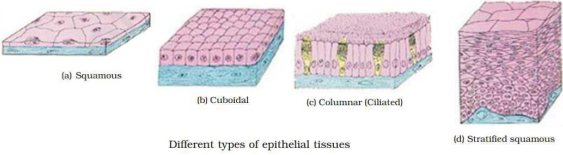
Describe the structure and function of different types of epithelial tissues. Draw a diagram of each type of epithelial tissue.
Solution
(N/A) Epithelial tissues are the covering or protective tissues in the animal body. Epithelium covers most organs and cavities within the body and keeps different body systems separate. The skin,the lining of the mouth,the lining of blood vessels,lung alveoli,and kidney tubules are all made of epithelial tissue.
Epithelial tissue cells are tightly packed and form a continuous sheet. They have only a small amount of cementing material between them and almost no intercellular spaces. The permeability of the cells of various epithelia plays an important role in regulating the exchange of materials between the body and the external environment and also between different parts of the body. Regardless of the type,all epithelia are usually separated from the underlying tissue by an extracellular fibrous basement membrane.
Epithelial tissues are of the following types:
$(1)$ Simple squamous epithelium: Extremely thin and flat,forming a delicate lining. Found in blood vessels and lung alveoli where transportation occurs.
$(2)$ Stratified squamous epithelium: Arranged in many layers to prevent wear and tear. Found in the skin and lining of the mouth.
$(3)$ Columnar epithelium: Tall epithelial cells present where absorption and secretion occur,such as the inner lining of the intestine. If they have cilia,they are called ciliated columnar epithelium,which helps in moving mucus.
$(4)$ Cuboidal epithelium: Cube-shaped cells forming the lining of kidney tubules and ducts of salivary glands,providing mechanical support.
Additionally,some epithelial tissue folds inward to form a multicellular gland,known as glandular epithelium.
0 likes
View Solution31
Medium
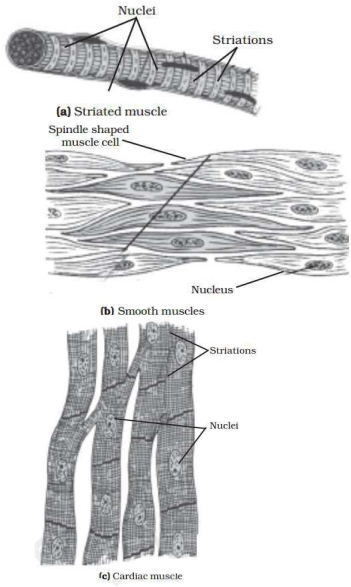
Draw well-labelled diagrams of various types of muscles found in the human body.
Solution
(N/A) The three main types of muscles found in the human body are as follows:
$1$. Striated Muscles (Skeletal Muscles): These are cylindrical,unbranched,and multinucleated. They show alternate light and dark bands (striations) and are attached to bones.
$2$. Smooth Muscles (Unstriated Muscles): These are spindle-shaped (fusiform) with a single central nucleus. They do not show striations and are found in the walls of internal organs like the stomach and intestines.
$3$. Cardiac Muscles: These are cylindrical,branched,and uninucleated. They show striations and are involuntary muscles found exclusively in the heart.
(Please refer to the provided image for the diagrams of these muscle types.)
0 likes
View Solution32
EasyMCQ
Name the muscular tissue whose cells are spindle-shaped and uninucleate.
A
Striated muscle
B
Cardiac muscle
C
Smooth muscle
D
Skeletal muscle
Solution
(C) The muscular tissue whose cells are spindle-shaped and uninucleate is known as $Smooth$ $muscle$ (also called $Unstriated$ $muscle$ or $Involuntary$ $muscle$).
These cells are long with pointed ends (spindle-shaped) and contain a single central nucleus (uninucleate).
They are found in the walls of internal organs such as the stomach, intestines, and blood vessels.
These cells are long with pointed ends (spindle-shaped) and contain a single central nucleus (uninucleate).
They are found in the walls of internal organs such as the stomach, intestines, and blood vessels.
0 likes
View Solution33
Easy
State the chemical composition of the solid matrix of cartilage.
Solution
(N/A) The solid matrix of cartilage is composed of proteins and sugars. These components are primarily organized as proteoglycans,which provide the tissue with its characteristic flexibility and strength.
0 likes
View Solution34
EasyMCQ
Name the animal tissue which acts as a heat insulator.
A
Epithelial tissue
B
Adipose tissue
C
Muscular tissue
D
Nervous tissue
Solution
(B) Adipose tissue is a type of connective tissue that stores fat. It is found below the skin and between internal organs. Due to the presence of fat,it acts as an insulator and prevents the loss of heat from the body,thereby helping to maintain body temperature.
0 likes
View Solution35
EasyMCQ
What is the function of the ligament?
A
Connects bone to muscle
B
Connects bone to bone
C
Connects muscle to muscle
D
Provides elasticity to skin
Solution
(B) ligament is a specialized type of connective tissue that connects bone to bone. It is highly elastic and provides stability to joints.
0 likes
View Solution36
EasyMCQ
What is the main function of $WBC$?
A
Transport of oxygen
B
Clotting of blood
C
Protection against infections
D
Regulation of body temperature
Solution
(C) $WBC$ (White Blood Cells),also known as leukocytes,are an essential part of the immune system.
Their primary function is to defend the body against pathogens such as bacteria,viruses,and other foreign substances.
They achieve this by engulfing foreign particles or by producing antibodies,thereby providing immunity to the body.
Their primary function is to defend the body against pathogens such as bacteria,viruses,and other foreign substances.
They achieve this by engulfing foreign particles or by producing antibodies,thereby providing immunity to the body.
0 likes
View Solution37
EasyMCQ
What is the function of $RBCs$?
A
To fight against infection
B
To transport oxygen and carbon dioxide
C
To help in blood clotting
D
To provide immunity
Solution
(B) $RBCs$ (Red Blood Cells) contain a respiratory pigment called haemoglobin.
Haemoglobin binds with $O_{2}$ to form oxyhaemoglobin,which facilitates the transport of oxygen from the lungs to the body tissues.
It also plays a role in the transport of $CO_{2}$ from the tissues back to the lungs for exhalation.
Haemoglobin binds with $O_{2}$ to form oxyhaemoglobin,which facilitates the transport of oxygen from the lungs to the body tissues.
It also plays a role in the transport of $CO_{2}$ from the tissues back to the lungs for exhalation.
0 likes
View Solution38
EasyMCQ
What are blood platelets?
A
Red blood cells
B
White blood cells
C
Cell fragments that help in blood clotting
D
Plasma proteins
Solution
(C) Blood platelets,also known as thrombocytes,are cell fragments derived from megakaryocytes in the bone marrow.
They play a crucial role in the process of blood clotting (coagulation) at the site of an injury to prevent excessive blood loss.
They play a crucial role in the process of blood clotting (coagulation) at the site of an injury to prevent excessive blood loss.
0 likes
View Solution39
EasyMCQ
Why are skeletal muscles known as striated muscles?
A
Due to their attachment to bones.
B
Due to the presence of alternate light and dark bands.
C
Due to their voluntary nature.
D
Due to their cylindrical shape.
Solution
(B) Skeletal muscles are known as striated muscles because,when observed under a microscope,they exhibit a characteristic pattern of alternate light and dark bands or striations when stained appropriately. These bands are caused by the regular arrangement of contractile proteins,specifically actin and myosin,within the muscle fibers. Consequently,they are referred to as striated muscles.
0 likes
View Solution40
EasyMCQ
Name the connective tissue that is found between skin and muscles.
A
Adipose tissue
B
Areolar connective tissue
C
Ligament
D
Tendon
Solution
(B) The connective tissue found between the skin and muscles is known as areolar connective tissue. It acts as a supporting and packing tissue between organs and fills the space inside the organs,supporting internal organs and helping in the repair of tissues.
0 likes
View Solution41
MediumMCQ
How is stratified squamous epithelial tissue different from simple squamous epithelial tissue?
A
Simple squamous is single-layered,while stratified squamous is multi-layered.
B
Simple squamous is multi-layered,while stratified squamous is single-layered.
C
Both are identical in structure.
D
Stratified squamous is found in the alveoli,while simple squamous is found in the skin.
Solution
(A) Simple squamous epithelial tissue consists of a single layer of extremely thin and flat cells,forming a delicate lining,such as in the blood vessels or lung alveoli.
Stratified squamous epithelial tissue consists of cells arranged in many layers to prevent wear and tear.
This multi-layered arrangement is specifically found in areas subjected to mechanical stress,such as the skin,the lining of the mouth,and the oesophagus.
Stratified squamous epithelial tissue consists of cells arranged in many layers to prevent wear and tear.
This multi-layered arrangement is specifically found in areas subjected to mechanical stress,such as the skin,the lining of the mouth,and the oesophagus.
0 likes
View Solution42
Easy
Name the muscular tissue which is present in the iris of the eye. What is the shape of these cells?
Solution
(N/A) The muscular tissue present in the iris of the eye is the $Smooth$ muscle (also known as involuntary muscle).
These cells are $spindle-shaped$ (fusiform), meaning they are wide in the middle and tapered at both ends.
These cells are $spindle-shaped$ (fusiform), meaning they are wide in the middle and tapered at both ends.
0 likes
View Solution43
Easy
Determine the location of the following tissues:
$1$. Unstriated muscle fibres
$2$. Cuboidal epithelium
$3$. Adipose tissue
$4$. Striated muscle fibres
$1$. Unstriated muscle fibres
$2$. Cuboidal epithelium
$3$. Adipose tissue
$4$. Striated muscle fibres
Solution
(N/A) $1$. Unstriated muscle fibres are found in the walls of the alimentary canal,iris of the eye,ureters,and bronchi.
$2$. Cuboidal epithelium is found in the lining of kidney tubules and ducts of salivary glands.
$3$. Adipose tissue is found below the skin and between internal organs.
$4$. Striated muscle fibres are found in the limbs,tongue,and body wall.
$2$. Cuboidal epithelium is found in the lining of kidney tubules and ducts of salivary glands.
$3$. Adipose tissue is found below the skin and between internal organs.
$4$. Striated muscle fibres are found in the limbs,tongue,and body wall.
0 likes
View Solution44
Easy
Which parts of our body are composed of nervous tissue? Name the cells that make up the nervous tissue.
Solution
(N/A) The nervous tissue is primarily found in the following parts of the body:
$(i)$ Brain
$(ii)$ Spinal cord
$(iii)$ Nerves
The cells that make up the nervous tissue are called neurons (or nerve cells).
$(i)$ Brain
$(ii)$ Spinal cord
$(iii)$ Nerves
The cells that make up the nervous tissue are called neurons (or nerve cells).
0 likes
View Solution45
Medium
$(a)$ Why is connective tissue called so?
$(b)$ What is the function of the areolar connective tissue?
$(c)$ Which substance is present in the adipocyte? How does it help?
$(b)$ What is the function of the areolar connective tissue?
$(c)$ Which substance is present in the adipocyte? How does it help?
Solution
(N/A) Connective tissue is called so because its primary function is to bind,support,and connect different tissues and organs of the body together.
$(b)$ Areolar connective tissue fills the space inside the organs,supports internal organs,and helps in the repair of tissues.
$(c)$ Adipocytes contain fat globules. This stored fat acts as an insulator against heat loss and provides energy to the body.
$(b)$ Areolar connective tissue fills the space inside the organs,supports internal organs,and helps in the repair of tissues.
$(c)$ Adipocytes contain fat globules. This stored fat acts as an insulator against heat loss and provides energy to the body.
0 likes
View Solution46
Medium
What are the distinctive features of cardiac muscles?
Solution
(N/A) Features of cardiac muscles are:
$(i)$ These are involuntary muscles that exhibit rhythmic contraction and relaxation throughout life.
$(ii)$ These muscles are composed of non-tapering cells with faint cross-striations.
$(iii)$ The cells of these muscles are cylindrical,branched,and uninucleate.
$(iv)$ These muscles do not get fatigued under normal conditions.
0 likes
View Solution47
Medium
What are the two main components of blood? Why is blood considered a type of connective tissue?
Solution
(N/A) The two main components of blood are plasma and blood cells (corpuscles).
Blood is considered a type of connective tissue because it consists of a fluid matrix,known as plasma,in which various blood cells are suspended. Connective tissues are defined by having cells embedded in an extracellular matrix,and blood fits this definition as the plasma acts as the matrix connecting different parts of the body by transporting nutrients,gases,and waste products.
Blood is considered a type of connective tissue because it consists of a fluid matrix,known as plasma,in which various blood cells are suspended. Connective tissues are defined by having cells embedded in an extracellular matrix,and blood fits this definition as the plasma acts as the matrix connecting different parts of the body by transporting nutrients,gases,and waste products.
0 likes
View Solution48
Easy
Name the liquid matrix of the blood. What does it contain? List any two functions of blood.
Solution
(N/A) The liquid matrix of the blood is called $Plasma$.
$Plasma$ contains water,proteins (such as $albumin$,$globulin$,and $fibrinogen$),salts (electrolytes),hormones,glucose,and waste products.
Two functions of blood are:
$1$. It transports respiratory gases ($O_2$ and $CO_2$) between the lungs and body tissues.
$2$. It transports digested food,hormones,and waste materials to different parts of the body.
0 likes
View Solution49
Medium
List any two differences between the structure and location of striated and unstriated muscles.
Solution
(N/A)
| Striated Muscles | Unstriated Muscles |
|---|---|
| $1.$ The cells are long,cylindrical,unbranched,and multinucleate. | $1.$ The cells are long,spindle-shaped (pointed at both ends),and uninucleate. |
| $2.$ These are mostly attached to bones and help in voluntary body movements. | $2.$ These are present in the walls of the alimentary canal,blood vessels,iris of the eye,ureters,and bronchi. |
0 likes
View Solution50
Easy
State one important function of each of the following:
$(a)$ Areolar tissue
$(b)$ Cuboidal epithelium
$(a)$ Areolar tissue
$(b)$ Cuboidal epithelium
Solution
(N/A) Areolar tissue fills the space inside the organs,supports internal organs,and helps in the repair of tissues. (Any $1$)
$(b)$ Cuboidal epithelium provides mechanical support and is involved in secretion and absorption.
$(b)$ Cuboidal epithelium provides mechanical support and is involved in secretion and absorption.
0 likes
View SolutionTISSUES — Animal Tissues · Frequently Asked Questions
1Are these TISSUES questions useful for JEE and NEET?
Yes. All questions in this section are mapped to JEE Main and NEET exam patterns. Previous year questions from JEE Main, NEET, GUJCET and state-level exams are included with full solutions.
2Can I switch to Hindi or Gujarati for these questions?
Yes. Use the language tabs in the hero section or the sidebar to view the same questions and solutions in English, Hindi or Gujarati.
3How do I generate a question paper from this subtopic?
Use the Vedclass Exam Paper Generator — select the chapter and subtopic, set difficulty, and generate Sets A, B, C, D automatically. First 3 chapters of every subject are free.
Vedclass Products
For Students
Vedclass Test Series
Mock tests in real JEE/NEET style with performance analysis. 5-day free trial.
Start Free TrialFor Teachers
Exam Paper Generator
Generate Set A/B/C/D papers from this chapter in 2 minutes. 3 chapters free.
Try FreeFor Institutes
Online Exam Module
Live online exams with unlimited students, 360° analytics & white-label branding.
See DemoFor Teachers & Institutes
Generate a TISSUES Exam Paper in 2 Minutes
Select subtopic & difficulty — Sets A, B, C, D auto-generated with No Repeat logic.
First 3 chapters of every subject are free — no payment required.