
A English
Animal Tissues Questions in English
Class 9 Science · TISSUES · Animal Tissues
98+
Questions
English
Language
100%
With Solutions
Showing 48 of 98 questions in English
51
Medium
Name the tissue that transmits stimuli in our body. How does this tissue enable animals to move rapidly in response to stimuli?
Solution
(N/A) The tissue that transmits stimuli in our body is the nervous tissue.
$(b)$ Nervous tissue contains specialized cells called neurons that receive and transmit electrical impulses. When a stimulus is received,the nervous tissue sends a signal to the muscle tissue. The muscle tissue then contracts or relaxes in response to these signals,which allows animals to move rapidly.
$(b)$ Nervous tissue contains specialized cells called neurons that receive and transmit electrical impulses. When a stimulus is received,the nervous tissue sends a signal to the muscle tissue. The muscle tissue then contracts or relaxes in response to these signals,which allows animals to move rapidly.
0 likes
View Solution52
Medium
Give reasons for the following:
Tissue $A$: Cells are filled with fat globules and the tissue acts as an insulator.
Tissue $B$: Has cylindrical,branched cells and the tissue shows rhythmic contraction and relaxation throughout life.
Tissue $A$: Cells are filled with fat globules and the tissue acts as an insulator.
Tissue $B$: Has cylindrical,branched cells and the tissue shows rhythmic contraction and relaxation throughout life.
Solution
(N/A) Tissue $A$ is Adipose tissue.
Reason: It is a type of connective tissue where cells are specialized to store fats in the form of globules. This fat layer acts as an insulator against heat loss from the body.
Tissue $B$ is Cardiac muscle.
Reason: Cardiac muscle cells are cylindrical,branched,and uninucleate. They are involuntary muscles that exhibit rhythmic contraction and relaxation throughout the life of an organism to pump blood.
0 likes
View Solution53
Medium
$(a)$ Voluntary muscles are also known as skeletal muscles. Justify.
$(b)$ Give two structural characteristics of these voluntary muscles.
$(b)$ Give two structural characteristics of these voluntary muscles.
Solution
(N/A) These muscles are called skeletal muscles because they are primarily attached to the bones of the skeleton and facilitate body movement.
$(b)$ Two structural characteristics are:
$(i)$ They exhibit alternating light and dark bands (striations) under a microscope.
$(ii)$ They are multinucleated (contain many nuclei) and the cells are cylindrical and unbranched.
$(b)$ Two structural characteristics are:
$(i)$ They exhibit alternating light and dark bands (striations) under a microscope.
$(ii)$ They are multinucleated (contain many nuclei) and the cells are cylindrical and unbranched.
0 likes
View Solution54
Medium
Write six functions of the epithelial tissue.
Solution
(N/A) $(1)$ Intercellular transport
$(2)$ Protection of underlying tissues from mechanical injury,drying,and chemical damage
$(3)$ Prevention of wear and tear of body surfaces
$(4)$ Absorption of water and nutrients
$(5)$ Extrusive movement (pushing materials like mucus or gametes forward)
$(6)$ Secretion of various substances like enzymes,hormones,and mucus.
0 likes
View Solution55
Medium
Name two types of $(i)$ fibres,$(ii)$ cells present in areolar connective tissue. $(iii)$ Where is this tissue located?
Solution
(N/A) $(i)$ Two types of fibres in areolar connective tissue are collagen fibres and elastic fibres (or reticular fibres).
$(ii)$ Two types of cells present in areolar connective tissue are fibroblasts,mast cells,macrophages,or plasma cells (any two).
$(iii)$ Areolar connective tissue is located between the skin and muscles,around blood vessels and nerves,and in the bone marrow.
$(ii)$ Two types of cells present in areolar connective tissue are fibroblasts,mast cells,macrophages,or plasma cells (any two).
$(iii)$ Areolar connective tissue is located between the skin and muscles,around blood vessels and nerves,and in the bone marrow.
0 likes
View Solution56
Difficult
Justify by giving two points that cartilage is a tissue. What is its matrix made of? Where are these tissues found in our body?
Solution
(N/A) Cartilage is considered a tissue because:
$1$. It consists of a group of cells that are similar in structure and perform a common function.
$2$. It has a distinct intercellular matrix that supports the cells.
Matrix Composition: The matrix of cartilage is composed of proteins and sugars.
Location: Cartilage is found in the ear,nose,trachea,and at the ends of bones at joints.
Functions:
$(i)$ Provides flexibility and support to body parts.
$(ii)$ Smoothens bone surfaces at joints to reduce friction.
0 likes
View Solution57
Medium
State any three points of difference between your limb and heart muscles.
Solution
(N/A) $(i)$ Muscles present in our limbs are voluntary,meaning they move or pause when we consciously decide to do so. In contrast,heart muscles are involuntary,exhibiting rhythmic contraction and relaxation throughout life without conscious control.
$(ii)$ Limb muscles are typically attached to bones and facilitate body movement,whereas heart muscles are not attached to bones and are specialized for the continuous pumping of blood.
$(iii)$ The cells of limb tissue (skeletal muscles) are long,cylindrical,unbranched,and multinucleate,while heart muscles (cardiac muscles) are cylindrical,branched,and uninucleate.
0 likes
View Solution58
Medium
Differentiate between bone and cartilage with respect to structure,function and location.
Solution
(N/A)
| Point of Difference | Bone | Cartilage |
|---|---|---|
| Structure | It is a strong and non-flexible tissue whose cells are embedded in a hard matrix composed of calcium and phosphorus compounds. | It is a soft and flexible tissue whose solid matrix is composed of proteins and sugars. It has widely spaced cells. |
| Function | It forms the framework that supports the body and anchors the muscles that support the main organs of the body. | It smoothens bone surfaces at joints and provides support and flexibility to body parts. |
| Location | It is present in the skeletal system. | It is present in the nose,ear,trachea,and larynx. |
0 likes
View Solution59
Medium
Give differences between ligaments and tendons.
Solution
(N/A)
| Ligaments | Tendons |
|---|---|
| $1$. Ligaments connect two bones. | $1$. Tendons connect bones to muscles. |
| $2$. This tissue is very elastic with considerable strength. | $2$. This tissue has great strength but limited flexibility. |
| $3$. Ligaments contain very little matrix. | $3$. Tendons contain more matrix compared to ligaments. |
| $4$. It is formed of yellow fibrous connective tissue. | $4$. It is formed of white fibrous connective tissue. |
0 likes
View Solution60
Medium
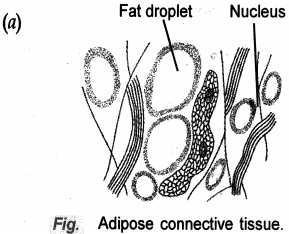
$(a)$ Draw the adipose connective tissue.
$(b)$ Mention one region in the body where this tissue is present and state one function of this tissue.
$(b)$ Mention one region in the body where this tissue is present and state one function of this tissue.
Solution
(N/A) The diagram of adipose connective tissue shows cells filled with fat globules and a peripheral nucleus.
$(b)$ $(i)$ Location: Adipose connective tissue is found below the skin and between internal organs.
$(ii)$ Function: It stores fats and thus acts as an insulator,helping to maintain body temperature.
$(b)$ $(i)$ Location: Adipose connective tissue is found below the skin and between internal organs.
$(ii)$ Function: It stores fats and thus acts as an insulator,helping to maintain body temperature.
0 likes
View Solution61
Medium
Give the location and functions of the following tissues:
$(a)$ Cartilage
$(b)$ Areolar tissue
$(c)$ Adipose tissue
$(a)$ Cartilage
$(b)$ Areolar tissue
$(c)$ Adipose tissue
Solution
(N/A) Cartilage:
Location: Present on the bone surface at joints,in the nose,ear,trachea,and larynx.
Function: It smoothens the bone surface at joints and provides structural support to the nose,ear,trachea,and larynx.
$(b)$ Areolar tissue:
Location: Found between the skin and muscles,around blood vessels and nerves,and in the bone marrow.
Function: It fills the space inside organs,supports internal organs,and helps in the repair of tissues.
$(c)$ Adipose tissue:
Location: Found below the skin and between internal organs.
Function: It acts as a storage site for fats and provides insulation to the body.
0 likes
View Solution62
Difficult
Give one reason for the following statements:
$(a)$ Blood is called a connective tissue.
$(b)$ Muscles are able to contract and relax to bring about movements.
$(c)$ Muscles of the heart are called involuntary muscles.
$(a)$ Blood is called a connective tissue.
$(b)$ Muscles are able to contract and relax to bring about movements.
$(c)$ Muscles of the heart are called involuntary muscles.
Solution
(N/A) Blood is considered a connective tissue because it connects different body organs by transporting gases,digested food,hormones,and waste materials throughout the body.
$(b)$ Muscles contain special proteins known as contractile proteins (actin and myosin),which contract and relax to facilitate movement.
$(c)$ Muscles of the heart are called involuntary muscles because they undergo rhythmic contraction and relaxation throughout life without conscious control and without getting fatigued.
0 likes
View Solution63
Medium
Write one term for the following tissues:
$(a)$ That joins muscle to bone.
$(b)$ Fat reservoir of our body.
$(c)$ Supporting,fills the space inside the organs,and helps in the repair of tissues.
$(a)$ That joins muscle to bone.
$(b)$ Fat reservoir of our body.
$(c)$ Supporting,fills the space inside the organs,and helps in the repair of tissues.
Solution
(N/A) Tendon: $A$ fibrous connective tissue that attaches muscle to bone.
$(b)$ Adipose tissue: $A$ specialized connective tissue that stores fat.
$(c)$ Areolar tissue: $A$ loose connective tissue that acts as a supporting framework,fills the space inside organs,and aids in tissue repair.
$(b)$ Adipose tissue: $A$ specialized connective tissue that stores fat.
$(c)$ Areolar tissue: $A$ loose connective tissue that acts as a supporting framework,fills the space inside organs,and aids in tissue repair.
0 likes
View Solution64
Medium
Name the kinds of muscles found in your limbs and lungs. How do they differ from each other structurally and functionally?
Solution
(N/A) Limbs: Striated muscles (Skeletal muscles).
Structure: Cells are long,cylindrical,multinucleated,and unbranched with alternate dark and light bands (striations).
Function: They are voluntary muscles,meaning they work under our conscious control.
$(b)$ Lungs: Smooth muscles (Non-striated muscles).
Structure: Cells are spindle-shaped (fusiform),uninucleated,and unbranched,lacking any striations.
Function: They are involuntary muscles,meaning they function automatically without conscious control.
0 likes
View Solution65
Medium
$(a)$ Name the animal tissue which is present in the larynx.
$(b)$ Write the chemical constituents of this tissue.
$(c)$ What functions does this tissue perform?
$(b)$ Write the chemical constituents of this tissue.
$(c)$ What functions does this tissue perform?
Solution
(N/A) The animal tissue present in the larynx is cartilage.
$(b)$ The chemical constituents of cartilage are proteins and sugars (specifically,the matrix is composed of proteins and carbohydrates).
$(c)$ Cartilage provides support and flexibility to body parts. It smoothens bone surfaces at joints and allows for easy bending and movement.
$(b)$ The chemical constituents of cartilage are proteins and sugars (specifically,the matrix is composed of proteins and carbohydrates).
$(c)$ Cartilage provides support and flexibility to body parts. It smoothens bone surfaces at joints and allows for easy bending and movement.
0 likes
View Solution66
Medium
Name the tissue found in the following locations:
$(a)$ Haversian canal
$(b)$ Chondrocyte
$(c)$ Eosinophils
Give one function of each of these.
$(a)$ Haversian canal
$(b)$ Chondrocyte
$(c)$ Eosinophils
Give one function of each of these.
Solution
(N/A) Bone: It forms the structural framework that supports the body,anchors muscles,and protects vital organs.
$(b)$ Cartilage: It smoothens bone surfaces at joints and provides flexibility for easy movement.
$(c)$ Blood: It transports gases,nutrients,hormones,waste products,and salts,and plays a key role in the body's defense mechanism.
$(b)$ Cartilage: It smoothens bone surfaces at joints and provides flexibility for easy movement.
$(c)$ Blood: It transports gases,nutrients,hormones,waste products,and salts,and plays a key role in the body's defense mechanism.
0 likes
View Solution67
Difficult
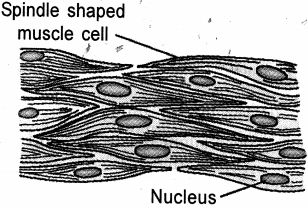
Draw a labelled diagram of unstriated (smooth) muscle tissue and mention its occurrence,features,and functions.
Solution
(N/A) Occurrence: These tissues are found in the walls of the alimentary canal,urinary bladder,oesophagus,and blood vessels.
Features:
$(i)$ They do not have any striations (bands).
$(ii)$ Cells are long,thin,and spindle-shaped.
$(iii)$ Each cell has a single,central nucleus.
Function:
$(i)$ These muscles are involuntary,meaning they do not work according to our will.
$(ii)$ They produce rhythmic movements in the alimentary canal,urinary bladder,and gall bladder to facilitate the transport of substances.
0 likes
View Solution68
EasyMCQ
Name the animal tissue which acts as a heat insulator.
A
Epithelial tissue
B
Adipose tissue
C
Muscular tissue
D
Nervous tissue
Solution
(B) Adipose tissue is a type of connective tissue that stores fat. It is located below the skin and between internal organs. Because fat is a poor conductor of heat,this tissue acts as an insulator,helping the body to retain heat and maintain a constant body temperature.
0 likes
View Solution69
EasyMCQ
Name a connective tissue which has a hard matrix.
A
Blood
B
Bone
C
Cartilage
D
Areolar tissue
Solution
(B) Bone is a type of connective tissue that forms the framework of the body. It has a hard and non-pliable matrix that is rich in calcium and phosphorus compounds.
0 likes
View Solution70
EasyMCQ
What are the two basic components of a connective tissue?
A
Cells and Fibers
B
Cells and Matrix
C
Matrix and Fibers
D
Cells and Ground Substance
Solution
(B) Connective tissues are composed of two primary components:
$1$. Cells: These include various types such as fibroblasts,mast cells,and macrophages.
$2$. Matrix: This is the intercellular substance,which consists of fibers (collagen,elastin) and a ground substance (a gel-like material).
$1$. Cells: These include various types such as fibroblasts,mast cells,and macrophages.
$2$. Matrix: This is the intercellular substance,which consists of fibers (collagen,elastin) and a ground substance (a gel-like material).
0 likes
View Solution71
Medium
Name the tissue that smoothens bone surface at joints.
Solution
(N/A) The tissue that smoothens the bone surface at joints is known as cartilage. Cartilage is a type of connective tissue that provides flexibility and reduces friction between bones at the joints,allowing for smooth movement.
0 likes
View Solution72
Medium
Name the muscular tissue which is present in the iris of the eye. What is the shape of these cells?
Solution
(N/A) The muscular tissue present in the iris of the eye is $Smooth$ muscle (also known as $Unstriated$ or $Involuntary$ muscle).
The cells of $Smooth$ muscle are $Spindle-shaped$ (fusiform),meaning they are wide in the middle and tapered at both ends.
The cells of $Smooth$ muscle are $Spindle-shaped$ (fusiform),meaning they are wide in the middle and tapered at both ends.
0 likes
View Solution73
Medium
Write two similarities between striated and cardiac muscles.
Solution
(N/A) $(i)$ Both types of muscles possess alternating dark and light bands,which give them a striated appearance.
$(ii)$ Both muscle types are composed of cylindrical,elongated fibers that contain multiple nuclei (in the case of striated) or are branched with central nuclei (in the case of cardiac),but both share the fundamental structural organization of myofibrils.
$(ii)$ Both muscle types are composed of cylindrical,elongated fibers that contain multiple nuclei (in the case of striated) or are branched with central nuclei (in the case of cardiac),but both share the fundamental structural organization of myofibrils.
0 likes
View Solution74
Medium
Correlate the first pair of words given below and accordingly write a suitable word in the second pair.
$(i)$ Heart : Cardiac muscles : : . . . . . . : Smooth muscles.
$(ii)$ Tissue repair : Areolar : : Insulation : . . . . . .
$(iii)$ Squamous epithelium : Protection : : . . . . . . : Absorption and secretion.
$(i)$ Heart : Cardiac muscles : : . . . . . . : Smooth muscles.
$(ii)$ Tissue repair : Areolar : : Insulation : . . . . . .
$(iii)$ Squamous epithelium : Protection : : . . . . . . : Absorption and secretion.
Solution
(A) $(i)$ The heart is composed of cardiac muscles. Similarly,organs like the stomach,intestines,and ureters are composed of smooth muscles. Thus,the blank is filled by $Ureters$ (or $Stomach/Intestines$).
$(ii)$ Areolar tissue is responsible for tissue repair. Adipose tissue is responsible for fat storage and insulation. Thus,the blank is filled by $Adipose$ tissue.
$(iii)$ Squamous epithelium is primarily involved in protection (e.g.,skin). Columnar epithelium is specialized for absorption and secretion (e.g.,lining of the intestine). Thus,the blank is filled by $Columnar$ $epithelium$.
0 likes
View Solution75
EasyMCQ
Which of the following is not a component of a nerve cell?
A
Axon
B
Nerve endings
C
Dendrites
D
Tendons
Solution
(D) nerve cell,or neuron,is the structural and functional unit of the nervous system.
It consists of a cell body (cyton),dendrites,and an axon.
$1$. Dendrites receive signals from other neurons.
$2$. The axon transmits impulses away from the cell body.
$3$. Nerve endings are the terminal branches of the axon that transmit signals to the next cell.
Tendons are a type of connective tissue that connects muscles to bones. Therefore,they are not a part of a nerve cell.
0 likes
View Solution76
EasyMCQ
Which of the following helps in the repair of tissue and fills up the space inside the organ?
A
Areolar tissue
B
Tendon
C
Adipose tissue
D
Cartilage
Solution
(A) Areolar tissue is a type of loose connective tissue found between the skin and muscles,around blood vessels and nerves,and in the bone marrow.
It acts as a supporting and packing tissue between organs.
It helps in the repair of tissues after an injury and fills the space inside the organs,providing structural support.
It acts as a supporting and packing tissue between organs.
It helps in the repair of tissues after an injury and fills the space inside the organs,providing structural support.
0 likes
View Solution77
Easy
State whether the following statement is true or false:
The brain,spinal cord,and nerves are all composed of muscular tissue.
The brain,spinal cord,and nerves are all composed of muscular tissue.
Solution
(B) The statement is False.
The brain,spinal cord,and nerves are components of the nervous system and are composed of nervous tissue,which consists of neurons and neuroglial cells. Muscular tissue is responsible for movement and contraction,whereas nervous tissue is responsible for the transmission of electrical impulses.
The brain,spinal cord,and nerves are components of the nervous system and are composed of nervous tissue,which consists of neurons and neuroglial cells. Muscular tissue is responsible for movement and contraction,whereas nervous tissue is responsible for the transmission of electrical impulses.
0 likes
View Solution78
EasyMCQ
State whether the following statement is true or false:
An individual nerve cell may be up to a metre long.
An individual nerve cell may be up to a metre long.
A
True
B
False
Solution
(A) The statement is True.
Nerve cells,also known as neurons,are the structural and functional units of the nervous system.
They are highly specialized cells designed to transmit electrical impulses throughout the body.
Some neurons,such as those extending from the spinal cord to the muscles in the feet,can reach lengths of up to $1 \text{ metre}$ or more,making them some of the longest cells in the human body.
0 likes
View Solution79
Easy
State whether the following statement is true or false:
The muscles of the heart show rhythmic contraction and relaxation throughout life.
The muscles of the heart show rhythmic contraction and relaxation throughout life.
Solution
(TRUE) The statement is $True$.
Cardiac muscles are involuntary muscles present in the heart.
These muscles undergo rhythmic contraction and relaxation from birth until death without getting fatigued,which ensures the continuous pumping of blood throughout the body.
Cardiac muscles are involuntary muscles present in the heart.
These muscles undergo rhythmic contraction and relaxation from birth until death without getting fatigued,which ensures the continuous pumping of blood throughout the body.
0 likes
View Solution80
Easy
State whether the following statement is true or false:
Epithelium covers most organs and cavities within the body.
Epithelium covers most organs and cavities within the body.
Solution
(TRUE) True. Epithelial tissue forms the protective covering of the body and lines the internal organs and cavities. It acts as a barrier,protecting underlying tissues from mechanical injury,drying out,and infection.
0 likes
View Solution81
Easy
State whether the following statement is true or false:
Cuboidal epithelium forms the lining of the oesophagus and the lining of the mouth.
Cuboidal epithelium forms the lining of the oesophagus and the lining of the mouth.
Solution
(FALSE) The statement is False.
The lining of the oesophagus and the mouth is composed of stratified squamous epithelium,not cuboidal epithelium.
Cuboidal epithelium is typically found in the lining of kidney tubules and ducts of salivary glands,where it provides mechanical support.
The lining of the oesophagus and the mouth is composed of stratified squamous epithelium,not cuboidal epithelium.
Cuboidal epithelium is typically found in the lining of kidney tubules and ducts of salivary glands,where it provides mechanical support.
0 likes
View Solution82
Easy
State whether the following statement is true or false:
All epithelium is usually not separated from the underlying tissue by an extracellular fibrous basement membrane.
All epithelium is usually not separated from the underlying tissue by an extracellular fibrous basement membrane.
Solution
(FALSE) The statement is False.
In biological tissues,all epithelial cells are characteristically separated from the underlying connective tissue by a thin,non-cellular,extracellular fibrous structure known as the basement membrane. This membrane provides structural support and acts as a selective filter for substances moving between the epithelium and the underlying tissue.
In biological tissues,all epithelial cells are characteristically separated from the underlying connective tissue by a thin,non-cellular,extracellular fibrous structure known as the basement membrane. This membrane provides structural support and acts as a selective filter for substances moving between the epithelium and the underlying tissue.
0 likes
View Solution83
EasyMCQ
Areolar connective tissue plays an important role in
A
Filling space inside the organs
B
The support of internal organs
C
All of these
D
Repair of tissues
Solution
(C) Areolar connective tissue is a type of loose connective tissue that is widely distributed in the body.
It serves several critical functions:
$1$. It acts as a supporting framework for epithelium.
$2$. It helps in filling the space inside the organs,thereby providing structural integrity.
$3$. It supports internal organs by holding them in place.
$4$. It plays a significant role in the repair of tissues after an injury.
Since all the given options are correct,the correct answer is $C$.
0 likes
View Solution84
EasyMCQ
Skeletal muscles are mostly attached to
A
Ligaments
B
Internal organs
C
Cartilage
D
Bones
Solution
(D) Skeletal muscles are a type of striated muscle tissue that is under voluntary control of the somatic nervous system.
These muscles are primarily attached to the bones of the skeleton by tendons.
When these muscles contract,they pull on the bones,which allows for movement of the body parts.
Therefore,the correct answer is $D$ (Bones).
These muscles are primarily attached to the bones of the skeleton by tendons.
When these muscles contract,they pull on the bones,which allows for movement of the body parts.
Therefore,the correct answer is $D$ (Bones).
0 likes
View Solution85
EasyMCQ
$A$ neuron consists of
A
All of these
B
Cell body
C
Nucleus
D
Cytoplasm
Solution
(A) neuron (nerve cell) is the structural and functional unit of the nervous system.
It consists of three main parts: the cell body (cyton or soma),dendrites,and the axon.
The cell body contains a central nucleus and cytoplasm (neuroplasm) along with other cell organelles like Nissl granules.
Since the cell body,nucleus,and cytoplasm are all essential components of a neuron,the correct answer is 'All of these'.
0 likes
View Solution86
EasyMCQ
Branched short parts of a neuron are called
A
Axon
B
Dendrites
C
Neurites
D
Cyton
Solution
(B) neuron consists of three main parts: the cell body (cyton),dendrites,and the axon.
$1$. The $Cyton$ (cell body) contains the nucleus and cytoplasm.
$2$. $Dendrites$ are the short,branched extensions that receive impulses from other neurons and conduct them towards the cell body.
$3$. The $Axon$ is a long,single fiber that conducts impulses away from the cell body.
Therefore,the branched short parts of a neuron are called dendrites.
0 likes
View Solution87
EasyMCQ
Fats are stored in the human body in which of the following tissues?
A
Cuboidal epithelium
B
Bones
C
Adipose tissue
D
Cartilage
Solution
(C) Adipose tissue is a specialized type of connective tissue found in the human body.
Its primary function is the storage of fat.
The cells of this tissue,known as adipocytes,are filled with fat globules.
This tissue acts as an insulator and helps in conserving body heat,as well as providing cushioning to internal organs.
Its primary function is the storage of fat.
The cells of this tissue,known as adipocytes,are filled with fat globules.
This tissue acts as an insulator and helps in conserving body heat,as well as providing cushioning to internal organs.
0 likes
View Solution88
EasyMCQ
Bone matrix is rich in
A
Fluoride and calcium
B
Phosphorus and potassium
C
Calcium and potassium
D
Calcium and phosphorus
Solution
(D) The bone matrix is a hard,non-pliable ground substance that forms the structural framework of bones.
It is primarily composed of inorganic salts,specifically calcium and phosphorus,which are deposited in the form of hydroxyapatite crystals.
These minerals provide the bone with its characteristic hardness and strength.
Therefore,the correct answer is $D$.
It is primarily composed of inorganic salts,specifically calcium and phosphorus,which are deposited in the form of hydroxyapatite crystals.
These minerals provide the bone with its characteristic hardness and strength.
Therefore,the correct answer is $D$.
0 likes
View Solution89
EasyMCQ
Contractile proteins are found in
A
Muscles
B
Bones
C
Blood
D
Cartilage
Solution
(A) Contractile proteins,primarily $Actin$ and $Myosin$,are responsible for the contraction and relaxation of muscle fibers.
These proteins are essential for movement and are found in high concentrations within muscle tissue.
Therefore,the correct answer is $A$.
These proteins are essential for movement and are found in high concentrations within muscle tissue.
Therefore,the correct answer is $A$.
0 likes
View Solution90
EasyMCQ
Voluntary muscles are found in
A
Alimentary canal
B
Limbs
C
Iris of the eye
D
Bronchi of lungs
Solution
(B) Voluntary muscles,also known as skeletal muscles,are attached to bones and are under the conscious control of the organism.
These muscles are responsible for the movement of body parts,such as the arms and legs (limbs).
In contrast,the alimentary canal,iris of the eye,and bronchi of the lungs contain involuntary (smooth) muscles that function without conscious control.
These muscles are responsible for the movement of body parts,such as the arms and legs (limbs).
In contrast,the alimentary canal,iris of the eye,and bronchi of the lungs contain involuntary (smooth) muscles that function without conscious control.
0 likes
View Solution91
EasyMCQ
Nervous tissue is not found in
A
Brain
B
Spinal cord
C
Tendons
D
Nerves
Solution
(C) Nervous tissue is specialized for the conduction of nerve impulses.
It is primarily found in the central nervous system $(CNS)$, which includes the $Brain$ and $Spinal cord$, and the peripheral nervous system $(PNS)$, which includes the $Nerves$.
$Tendons$ are a type of dense regular connective tissue that connects muscles to bones.
Therefore, nervous tissue is not found in tendons.
0 likes
View Solution92
MediumMCQ
The intestine absorbs digested food materials. Which type of epithelial cells are responsible for this?
A
Stratified squamous epithelium
B
Columnar epithelium
C
Spindle fibres
D
Cuboidal epithelium
Solution
(B) The inner lining of the intestine is composed of columnar epithelial cells.
These cells are tall and pillar-like,which provides a large surface area for the absorption of nutrients and secretion of enzymes.
Therefore,columnar epithelium is responsible for the absorption of digested food materials in the intestine.
These cells are tall and pillar-like,which provides a large surface area for the absorption of nutrients and secretion of enzymes.
Therefore,columnar epithelium is responsible for the absorption of digested food materials in the intestine.
0 likes
View Solution93
MediumMCQ
$A$ person met with an accident in which two long bones of the hand were dislocated. Which among the following may be the possible reason?
A
Tendon break
B
Break of skeletal muscle
C
Ligament break
D
Areolar tissue break
Solution
(C) dislocation occurs when the bones that form a joint are forced out of their normal positions.
Ligaments are specialized connective tissues that connect one bone to another bone.
They provide stability to the joints.
When a ligament is torn or broken due to an accident,the bones held together by that ligament lose their structural support and alignment,leading to dislocation.
Therefore,a ligament break is the most likely cause for the dislocation of bones.
0 likes
View Solution94
EasyMCQ
The muscular tissue which functions throughout life continuously without fatigue is
A
Skeletal muscle
B
Voluntary muscle
C
Smooth muscle
D
Cardiac muscle
Solution
(D) Cardiac muscle is the correct answer.
Cardiac muscles are involuntary muscles present in the heart.
These muscles contract and relax rhythmically throughout the life of an individual without getting fatigued.
Skeletal and voluntary muscles (which are the same) get fatigued after some time of continuous work.
Smooth muscles are also involuntary but are found in the walls of internal organs and do not exhibit the same rhythmic,tireless contraction as cardiac muscle.
0 likes
View Solution95
EasyMCQ
Which of the following cells is found in the cartilaginous tissue of the body?
A
Chondrocytes
B
Mast cells
C
Basophils
D
Osteocytes
Solution
(A) Cartilage is a specialized connective tissue that provides structural support and flexibility to various parts of the body.
$1$. $Chondrocytes$ are the specialized cells found within the matrix of cartilage.
$2$. $Mast$ $cells$ and $Basophils$ are types of white blood cells involved in immune responses and are found in connective tissue proper or blood.
$3$. $Osteocytes$ are the mature bone cells found in bone tissue.
Therefore,the correct cell type found in cartilaginous tissue is $Chondrocytes$.
0 likes
View Solution96
MediumMCQ
Which muscles act involuntarily?
$(i)$ Striated muscles
$(ii)$ Smooth muscles
$(iii)$ Cardiac muscles
$(iv)$ Skeletal muscles
$(i)$ Striated muscles
$(ii)$ Smooth muscles
$(iii)$ Cardiac muscles
$(iv)$ Skeletal muscles
A
$(ii)$ and $(iii)$
B
$(i)$ and $(ii)$
C
$(iii)$ and $(iv)$
D
$(i)$ and $(iv)$
Solution
(A) Involuntary muscles are those whose activity is not under the conscious control of the organism.
$(i)$ Striated muscles (Skeletal muscles) are voluntary,as they are attached to bones and controlled by the somatic nervous system.
$(ii)$ Smooth muscles are involuntary; they are found in the walls of internal organs like the stomach and blood vessels.
$(iii)$ Cardiac muscles are involuntary; they are found in the heart and contract rhythmically without conscious effort.
$(iv)$ Skeletal muscles are voluntary.
Therefore,$(ii)$ and $(iii)$ are involuntary muscles.
0 likes
View Solution97
EasyMCQ
Select the incorrect sentence.
A
Blood has a matrix containing proteins,salts,and hormones.
B
Two bones are connected with ligaments.
C
Cartilage is a form of connective tissue.
D
Tendons are non-fibrous tissue and fragile.
Solution
(D) $1$. Blood is a fluid connective tissue where the matrix is plasma,which contains proteins,salts,and hormones. Thus,statement $A$ is correct.
$2$. Ligaments are specialized connective tissues that connect two bones together. Thus,statement $B$ is correct.
$3$. Cartilage is a type of skeletal connective tissue characterized by a solid but flexible matrix. Thus,statement $C$ is correct.
$4$. Tendons are fibrous connective tissues with great strength and limited flexibility,which connect muscles to bones. They are not non-fibrous or fragile. Thus,statement $D$ is incorrect.
0 likes
View Solution98
EasyMCQ
Cartilage is not found in
A
Kidney
B
Nose
C
Ear
D
Larynx
Solution
(A) Cartilage is a type of specialized connective tissue that provides support and flexibility to various body parts.
It is found in the nose,ear,larynx (voice box),and at the ends of long bones (articular cartilage).
The kidney is an organ primarily composed of epithelial tissue,connective tissue,and blood vessels,but it does not contain cartilage.
Therefore,the correct answer is $A$ (Kidney).
It is found in the nose,ear,larynx (voice box),and at the ends of long bones (articular cartilage).
The kidney is an organ primarily composed of epithelial tissue,connective tissue,and blood vessels,but it does not contain cartilage.
Therefore,the correct answer is $A$ (Kidney).
0 likes
View SolutionTISSUES — Animal Tissues · Frequently Asked Questions
1Are these TISSUES questions useful for JEE and NEET?
Yes. All questions in this section are mapped to JEE Main and NEET exam patterns. Previous year questions from JEE Main, NEET, GUJCET and state-level exams are included with full solutions.
2Can I switch to Hindi or Gujarati for these questions?
Yes. Use the language tabs in the hero section or the sidebar to view the same questions and solutions in English, Hindi or Gujarati.
3How do I generate a question paper from this subtopic?
Use the Vedclass Exam Paper Generator — select the chapter and subtopic, set difficulty, and generate Sets A, B, C, D automatically. First 3 chapters of every subject are free.
Vedclass Products
For Students
Vedclass Test Series
Mock tests in real JEE/NEET style with performance analysis. 5-day free trial.
Start Free TrialFor Teachers
Exam Paper Generator
Generate Set A/B/C/D papers from this chapter in 2 minutes. 3 chapters free.
Try FreeFor Institutes
Online Exam Module
Live online exams with unlimited students, 360° analytics & white-label branding.
See DemoFor Teachers & Institutes
Generate a TISSUES Exam Paper in 2 Minutes
Select subtopic & difficulty — Sets A, B, C, D auto-generated with No Repeat logic.
First 3 chapters of every subject are free — no payment required.