
A English
Mix Examples - Pair of Linear Equations in Two Variables Questions in English
Class 10 Mathematics · Pair of Linear Equations in Two Variables · Mix Examples - Pair of Linear Equations in Two Variables
246+
Questions
English
Language
100%
With Solutions
Showing 50 of 246 questions in English
1
Medium
On comparing the ratios $\frac{a_{1}}{a_{2}}, \frac{b_{1}}{b_{2}}$ and $\frac{c_{1}}{c_{2}},$ find out whether the following pair of linear equations are consistent or inconsistent.
$3x + 2y = 5; \quad 2x - 3y = 7$
$3x + 2y = 5; \quad 2x - 3y = 7$
Solution
(A) Given equations are:
$3x + 2y - 5 = 0$
$2x - 3y - 7 = 0$
Comparing these with the standard form $a_{1}x + b_{1}y + c_{1} = 0$ and $a_{2}x + b_{2}y + c_{2} = 0$,we get:
$a_{1} = 3, b_{1} = 2, c_{1} = -5$
$a_{2} = 2, b_{2} = -3, c_{2} = -7$
Now,calculating the ratios:
$\frac{a_{1}}{a_{2}} = \frac{3}{2}$
$\frac{b_{1}}{b_{2}} = \frac{2}{-3} = -\frac{2}{3}$
Since $\frac{a_{1}}{a_{2}} \neq \frac{b_{1}}{b_{2}}$,the lines intersect at a single point.
Therefore,the pair of linear equations has a unique solution and is consistent.
0 likes
View Solution2
MediumMCQ
On comparing the ratios $\frac{a_{1}}{a_{2}}, \frac{b_{1}}{b_{2}}$ and $\frac{c_{1}}{c_{2}}$,find out whether the following pair of linear equations are consistent or inconsistent:
$\frac{4}{3} x + 2 y = 8$; $2 x + 3 y = 12$
$\frac{4}{3} x + 2 y = 8$; $2 x + 3 y = 12$
A
Consistent
B
Inconsistent
C
Dependent
D
None of these
Solution
(A) Given equations are:
$1) \frac{4}{3} x + 2 y - 8 = 0$
$2) 2 x + 3 y - 12 = 0$
Comparing with the standard form $a_{1}x + b_{1}y + c_{1} = 0$ and $a_{2}x + b_{2}y + c_{2} = 0$:
$a_{1} = \frac{4}{3}, b_{1} = 2, c_{1} = -8$
$a_{2} = 2, b_{2} = 3, c_{2} = -12$
Calculating the ratios:
$\frac{a_{1}}{a_{2}} = \frac{4/3}{2} = \frac{4}{6} = \frac{2}{3}$
$\frac{b_{1}}{b_{2}} = \frac{2}{3}$
$\frac{c_{1}}{c_{2}} = \frac{-8}{-12} = \frac{2}{3}$
Since $\frac{a_{1}}{a_{2}} = \frac{b_{1}}{b_{2}} = \frac{c_{1}}{c_{2}}$,the lines are coincident.
Because the lines are coincident,they have infinitely many solutions.
Therefore,the pair of linear equations is consistent.
0 likes
View Solution3
Difficult
Solve $2x + 3y = 11$ and $2x - 4y = -24$ and hence find the value of $m$ for which $y = mx + 3$.
Solution
(M = -1) Given equations are:
$2x + 3y = 11$ $...(1)$
$2x - 4y = -24$ $...(2)$
From equation $(1)$,we express $x$ in terms of $y$:
$2x = 11 - 3y$
$x = \frac{11 - 3y}{2}$ $...(3)$
Substituting the value of $x$ from equation $(3)$ into equation $(2)$:
$2\left(\frac{11 - 3y}{2}\right) - 4y = -24$
$11 - 3y - 4y = -24$
$11 - 7y = -24$
$-7y = -24 - 11$
$-7y = -35$
$y = 5$
Now,substitute $y = 5$ into equation $(3)$ to find $x$:
$x = \frac{11 - 3(5)}{2} = \frac{11 - 15}{2} = \frac{-4}{2} = -2$
So,the solution is $x = -2$ and $y = 5$.
Now,substitute these values into the equation $y = mx + 3$ to find $m$:
$5 = m(-2) + 3$
$5 - 3 = -2m$
$2 = -2m$
$m = -1$
0 likes
View Solution4
EasyMCQ
The pair of equations $5x - 15y = 8$ and $3x - 9y = \frac{24}{5}$ has
A
infinitely many solutions
B
two solutions
C
one solution
D
no solution
Solution
(A) Given equations are:
$5x - 15y = 8$ --- $(1)$
$3x - 9y = \frac{24}{5}$ --- $(2)$
Comparing these with the standard form $a_1x + b_1y = c_1$ and $a_2x + b_2y = c_2$:
$a_1 = 5, b_1 = -15, c_1 = 8$
$a_2 = 3, b_2 = -9, c_2 = \frac{24}{5}$
Now,calculate the ratios:
$\frac{a_1}{a_2} = \frac{5}{3}$
$\frac{b_1}{b_2} = \frac{-15}{-9} = \frac{5}{3}$
$\frac{c_1}{c_2} = \frac{8}{24/5} = \frac{8 \times 5}{24} = \frac{40}{24} = \frac{5}{3}$
Since $\frac{a_1}{a_2} = \frac{b_1}{b_2} = \frac{c_1}{c_2} = \frac{5}{3}$,the lines are coincident.
Therefore,the pair of equations has infinitely many solutions.
0 likes
View Solution5
MediumMCQ
The sum of the digits of a two-digit number is $9$. If $27$ is added to it,the digits of the number get reversed. The number is
A
$25$
B
$36$
C
$63$
D
$72$
Solution
(B) Let the tens digit be $x$ and the units digit be $y$. The number is $10x + y$.
According to the problem,the sum of the digits is $x + y = 9$ (Equation $1$).
When $27$ is added to the number,the digits are reversed,so the new number is $10y + x$.
Thus,$(10x + y) + 27 = 10y + x$.
Rearranging the terms: $10x - x + y - 10y = -27$,which simplifies to $9x - 9y = -27$.
Dividing by $9$,we get $x - y = -3$ (Equation $2$).
Adding Equation $1$ and Equation $2$: $(x + y) + (x - y) = 9 + (-3)$,which gives $2x = 6$,so $x = 3$.
Substituting $x = 3$ into Equation $1$: $3 + y = 9$,so $y = 6$.
The number is $10(3) + 6 = 36$.
0 likes
View Solution6
MediumMCQ
If a pair of linear equations is consistent,then the lines will be
A
intersecting or coincident
B
always coincident
C
always intersecting
D
parallel
Solution
(A) pair of linear equations is said to be consistent if it has at least one solution.
$1$. If the lines intersect at a single point,the system has a unique solution,and the condition is $\frac{a_1}{a_2} \neq \frac{b_1}{b_2}$.
$2$. If the lines are coincident,the system has infinitely many solutions,and the condition is $\frac{a_1}{a_2} = \frac{b_1}{b_2} = \frac{c_1}{c_2}$.
Since both cases provide at least one solution,the lines are either intersecting or coincident.
0 likes
View Solution7
MediumMCQ
The pair of equations $y=0$ and $y=-7$ has
A
one solution
B
no solution
C
infinitely many solutions
D
two solutions
Solution
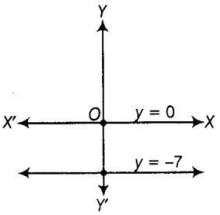
(B) The given pair of equations are $y=0$ and $y=-7$.
$y=0$ represents the $x$-axis.
$y=-7$ represents a line parallel to the $x$-axis at a distance of $7$ units below it.
Since both lines are parallel to each other,they will never intersect.
Therefore,the pair of equations has no solution.
$y=0$ represents the $x$-axis.
$y=-7$ represents a line parallel to the $x$-axis at a distance of $7$ units below it.
Since both lines are parallel to each other,they will never intersect.
Therefore,the pair of equations has no solution.
1 likes
View Solution8
MediumMCQ
If the lines given by $3x + 2ky = 2$ and $2x + 5y + 1 = 0$ are parallel,then the value of $k$ is
A
$\frac{15}{4}$
B
$\frac{3}{2}$
C
$\frac{2}{5}$
D
$\frac{-5}{4}$
Solution
(A) The condition for two lines $a_1x + b_1y + c_1 = 0$ and $a_2x + b_2y + c_2 = 0$ to be parallel is $\frac{a_1}{a_2} = \frac{b_1}{b_2} \neq \frac{c_1}{c_2}$.
Given the equations:
$3x + 2ky - 2 = 0$
$2x + 5y + 1 = 0$
Here,$a_1 = 3, b_1 = 2k, c_1 = -2$ and $a_2 = 2, b_2 = 5, c_2 = 1$.
For the lines to be parallel,we must have $\frac{a_1}{a_2} = \frac{b_1}{b_2}$.
Substituting the values,we get $\frac{3}{2} = \frac{2k}{5}$.
Cross-multiplying,we get $3 \times 5 = 2 \times 2k$,which implies $15 = 4k$.
Therefore,$k = \frac{15}{4}$.
0 likes
View Solution9
DifficultMCQ
The value of $c$ for which the pair of equations $cx - y = 2$ and $6x - 2y = 3$ will have infinitely many solutions is
A
$3$
B
no value
C
$-3$
D
$-12$
Solution
(B) The condition for a pair of linear equations $a_1x + b_1y + c_1 = 0$ and $a_2x + b_2y + c_2 = 0$ to have infinitely many solutions is $\frac{a_1}{a_2} = \frac{b_1}{b_2} = \frac{c_1}{c_2}$.
The given equations are $cx - y - 2 = 0$ and $6x - 2y - 3 = 0$.
Here,$a_1 = c, b_1 = -1, c_1 = -2$ and $a_2 = 6, b_2 = -2, c_2 = -3$.
Applying the condition: $\frac{c}{6} = \frac{-1}{-2} = \frac{-2}{-3}$.
This simplifies to $\frac{c}{6} = \frac{1}{2} = \frac{2}{3}$.
Since $\frac{1}{2} \neq \frac{2}{3}$,there is no value of $c$ that satisfies both equalities simultaneously.
Therefore,the pair of equations will have no value of $c$ for which they have infinitely many solutions.
0 likes
View Solution10
DifficultMCQ
One equation of a pair of dependent linear equations is $-5x + 7y = 2$. The second equation can be
A
$10x + 14y + 4 = 0$
B
$-10x - 14y + 4 = 0$
C
$10x - 14y = -4$
D
$-10x + 14y + 4 = 0$
Solution
(C) For a pair of linear equations to be dependent,they must represent the same line,meaning their coefficients must be proportional: $\frac{a_1}{a_2} = \frac{b_1}{b_2} = \frac{c_1}{c_2} = k$.
Given equation: $-5x + 7y - 2 = 0$.
Comparing with $a_1x + b_1y + c_1 = 0$,we have $a_1 = -5, b_1 = 7, c_1 = -2$.
For the second equation,we multiply the given equation by a constant $k$. Let $k = 2$:
$2(-5x + 7y - 2) = 2(0)$
$-10x + 14y - 4 = 0$
Rearranging this,we get $10x - 14y + 4 = 0$.
Comparing this with option $(C)$: $10x - 14y = -4$ is equivalent to $10x - 14y + 4 = 0$.
0 likes
View Solution11
MediumMCQ
$A$ pair of linear equations which has a unique solution $x=2, y=-3$ is
A
$x+y=1$ and $2x-3y=-5$
B
$2x-y=1$ and $3x+2y=0$
C
$x-4y-14=0$ and $5x-y-13=0$
D
$2x+5y=-11$ and $4x+10y=-22$
Solution
(C) For a pair of linear equations to have a unique solution $(x=2, y=-3)$,these values must satisfy both equations in the pair.
Let us check the options:
Option $(A): x+y=1 \implies 2+(-3) = -1 \neq 1$. (Incorrect)
Option $(B): 2x-y=1 \implies 2(2)-(-3) = 4+3 = 7 \neq 1$. (Incorrect)
Option $(C): x-4y-14=0 \implies 2-4(-3)-14 = 2+12-14 = 0$. (Satisfied)
$5x-y-13=0 \implies 5(2)-(-3)-13 = 10+3-13 = 0$. (Satisfied)
Since both equations in option $(C)$ are satisfied by $(x=2, y=-3)$ and the lines are not coincident (slopes are $1/4$ and $5$),the solution is unique.
Note: Option $(D)$ represents coincident lines ($4x+10y=-22$ is $2$ times $2x+5y=-11$),which have infinitely many solutions,not a unique one.
0 likes
View Solution12
Medium
Is it true to say that the pair of equations $-x + 2y + 2 = 0$ and $\frac{1}{2}x - \frac{1}{4}y - 1 = 0$ has a unique solution? Justify your answer.
Solution
(A) Yes,it is true.
Given equations are:
$1) -x + 2y + 2 = 0$
$2) \frac{1}{2}x - \frac{1}{4}y - 1 = 0$
Comparing these with the standard form $a_1x + b_1y + c_1 = 0$ and $a_2x + b_2y + c_2 = 0$:
$a_1 = -1, b_1 = 2, c_1 = 2$
$a_2 = \frac{1}{2}, b_2 = -\frac{1}{4}, c_2 = -1$
Now,calculate the ratios:
$\frac{a_1}{a_2} = \frac{-1}{1/2} = -2$
$\frac{b_1}{b_2} = \frac{2}{-1/4} = -8$
Since $\frac{a_1}{a_2} \neq \frac{b_1}{b_2}$ (i.e.,$-2 \neq -8$),the pair of linear equations has a unique solution.
0 likes
View Solution13
Medium
Do the following pair of linear equations have no solution? Justify your answer.
$y + 6x = 6$ and $y = 2x$
$y + 6x = 6$ and $y = 2x$
Solution
(B) The condition for a pair of linear equations $a_1x + b_1y + c_1 = 0$ and $a_2x + b_2y + c_2 = 0$ to have no solution is $\frac{a_1}{a_2} = \frac{b_1}{b_2} \neq \frac{c_1}{c_2}$.
Given equations are:
$6x + y - 6 = 0$ --- $(i)$
$2x - y = 0$ --- $(ii)$
Here,$a_1 = 6, b_1 = 1, c_1 = -6$ and $a_2 = 2, b_2 = -1, c_2 = 0$.
Calculating the ratios:
$\frac{a_1}{a_2} = \frac{6}{2} = 3$
$\frac{b_1}{b_2} = \frac{1}{-1} = -1$
Since $\frac{a_1}{a_2} \neq \frac{b_1}{b_2}$ $(3 \neq -1)$,the lines intersect at a single point.
Therefore,the given pair of linear equations has a unique solution,not 'no solution'.
0 likes
View Solution14
Medium
Do the following pair of linear equations have no solution? Justify your answer.
$3x + y - 3 = 0$
$2x + \frac{2}{3}y = 2$
$3x + y - 3 = 0$
$2x + \frac{2}{3}y = 2$
Solution
(B) No,the given pair of equations is:
$3x + y - 3 = 0$ and $2x + \frac{2}{3}y - 2 = 0$
Here,the coefficients are:
$a_1 = 3, b_1 = 1, c_1 = -3$
$a_2 = 2, b_2 = \frac{2}{3}, c_2 = -2$
Calculating the ratios:
$\frac{a_1}{a_2} = \frac{3}{2}$
$\frac{b_1}{b_2} = \frac{1}{2/3} = \frac{3}{2}$
$\frac{c_1}{c_2} = \frac{-3}{-2} = \frac{3}{2}$
Since $\frac{a_1}{a_2} = \frac{b_1}{b_2} = \frac{c_1}{c_2} = \frac{3}{2}$,the lines are coincident.
Therefore,the given pair of linear equations has infinitely many solutions,not no solution.
0 likes
View Solution15
Medium
Do the following equations represent a pair of coincident lines? Justify your answer.
$-2x - 3y = 1$
$6y + 4x = -2$
$-2x - 3y = 1$
$6y + 4x = -2$
Solution
(A) The condition for two lines to be coincident is given by the ratio of their coefficients:
$\frac{a_1}{a_2} = \frac{b_1}{b_2} = \frac{c_1}{c_2}$
First,rewrite the given equations in the standard form $ax + by + c = 0$:
$1) -2x - 3y - 1 = 0$
$2) 4x + 6y + 2 = 0$
Here,the coefficients are:
$a_1 = -2, b_1 = -3, c_1 = -1$
$a_2 = 4, b_2 = 6, c_2 = 2$
Now,calculate the ratios:
$\frac{a_1}{a_2} = \frac{-2}{4} = -\frac{1}{2}$
$\frac{b_1}{b_2} = \frac{-3}{6} = -\frac{1}{2}$
$\frac{c_1}{c_2} = \frac{-1}{2} = -\frac{1}{2}$
Since $\frac{a_1}{a_2} = \frac{b_1}{b_2} = \frac{c_1}{c_2} = -\frac{1}{2}$,the given pair of linear equations represents coincident lines.
0 likes
View Solution16
MediumMCQ
Are the following pair of linear equations consistent? Justify your answer.
$-3x - 4y = 12$
$3x + 4y = 12$
$-3x - 4y = 12$
$3x + 4y = 12$
A
Yes,they are consistent.
B
No,they are inconsistent.
C
Yes,they have infinitely many solutions.
D
Yes,they have a unique solution.
Solution
(B) pair of linear equations is consistent if it has at least one solution. This occurs when:
$1$. $\frac{a_1}{a_2} \neq \frac{b_1}{b_2}$ (Unique solution)
$2$. $\frac{a_1}{a_2} = \frac{b_1}{b_2} = \frac{c_1}{c_2}$ (Infinitely many solutions)
Given equations:
$-3x - 4y - 12 = 0$
$3x + 4y - 12 = 0$
Here,$a_1 = -3, b_1 = -4, c_1 = -12$ and $a_2 = 3, b_2 = 4, c_2 = -12$.
Calculating the ratios:
$\frac{a_1}{a_2} = \frac{-3}{3} = -1$
$\frac{b_1}{b_2} = \frac{-4}{4} = -1$
$\frac{c_1}{c_2} = \frac{-12}{-12} = 1$
Since $\frac{a_1}{a_2} = \frac{b_1}{b_2} \neq \frac{c_1}{c_2}$,the lines are parallel and do not intersect.
Therefore,the pair of linear equations is inconsistent.
0 likes
View Solution17
Medium
Are the following pair of linear equations consistent? Justify your answer.
$\frac{3}{5} x - y = \frac{1}{2}$
$\frac{1}{5} x - 3 y = \frac{1}{6}$
$\frac{3}{5} x - y = \frac{1}{2}$
$\frac{1}{5} x - 3 y = \frac{1}{6}$
Solution
(A) pair of linear equations is consistent if it has at least one solution. The conditions are:
$1$. $\frac{a_1}{a_2} \neq \frac{b_1}{b_2}$ (Unique solution)
$2$. $\frac{a_1}{a_2} = \frac{b_1}{b_2} = \frac{c_1}{c_2}$ (Infinitely many solutions)
Given equations:
$Eq_1: \frac{3}{5} x - y - \frac{1}{2} = 0$
$Eq_2: \frac{1}{5} x - 3 y - \frac{1}{6} = 0$
Comparing with $a_1 x + b_1 y + c_1 = 0$ and $a_2 x + b_2 y + c_2 = 0$:
$a_1 = \frac{3}{5}, b_1 = -1, c_1 = -\frac{1}{2}$
$a_2 = \frac{1}{5}, b_2 = -3, c_2 = -\frac{1}{6}$
Calculating ratios:
$\frac{a_1}{a_2} = \frac{3/5}{1/5} = 3$
$\frac{b_1}{b_2} = \frac{-1}{-3} = \frac{1}{3}$
Since $\frac{a_1}{a_2} \neq \frac{b_1}{b_2}$ $(3 \neq \frac{1}{3})$,the system has a unique solution.
Therefore,the given pair of linear equations is consistent.
0 likes
View Solution18
Medium
Are the following pair of linear equations consistent? Justify your answer.
$2ax + by = a$
$4ax + 2by - 2a = 0$; $a, b \neq 0$
$2ax + by = a$
$4ax + 2by - 2a = 0$; $a, b \neq 0$
Solution
(A) pair of linear equations is consistent if it has at least one solution. The conditions are:
$1$. $\frac{a_1}{a_2} \neq \frac{b_1}{b_2}$ (Unique solution)
$2$. $\frac{a_1}{a_2} = \frac{b_1}{b_2} = \frac{c_1}{c_2}$ (Infinitely many solutions)
Given equations:
$2ax + by - a = 0$
$4ax + 2by - 2a = 0$
Here,$a_1 = 2a, b_1 = b, c_1 = -a$ and $a_2 = 4a, b_2 = 2b, c_2 = -2a$.
Calculating the ratios:
$\frac{a_1}{a_2} = \frac{2a}{4a} = \frac{1}{2}$
$\frac{b_1}{b_2} = \frac{b}{2b} = \frac{1}{2}$
$\frac{c_1}{c_2} = \frac{-a}{-2a} = \frac{1}{2}$
Since $\frac{a_1}{a_2} = \frac{b_1}{b_2} = \frac{c_1}{c_2} = \frac{1}{2}$,the system has infinitely many solutions. Therefore,the pair of linear equations is consistent.
0 likes
View Solution19
Medium
Are the following pair of linear equations consistent? Justify your answer.
$x + 3y = 11$
$2(2x + 6y) = 22$
$x + 3y = 11$
$2(2x + 6y) = 22$
Solution
(B) pair of linear equations is consistent if it has at least one solution. This occurs when:
$1$. $\frac{a_1}{a_2} \neq \frac{b_1}{b_2}$ (Unique solution)
$2$. $\frac{a_1}{a_2} = \frac{b_1}{b_2} = \frac{c_1}{c_2}$ (Infinitely many solutions)
Given equations:
$x + 3y = 11$ (Equation $1$)
$2(2x + 6y) = 22 \implies 4x + 12y = 22 \implies 2x + 6y = 11$ (Equation $2$)
Comparing with $a_1x + b_1y + c_1 = 0$ and $a_2x + b_2y + c_2 = 0$:
For Equation $1$: $a_1 = 1, b_1 = 3, c_1 = -11$
For Equation $2$: $a_2 = 2, b_2 = 6, c_2 = -11$
Calculating ratios:
$\frac{a_1}{a_2} = \frac{1}{2}$
$\frac{b_1}{b_2} = \frac{3}{6} = \frac{1}{2}$
$\frac{c_1}{c_2} = \frac{-11}{-11} = 1$
Since $\frac{a_1}{a_2} = \frac{b_1}{b_2} \neq \frac{c_1}{c_2}$,the lines are parallel and have no solution.
Therefore,the given pair of linear equations is inconsistent.
0 likes
View Solution20
Difficult
For the pair of equations $\lambda x + 3y = -7$ and $2x + 6y = 14$ to have infinitely many solutions,the value of $\lambda$ should be $1$. Is the statement true? Give reasons.
Solution
(B) The given pair of linear equations is $\lambda x + 3y + 7 = 0$ and $2x + 6y - 14 = 0$.
For a system of linear equations $a_1x + b_1y + c_1 = 0$ and $a_2x + b_2y + c_2 = 0$ to have infinitely many solutions,the condition is $\frac{a_1}{a_2} = \frac{b_1}{b_2} = \frac{c_1}{c_2}$.
Here,$a_1 = \lambda, b_1 = 3, c_1 = 7$ and $a_2 = 2, b_2 = 6, c_2 = -14$.
Substituting these values into the condition,we get $\frac{\lambda}{2} = \frac{3}{6} = \frac{7}{-14}$.
Simplifying the ratios,we get $\frac{\lambda}{2} = \frac{1}{2} = -\frac{1}{2}$.
Since $\frac{1}{2} \neq -\frac{1}{2}$,the condition $\frac{a_1}{a_2} = \frac{b_1}{b_2} = \frac{c_1}{c_2}$ can never be satisfied for any value of $\lambda$.
Therefore,the statement is false.
0 likes
View Solution21
DifficultMCQ
For all real values of $c,$ the pair of equations $x-2y=8$ and $5x-10y=c$ have a unique solution. Justify whether it is true or false.
A
True
B
False
C
Cannot be determined
D
Depends on the value of $x$
Solution
(B) The given pair of linear equations is:
$x - 2y = 8$
$5x - 10y = c$
Comparing these with the standard form $a_1x + b_1y + c_1 = 0$ and $a_2x + b_2y + c_2 = 0$,we get:
$a_1 = 1, b_1 = -2, c_1 = -8$
$a_2 = 5, b_2 = -10, c_2 = -c$
For a system of linear equations to have a unique solution,the condition is $\frac{a_1}{a_2} \neq \frac{b_1}{b_2}$.
Here,$\frac{a_1}{a_2} = \frac{1}{5}$ and $\frac{b_1}{b_2} = \frac{-2}{-10} = \frac{1}{5}$.
Since $\frac{a_1}{a_2} = \frac{b_1}{b_2}$,the system can never have a unique solution regardless of the value of $c$.
If $c = 40$,then $\frac{a_1}{a_2} = \frac{b_1}{b_2} = \frac{c_1}{c_2} = \frac{1}{5}$,which means the system has infinitely many solutions.
If $c \neq 40$,the system has no solution.
Therefore,the statement is False.
0 likes
View Solution22
DifficultMCQ
For which values of $p$ and $q$ will the following pair of linear equations have infinitely many solutions?
$4x + 5y = 2$
$(2p + 7q)x + (p + 8q)y = 2q - p + 1$
$4x + 5y = 2$
$(2p + 7q)x + (p + 8q)y = 2q - p + 1$
A
$p = -4, q = 4$
B
$p = -2, q = 3$
C
$p = -3, q = 2$
D
$p = -1, q = 2$
Solution
(D) For a pair of linear equations $a_1x + b_1y = c_1$ and $a_2x + b_2y = c_2$ to have infinitely many solutions,the condition is $\frac{a_1}{a_2} = \frac{b_1}{b_2} = \frac{c_1}{c_2}$.
Given equations are $4x + 5y = 2$ and $(2p + 7q)x + (p + 8q)y = 2q - p + 1$.
Here,$\frac{a_1}{a_2} = \frac{4}{2p + 7q}$,$\frac{b_1}{b_2} = \frac{5}{p + 8q}$,and $\frac{c_1}{c_2} = \frac{2}{2q - p + 1}$.
Equating $\frac{a_1}{a_2} = \frac{b_1}{b_2}$:
$\frac{4}{2p + 7q} = \frac{5}{p + 8q} \implies 4(p + 8q) = 5(2p + 7q) \implies 4p + 32q = 10p + 35q \implies 6p + 3q = 0 \implies q = -2p$ (Equation $1$).
Equating $\frac{a_1}{a_2} = \frac{c_1}{c_2}$:
$\frac{4}{2p + 7q} = \frac{2}{2q - p + 1} \implies 4(2q - p + 1) = 2(2p + 7q) \implies 8q - 4p + 4 = 4p + 14q \implies 8p + 6q = 4 \implies 4p + 3q = 2$ (Equation $2$).
Substituting $q = -2p$ into Equation $2$:
$4p + 3(-2p) = 2 \implies 4p - 6p = 2 \implies -2p = 2 \implies p = -1$.
Now,$q = -2(-1) = 2$.
Thus,for $p = -1$ and $q = 2$,the equations have infinitely many solutions.
0 likes
View Solution23
MediumMCQ
Solve the following pair of linear equations:
$21x + 47y = 110$
$47x + 21y = 162$
$21x + 47y = 110$
$47x + 21y = 162$
A
$x = 3, y = 1$
B
$x = 3, y = 2$
C
$x = 2, y = 1$
D
$x = 3, y = 3$
Solution
(A) Given equations are:
$21x + 47y = 110$ --- $(1)$
$47x + 21y = 162$ --- $(2)$
Adding $(1)$ and $(2)$:
$(21x + 47x) + (47y + 21y) = 110 + 162$
$68x + 68y = 272$
Dividing by $68$:
$x + y = 4$ --- $(3)$
Subtracting $(1)$ from $(2)$:
$(47x - 21x) + (21y - 47y) = 162 - 110$
$26x - 26y = 52$
Dividing by $26$:
$x - y = 2$ --- $(4)$
Adding $(3)$ and $(4)$:
$(x + y) + (x - y) = 4 + 2$
$2x = 6$
$x = 3$
Substituting $x = 3$ in $(3)$:
$3 + y = 4$
$y = 1$
Thus,the solution is $x = 3, y = 1$.
0 likes
View Solution24
DifficultMCQ
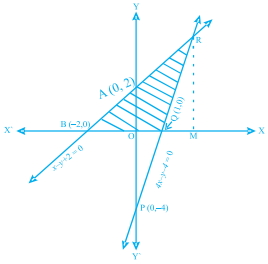
Draw the graphs of the pair of linear equations $x-y+2=0$ and $4x-y-4=0$. Calculate the area of the triangle formed by the lines so drawn and the $x$-axis (in sq. units).
A
$3.6$
B
$6$
C
$36$
D
$3$
Solution
(B) To draw the graphs of the given equations,we find two solutions for each equation:
For $x-y+2=0$:
For $4x-y-4=0$:
Plot the points $A(0, 2)$,$B(-2, 0)$,$P(0, -4)$,and $Q(1, 0)$ on a graph and draw the lines $AB$ and $PQ$. The lines intersect at point $R(2, 4)$.
The triangle formed by these lines and the $x$-axis is $\triangle BQR$,with vertices $B(-2, 0)$,$Q(1, 0)$,and $R(2, 4)$.
Area of triangle $= \frac{1}{2} \times \text{Base} \times \text{Altitude}$.
Here,Base $= BQ = |1 - (-2)| = 3$ units.
Altitude $= \text{Ordinate of } R = 4$ units.
Area $= \frac{1}{2} \times 3 \times 4 = 6$ sq. units.
For $x-y+2=0$:
| $x$ | $0$ | $-2$ |
| $y=x+2$ | $2$ | $0$ |
For $4x-y-4=0$:
| $x$ | $0$ | $1$ |
| $y=4x-4$ | $-4$ | $0$ |
Plot the points $A(0, 2)$,$B(-2, 0)$,$P(0, -4)$,and $Q(1, 0)$ on a graph and draw the lines $AB$ and $PQ$. The lines intersect at point $R(2, 4)$.
The triangle formed by these lines and the $x$-axis is $\triangle BQR$,with vertices $B(-2, 0)$,$Q(1, 0)$,and $R(2, 4)$.
Area of triangle $= \frac{1}{2} \times \text{Base} \times \text{Altitude}$.
Here,Base $= BQ = |1 - (-2)| = 3$ units.
Altitude $= \text{Ordinate of } R = 4$ units.
Area $= \frac{1}{2} \times 3 \times 4 = 6$ sq. units.
0 likes
View Solution25
Difficult
For which value$(s)$ of $\lambda$,do the pair of linear equations $\lambda x + y = \lambda^2$ and $x + \lambda y = 1$ have:
$(i)$ no solution?
$(ii)$ infinitely many solutions?
$(iii)$ a unique solution?
$(i)$ no solution?
$(ii)$ infinitely many solutions?
$(iii)$ a unique solution?
Solution
(A) The given pair of linear equations is $\lambda x + y = \lambda^2$ and $x + \lambda y = 1$.
Comparing with $a_1x + b_1y + c_1 = 0$ and $a_2x + b_2y + c_2 = 0$,we have $a_1 = \lambda, b_1 = 1, c_1 = -\lambda^2$ and $a_2 = 1, b_2 = \lambda, c_2 = -1$.
$(i)$ For no solution,the condition is $\frac{a_1}{a_2} = \frac{b_1}{b_2} \neq \frac{c_1}{c_2}$.
$\frac{\lambda}{1} = \frac{1}{\lambda} \neq \frac{-\lambda^2}{-1} \Rightarrow \lambda^2 = 1$ and $\lambda^2 \neq 1$. This is impossible for $\lambda = 1$. For $\lambda = -1$,$\frac{-1}{1} = \frac{1}{-1} \neq \frac{-(-1)^2}{-1} \Rightarrow -1 = -1 \neq 1$. Thus,for $\lambda = -1$,there is no solution.
$(ii)$ For infinitely many solutions,the condition is $\frac{a_1}{a_2} = \frac{b_1}{b_2} = \frac{c_1}{c_2}$.
$\frac{\lambda}{1} = \frac{1}{\lambda} = \frac{-\lambda^2}{-1} \Rightarrow \lambda^2 = 1$ and $\lambda = \lambda^3$. This holds for $\lambda = 1$.
$(iii)$ For a unique solution,the condition is $\frac{a_1}{a_2} \neq \frac{b_1}{b_2}$.
$\frac{\lambda}{1} \neq \frac{1}{\lambda} \Rightarrow \lambda^2 \neq 1 \Rightarrow \lambda \neq \pm 1$. Thus,all real values of $\lambda$ except $\pm 1$ yield a unique solution.
0 likes
View Solution26
DifficultMCQ
For what value$(s)$ of $k$ does the pair of equations $kx + 3y = k - 3$ and $12x + ky = k$ have no solution?
A
$-3$
B
$3$
C
$6$
D
$-6$
Solution
(D) The given pair of linear equations is:
$kx + 3y = (k - 3)$
$12x + ky = k$
Comparing with $a_1x + b_1y + c_1 = 0$ and $a_2x + b_2y + c_2 = 0$,we get:
$a_1 = k, b_1 = 3, c_1 = -(k - 3)$
$a_2 = 12, b_2 = k, c_2 = -k$
For the pair of linear equations to have no solution,the condition is:
$\frac{a_1}{a_2} = \frac{b_1}{b_2} \neq \frac{c_1}{c_2}$
$\frac{k}{12} = \frac{3}{k} \neq \frac{-(k - 3)}{-k}$
Taking the first two parts:
$\frac{k}{12} = \frac{3}{k} \Rightarrow k^2 = 36 \Rightarrow k = \pm 6$
Now,checking the condition $\frac{b_1}{b_2} \neq \frac{c_1}{c_2}$:
If $k = 6$,then $\frac{3}{6} = \frac{1}{2}$ and $\frac{k-3}{k} = \frac{6-3}{6} = \frac{3}{6} = \frac{1}{2}$. Since $\frac{1}{2} = \frac{1}{2}$,$k = 6$ gives infinitely many solutions.
If $k = -6$,then $\frac{3}{-6} = -\frac{1}{2}$ and $\frac{k-3}{k} = \frac{-6-3}{-6} = \frac{-9}{-6} = \frac{3}{2}$. Since $-\frac{1}{2} \neq \frac{3}{2}$,the condition holds.
Thus,the value of $k$ for which there is no solution is $-6$.
0 likes
View Solution27
DifficultMCQ
For which values of $a$ and $b$ does the following pair of linear equations have infinitely many solutions?
$x + 2y = 1$
$(a - b)x + (a + b)y = a + b - 2$
$x + 2y = 1$
$(a - b)x + (a + b)y = a + b - 2$
A
$a = 3, b = 1$
B
$a = 2, b = 1$
C
$a = 3, b = 4$
D
$a = 5, b = 6$
Solution
(A) The given pair of linear equations is:
$x + 2y - 1 = 0$ .....$(i)$
$(a - b)x + (a + b)y - (a + b - 2) = 0$ .....$(ii)$
Comparing with $a_1x + b_1y + c_1 = 0$ and $a_2x + b_2y + c_2 = 0$,we get:
$a_1 = 1, b_1 = 2, c_1 = -1$
$a_2 = (a - b), b_2 = (a + b), c_2 = -(a + b - 2)$
For infinitely many solutions,the condition is:
$\frac{a_1}{a_2} = \frac{b_1}{b_2} = \frac{c_1}{c_2}$
$\frac{1}{a - b} = \frac{2}{a + b} = \frac{-1}{-(a + b - 2)}$
Taking the first two parts:
$\frac{1}{a - b} = \frac{2}{a + b} \Rightarrow a + b = 2a - 2b \Rightarrow a = 3b$ .....$(iii)$
Taking the last two parts:
$\frac{2}{a + b} = \frac{1}{a + b - 2} \Rightarrow 2a + 2b - 4 = a + b \Rightarrow a + b = 4$ .....$(iv)$
Substituting the value of $a$ from $(iii)$ into $(iv)$:
$3b + b = 4 \Rightarrow 4b = 4 \Rightarrow b = 1$
Substituting $b = 1$ into $(iii)$:
$a = 3(1) = 3$
Thus,for $a = 3$ and $b = 1$,the given pair of equations has infinitely many solutions.
0 likes
View Solution28
DifficultMCQ
Find the value$(s)$ of $p$ for the pair of equations $-x + py = 1$ and $px - y = 1$ if the system has no solution.
A
$3$
B
$2$
C
$1$
D
$4$
Solution
(C) The given pair of linear equations is:
$-x + py - 1 = 0 \quad ...(i)$
$px - y - 1 = 0 \quad ...(ii)$
Comparing these with the standard form $ax + by + c = 0$,we get:
$a_1 = -1, b_1 = p, c_1 = -1$ (from Eq. $i$)
$a_2 = p, b_2 = -1, c_2 = -1$ (from Eq. $ii$)
For a pair of linear equations to have no solution,the lines must be parallel,which implies:
$\frac{a_1}{a_2} = \frac{b_1}{b_2} \neq \frac{c_1}{c_2}$
Substituting the values:
$\frac{-1}{p} = \frac{p}{-1} \neq \frac{-1}{-1}$
Taking the first two parts:
$\frac{-1}{p} = \frac{p}{-1} \Rightarrow p^2 = 1 \Rightarrow p = \pm 1$
Taking the condition $\frac{p}{-1} \neq \frac{-1}{-1}$:
$\frac{p}{-1} \neq 1 \Rightarrow p \neq -1$
Since $p = \pm 1$ and $p \neq -1$,the only valid value is $p = 1$.
0 likes
View Solution29
DifficultMCQ
Find the value$(s)$ of $p$ for the equations $-3x + 5y = 7$ and $2px - 3y = 1$ if the lines represented by these equations intersect at a unique point.
A
$p \neq \frac{7}{10}$
B
$p \neq \frac{3}{10}$
C
$p \neq \frac{11}{10}$
D
$p \neq \frac{9}{10}$
Solution
(D) Given,the pair of linear equations is:
$-3x + 5y - 7 = 0 \dots (i)$
$2px - 3y - 1 = 0 \dots (ii)$
Comparing these with the standard form $ax + by + c = 0$,we get:
$a_1 = -3, b_1 = 5, c_1 = -7$
$a_2 = 2p, b_2 = -3, c_2 = -1$
For the lines to intersect at a unique point,the condition for a unique solution is:
$\frac{a_1}{a_2} \neq \frac{b_1}{b_2}$
Substituting the values:
$\frac{-3}{2p} \neq \frac{5}{-3}$
Cross-multiplying,we get:
$(-3) \times (-3) \neq 5 \times (2p)$
$9 \neq 10p$
$p \neq \frac{9}{10}$
Thus,the lines intersect at a unique point for all real values of $p$ except $\frac{9}{10}$.
0 likes
View Solution30
DifficultMCQ
The ratio of incomes of two persons is $9:7$ and the ratio of their expenditures is $4:3$. If each of them manages to save ₹ $2000$ per month,find their monthly incomes.
A
₹ $18,000$ and ₹ $14,000$
B
₹ $16,000$ and ₹ $12,000$
C
₹ $20,000$ and ₹ $16,000$
D
₹ $27,000$ and ₹ $21,000$
Solution
(A) Let the incomes of the two persons be ₹ $9x$ and ₹ $7x$,and their expenditures be ₹ $4y$ and ₹ $3y$ respectively.
Since $\text{Income} - \text{Expenditure} = \text{Savings}$,we have:
$9x - 4y = 2000$ $...(1)$
$7x - 3y = 2000$ $...(2)$
To solve these equations,multiply equation $(1)$ by $3$ and equation $(2)$ by $4$:
$27x - 12y = 6000$ $...(3)$
$28x - 12y = 8000$ $...(4)$
Subtracting equation $(3)$ from equation $(4)$:
$(28x - 27x) - (12y - 12y) = 8000 - 6000$
$x = 2000$
Substituting $x = 2000$ into equation $(1)$:
$9(2000) - 4y = 2000$
$18000 - 4y = 2000$
$4y = 16000$
$y = 4000$
The monthly incomes are $9x = 9 \times 2000 = ₹ 18,000$ and $7x = 7 \times 2000 = ₹ 14,000$.
0 likes
View Solution31
Difficult
The sum of a two-digit number and the number obtained by reversing the digits is $66$. If the digits of the number differ by $2$,find the number. How many such numbers are there?
Solution
(A) Let the ten's digit be $x$ and the unit's digit be $y$. The number is $10x + y$.
When the digits are reversed,the new number is $10y + x$.
According to the problem,$(10x + y) + (10y + x) = 66$.
$11x + 11y = 66$,which simplifies to $x + y = 6$ $...(1)$.
Given that the digits differ by $2$,we have two cases:
Case $1$: $x - y = 2$ $...(2)$.
Adding $(1)$ and $(2)$: $2x = 8 \implies x = 4$. Substituting $x=4$ in $(1)$,$y = 2$. The number is $42$.
Case $2$: $y - x = 2$ $...(3)$.
Adding $(1)$ and $(3)$: $2y = 8 \implies y = 4$. Substituting $y=4$ in $(1)$,$x = 2$. The number is $24$.
Thus,there are two such numbers: $42$ and $24$.
0 likes
View Solution32
Difficult
Solve the following pair of linear equations by the elimination method and the substitution method:
$x+y=5$ and $2x-3y=4$
$x+y=5$ and $2x-3y=4$
Solution
(N/A) By elimination method:
$x+y=5$ $...(1)$
$2x-3y=4$ $...(2)$
Multiplying equation $(1)$ by $2$,we obtain:
$2x+2y=10$ $...(3)$
Subtracting equation $(2)$ from equation $(3)$,we obtain:
$(2x+2y) - (2x-3y) = 10 - 4$
$5y = 6$
$y = \frac{6}{5}$ $...(4)$
Substituting the value of $y$ in equation $(1)$,we obtain:
$x + \frac{6}{5} = 5$
$x = 5 - \frac{6}{5} = \frac{25-6}{5} = \frac{19}{5}$
Therefore,$x = \frac{19}{5}, y = \frac{6}{5}$.
By substitution method:
From equation $(1)$,we obtain:
$x = 5 - y$ $...(5)$
Substituting this value in equation $(2)$,we obtain:
$2(5-y) - 3y = 4$
$10 - 2y - 3y = 4$
$10 - 5y = 4$
$-5y = 4 - 10$
$-5y = -6$
$y = \frac{6}{5}$
Substituting the value of $y$ in equation $(5)$,we obtain:
$x = 5 - \frac{6}{5} = \frac{19}{5}$
Therefore,$x = \frac{19}{5}, y = \frac{6}{5}$.
0 likes
View Solution33
Medium
Solve the following pair of linear equations by the elimination method and the substitution method:
$3x + 4y = 10$ and $2x - 2y = 2$
$3x + 4y = 10$ and $2x - 2y = 2$
Solution
(N/A) By elimination method:
$3x + 4y = 10$ $...(1)$
$2x - 2y = 2$ $...(2)$
Multiplying equation $(2)$ by $2$,we obtain:
$4x - 4y = 4$ $...(3)$
Adding equation $(1)$ and $(3)$,we obtain:
$7x = 14$
$x = 2$ $...(4)$
Substituting $x = 2$ in equation $(1)$,we obtain:
$3(2) + 4y = 10$
$6 + 4y = 10$
$4y = 4$
$y = 1$
Hence,$x = 2, y = 1$.
By substitution method:
From equation $(2)$,we obtain:
$2x = 2 + 2y$
$x = 1 + y$ $...(5)$
Putting this value in equation $(1)$,we obtain:
$3(1 + y) + 4y = 10$
$3 + 3y + 4y = 10$
$7y = 7$
$y = 1$
Substituting the value $y = 1$ in equation $(5)$,we obtain:
$x = 1 + 1 = 2$
Therefore,$x = 2, y = 1$.
0 likes
View Solution34
Difficult
Solve the following pair of linear equations by the elimination method and the substitution method:
$3x - 5y - 4 = 0$ and $9x = 2y + 7$
$3x - 5y - 4 = 0$ and $9x = 2y + 7$
Solution
(N/A) Given equations are:
$1) 3x - 5y = 4$
$2) 9x - 2y = 7$
Elimination Method:
Multiply equation $(1)$ by $3$ to make the coefficients of $x$ equal:
$9x - 15y = 12$ $(3)$
Subtract equation $(2)$ from $(3)$:
$(9x - 15y) - (9x - 2y) = 12 - 7$
$-13y = 5$
$y = -5/13$
Substitute $y = -5/13$ into equation $(1)$:
$3x - 5(-5/13) = 4$
$3x + 25/13 = 4$
$3x = 4 - 25/13 = (52 - 25)/13 = 27/13$
$x = 9/13$
Substitution Method:
From equation $(1)$,$3x = 5y + 4$,so $x = (5y + 4)/3$.
Substitute this into equation $(2)$:
$9((5y + 4)/3) - 2y = 7$
$3(5y + 4) - 2y = 7$
$15y + 12 - 2y = 7$
$13y = -5$
$y = -5/13$
Then $x = (5(-5/13) + 4)/3 = (-25/13 + 52/13)/3 = (27/13)/3 = 9/13$.
Thus,the solution is $x = 9/13$ and $y = -5/13$.
0 likes
View Solution35
Medium
Solve the following pair of linear equations by the elimination method and the substitution method:
$\frac{x}{2} + \frac{2y}{3} = -1$ and $x - \frac{y}{3} = 3$
$\frac{x}{2} + \frac{2y}{3} = -1$ and $x - \frac{y}{3} = 3$
Solution
(X=2, Y=-3) Given equations:
$(1)$ $\frac{x}{2} + \frac{2y}{3} = -1$
$(2)$ $x - \frac{y}{3} = 3$
Simplify equation $(1)$ by multiplying by $6$: $3x + 4y = -6$ $(3)$
Simplify equation $(2)$ by multiplying by $3$: $3x - y = 9$ $(4)$
Elimination Method:
Subtract $(4)$ from $(3)$: $(3x + 4y) - (3x - y) = -6 - 9$
$5y = -15 \implies y = -3$
Substitute $y = -3$ into $(4)$: $3x - (-3) = 9 \implies 3x + 3 = 9 \implies 3x = 6 \implies x = 2$
Substitution Method:
From $(4)$,$y = 3x - 9$
Substitute into $(3)$: $3x + 4(3x - 9) = -6$
$3x + 12x - 36 = -6 \implies 15x = 30 \implies x = 2$
Substitute $x = 2$ into $y = 3x - 9$: $y = 3(2) - 9 = 6 - 9 = -3$
Final solution: $x = 2, y = -3$.
0 likes
View Solution36
Easy
From a bus stand in Bangalore,if we buy $2$ tickets to Malleswaram and $3$ tickets to Yeshwanthpur,the total cost is ₹ $46$; but if we buy $3$ tickets to Malleswaram and $5$ tickets to Yeshwanthpur,the total cost is ₹ $74$. Find the fares from the bus stand to Malleswaram and to Yeshwanthpur.
Solution
(N/A) Let ₹ $x$ be the fare from the bus stand in Bangalore to Malleswaram,and ₹ $y$ be the fare to Yeshwanthpur. From the given information,we have:
$2x + 3y = 46$,i.e.,$2x + 3y - 46 = 0$ $...(1)$
$3x + 5y = 74$,i.e.,$3x + 5y - 74 = 0$ $...(2)$
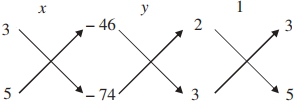
To solve the equations by the cross-multiplication method,we use the coefficients as follows:
$\frac{x}{(3)(-74) - (5)(-46)} = \frac{y}{(-46)(3) - (-74)(2)} = \frac{1}{(2)(5) - (3)(3)}$
i.e.,$\frac{x}{-222 + 230} = \frac{y}{-138 + 148} = \frac{1}{10 - 9}$
i.e.,$\frac{x}{8} = \frac{y}{10} = \frac{1}{1}$
Thus,$\frac{x}{8} = 1$ and $\frac{y}{10} = 1$,which gives $x = 8$ and $y = 10$.
Hence,the fare from the bus stand in Bangalore to Malleswaram is ₹ $8$ and the fare to Yeshwanthpur is ₹ $10$.
0 likes
View Solution37
EasyMCQ
For which values of $p$ does the pair of equations given below have a unique solution?
$4x + py + 8 = 0$
$2x + 2y + 2 = 0$
$4x + py + 8 = 0$
$2x + 2y + 2 = 0$
A
$p = 4$
B
$p \neq 4$
C
$p = 2$
D
$p \neq 2$
Solution
(B) The given equations are $4x + py + 8 = 0$ and $2x + 2y + 2 = 0$.
Comparing these with the standard form $a_{1}x + b_{1}y + c_{1} = 0$ and $a_{2}x + b_{2}y + c_{2} = 0$,we get:
$a_{1} = 4, b_{1} = p, c_{1} = 8$
$a_{2} = 2, b_{2} = 2, c_{2} = 2$
For a pair of linear equations to have a unique solution,the condition is $\frac{a_{1}}{a_{2}} \neq \frac{b_{1}}{b_{2}}$.
Substituting the values,we get $\frac{4}{2} \neq \frac{p}{2}$.
This simplifies to $2 \neq \frac{p}{2}$.
Multiplying both sides by $2$,we get $p \neq 4$.
Thus,for all real values of $p$ except $4$,the pair of equations has a unique solution.
1 likes
View Solution38
DifficultMCQ
For what value of $k$ will the following pair of linear equations have infinitely many solutions?
$kx + 3y - (k - 3) = 0$
$12x + ky - k = 0$
$kx + 3y - (k - 3) = 0$
$12x + ky - k = 0$
A
$k = 6$
B
$k = -6$
C
$k = 0$
D
$k = \pm 6$
Solution
(A) For a pair of linear equations $a_1x + b_1y + c_1 = 0$ and $a_2x + b_2y + c_2 = 0$ to have infinitely many solutions,the condition is $\frac{a_1}{a_2} = \frac{b_1}{b_2} = \frac{c_1}{c_2}$.
Given equations are $kx + 3y - (k - 3) = 0$ and $12x + ky - k = 0$.
Here,$a_1 = k, b_1 = 3, c_1 = -(k - 3)$ and $a_2 = 12, b_2 = k, c_2 = -k$.
Applying the condition: $\frac{k}{12} = \frac{3}{k} = \frac{-(k - 3)}{-k}$.
From $\frac{k}{12} = \frac{3}{k}$,we get $k^2 = 36$,so $k = \pm 6$.
From $\frac{3}{k} = \frac{k - 3}{k}$,we get $3k = k(k - 3) \implies 3k = k^2 - 3k \implies k^2 - 6k = 0 \implies k(k - 6) = 0$. Thus,$k = 0$ or $k = 6$.
The common value satisfying both conditions is $k = 6$.
0 likes
View Solution39
Easy
Which of the following pairs of linear equations has a unique solution,no solution,or infinitely many solutions? In case there is a unique solution,find it by using the cross-multiplication method.
$x - 3y - 3 = 0$
$3x - 9y - 2 = 0$
$x - 3y - 3 = 0$
$3x - 9y - 2 = 0$
Solution
(B) Given equations are:
$x - 3y - 3 = 0$ ... $(1)$
$3x - 9y - 2 = 0$ ... $(2)$
Comparing these with the standard form $a_1x + b_1y + c_1 = 0$ and $a_2x + b_2y + c_2 = 0$,we get:
$a_1 = 1, b_1 = -3, c_1 = -3$
$a_2 = 3, b_2 = -9, c_2 = -2$
Now,calculating the ratios:
$\frac{a_1}{a_2} = \frac{1}{3}$
$\frac{b_1}{b_2} = \frac{-3}{-9} = \frac{1}{3}$
$\frac{c_1}{c_2} = \frac{-3}{-2} = \frac{3}{2}$
Since $\frac{a_1}{a_2} = \frac{b_1}{b_2} \neq \frac{c_1}{c_2}$,the lines represented by these equations are parallel to each other.
Therefore,the system of equations has no solution.
0 likes
View Solution40
Difficult
Which of the following pairs of linear equations has a unique solution,no solution,or infinitely many solutions? In case there is a unique solution,find it by using the cross-multiplication method.
$2x + y = 5$
$3x + 2y = 8$
$2x + y = 5$
$3x + 2y = 8$
Solution
(A) Given equations are:
$2x + y - 5 = 0$
$3x + 2y - 8 = 0$
Comparing with $a_1x + b_1y + c_1 = 0$ and $a_2x + b_2y + c_2 = 0$:
$a_1 = 2, b_1 = 1, c_1 = -5$
$a_2 = 3, b_2 = 2, c_2 = -8$
Calculating ratios:
$\frac{a_1}{a_2} = \frac{2}{3}, \quad \frac{b_1}{b_2} = \frac{1}{2}, \quad \frac{c_1}{c_2} = \frac{-5}{-8} = \frac{5}{8}$
Since $\frac{a_1}{a_2} \neq \frac{b_1}{b_2}$,the pair of equations has a unique solution.
Using the cross-multiplication method:
$\frac{x}{b_1c_2 - b_2c_1} = \frac{y}{c_1a_2 - c_2a_1} = \frac{1}{a_1b_2 - a_2b_1}$
$\frac{x}{(1)(-8) - (2)(-5)} = \frac{y}{(-5)(3) - (-8)(2)} = \frac{1}{(2)(2) - (3)(1)}$
$\frac{x}{-8 + 10} = \frac{y}{-15 + 16} = \frac{1}{4 - 3}$
$\frac{x}{2} = \frac{y}{1} = \frac{1}{1}$
Thus,$x = 2$ and $y = 1$.
0 likes
View Solution41
Medium
Which of the following pairs of linear equations has a unique solution,no solution,or infinitely many solutions? In case there is a unique solution,find it by using the cross-multiplication method.
$3x - 5y = 20$
$6x - 10y = 40$
$3x - 5y = 20$
$6x - 10y = 40$
Solution
(D) Given equations are:
$3x - 5y - 20 = 0$ --- $(1)$
$6x - 10y - 40 = 0$ --- $(2)$
Comparing these with the standard form $a_1x + b_1y + c_1 = 0$ and $a_2x + b_2y + c_2 = 0$,we get:
$a_1 = 3, b_1 = -5, c_1 = -20$
$a_2 = 6, b_2 = -10, c_2 = -40$
Now,calculating the ratios:
$\frac{a_1}{a_2} = \frac{3}{6} = \frac{1}{2}$
$\frac{b_1}{b_2} = \frac{-5}{-10} = \frac{1}{2}$
$\frac{c_1}{c_2} = \frac{-20}{-40} = \frac{1}{2}$
Since $\frac{a_1}{a_2} = \frac{b_1}{b_2} = \frac{c_1}{c_2}$,the lines are coincident.
Therefore,the system of linear equations has infinitely many solutions.
0 likes
View Solution42
Difficult
Which of the following pairs of linear equations has a unique solution,no solution,or infinitely many solutions? In case there is a unique solution,find it by using the cross-multiplication method.
$x - 3y - 7 = 0$
$3x - 3y - 15 = 0$
$x - 3y - 7 = 0$
$3x - 3y - 15 = 0$
Solution
(A) Given equations are:
$x - 3y - 7 = 0$ ... $(1)$
$3x - 3y - 15 = 0$ ... $(2)$
Comparing with $a_1x + b_1y + c_1 = 0$ and $a_2x + b_2y + c_2 = 0$:
$a_1 = 1, b_1 = -3, c_1 = -7$
$a_2 = 3, b_2 = -3, c_2 = -15$
Calculating ratios:
$\frac{a_1}{a_2} = \frac{1}{3}, \quad \frac{b_1}{b_2} = \frac{-3}{-3} = 1, \quad \frac{c_1}{c_2} = \frac{-7}{-15} = \frac{7}{15}$
Since $\frac{a_1}{a_2} \neq \frac{b_1}{b_2}$ (i.e.,$\frac{1}{3} \neq 1$),the system has a unique solution.
Using the cross-multiplication method:
$\frac{x}{b_1c_2 - b_2c_1} = \frac{y}{c_1a_2 - c_2a_1} = \frac{1}{a_1b_2 - a_2b_1}$
$\frac{x}{(-3)(-15) - (-3)(-7)} = \frac{y}{(-7)(3) - (-15)(1)} = \frac{1}{(1)(-3) - (3)(-3)}$
$\frac{x}{45 - 21} = \frac{y}{-21 + 15} = \frac{1}{-3 + 9}$
$\frac{x}{24} = \frac{y}{-6} = \frac{1}{6}$
For $x$: $\frac{x}{24} = \frac{1}{6} \implies x = \frac{24}{6} = 4$
For $y$: $\frac{y}{-6} = \frac{1}{6} \implies y = \frac{-6}{6} = -1$
Thus,the unique solution is $x = 4, y = -1$.
1 likes
View Solution43
MediumMCQ
For which values of $a$ and $b$ does the following pair of linear equations have an infinite number of solutions?
$2x + 3y = 7$
$(a-b)x + (a+b)y = 3a + b - 2$
$2x + 3y = 7$
$(a-b)x + (a+b)y = 3a + b - 2$
A
$a=5, b=1$
B
$a=1, b=5$
C
$a=2, b=3$
D
$a=3, b=2$
Solution
(A) The given equations are:
$2x + 3y - 7 = 0$
$(a-b)x + (a+b)y - (3a + b - 2) = 0$
For a system of linear equations $\frac{a_1}{a_2}x + \frac{b_1}{b_2}y + \frac{c_1}{c_2} = 0$ to have infinitely many solutions,the condition is $\frac{a_1}{a_2} = \frac{b_1}{b_2} = \frac{c_1}{c_2}$.
Here,$\frac{a_1}{a_2} = \frac{2}{a-b}$,$\frac{b_1}{b_2} = \frac{3}{a+b}$,and $\frac{c_1}{c_2} = \frac{-7}{-(3a+b-2)} = \frac{7}{3a+b-2}$.
Equating the ratios:
$1) \frac{2}{a-b} = \frac{3}{a+b} \implies 2a + 2b = 3a - 3b \implies a - 5b = 0 \implies a = 5b$ (Equation $1$)
$2) \frac{2}{a-b} = \frac{7}{3a+b-2} \implies 6a + 2b - 4 = 7a - 7b \implies a - 9b = -4$ (Equation $2$)
Substituting $a = 5b$ into Equation $2$:
$5b - 9b = -4 \implies -4b = -4 \implies b = 1$.
Now,substituting $b = 1$ into $a = 5b$:
$a = 5(1) = 5$.
Thus,the values are $a = 5$ and $b = 1$.
0 likes
View Solution44
Medium
Solve the following pair of linear equations by the substitution and cross-multiplication methods:
$8x + 5y = 9$
$3x + 2y = 4$
$8x + 5y = 9$
$3x + 2y = 4$
Solution
(A) Given equations are:
$8x + 5y = 9$ $...(i)$
$3x + 2y = 4$ $...(ii)$
Substitution Method:
From equation $(ii)$,we get:
$3x = 4 - 2y \implies x = \frac{4 - 2y}{3}$ $...(iii)$
Substituting $(iii)$ in $(i)$:
$8(\frac{4 - 2y}{3}) + 5y = 9$
$32 - 16y + 15y = 27$
$-y = 27 - 32$
$-y = -5 \implies y = 5$
Substituting $y = 5$ in $(iii)$:
$x = \frac{4 - 2(5)}{3} = \frac{4 - 10}{3} = \frac{-6}{3} = -2$
Thus,$x = -2, y = 5$.
Cross-multiplication Method:
$8x + 5y - 9 = 0$
$3x + 2y - 4 = 0$
Using the formula $\frac{x}{b_1c_2 - b_2c_1} = \frac{y}{c_1a_2 - c_2a_1} = \frac{1}{a_1b_2 - a_2b_1}$:
$\frac{x}{(5)(-4) - (2)(-9)} = \frac{y}{(-9)(3) - (-4)(8)} = \frac{1}{(8)(2) - (3)(5)}$
$\frac{x}{-20 + 18} = \frac{y}{-27 + 32} = \frac{1}{16 - 15}$
$\frac{x}{-2} = \frac{y}{5} = \frac{1}{1}$
$x = -2, y = 5$.
0 likes
View Solution45
Medium
Form the pair of linear equations in the following problems and find their solutions (if they exist) by any algebraic method.
$A$ part of monthly hostel charges is fixed and the remaining depends on the number of days one has taken food in the mess. When a student $A$ takes food for $20$ days she has to pay ₹ $1000$ as hostel charges,whereas a student $B$,who takes food for $26$ days,pays ₹ $1180$ as hostel charges. Find the fixed charges and the cost of food per day.
$A$ part of monthly hostel charges is fixed and the remaining depends on the number of days one has taken food in the mess. When a student $A$ takes food for $20$ days she has to pay ₹ $1000$ as hostel charges,whereas a student $B$,who takes food for $26$ days,pays ₹ $1180$ as hostel charges. Find the fixed charges and the cost of food per day.
Solution
(N/A) Let $x$ be the fixed monthly hostel charge and $y$ be the cost of food per day.
According to the given information:
For student $A$: $x + 20y = 1000$ $...(1)$
For student $B$: $x + 26y = 1180$ $...(2)$
Subtracting equation $(1)$ from equation $(2)$,we get:
$(x + 26y) - (x + 20y) = 1180 - 1000$
$6y = 180$
$y = 30$
Substituting $y = 30$ in equation $(1)$:
$x + 20(30) = 1000$
$x + 600 = 1000$
$x = 400$
Thus,the fixed monthly charge is ₹ $400$ and the cost of food per day is ₹ $30$.
0 likes
View Solution46
Easy
Form the pair of linear equations in the following problems and find their solutions (if they exist) by any algebraic method. $A$ fraction becomes $\frac{1}{3}$ when $1$ is subtracted from the numerator and it becomes $\frac{1}{4}$ when $8$ is added to its denominator. Find the fraction.
Solution
(A) Let the fraction be $\frac{x}{y}$.
According to the given information:
$\frac{x-1}{y} = \frac{1}{3} \implies 3x - y = 3$ $...(1)$
$\frac{x}{y+8} = \frac{1}{4} \implies 4x - y = 8$ $...(2)$
Subtracting equation $(1)$ from equation $(2)$,we obtain:
$(4x - y) - (3x - y) = 8 - 3$
$x = 5$
Substituting the value of $x$ in equation $(1)$:
$3(5) - y = 3$
$15 - y = 3$
$y = 12$
Hence,the fraction is $\frac{5}{12}$.
0 likes
View Solution47
Medium
Form the pair of linear equations in the following problems and find their solutions (if they exist) by any algebraic method.
Yash scored $40$ marks in a test,getting $3$ marks for each right answer and losing $1$ mark for each wrong answer. Had $4$ marks been awarded for each correct answer and $2$ marks been deducted for each incorrect answer,then Yash would have scored $50$ marks. How many questions were there in the test?
Yash scored $40$ marks in a test,getting $3$ marks for each right answer and losing $1$ mark for each wrong answer. Had $4$ marks been awarded for each correct answer and $2$ marks been deducted for each incorrect answer,then Yash would have scored $50$ marks. How many questions were there in the test?
Solution
(20) Let the number of right answers be $x$ and the number of wrong answers be $y$.
According to the given information:
For the first case: $3x - y = 40$ $...(1)$
For the second case: $4x - 2y = 50$
Dividing the second equation by $2$,we get: $2x - y = 25$ $...(2)$
Subtracting equation $(2)$ from equation $(1)$:
$(3x - y) - (2x - y) = 40 - 25$
$x = 15$
Substituting $x = 15$ in equation $(2)$:
$2(15) - y = 25$
$30 - y = 25$
$y = 5$
Therefore,the number of right answers is $15$ and the number of wrong answers is $5$.
Total number of questions $= x + y = 15 + 5 = 20$.
0 likes
View Solution48
Easy
Places $A$ and $B$ are $100 \ km$ apart on a highway. One car starts from $A$ and another from $B$ at the same time. If the cars travel in the same direction at different speeds,they meet in $5 \ hours$. If they travel towards each other,they meet in $1 \ hour$. What are the speeds of the two cars?
Solution
(A) Let the speed of the $1^{st}$ car be $u \ km/h$ and the $2^{nd}$ car be $v \ km/h$.
When the cars travel in the same direction,their relative speed is $(u - v) \ km/h$. Since they meet in $5 \ hours$ covering a distance of $100 \ km$,we have:
$5(u - v) = 100 \Rightarrow u - v = 20 \quad \dots(1)$
When the cars travel towards each other,their relative speed is $(u + v) \ km/h$. Since they meet in $1 \ hour$ covering a distance of $100 \ km$,we have:
$1(u + v) = 100 \Rightarrow u + v = 100 \quad \dots(2)$
Adding equations $(1)$ and $(2)$:
$(u - v) + (u + v) = 20 + 100$
$2u = 120 \Rightarrow u = 60 \ km/h$
Substituting $u = 60$ in equation $(2)$:
$60 + v = 100 \Rightarrow v = 40 \ km/h$
Thus,the speed of the first car is $60 \ km/h$ and the speed of the second car is $40 \ km/h$.
0 likes
View Solution49
Medium
Form the pair of linear equations in the following problems and find their solutions (if they exist) by any algebraic method.
The area of a rectangle gets reduced by $9$ square units,if its length is reduced by $5$ units and breadth is increased by $3$ units. If we increase the length by $3$ units and the breadth by $2$ units,the area increases by $67$ square units. Find the dimensions of the rectangle.
The area of a rectangle gets reduced by $9$ square units,if its length is reduced by $5$ units and breadth is increased by $3$ units. If we increase the length by $3$ units and the breadth by $2$ units,the area increases by $67$ square units. Find the dimensions of the rectangle.
Solution
(A) Let the length and breadth of the rectangle be $x$ units and $y$ units respectively.
Area $= x y$
According to the first condition:
$(x - 5)(y + 3) = xy - 9$
$xy + 3x - 5y - 15 = xy - 9$
$3x - 5y = 6$ ...$(1)$
According to the second condition:
$(x + 3)(y + 2) = xy + 67$
$xy + 2x + 3y + 6 = xy + 67$
$2x + 3y = 61$ ...$(2)$
Solving equations $(1)$ and $(2)$ by the cross-multiplication method:
$\frac{x}{(-5)(-61) - (3)(-6)} = \frac{y}{(-6)(2) - (-61)(3)} = \frac{1}{(3)(3) - (-5)(2)}$
$\frac{x}{305 + 18} = \frac{y}{-12 + 183} = \frac{1}{9 + 10}$
$\frac{x}{323} = \frac{y}{171} = \frac{1}{19}$
$x = \frac{323}{19} = 17$
$y = \frac{171}{19} = 9$
Thus,the length is $17$ units and the breadth is $9$ units.
0 likes
View Solution50
Difficult
$A$ boat goes $30\, km$ upstream and $44\, km$ downstream in $10\, hours.$ In $13\, hours,$ it can go $40\, km$ upstream and $55\, km$ downstream. Determine the speed of the stream and that of the boat in still water.
Solution
(N/A) Let the speed of the boat in still water be $x\, km/h$ and the speed of the stream be $y\, km/h.$
Then the speed of the boat downstream $= (x+y)\, km/h$ and the speed of the boat upstream $= (x-y)\, km/h.$
Using the formula,$\text{time} = \frac{\text{distance}}{\text{speed}}.$
In the first case,the total time taken is $10\, hours$ for $30\, km$ upstream and $44\, km$ downstream:
$\frac{30}{x-y} + \frac{44}{x+y} = 10 \quad ...(1)$
In the second case,the total time taken is $13\, hours$ for $40\, km$ upstream and $55\, km$ downstream:
$\frac{40}{x-y} + \frac{55}{x+y} = 13 \quad ...(2)$
Let $\frac{1}{x-y} = u$ and $\frac{1}{x+y} = v \quad ...(3)$
Substituting these into equations $(1)$ and $(2)$:
$30u + 44v = 10 \quad ...(4)$
$40u + 55v = 13 \quad ...(5)$
Solving these using the elimination method:
Multiply $(4)$ by $4$ and $(5)$ by $3$:
$120u + 176v = 40$
$120u + 165v = 39$
Subtracting the equations: $11v = 1 \implies v = \frac{1}{11}.$
Substituting $v = \frac{1}{11}$ in $(4)$:
$30u + 44(\frac{1}{11}) = 10 \implies 30u + 4 = 10 \implies 30u = 6 \implies u = \frac{1}{5}.$
Now,$\frac{1}{x-y} = \frac{1}{5} \implies x-y = 5$ and $\frac{1}{x+y} = \frac{1}{11} \implies x+y = 11.$
Adding these: $2x = 16 \implies x = 8.$
Subtracting these: $2y = 6 \implies y = 3.$
Thus,the speed of the boat in still water is $8\, km/h$ and the speed of the stream is $3\, km/h.$

0 likes
View SolutionPair of Linear Equations in Two Variables — Mix Examples - Pair of Linear Equations in Two Variables · Frequently Asked Questions
1Are these Pair of Linear Equations in Two Variables questions useful for JEE and NEET?
Yes. All questions in this section are mapped to JEE Main and NEET exam patterns. Previous year questions from JEE Main, NEET, GUJCET and state-level exams are included with full solutions.
2Can I switch to Hindi or Gujarati for these questions?
Yes. Use the language tabs in the hero section or the sidebar to view the same questions and solutions in English, Hindi or Gujarati.
3How do I generate a question paper from this subtopic?
Use the Vedclass Exam Paper Generator — select the chapter and subtopic, set difficulty, and generate Sets A, B, C, D automatically. First 3 chapters of every subject are free.
Vedclass Products
For Students
Vedclass Test Series
Mock tests in real JEE/NEET style with performance analysis. 5-day free trial.
Start Free TrialFor Teachers
Exam Paper Generator
Generate Set A/B/C/D papers from this chapter in 2 minutes. 3 chapters free.
Try FreeFor Institutes
Online Exam Module
Live online exams with unlimited students, 360° analytics & white-label branding.
See DemoFor Teachers & Institutes
Generate a Pair of Linear Equations in Two Variables Exam Paper in 2 Minutes
Select subtopic & difficulty — Sets A, B, C, D auto-generated with No Repeat logic.
First 3 chapters of every subject are free — no payment required.