
A English
Mix Examples - Quadratic Equations Questions in English
Class 10 Mathematics · Quadratic Equations · Mix Examples - Quadratic Equations
25+
Questions
English
Language
100%
With Solutions
Showing 25 of 25 questions in English
1
Easy
State whether the following statements are true or false. Justify your answers.
$(i)$ Every quadratic equation has at most two roots.
$(ii)$ If the coefficient of $x^{2}$ and the constant term of a quadratic equation have opposite signs,then the quadratic equation has real roots.
$(i)$ Every quadratic equation has at most two roots.
$(ii)$ If the coefficient of $x^{2}$ and the constant term of a quadratic equation have opposite signs,then the quadratic equation has real roots.
Solution
(A) $(i)$ True. $A$ quadratic equation is of the form $ax^{2} + bx + c = 0$ where $a \neq 0$. By the Fundamental Theorem of Algebra,a polynomial of degree $n$ has at most $n$ roots. Since a quadratic equation has degree $2$,it can have at most $2$ roots.
$(ii)$ True. For a quadratic equation $ax^{2} + bx + c = 0$,the discriminant is $D = b^{2} - 4ac$. If the coefficient of $x^{2}$ $(a)$ and the constant term $(c)$ have opposite signs,then $ac < 0$. Consequently,$-4ac > 0$. Since $b^{2} \geq 0$,it follows that $D = b^{2} - 4ac > 0$. Because the discriminant is positive,the quadratic equation must have two distinct real roots.
$(ii)$ True. For a quadratic equation $ax^{2} + bx + c = 0$,the discriminant is $D = b^{2} - 4ac$. If the coefficient of $x^{2}$ $(a)$ and the constant term $(c)$ have opposite signs,then $ac < 0$. Consequently,$-4ac > 0$. Since $b^{2} \geq 0$,it follows that $D = b^{2} - 4ac > 0$. Because the discriminant is positive,the quadratic equation must have two distinct real roots.
0 likes
View Solution2
Easy
Write whether the following statements are true or false. Justify your answers.
$(i)$ If the coefficient of $x^{2}$ and the constant term have the same sign and if the coefficient of $x$ term is zero,then the quadratic equation has no real roots.
$(ii)$ Every quadratic equation has at least two roots.
$(i)$ If the coefficient of $x^{2}$ and the constant term have the same sign and if the coefficient of $x$ term is zero,then the quadratic equation has no real roots.
$(ii)$ Every quadratic equation has at least two roots.
Solution
(A) $(i)$ True. For a quadratic equation $ax^{2} + bx + c = 0$,the discriminant is $D = b^{2} - 4ac$. Given $b = 0$,we have $D = -4ac$. If $a$ and $c$ have the same sign,then $ac > 0$,which implies $D = -4ac < 0$. Since the discriminant is negative,the equation has no real roots.
$(ii)$ False. $A$ quadratic equation has exactly two roots (which may be real and distinct,real and equal,or complex/imaginary). It does not necessarily have "at least" two roots in the context of real numbers,and it cannot have more than two roots.
$(ii)$ False. $A$ quadratic equation has exactly two roots (which may be real and distinct,real and equal,or complex/imaginary). It does not necessarily have "at least" two roots in the context of real numbers,and it cannot have more than two roots.
0 likes
View Solution3
MediumMCQ
$A$ motor boat whose speed is $18\, km/h$ in still water takes $1\, hour$ more to go $24\, km$ upstream than to return downstream to the same spot. Find the speed of the stream. (in $ km/h$)
A
$2$
B
$4$
C
$6$
D
$8$
Solution
(C) Let the speed of the stream be $x\, km/h$.
Therefore,the speed of the boat upstream is $(18-x)\, km/h$ and the speed of the boat downstream is $(18+x)\, km/h$.
The time taken to go upstream is $\frac{\text{distance}}{\text{speed}} = \frac{24}{18-x}\, \text{hours}$.
Similarly,the time taken to go downstream is $\frac{24}{18+x}\, \text{hours}$.
According to the problem,the difference in time is $1\, \text{hour}$:
$\frac{24}{18-x} - \frac{24}{18+x} = 1$
Multiplying by $(18-x)(18+x)$,we get:
$24(18+x) - 24(18-x) = (18-x)(18+x)$
$432 + 24x - 432 + 24x = 324 - x^2$
$48x = 324 - x^2$
$x^2 + 48x - 324 = 0$
Using the quadratic formula $x = \frac{-b \pm \sqrt{b^2 - 4ac}}{2a}$:
$x = \frac{-48 \pm \sqrt{48^2 - 4(1)(-324)}}{2(1)}$
$x = \frac{-48 \pm \sqrt{2304 + 1296}}{2} = \frac{-48 \pm \sqrt{3600}}{2}$
$x = \frac{-48 \pm 60}{2}$
Since speed cannot be negative,we take $x = \frac{-48 + 60}{2} = \frac{12}{2} = 6\, km/h$.
1 likes
View Solution4
Difficult
The difference of squares of two numbers is $180$. The square of the smaller number is $8$ times the larger number. Find the two numbers.
Solution
(A) Let the larger number be $x$ and the smaller number be $y$.
According to the given conditions:
$x^2 - y^2 = 180$ --- $(1)$
$y^2 = 8x$ --- $(2)$
Substituting equation $(2)$ into equation $(1)$:
$x^2 - 8x = 180$
$x^2 - 8x - 180 = 0$
Factoring the quadratic equation:
$x^2 - 18x + 10x - 180 = 0$
$x(x - 18) + 10(x - 18) = 0$
$(x - 18)(x + 10) = 0$
So,$x = 18$ or $x = -10$.
Since $y^2 = 8x$,if $x = -10$,then $y^2 = -80$,which is impossible for real numbers. Thus,$x = 18$.
Now,find $y$:
$y^2 = 8(18) = 144$
$y = \pm \sqrt{144} = \pm 12$.
Therefore,the two numbers are $(18, 12)$ or $(18, -12)$.
0 likes
View Solution5
DifficultMCQ
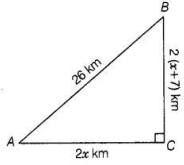
For going to a city $B$ from city $A$,there is a route via city $C$ such that $AC \perp CB$,$AC = 2x \, km$ and $CB = 2(x+7) \, km$. It is proposed to construct a $26 \, km$ highway which directly connects the two cities $A$ and $B$. Find how much distance will be saved in reaching city $B$ from city $A$ after the construction of the highway (in $km$).
A
$8$
B
$10$
C
$12$
D
$25$
Solution
(A) Given,$AC \perp CB$,$AC = 2x \, km$,$CB = 2(x+7) \, km$ and $AB = 26 \, km$.
From the figure,we have a right-angled $\triangle ACB$ with the right angle at $C$.
In $\triangle ACB$,by the Pythagoras theorem:
$AB^2 = AC^2 + BC^2$
$(26)^2 = (2x)^2 + \{2(x+7)\}^2$
$676 = 4x^2 + 4(x^2 + 49 + 14x)$
$676 = 4x^2 + 4x^2 + 196 + 56x$
$676 = 8x^2 + 56x + 196$
$8x^2 + 56x - 480 = 0$
Dividing by $8$,we get:
$x^2 + 7x - 60 = 0$
$x^2 + 12x - 5x - 60 = 0$
$x(x + 12) - 5(x + 12) = 0$
$(x + 12)(x - 5) = 0$
$x = -12$ or $x = 5$.
Since distance cannot be negative,$x = 5$ (as $x \neq -12$).
Now,$AC = 2x = 2(5) = 10 \, km$ and $BC = 2(x+7) = 2(5+7) = 24 \, km$.
The distance covered to reach city $B$ from city $A$ via city $C$ is $AC + BC = 10 + 24 = 34 \, km$.
The distance covered to reach city $B$ from city $A$ after the construction of the highway is $AB = 26 \, km$.
Therefore,the distance saved is $34 - 26 = 8 \, km$.
0 likes
View Solution6
DifficultMCQ
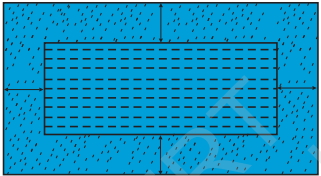
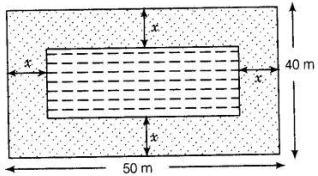
In the centre of a rectangular lawn of dimensions $50\, m \times 40\, m$,a rectangular pond has to be constructed so that the area of the grass surrounding the pond would be $1184\, m^{2}$ [see $Fig.$]. Find the length and breadth of the pond. (in $m$)
A
$34, 24$
B
$43, 53$
C
$64, 54$
D
$35, 55$
Solution
(A) Let the width of the grass strip around the pond be $x\, m$.
Given,the dimensions of the rectangular lawn are $50\, m \times 40\, m$.
Therefore,the length of the pond is $(50 - 2x)\, m$ and the breadth of the pond is $(40 - 2x)\, m$.
The area of the grass surrounding the pond is given by the difference between the area of the lawn and the area of the pond.
Area of grass = (Area of lawn) - (Area of pond)
$1184 = (50 \times 40) - (50 - 2x)(40 - 2x)$
$1184 = 2000 - (2000 - 100x - 80x + 4x^{2})$
$1184 = 2000 - 2000 + 180x - 4x^{2}$
$4x^{2} - 180x + 1184 = 0$
Dividing by $4$:
$x^{2} - 45x + 296 = 0$
$x^{2} - 37x - 8x + 296 = 0$
$x(x - 37) - 8(x - 37) = 0$
$(x - 37)(x - 8) = 0$
So,$x = 37$ or $x = 8$.
If $x = 37$,the dimensions of the pond would be negative,which is not possible. Thus,$x = 8$.
Length of pond = $50 - 2(8) = 50 - 16 = 34\, m$.
Breadth of pond = $40 - 2(8) = 40 - 16 = 24\, m$.
Therefore,the length and breadth of the pond are $34\, m$ and $24\, m$ respectively.
0 likes
View Solution7
DifficultMCQ
$A$ person,rowing at the rate of $5 \, km/h$ in still water,takes thrice as much time in going $40 \, km$ upstream as in going $40 \, km$ downstream. Find the speed of the stream in $km/h$.
A
$1.5$
B
$3.5$
C
$2.5$
D
$4$
Solution
(C) Let the speed of the stream be $v \, km/h$.
Given that,the speed of the person in still water is $5 \, km/h$.
The speed of the person downstream is $(5 + v) \, km/h$.
The speed of the person upstream is $(5 - v) \, km/h$.
Time taken to cover $40 \, km$ downstream is $t_1 = \frac{40}{5 + v} \, h$.
Time taken to cover $40 \, km$ upstream is $t_2 = \frac{40}{5 - v} \, h$.
According to the problem,the time taken upstream is thrice the time taken downstream,so $t_2 = 3 \times t_1$.
Substituting the values: $\frac{40}{5 - v} = 3 \times \frac{40}{5 + v}$.
Dividing both sides by $40$: $\frac{1}{5 - v} = \frac{3}{5 + v}$.
Cross-multiplying: $5 + v = 3(5 - v)$.
$5 + v = 15 - 3v$.
$4v = 10$.
$v = 2.5 \, km/h$.
Thus,the speed of the stream is $2.5 \, km/h$.
0 likes
View Solution8
EasyMCQ
For a two-digit number,if the sum of its digits is equal to the product of its digits,then the number is .............
A
$11$
B
$23$
C
$10$
D
$22$
Solution
(D) Let the two-digit number be represented as $10x + y$,where $x$ is the tens digit and $y$ is the units digit.
According to the problem,the sum of the digits is equal to the product of the digits:
$x + y = xy$
Rearranging the equation:
$xy - x - y = 0$
Adding $1$ to both sides to factorize:
$xy - x - y + 1 = 1$
$(x - 1)(y - 1) = 1$
Since $x$ and $y$ are digits ($1$ to $9$ for $x$,$0$ to $9$ for $y$),the only integer solution for $(x - 1)(y - 1) = 1$ is:
$x - 1 = 1 \implies x = 2$
$y - 1 = 1 \implies y = 2$
Thus,the number is $10(2) + 2 = 22$.
0 likes
View Solution9
MediumMCQ
In $\Delta ABC$,$m\angle B = 90^{\circ}$,$AB = 2x + 3$,$BC = x + 2$,and $AC = 3x - 1$. Find the value of $x$.
A
$6$
B
$5$
C
$4$
D
$2$
Solution
(A) In $\Delta ABC$,since $m\angle B = 90^{\circ}$,by the Pythagorean theorem:
$AC^2 = AB^2 + BC^2$
$(3x - 1)^2 = (2x + 3)^2 + (x + 2)^2$
$9x^2 - 6x + 1 = (4x^2 + 12x + 9) + (x^2 + 4x + 4)$
$9x^2 - 6x + 1 = 5x^2 + 16x + 13$
$4x^2 - 22x - 12 = 0$
Dividing by $2$:
$2x^2 - 11x - 6 = 0$
$2x^2 - 12x + x - 6 = 0$
$2x(x - 6) + 1(x - 6) = 0$
$(x - 6)(2x + 1) = 0$
Thus,$x = 6$ or $x = -\frac{1}{2}$.
Since side lengths must be positive,$x = -\frac{1}{2}$ is rejected because it results in negative side lengths.
Therefore,$x = 6$.
0 likes
View Solution10
Medium
$\square XYZW$ is a rectangle. If $XY + YZ = 17$ and $XZ + YW = 26$,find $XY$ and $YZ$ (given $XY > YZ$).
Solution
(A) In a rectangle,the diagonals are equal in length,so $XZ = YW$. Given $XZ + YW = 26$,we have $2XZ = 26$,which implies $XZ = 13$.
In the right-angled triangle $\triangle XYZ$,by the Pythagorean theorem,$XY^2 + YZ^2 = XZ^2 = 13^2 = 169$.
We are given $XY + YZ = 17$. Squaring both sides,we get $(XY + YZ)^2 = 17^2 = 289$.
Expanding this,$XY^2 + YZ^2 + 2(XY \cdot YZ) = 289$.
Substituting $XY^2 + YZ^2 = 169$,we get $169 + 2(XY \cdot YZ) = 289$,so $2(XY \cdot YZ) = 120$,which means $XY \cdot YZ = 60$.
We need two numbers that add to $17$ and multiply to $60$. These are $12$ and $5$.
Since $XY > YZ$,we have $XY = 12$ and $YZ = 5$.
0 likes
View Solution11
MediumMCQ
In $\Delta ABC$,$m \angle A = 90^{\circ}$. If $AB = 3x - 2$,$AC = 5x + 4$,and $BC = 6x + 2$,find the value of $x$.
A
$10$
B
$4$
C
$2$
D
$12$
Solution
(B) Since $\Delta ABC$ is a right-angled triangle with $m \angle A = 90^{\circ}$,by the Pythagorean theorem,we have:
$AB^2 + AC^2 = BC^2$
Substituting the given expressions:
$(3x - 2)^2 + (5x + 4)^2 = (6x + 2)^2$
Expanding the squares:
$(9x^2 - 12x + 4) + (25x^2 + 40x + 16) = (36x^2 + 24x + 4)$
Combining like terms on the left side:
$34x^2 + 28x + 20 = 36x^2 + 24x + 4$
Rearranging the terms to one side:
$36x^2 - 34x^2 + 24x - 28x + 4 - 20 = 0$
$2x^2 - 4x - 16 = 0$
Dividing the entire equation by $2$:
$x^2 - 2x - 8 = 0$
Factoring the quadratic equation:
$(x - 4)(x + 2) = 0$
This gives $x = 4$ or $x = -2$.
Since lengths must be positive,$3x - 2 > 0$ implies $x > 2/3$. Thus,$x = 4$ is the only valid solution.
0 likes
View Solution12
MediumMCQ
The perimeter of rectangle $ABCD$ is $28$. If $AC = 10$ and $AB < BC$,find the measures of its sides.
A
$6$ and $8$
B
$5$ and $9$
C
$4$ and $10$
D
$7$ and $7$
Solution
(A) Let the sides of the rectangle be $AB = x$ and $BC = y$.
The perimeter of a rectangle is given by $2(x + y) = 28$,which simplifies to $x + y = 14$.
In a rectangle,the diagonal $AC$ forms a right-angled triangle $ABC$ with sides $AB$ and $BC$.
By the Pythagorean theorem,$x^2 + y^2 = AC^2 = 10^2 = 100$.
We have the system of equations:
$1) x + y = 14$
$2) x^2 + y^2 = 100$
From $(1)$,$y = 14 - x$. Substituting this into $(2)$:
$x^2 + (14 - x)^2 = 100$
$x^2 + 196 - 28x + x^2 = 100$
$2x^2 - 28x + 96 = 0$
$x^2 - 14x + 48 = 0$
$(x - 6)(x - 8) = 0$
So,$x = 6$ or $x = 8$.
If $x = 6$,then $y = 14 - 6 = 8$. Since $AB < BC$ $(6 < 8)$,this is a valid solution.
If $x = 8$,then $y = 14 - 8 = 6$. This contradicts $AB < BC$.
Therefore,the sides are $AB = 6$ and $BC = 8$.
0 likes
View Solution13
EasyMCQ
In rectangle $HIJK$,$HJ = 13$ and $HI = 5$. Then,the perimeter of rectangle $HIJK$ is.......
A
$34$
B
$20$
C
$17$
D
$36$
Solution
(A) In rectangle $HIJK$,$HJ$ is the diagonal and $HI$ is one of the sides.
Let the sides be $HI = l = 5$ and $IJ = w$. The diagonal $HJ$ forms a right-angled triangle $\triangle HIJ$ with sides $HI$ and $IJ$.
By the Pythagorean theorem,$HI^2 + IJ^2 = HJ^2$.
$5^2 + IJ^2 = 13^2$.
$25 + IJ^2 = 169$.
$IJ^2 = 169 - 25 = 144$.
$IJ = \sqrt{144} = 12$.
Now,the perimeter of the rectangle is given by $P = 2(l + w)$.
$P = 2(5 + 12) = 2(17) = 34$.
0 likes
View Solution14
DifficultMCQ
The speed of the flow of a river is $3 \, km/hr$. $A$ motorboat goes $12 \, km$ downstream and comes back in a total time of $3$ hours. Find the speed of the motorboat in still water. (The speed of flow of water is less than the speed of the boat.)
A
$12$
B
$1$
C
$8$
D
$9$
Solution
(D) Let the speed of the motorboat in still water be $x \, km/hr$.
Therefore,the speed of the motorboat going downstream is $(x+3) \, km/hr$ and its speed going upstream is $(x-3) \, km/hr$.
Hence,the time taken to cover $12 \, km$ downstream is $\frac{12}{x+3}$ hours and the time taken to cover the same distance,i.e.,$12 \, km$ to come back upstream is $\frac{12}{x-3}$ hours.
According to the problem,the total time taken is $3$ hours.
$\frac{12}{x+3} + \frac{12}{x-3} = 3$
$12(x-3) + 12(x+3) = 3(x+3)(x-3)$
$12x - 36 + 12x + 36 = 3(x^2 - 9)$
$24x = 3x^2 - 27$
$3x^2 - 24x - 27 = 0$
Dividing by $3$,we get $x^2 - 8x - 9 = 0$.
$(x-9)(x+1) = 0$
$x = 9$ or $x = -1$.
Since the speed cannot be negative,$x = 9 \, km/hr$.
0 likes
View Solution15
DifficultMCQ
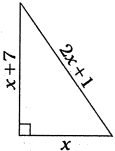
The hypotenuse of a garden in the shape of a right triangle is $1$ metre more than twice the shortest side. If the longer side containing the right angle is $7$ metres more than the shorter side,find the sides of the garden.
A
$10\,m, 5\,m, 3\,m$
B
$22\,m, 9\,m, 13\,m$
C
$14\,m, 23\,m, 10\,m$
D
$8\,m, 15\,m, 17\,m$
Solution
(D) Let the shorter side among the sides containing the right angle (i.e.,base) be $x$ metres.
Then,the other side containing the right angle (i.e.,altitude) is $(x+7)$ metres and the hypotenuse is $(2x+1)$ metres.
By Pythagoras' theorem,$(\text{Hypotenuse})^2 = (\text{Base})^2 + (\text{Altitude})^2$.
Therefore,$(2x+1)^2 = x^2 + (x+7)^2$.
$4x^2 + 4x + 1 = x^2 + x^2 + 14x + 49$.
$4x^2 + 4x + 1 = 2x^2 + 14x + 49$.
$2x^2 - 10x - 48 = 0$.
Dividing by $2$,we get $x^2 - 5x - 24 = 0$.
$(x-8)(x+3) = 0$.
So,$x=8$ or $x=-3$.
Since the side of a triangle cannot be negative,$x=8$.
Thus,the base is $8\,m$,the altitude is $8+7=15\,m$,and the hypotenuse is $2(8)+1=17\,m$.
The sides of the garden are $8\,m, 15\,m$ and $17\,m$.
0 likes
View Solution16
DifficultMCQ
The difference between the lengths of the sides of a right triangle which form the right angle is $7 \, cm$. If its perimeter is $30 \, cm$,find the lengths of the sides.
A
$5 \, cm, 12 \, cm, 13 \, cm$
B
$15 \, cm, 24 \, cm, 13 \, cm$
C
$5 \, cm, 20 \, cm, 26 \, cm$
D
$10 \, cm, 22 \, cm, 26 \, cm$
Solution
(A) Let the two sides forming the right angle be $x \, cm$ and $(x + 7) \, cm$.
By the Pythagorean theorem,the hypotenuse is $\sqrt{x^2 + (x + 7)^2} = \sqrt{x^2 + x^2 + 14x + 49} = \sqrt{2x^2 + 14x + 49}$.
The perimeter is given as $30 \, cm$,so $x + (x + 7) + \sqrt{2x^2 + 14x + 49} = 30$.
$2x + 7 + \sqrt{2x^2 + 14x + 49} = 30$.
$\sqrt{2x^2 + 14x + 49} = 23 - 2x$.
Squaring both sides: $2x^2 + 14x + 49 = (23 - 2x)^2$.
$2x^2 + 14x + 49 = 529 - 92x + 4x^2$.
$2x^2 - 106x + 480 = 0$.
$x^2 - 53x + 240 = 0$.
$(x - 5)(x - 48) = 0$.
Since $x$ cannot be $48$ (as the perimeter is $30$),$x = 5$.
The sides are $5 \, cm$,$5 + 7 = 12 \, cm$,and the hypotenuse is $\sqrt{5^2 + 12^2} = \sqrt{25 + 144} = \sqrt{169} = 13 \, cm$.
0 likes
View Solution17
MediumMCQ
The denominator of a non-zero ratio is one less than twice the numerator. If the sum of the ratio and its reciprocal is $2 \frac{4}{15},$ find the ratio.
A
$3/5$
B
$5/3$
C
$2/3$
D
$3/2$
Solution
(A) Let the numerator be $x$. Then the denominator is $2x - 1$. The ratio is $\frac{x}{2x - 1}$.
According to the problem,the sum of the ratio and its reciprocal is $2 \frac{4}{15} = \frac{34}{15}$.
So,$\frac{x}{2x - 1} + \frac{2x - 1}{x} = \frac{34}{15}$.
Let $y = \frac{x}{2x - 1}$. Then $y + \frac{1}{y} = \frac{34}{15}$.
$15y^2 - 34y + 15 = 0$.
$15y^2 - 25y - 9y + 15 = 0$.
$5y(3y - 5) - 3(3y - 5) = 0$.
$(5y - 3)(3y - 5) = 0$.
So,$y = 3/5$ or $y = 5/3$.
If $y = 3/5$,then $\frac{x}{2x - 1} = \frac{3}{5} \implies 5x = 6x - 3 \implies x = 3$. The ratio is $\frac{3}{2(3) - 1} = \frac{3}{5}$.
If $y = 5/3$,then $\frac{x}{2x - 1} = \frac{5}{3} \implies 3x = 10x - 5 \implies 7x = 5 \implies x = 5/7$. The ratio is $\frac{5/7}{2(5/7) - 1} = \frac{5/7}{3/7} = \frac{5}{3}$.
0 likes
View Solution18
DifficultMCQ
While selling a calculator for Rs. $56$,the profit percentage is equal to its cost price in rupees. Find the cost price of the calculator.
A
$40$
B
$46$
C
$36$
D
$52$
Solution
(A) Let the cost price of the calculator be $x$ rupees.
Given that the profit percentage is equal to the cost price,the profit percentage is $x\%$.
Profit = $\text{Cost Price} \times \frac{\text{Profit Percentage}}{100} = x \times \frac{x}{100} = \frac{x^2}{100}$.
Selling Price = $\text{Cost Price} + \text{Profit} = x + \frac{x^2}{100}$.
Given that the selling price is Rs. $56$,we have the equation: $x + \frac{x^2}{100} = 56$.
Multiplying by $100$,we get $100x + x^2 = 5600$,which simplifies to $x^2 + 100x - 5600 = 0$.
Factoring the quadratic equation: $x^2 + 140x - 40x - 5600 = 0$.
$x(x + 140) - 40(x + 140) = 0$.
$(x - 40)(x + 140) = 0$.
Since the cost price cannot be negative,$x = 40$.
Therefore,the cost price of the calculator is Rs. $40$.
0 likes
View Solution19
MediumMCQ
The sum of two numbers is $15$. If the sum of their reciprocals is $\frac{3}{10}$,then find the numbers.
A
$1, 2$
B
$0, 3$
C
$5, 10$
D
$4, 13$
Solution
(C) Let the two numbers be $x$ and $y$.
Given: $x + y = 15$ (Equation $1$).
Given: $\frac{1}{x} + \frac{1}{y} = \frac{3}{10}$ (Equation $2$).
From Equation $2$,we get $\frac{x + y}{xy} = \frac{3}{10}$.
Substituting the value of $x + y$ from Equation $1$ into this expression: $\frac{15}{xy} = \frac{3}{10}$.
Solving for $xy$: $3xy = 150$,so $xy = 50$.
Now we have $x + y = 15$ and $xy = 50$.
These are the roots of the quadratic equation $t^2 - (x + y)t + xy = 0$.
Substituting the values: $t^2 - 15t + 50 = 0$.
Factoring the quadratic: $(t - 5)(t - 10) = 0$.
Thus,$t = 5$ or $t = 10$.
The two numbers are $5$ and $10$.
0 likes
View Solution20
DifficultMCQ
The speed of a motorboat in still water is $9\,km/h$. In a river,it covers $12\,km$ downstream and the same distance upstream in a total time of $3\,hours$. Find the speed of the current of the river. (The speed of the current of the river is less than the speed of the motorboat in still water.) (in $,km/h$)
A
$5$
B
$1$
C
$7$
D
$3$
Solution
(D) Let the speed of the current be $x\,km/h$.
Speed downstream = $(9 + x)\,km/h$.
Speed upstream = $(9 - x)\,km/h$.
Time taken downstream = $\frac{12}{9 + x}$.
Time taken upstream = $\frac{12}{9 - x}$.
Total time = $3\,hours$,so $\frac{12}{9 + x} + \frac{12}{9 - x} = 3$.
Dividing by $3$: $\frac{4}{9 + x} + \frac{4}{9 - x} = 1$.
$4(9 - x) + 4(9 + x) = (9 + x)(9 - x)$.
$36 - 4x + 36 + 4x = 81 - x^2$.
$72 = 81 - x^2$.
$x^2 = 81 - 72 = 9$.
$x = 3\,km/h$ (since speed cannot be negative).
0 likes
View Solution21
DifficultMCQ
The product of the digits of a two-digit number is $15$. If the digits of this number are interchanged,the new number so obtained is $18$ more than the original number. Find the original number.
A
$30$
B
$35$
C
$23$
D
$40$
Solution
(B) Let the tens digit be $x$ and the units digit be $y$. The number is $10x + y$.
Given that the product of the digits is $xy = 15$.
When the digits are interchanged,the new number is $10y + x$.
According to the problem,the new number is $18$ more than the original number:
$(10y + x) - (10x + y) = 18$
$9y - 9x = 18$
$y - x = 2$,which implies $y = x + 2$.
Substitute $y = x + 2$ into the product equation $xy = 15$:
$x(x + 2) = 15$
$x^2 + 2x - 15 = 0$
$(x + 5)(x - 3) = 0$
Since $x$ must be a positive digit,$x = 3$.
Then $y = 3 + 2 = 5$.
The original number is $10(3) + 5 = 35$.
0 likes
View Solution22
DifficultMCQ
The perimeter of a bigger square is $12\,m$ more than the perimeter of a smaller square. Three times the area of the smaller square is $11\,m^2$ more than the area of the bigger square. Find the length of the side of the bigger square.
A
$3$
B
$9$
C
$8$
D
$5$
Solution
(C) Let the side of the smaller square be $x\,m$ and the side of the bigger square be $y\,m$.
The perimeter of the smaller square is $4x$ and the perimeter of the bigger square is $4y$.
According to the problem,$4y = 4x + 12$,which simplifies to $y = x + 3$.
The area of the smaller square is $x^2$ and the area of the bigger square is $y^2$.
According to the problem,$3x^2 = y^2 + 11$.
Substitute $y = x + 3$ into the second equation:
$3x^2 = (x + 3)^2 + 11$
$3x^2 = x^2 + 6x + 9 + 11$
$2x^2 - 6x - 20 = 0$
$x^2 - 3x - 10 = 0$
$(x - 5)(x + 2) = 0$
Since the side length cannot be negative,$x = 5$.
Therefore,the side of the bigger square is $y = x + 3 = 5 + 3 = 8\,m$.
0 likes
View Solution23
MediumMCQ
If the sum and the product of the digits of a two-digit number are the same,then the number is $\ldots \ldots \ldots \ldots$
A
$11$
B
$23$
C
$10$
D
$22$
Solution
(D) Let the two-digit number be represented as $10x + y$,where $x$ is the tens digit and $y$ is the units digit.
According to the problem,the sum of the digits is equal to the product of the digits:
$x + y = xy$
Rearranging the equation to solve for $y$:
$x = xy - y$
$x = y(x - 1)$
$y = \frac{x}{x - 1}$
Since $x$ and $y$ must be integers between $1$ and $9$ (with $x \neq 0$ for a two-digit number):
If $x = 2$,then $y = \frac{2}{2 - 1} = 2$.
The number is $10(2) + 2 = 22$.
Check: Sum of digits $= 2 + 2 = 4$; Product of digits $= 2 \times 2 = 4$. Both are equal.
Thus,the number is $22$.
0 likes
View Solution24
MediumMCQ
If one root of $x^{2}-5x+6=0$ is also the root of $x^{2}+3x+c=0$,then $c = \ldots$
A
$10$ or $18$
B
$-10$ or $-18$
C
$9$ or $5$
D
$-9$ or $-5$
Solution
(B) First,solve the quadratic equation $x^{2}-5x+6=0$.
Factorizing the equation: $(x-2)(x-3)=0$.
Thus,the roots are $x=2$ or $x=3$.
Case $1$: If $x=2$ is a root of $x^{2}+3x+c=0$,then $(2)^{2}+3(2)+c=0$.
$4+6+c=0 \implies 10+c=0 \implies c=-10$.
Case $2$: If $x=3$ is a root of $x^{2}+3x+c=0$,then $(3)^{2}+3(3)+c=0$.
$9+9+c=0 \implies 18+c=0 \implies c=-18$.
Therefore,the possible values for $c$ are $-10$ or $-18$.
0 likes
View Solution25
EasyMCQ
Out of the following triplets,$\ldots \ldots \ldots \ldots$ is not a Pythagorean triplet.
A
$7, 24, 25$
B
$20, 21, 29$
C
$11, 60, 61$
D
$13, 35, 37$
Solution
(D) triplet $(a, b, c)$ is a Pythagorean triplet if it satisfies the condition $a^2 + b^2 = c^2$,where $c$ is the largest number.
For option $A$: $7^2 + 24^2 = 49 + 576 = 625 = 25^2$. This is a Pythagorean triplet.
For option $B$: $20^2 + 21^2 = 400 + 441 = 841 = 29^2$. This is a Pythagorean triplet.
For option $C$: $11^2 + 60^2 = 121 + 3600 = 3721 = 61^2$. This is a Pythagorean triplet.
For option $D$: $13^2 + 35^2 = 169 + 1225 = 1394$,while $37^2 = 1369$. Since $1394 \neq 1369$,this is not a Pythagorean triplet.
0 likes
View SolutionQuadratic Equations — Mix Examples - Quadratic Equations · Frequently Asked Questions
1Are these Quadratic Equations questions useful for JEE and NEET?
Yes. All questions in this section are mapped to JEE Main and NEET exam patterns. Previous year questions from JEE Main, NEET, GUJCET and state-level exams are included with full solutions.
2Can I switch to Hindi or Gujarati for these questions?
Yes. Use the language tabs in the hero section or the sidebar to view the same questions and solutions in English, Hindi or Gujarati.
3How do I generate a question paper from this subtopic?
Use the Vedclass Exam Paper Generator — select the chapter and subtopic, set difficulty, and generate Sets A, B, C, D automatically. First 3 chapters of every subject are free.
Vedclass Products
For Students
Vedclass Test Series
Mock tests in real JEE/NEET style with performance analysis. 5-day free trial.
Start Free TrialFor Teachers
Exam Paper Generator
Generate Set A/B/C/D papers from this chapter in 2 minutes. 3 chapters free.
Try FreeFor Institutes
Online Exam Module
Live online exams with unlimited students, 360° analytics & white-label branding.
See DemoFor Teachers & Institutes
Generate a Quadratic Equations Exam Paper in 2 Minutes
Select subtopic & difficulty — Sets A, B, C, D auto-generated with No Repeat logic.
First 3 chapters of every subject are free — no payment required.