
A English
Soaps and Detergents Questions in English
Class 10 Science · Carbon and its Compounds · Soaps and Detergents
27+
Questions
English
Language
100%
With Solutions
Showing 27 of 27 questions in English
1
Medium
Would you be able to check if water is hard by using a detergent?
Solution
(NO) Detergents are ammonium or sulphonate salts of long-chain carboxylic acids. Unlike soap,they do not react with calcium $(Ca^{2+})$ and magnesium $(Mg^{2+})$ ions present in hard water to form scum. They produce a good amount of lather regardless of whether the water is hard or soft. This means that detergents perform equally well in both soft and hard water. Therefore,detergents cannot be used to check whether water is hard or not.
0 likes
View Solution2
Medium
People use a variety of methods to wash clothes. Usually after adding the soap,they 'beat' the clothes on a stone,or beat it with a paddle,scrub with a brush or the mixture is agitated in a washing machine. Why is agitation necessary to get clean clothes?
Solution
(N/A) soap molecule has two parts,namely hydrophobic and hydrophilic. With the help of these,it attaches to the grease or dirt particle and forms a cluster called a micelle. These micelles remain suspended as a colloid. To remove these micelles (which entrap the dirt),it is necessary to agitate the clothes to dislodge them from the fabric surface.
0 likes
View Solution3
MediumMCQ
Why does micelle formation take place when soap is added to water? Will a micelle be formed in other solvents such as ethanol also?
A
Soap molecules form micelles in water due to their amphiphilic nature.
B
Micelles are spherical aggregates of soap molecules.
C
Micelles will not form in ethanol because the hydrocarbon chain is soluble in ethanol.
D
Micelles form in all solvents regardless of polarity.
Solution
(A) Micelles are formed when soap is added to water because soap molecules are amphiphilic,containing a hydrophobic hydrocarbon tail and a hydrophilic ionic head.
In water,the hydrophobic tails cluster together to avoid contact with water,while the hydrophilic heads face outward,forming a spherical structure called a micelle.
Micelles will not be formed in other solvents like ethanol.
This is because the hydrocarbon chains of soap molecules are soluble in organic solvents like ethanol,preventing the aggregation required to form micelles.
0 likes
View Solution4
Medium
Explain the formation of scum when hard water is treated with soap.
Solution
(N/A) Soap does not work properly in hard water. Soap is a sodium or potassium salt of long-chain fatty acids. Hard water contains dissolved salts of calcium $(Ca^{2+})$ and magnesium $(Mg^{2+})$. When soap is added to hard water,the calcium and magnesium ions present in the water displace the sodium or potassium ions from the soap molecules. This reaction results in the formation of an insoluble white precipitate known as scum. Because of this reaction,a significant amount of soap is wasted before any lather can be formed.
0 likes
View Solution5
EasyMCQ
What change will you observe if you test soap with litmus paper (red and blue)?
A
Red litmus turns blue,blue litmus remains blue.
B
Red litmus remains red,blue litmus turns red.
C
Red litmus turns blue,blue litmus turns red.
D
Red litmus remains red,blue litmus remains blue.
Solution
(A) Soap is basic in nature because it is a salt of a strong base and a weak acid.
Basic substances turn red litmus paper blue.
Blue litmus paper does not change its colour in a basic solution.
Therefore,red litmus will turn blue,and blue litmus will remain blue.
Basic substances turn red litmus paper blue.
Blue litmus paper does not change its colour in a basic solution.
Therefore,red litmus will turn blue,and blue litmus will remain blue.
0 likes
View Solution6
Medium
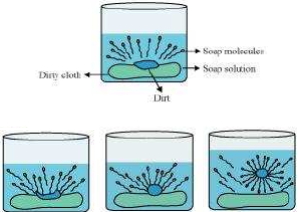
Explain the mechanism of the cleaning action of soaps.
Solution
(N/A) Cleansing action of soaps:
$1$. Soap molecules consist of two parts: a long hydrocarbon chain which is hydrophobic (water-repelling) and an ionic head which is hydrophilic (water-attracting).
$2$. When soap is dissolved in water,the hydrophobic ends attach themselves to the dirt particles,which are typically oily or greasy in nature.
$3$. The hydrophilic ends remain pointed outwards towards the water.
$4$. These molecules arrange themselves in a spherical structure called a 'micelle',with the dirt trapped at the center.
$5$. The negatively charged ionic heads create a repulsive force between micelles,preventing them from re-attaching to the cloth.
$6$. Finally,the dirt is rinsed away along with the water,leaving the cloth clean.
1 likes
View Solution7
EasyMCQ
The soap molecule has a
A
hydrophilic head and a hydrophobic tail
B
hydrophobic head and a hydrophilic tail
C
hydrophobic head and a hydrophobic tail
D
hydrophilic head and a hydrophilic tail
Solution
(A) soap molecule consists of two parts: a long hydrocarbon chain and an ionic end.
$1$. The ionic end is hydrophilic,meaning it is water-attracting (water-loving).
$2$. The long hydrocarbon chain is hydrophobic,meaning it is water-repelling (water-fearing).
Therefore,the soap molecule has a hydrophilic head and a hydrophobic tail.
$1$. The ionic end is hydrophilic,meaning it is water-attracting (water-loving).
$2$. The long hydrocarbon chain is hydrophobic,meaning it is water-repelling (water-fearing).
Therefore,the soap molecule has a hydrophilic head and a hydrophobic tail.
0 likes
View Solution8
MediumMCQ
In the soap micelles,
A
the ionic end of soap is in the interior of the cluster and the carbon chain is out of the cluster.
B
the ionic end of soap is on the surface of the cluster while the carbon chain is in the interior of the cluster.
C
both ionic end and carbon chain are in the interior of the cluster.
D
both ionic end and carbon chain are on the exterior of the cluster.
Solution
(B) Soap molecules are sodium or potassium salts of long-chain carboxylic acids.
Each soap molecule has two parts: a long hydrocarbon chain (hydrophobic tail) and an ionic head (hydrophilic head).
When soap is dissolved in water,the hydrophobic tails cluster together to avoid contact with water,forming the interior of the micelle.
The hydrophilic ionic heads face outward towards the water,forming the surface of the micelle.
Therefore,the ionic end is on the surface,and the carbon chain is in the interior of the cluster.
0 likes
View Solution9
MediumMCQ
Which of the following represents a saponification reaction?
A
$CH_3COONa + NaOH \xrightarrow{CaO} CH_4 + Na_2CO_3$
B
$CH_3COOH + C_2H_5OH \xrightarrow{H_2SO_4} CH_3COOC_2H_5 + H_2O$
C
$2CH_3COOH + 2Na \rightarrow 2CH_3COONa + H_2$
D
$CH_3COOC_2H_5 + NaOH \rightarrow CH_3COONa + C_2H_5OH$
Solution
(D) Saponification is the process of alkaline hydrolysis of an ester to produce a soap (carboxylate salt) and an alcohol.
In this reaction,an ester $(CH_3COOC_2H_5)$ reacts with a strong base $(NaOH)$ to form sodium acetate $(CH_3COONa)$ and ethanol $(C_2H_5OH)$.
Option $D$ correctly represents this reaction: $CH_3COOC_2H_5 + NaOH \rightarrow CH_3COONa + C_2H_5OH$.
In this reaction,an ester $(CH_3COOC_2H_5)$ reacts with a strong base $(NaOH)$ to form sodium acetate $(CH_3COONa)$ and ethanol $(C_2H_5OH)$.
Option $D$ correctly represents this reaction: $CH_3COOC_2H_5 + NaOH \rightarrow CH_3COONa + C_2H_5OH$.
0 likes
View Solution10
EasyMCQ
Why are detergents better cleansing agents than soaps? Explain.
A
Detergents are cheaper.
B
Detergents work effectively in both hard and soft water.
C
Detergents are biodegradable.
D
Detergents produce more foam.
Solution
(B) Detergents are considered better cleansing agents than soaps because they can function effectively in both hard and soft water.
Soaps react with calcium $(Ca^{2+})$ and magnesium $(Mg^{2+})$ ions present in hard water to form insoluble precipitates known as scum,which reduces their cleaning efficiency.
In contrast,the charged ends of detergent molecules do not form insoluble precipitates with these ions,allowing them to maintain their cleansing action even in hard water.
0 likes
View Solution11
Medium
What is saponification? Write the reaction involved in this process.
Solution
(N/A) Saponification is the chemical process of converting an ester into a soap (a salt of a carboxylic acid) and an alcohol by treating it with an alkali like sodium hydroxide $(NaOH)$.
The general reaction is:
$CH_3COOC_2H_5 + NaOH \rightarrow CH_3COONa + C_2H_5OH$
(Ethyl acetate + Sodium hydroxide $\rightarrow$ Sodium acetate + Ethanol)
The general reaction is:
$CH_3COOC_2H_5 + NaOH \rightarrow CH_3COONa + C_2H_5OH$
(Ethyl acetate + Sodium hydroxide $\rightarrow$ Sodium acetate + Ethanol)
0 likes
View Solution12
EasyMCQ
Will micelle formation take place when soap is dissolved in an organic solvent?
A
Yes,it will form.
B
No,it will not form.
C
It depends on the temperature.
D
It depends on the concentration of soap.
Solution
(B) Micelle formation will not take place when soap is dissolved in an organic solvent.
Soap molecules consist of a hydrophobic hydrocarbon tail and a hydrophilic ionic head.
In an aqueous solution,the hydrophobic tails aggregate to avoid water,while the hydrophilic heads interact with water,leading to micelle formation.
In an organic solvent,the hydrophobic tails are soluble,so there is no driving force for the molecules to aggregate into a micelle structure.
0 likes
View Solution13
Easy
Explain why washing clothes with hard water is not effective.
Solution
(N/A) Hard water contains dissolved salts of calcium $(Ca^{2+})$ and magnesium $(Mg^{2+})$ ions. When soap is added to hard water,these ions react with the soap molecules to form an insoluble precipitate known as scum. Because the soap is consumed in forming this scum,it is unable to form a lather with the water,which is necessary for cleaning clothes. Consequently,a large amount of soap is wasted,and the cleaning process becomes ineffective.
0 likes
View Solution14
EasyMCQ
How is scum formed?
A
By the reaction of soap with soft water.
B
By the reaction of soap with hard water containing calcium and magnesium salts.
C
By the reaction of detergent with distilled water.
D
By the reaction of soap with oil and grease.
Solution
(B) When soap reacts with hard water,the minerals present in the water,specifically calcium and magnesium ions,react with the soap molecules.
This reaction results in the formation of an insoluble white curdy precipitate known as scum.
Because the soap is consumed in forming this scum,it significantly reduces the cleaning efficiency of the soap.
This reaction results in the formation of an insoluble white curdy precipitate known as scum.
Because the soap is consumed in forming this scum,it significantly reduces the cleaning efficiency of the soap.
0 likes
View Solution15
Medium
Why are detergents preferred over soaps for washing clothes in hard water? Explain.
Solution
(N/A) Detergents are preferred over soaps for washing clothes in hard water because:
$(i)$ They do not form insoluble precipitates (scum) with calcium and magnesium ions present in hard water.
$(ii)$ They are effective in both soft and hard water and produce more lather.
$(iii)$ They have a stronger cleansing action compared to soaps.
$(i)$ They do not form insoluble precipitates (scum) with calcium and magnesium ions present in hard water.
$(ii)$ They are effective in both soft and hard water and produce more lather.
$(iii)$ They have a stronger cleansing action compared to soaps.
0 likes
View Solution16
Easy
What are soaps? Why do they form scum with hard water?
Solution
(N/A) Soaps are defined as the sodium or potassium salts of long-chain carboxylic acids (higher fatty acids).
When soap is added to hard water,the calcium $(Ca^{2+})$ and magnesium $(Mg^{2+})$ ions present in the water react with the soap molecules.
This reaction results in the formation of insoluble precipitates known as scum (calcium or magnesium stearate).
Because these insoluble salts do not dissolve,they interfere with the cleaning action of soap and form a sticky residue.
0 likes
View Solution17
Medium
$(a)$ Soaps cannot be used with hard water. Why?
$(b)$ Give the chemical composition of detergents.
$(c)$ Give one advantage of detergents over soaps.
$(b)$ Give the chemical composition of detergents.
$(c)$ Give one advantage of detergents over soaps.
Solution
(N/A) Hard water contains calcium $(Ca^{2+})$ and magnesium $(Mg^{2+})$ salts. These ions react with soap molecules to form an insoluble substance known as scum,which prevents the soap from forming a lather.
$(b)$ Detergents are generally the ammonium or sulphonate salts of long-chain carboxylic acids.
$(c)$ The main advantage is that detergents do not form insoluble precipitates (scum) with the calcium and magnesium ions present in hard water,allowing them to remain effective for cleaning even in hard water.
0 likes
View Solution18
Medium
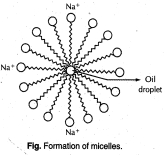
With the help of a diagram,explain the cleansing action of soap.
Solution
(N/A) soap molecule consists of two parts: a long hydrocarbon chain which is hydrophobic (water-repelling) and an ionic head which is hydrophilic (water-attracting).
When soap is dissolved in water,the hydrophobic tails attach themselves to the oil or dirt particles,while the hydrophilic heads point outwards into the water.
This arrangement forms a spherical structure known as a micelle.
The hydrophobic tails trap the oil droplet in the center,and the hydrophilic heads,being negatively charged,repel each other,keeping the dirt suspended in the water as an emulsion.
This allows the dirt to be easily rinsed away from the clothes during washing.
0 likes
View Solution19
Difficult
Both soap and detergent are some type of salts. What is the difference between them? Describe in brief the cleansing action of soap. Why do soaps not form lather in hard water? List two problems that arise due to the use of detergents instead of soaps.
Solution
(A) Soaps are $Na^+$ or $K^+$ salts of long-chain carboxylic acids.
Detergents are ammonium or sulphonate salts of long-chain hydrocarbons.
Cleansing action of soap: $A$ soap molecule has two parts: a hydrophilic (water-loving) ionic head and a hydrophobic (water-repelling) hydrocarbon tail. The tail attaches to oily dirt,while the head remains in water. This forms a structure called a $micelle$. When rinsed,the $micelle$ is washed away,carrying the dirt with it.
Soaps do not form lather in hard water because they react with $Ca^{2+}$ and $Mg^{2+}$ ions present in hard water to form an insoluble precipitate known as $scum$.
Problems due to the use of detergents:
$1$. Most detergents are non-biodegradable,leading to water and soil pollution.
$2$. They can cause skin irritation or allergic reactions in some individuals.
0 likes
View Solution20
Medium
$(a)$ Differentiate between soap and detergent.
$(b)$ Explain why soaps form scum with hard water,whereas detergents do not.
$(b)$ Explain why soaps form scum with hard water,whereas detergents do not.
Solution
(N/A)
$(b)$ Hard water contains $Ca^{2+}$ and $Mg^{2+}$ ions. These ions react with the long-chain fatty acid part of the soap to form insoluble precipitates known as scum,which hinders the cleaning process. Detergents,however,form soluble salts with these ions,so they do not form scum and work effectively in hard water.
Chemical reaction: $2C_{17}H_{35}COONa + Ca^{2+} (Mg^{2+}) \longrightarrow (C_{17}H_{35}COO)_{2}Ca (Mg) + 2Na^{+}$
| $Soaps$ | $Detergents$ |
|---|---|
| $(i)$ $Soaps$ are sodium or potassium salts of long-chain carboxylic acids. | $(i)$ $Detergents$ are ammonium or sulphonate salts of long-chain carboxylic acids. |
| $(ii)$ $Soaps$ have lesser cleansing action compared to detergents. | $(ii)$ $Detergents$ have better cleansing action compared to soaps. |
| $(iii)$ $Soaps$ are made from animal or plant fats. | $(iii)$ $Detergents$ are made from petrochemicals. |
| $(iv)$ $Soaps$ are biodegradable. | $(iv)$ $Detergents$ are generally non-biodegradable. |
$(b)$ Hard water contains $Ca^{2+}$ and $Mg^{2+}$ ions. These ions react with the long-chain fatty acid part of the soap to form insoluble precipitates known as scum,which hinders the cleaning process. Detergents,however,form soluble salts with these ions,so they do not form scum and work effectively in hard water.
Chemical reaction: $2C_{17}H_{35}COONa + Ca^{2+} (Mg^{2+}) \longrightarrow (C_{17}H_{35}COO)_{2}Ca (Mg) + 2Na^{+}$
0 likes
View Solution21
Medium
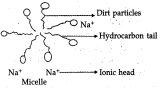
What are soaps chemically? How do they differ from synthetic detergents? Explain the mechanism and the cleansing action of soap.
Solution
(N/A) Chemical Nature: Soaps are the sodium or potassium salts of long-chain fatty acids (e.g.,stearic acid).
Difference from Synthetic Detergents: Soaps are effective only in soft water and form scum in hard water. Synthetic detergents are ammonium or sulphonate salts of long-chain carboxylic acids and are effective in both soft and hard water.
Cleansing Action (Micelle Formation): Soap molecules have two parts: a hydrophilic ionic head and a hydrophobic hydrocarbon tail.
When soap is dissolved in water,the hydrophobic tails attach to the dirt (oil/grease) particles,while the hydrophilic heads remain in the water.
This forms a spherical structure called a micelle,with the dirt trapped in the center.
The ionic heads on the surface of the micelle repel each other due to like charges,keeping the micelles suspended in water as a colloid,which is then washed away with the water.
0 likes
View Solution22
Medium
$(a)$ Why is hard water not suitable for washing clothes with soap?
$(b)$ Why does micelle formation take place when soap is added to water?
$(c)$ What is saponification?
$(b)$ Why does micelle formation take place when soap is added to water?
$(c)$ What is saponification?
Solution
(N/A) Hard water contains dissolved salts of calcium and magnesium. When soap is added to hard water,it reacts with these ions to form an insoluble precipitate known as scum. This prevents the formation of lather,making it ineffective for cleaning.
$(b)$ Soap molecules have a dual nature: a hydrophilic (water-loving) head and a hydrophobic (water-repelling) hydrocarbon tail. When added to water,the hydrophobic tails cluster together to avoid water,while the hydrophilic heads face outward toward the water,resulting in the formation of spherical structures called micelles.
$(c)$ Saponification is the chemical process in which an ester is reacted with an alkali (like sodium hydroxide) to produce soap (a salt of a fatty acid) and alcohol (glycerol).
0 likes
View Solution23
Medium
Why is hard water not suitable for washing clothes with soap?
Solution
(N/A) Hard water contains dissolved salts of calcium and magnesium,specifically their bicarbonates,chlorides,and sulphates. When soap (which consists of sodium or potassium salts of long-chain fatty acids) is added to hard water,these calcium and magnesium ions react with the soap molecules to form insoluble precipitates known as scum. Because the soap molecules are consumed in this chemical reaction to form scum,they are no longer available to form micelles and perform the cleansing action on clothes.
0 likes
View Solution24
Easy
State whether the following statement is true or false:
Scum is formed due to the reaction of soap with calcium and magnesium salts present in hard water.
Scum is formed due to the reaction of soap with calcium and magnesium salts present in hard water.
Solution
(TRUE) The statement is True.
Soap consists of sodium or potassium salts of long-chain fatty acids.
When soap is added to hard water,which contains dissolved calcium $(Ca^{2+})$ and magnesium $(Mg^{2+})$ ions,these ions react with the soap molecules.
This reaction leads to the formation of an insoluble precipitate known as scum (or curd),which makes it difficult for soap to form a lather.
0 likes
View Solution25
EasyMCQ
What is the reaction to form soap known as?
A
Esterification
B
Saponification
C
Polymerisation
D
Hydrogenation
Solution
(B) The reaction used to form soap is known as $Saponification$. In this process, fats or oils (esters of fatty acids and glycerol) are heated with a strong base like $NaOH$ or $KOH$. This reaction results in the formation of soap (sodium or potassium salts of fatty acids) and glycerol. The general equation is: $\text{Fat/Oil} + \text{NaOH} \rightarrow \text{Soap} + \text{Glycerol}$.
0 likes
View Solution26
EasyMCQ
Which functional group is attached to the hydrocarbon chain in soap?
A
$-CONH_{2}$
B
$-COOCH_{3}$
C
$-SO_{3}Na$
D
$-COONa$
Solution
(D) Soap is chemically defined as the sodium or potassium salt of long-chain fatty acids.
These fatty acids consist of a long hydrocarbon chain (hydrophobic tail) attached to a carboxylate group (hydrophilic head).
The general formula for soap is $R-COONa$,where $R$ represents a long-chain hydrocarbon group (typically $C_{15}H_{31}$ or $C_{17}H_{35}$).
Therefore,the functional group attached to the hydrocarbon chain in soap is the carboxylate group,represented as $-COONa$.
0 likes
View Solution27
EasyMCQ
Which functional group is present in the hydrocarbon chain of a detergent?
A
$-SO_{3}Na$
B
$-CO_{3}Na$
C
$-COONa$
D
$-COOH$
Solution
(A) Detergents are ammonium or sulphonate salts of long-chain carboxylic acids.
Specifically,the most common detergents are sodium salts of long-chain benzene sulphonic acids.
The functional group present in the hydrocarbon chain of a detergent is the sulphonate group,represented as $-SO_{3}Na$.
Therefore,the correct option is $A$.
Specifically,the most common detergents are sodium salts of long-chain benzene sulphonic acids.
The functional group present in the hydrocarbon chain of a detergent is the sulphonate group,represented as $-SO_{3}Na$.
Therefore,the correct option is $A$.
0 likes
View SolutionCarbon and its Compounds — Soaps and Detergents · Frequently Asked Questions
1Are these Carbon and its Compounds questions useful for JEE and NEET?
Yes. All questions in this section are mapped to JEE Main and NEET exam patterns. Previous year questions from JEE Main, NEET, GUJCET and state-level exams are included with full solutions.
2Can I switch to Hindi or Gujarati for these questions?
Yes. Use the language tabs in the hero section or the sidebar to view the same questions and solutions in English, Hindi or Gujarati.
3How do I generate a question paper from this subtopic?
Use the Vedclass Exam Paper Generator — select the chapter and subtopic, set difficulty, and generate Sets A, B, C, D automatically. First 3 chapters of every subject are free.
Vedclass Products
For Students
Vedclass Test Series
Mock tests in real JEE/NEET style with performance analysis. 5-day free trial.
Start Free TrialFor Teachers
Exam Paper Generator
Generate Set A/B/C/D papers from this chapter in 2 minutes. 3 chapters free.
Try FreeFor Institutes
Online Exam Module
Live online exams with unlimited students, 360° analytics & white-label branding.
See DemoFor Teachers & Institutes
Generate a Carbon and its Compounds Exam Paper in 2 Minutes
Select subtopic & difficulty — Sets A, B, C, D auto-generated with No Repeat logic.
First 3 chapters of every subject are free — no payment required.