
A English
Versatile Nature of Carbon (Hydrocarbons, Functional Groups, Homologous Series, Nomenclature) Questions in English
Class 10 Science · Carbon and its Compounds · Versatile Nature of Carbon (Hydrocarbons, Functional Groups, Homologous Series, Nomenclature)
92+
Questions
English
Language
100%
With Solutions
Showing 50 of 92 questions in English
1
MediumMCQ
How many structural isomers can you draw for pentane?
A
$2$
B
$3$
C
$4$
D
$5$
Solution
(B) Three structural isomers are possible for pentane $(C_{5}H_{12})$:
$(i)$ $n$-pentane: $CH_{3}-CH_{2}-CH_{2}-CH_{2}-CH_{3}$
$(ii)$ Isopentane ($2$-methylbutane): $CH_{3}-CH(CH_{3})-CH_{2}-CH_{3}$
$(iii)$ Neopentane ($2$,$2$-dimethylpropane): $C(CH_{3})_{4}$
$(i)$ $n$-pentane: $CH_{3}-CH_{2}-CH_{2}-CH_{2}-CH_{3}$
$(ii)$ Isopentane ($2$-methylbutane): $CH_{3}-CH(CH_{3})-CH_{2}-CH_{3}$
$(iii)$ Neopentane ($2$,$2$-dimethylpropane): $C(CH_{3})_{4}$
0 likes
View Solution2
MediumMCQ
What are the two properties of carbon which lead to the huge number of carbon compounds we see around us?
A
Catenation and Tetravalency
B
Isomerism and Allotropy
C
Electronegativity and Ionization
D
Hybridization and Polarity
Solution
(A) The two unique properties of carbon that lead to the formation of a vast number of carbon compounds are:
$(i)$ Catenation: It is the unique ability of carbon atoms to form strong covalent bonds with other carbon atoms,resulting in the formation of long chains,branched chains,or ring structures.
$(ii)$ Tetravalency: Carbon has a valency of $4$,which allows it to form covalent bonds with four other atoms of carbon or atoms of other monovalent elements like hydrogen,oxygen,nitrogen,or halogens.
0 likes
View Solution3
Medium
Draw the structures for the following compounds:
$(i)$ Butanone
$(ii)$ Hexanal
$(i)$ Butanone
$(ii)$ Hexanal
Solution
(N/A) $(i)$ Butanone: $CH_{3}CH_{2}COCH_{3}$
Structure: $CH_{3}-CH_{2}-C(=O)-CH_{3}$
$(ii)$ Hexanal: $CH_{3}CH_{2}CH_{2}CH_{2}CH_{2}CHO$
Structure: $CH_{3}-CH_{2}-CH_{2}-CH_{2}-CH_{2}-CHO$
Structure: $CH_{3}-CH_{2}-C(=O)-CH_{3}$
$(ii)$ Hexanal: $CH_{3}CH_{2}CH_{2}CH_{2}CH_{2}CHO$
Structure: $CH_{3}-CH_{2}-CH_{2}-CH_{2}-CH_{2}-CHO$
0 likes
View Solution4
EasyMCQ
Butanone is a four-carbon compound with the functional group
A
carboxylic acid.
B
aldehyde.
C
ketone.
D
alcohol.
Solution
(C) Butanone is a $4$-carbon ketone with the chemical formula $CH_3COCH_2CH_3$.
The suffix '-one' in the name 'butanone' indicates the presence of a ketone functional group $(>C=O)$.
The suffix '-one' in the name 'butanone' indicates the presence of a ketone functional group $(>C=O)$.
0 likes
View Solution5
Medium
What is a homologous series? Explain with an example.
Solution
(N/A) homologous series is a group of organic compounds that have the same functional group and similar chemical properties,and in which successive members differ by a $-CH_2$ unit.
For example,the alkane series is a homologous series with the general formula $C_nH_{2n+2}$.
$1$. Methane: $CH_4$
$2$. Ethane: $C_2H_6$ (or $CH_3CH_3$)
$3$. Propane: $C_3H_8$ (or $CH_3CH_2CH_3$)
$4$. Butane: $C_4H_{10}$ (or $CH_3CH_2CH_2CH_3$)
In this series,each successive member differs by a $-CH_2$ group,which corresponds to a molecular mass difference of $14 \ u$.
0 likes
View Solution6
MediumMCQ
How would you name the following compounds?
$(i)$ $CH_3-CH_2-Br$
$(ii)$ $H-CHO$
$(iii)$ $CH_3-CH_2-CH_2-CH_2-C \equiv CH$
$(i)$ $CH_3-CH_2-Br$
$(ii)$ $H-CHO$
$(iii)$ $CH_3-CH_2-CH_2-CH_2-C \equiv CH$
A
Bromoethane,Methanal,Hex$-1-$yne
B
Bromoethane,Ethanal,Hex$-1-$yne
C
Chloroethane,Methanal,Hex$-1-$yne
D
Bromoethane,Methanal,Hex$-2-$yne
Solution
(A) The $IUPAC$ naming rules are applied as follows:
$(i)$ $CH_3-CH_2-Br$: This is a two-carbon chain with a bromine substituent. The prefix for bromine is 'bromo' and the alkane is 'ethane'. Thus,it is named Bromoethane.
$(ii)$ $H-CHO$: This is a one-carbon aldehyde. The prefix for one carbon is 'meth-' and the suffix for aldehyde is '-al'. Thus,it is named Methanal.
$(iii)$ $CH_3-CH_2-CH_2-CH_2-C \equiv CH$: This is a six-carbon chain with a triple bond at the first position. The prefix for six carbons is 'hex-' and the suffix for an alkyne is '-yne'. Since the triple bond starts at the first carbon,it is named Hex$-1-$yne.
0 likes
View Solution7
MediumMCQ
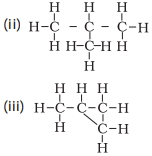
Which of the following are correct structural isomers of butane $(C_4H_{10})$?
$(i)$ $n$-butane: $CH_3-CH_2-CH_2-CH_3$
(ii) Isobutane ($2$-methylpropane): $CH_3-CH(CH_3)-CH_3$
(iii) Cyclobutane: $A$ four-carbon ring structure $(C_4H_8)$
(iv) Ethane dimer: Not a valid isomer of butane.
$(i)$ $n$-butane: $CH_3-CH_2-CH_2-CH_3$
(ii) Isobutane ($2$-methylpropane): $CH_3-CH(CH_3)-CH_3$
(iii) Cyclobutane: $A$ four-carbon ring structure $(C_4H_8)$
(iv) Ethane dimer: Not a valid isomer of butane.
A
$(i)$ and $(ii)$
B
$(ii)$ and $(iv)$
C
$(i)$ and $(iii)$
D
$(iii)$ and $(iv)$
Solution
(A) Butane has the molecular formula $C_4H_{10}$.
Structural isomers are compounds with the same molecular formula but different structural arrangements.
$(i)$ $n$-butane is a straight-chain isomer of butane $(C_4H_{10})$.
(ii) Isobutane ($2$-methylpropane) is a branched-chain isomer of butane $(C_4H_{10})$.
(iii) Cyclobutane has the formula $C_4H_8$,so it is not an isomer of butane.
(iv) The structure shown is not a valid isomer of butane.
Therefore,$(i)$ and $(ii)$ are the correct structural isomers of butane.
0 likes
View Solution8
EasyMCQ
In which of the following compounds,$-OH$ is the functional group?
A
Butanone
B
Butanal
C
Butanoic acid
D
Butanol
Solution
(D) The functional group $-OH$ represents an alcohol.
In the given options:
$1$. Butanone is a ketone with the functional group $C=O$.
$2$. Butanal is an aldehyde with the functional group $-CHO$.
$3$. Butanoic acid is a carboxylic acid with the functional group $-COOH$.
$4$. Butanol is an alcohol with the functional group $-OH$.
Therefore,the correct option is $D$.
0 likes
View Solution9
MediumMCQ
The structural formula of ethyne is:
A
$H_2C=CH_2$
B
$CH_3-C\equiv CH$
C
$H-C\equiv C-H$
D
$C_2H_6$
Solution
(C) Ethyne,also known as acetylene,is the simplest alkyne with the chemical formula $C_2H_2$.
It consists of two carbon atoms connected by a triple bond,with each carbon atom bonded to one hydrogen atom.
The structural formula is represented as $H-C\equiv C-H$.
It consists of two carbon atoms connected by a triple bond,with each carbon atom bonded to one hydrogen atom.
The structural formula is represented as $H-C\equiv C-H$.
0 likes
View Solution10
MediumMCQ
Identify the unsaturated compounds from the following:
$(i)$ Propane
$(ii)$ Propene
$(iii)$ Propyne
$(iv)$ Chloropropane
$(i)$ Propane
$(ii)$ Propene
$(iii)$ Propyne
$(iv)$ Chloropropane
A
$(i)$ and $(ii)$
B
$(ii)$ and $(iv)$
C
$(iii)$ and $(iv)$
D
$(ii)$ and $(iii)$
Solution
(D) Unsaturated compounds are those hydrocarbons that contain at least one carbon-carbon double bond $(C=C)$ or triple bond $(C≡C)$.
$(i)$ Propane $(C_3H_8)$ is an alkane,which is a saturated hydrocarbon.
$(ii)$ Propene $(C_3H_6)$ contains a double bond,making it an unsaturated hydrocarbon.
$(iii)$ Propyne $(C_3H_4)$ contains a triple bond,making it an unsaturated hydrocarbon.
$(iv)$ Chloropropane $(C_3H_7Cl)$ is a substituted alkane,which is saturated.
Therefore,$(ii)$ and $(iii)$ are unsaturated compounds.
0 likes
View Solution11
MediumMCQ
Which of the following is not a straight chain hydrocarbon?
A
$CH_3-CH_2-CH_2-CH_2-CH_2-CH_3$ (represented as a branched structure)
B
$CH_3-CH_2-CH_2-CH_2-CH_2-CH_3$
C
$(CH_3)_2CH-CH_2-CH_2-CH_3$
D
$CH_3-CH_2-CH_2-CH_2-CH_2-CH_3$ (represented as a branched structure)
Solution
(C) straight chain hydrocarbon is one where carbon atoms are linked in a single continuous line without any side chains or branches.
Option $B$ represents $n$-hexane,which is a straight chain.
Option $A$ is $CH_3-CH_2-CH_2-CH_2-CH_2-CH_3$,which is $n$-hexane (straight chain).
Option $C$ is $2$-methylpentane,which has a methyl group attached to the second carbon,making it a branched chain hydrocarbon.
Option $D$ is also a representation of a straight chain hydrocarbon.
Therefore,option $C$ is the correct answer as it is a branched chain hydrocarbon.
0 likes
View Solution12
MediumMCQ
Which among the following are unsaturated hydrocarbons?
$(i) H_3C - CH_2 - CH_2 - CH_3$
$(ii) H_3C - C \equiv C - CH_3$
$(iii) H_3C - CH(CH_3) - CH_3$
$(iv) H_3C - C(CH_3) = CH_2$
$(i) H_3C - CH_2 - CH_2 - CH_3$
$(ii) H_3C - C \equiv C - CH_3$
$(iii) H_3C - CH(CH_3) - CH_3$
$(iv) H_3C - C(CH_3) = CH_2$
A
$(i)$ and $(iii)$
B
$(ii)$ and $(iii)$
C
$(iii)$ and $(iv)$
D
$(ii)$ and $(iv)$
Solution
(D) Unsaturated hydrocarbons are those that contain at least one carbon-carbon double bond $(C=C)$ or triple bond $(C \equiv C)$.
$(i) H_3C - CH_2 - CH_2 - CH_3$ is Butane,a saturated hydrocarbon (alkane).
$(ii) H_3C - C \equiv C - CH_3$ is But$-2-$yne,which contains a carbon-carbon triple bond,making it unsaturated.
$(iii) H_3C - CH(CH_3) - CH_3$ is Isobutane ($2$-methylpropane),a saturated hydrocarbon (alkane).
$(iv) H_3C - C(CH_3) = CH_2$ is $2-$methylpropene,which contains a carbon-carbon double bond,making it unsaturated.
Therefore,$(ii)$ and $(iv)$ are unsaturated hydrocarbons.
0 likes
View Solution13
MediumMCQ
Which of the following does not belong to the same homologous series?
A
$C_4H_8$
B
$C_2H_6$
C
$C_3H_8$
D
$CH_4$
Solution
(A) homologous series is a group of organic compounds having the same functional group and similar chemical properties,where each successive member differs by a $CH_2$ unit.
Compounds with the general formula $C_nH_{2n+2}$ belong to the alkane series.
Checking the given options:
$B) C_2H_6$ follows $C_nH_{2n+2}$ ($n=2$,$2(2)+2=6$).
$C) C_3H_8$ follows $C_nH_{2n+2}$ ($n=3$,$2(3)+2=8$).
$D) CH_4$ follows $C_nH_{2n+2}$ ($n=1$,$2(1)+2=4$).
$A) C_4H_8$ follows the general formula $C_nH_{2n}$,which represents the alkene series.
Therefore,$C_4H_8$ does not belong to the same homologous series as the others.
0 likes
View Solution14
MediumMCQ
The name of the compound $CH_{3}-CH_{2}-CHO$ is
A
Propanone
B
Propanal
C
Ethanol
D
Ethanal
Solution
(B) The given compound is $CH_{3}-CH_{2}-CHO$.
This molecule contains a chain of $3$ carbon atoms.
The functional group present is the aldehyde group $(-CHO)$.
For an aldehyde with $3$ carbon atoms,the parent alkane is propane.
Replacing the terminal '$e$' of propane with '$al$' gives the name propanal.
Therefore,the correct name is propanal.
This molecule contains a chain of $3$ carbon atoms.
The functional group present is the aldehyde group $(-CHO)$.
For an aldehyde with $3$ carbon atoms,the parent alkane is propane.
Replacing the terminal '$e$' of propane with '$al$' gives the name propanal.
Therefore,the correct name is propanal.
0 likes
View Solution15
MediumMCQ
Which of the following are the heteroatoms present in $CH_{3}-CH_{2}-O-CH_{2}-CH_{2}Cl$?
$(i)$ Oxygen
$(ii)$ Carbon
$(iii)$ Hydrogen
$(iv)$ Chlorine
$(i)$ Oxygen
$(ii)$ Carbon
$(iii)$ Hydrogen
$(iv)$ Chlorine
A
$(i)$ and $(ii)$
B
$(ii)$ and $(iii)$
C
$(i)$ and $(iv)$
D
$(iii)$ and $(iv)$
Solution
(C) In organic chemistry,atoms other than carbon and hydrogen present in a molecule are known as heteroatoms.
In the given compound $CH_{3}-CH_{2}-O-CH_{2}-CH_{2}Cl$:
$1$. Carbon $(C)$ and Hydrogen $(H)$ are the basic elements forming the hydrocarbon chain.
$2$. Oxygen $(O)$ and Chlorine $(Cl)$ are atoms other than carbon and hydrogen.
Therefore,Oxygen and Chlorine are the heteroatoms present in the molecule.
Thus,the correct option is $(i)$ and $(iv)$.
0 likes
View Solution16
EasyMCQ
The first member of the alkyne homologous series is:
A
Ethyne
B
Ethene
C
Propyne
D
Methane
Solution
(A) The general formula for the alkyne homologous series is $C_nH_{2n-2}$,where $n$ is the number of carbon atoms.
For the first member,we set $n = 2$ because a triple bond requires at least two carbon atoms.
Substituting $n = 2$ into the formula: $C_2H_{2(2)-2} = C_2H_2$.
$C_2H_2$ is known as ethyne (also called acetylene).
Therefore,the first member of the alkyne series is ethyne.
For the first member,we set $n = 2$ because a triple bond requires at least two carbon atoms.
Substituting $n = 2$ into the formula: $C_2H_{2(2)-2} = C_2H_2$.
$C_2H_2$ is known as ethyne (also called acetylene).
Therefore,the first member of the alkyne series is ethyne.
0 likes
View Solution17
MediumMCQ
Write the names of the following compounds:
$(a)$ $CH_3-CH_2-CH_2-CH_2-COOH$
$(b)$ $CH_3-CH_2-C \equiv CH$
$(a)$ $CH_3-CH_2-CH_2-CH_2-COOH$
$(b)$ $CH_3-CH_2-C \equiv CH$
A
$(a)$ Pentanone,$(b)$ Butine
B
$(a)$ Pentanone,$(b)$ Butyne
C
$(a)$ Pentanoic acid,$(b)$ Butyne
D
$(a)$ Pentanoic acid,$(b)$ Butene
Solution
(C) The compound $CH_3-CH_2-CH_2-CH_2-COOH$ contains $5$ carbon atoms in the main chain and a carboxylic acid functional group $(-COOH)$. Therefore,its $IUPAC$ name is Pentanoic acid.
$(b)$ The compound $CH_3-CH_2-C \equiv CH$ contains $4$ carbon atoms in the main chain and a triple bond between the $3^{rd}$ and $4^{th}$ carbon atoms. Therefore,its $IUPAC$ name is But$-1-$yne or simply Butyne.
$(b)$ The compound $CH_3-CH_2-C \equiv CH$ contains $4$ carbon atoms in the main chain and a triple bond between the $3^{rd}$ and $4^{th}$ carbon atoms. Therefore,its $IUPAC$ name is But$-1-$yne or simply Butyne.
0 likes
View Solution18
MediumMCQ
Write the $IUPAC$ names of the following compounds:
$(a)$ $CH_3-CH_2-CH_2-CH_2-CH_2-CH_2-CHO$
$(b)$ $CH_3-CH_2-CH_2-CH_2-CH_2-OH$
$(a)$ $CH_3-CH_2-CH_2-CH_2-CH_2-CH_2-CHO$
$(b)$ $CH_3-CH_2-CH_2-CH_2-CH_2-OH$
A
$(a)$ Heptanone,$(b)$ Pentenal
B
$(a)$ Heptanal,$(b)$ Pentenal
C
$(a)$ Heptanol,$(b)$ Pentanol
D
$(a)$ Heptanal,$(b)$ Pentanol
Solution
(D) The given structure is $CH_3-CH_2-CH_2-CH_2-CH_2-CH_2-CHO$. It contains $7$ carbon atoms and an aldehyde functional group $(-CHO)$. Therefore,the $IUPAC$ name is Heptanal.
$(b)$ The given structure is $CH_3-CH_2-CH_2-CH_2-CH_2-OH$. It contains $5$ carbon atoms and an alcohol functional group $(-OH)$. Therefore,the $IUPAC$ name is Pentanol.
$(b)$ The given structure is $CH_3-CH_2-CH_2-CH_2-CH_2-OH$. It contains $5$ carbon atoms and an alcohol functional group $(-OH)$. Therefore,the $IUPAC$ name is Pentanol.
0 likes
View Solution19
MediumMCQ
Identify and name the functional groups present in the following compounds:
$(a)$ $CH_3-CH_2-CH_2-OH$
$(b)$ $CH_3-CH_2-COOH$
$(a)$ $CH_3-CH_2-CH_2-OH$
$(b)$ $CH_3-CH_2-COOH$
A
Alcohol and Carboxylic acid
B
Aldehyde and Ketone
C
Ether and Ester
D
Amine and Amide
Solution
(A) The structure $CH_3-CH_2-CH_2-OH$ contains the $-OH$ group,which is the functional group for alcohols. Therefore,it is an alcohol (propanol).
$(b)$ The structure $CH_3-CH_2-COOH$ contains the $-COOH$ group,which is the functional group for carboxylic acids. Therefore,it is a carboxylic acid (propanoic acid).
$(b)$ The structure $CH_3-CH_2-COOH$ contains the $-COOH$ group,which is the functional group for carboxylic acids. Therefore,it is a carboxylic acid (propanoic acid).
0 likes
View Solution20
Medium
Identify and name the functional groups present in the following compounds.
$(a)$ $CH_3-CO-CH_2-CH_3$
$(b)$ $CH_3-CH_2-CH=CH_2$
$(a)$ $CH_3-CO-CH_2-CH_3$
$(b)$ $CH_3-CH_2-CH=CH_2$
Solution
(A) The structure $CH_3-CO-CH_2-CH_3$ contains a carbonyl group bonded to two carbon atoms,which is characteristic of a $\text{Ketone}$ functional group.
$(b)$ The structure $CH_3-CH_2-CH=CH_2$ contains a carbon-carbon double bond,which is characteristic of an $\text{Alkene}$ functional group.
$(b)$ The structure $CH_3-CH_2-CH=CH_2$ contains a carbon-carbon double bond,which is characteristic of an $\text{Alkene}$ functional group.
0 likes
View Solution21
Medium
Identify the functional groups present in the following compounds:
$(a) CH_3COCH_2CH_2CH_2CH_3$
$(b) CH_3CH_2CH_2COOH$
$(c) CH_3CH_2CH_2CH_2CHO$
$(d) CH_3CH_2OH$
$(a) CH_3COCH_2CH_2CH_2CH_3$
$(b) CH_3CH_2CH_2COOH$
$(c) CH_3CH_2CH_2CH_2CHO$
$(d) CH_3CH_2OH$
Solution
(A) $(a) CH_3COCH_2CH_2CH_2CH_3$ contains a ketone group $(-CO-)$.
$(b) CH_3CH_2CH_2COOH$ contains a carboxylic acid group $(-COOH)$.
$(c) CH_3CH_2CH_2CH_2CHO$ contains an aldehyde group $(-CHO)$.
$(d) CH_3CH_2OH$ contains an alcohol group $(-OH)$.
$(b) CH_3CH_2CH_2COOH$ contains a carboxylic acid group $(-COOH)$.
$(c) CH_3CH_2CH_2CH_2CHO$ contains an aldehyde group $(-CHO)$.
$(d) CH_3CH_2OH$ contains an alcohol group $(-OH)$.
0 likes
View Solution22
Medium
Write the structural formulae of all the isomers of hexane $(C_6H_{14})$.
Solution
(N/A) Hexane $(C_6H_{14})$ has five structural isomers:
$(a)$ $n$-Hexane: $CH_3-CH_2-CH_2-CH_2-CH_2-CH_3$
$(b)$ $2$-Methylpentane: $CH_3-CH(CH_3)-CH_2-CH_2-CH_3$
$(c)$ $3$-Methylpentane: $CH_3-CH_2-CH(CH_3)-CH_2-CH_3$
$(d)$ $2,2$-Dimethylbutane: $CH_3-C(CH_3)_2-CH_2-CH_3$
$(e)$ $2,3$-Dimethylbutane: $CH_3-CH(CH_3)-CH(CH_3)-CH_3$
$(a)$ $n$-Hexane: $CH_3-CH_2-CH_2-CH_2-CH_2-CH_3$
$(b)$ $2$-Methylpentane: $CH_3-CH(CH_3)-CH_2-CH_2-CH_3$
$(c)$ $3$-Methylpentane: $CH_3-CH_2-CH(CH_3)-CH_2-CH_3$
$(d)$ $2,2$-Dimethylbutane: $CH_3-C(CH_3)_2-CH_2-CH_3$
$(e)$ $2,3$-Dimethylbutane: $CH_3-CH(CH_3)-CH(CH_3)-CH_3$
0 likes
View Solution23
Easy
What are hydrocarbons? Give examples.
Solution
(N/A) Hydrocarbons are organic compounds consisting entirely of carbon and hydrogen atoms. They serve as the fundamental building blocks of organic chemistry.
Examples include:
$1$. Methane $(CH_4)$
$2$. Ethane $(C_2H_6)$
$3$. Propane $(C_3H_8)$
Examples include:
$1$. Methane $(CH_4)$
$2$. Ethane $(C_2H_6)$
$3$. Propane $(C_3H_8)$
0 likes
View Solution24
Medium
Give the structural differences between saturated and unsaturated hydrocarbons with two examples each.
Solution
(N/A) Saturated hydrocarbons contain only carbon-carbon single bonds $(C-C)$.
Unsaturated hydrocarbons contain at least one carbon-carbon double $(C=C)$ or triple $(C\equiv C)$ bond.
Examples of Saturated hydrocarbons:
$1$. Methane $(CH_4)$: $H-C(H)(H)-H$
$2$. Ethane $(C_2H_6)$: $H_3C-CH_3$
Examples of Unsaturated hydrocarbons:
$1$. Ethene $(C_2H_4)$: $H_2C=CH_2$
$2$. Ethyne $(C_2H_2)$: $HC\equiv CH$
0 likes
View Solution25
Medium
What is a functional group? Give examples of four different functional groups.
Solution
(N/A) functional group is an atom or a group of atoms joined in a specific manner that is responsible for the characteristic chemical properties of organic compounds.
Examples of four different functional groups are:
$1$. Hydroxyl group: $-OH$
$2$. Aldehyde group: $-CHO$
$3$. Carboxylic acid group: $-COOH$
$4$. Ketone group: $>C=O$
Examples of four different functional groups are:
$1$. Hydroxyl group: $-OH$
$2$. Aldehyde group: $-CHO$
$3$. Carboxylic acid group: $-COOH$
$4$. Ketone group: $>C=O$
0 likes
View Solution26
Medium
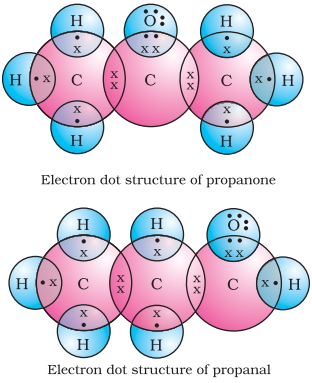
Draw the possible isomers of the compound with molecular formula $C_3H_6O$ and also give their electron dot structures.
Solution
(N/A) The molecular formula $C_3H_6O$ corresponds to two functional isomers:
$1$. Propanone $(CH_3COCH_3)$: $A$ ketone.
$2$. Propanal $(CH_3CH_2CHO)$: An aldehyde.
The electron dot structures are as follows:
- For Propanone: The central carbon atom is double-bonded to an oxygen atom and single-bonded to two methyl groups.
- For Propanal: The terminal carbon atom is double-bonded to an oxygen atom and single-bonded to a hydrogen atom and an ethyl group.
0 likes
View Solution27
EasyMCQ
$A$ colourless gas '$X$' has a formula $C_{3}H_{6}$. It decolourises bromine water. Write the chemical name of '$X$'.
A
Propane
B
Propene
C
Propyne
D
Cyclopropane
Solution
(B) The chemical formula $C_{3}H_{6}$ corresponds to the general formula $C_{n}H_{2n}$,which is characteristic of alkenes.
Alkenes are unsaturated hydrocarbons containing a carbon-carbon double bond.
Bromine water is a standard test for unsaturation; it turns from reddish-brown to colourless in the presence of alkenes or alkynes.
Since the compound is an alkene with $3$ carbon atoms,its name is propene $\left(H_{3}C-CH=CH_{2}\right)$.
0 likes
View Solution28
Easy
Write the name and structure of an aldehyde with four carbon atoms in its molecule.
Solution
(N/A) The aldehyde with four carbon atoms is known as Butanal.
Its structural formula is $CH_{3}-CH_{2}-CH_{2}-CHO$.
Its structural formula is $CH_{3}-CH_{2}-CH_{2}-CHO$.
0 likes
View Solution29
Easy
Draw the structural formula of methanoic acid.
Solution
(N/A) Methanoic acid is the simplest carboxylic acid with the chemical formula $HCOOH$.
Its structural formula consists of a carbon atom double-bonded to an oxygen atom,single-bonded to a hydroxyl group $(-OH)$,and single-bonded to a hydrogen atom.
The structure is represented as:
$H - C(=O) - OH$
Its structural formula consists of a carbon atom double-bonded to an oxygen atom,single-bonded to a hydroxyl group $(-OH)$,and single-bonded to a hydrogen atom.
The structure is represented as:
$H - C(=O) - OH$
0 likes
View Solution30
Easy
The formula of citric acid is shown below:
$\begin{matrix}
\,\,\,\,\,COOH \\
|\,\,\,\,\,\,\, \\
CH_{2}\, \\
|\,\,\,\,\, \\
HO-C-COOH \\
|\,\,\,\,\, \\
\,CH_{2} \\
|\,\,\,\,\, \\
\,\,\,\,\,\,COOH \\
\end{matrix}$
State the name of the $-COOH$ functional group present in citric acid.
$\begin{matrix}
\,\,\,\,\,COOH \\
|\,\,\,\,\,\,\, \\
CH_{2}\, \\
|\,\,\,\,\, \\
HO-C-COOH \\
|\,\,\,\,\, \\
\,CH_{2} \\
|\,\,\,\,\, \\
\,\,\,\,\,\,COOH \\
\end{matrix}$
State the name of the $-COOH$ functional group present in citric acid.
Solution
(N/A) The functional group $-COOH$ present in citric acid is known as the Carboxylic acid group. It is a characteristic functional group found in organic acids,where a carbon atom is double-bonded to an oxygen atom and single-bonded to a hydroxyl group $(-OH)$.
0 likes
View Solution31
Easy
Give the formula and name of the alkane which contains four carbon atoms in each molecule.
Solution
(N/A) The general formula for an alkane is $C_{n}H_{2n+2}$,where $n$ is the number of carbon atoms.
Given that the molecule contains $n = 4$ carbon atoms.
Substituting $n = 4$ into the formula: $C_{4}H_{2(4)+2} = C_{4}H_{8+2} = C_{4}H_{10}$.
The alkane with four carbon atoms is named Butane.
Given that the molecule contains $n = 4$ carbon atoms.
Substituting $n = 4$ into the formula: $C_{4}H_{2(4)+2} = C_{4}H_{8+2} = C_{4}H_{10}$.
The alkane with four carbon atoms is named Butane.
0 likes
View Solution32
Easy
Name the functional group present in the following compounds:
$(i)$ $CH_{3}-CH_{2}-CH_{2}-COOH$
$(ii)$ $CH_{3}-CO-CH_{2}-CH_{3}$
$(i)$ $CH_{3}-CH_{2}-CH_{2}-COOH$
$(ii)$ $CH_{3}-CO-CH_{2}-CH_{3}$
Solution
(N/A) $(i)$ The compound $CH_{3}-CH_{2}-CH_{2}-COOH$ contains the $-COOH$ group,which is a Carboxylic acid functional group.
$(ii)$ The compound $CH_{3}-CO-CH_{2}-CH_{3}$ contains the $C=O$ group bonded to two carbon atoms,which is a Ketone functional group.
$(ii)$ The compound $CH_{3}-CO-CH_{2}-CH_{3}$ contains the $C=O$ group bonded to two carbon atoms,which is a Ketone functional group.
0 likes
View Solution33
Easy
Write the molecular formula of benzene and state the number of double bonds in its structure.
Solution
(N/A) $(i)$ The molecular formula of benzene is $C_{6}H_{6}$.
$(ii)$ It contains three double bonds in its structure.
$(ii)$ It contains three double bonds in its structure.
0 likes
View Solution34
Easy
The molecular formula of $A$ is $C_{10}H_{18}$ and $B$ is $C_{18}H_{36}$. Name the homologous series to which they belong.
Solution
(A) For $A$ $(C_{10}H_{18})$: The general formula for an alkyne is $C_nH_{2n-2}$. Here,$n = 10$,so $2n - 2 = 2(10) - 2 = 18$. Thus,$A$ belongs to the alkyne homologous series.
For $B$ $(C_{18}H_{36})$: The general formula for an alkene is $C_nH_{2n}$. Here,$n = 18$,so $2n = 2(18) = 36$. Thus,$B$ belongs to the alkene homologous series.
For $B$ $(C_{18}H_{36})$: The general formula for an alkene is $C_nH_{2n}$. Here,$n = 18$,so $2n = 2(18) = 36$. Thus,$B$ belongs to the alkene homologous series.
0 likes
View Solution35
Medium
Write the names of the next homologues of $CH_{3}CH_{2}OH$ and $HCOOH$.
Solution
(N/A) homologous series is a group of organic compounds having the same functional group and similar chemical properties,where each successive member differs by a $CH_{2}$ unit.
$1$. For $CH_{3}CH_{2}OH$ (Ethanol),the next homologue is obtained by adding a $CH_{2}$ group,which results in $CH_{3}CH_{2}CH_{2}OH$ (Propan$-1-$ol).
$2$. For $HCOOH$ (Methanoic acid),the next homologue is obtained by adding a $CH_{2}$ group,which results in $CH_{3}COOH$ (Ethanoic acid).
Therefore,the next homologues are Propanol and Ethanoic acid respectively.
0 likes
View Solution36
Medium
How would you name the following compounds?
$(i)$ $CH_{3}-CH_{2}-CH=CH_{2}$
$(ii)$ $CH_{3}-CH_{2}-CH_{2}-C(CH_{3})_{2}-CH_{3}$
$(iii)$ $CH_{3}-CH_{2}-CHO$
$(iv)$ $CH_{3}-CH(OH)-CH_{3}$
$(i)$ $CH_{3}-CH_{2}-CH=CH_{2}$
$(ii)$ $CH_{3}-CH_{2}-CH_{2}-C(CH_{3})_{2}-CH_{3}$
$(iii)$ $CH_{3}-CH_{2}-CHO$
$(iv)$ $CH_{3}-CH(OH)-CH_{3}$
Solution
(A-D) $(i)$ The compound $CH_{3}-CH_{2}-CH=CH_{2}$ has four carbon atoms and a double bond,so it is named But-$1$-ene.
$(ii)$ The compound $CH_{3}-CH_{2}-CH_{2}-C(CH_{3})_{2}-CH_{3}$ has a five-carbon chain with two methyl groups at the second position from the end,so it is named $2,2$-Dimethylpentane.
$(iii)$ The compound $CH_{3}-CH_{2}-CHO$ has three carbon atoms and an aldehyde functional group,so it is named Propanal.
$(iv)$ The compound $CH_{3}-CH(OH)-CH_{3}$ has three carbon atoms and an alcohol functional group at the second carbon,so it is named Propan-$2$-ol.
0 likes
View Solution37
Easy
Draw the structure of the simplest ketone.
Solution
(N/A) The simplest ketone is acetone,also known as propanone. Its chemical formula is $CH_3COCH_3$. The structure consists of a central carbonyl group $(C=O)$ bonded to two methyl groups $(CH_3)$.
Structure:
$CH_3 - C(=O) - CH_3$
Structure:
$CH_3 - C(=O) - CH_3$
0 likes
View Solution38
EasyMCQ
Which two of the following compounds belong to the same homologous series?
$C_{2}H_{6}O, C_{2}H_{6}O_{2}, C_{2}H_{6}, CH_{4}O$
$C_{2}H_{6}O, C_{2}H_{6}O_{2}, C_{2}H_{6}, CH_{4}O$
A
$C_{2}H_{6}O$ and $C_{2}H_{6}O_{2}$
B
$C_{2}H_{6}O$ and $CH_{4}O$
C
$C_{2}H_{6}$ and $CH_{4}O$
D
$C_{2}H_{6}O_{2}$ and $C_{2}H_{6}$
Solution
(B) homologous series is a group of organic compounds having the same functional group and similar chemical properties,where each successive member differs by a $CH_{2}$ unit.
$1$. $C_{2}H_{6}O$ can represent ethanol $(C_{2}H_{5}OH)$.
$2$. $CH_{4}O$ represents methanol $(CH_{3}OH)$.
Both compounds contain the same functional group,which is the hydroxyl group $(-OH)$.
Since they belong to the alcohol homologous series,$C_{2}H_{6}O$ and $CH_{4}O$ are the correct pair.
$1$. $C_{2}H_{6}O$ can represent ethanol $(C_{2}H_{5}OH)$.
$2$. $CH_{4}O$ represents methanol $(CH_{3}OH)$.
Both compounds contain the same functional group,which is the hydroxyl group $(-OH)$.
Since they belong to the alcohol homologous series,$C_{2}H_{6}O$ and $CH_{4}O$ are the correct pair.
0 likes
View Solution39
Medium
What is the difference between two consecutive members in a homologous series of alkanes in terms of:
$(i)$ molecular mass.
$(ii)$ number of atoms of elements.
$(i)$ molecular mass.
$(ii)$ number of atoms of elements.
Solution
(N/A) In a homologous series of alkanes,each successive member differs from the previous one by a $-CH_2-$ group.
$(i)$ The difference in molecular mass is calculated as: $(1 \times 12) + (2 \times 1) = 14 \ u$.
$(ii)$ The difference in the number of atoms is one carbon atom and two hydrogen atoms,represented by the group $-CH_2-$.
$(i)$ The difference in molecular mass is calculated as: $(1 \times 12) + (2 \times 1) = 14 \ u$.
$(ii)$ The difference in the number of atoms is one carbon atom and two hydrogen atoms,represented by the group $-CH_2-$.
0 likes
View Solution40
Medium
$C_{3}H_{6}$,$C_{4}H_{8}$,and $C_{5}H_{10}$ belong to the same homologous series.
$(i)$ Define homologous series.
$(ii)$ Why are the melting and boiling points of $C_{5}H_{10}$ higher than $C_{4}H_{8}$?
$(iii)$ Arrange these hydrocarbons in order of increasing boiling points.
$(i)$ Define homologous series.
$(ii)$ Why are the melting and boiling points of $C_{5}H_{10}$ higher than $C_{4}H_{8}$?
$(iii)$ Arrange these hydrocarbons in order of increasing boiling points.
Solution
(N/A) $(i)$ $A$ homologous series is a group of organic compounds having the same functional group and similar chemical properties,in which all successive members differ by a $-CH_{2}$ unit.
$(ii)$ The melting and boiling points of $C_{5}H_{10}$ are higher than those of $C_{4}H_{8}$ because the molecular mass of $C_{5}H_{10}$ is greater than that of $C_{4}H_{8}$. As molecular mass increases,the intermolecular forces of attraction increase,requiring more energy to overcome them.
$(iii)$ The order of increasing boiling points is: $C_{3}H_{6} < C_{4}H_{8} < C_{5}H_{10}$.
0 likes
View Solution41
Medium
The general formula of three compounds $A, B$ and $C$ is $C_{n}H_{2n}$. $B$ has the highest boiling point and $C$ has the lowest boiling point.
$(i)$ Mention the type of compound $A, B$ and $C$.
$(ii)$ Which of these has the minimum number of carbon atoms?
$(iii)$ Name the homologous series to which $A, B$ and $C$ belong.
$(i)$ Mention the type of compound $A, B$ and $C$.
$(ii)$ Which of these has the minimum number of carbon atoms?
$(iii)$ Name the homologous series to which $A, B$ and $C$ belong.
Solution
(C) $(i)$ Compounds $A, B$ and $C$ are unsaturated hydrocarbons containing a carbon-carbon double bond.
$(ii)$ The boiling point of members of a homologous series increases with an increase in molecular mass (i.e.,an increase in the number of carbon atoms). Since compound $C$ has the lowest boiling point,it must have the minimum number of carbon atoms.
$(iii)$ The general formula $C_{n}H_{2n}$ represents the homologous series of alkenes.
0 likes
View Solution42
EasyMCQ
Select alkenes and alkynes from the following:
$C_{2}H_{4}, C_{3}H_{4}, C_{2}H_{2}, C_{4}H_{8}$
$C_{2}H_{4}, C_{3}H_{4}, C_{2}H_{2}, C_{4}H_{8}$
A
$C_{2}H_{4}, C_{4}H_{8}$ are alkenes; $C_{3}H_{4}, C_{2}H_{2}$ are alkynes
B
$C_{2}H_{4}, C_{2}H_{2}$ are alkenes; $C_{3}H_{4}, C_{4}H_{8}$ are alkynes
C
$C_{3}H_{4}, C_{4}H_{8}$ are alkenes; $C_{2}H_{4}, C_{2}H_{2}$ are alkynes
D
$C_{2}H_{2}, C_{4}H_{8}$ are alkenes; $C_{2}H_{4}, C_{3}H_{4}$ are alkynes
Solution
(A) Alkenes follow the general formula $C_{n}H_{2n}$.
$C_{2}H_{4}$ $(n=2)$ and $C_{4}H_{8}$ $(n=4)$ fit this formula,so they are alkenes.
Alkynes follow the general formula $C_{n}H_{2n-2}$.
$C_{3}H_{4}$ $(n=3)$ and $C_{2}H_{2}$ $(n=2)$ fit this formula,so they are alkynes.
$C_{2}H_{4}$ $(n=2)$ and $C_{4}H_{8}$ $(n=4)$ fit this formula,so they are alkenes.
Alkynes follow the general formula $C_{n}H_{2n-2}$.
$C_{3}H_{4}$ $(n=3)$ and $C_{2}H_{2}$ $(n=2)$ fit this formula,so they are alkynes.
0 likes
View Solution43
Medium
Name the functional group of the following compounds:
$(i) \ R-COOH$
$(ii) \ R-COOR'$
$(iii) \ R-OH$
$(iv) \ R-X$
$(i) \ R-COOH$
$(ii) \ R-COOR'$
$(iii) \ R-OH$
$(iv) \ R-X$
Solution
(N/A) $(i)$ The functional group $-COOH$ is known as the Carboxylic acid group.
$(ii)$ The functional group $-COOR'$ is known as the Ester group.
$(iii)$ The functional group $-OH$ is known as the Alcohol group.
$(iv)$ The functional group $-X$ (where $X = F, Cl, Br, I$) is known as the Halide group,and the compound is called an Alkyl halide or Haloalkane.
$(ii)$ The functional group $-COOR'$ is known as the Ester group.
$(iii)$ The functional group $-OH$ is known as the Alcohol group.
$(iv)$ The functional group $-X$ (where $X = F, Cl, Br, I$) is known as the Halide group,and the compound is called an Alkyl halide or Haloalkane.
0 likes
View Solution44
Medium
List four characteristics of homologous series.
Solution
(N/A) $(i)$ All members of a homologous series contain the same functional group.
$(ii)$ They exhibit similar chemical properties due to the presence of the same functional group.
$(iii)$ There is a regular gradation in physical properties such as melting point,boiling point,and density with an increase in molecular mass.
$(iv)$ Any two successive members of the series differ by a $-CH_2$ unit or a molecular mass of $14u$.
0 likes
View Solution45
MediumMCQ
What is meant by homologous series of carbon compounds? Classify the following carbon compounds into two homologous series and name them.
$C_{3}H_{4}, C_{3}H_{6}, C_{4}H_{6}, C_{4}H_{8}, C_{5}H_{8}, C_{5}H_{10}$
$C_{3}H_{4}, C_{3}H_{6}, C_{4}H_{6}, C_{4}H_{8}, C_{5}H_{8}, C_{5}H_{10}$
A
Alkynes and Alkanes
B
Alkenes and Alkanes
C
Alkynes and Alkenes
D
Alkanes and Alkenes
Solution
(C) homologous series is a group of organic compounds having the same functional group and similar chemical properties,in which the successive members differ by a $-CH_{2}$ group.
$1$. Alkynes: These follow the general formula $C_{n}H_{2n-2}$. The compounds $C_{3}H_{4}, C_{4}H_{6}, C_{5}H_{8}$ belong to this series.
$2$. Alkenes: These follow the general formula $C_{n}H_{2n}$. The compounds $C_{3}H_{6}, C_{4}H_{8}, C_{5}H_{10}$ belong to this series.
$1$. Alkynes: These follow the general formula $C_{n}H_{2n-2}$. The compounds $C_{3}H_{4}, C_{4}H_{6}, C_{5}H_{8}$ belong to this series.
$2$. Alkenes: These follow the general formula $C_{n}H_{2n}$. The compounds $C_{3}H_{6}, C_{4}H_{8}, C_{5}H_{10}$ belong to this series.
0 likes
View Solution46
Medium
$(i)$ Distinguish between saturated hydrocarbons and unsaturated hydrocarbons with the help of the combustion process.
$(ii)$ Write the chemical names of $C_{4}H_{10}$ and $C_{2}H_{2}$ and draw their structures.
$(ii)$ Write the chemical names of $C_{4}H_{10}$ and $C_{2}H_{2}$ and draw their structures.
Solution
(N/A)
$(ii)$ $(a)$ The chemical name of $C_{4}H_{10}$ is Butane. Its structure is: $CH_{3}-CH_{2}-CH_{2}-CH_{3}$.
$(b)$ The chemical name of $C_{2}H_{2}$ is Ethyne. Its structure is: $H-C\equiv C-H$.
| Saturated hydrocarbons | Unsaturated hydrocarbons |
|---|---|
| $1.$ Saturated hydrocarbons burn with a clean blue flame because they have a higher hydrogen-to-carbon ratio,allowing for complete combustion. | $1.$ Unsaturated hydrocarbons burn with a yellow,sooty flame due to a higher carbon-to-hydrogen ratio,which leads to incomplete combustion. |
| $2.$ They undergo complete combustion,producing only $CO_{2}$ and $H_{2}O$ as products. | $2.$ They undergo incomplete combustion,producing unburnt carbon particles (soot) in addition to $CO_{2}$ and $H_{2}O$. |
$(ii)$ $(a)$ The chemical name of $C_{4}H_{10}$ is Butane. Its structure is: $CH_{3}-CH_{2}-CH_{2}-CH_{3}$.
$(b)$ The chemical name of $C_{2}H_{2}$ is Ethyne. Its structure is: $H-C\equiv C-H$.
0 likes
View Solution47
Medium
Define the term 'structural isomerism'. Explain why propane cannot exhibit this property. Draw the structures of possible isomers of butane,$C_{4}H_{10}$.
Solution
(N/A) $(i)$ Structural isomerism is the phenomenon in which compounds have the same molecular formula but different structural arrangements of atoms.
$(ii)$ Propane $(C_{3}H_{8})$ cannot exhibit structural isomerism because it contains only three carbon atoms. With only three carbon atoms,there is only one possible way to arrange them in a chain,meaning no alternative structural arrangement can be formed.
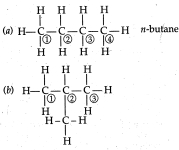
$(iii)$ Butane $(C_{4}H_{10})$ has two structural isomers:
$(a)$ $n$-butane: $A$ straight-chain structure where four carbon atoms are linked in a single row.
$(b)$ Isobutane ($2$-methylpropane): $A$ branched-chain structure where three carbon atoms form the main chain and one carbon atom is attached as a branch to the central carbon atom.
0 likes
View Solution48
Medium
Why are homologous series of carbon compounds so called? Write the chemical formula of two consecutive members of a homologous series and state the part of these compounds that determines their $(i)$ physical properties,and (ii) chemical properties.
Solution
(N/A) homologous series is a group of organic compounds having the same functional group and similar chemical properties,in which all successive members differ by a $-CH_2$ unit.
Two consecutive members of the homologous series of alcohols are:
$(i)$ Methanol: $CH_3OH$
(ii) Ethanol: $C_2H_5OH$
$(i)$ The physical properties (such as melting point,boiling point,and solubility) of the compounds in a homologous series are determined by the length of the carbon chain (molecular mass).
(ii) The chemical properties of the compounds in a homologous series are determined by the functional group present in the molecule.
0 likes
View Solution49
Medium
$(a)$ What are hydrocarbons?
$(b)$ Write the structural difference between saturated and unsaturated hydrocarbons.
$(b)$ Write the structural difference between saturated and unsaturated hydrocarbons.
Solution
(N/A) Hydrocarbons are organic compounds consisting entirely of carbon and hydrogen atoms linked by covalent bonds.
$(b)$ The structural difference is that saturated hydrocarbons contain only single covalent bonds between carbon atoms (e.g.,alkanes),whereas unsaturated hydrocarbons contain at least one double or triple covalent bond between carbon atoms (e.g.,alkenes or alkynes).
$(b)$ The structural difference is that saturated hydrocarbons contain only single covalent bonds between carbon atoms (e.g.,alkanes),whereas unsaturated hydrocarbons contain at least one double or triple covalent bond between carbon atoms (e.g.,alkenes or alkynes).
0 likes
View Solution50
Easy
Write the name of the next homologue of $CH_{3}OH$ and $HCOOH$.
Solution
(N/A) homologous series is a group of organic compounds having the same functional group and similar chemical properties,where each successive member differs by a $CH_{2}$ unit.
$1$. For $CH_{3}OH$ (Methanol),the next homologue is obtained by adding a $CH_{2}$ group,which results in $C_{2}H_{5}OH$ (Ethanol).
$2$. For $HCOOH$ (Methanoic acid),the next homologue is obtained by adding a $CH_{2}$ group,which results in $CH_{3}COOH$ (Ethanoic acid).
$1$. For $CH_{3}OH$ (Methanol),the next homologue is obtained by adding a $CH_{2}$ group,which results in $C_{2}H_{5}OH$ (Ethanol).
$2$. For $HCOOH$ (Methanoic acid),the next homologue is obtained by adding a $CH_{2}$ group,which results in $CH_{3}COOH$ (Ethanoic acid).
0 likes
View SolutionCarbon and its Compounds — Versatile Nature of Carbon (Hydrocarbons, Functional Groups, Homologous Series, Nomenclature) · Frequently Asked Questions
1Are these Carbon and its Compounds questions useful for JEE and NEET?
Yes. All questions in this section are mapped to JEE Main and NEET exam patterns. Previous year questions from JEE Main, NEET, GUJCET and state-level exams are included with full solutions.
2Can I switch to Hindi or Gujarati for these questions?
Yes. Use the language tabs in the hero section or the sidebar to view the same questions and solutions in English, Hindi or Gujarati.
3How do I generate a question paper from this subtopic?
Use the Vedclass Exam Paper Generator — select the chapter and subtopic, set difficulty, and generate Sets A, B, C, D automatically. First 3 chapters of every subject are free.
Vedclass Products
For Students
Vedclass Test Series
Mock tests in real JEE/NEET style with performance analysis. 5-day free trial.
Start Free TrialFor Teachers
Exam Paper Generator
Generate Set A/B/C/D papers from this chapter in 2 minutes. 3 chapters free.
Try FreeFor Institutes
Online Exam Module
Live online exams with unlimited students, 360° analytics & white-label branding.
See DemoFor Teachers & Institutes
Generate a Carbon and its Compounds Exam Paper in 2 Minutes
Select subtopic & difficulty — Sets A, B, C, D auto-generated with No Repeat logic.
First 3 chapters of every subject are free — no payment required.