
A English
Bonding in Carbon - The Covalent Bond Questions in English
Class 10 Science · Carbon and its Compounds · Bonding in Carbon - The Covalent Bond
45+
Questions
English
Language
100%
With Solutions
Showing 45 of 45 questions in English
1
Medium
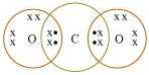
What would be the electron dot structure of carbon dioxide which has the formula $CO_2$?
Solution
(N/A) The electron dot structure of $CO_2$ is formed by the sharing of electrons between one carbon atom and two oxygen atoms.
Carbon has $4$ valence electrons,and each oxygen atom has $6$ valence electrons.
To achieve a stable octet configuration,the carbon atom shares $2$ electrons with each of the two oxygen atoms,resulting in two double bonds.
This sharing is represented by the electron dot structure where the shared pairs of electrons are placed between the atoms:
(Image: $1067-$s1)
0 likes
View Solution2
Medium
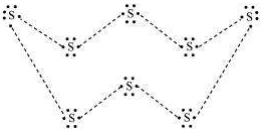
What would be the electron dot structure of a molecule of sulphur which is made up of eight atoms of sulphur?
Solution
(N/A) sulphur molecule consists of eight atoms of sulphur $(S_8)$ joined together in a puckered ring structure.
Each sulphur atom has $6$ valence electrons and requires $2$ more electrons to complete its octet.
Therefore,each sulphur atom forms two single covalent bonds with two adjacent sulphur atoms.
The electron dot structure shows each sulphur atom sharing two electrons with its neighbors,resulting in a crown-shaped ring.
0 likes
View Solution3
Medium
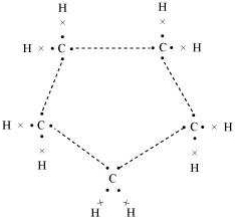
What will be the formula and electron dot structure of cyclopentane?
Solution
(N/A) The chemical formula for cyclopentane is $C_5H_{10}$.
Cyclopentane is a cyclic hydrocarbon with five carbon atoms arranged in a ring. Each carbon atom is bonded to two other carbon atoms and two hydrogen atoms.
The electron dot structure represents the sharing of electrons between atoms to form covalent bonds. In the structure,each carbon atom shares electrons with two adjacent carbon atoms and two hydrogen atoms to complete its octet,while each hydrogen atom shares an electron to complete its duplet.
[Image Description: $A$ pentagonal ring of five carbon atoms,where each carbon is bonded to two hydrogen atoms.]
0 likes
View Solution4
MediumMCQ
Ethane,with the molecular formula $C_2H_6$,has:
A
$6$ covalent bonds.
B
$7$ covalent bonds.
C
$8$ covalent bonds.
D
$9$ covalent bonds.
Solution
(B) The molecular formula of ethane is $C_2H_6$.
In this molecule,there is one $C-C$ single bond.
Each carbon atom is bonded to three hydrogen atoms,forming three $C-H$ bonds per carbon atom.
Therefore,there are $6$ $C-H$ bonds and $1$ $C-C$ bond.
Total number of covalent bonds = $6 + 1 = 7$.
In this molecule,there is one $C-C$ single bond.
Each carbon atom is bonded to three hydrogen atoms,forming three $C-H$ bonds per carbon atom.
Therefore,there are $6$ $C-H$ bonds and $1$ $C-C$ bond.
Total number of covalent bonds = $6 + 1 = 7$.
0 likes
View Solution5
Medium
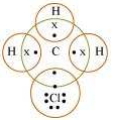
Explain the nature of the covalent bond using the bond formation in $CH_3Cl$.
Solution
(N/A) Carbon can neither lose four of its electrons nor gain four electrons as both the processes require a large amount of energy and would make the system unstable. Therefore,it completes its octet by sharing its four electrons with other carbon atoms or with atoms of other elements. The bonds that are formed by sharing electrons are known as covalent bonds. In covalent bonding,both the atoms share the valence electrons,i.e.,the shared electrons belong to the valence shells of both the atoms.
Here,carbon requires $4$ electrons to complete its octet,while each hydrogen atom requires one electron to complete its duplet. Also,chlorine requires one electron to complete its octet. Therefore,all of these share the electrons and as a result,carbon forms $3$ bonds with hydrogen and one with chlorine to form $CH_3Cl$.
Here,carbon requires $4$ electrons to complete its octet,while each hydrogen atom requires one electron to complete its duplet. Also,chlorine requires one electron to complete its octet. Therefore,all of these share the electrons and as a result,carbon forms $3$ bonds with hydrogen and one with chlorine to form $CH_3Cl$.
0 likes
View Solution6
Medium
Draw the electron dot structures for:
$(a)$ Ethanoic acid
$(b)$ $H_2S$
$(a)$ Ethanoic acid
$(b)$ $H_2S$
Solution
(N/A) The electron dot structure of ethanoic acid $(CH_3COOH)$ involves sharing of electrons between carbon,hydrogen,and oxygen atoms to complete their octets/duplets.
(See the provided image for the structural representation).
$(b)$ The electron dot structure of hydrogen sulfide $(H_2S)$ involves the sulfur atom sharing one electron each with two hydrogen atoms to form two covalent bonds,completing the octet of sulfur and the duplet of hydrogen.
(See the provided image for the structural representation).
(See the provided image for the structural representation).
$(b)$ The electron dot structure of hydrogen sulfide $(H_2S)$ involves the sulfur atom sharing one electron each with two hydrogen atoms to form two covalent bonds,completing the octet of sulfur and the duplet of hydrogen.
(See the provided image for the structural representation).
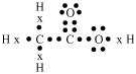
0 likes
View Solution7
Medium
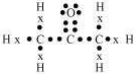
Draw the electron dot structures for
$(a)$ propanone
$(b)$ $F_2$
$(a)$ propanone
$(b)$ $F_2$
Solution
(N/A) Propanone: The chemical formula of propanone is $CH_3COCH_3$. In this structure,the central carbon atom is double-bonded to an oxygen atom and single-bonded to two other carbon atoms. Each of these two carbon atoms is further bonded to three hydrogen atoms.
(Image provided in the original context shows the electron sharing between atoms.)
$(b)$ $F_2$: Fluorine has $7$ valence electrons. To achieve a stable octet,two fluorine atoms share one pair of electrons,forming a single covalent bond.
(Image provided in the original context shows the electron sharing between atoms.)
$(b)$ $F_2$: Fluorine has $7$ valence electrons. To achieve a stable octet,two fluorine atoms share one pair of electrons,forming a single covalent bond.
0 likes
View Solution8
MediumMCQ
$A$ non-metal $X$ exists in two different forms $Y$ and $Z$. $Y$ is the hardest natural substance, whereas $Z$ is a good conductor of electricity. Identify $X$, $Y$ and $Z$.
A
$X = \text{Carbon}, Y = \text{Diamond}, Z = \text{Graphite}$
B
$X = \text{Sulfur}, Y = \text{Diamond}, Z = \text{Graphite}$
C
$X = \text{Carbon}, Y = \text{Graphite}, Z = \text{Diamond}$
D
$X = \text{Phosphorus}, Y = \text{Diamond}, Z = \text{Graphite}$
Solution
(A) The non-metal $X$ is Carbon, which exhibits allotropy.
$Y$ is Diamond, which is the hardest natural substance known.
$Z$ is Graphite, which is a good conductor of electricity due to the presence of free electrons.
Therefore, $X = \text{Carbon}, Y = \text{Diamond}, Z = \text{Graphite}$.
$Y$ is Diamond, which is the hardest natural substance known.
$Z$ is Graphite, which is a good conductor of electricity due to the presence of free electrons.
Therefore, $X = \text{Carbon}, Y = \text{Diamond}, Z = \text{Graphite}$.
0 likes
View Solution9
MediumMCQ
Which of the following statements are usually correct for carbon compounds?
$(i)$ Are good conductors of electricity
$(ii)$ Are poor conductors of electricity
$(iii)$ Have strong forces of attraction between their molecules
$(iv)$ Do not have strong forces of attraction between their molecules
$(i)$ Are good conductors of electricity
$(ii)$ Are poor conductors of electricity
$(iii)$ Have strong forces of attraction between their molecules
$(iv)$ Do not have strong forces of attraction between their molecules
A
$(i)$ and $(iii)$
B
$(ii)$ and $(iv)$
C
$(i)$ and $(iv)$
D
$(ii)$ and $(iii)$
Solution
(B) Carbon compounds are covalent compounds formed by the sharing of electrons.
$(i)$ They do not contain charged particles (ions) and are therefore poor conductors of electricity. Thus,statement $(ii)$ is correct and $(i)$ is incorrect.
$(ii)$ Due to the covalent nature of the bonds,the forces of attraction between the molecules are not very strong. Consequently,they have low melting and boiling points. Thus,statement $(iv)$ is correct and $(iii)$ is incorrect.
Therefore,statements $(ii)$ and $(iv)$ are correct.
0 likes
View Solution10
EasyMCQ
$A$ molecule of ammonia $(NH_3)$ has
A
only triple bonds
B
only double bonds
C
only single bonds
D
two double bonds and one single bond
Solution
(C) In an ammonia molecule $(NH_3)$,the central nitrogen atom $(N)$ has $5$ valence electrons.
It forms three covalent bonds with three hydrogen atoms $(H)$ to complete its octet.
Each $N-H$ bond is a single covalent bond formed by the sharing of one pair of electrons.
Therefore,the ammonia molecule contains only three single bonds and one lone pair of electrons on the nitrogen atom.
It forms three covalent bonds with three hydrogen atoms $(H)$ to complete its octet.
Each $N-H$ bond is a single covalent bond formed by the sharing of one pair of electrons.
Therefore,the ammonia molecule contains only three single bonds and one lone pair of electrons on the nitrogen atom.
0 likes
View Solution11
EasyMCQ
Buckminsterfullerene is an allotropic form of
A
phosphorus
B
sulphur
C
tin
D
carbon
Solution
(D) Buckminsterfullerene is a spherical molecule with the formula $C_{60}$.
It is one of the well-known allotropes of carbon,consisting of $60$ carbon atoms arranged in a structure resembling a soccer ball (a truncated icosahedron).
Other common allotropes of carbon include diamond and graphite.
It is one of the well-known allotropes of carbon,consisting of $60$ carbon atoms arranged in a structure resembling a soccer ball (a truncated icosahedron).
Other common allotropes of carbon include diamond and graphite.
0 likes
View Solution12
MediumMCQ
Which of the following is the correct representation of the electron dot structure of nitrogen $(N_2)$?
A
$\overset{\centerdot \centerdot }{:N} :: \overset{\centerdot \centerdot }{N:}$
B
$:N \vdots N:$
C
$\overset{\centerdot \centerdot }{:N} \vdots \overset{\centerdot \centerdot }{N:}$
D
$\overset{\centerdot }{:N} : : : \overset{\centerdot }{N:}$
Solution
(B) The atomic number of nitrogen $(N)$ is $7$,and its electronic configuration is $2, 5$.
To achieve a stable octet,each nitrogen atom needs $3$ more electrons.
Therefore,two nitrogen atoms share $3$ pairs of electrons between them to form a triple covalent bond.
In the electron dot structure,the $3$ shared pairs are represented by $3$ dots between the two $N$ atoms,and the remaining lone pair on each nitrogen is represented by $2$ dots.
Thus,the correct representation is $:N \vdots N:$.
0 likes
View Solution13
MediumMCQ
Pentane has the molecular formula $C_5H_{12}$. It has
A
$5$ covalent bonds
B
$12$ covalent bonds
C
$16$ covalent bonds
D
$17$ covalent bonds
Solution
(C) The molecular formula of pentane is $C_5H_{12}$.
In pentane,there are $5$ carbon atoms linked together in a chain by $4$ $C-C$ single covalent bonds.
Each carbon atom is bonded to hydrogen atoms to satisfy its valency of $4$.
There are $12$ $C-H$ single covalent bonds.
Total number of covalent bonds = (Number of $C-C$ bonds) + (Number of $C-H$ bonds) = $4 + 12 = 16$ covalent bonds.
0 likes
View Solution14
EasyMCQ
Carbon forms four covalent bonds by sharing its four valence electrons with four univalent atoms,e.g. hydrogen. After the formation of four bonds,carbon attains the electronic configuration of
A
neon
B
helium
C
argon
D
krypton
Solution
(A) Carbon has an atomic number of $6$. Its electronic configuration is $(2, 4)$.
To achieve a stable octet,carbon shares its $4$ valence electrons with other atoms to form $4$ covalent bonds.
By sharing $4$ electrons,carbon gains $4$ additional electrons in its valence shell,making the total number of electrons in the valence shell $4 + 4 = 8$.
This results in a total of $2 + 8 = 10$ electrons,which corresponds to the electronic configuration of neon ($10$ electrons: $2, 8$).
0 likes
View Solution15
EasyMCQ
The correct electron dot structure of a water molecule is
A
$H\centerdot \underset{\centerdot \,\,\centerdot }{\overset{\centerdot \,\,\centerdot }{\mathop{O}}}\,\centerdot H$
B
$H:\underset{\centerdot \,\,\centerdot }{\overset{\centerdot \,\,\centerdot }{\mathop{O}}}\,:H$
C
$H:\underset{\centerdot \,\,\centerdot }{\overset{\centerdot \,\,\centerdot }{\mathop{O}}}\,\centerdot H$
D
$H:O:H$
0 likes
View Solution16
Medium
Carbon,a Group $14$ element in the Periodic Table,is known to form compounds with many elements. Write an example of a compound formed with:
$(a)$ Chlorine (Group $17$ of Periodic Table)
$(b)$ Oxygen (Group $16$ of Periodic Table)
$(a)$ Chlorine (Group $17$ of Periodic Table)
$(b)$ Oxygen (Group $16$ of Periodic Table)
Solution
(N/A) Carbon tetrachloride $(CCl_4)$ is formed when carbon reacts with chlorine.
$(b)$ Carbon dioxide $(CO_2)$ is formed when carbon reacts with oxygen.
$(b)$ Carbon dioxide $(CO_2)$ is formed when carbon reacts with oxygen.
0 likes
View Solution17
Medium
In electron dot structure,the valence shell electrons are represented by crosses or dots.
$(a)$ The atomic number of chlorine is $17$. Write its electronic configuration.
$(b)$ Draw the electron dot structure of chlorine molecule $(Cl_2)$.
$(a)$ The atomic number of chlorine is $17$. Write its electronic configuration.
$(b)$ Draw the electron dot structure of chlorine molecule $(Cl_2)$.
Solution
(N/A) The atomic number of chlorine is $17$. Its electronic configuration is $2, 8, 7$ in $K, L, M$ shells respectively.
$(b)$ Each chlorine atom has $7$ valence electrons. To complete its octet,each chlorine atom shares one electron with another chlorine atom,forming a single covalent bond. The electron dot structure is as follows:
:Cl:Cl: (with $6$ dots around each Cl and $2$ shared dots in the middle)
$(b)$ Each chlorine atom has $7$ valence electrons. To complete its octet,each chlorine atom shares one electron with another chlorine atom,forming a single covalent bond. The electron dot structure is as follows:
:Cl:Cl: (with $6$ dots around each Cl and $2$ shared dots in the middle)

0 likes
View Solution18
Easy
Catenation is the ability of an atom to form bonds with other atoms of the same element. It is exhibited by both carbon and silicon. Compare the ability of catenation of the two elements. Give reasons.
Solution
(N/A) Carbon exhibits catenation to a much greater extent than silicon.
This is primarily due to the smaller atomic size of carbon,which allows for the formation of strong and stable $C-C$ covalent bonds.
In contrast,silicon has a larger atomic size,which results in longer and weaker $Si-Si$ bonds,making them less stable compared to $C-C$ bonds.
Additionally,the high bond energy of the $C-C$ bond contributes to the extensive catenation observed in carbon compounds.
0 likes
View Solution19
EasyMCQ
An element which is an essential constituent of all organic compounds belongs to
A
Group $14$
B
Group $1$
C
Group $15$
D
Group $16$
Solution
(A) All organic compounds are based on carbon chains or rings.
Carbon is the fundamental element that forms the backbone of every organic molecule.
Carbon has an atomic number of $6$ and its electronic configuration is $2, 4$.
It belongs to Group $14$ of the periodic table,which is the carbon family.
Therefore,the correct option is $A$.
Carbon is the fundamental element that forms the backbone of every organic molecule.
Carbon has an atomic number of $6$ and its electronic configuration is $2, 4$.
It belongs to Group $14$ of the periodic table,which is the carbon family.
Therefore,the correct option is $A$.
0 likes
View Solution20
EasyMCQ
If an element $X$ is placed in group $14$,what will be the formula and the nature of bonding of its chloride?
A
$XCl_4$; Covalent bonding
B
$XCl_2$; Ionic bonding
C
$XCl_4$; Ionic bonding
D
$XCl_2$; Covalent bonding
Solution
(A) Elements in group $14$ have $4$ valence electrons in their outermost shell.
To achieve a stable octet,the element $X$ shares its $4$ valence electrons with $4$ chlorine atoms,each contributing one electron.
Therefore,the formula of the chloride formed is $XCl_4$.
Since the bond is formed by the sharing of electrons between the element $X$ and chlorine atoms,the nature of the bonding is covalent.
0 likes
View Solution21
Medium
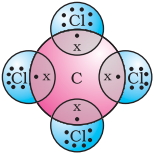
Write the chemical formula and draw the electron dot structure of carbon tetrachloride.
Solution
(N/A) The chemical formula of carbon tetrachloride is $CCl_4$.
In this molecule,one carbon atom shares its $4$ valence electrons with $4$ chlorine atoms,each contributing one electron to form $4$ covalent bonds.
Each chlorine atom completes its octet by sharing one electron with carbon,and the carbon atom completes its octet by sharing its $4$ electrons with the $4$ chlorine atoms.
The electron dot structure is as follows:
(The central Carbon atom is surrounded by four Chlorine atoms,with one shared pair of electrons between the Carbon and each Chlorine atom.)
0 likes
View Solution22
Medium
An element $X$ of group $15$ exists as a diatomic molecule and combines with hydrogen at $773 \, K$ in the presence of a catalyst to form a compound,ammonia,which has a characteristic pungent smell.
$(a)$ Identify the element $X$. How many valence electrons does it have?
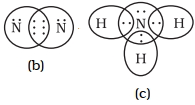
$(b)$ Draw the electron dot structure of the diatomic molecule of $X$. What type of bond is formed in it?
$(c)$ Draw the electron dot structure for ammonia and what type of bond is formed in it?
$(a)$ Identify the element $X$. How many valence electrons does it have?
$(b)$ Draw the electron dot structure of the diatomic molecule of $X$. What type of bond is formed in it?
$(c)$ Draw the electron dot structure for ammonia and what type of bond is formed in it?
Solution
(A) The element $X$ is Nitrogen $(N)$. Its atomic number is $7$,and its electronic configuration is $2, 5$. Therefore,it has $5$ valence electrons.
$(b)$ The diatomic molecule of nitrogen is $N_2$. The electron dot structure shows that each nitrogen atom shares $3$ electrons with the other to complete its octet,resulting in a triple covalent bond.
$(c)$ In ammonia $(NH_3)$,the nitrogen atom shares one electron with each of the $3$ hydrogen atoms. This results in the formation of $3$ single covalent bonds.
0 likes
View Solution23
EasyMCQ
$A$ molecule of ammonia has the formula $NH_{3}$. Predict the total number of bonds present around the nitrogen atom.
A
$1$
B
$2$
C
$3$
D
$4$
Solution
(C) The nitrogen atom in an ammonia molecule $(NH_{3})$ has an atomic number of $7$,with an electronic configuration of $2, 5$. To achieve a stable octet,nitrogen requires $3$ more electrons. It shares these $3$ electrons with $3$ hydrogen atoms,forming $3$ covalent bonds. Therefore,there are $3$ bonds present around the nitrogen atom.
0 likes
View Solution24
EasyMCQ
Write the number of covalent bonds in the molecule of ethane.
A
$5$
B
$6$
C
$7$
D
$8$
Solution
(C) The chemical formula of ethane is $C_2H_6$.
In an ethane molecule,there is one $C-C$ single covalent bond.
There are six $C-H$ single covalent bonds (three for each carbon atom).
Therefore,the total number of covalent bonds in ethane is $1 + 6 = 7$.
In an ethane molecule,there is one $C-C$ single covalent bond.
There are six $C-H$ single covalent bonds (three for each carbon atom).
Therefore,the total number of covalent bonds in ethane is $1 + 6 = 7$.
0 likes
View Solution25
EasyMCQ
Carbon has four electrons in its valence shell. How does carbon attain stable electronic configuration?
A
By losing four electrons
B
By gaining four electrons
C
By sharing four electrons with other atoms
D
By transferring four electrons to other atoms
Solution
(C) Carbon has an atomic number of $6$ and an electronic configuration of $(2, 4)$.
It has $4$ electrons in its outermost shell.
To attain a stable noble gas configuration (octet),it requires $4$ more electrons.
Since it is difficult to lose or gain $4$ electrons due to energy constraints,carbon achieves stability by sharing its $4$ valence electrons with other atoms to form covalent bonds.
0 likes
View Solution26
Easy
State the valency of each carbon atom in $(i)$ an alkane and $(ii)$ an alkyne.
Solution
(4) $(i)$ In an alkane,each carbon atom is bonded to four other atoms through single covalent bonds,so its valency is $4$.
$(ii)$ In an alkyne,each carbon atom involved in the triple bond is bonded to two other atoms,maintaining a total valency of $4$.
$(ii)$ In an alkyne,each carbon atom involved in the triple bond is bonded to two other atoms,maintaining a total valency of $4$.
0 likes
View Solution27
Easy
List two characteristic features of carbon which,when put together,give rise to a large number of carbon compounds.
Solution
(N/A) The two characteristic features of carbon that lead to the formation of a vast number of carbon compounds are:
$(i)$ Catenation: The unique ability of carbon atoms to form bonds with other carbon atoms,giving rise to large molecules (chains,branched chains,or rings).
$(ii)$ Tetravalency: Carbon has a valency of $4$,which allows it to bond with four other atoms of carbon or atoms of other monovalent elements like hydrogen,oxygen,nitrogen,sulfur,chlorine,etc.
0 likes
View Solution28
Medium
Draw the electron dot structure of ethane,$C_{2}H_{6}$.
Solution
(N/A) To draw the electron dot structure of ethane $(C_{2}H_{6})$:
$1$. Ethane consists of two carbon atoms bonded together by a single covalent bond.
$2$. Each carbon atom is further bonded to three hydrogen atoms.
$3$. Carbon has $4$ valence electrons and hydrogen has $1$ valence electron.
$4$. Each carbon atom shares one electron with the other carbon atom and one electron with each of the three hydrogen atoms to complete its octet.
$5$. The structure is represented as:
$H \quad H$
$| \quad |$
$H-C-C-H$
$| \quad |$
$H \quad H$
The electron dot structure is:
$H \quad H$
$.. \quad ..$
$H : C : C : H$
$.. \quad ..$
$H \quad H$
0 likes
View Solution29
Easy
Why do carbon compounds not conduct electricity?
Solution
(N/A) Carbon compounds are generally covalent in nature,meaning they are formed by the sharing of electrons between atoms. Because they do not dissociate into ions or charged particles when dissolved in water or in a molten state,they lack the free charge carriers necessary to conduct electricity.
0 likes
View Solution30
Medium
State reasons to explain why covalent compounds:
$(i)$ are bad conductors of electricity?
$(ii)$ have low melting and boiling points?
$(i)$ are bad conductors of electricity?
$(ii)$ have low melting and boiling points?
Solution
(N/A) $(i)$ Covalent compounds are bad conductors of electricity because the bonding in these compounds does not give rise to any charged ions.
$(ii)$ Covalently bonded molecules have strong covalent bonds within the molecule,but the intermolecular forces of attraction between the molecules are very weak,which results in low melting and boiling points.
$(ii)$ Covalently bonded molecules have strong covalent bonds within the molecule,but the intermolecular forces of attraction between the molecules are very weak,which results in low melting and boiling points.
0 likes
View Solution31
Easy
List two characteristics of covalent compounds.
Solution
(N/A) $(i)$ Covalent compounds have low melting and boiling points.
$(ii)$ Covalent compounds do not conduct electricity.
$(ii)$ Covalent compounds do not conduct electricity.
0 likes
View Solution32
Easy
Name an element,other than carbon,which exhibits the property of catenation up to seven or eight atoms. Are these compounds stable?
Solution
(N/A) $(i)$ Silicon is the element that exhibits the property of catenation up to seven or eight atoms.
$(ii)$ No,these compounds are not stable because they are highly reactive,especially in the presence of oxygen or moisture,due to the weak $Si-Si$ bond compared to the $C-C$ bond.
$(ii)$ No,these compounds are not stable because they are highly reactive,especially in the presence of oxygen or moisture,due to the weak $Si-Si$ bond compared to the $C-C$ bond.
0 likes
View Solution33
Medium
Carbon does not form ionic compounds. Why?
Solution
(N/A) To form an ionic bond,carbon would either need to lose $4e^-$ to form a $C^{4+}$ ion or gain $4e^-$ to form a $C^{4-}$ ion.
$1$. Losing $4e^-$ requires a very large amount of energy to overcome the strong nuclear attraction,which is not energetically favorable.
$2$. Gaining $4e^-$ would result in $10e^-$ being held by only $6$ protons in the nucleus,which creates significant instability due to the difficulty of the nucleus in holding such a large number of electrons.
Therefore,carbon does not form ionic compounds and instead forms covalent bonds by sharing electrons.
0 likes
View Solution34
EasyMCQ
An element which is an essential constituent of all organic compounds belongs to :
A
Group $1$
B
Group $15$
C
Group $14$
D
Group $16$
Solution
(C) All organic compounds are based on carbon chains or rings.
Carbon is the fundamental element that forms the backbone of all organic molecules.
Carbon has an atomic number of $6$ and its electronic configuration is $2, 4$.
It belongs to Group $14$ of the periodic table,which is the carbon family.
Carbon is the fundamental element that forms the backbone of all organic molecules.
Carbon has an atomic number of $6$ and its electronic configuration is $2, 4$.
It belongs to Group $14$ of the periodic table,which is the carbon family.
0 likes
View Solution35
Medium
State the two properties of carbon which make it unique among other elements. State the two uses of carbon which are based on its unique property.
Solution
(A) Two properties of carbon that make it unique among other elements are:
$(i)$ Catenation: Carbon has the unique ability to form strong covalent bonds with other carbon atoms,resulting in the formation of long chains,branched chains,or ring structures.
$(ii)$ Tetravalency: Carbon has a valency of $4$,allowing it to form stable bonds with four other atoms of carbon or other monovalent elements like hydrogen,oxygen,nitrogen,or halogens.
Two uses of carbon based on its properties are:
$(i)$ Graphite (an allotrope of carbon) is used in pencil leads and as a dry lubricant due to its layered structure and weak inter-layer forces.
$(ii)$ Diamond (an allotrope of carbon) is used in cutting and drilling tools because of its extremely hard,three-dimensional tetrahedral crystal lattice structure.
0 likes
View Solution36
Medium
List three physical properties of covalent compounds and give reason for each.
Solution
(N/A) $(i)$ Covalent compounds have low melting and boiling points because the intermolecular forces between them are weak.
$(ii)$ Generally,these are poor conductors of electricity because the electrons are shared between atoms and no free charged particles (ions) are formed.
$(iii)$ Generally,covalent compounds are soluble in organic solvents,such as ether or benzene,and are insoluble in water. This is because these compounds are typically non-polar and follow the principle of 'like dissolves like',meaning they dissolve in non-polar solvents.
0 likes
View Solution37
Medium
An atom of an element contains six electrons in its valence shell. This element is the second major component of air. It exists as a diatomic molecule.
$(i)$ Identify the element.
$(ii)$ Show the bond formed between two atoms of this element.
$(iii)$ Write the nature of the bond between the two atoms.
$(i)$ Identify the element.
$(ii)$ Show the bond formed between two atoms of this element.
$(iii)$ Write the nature of the bond between the two atoms.
Solution
(N/A) $(i)$ The element is Oxygen $(O)$.
$(ii)$ The bond formation between two oxygen atoms is shown in the figure.
$(iii)$ The nature of the bond is a double covalent bond,as each oxygen atom shares two electrons to complete its octet.
$(ii)$ The bond formation between two oxygen atoms is shown in the figure.
$(iii)$ The nature of the bond is a double covalent bond,as each oxygen atom shares two electrons to complete its octet.

0 likes
View Solution38
EasyMCQ
Ethane,with the molecular formula $C_{2}H_{6}$,has
A
$6$ covalent bonds
B
$9$ covalent bonds
C
$8$ covalent bonds
D
$7$ covalent bonds
Solution
(D) The molecular formula of ethane is $C_{2}H_{6}$.
In ethane,there are two carbon atoms linked by a single covalent bond $(C-C)$.
Each carbon atom is further bonded to three hydrogen atoms by single covalent bonds $(C-H)$.
Total bonds = $1$ ($C-C$ bond) + $6$ ($C-H$ bonds) = $7$ covalent bonds.
Therefore,ethane has $7$ covalent bonds.
In ethane,there are two carbon atoms linked by a single covalent bond $(C-C)$.
Each carbon atom is further bonded to three hydrogen atoms by single covalent bonds $(C-H)$.
Total bonds = $1$ ($C-C$ bond) + $6$ ($C-H$ bonds) = $7$ covalent bonds.
Therefore,ethane has $7$ covalent bonds.
0 likes
View Solution39
EasyMCQ
The number of electron pairs shared by the two carbon atoms which are bonded by a triple bond are:
A
One pair
B
Three pairs
C
Two pairs
D
Six pairs
Solution
(B) triple bond is formed when two atoms share three pairs of electrons between them.
In a triple bond,each carbon atom contributes three electrons to the shared pool,resulting in a total of $3$ shared electron pairs.
Therefore,the number of electron pairs shared by two carbon atoms bonded by a triple bond is $3$ pairs.
In a triple bond,each carbon atom contributes three electrons to the shared pool,resulting in a total of $3$ shared electron pairs.
Therefore,the number of electron pairs shared by two carbon atoms bonded by a triple bond is $3$ pairs.
0 likes
View Solution40
MediumMCQ
Which of the following is the correct representation of the electron dot structure of nitrogen $(N_2)$?
A
$:N \vdots \vdots N:$
B
$:\ddot{N}::\ddot{N}:$
C
$:\ddot{N} \vdots \ddot{N}:$
D
$:\ddot{N}:\ddot{N}:$
Solution
(C) The atomic number of nitrogen $(N)$ is $7$. Its electronic configuration is $2, 5$.
To achieve a stable octet,each nitrogen atom needs $3$ more electrons.
Therefore,two nitrogen atoms share $3$ pairs of electrons between them to form a triple covalent bond.
Each nitrogen atom has one lone pair of electrons remaining.
The correct electron dot structure is represented by showing $3$ shared pairs of electrons between the two $N$ atoms and one lone pair on each $N$ atom,which is $:N \vdots N:$. Among the given options,the structure representing $3$ shared pairs (triple bond) and one lone pair on each atom is correctly depicted in option $C$.
0 likes
View Solution41
MediumMCQ
Carbon forms four covalent bonds by sharing its four valence electrons with four univalent atoms,e.g.,hydrogen. After the formation of four bonds,carbon attains the electronic configuration of:
A
helium
B
argon
C
krypton
D
neon
Solution
(D) Carbon has an atomic number of $6$. Its electronic configuration is $2, 4$.
To achieve a stable octet,carbon shares its $4$ valence electrons with other atoms to form $4$ covalent bonds.
By sharing $4$ electrons,carbon gains $4$ additional electrons in its valence shell,resulting in a total of $8$ valence electrons ($2 + 4 + 4 = 10$ total electrons).
The electronic configuration becomes $2, 8$,which is the configuration of the noble gas neon ($Ne$,atomic number $10$).
0 likes
View Solution42
MediumMCQ
The correct electron dot structure of a water molecule is:
A
$H:\underset{\centerdot \,\centerdot }{\overset{\centerdot \,\centerdot }{\mathop{O}}}\,:H$
B
$H:\underset{\centerdot \,\centerdot }{\overset{\centerdot \,\centerdot }{\mathop{O}}}\,\centerdot H$
C
$H\centerdot \underset{\centerdot \,\centerdot }{\overset{\centerdot \,\centerdot }{\mathop{O}}}\,\centerdot H$
D
$H:O:H$
Solution
(A) water molecule $(H_2O)$ consists of one oxygen atom bonded to two hydrogen atoms.
Oxygen has $6$ valence electrons and requires $2$ more to complete its octet.
Each hydrogen atom has $1$ valence electron and requires $1$ more to complete its duplet.
Oxygen shares one electron with each hydrogen atom,forming two covalent bonds.
This leaves two lone pairs of electrons on the oxygen atom.
The correct electron dot structure represents the shared pairs as colons $(:)$ and shows the lone pairs on the oxygen atom as two pairs of dots.
Thus,the structure is $H:\underset{\centerdot \,\centerdot }{\overset{\centerdot \,\centerdot }{\mathop{O}}}\,:H$.
0 likes
View Solution43
MediumMCQ
Pentane has the molecular formula $C_{5}H_{12}$. It has:
A
$5$ covalent bonds
B
$12$ covalent bonds
C
$17$ covalent bonds
D
$16$ covalent bonds
Solution
(D) The molecular formula of pentane is $C_{5}H_{12}$.
To find the number of covalent bonds,we can use the structural formula of pentane.
Pentane is an alkane with a straight chain of $5$ carbon atoms.
Each carbon atom is bonded to other atoms via single covalent bonds.
There are $4$ $C-C$ bonds between the $5$ carbon atoms.
Each carbon atom is also bonded to hydrogen atoms to satisfy its valency of $4$.
Specifically,the $3$ terminal carbon atoms are bonded to $3$ hydrogen atoms each ($3 \times 3 = 9$ bonds),and the $2$ internal carbon atoms are bonded to $2$ hydrogen atoms each ($2 \times 2 = 4$ bonds). However,in a chain of $5$ carbons $(C-C-C-C-C)$,there are $4$ $C-C$ bonds and $12$ $C-H$ bonds.
Total covalent bonds = (Number of $C-C$ bonds) + (Number of $C-H$ bonds) = $4 + 12 = 16$ covalent bonds.
Alternatively,for any alkane with $n$ carbon atoms,the total number of covalent bonds is given by the formula $3n + 1$.
For pentane,$n = 5$,so total bonds = $3(5) + 1 = 15 + 1 = 16$.
0 likes
View Solution44
Easy
Write true or false for the following statement:
Two pairs of electrons are shared between two nitrogen atoms to form a nitrogen molecule.
Two pairs of electrons are shared between two nitrogen atoms to form a nitrogen molecule.
Solution
(FALSE) False. $A$ nitrogen molecule $(N_2)$ is formed by the sharing of three pairs of electrons between two nitrogen atoms,resulting in a triple covalent bond $(N \equiv N)$.
0 likes
View Solution45
EasyMCQ
Which element forms the basis of components like vitamins,proteins,and carbohydrates?
A
Carbon
B
Sodium
C
Sulfur
D
Chlorine
Solution
(A) Carbon is the fundamental element that forms the backbone of all organic molecules,including vitamins,proteins,and carbohydrates. These compounds are known as organic compounds because they are primarily composed of carbon atoms bonded to hydrogen,oxygen,nitrogen,and other elements. Carbon's unique ability to form stable covalent bonds with itself and other atoms allows for the complex structures required for life.
0 likes
View SolutionCarbon and its Compounds — Bonding in Carbon - The Covalent Bond · Frequently Asked Questions
1Are these Carbon and its Compounds questions useful for JEE and NEET?
Yes. All questions in this section are mapped to JEE Main and NEET exam patterns. Previous year questions from JEE Main, NEET, GUJCET and state-level exams are included with full solutions.
2Can I switch to Hindi or Gujarati for these questions?
Yes. Use the language tabs in the hero section or the sidebar to view the same questions and solutions in English, Hindi or Gujarati.
3How do I generate a question paper from this subtopic?
Use the Vedclass Exam Paper Generator — select the chapter and subtopic, set difficulty, and generate Sets A, B, C, D automatically. First 3 chapters of every subject are free.
Vedclass Products
For Students
Vedclass Test Series
Mock tests in real JEE/NEET style with performance analysis. 5-day free trial.
Start Free TrialFor Teachers
Exam Paper Generator
Generate Set A/B/C/D papers from this chapter in 2 minutes. 3 chapters free.
Try FreeFor Institutes
Online Exam Module
Live online exams with unlimited students, 360° analytics & white-label branding.
See DemoFor Teachers & Institutes
Generate a Carbon and its Compounds Exam Paper in 2 Minutes
Select subtopic & difficulty — Sets A, B, C, D auto-generated with No Repeat logic.
First 3 chapters of every subject are free — no payment required.