
A English
Mix Examples - Carbon and its Compounds Questions in English
Class 10 Science · Carbon and its Compounds · Mix Examples - Carbon and its Compounds
38+
Questions
English
Language
100%
With Solutions
Showing 38 of 38 questions in English
1
Medium
Write the balanced chemical equations for the following reactions and identify the type of reaction in each case.
$(a)$ Ethanol is warmed with ethanoic acid to form ethyl acetate in the presence of concentrated $H_2SO_4$.
$(b)$ Ethene is burnt in the presence of oxygen to form carbon dioxide, water and releases heat and light.
$(a)$ Ethanol is warmed with ethanoic acid to form ethyl acetate in the presence of concentrated $H_2SO_4$.
$(b)$ Ethene is burnt in the presence of oxygen to form carbon dioxide, water and releases heat and light.
Solution
(N/A) $C_2H_5OH(l) + CH_3COOH(l) \xrightarrow{conc. H_2SO_4} CH_3COOC_2H_5(l) + H_2O(l)$
This is an esterification reaction (a type of condensation reaction).
$(b)$ $C_2H_4(g) + 3O_2(g) \longrightarrow 2CO_2(g) + 2H_2O(g) + \text{Heat} + \text{Light}$
This is a combustion reaction (a type of redox reaction).
This is an esterification reaction (a type of condensation reaction).
$(b)$ $C_2H_4(g) + 3O_2(g) \longrightarrow 2CO_2(g) + 2H_2O(g) + \text{Heat} + \text{Light}$
This is a combustion reaction (a type of redox reaction).
0 likes
View Solution2
Medium
$A$ non-metal $A$ is an important constituent of our food and forms two oxides $B$ and $C$. Oxide $B$ is toxic,whereas $C$ causes global warming.
$(a)$ Identify $A$,$B$,and $C$.
$(b)$ To which Group of the Periodic Table does $A$ belong?
$(a)$ Identify $A$,$B$,and $C$.
$(b)$ To which Group of the Periodic Table does $A$ belong?
Solution
(N/A) is carbon $(C)$,$B$ is carbon monoxide $(CO)$,and $C$ is carbon dioxide $(CO_2)$.
$(b)$ Carbon $(A)$ has an atomic number of $6$,with an electronic configuration of $2, 4$. It belongs to Group-$14$ of the Periodic Table.
$(b)$ Carbon $(A)$ has an atomic number of $6$,with an electronic configuration of $2, 4$. It belongs to Group-$14$ of the Periodic Table.
0 likes
View Solution3
EasyMCQ
Carbon exists in the atmosphere in the form of
A
carbon monoxide in traces and carbon dioxide
B
carbon monoxide only
C
carbon dioxide only
D
coal
Solution
(A) Carbon is present in the Earth's atmosphere primarily as $CO_2$ (carbon dioxide).
While $CO_2$ is the most abundant form,carbon monoxide $(CO)$ is also present in the atmosphere in trace amounts due to incomplete combustion of fossil fuels and other natural processes.
Therefore,carbon exists in the atmosphere in the form of carbon monoxide in traces and carbon dioxide.
While $CO_2$ is the most abundant form,carbon monoxide $(CO)$ is also present in the atmosphere in trace amounts due to incomplete combustion of fossil fuels and other natural processes.
Therefore,carbon exists in the atmosphere in the form of carbon monoxide in traces and carbon dioxide.
0 likes
View Solution4
MediumMCQ
The structural formula of benzene is:
A
B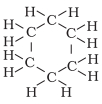
C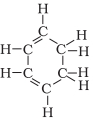
D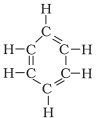
Solution
(D) Benzene $(C_6H_6)$ is an aromatic hydrocarbon with a cyclic structure.
It consists of a six-carbon ring with alternating single and double bonds.
Each carbon atom in the ring is bonded to one hydrogen atom.
Option $D$ correctly represents this structure,showing the alternating double bonds and the correct valency for each carbon atom.
It consists of a six-carbon ring with alternating single and double bonds.
Each carbon atom in the ring is bonded to one hydrogen atom.
Option $D$ correctly represents this structure,showing the alternating double bonds and the correct valency for each carbon atom.
0 likes
View Solution5
MediumMCQ
Match the reactions given in Column $(A)$ with the names given in Column $(B).$
| Column $(A)$ | Column $(B)$ |
| $(a)$ $CH_{3}OH + CH_{3}COOH \xrightarrow{H^{+}} CH_{3}COOCH_{3} + H_{2}O$ | $(i)$ Addition reaction |
| $(b)$ $CH_{2}=CH_{2} + H_{2} \xrightarrow{Ni} CH_{3}-CH_{3}$ | $(ii)$ Substitution reaction |
| $(c)$ $CH_{4} + Cl_{2} \xrightarrow{\text{Sunlight}} CH_{3}Cl + HCl$ | $(iii)$ Neutralisation reaction |
| $(d)$ $CH_{3}COOH + NaOH \longrightarrow CH_{3}COONa + H_{2}O$ | $(iv)$ Esterification reaction |
A
$(a)-(iv), (b)-(iii), (c)-(ii), (d)-(i)$
B
$(a)-(iv), (b)-(i), (c)-(ii), (d)-(iii)$
C
$(a)-(ii), (b)-(i), (c)-(iii), (d)-(iv)$
D
$(a)-(iii), (b)-(ii), (c)-(i), (d)-(iv)$
Solution
(B) The correct matches are as follows:
$(a)$ $CH_{3}OH + CH_{3}COOH \xrightarrow{H^{+}} CH_{3}COOCH_{3} + H_{2}O$ is an Esterification reaction $(iv)$, where an alcohol and a carboxylic acid react to form an ester.
$(b)$ $CH_{2}=CH_{2} + H_{2} \xrightarrow{Ni} CH_{3}-CH_{3}$ is an Addition reaction $(i)$, where hydrogen is added across the double bond of an unsaturated hydrocarbon.
$(c)$ $CH_{4} + Cl_{2} \xrightarrow{\text{Sunlight}} CH_{3}Cl + HCl$ is a Substitution reaction $(ii)$, where a hydrogen atom in methane is replaced by a chlorine atom.
$(d)$ $CH_{3}COOH + NaOH \longrightarrow CH_{3}COONa + H_{2}O$ is a Neutralisation reaction $(iii)$, where an acid reacts with a base to form salt and water.
Therefore, the correct sequence is $(a)-(iv), (b)-(i), (c)-(ii), (d)-(iii)$.
0 likes
View Solution6
Medium
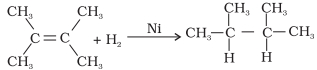
What is the role of the metal or reagents written on the arrows in the given chemical reactions?
$(a)$
$(b)$ $CH_{3}COOH + CH_{3}CH_{2}OH \xrightarrow{Conc. H_{2}SO_{4}} CH_{3}COOC_{2}H_{5} + H_{2}O$
$(c)$ $CH_{3}CH_{2}OH \xrightarrow[Heat]{Alkaline KMnO_{4}} CH_{3}COOH$
$(a)$
$(b)$ $CH_{3}COOH + CH_{3}CH_{2}OH \xrightarrow{Conc. H_{2}SO_{4}} CH_{3}COOC_{2}H_{5} + H_{2}O$
$(c)$ $CH_{3}CH_{2}OH \xrightarrow[Heat]{Alkaline KMnO_{4}} CH_{3}COOH$
Solution
(N/A) $Ni$ (Nickel) acts as a catalyst in the hydrogenation reaction.
$(b)$ Concentrated $H_{2}SO_{4}$ (Sulfuric acid) acts as a dehydrating agent and a catalyst in the esterification reaction.
$(c)$ Alkaline $KMnO_{4}$ (Potassium permanganate) acts as an oxidizing agent.
$(b)$ Concentrated $H_{2}SO_{4}$ (Sulfuric acid) acts as a dehydrating agent and a catalyst in the esterification reaction.
$(c)$ Alkaline $KMnO_{4}$ (Potassium permanganate) acts as an oxidizing agent.
0 likes
View Solution7
Medium
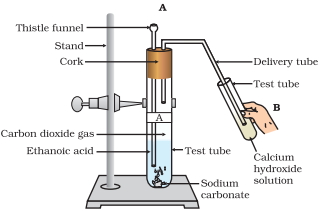
Look at the figure and answer the following questions:
$(a)$ If ethanol is used instead of ethanoic acid,would you expect the same change?
$(b)$ How can a solution of lime water be prepared in the laboratory?
$(a)$ If ethanol is used instead of ethanoic acid,would you expect the same change?
$(b)$ How can a solution of lime water be prepared in the laboratory?
Solution
(N/A) As $C_2H_5OH$ (ethanol) and $Na_2CO_3$ (sodium carbonate) do not react with each other,a similar change (effervescence due to $CO_2$ evolution) is not expected.
$C_2H_5OH + Na_2CO_3 \rightarrow$ No reaction
$(b)$ Lime water (calcium hydroxide solution) is prepared in the laboratory by dissolving a small amount of calcium oxide $(CaO)$ in water. The mixture is stirred and then allowed to settle. The clear supernatant liquid is then decanted or filtered to obtain the lime water solution.
0 likes
View Solution8
Medium
Explain the given reactions with examples:
$(a)$ Saponification reaction
$(b)$ Combustion reaction
$(a)$ Saponification reaction
$(b)$ Combustion reaction
Solution
(N/A) Saponification: It is the process of making soap by the alkaline hydrolysis of an ester. When an ester like ethyl acetate reacts with sodium hydroxide, it produces sodium acetate and ethanol.
$CH_{3}COOC_{2}H_{5} + NaOH \rightarrow CH_{3}COONa + C_{2}H_{5}OH$
$(b)$ Combustion: It is the process of burning a carbon compound in the presence of oxygen to release energy in the form of heat and light. For example, the combustion of methane:
$CH_{4} + 2O_{2} \rightarrow CO_{2} + 2H_{2}O + \text{Heat and Light}$
0 likes
View Solution9
Medium
What happens when (Give equations also):
$(i)$ Methane reacts with excess of chlorine in the presence of diffused sunlight.
$(ii)$ Ethanol undergoes combustion.
$(iii)$ Ethyl alcohol reacts with acidified potassium dichromate.
$(i)$ Methane reacts with excess of chlorine in the presence of diffused sunlight.
$(ii)$ Ethanol undergoes combustion.
$(iii)$ Ethyl alcohol reacts with acidified potassium dichromate.
Solution
(N/A) $(i)$ Methane reacts with excess chlorine in the presence of diffused sunlight to form carbon tetrachloride and hydrogen chloride:
$CH_{4} + 4Cl_{2} \xrightarrow{\text{Diffused sunlight}} CCl_{4} + 4HCl$
$(ii)$ Ethanol undergoes complete combustion to produce carbon dioxide,water,and energy (heat and light):
$CH_{3}CH_{2}OH + 3O_{2} \longrightarrow 2CO_{2} + 3H_{2}O + \text{Heat and light}$
$(iii)$ Ethyl alcohol (ethanol) is oxidized by acidified potassium dichromate $(K_{2}Cr_{2}O_{7})$ to form ethanoic acid:
$CH_{3}CH_{2}OH + 2[O] \xrightarrow{\text{Acidified } K_{2}Cr_{2}O_{7}} CH_{3}COOH + H_{2}O$
0 likes
View Solution10
Medium
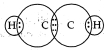
Draw the electron-dot structure for ethyne. $A$ mixture of ethyne and oxygen is burnt for welding. In your opinion,why cannot we use a mixture of ethyne and air for this purpose?
Solution
(N/A) The electron-dot structure of ethyne $(C_2H_2)$ shows a triple bond between the two carbon atoms and a single bond between each carbon and hydrogen atom.
In pure oxygen,ethyne undergoes complete combustion,which releases a large amount of heat,attaining the high temperature required for welding.
In contrast,air contains a lower percentage of oxygen compared to pure oxygen. When ethyne is burnt in air,it undergoes incomplete combustion,which produces a sooty flame and does not generate the high temperature necessary for welding.
0 likes
View Solution11
Medium
Complete the following chemical reactions and write the chemical name of the products obtained.
$(i)$ $CH_{2}=CH_{2} + H_{2}O \longrightarrow$
$(ii)$ $CH_{3}COOH + NaOH \longrightarrow$
$(iii)$ $CH_{3}CH_{2}OH \xrightarrow{H_{2}SO_{4}} $
$(iv)$ $HCOOH + Na \longrightarrow$
$(v)$ $C_{2}H_{5}OH \xrightarrow{\text{Alk. } KMnO_{4}} $
$(i)$ $CH_{2}=CH_{2} + H_{2}O \longrightarrow$
$(ii)$ $CH_{3}COOH + NaOH \longrightarrow$
$(iii)$ $CH_{3}CH_{2}OH \xrightarrow{H_{2}SO_{4}} $
$(iv)$ $HCOOH + Na \longrightarrow$
$(v)$ $C_{2}H_{5}OH \xrightarrow{\text{Alk. } KMnO_{4}} $
Solution
(N/A) $(i)$ $CH_{2}=CH_{2} + H_{2}O \longrightarrow C_{2}H_{5}OH$ (Ethanol)
$(ii)$ $CH_{3}COOH + NaOH \longrightarrow CH_{3}COONa$ (Sodium acetate) $+ H_{2}O$
$(iii)$ $CH_{3}CH_{2}OH \xrightarrow{H_{2}SO_{4}} CH_{2}=CH_{2}$ (Ethene) $+ H_{2}O$
$(iv)$ $HCOOH + Na \longrightarrow HCOONa$ (Sodium formate) $+ \frac{1}{2}H_{2}$
$(v)$ $C_{2}H_{5}OH \xrightarrow{\text{Alk. } KMnO_{4}} CH_{3}COOH$ (Ethanoic acid)
0 likes
View Solution12
Medium
Identify the compounds $A$ to $E$ in the following reaction sequence:
$(i)$ $CH_3CH_2OH \xrightarrow[dil. HCl]{KMnO_4/KOH} (A) + H_2O$
$(ii)$ $CH_3CH_2OH + A \xrightarrow[\Delta]{Conc. H_2SO_4} B + H_2O$
$(iii)$ $B + NaOH \rightarrow C + CH_3CH_2OH$
$(iv)$ $A + NaHCO_3 \rightarrow C + D + H_2O$
$(v)$ $CH_3CH_2OH + E \rightarrow CH_3CH_2ONa + H_2$
$(i)$ $CH_3CH_2OH \xrightarrow[dil. HCl]{KMnO_4/KOH} (A) + H_2O$
$(ii)$ $CH_3CH_2OH + A \xrightarrow[\Delta]{Conc. H_2SO_4} B + H_2O$
$(iii)$ $B + NaOH \rightarrow C + CH_3CH_2OH$
$(iv)$ $A + NaHCO_3 \rightarrow C + D + H_2O$
$(v)$ $CH_3CH_2OH + E \rightarrow CH_3CH_2ONa + H_2$
Solution
(A) $(i)$ Ethanol $(CH_3CH_2OH)$ undergoes oxidation with alkaline $KMnO_4$ to form Ethanoic acid $(A = CH_3COOH)$.
$(ii)$ Ethanol reacts with Ethanoic acid $(A)$ in the presence of concentrated $H_2SO_4$ to form Ethyl ethanoate $(B = CH_3COOCH_2CH_3)$ and water.
$(iii)$ Ethyl ethanoate $(B)$ undergoes saponification with $NaOH$ to form Sodium ethanoate $(C = CH_3COONa)$ and Ethanol.
$(iv)$ Ethanoic acid $(A)$ reacts with $NaHCO_3$ to form Sodium ethanoate $(C)$,Carbon dioxide $(D = CO_2)$,and water.
$(v)$ Ethanol reacts with Sodium $(E = Na)$ to form Sodium ethoxide $(CH_3CH_2ONa)$ and Hydrogen gas.
0 likes
View Solution13
Medium
$(a)$ Complete the following equations:
$(i)$ $CH_4 + 2O_2 \longrightarrow CO_2 + 2H_2O + \text{Heat} + \text{Light}$
$(ii)$ $CH_3COOH + C_2H_5OH \xrightarrow{\text{Acid}} CH_3COOC_2H_5 + H_2O$
$(iii)$ $CH_3CH_2OH \xrightarrow[\text{443 K}]{\text{Conc. } H_2SO_4} CH_2=CH_2 + H_2O$
$(i)$ $CH_4 + 2O_2 \longrightarrow CO_2 + 2H_2O + \text{Heat} + \text{Light}$
$(ii)$ $CH_3COOH + C_2H_5OH \xrightarrow{\text{Acid}} CH_3COOC_2H_5 + H_2O$
$(iii)$ $CH_3CH_2OH \xrightarrow[\text{443 K}]{\text{Conc. } H_2SO_4} CH_2=CH_2 + H_2O$
Solution
(A) $(i)$ Combustion of methane in excess oxygen produces carbon dioxide, water, heat, and light: $CH_4 + 2O_2 \longrightarrow CO_2 + 2H_2O + \text{Heat} + \text{Light}$.
$(ii)$ Esterification reaction between ethanoic acid and ethanol in the presence of an acid catalyst produces ethyl ethanoate (ester) and water: $CH_3COOH + C_2H_5OH \xrightarrow{\text{Acid}} CH_3COOC_2H_5 + H_2O$.
$(iii)$ Dehydration of ethanol using concentrated sulfuric acid at $443 \text{ K}$ produces ethene and water: $CH_3CH_2OH \xrightarrow[\text{443 K}]{\text{Conc. } H_2SO_4} CH_2=CH_2 + H_2O$.
0 likes
View Solution14
Medium
$(i)$ Give one example with a chemical equation for the following reactions:
$(a)$ Substitution reaction.
$(b)$ Saponification reaction.
$(c)$ Combustion reaction.
$(a)$ Substitution reaction.
$(b)$ Saponification reaction.
$(c)$ Combustion reaction.
Solution
(N/A) Substitution reaction: Methane reacts with chlorine in the presence of sunlight to form chloromethane and hydrogen chloride.
$CH_4 + Cl_2 \xrightarrow{\text{Sunlight}} CH_3Cl + HCl$
$(b)$ Saponification reaction: Ethyl acetate reacts with sodium hydroxide to form ethanol and sodium acetate.
$CH_3COOC_2H_5 + NaOH \longrightarrow C_2H_5OH + CH_3COONa$
$(c)$ Combustion reaction: Methane burns in oxygen to produce carbon dioxide,water,and heat energy.
$CH_4 + 2O_2 \longrightarrow CO_2 + 2H_2O + \text{Heat} + \text{Light}$
0 likes
View Solution15
EasyMCQ
Mention the functional group which always occurs at the terminal position of a carbon chain of an organic compound.
A
Alcoholic group
B
Aldehydic group
C
Ketonic group
D
Carboxyl group
Solution
(B, D) The functional groups that always occur at the terminal position of a carbon chain are the Aldehydic group $(-CHO)$ and the Carboxyl group $(-COOH)$.
In these groups,the carbon atom is already bonded to an oxygen atom via a double bond and to a hydrogen atom (in aldehydes) or a hydroxyl group (in carboxylic acids),leaving only one valency available for the carbon chain,which forces them to be at the end of the chain.
In these groups,the carbon atom is already bonded to an oxygen atom via a double bond and to a hydrogen atom (in aldehydes) or a hydroxyl group (in carboxylic acids),leaving only one valency available for the carbon chain,which forces them to be at the end of the chain.
0 likes
View Solution16
EasyMCQ
Which gas is present both in natural gas and biogas?
A
Methane
B
Ethane
C
Propane
D
Butane
Solution
(A) Natural gas is primarily composed of $CH_4$ (Methane), typically ranging from $70\%$ to $90\%$. Biogas is produced by the anaerobic decomposition of organic matter and also consists mainly of $CH_4$ (Methane), usually between $50\%$ and $75\%$. Therefore, $CH_4$ (Methane) is the common gas present in both.
0 likes
View Solution17
Medium
An element is a main constituent of paper,diamond and clothes etc. It forms covalent bonds with itself and other elements.
$(a)$ Identify the element.
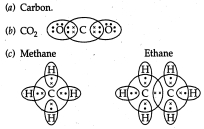
$(b)$ Write the electron dot structure of its oxide.
$(c)$ Draw the electron dot structure of methane and ethane.
$(a)$ Identify the element.
$(b)$ Write the electron dot structure of its oxide.
$(c)$ Draw the electron dot structure of methane and ethane.
Solution
(N/A) The element is Carbon $(C)$.
$(b)$ The oxide of carbon is Carbon dioxide $(CO_2)$. The electron dot structure involves carbon sharing two pairs of electrons with each of the two oxygen atoms to complete its octet.
$(c)$ Methane $(CH_4)$ has one carbon atom bonded to four hydrogen atoms. Ethane $(C_2H_6)$ has two carbon atoms bonded to each other and to three hydrogen atoms each.
0 likes
View Solution18
Medium
Explain how covalent bonds are formed. Mention physical properties of covalent compounds. Draw the electron dot structure of $CCl_{4}$.
Solution
(N/A) covalent bond is formed when two atoms share valence electrons to achieve a stable noble gas electronic configuration,as they cannot gain or lose electrons from their outermost shell.
Physical properties of covalent compounds include:
$(i)$ They are generally poor conductors of electricity.
$(ii)$ They have low boiling and melting points due to weak intermolecular forces.
$(iii)$ They are generally soluble in organic solvents.
$(iv)$ They are typically found in liquid or gaseous states at room temperature.
In $CCl_{4}$,carbon has $4$ valence electrons and each of the four chlorine atoms has $7$ valence electrons. Carbon shares one electron with each of the four chlorine atoms to complete its octet,and each chlorine atom completes its octet by sharing one electron with carbon.

0 likes
View Solution19
EasyMCQ
Melittin present in the bite of honeybee is a polypeptide containing $......$ amino acids.
A
$14$
B
$21$
C
$26$
D
$38$
Solution
(C) Melittin is the principal active component of honeybee venom ($Apis$ $mellifera$).
It is a basic polypeptide consisting of $26$ amino acid residues.
Its primary structure is $Gly-Ile-Gly-Ala-Val-Leu-Lys-Val-Leu-Thr-Thr-Gly-Leu-Pro-Ala-Leu-Ile-Ser-Trp-Ile-Lys-Arg-Lys-Arg-Gln-Gln-NH_2$.
Therefore,the correct option is $C$.
It is a basic polypeptide consisting of $26$ amino acid residues.
Its primary structure is $Gly-Ile-Gly-Ala-Val-Leu-Lys-Val-Leu-Thr-Thr-Gly-Leu-Pro-Ala-Leu-Ile-Ser-Trp-Ile-Lys-Arg-Lys-Arg-Gln-Gln-NH_2$.
Therefore,the correct option is $C$.
0 likes
View Solution20
EasyMCQ
Which gas is a mixture of carbon monoxide $(CO)$ and dihydrogen $(H_2)$?
A
Coal gas
B
Marsh gas
C
Biogas
D
Water gas
Solution
(D) Water gas is a mixture of carbon monoxide $(CO)$ and dihydrogen $(H_2)$.
It is produced by passing steam over red-hot coke at high temperatures.
The chemical reaction is: $C(s) + H_2O(g) \xrightarrow{1273 K} CO(g) + H_2(g)$.
It is produced by passing steam over red-hot coke at high temperatures.
The chemical reaction is: $C(s) + H_2O(g) \xrightarrow{1273 K} CO(g) + H_2(g)$.
0 likes
View Solution21
EasyMCQ
Which of the following is used in conveyor belts?
A
Polythene
B
$PVC$
C
Teflon
D
Neoprene
Solution
(D) Neoprene is a synthetic rubber produced by the polymerization of chloroprene.
It possesses excellent chemical stability and maintains flexibility over a wide temperature range.
Due to its high resistance to oil,heat,and weathering,it is widely used in the manufacturing of conveyor belts,gaskets,and hoses.
It possesses excellent chemical stability and maintains flexibility over a wide temperature range.
Due to its high resistance to oil,heat,and weathering,it is widely used in the manufacturing of conveyor belts,gaskets,and hoses.
0 likes
View Solution22
EasyMCQ
Which of the following tests is used for the detection of glucose?
A
Fehling's test
B
Iodine test
C
Tollens' test
D
Benedict's test
Solution
(D) Glucose is a reducing sugar because it contains a free aldehyde group $(-CHO)$ or a hemiacetal group that can open to form an aldehyde.
Both Fehling's test and Benedict's test are used to detect the presence of reducing sugars like glucose.
However,in the context of standard chemistry curricula,Benedict's test is the most commonly cited qualitative test for the detection of glucose in biological samples.
Therefore,the correct option is $D$.
0 likes
View Solution23
EasyMCQ
Which catalyst is used in the Fischer-Tropsch process to synthesize hydrocarbons or oxygenated compounds like propanone?
A
$Ag_{2}O$
B
$CoO$
C
$Fe_{2}O_{3}$
D
$Ni$
Solution
(B) The Fischer-Tropsch process is a collection of chemical reactions that converts a mixture of carbon monoxide $(CO)$ and hydrogen $(H_{2})$ into liquid hydrocarbons or oxygenated compounds.
Cobalt $(CoO)$ or Iron-based catalysts are typically employed in this process.
Among the given options,Cobalt oxide $(CoO)$ is a well-known catalyst used in Fischer-Tropsch synthesis to facilitate the production of various organic compounds,including ketones like propanone under specific conditions.
0 likes
View Solution24
EasyMCQ
Which monomer is present in bakelite?
A
Methanal
B
Ethene
C
Vinyl chloride
D
Isoprene
Solution
(A) Bakelite is a thermosetting polymer formed by the condensation polymerization of phenol and formaldehyde (methanal).
In this reaction,phenol reacts with methanal $(HCHO)$ in the presence of an acid or base catalyst to produce a cross-linked polymer structure.
Therefore,methanal is one of the essential monomers used in the synthesis of bakelite.
In this reaction,phenol reacts with methanal $(HCHO)$ in the presence of an acid or base catalyst to produce a cross-linked polymer structure.
Therefore,methanal is one of the essential monomers used in the synthesis of bakelite.
0 likes
View Solution25
EasyMCQ
What is the monomer unit of Teflon?
A
Vinyl chloride
B
Ethene
C
Isoprene
D
Tetrafluoroethene
Solution
(D) Teflon is a synthetic fluoropolymer of tetrafluoroethylene.
It is produced by the polymerization of the monomer $CF_2=CF_2$ (tetrafluoroethene).
The chemical formula of the monomer is $C_2F_4$.
Therefore,the correct monomer unit is tetrafluoroethene.
It is produced by the polymerization of the monomer $CF_2=CF_2$ (tetrafluoroethene).
The chemical formula of the monomer is $C_2F_4$.
Therefore,the correct monomer unit is tetrafluoroethene.
0 likes
View Solution26
EasyMCQ
What is the monomer of natural rubber?
A
Chloroprene
B
Isoprene
C
Ethene
D
Chloroethene
Solution
(B) Natural rubber is a polymer made up of repeating units of $2$-methyl-$1,3$-butadiene,which is commonly known as isoprene.
Its chemical formula is $C_5H_8$.
When these isoprene units polymerize,they form polyisoprene,which constitutes natural rubber.
Therefore,the correct monomer is isoprene.
Its chemical formula is $C_5H_8$.
When these isoprene units polymerize,they form polyisoprene,which constitutes natural rubber.
Therefore,the correct monomer is isoprene.
0 likes
View Solution27
EasyMCQ
What is the monomer unit of neoprene?
A
Chloroethene
B
Vinyl chloride
C
Chloroprene
D
Isoprene
Solution
(C) Neoprene is a synthetic rubber produced by the polymerization of chloroprene.
Its chemical name is $2$-chloro-$1,3$-butadiene.
The polymerization process involves the addition of chloroprene units to form a long chain polymer.
Therefore,the correct monomer unit is chloroprene.
Its chemical name is $2$-chloro-$1,3$-butadiene.
The polymerization process involves the addition of chloroprene units to form a long chain polymer.
Therefore,the correct monomer unit is chloroprene.
0 likes
View Solution28
EasyMCQ
Which of the following is a natural polymer?
A
Vulcanized rubber
B
Cellulose
C
Neoprene
D
Teflon
Solution
(B) natural polymer is a polymer that occurs naturally in living organisms.
$1$. Cellulose is a natural polysaccharide found in the cell walls of plants.
$2$. Vulcanized rubber is a modified form of natural rubber,making it a semi-synthetic polymer.
$3$. Neoprene is a synthetic rubber produced by the polymerization of chloroprene.
$4$. Teflon (polytetrafluoroethylene) is a synthetic fluoropolymer.
Therefore,cellulose is the correct answer.
0 likes
View Solution29
EasyMCQ
Which of the following compounds is an addition polymer?
A
Polystyrene
B
Nylon
C
Polyester
D
Polyamide
Solution
(A) An addition polymer is formed by the repeated addition of monomer units containing double or triple bonds without the loss of any small molecules.
Polystyrene is formed by the polymerization of styrene $(C_6H_5CH=CH_2)$ monomers through an addition reaction.
Nylon,polyester,and polyamide are condensation polymers,which are formed by the loss of small molecules like $H_2O$ or $CH_3OH$ during the polymerization process.
Therefore,the correct answer is Polystyrene.
0 likes
View Solution30
EasyMCQ
Which of the following compounds is a condensation polymer?
A
Polythene
B
Natural rubber
C
Teflon
D
Nylon
Solution
(D) condensation polymer is formed by the repeated condensation reaction between two different bi-functional or tri-functional monomeric units, usually accompanied by the elimination of small molecules like $H_2O$, $HCl$, or $NH_3$.
$Nylon$ (specifically $Nylon-6,6$) is a classic example of a condensation polymer formed by the reaction between hexamethylenediamine and adipic acid.
In contrast, $Polythene$, $Natural \text{ } rubber$, and $Teflon$ are addition polymers formed by the repeated addition of monomer units without the loss of any small molecules.
0 likes
View Solution31
EasyMCQ
The high temperature resistance property of $Neoprene$ is due to the presence of a large number of which atom?
A
Hydrogen
B
Nitrogen
C
Chlorine
D
Carbon
Solution
(C) $Neoprene$ is a synthetic rubber produced by the polymerization of $Chloroprene$ $(2-chloro-1,3-butadiene)$.
The chemical structure of $Neoprene$ contains a chlorine atom attached to the carbon chain.
This chlorine atom provides $Neoprene$ with excellent resistance to heat,oil,and chemical degradation compared to natural rubber.
Therefore,the high temperature resistance is primarily due to the presence of the chlorine atom.
0 likes
View Solution32
EasyMCQ
Which polymer is formed by reacting a compound containing two carboxylic acid groups and a compound containing two hydroxyl groups?
A
Polyamide
B
Nylon-$6,6$
C
Neoprene
D
Polyester
Solution
(D) The reaction between a dicarboxylic acid (a compound with two carboxylic acid groups) and a diol (a compound with two hydroxyl groups) is a condensation polymerization reaction.
This reaction results in the formation of an ester linkage $(-COO-)$ between the monomers.
Polymers formed through this process are known as polyesters.
For example,Terylene (or Dacron) is formed by the condensation polymerization of ethylene glycol (a diol) and terephthalic acid (a dicarboxylic acid).
0 likes
View Solution33
EasyMCQ
Which condensation polymer is formed from hexamethylenediamine and adipic acid?
A
Polyester
B
Nylon-$66$
C
Teflon
D
Neoprene
Solution
(B) The condensation polymerization of hexamethylenediamine $(H_2N(CH_2)_6NH_2)$ and adipic acid $(HOOC(CH_2)_4COOH)$ results in the formation of Nylon-$66$.
This process involves the loss of water molecules $(H_2O)$ during the formation of amide linkages between the monomers.
Therefore,the correct answer is Nylon-$66$.
This process involves the loss of water molecules $(H_2O)$ during the formation of amide linkages between the monomers.
Therefore,the correct answer is Nylon-$66$.
0 likes
View Solution34
EasyMCQ
Which of the following is not a biopolymer?
A
Polysaccharide
B
Polythene
C
Protein
D
Nucleic acid
Solution
(B) biopolymer is a polymer produced by living organisms.
Polysaccharides (like starch and cellulose),proteins,and nucleic acids ($DNA$ and $RNA$) are all naturally occurring polymers found in living systems.
Polythene is a synthetic polymer made from the polymerization of ethylene $(C_2H_4)$ and is not produced by living organisms.
Therefore,polythene is not a biopolymer.
0 likes
View Solution35
EasyMCQ
Which of the following polymer substances is inert towards environmental processes?
A
Polyethylene
B
Polysaccharide
C
Protein
D
Nucleic acid
Solution
(A) Polyethylene is a synthetic polymer made from the polymerization of ethylene monomers.
It is chemically inert and non-biodegradable,meaning it does not break down easily through natural environmental processes like microbial action or hydrolysis.
In contrast,polysaccharides,proteins,and nucleic acids are natural biopolymers that are biodegradable and can be broken down by enzymes and environmental factors.
0 likes
View Solution36
EasyMCQ
Which of the following is a biodegradable synthetic polymer?
A
$PVC$
B
Polybutadiene
C
Teflon
D
$PHBV$
Solution
(D) $PHBV$ (Poly-$\beta$-hydroxybutyrate-co-$\beta$-hydroxyvalerate) is a biodegradable synthetic polymer.
It is produced by certain bacteria and is used in packaging, orthopedic devices, and controlled drug release.
$PVC$, Polybutadiene, and Teflon are non-biodegradable synthetic polymers.
It is produced by certain bacteria and is used in packaging, orthopedic devices, and controlled drug release.
$PVC$, Polybutadiene, and Teflon are non-biodegradable synthetic polymers.
0 likes
View Solution37
EasyMCQ
Which biopolymer was first used for post-operative stitches?
A
Dextran
B
$PHBV$
C
$SBR$
D
$PVC$
Solution
(B) The biopolymer $PHBV$ (Poly-$\beta$-hydroxybutyrate-co-$\beta$-hydroxyvalerate) is a biodegradable, non-toxic, and biocompatible polymer.
It is produced by certain bacteria and is used in orthopedic devices and for controlled drug release.
It was the first biopolymer used for post-operative stitches because it is biodegradable and does not require removal, as it is naturally broken down by the body.
It is produced by certain bacteria and is used in orthopedic devices and for controlled drug release.
It was the first biopolymer used for post-operative stitches because it is biodegradable and does not require removal, as it is naturally broken down by the body.
0 likes
View Solution38
EasyMCQ
Which polymer is used in controlled-release drug capsules?
A
Neoprene
B
Dextran
C
Nylon
D
$PHBV$
Solution
(D) The polymer used in controlled-release drug capsules is $PHBV$ (Poly-$\beta$-hydroxybutyrate-co-$\beta$-hydroxyvalerate).
$PHBV$ is a biodegradable, aliphatic polyester that is biocompatible.
Due to its ability to degrade in the body over time, it is widely used in medical applications, including the encapsulation of drugs for controlled release.
$PHBV$ is a biodegradable, aliphatic polyester that is biocompatible.
Due to its ability to degrade in the body over time, it is widely used in medical applications, including the encapsulation of drugs for controlled release.
0 likes
View SolutionCarbon and its Compounds — Mix Examples - Carbon and its Compounds · Frequently Asked Questions
1Are these Carbon and its Compounds questions useful for JEE and NEET?
Yes. All questions in this section are mapped to JEE Main and NEET exam patterns. Previous year questions from JEE Main, NEET, GUJCET and state-level exams are included with full solutions.
2Can I switch to Hindi or Gujarati for these questions?
Yes. Use the language tabs in the hero section or the sidebar to view the same questions and solutions in English, Hindi or Gujarati.
3How do I generate a question paper from this subtopic?
Use the Vedclass Exam Paper Generator — select the chapter and subtopic, set difficulty, and generate Sets A, B, C, D automatically. First 3 chapters of every subject are free.
Vedclass Products
For Students
Vedclass Test Series
Mock tests in real JEE/NEET style with performance analysis. 5-day free trial.
Start Free TrialFor Teachers
Exam Paper Generator
Generate Set A/B/C/D papers from this chapter in 2 minutes. 3 chapters free.
Try FreeFor Institutes
Online Exam Module
Live online exams with unlimited students, 360° analytics & white-label branding.
See DemoFor Teachers & Institutes
Generate a Carbon and its Compounds Exam Paper in 2 Minutes
Select subtopic & difficulty — Sets A, B, C, D auto-generated with No Repeat logic.
First 3 chapters of every subject are free — no payment required.