
A English
Electric Current and Circuit Questions in English
Class 10 Science · Electricity · Electric Current and Circuit
72+
Questions
English
Language
100%
With Solutions
Showing 50 of 72 questions in English
1
EasyMCQ
What does an electric circuit mean?
A
$A$ continuous and closed path of an electric current.
B
$A$ broken path of an electric current.
C
$A$ source of electricity only.
D
$A$ collection of wires only.
Solution
(A) An electric circuit is a continuous and closed path of an electric current.
It consists of electric devices,switching devices,and a source of electricity,all connected by conducting wires.
It consists of electric devices,switching devices,and a source of electricity,all connected by conducting wires.
0 likes
View Solution2
EasyMCQ
Define the unit of electric current.
A
Ampere
B
Volt
C
Ohm
D
Watt
Solution
(A) The unit of electric current is the ampere $(A)$.
$1$ ampere is defined as the flow of $1$ coulomb $(C)$ of electric charge through a cross-section of a conductor in $1$ second $(s)$.
Mathematically,$I = Q / t$,where $I$ is current in amperes,$Q$ is charge in coulombs,and $t$ is time in seconds.
$1$ ampere is defined as the flow of $1$ coulomb $(C)$ of electric charge through a cross-section of a conductor in $1$ second $(s)$.
Mathematically,$I = Q / t$,where $I$ is current in amperes,$Q$ is charge in coulombs,and $t$ is time in seconds.
0 likes
View Solution3
Medium
Calculate the number of electrons constituting one coulomb of charge.
Solution
(N/A) One electron possesses a charge of $1.6 \times 10^{-19} \, C$,which means $1.6 \times 10^{-19} \, C$ of charge is contained in $1$ electron.
Using the formula $Q = ne$,where $Q = 1 \, C$ and $e = 1.6 \times 10^{-19} \, C$:
$n = \frac{Q}{e} = \frac{1}{1.6 \times 10^{-19}} = 0.625 \times 10^{19} = 6.25 \times 10^{18}$.
Therefore,$6.25 \times 10^{18}$ electrons constitute one coulomb of charge.
Using the formula $Q = ne$,where $Q = 1 \, C$ and $e = 1.6 \times 10^{-19} \, C$:
$n = \frac{Q}{e} = \frac{1}{1.6 \times 10^{-19}} = 0.625 \times 10^{19} = 6.25 \times 10^{18}$.
Therefore,$6.25 \times 10^{18}$ electrons constitute one coulomb of charge.
0 likes
View Solution4
EasyMCQ
$A$ current of $1\, A$ is drawn by a filament of an electric bulb. The number of electrons passing through a cross-section of the filament in $16$ seconds would be roughly:
A
$10^{23}$
B
$10^{16}$
C
$10^{18}$
D
$10^{20}$
Solution
(D) The formula for electric current is $I = Q / t$,where $I$ is the current,$Q$ is the total charge,and $t$ is the time.
Given $I = 1\, A$ and $t = 16\, s$,the total charge $Q = I \times t = 1\, A \times 16\, s = 16\, C$.
The charge of a single electron is $e = 1.6 \times 10^{-19}\, C$.
The number of electrons $n$ is given by the formula $Q = n \times e$,which implies $n = Q / e$.
Substituting the values: $n = 16 / (1.6 \times 10^{-19}) = 10 / 10^{-19} = 10^{20}$.
Therefore,the number of electrons passing through the filament is $10^{20}$.
0 likes
View Solution5
MediumMCQ
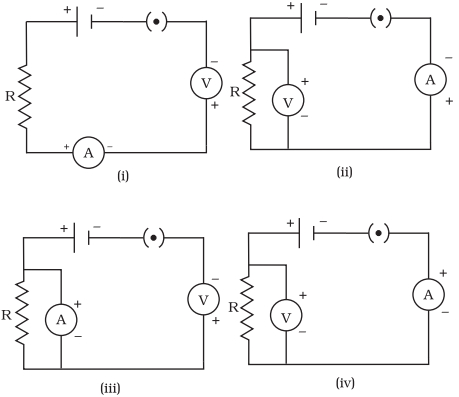
Identify the circuit (Figure) in which the electrical components have been properly connected.
A
$(ii)$
B
$(i)$
C
$(iii)$
D
$(iv)$
Solution
(D) To determine the correct circuit,we must follow these rules for connecting electrical components:
$1$. An ammeter $(A)$ must always be connected in series with the circuit component (resistor $R$) to measure the current flowing through it. Its positive terminal should be connected towards the positive terminal of the battery.
$2$. $A$ voltmeter $(V)$ must always be connected in parallel across the component (resistor $R$) whose potential difference is to be measured. Its positive terminal should be connected towards the positive terminal of the battery.
Evaluating the circuits:
- Circuit $(i)$: The voltmeter is connected in series,which is incorrect.
- Circuit $(ii)$: The ammeter is connected in parallel,which is incorrect.
- Circuit $(iii)$: The ammeter is connected in parallel,which is incorrect.
- Circuit $(iv)$: The ammeter is connected in series with the resistor,and the voltmeter is connected in parallel across the resistor. Both are connected with the correct polarity. Thus,this is the correctly connected circuit.
0 likes
View Solution6
EasyMCQ
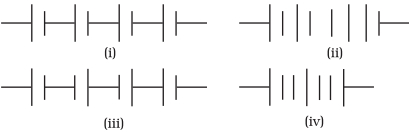
Which of the following combinations of cells in series (as shown in the figure) correctly represents the arrangement to obtain maximum potential?
A
$(i)$
B
$(ii)$
C
$(iii)$
D
$(iv)$
Solution
(A) To obtain the maximum potential difference from a combination of cells in series,the positive terminal of one cell must be connected to the negative terminal of the next cell.
In this arrangement,the potentials of the individual cells add up $(V_{total} = V_1 + V_2 + V_3 + ...)$.
Looking at the provided diagrams:
- In diagram $(i)$,the cells are connected such that the positive terminal of one is connected to the negative terminal of the next,which is the correct series arrangement.
- In the other diagrams,some cells are connected in reverse polarity,which would subtract from the total potential.
Therefore,$(i)$ is the correct representation.
0 likes
View Solution7
EasyMCQ
If the charge on an electron is $1.6 \times 10^{-19} \text{ C}$,find the approximate number of electrons in $1 \text{ C}$.
A
$6.25 \times 10^{18}$
B
$6 \times 10^{18}$
C
$1.6 \times 10^{19}$
D
$6.25 \times 10^{17}$
Solution
(A) The quantization of electric charge is given by the formula $q = ne$,where $q$ is the total charge,$n$ is the number of electrons,and $e$ is the elementary charge.
Given $q = 1 \text{ C}$ and $e = 1.6 \times 10^{-19} \text{ C}$.
To find the number of electrons $(n)$,we rearrange the formula: $n = q / e$.
Substituting the values: $n = 1 / (1.6 \times 10^{-19}) = 10^{19} / 1.6 = 6.25 \times 10^{18}$.
Therefore,there are approximately $6.25 \times 10^{18}$ electrons in $1 \text{ C}$ of charge.
0 likes
View Solution8
EasyMCQ
Calculate the number of electrons constituting one coulomb of charge. (Charge on one electron $= 1.6 \times 10^{-19} \text{ C}$)
A
$6.25 \times 10^{18}$
B
$1.6 \times 10^{19}$
C
$6.25 \times 10^{17}$
D
$1.6 \times 10^{18}$
Solution
(A) The total charge $Q$ is given as $1 \text{ C}$.
The charge on a single electron $e$ is $1.6 \times 10^{-19} \text{ C}$.
Using the quantization of charge formula, $Q = ne$, where $n$ is the number of electrons.
Therefore, $n = Q / e$.
$n = 1 \text{ C} / (1.6 \times 10^{-19} \text{ C})$.
$n = 1 / 1.6 \times 10^{19}$.
$n = 0.625 \times 10^{19}$.
$n = 6.25 \times 10^{18}$ electrons.
0 likes
View Solution9
Easy
$(a)$ Name the instrument/device used to measure electric current in a circuit.
$(b)$ How is an ammeter connected in a circuit to measure current flowing through it?
$(b)$ How is an ammeter connected in a circuit to measure current flowing through it?
Solution
(N/A) The instrument used to measure electric current in a circuit is called an $Ammeter$.
$(b)$ An $Ammeter$ is always connected in $series$ with the component or circuit through which the current is to be measured. This ensures that the total current flowing through the circuit passes through the $Ammeter$.
$(b)$ An $Ammeter$ is always connected in $series$ with the component or circuit through which the current is to be measured. This ensures that the total current flowing through the circuit passes through the $Ammeter$.
0 likes
View Solution10
Easy
In an electric circuit,state the relationship between the direction of conventional current and the direction of flow of electrons.
Solution
(N/A) The direction of conventional current is defined as the direction in which positive charges would move. Since electrons are negatively charged,they flow in the direction opposite to the conventional current. Therefore,the direction of conventional current is opposite to the direction of flow of electrons.
0 likes
View Solution11
EasyMCQ
Which particles are responsible for the flow of current in conductors?
A
Protons
B
Electrons
C
Neutrons
D
Positrons
Solution
(B) In metallic conductors,the flow of electric current is primarily due to the movement of free electrons. These electrons are negatively charged particles that move through the crystal lattice of the conductor when an external electric field is applied.
0 likes
View Solution12
EasyMCQ
How can we measure the current in a circuit?
A
By using a voltmeter
B
By using an ammeter
C
By using a galvanometer
D
By using a potentiometer
Solution
(B) The electric current in a circuit is measured using a device called an $Ammeter$.
An $Ammeter$ is always connected in series with the component through which the current is to be measured.
An $Ammeter$ is always connected in series with the component through which the current is to be measured.
0 likes
View Solution13
EasyMCQ
How is an ammeter connected in a circuit?
A
In series
B
In parallel
C
In series-parallel
D
None of the above
Solution
(A) An ammeter is a device used to measure the electric current flowing through a circuit. To measure the total current passing through the components,it must be connected in series with the circuit elements so that the same current flows through it.
0 likes
View Solution14
Easy
Define current. Give its $SI$ unit.
Solution
(N/A) Electric current is defined as the rate of flow of electric charge through a conductor. Mathematically,it is the amount of charge $Q$ flowing through a cross-section of a conductor in time $t$,expressed as $I = Q/t$.
The $SI$ unit of electric current is the ampere $(A)$,which is equivalent to one coulomb per second $(1 \ A = 1 \ C/s).$
The $SI$ unit of electric current is the ampere $(A)$,which is equivalent to one coulomb per second $(1 \ A = 1 \ C/s).$
0 likes
View Solution15
EasyMCQ
Does an ammeter have a low or a high resistance?
A
Low resistance
B
High resistance
C
Infinite resistance
D
Zero resistance
Solution
(A) An ammeter is a device used to measure the electric current in a circuit.
To measure current accurately,it must be connected in series with the circuit components.
If an ammeter had high resistance,it would significantly reduce the total current flowing through the circuit,leading to inaccurate readings.
Therefore,an ideal ammeter is designed to have a very low resistance so that it does not impede the flow of current.
0 likes
View Solution16
Easy
Define an electric circuit. Distinguish between an open and a closed circuit.
Solution
(N/A) An electric circuit is a continuous and closed path along which an electric current flows.
An open circuit is a circuit in which the path is broken or the switch is in the $OFF$ position,preventing the flow of current.
$A$ closed circuit is a circuit in which the path is complete and the switch is in the $ON$ position,allowing the electric current to flow continuously.
An open circuit is a circuit in which the path is broken or the switch is in the $OFF$ position,preventing the flow of current.
$A$ closed circuit is a circuit in which the path is complete and the switch is in the $ON$ position,allowing the electric current to flow continuously.
0 likes
View Solution17
EasyMCQ
The amount of charge passing through a cell in $4 \, s$ is $12 \, C$. Find the current supplied by the cell. (in $, A$)
A
$3$
B
$4$
C
$12$
D
$48$
Solution
(A) Given: Charge $Q = 12 \, C$,time $t = 4 \, s$.
The formula for electric current $I$ is given by $I = \frac{Q}{t}$.
Substituting the values,we get $I = \frac{12 \, C}{4 \, s} = 3 \, A$.
Therefore,the current supplied by the cell is $3 \, A$.
The formula for electric current $I$ is given by $I = \frac{Q}{t}$.
Substituting the values,we get $I = \frac{12 \, C}{4 \, s} = 3 \, A$.
Therefore,the current supplied by the cell is $3 \, A$.
0 likes
View Solution18
MediumMCQ
Calculate the number of electrons that would flow per second through the cross-section of a wire when $1 \, A$ current flows in it.
A
$6.25 \times 10^{18}$
B
$1.6 \times 10^{19}$
C
$6.25 \times 10^{19}$
D
$1.6 \times 10^{18}$
Solution
(A) Given: Current $I = 1 \, A$, Time $t = 1 \, s$.
We know that charge $Q = I \times t$.
Therefore, $Q = 1 \, A \times 1 \, s = 1 \, C$.
The charge of a single electron is $e = 1.6 \times 10^{-19} \, C$.
The number of electrons $n$ is given by the formula $n = \frac{Q}{e}$.
Substituting the values: $n = \frac{1 \, C}{1.6 \times 10^{-19} \, C}$.
$n = 0.625 \times 10^{19} = 6.25 \times 10^{18}$ electrons per second.
0 likes
View Solution19
Medium
List in a tabular form two differences between a voltmeter and an ammeter.
Solution
(N/A)
| Voltmeter | Ammeter |
| $(a)$ It is used to measure the potential difference between two points in a circuit. | $(a)$ It is used to measure the electric current flowing through a circuit. |
| $(b)$ It is always connected in parallel across the component. | $(b)$ It is always connected in series with the component. |
| $(c)$ It has a very high resistance to ensure minimal current flows through it. | $(c)$ It has a very low resistance to ensure minimal voltage drop across it. |
0 likes
View Solution20
Medium
$(a)$ What are the values of $mA$ and $\mu A$ in terms of Ampere $(A)$?
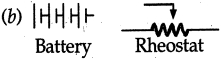
$(b)$ Draw the symbols of a battery and a rheostat.
$(b)$ Draw the symbols of a battery and a rheostat.
Solution
(N/A) The values are as follows:
$1 \text{ mA (milliampere)} = 10^{-3} \text{ A} = \frac{1}{1000} \text{ A}$
$1 \text{ } \mu\text{A (microampere)} = 10^{-6} \text{ A} = \frac{1}{1000000} \text{ A}$
$(b)$ The symbols for a battery and a rheostat are shown in the image provided.
$1 \text{ mA (milliampere)} = 10^{-3} \text{ A} = \frac{1}{1000} \text{ A}$
$1 \text{ } \mu\text{A (microampere)} = 10^{-6} \text{ A} = \frac{1}{1000000} \text{ A}$
$(b)$ The symbols for a battery and a rheostat are shown in the image provided.
0 likes
View Solution21
Easy
Define current,give its mathematical expression. What is its $SI$ unit?
Solution
(N/A) Electric current is defined as the rate of flow of electric charge through a conductor.
Mathematically,it is expressed as $I = \frac{Q}{t}$,where $I$ is the current,$Q$ is the net charge flowing through a cross-section,and $t$ is the time taken.
The $SI$ unit of electric current is the ampere $(A)$.
Mathematically,it is expressed as $I = \frac{Q}{t}$,where $I$ is the current,$Q$ is the net charge flowing through a cross-section,and $t$ is the time taken.
The $SI$ unit of electric current is the ampere $(A)$.
0 likes
View Solution22
Easy
Define one ampere.
Solution
(N/A) The current through a conductor is said to be $1$ ampere if a charge of $1$ coulomb flows through it in $1$ second. Mathematically,it is expressed as $I = Q/t$,where $I = 1 \text{ A}$,$Q = 1 \text{ C}$,and $t = 1 \text{ s}$.
0 likes
View Solution23
Easy
An electric bulb draws a current of $0.2 A$ when the voltage is $220 V$. Calculate the amount of charge flowing through it in one hour.
Solution
(720 C) The formula for electric charge is $Q = I \times t$.
Given:
Current $(I)$ = $0.2 A$
Time $(t)$ = $1 \text{ hour} = 3600 s$
Calculation:
$Q = 0.2 A \times 3600 s$
$Q = 720 C$
Therefore,the total charge flowing through the bulb is $720 C$.
Given:
Current $(I)$ = $0.2 A$
Time $(t)$ = $1 \text{ hour} = 3600 s$
Calculation:
$Q = 0.2 A \times 3600 s$
$Q = 720 C$
Therefore,the total charge flowing through the bulb is $720 C$.
0 likes
View Solution24
EasyMCQ
An electric iron draws a current of $0.5\, A$ when the voltage is $200\, V$. Calculate the amount of electric charge flowing through it in one hour. (in $C$)
A
$1800$
B
$3600$
C
$720$
D
$900$
Solution
(A) Given:
Current $(I)$ = $0.5\, A$
Time $(t)$ = $1\, \text{hour} = 60 \times 60 = 3600\, s$
Voltage $(V)$ = $200\, V$
Formula for electric charge is $Q = I \times t$
Substituting the values:
$Q = 0.5\, A \times 3600\, s = 1800\, C$
Therefore, the amount of electric charge flowing through the electric iron is $1800\, C$.
0 likes
View Solution25
Easy
An electric appliance draws a current of $0.4\, A$ when the voltage is $200\, V$. Calculate the amount of charge flowing through it in one hour.
Solution
(1440 C) The formula for electric charge is $Q = I \times t$.
Given:
Current $(I)$ = $0.4\, A$
Time $(t)$ = $1\, \text{hour} = 60 \times 60\, s = 3600\, s$.
Substituting the values into the formula:
$Q = 0.4\, A \times 3600\, s$
$Q = 1440\, C$.
Therefore, the total charge flowing through the appliance is $1440\, C$.
Given:
Current $(I)$ = $0.4\, A$
Time $(t)$ = $1\, \text{hour} = 60 \times 60\, s = 3600\, s$.
Substituting the values into the formula:
$Q = 0.4\, A \times 3600\, s$
$Q = 1440\, C$.
Therefore, the total charge flowing through the appliance is $1440\, C$.
0 likes
View Solution26
EasyMCQ
What is the frequency of $DC$ (in $Hz$)?
A
$0$
B
$50$
C
$60$
D
$100$
Solution
(A) Direct Current $(DC)$ flows in a constant direction and maintains a constant magnitude over time.
Since the current does not oscillate or change its direction periodically,it does not complete any cycles per second.
Therefore,the frequency of $DC$ is $0 \ Hz$.
Since the current does not oscillate or change its direction periodically,it does not complete any cycles per second.
Therefore,the frequency of $DC$ is $0 \ Hz$.
0 likes
View Solution27
EasyMCQ
The electric current that always flows in the same direction is called alternating current.
A
True
B
False
Solution
(B) The statement is $False$.
Electric current that flows in a single direction is known as $Direct \ Current$ $(DC)$.
$Alternating \ Current$ $(AC)$ is the current that periodically reverses its direction.
Electric current that flows in a single direction is known as $Direct \ Current$ $(DC)$.
$Alternating \ Current$ $(AC)$ is the current that periodically reverses its direction.
0 likes
View Solution28
EasyMCQ
One should always use rubber gloves and rubber shoes when dealing with electricity.
A
True
B
False
Solution
(A) Rubber is an insulator,meaning it does not allow electric current to flow through it. By wearing rubber gloves and rubber shoes,a person creates a high-resistance barrier that prevents electricity from passing through the body to the ground,thereby protecting the individual from electric shocks.
0 likes
View Solution29
Easy
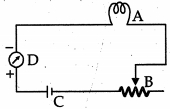
Given below is a circuit showing current flowing in it. Identify each component $A, B, C, D$ of this circuit.
Solution
(N/A) Based on standard circuit symbols:
$A$ represents an electric bulb,which is a load in the circuit.
$B$ represents a rheostat (variable resistor),used to control the current in the circuit.
$C$ represents an electric cell,which acts as the source of potential difference.
$D$ represents an ammeter,which is used to measure the electric current flowing through the circuit.
0 likes
View Solution30
MediumMCQ
Name and define the $SI$ unit of current. Calculate the number of electrons that flow through a conductor in $1$ second to constitute a current of $1$ ampere. (Charge on an electron $= 1.6 \times 10^{-19} \text{ C}$)
A
Ampere,$6.25 \times 10^{18}$ electrons
B
Coulomb,$1.6 \times 10^{19}$ electrons
C
Volt,$6.25 \times 10^{19}$ electrons
D
Ohm,$1.0 \times 10^{18}$ electrons
Solution
(A) The $SI$ unit of electric current is the ampere $(A)$.
One ampere is defined as the flow of $1$ coulomb of charge per second through a conductor $(1 \text{ A} = 1 \text{ C/s})$.
To calculate the number of electrons $(n)$:
Given: Current $(I)$ = $1 \text{ A}$,Time $(t)$ = $1 \text{ s}$,Charge on an electron $(e)$ = $1.6 \times 10^{-19} \text{ C}$.
Using the formula $Q = I \times t$ and $Q = n \times e$,we get $n = \frac{I \times t}{e}$.
$n = \frac{1 \text{ A} \times 1 \text{ s}}{1.6 \times 10^{-19} \text{ C}} = \frac{1}{1.6} \times 10^{19} = 6.25 \times 10^{18}$.
Thus,$6.25 \times 10^{18}$ electrons flow through the conductor in $1$ second.
0 likes
View Solution31
Medium
$(a)$ How is the direction of electric current related to the direction of flow of electrons in a wire?
$(b)$ Calculate the current in a circuit,if $500 \, C$ of charge passes through it in $10$ minutes.
$(b)$ Calculate the current in a circuit,if $500 \, C$ of charge passes through it in $10$ minutes.
Solution
(N/A) The direction of electric current is conventionally defined as opposite to the direction of the flow of electrons in a wire.
$(b)$ Given:
Charge $(Q) = 500 \, C$
Time $(t) = 10 \, \text{minutes} = 10 \times 60 \, \text{s} = 600 \, \text{s}$
Using the formula for electric current:
$I = \frac{Q}{t}$
$I = \frac{500 \, C}{600 \, \text{s}}$
$I = 0.833 \, \text{A}$
Therefore,the current in the circuit is approximately $0.833 \, \text{A}$.
0 likes
View Solution32
EasyMCQ
$A$ current of $0.5\, A$ is drawn by a filament of an electric bulb for $10$ minutes. Find the amount of electric charge that flows through the circuit. (in $C$)
A
$300$
B
$30$
C
$3000$
D
$5$
Solution
(A) Given: Current $I = 0.5\, A$, Time $t = 10\, \text{min} = 10 \times 60 = 600\, \text{s}$.
The formula for electric charge $Q$ is $Q = I \times t$.
Substituting the values: $Q = 0.5\, A \times 600\, \text{s} = 300\, C$.
Therefore, the amount of electric charge that flows through the circuit is $300\, C$.
The formula for electric charge $Q$ is $Q = I \times t$.
Substituting the values: $Q = 0.5\, A \times 600\, \text{s} = 300\, C$.
Therefore, the amount of electric charge that flows through the circuit is $300\, C$.
0 likes
View Solution33
Medium
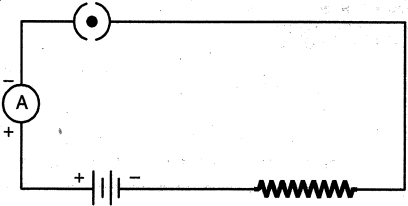
What is meant by an electric circuit? Draw a circuit diagram to show an electric circuit comprising a battery of two cells,a resistor,an ammeter,and a plug key when the circuit is closed.
Solution
(N/A) An electric circuit is a continuous and closed path in which an electric current flows.
The circuit diagram consists of a battery of two cells,a resistor,an ammeter,and a closed plug key connected in series. The ammeter is connected in series with the resistor,and the positive terminal of the battery is connected to the positive terminal of the ammeter.
The circuit diagram consists of a battery of two cells,a resistor,an ammeter,and a closed plug key connected in series. The ammeter is connected in series with the resistor,and the positive terminal of the battery is connected to the positive terminal of the ammeter.
0 likes
View Solution34
Easy
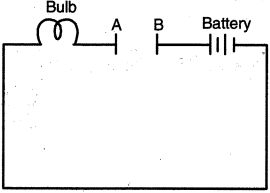
In an experimental set-up as shown below,a piece of silver was placed touching points $A$ and $B$. Next time it was replaced by a piece of wood. In which case did the bulb glow? Give reason to justify the observation.
Solution
(N/A) The bulb will glow only when the piece of silver is placed between points $A$ and $B$.
Silver is a metal and acts as a good conductor of electricity,which completes the electrical circuit and allows current to flow through the bulb.
In contrast,wood is an insulator (a bad conductor of electricity). When a piece of wood is placed between points $A$ and $B$,it breaks the electrical circuit,preventing the flow of current,and therefore the bulb does not glow.
0 likes
View Solution35
EasyMCQ
The unit of measurement of charge is coulomb.
A
True
B
False
Solution
(A) The $SI$ unit of electric charge is the coulomb $(C)$. It is defined as the amount of charge transported by a constant current of one ampere in one second $(1 \ C = 1 \ A \cdot s)$.
0 likes
View Solution36
EasyMCQ
An electron in a metal is free to move anywhere but cannot leave the metal.
A
True
B
False
Solution
(A) In a metal,electrons in the outermost shells of atoms are loosely bound to the nucleus. These are called free electrons. They can move randomly throughout the entire volume of the metal conductor. However,they cannot escape the metal surface under normal conditions because there is a potential barrier at the surface that keeps them confined within the material.
0 likes
View Solution37
EasyMCQ
The quantity of charge flowing past a point multiplied by time is current.
A
True
B
False
C
Cannot be determined
D
None of the above
Solution
(B) The definition of electric current $(I)$ is the rate of flow of electric charge $(Q)$ through a conductor.
Mathematically,current is defined as the quantity of charge flowing past a point divided by the time $(t)$ taken for that flow.
Formula: $I = Q / t$.
Therefore,the statement that current is charge multiplied by time is incorrect.
Mathematically,current is defined as the quantity of charge flowing past a point divided by the time $(t)$ taken for that flow.
Formula: $I = Q / t$.
Therefore,the statement that current is charge multiplied by time is incorrect.
0 likes
View Solution38
EasyMCQ
The flow of charge through a conducting wire connected to a cell is the result of chemical reaction inside the cell.
A
True
B
False
Solution
(A) cell is a device that converts chemical energy into electrical energy. Inside the cell,chemical reactions occur that create a potential difference between the two terminals. This potential difference drives the flow of electrons (charge) through the connected conducting wire,resulting in an electric current.
0 likes
View Solution39
EasyMCQ
What is the $SI$ unit of electric charge?
A
Ampere
B
Volt
C
Watt
D
Coulomb
Solution
(D) The $SI$ unit of electric charge is the Coulomb $(C)$.
$1$ Coulomb is defined as the quantity of charge that passes through a point in a circuit when a current of $1$ Ampere flows for $1$ second.
- Ampere $(A)$ is the $SI$ unit of electric current.
- Volt $(V)$ is the $SI$ unit of electric potential difference.
- Watt $(W)$ is the $SI$ unit of power.
$1$ Coulomb is defined as the quantity of charge that passes through a point in a circuit when a current of $1$ Ampere flows for $1$ second.
- Ampere $(A)$ is the $SI$ unit of electric current.
- Volt $(V)$ is the $SI$ unit of electric potential difference.
- Watt $(W)$ is the $SI$ unit of power.
0 likes
View Solution40
EasyMCQ
How many electrons will there be in $1.6 \ C$ charge?
A
$10^{17}$
B
$10^{18}$
C
$10^{19}$
D
$10^{20}$
Solution
(C) The quantization of electric charge is given by the formula $Q = ne$,where $Q$ is the total charge,$n$ is the number of electrons,and $e$ is the elementary charge of an electron.
Given: Total charge $Q = 1.6 \ C$ and the charge of one electron $e = 1.6 \times 10^{-19} \ C$.
Rearranging the formula to solve for $n$: $n = Q / e$.
Substituting the values: $n = 1.6 \ C / (1.6 \times 10^{-19} \ C) = 1 / 10^{-19} = 10^{19}$.
Therefore,there are $10^{19}$ electrons in a charge of $1.6 \ C$.
0 likes
View Solution41
EasyMCQ
$1\, \mu A = \dots \dots \dots \,mA$
A
$10^{-6}$
B
$10^{-3}$
C
$10^{3}$
D
$10^{6}$
Solution
(B) The prefix $\mu$ (micro) represents $10^{-6}$ and the prefix $m$ (milli) represents $10^{-3}$.
To convert $1\, \mu A$ to $mA$,we use the following calculation:
$1\, \mu A = 10^{-6}\, A$
$1\, mA = 10^{-3}\, A$
Therefore,$1\, \mu A = \frac{10^{-6}}{10^{-3}}\, mA = 10^{-6 - (-3)}\, mA = 10^{-3}\, mA$.
To convert $1\, \mu A$ to $mA$,we use the following calculation:
$1\, \mu A = 10^{-6}\, A$
$1\, mA = 10^{-3}\, A$
Therefore,$1\, \mu A = \frac{10^{-6}}{10^{-3}}\, mA = 10^{-6 - (-3)}\, mA = 10^{-3}\, mA$.
0 likes
View Solution42
EasyMCQ
Which of the following materials has the highest number of free electrons?
A
Copper
B
Glass
C
Rubber
D
Paper
Solution
(A) Free electrons are the charge carriers responsible for electrical conductivity in materials.
Materials are classified as conductors,insulators,or semiconductors based on the availability of free electrons.
$A$. Copper is a metal and an excellent conductor of electricity because it possesses a large number of free electrons.
$B$. Glass,$C$. Rubber,and $D$. Paper are insulators,meaning they have very few or negligible free electrons,which prevents the flow of electric current.
Therefore,Copper has the highest number of free electrons among the given options.
0 likes
View Solution43
EasyMCQ
The formula for an electric current is $.....$
A
$I = Q \cdot t$
B
$I = Q / t$
C
$I = t / Q$
D
$I = W \cdot t$
Solution
(B) Electric current $(I)$ is defined as the rate of flow of electric charge $(Q)$ through a conductor.
Mathematically,it is expressed as the amount of charge flowing per unit time $(t)$.
Therefore,the formula is $I = Q / t$,where $I$ is current in Amperes,$Q$ is charge in Coulombs,and $t$ is time in seconds.
Mathematically,it is expressed as the amount of charge flowing per unit time $(t)$.
Therefore,the formula is $I = Q / t$,where $I$ is current in Amperes,$Q$ is charge in Coulombs,and $t$ is time in seconds.
0 likes
View Solution44
EasyMCQ
The amount of $2 \ A$ electric current is passed for $1 \ minute$ through a conducting wire. How much total electric charge will pass through this wire (in $C$)?
A
$2$
B
$30$
C
$60$
D
$120$
Solution
(D) The formula for electric charge $(Q)$ is given by the product of electric current $(I)$ and time $(t)$: $Q = I \times t$.
Given:
Electric current $(I)$ = $2 \ A$
Time $(t)$ = $1 \ minute = 60 \ seconds$.
Substituting the values into the formula:
$Q = 2 \ A \times 60 \ s = 120 \ C$.
Therefore,the total electric charge passing through the wire is $120 \ C$.
Given:
Electric current $(I)$ = $2 \ A$
Time $(t)$ = $1 \ minute = 60 \ seconds$.
Substituting the values into the formula:
$Q = 2 \ A \times 60 \ s = 120 \ C$.
Therefore,the total electric charge passing through the wire is $120 \ C$.
0 likes
View Solution45
EasyMCQ
If $4.8 \text{ A}$ current is passed through an electrical appliance,then the number of electrons passing through it in $1 \text{ second}$ will be $......$
A
$0.33 \times 10^{19}$
B
$3.3 \times 10^{19}$
C
$3 \times 10^{19}$
D
$4.8 \times 10^{19}$
Solution
(C) The formula for electric current $(I)$ is given by $I = \frac{Q}{t}$,where $Q$ is the total charge and $t$ is the time.
Since $Q = ne$,where $n$ is the number of electrons and $e$ is the elementary charge $(e \approx 1.6 \times 10^{-19} \text{ C})$,the formula becomes $I = \frac{ne}{t}$.
Given: $I = 4.8 \text{ A}$,$t = 1 \text{ s}$,and $e = 1.6 \times 10^{-19} \text{ C}$.
Rearranging for $n$: $n = \frac{I \times t}{e}$.
Substituting the values: $n = \frac{4.8 \times 1}{1.6 \times 10^{-19}}$.
$n = 3 \times 10^{19}$ electrons.
Therefore,the number of electrons passing through the appliance is $3 \times 10^{19}$.
0 likes
View Solution46
EasyMCQ
What type of electric charge does a proton possess?
A
Positive
B
Negative
C
Zero
D
Neutral
Solution
(A) proton is a subatomic particle found in the nucleus of an atom.
It carries a fundamental positive electric charge of approximately $+1.602 \times 10^{-19} \ C$.
Therefore,the correct option is $A$.
It carries a fundamental positive electric charge of approximately $+1.602 \times 10^{-19} \ C$.
Therefore,the correct option is $A$.
0 likes
View Solution47
EasyMCQ
What type of electric charge does an electron possess?
A
Zero
B
Positive
C
Negative
D
No charge
Solution
(C) An electron is a subatomic particle that carries a fundamental negative electric charge. By convention,the charge of an electron is defined as $-1.602 \times 10^{-19} \ C$.
0 likes
View Solution48
EasyMCQ
What is the magnitude of the electric charge on an electron?
A
$1.6 \times 10^{-19} \ C$
B
$6.25 \times 10^{-18} \ C$
C
$1.6 \times 10^{-18} \ C$
D
$6.25 \times 10^{-19} \ C$
Solution
(A) The elementary charge,denoted by $e$,is the electric charge carried by a single proton or,equivalently,the magnitude of the negative electric charge carried by a single electron.
It is a fundamental physical constant.
The value of the charge on an electron is approximately $1.602 \times 10^{-19} \ C$.
Therefore,the correct magnitude is $1.6 \times 10^{-19} \ C$.
It is a fundamental physical constant.
The value of the charge on an electron is approximately $1.602 \times 10^{-19} \ C$.
Therefore,the correct magnitude is $1.6 \times 10^{-19} \ C$.
0 likes
View Solution49
EasyMCQ
How many electrons constitute a total charge of $1 \ C$?
A
$1.6 \times 10^{19}$
B
$6.25 \times 10^{18}$
C
$1.6 \times 10^{18}$
D
$6.25 \times 10^{19}$
Solution
(B) The quantization of electric charge is given by the formula $Q = ne$,where $Q$ is the total charge,$n$ is the number of electrons,and $e$ is the elementary charge of an electron.
Given: $Q = 1 \ C$ and $e = 1.6 \times 10^{-19} \ C$.
Rearranging the formula to solve for $n$: $n = Q / e$.
Substituting the values: $n = 1 / (1.6 \times 10^{-19})$.
$n = 10^{19} / 1.6$.
$n = 0.625 \times 10^{19} = 6.25 \times 10^{18}$.
Therefore,$6.25 \times 10^{18}$ electrons constitute a total charge of $1 \ C$.
0 likes
View Solution50
EasyMCQ
What is the total electric charge on $100$ protons in Coulombs?
A
$1.6 \times 10^{-21}$
B
$1.6 \times 10^{-20}$
C
$1.6 \times 10^{-17}$
D
$1.6 \times 10^{-16}$
Solution
(C) The charge of a single proton is $e = 1.6 \times 10^{-19} \ C$.
To find the total charge $(Q)$ on $n = 100$ protons,we use the formula $Q = n \times e$.
Substituting the values: $Q = 100 \times (1.6 \times 10^{-19} \ C)$.
$Q = 10^2 \times 1.6 \times 10^{-19} \ C$.
$Q = 1.6 \times 10^{-17} \ C$.
Therefore,the total electric charge is $1.6 \times 10^{-17} \ C$.
To find the total charge $(Q)$ on $n = 100$ protons,we use the formula $Q = n \times e$.
Substituting the values: $Q = 100 \times (1.6 \times 10^{-19} \ C)$.
$Q = 10^2 \times 1.6 \times 10^{-19} \ C$.
$Q = 1.6 \times 10^{-17} \ C$.
Therefore,the total electric charge is $1.6 \times 10^{-17} \ C$.
0 likes
View SolutionElectricity — Electric Current and Circuit · Frequently Asked Questions
1Are these Electricity questions useful for JEE and NEET?
Yes. All questions in this section are mapped to JEE Main and NEET exam patterns. Previous year questions from JEE Main, NEET, GUJCET and state-level exams are included with full solutions.
2Can I switch to Hindi or Gujarati for these questions?
Yes. Use the language tabs in the hero section or the sidebar to view the same questions and solutions in English, Hindi or Gujarati.
3How do I generate a question paper from this subtopic?
Use the Vedclass Exam Paper Generator — select the chapter and subtopic, set difficulty, and generate Sets A, B, C, D automatically. First 3 chapters of every subject are free.
Vedclass Products
For Students
Vedclass Test Series
Mock tests in real JEE/NEET style with performance analysis. 5-day free trial.
Start Free TrialFor Teachers
Exam Paper Generator
Generate Set A/B/C/D papers from this chapter in 2 minutes. 3 chapters free.
Try FreeFor Institutes
Online Exam Module
Live online exams with unlimited students, 360° analytics & white-label branding.
See DemoFor Teachers & Institutes
Generate a Electricity Exam Paper in 2 Minutes
Select subtopic & difficulty — Sets A, B, C, D auto-generated with No Repeat logic.
First 3 chapters of every subject are free — no payment required.