
A English
Resistors in Series and Parallel Questions in English
Class 10 Science · Electricity · Resistors in Series and Parallel
84+
Questions
English
Language
100%
With Solutions
Showing 50 of 84 questions in English
1
Medium
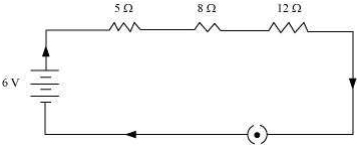
Draw a schematic diagram of a circuit consisting of a battery of three cells of $2\, V$ each,a $5 \,\Omega $ resistor,an $8\,\Omega $ resistor,and a $12\,\Omega $ resistor,and a plug key,all connected in series.
Solution
(N/A) Three cells of potential $2\, V$ each,connected in series,are equivalent to a battery of potential $2\, V + 2\, V + 2\, V = 6\, V$.
The following circuit diagram shows three resistors of resistances $5 \,\Omega$,$8 \,\Omega$,and $12 \,\Omega$ respectively,connected in series with a battery of potential $6\, V$ and a closed plug key.
The following circuit diagram shows three resistors of resistances $5 \,\Omega$,$8 \,\Omega$,and $12 \,\Omega$ respectively,connected in series with a battery of potential $6\, V$ and a closed plug key.
0 likes
View Solution2
Difficult
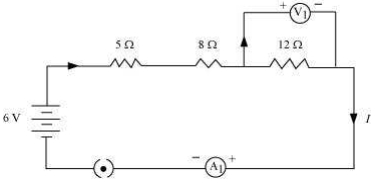
Draw a schematic diagram of a circuit consisting of a battery of three cells of $2\, V$ each,a $5\,\Omega$ resistor,an $8\,\Omega$ resistor,and a $12\,\Omega$ resistor,and a plug key,all connected in series. Include an ammeter to measure the current through the resistors and a voltmeter to measure the potential difference across the $12\,\Omega$ resistor. What would be the readings in the ammeter and the voltmeter?
Solution
(N/A) To measure the current flowing through the resistors,an ammeter should be connected in the circuit in series with the resistors. To measure the potential difference across the $12\,\Omega$ resistor,a voltmeter should be connected in parallel to this resistor.
The total voltage of the battery is $V = 3 \times 2\, V = 6\, V$.
The resistances are connected in series,so the total resistance $R$ is:
$R = 5\,\Omega + 8\,\Omega + 12\,\Omega = 25\,\Omega$.
According to Ohm's law,$V = IR$,the current $I$ flowing through the circuit is:
$I = \frac{V}{R} = \frac{6\, V}{25\,\Omega} = 0.24\, A$.
Thus,the ammeter reading is $0.24\, A$.
The potential difference $V_1$ across the $12\,\Omega$ resistor is calculated using Ohm's law:
$V_1 = I \times R_{12\,\Omega} = 0.24\, A \times 12\,\Omega = 2.88\, V$.
Therefore,the reading of the voltmeter is $2.88\, V$.
0 likes
View Solution3
MediumMCQ
Judge the equivalent resistance when the following are connected in parallel: $1\, \Omega$ and $10^6\, \Omega$.
A
Less than $1\, \Omega$
B
More than $1\, \Omega$
C
Exactly $1\, \Omega$
D
Exactly $10^6\, \Omega$
Solution
(A) When two resistors $R_1$ and $R_2$ are connected in parallel,the equivalent resistance $R$ is given by the formula: $\frac{1}{R} = \frac{1}{R_1} + \frac{1}{R_2}$.
Given $R_1 = 1\, \Omega$ and $R_2 = 10^6\, \Omega$.
Substituting the values: $\frac{1}{R} = \frac{1}{1} + \frac{1}{10^6} = 1 + 0.000001 = 1.000001\, \Omega^{-1}$.
Therefore,$R = \frac{1}{1.000001} \approx 0.999999\, \Omega$.
Since $0.999999\, \Omega < 1\, \Omega$,the equivalent resistance is slightly less than $1\, \Omega$.
0 likes
View Solution4
Difficult
Judge the equivalent resistance when the following are connected in parallel: $1 \, \Omega$,$10^3 \, \Omega$,and $10^6 \, \Omega$.
Solution
(D) When $1 \, \Omega$,$10^3 \, \Omega$,and $10^6 \, \Omega$ are connected in parallel,the equivalent resistance $R$ is given by the formula:
$\frac{1}{R} = \frac{1}{R_1} + \frac{1}{R_2} + \frac{1}{R_3}$
Substituting the values:
$\frac{1}{R} = \frac{1}{1} + \frac{1}{10^3} + \frac{1}{10^6} = 1 + 0.001 + 0.000001 = 1.001001 \, \Omega^{-1}$
Therefore,$R = \frac{1}{1.001001} \approx 0.999 \, \Omega$.
In a parallel combination,the equivalent resistance is always less than the smallest individual resistance. Since $1 \, \Omega$ is the smallest,the result $0.999 \, \Omega$ is consistent with this principle.
0 likes
View Solution5
Difficult
An electric lamp of $100 \,\Omega$,a toaster of resistance $50 \,\Omega$,and a water filter of resistance $500 \,\Omega$ are connected in parallel to a $220 \,V$ source. What is the resistance of an electric iron connected to the same source that takes as much current as all three appliances,and what is the current through it?
Solution
(D) Resistance of electric lamp,$R_1 = 100 \,\Omega$.
Resistance of toaster,$R_2 = 50 \,\Omega$.
Resistance of water filter,$R_3 = 500 \,\Omega$.
Voltage of the source,$V = 220 \,V$.
These are connected in parallel.
Let $R$ be the equivalent resistance of the circuit.
$\frac{1}{R} = \frac{1}{R_1} + \frac{1}{R_2} + \frac{1}{R_3} = \frac{1}{100} + \frac{1}{50} + \frac{1}{500}$.
$\frac{1}{R} = \frac{5 + 10 + 1}{500} = \frac{16}{500}$.
$R = \frac{500}{16} \,\Omega = 31.25 \,\Omega$.
According to Ohm's law,$V = IR$,so the total current $I = \frac{V}{R}$.
$I = \frac{220}{500/16} = \frac{220 \times 16}{500} = 7.04 \,A$.
Since the electric iron takes as much current as all three appliances,the current through the iron is $I' = 7.04 \,A$.
Using Ohm's law for the electric iron,$R' = \frac{V}{I'} = \frac{220}{7.04} = 31.25 \,\Omega$.
Therefore,the resistance of the electric iron is $31.25 \,\Omega$ and the current flowing through it is $7.04 \,A$.
0 likes
View Solution6
Medium
What are the advantages of connecting electrical devices in parallel with the battery instead of connecting them in series?
Solution
(N/A) $1$. In a parallel circuit,the voltage remains the same across all electrical appliances,which is equal to the source voltage. This ensures that each device operates at its rated voltage.
$2$. If one electrical appliance stops working due to a defect or switch-off,the other appliances continue to function because each device has its own independent circuit path.
$3$. The total effective resistance of the circuit decreases when appliances are connected in parallel,allowing for a higher total current to be drawn from the source as needed.
0 likes
View Solution7
Difficult
How can three resistors of resistances $2 \,\Omega$,$3 \,\Omega$,and $6 \,\Omega$ be connected to give a total resistance of $4 \,\Omega$?
Solution
(N/A) We have three resistors with resistances $R_1 = 2 \,\Omega$,$R_2 = 3 \,\Omega$,and $R_3 = 6 \,\Omega$.
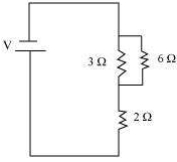
To obtain a total resistance of $4 \,\Omega$,we connect the $3 \,\Omega$ and $6 \,\Omega$ resistors in parallel,and then connect this combination in series with the $2 \,\Omega$ resistor.
First,calculate the equivalent resistance $(R_p)$ of the $3 \,\Omega$ and $6 \,\Omega$ resistors connected in parallel:
$\frac{1}{R_p} = \frac{1}{3} + \frac{1}{6} = \frac{2+1}{6} = \frac{3}{6} = \frac{1}{2}$
$R_p = 2 \,\Omega$
Next,connect this equivalent resistance $(R_p)$ in series with the $2 \,\Omega$ resistor:
$R_{total} = R_p + 2 \,\Omega = 2 \,\Omega + 2 \,\Omega = 4 \,\Omega$
Thus,the total resistance of the circuit is $4 \,\Omega$.
0 likes
View Solution8
Medium
How can three resistors of resistances $2\, \Omega$,$3\, \Omega$,and $6\, \Omega$ be connected to give a total resistance of $1\, \Omega$?
Solution
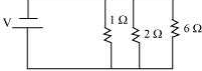
(N/A) To obtain a total resistance of $1\, \Omega$ from resistors of $2\, \Omega$,$3\, \Omega$,and $6\, \Omega$,they must be connected in parallel.
The formula for the equivalent resistance $(R_p)$ of resistors connected in parallel is given by:
$\frac{1}{R_p} = \frac{1}{R_1} + \frac{1}{R_2} + \frac{1}{R_3}$
Substituting the given values:
$\frac{1}{R_p} = \frac{1}{2} + \frac{1}{3} + \frac{1}{6}$
Taking the least common multiple $(LCM)$ of $2, 3,$ and $6$,which is $6$:
$\frac{1}{R_p} = \frac{3 + 2 + 1}{6} = \frac{6}{6} = 1\, \Omega^{-1}$
Therefore,$R_p = 1\, \Omega$.
Thus,connecting all three resistors in parallel results in a total resistance of $1\, \Omega$.
0 likes
View Solution9
MediumMCQ
What is the highest and lowest total resistance that can be secured by combinations of four coils of resistance $4 \,\Omega, 8 \,\Omega, 12 \,\Omega$ and $24 \,\Omega$?
A
$48 \,\Omega; 2 \,\Omega$
B
$24 \,\Omega; 4 \,\Omega$
C
$24 \,\Omega; 2 \,\Omega$
D
$48 \,\Omega; 1 \,\Omega$
Solution
(A) Given four coils with resistances $R_1 = 4 \,\Omega, R_2 = 8 \,\Omega, R_3 = 12 \,\Omega$,and $R_4 = 24 \,\Omega$.
$(a)$ To obtain the highest total resistance,the coils must be connected in series. The equivalent resistance $R_s$ is the sum of individual resistances:
$R_s = R_1 + R_2 + R_3 + R_4 = 4 + 8 + 12 + 24 = 48 \,\Omega$.
$(b)$ To obtain the lowest total resistance,the coils must be connected in parallel. The equivalent resistance $R_p$ is given by:
$\frac{1}{R_p} = \frac{1}{R_1} + \frac{1}{R_2} + \frac{1}{R_3} + \frac{1}{R_4} = \frac{1}{4} + \frac{1}{8} + \frac{1}{12} + \frac{1}{24}$.
Taking the least common multiple $(LCM)$ of $4, 8, 12, 24$,which is $24$:
$\frac{1}{R_p} = \frac{6 + 3 + 2 + 1}{24} = \frac{12}{24} = \frac{1}{2}$.
Therefore,$R_p = 2 \,\Omega$.
Thus,the highest resistance is $48 \,\Omega$ and the lowest resistance is $2 \,\Omega$.
0 likes
View Solution10
DifficultMCQ
$A$ piece of wire of resistance $R$ is cut into five equal parts. These parts are then connected in parallel. If the equivalent resistance of this combination is $R'$,then the ratio $R/R'$ is
A
$1/25$
B
$1/5$
C
$25$
D
$5$
Solution
(C) The resistance of a wire is directly proportional to its length $(R \propto l)$.
When a wire of resistance $R$ is cut into five equal parts,the resistance of each part becomes $R/5$.
When these five parts are connected in parallel,the equivalent resistance $R'$ is given by the formula:
$1/R' = 1/R_1 + 1/R_2 + 1/R_3 + 1/R_4 + 1/R_5$
Substituting $R_1 = R_2 = R_3 = R_4 = R_5 = R/5$:
$1/R' = 5/R + 5/R + 5/R + 5/R + 5/R = 25/R$
Therefore,$R/R' = 25$.
0 likes
View Solution11
DifficultMCQ
$A$ battery of $9 \, V$ is connected in series with resistors of $0.2 \, \Omega$,$0.3 \, \Omega$,$0.4 \, \Omega$,$0.5 \, \Omega$,and $12 \, \Omega$ respectively. How much current (in $A$) would flow through the $12 \, \Omega$ resistor?
A
$1.33$
B
$1.67$
C
$0.67$
D
$0.33$
Solution
(C) In a series circuit,the current remains the same through all components. According to Ohm's law,the current $I$ is given by $I = \frac{V}{R_{eq}}$.
The equivalent resistance $R_{eq}$ for resistors connected in series is the sum of individual resistances:
$R_{eq} = 0.2 + 0.3 + 0.4 + 0.5 + 12 = 13.4 \, \Omega$.
Given the potential difference $V = 9 \, V$,the current is:
$I = \frac{9}{13.4} \approx 0.671 \, A$.
Thus,the current flowing through the $12 \, \Omega$ resistor is approximately $0.67 \, A$.
0 likes
View Solution12
DifficultMCQ
How many $176 \,\Omega$ resistors (in parallel) are required to carry $5 \,A$ on a $220 \,V$ line?
A
$6$
B
$8$
C
$2$
D
$4$
Solution
(D) According to Ohm's law,the equivalent resistance $R$ required for the circuit is given by $V = I R$,which implies $R = V / I$.
Given supply voltage $V = 220 \,V$ and current $I = 5 \,A$,the required equivalent resistance is $R = 220 / 5 = 44 \,\Omega$.
When $x$ resistors of resistance $r = 176 \,\Omega$ are connected in parallel,the equivalent resistance $R$ is given by $1 / R = x / r$.
Substituting the values,we get $1 / 44 = x / 176$.
Solving for $x$,we get $x = 176 / 44 = 4$.
Therefore,$4$ resistors of $176 \,\Omega$ are required.
0 likes
View Solution13
Difficult
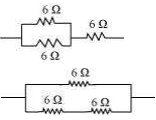
Show how you would connect three resistors,each of resistance $6 \, \Omega$,so that the combination has a resistance of $(i)$ $9 \, \Omega$,$(ii)$ $4 \, \Omega$.
Solution
(N/A) To obtain the desired equivalent resistance,we analyze different combinations of the three $6 \, \Omega$ resistors.
$(i)$ To get $9 \, \Omega$:
We connect two $6 \, \Omega$ resistors in parallel and the third $6 \, \Omega$ resistor in series with this combination.
Equivalent resistance of the parallel part: $\frac{1}{R_p} = \frac{1}{6} + \frac{1}{6} = \frac{2}{6} = \frac{1}{3} \implies R_p = 3 \, \Omega$.
Total resistance: $R_{eq} = R_p + 6 \, \Omega = 3 \, \Omega + 6 \, \Omega = 9 \, \Omega$.
$(ii)$ To get $4 \, \Omega$:
We connect two $6 \, \Omega$ resistors in series and the third $6 \, \Omega$ resistor in parallel with this combination.
Equivalent resistance of the series part: $R_s = 6 \, \Omega + 6 \, \Omega = 12 \, \Omega$.
Total resistance: $\frac{1}{R_{eq}} = \frac{1}{R_s} + \frac{1}{6} = \frac{1}{12} + \frac{1}{6} = \frac{1+2}{12} = \frac{3}{12} = \frac{1}{4} \implies R_{eq} = 4 \, \Omega$.
0 likes
View Solution14
MediumMCQ
What is the maximum resistance which can be made using five resistors each of $1/5 \ \Omega$ (in $\Omega$)?
A
$0.2$
B
$1$
C
$5$
D
$10$
Solution
(B) To obtain the maximum resistance from a given set of resistors,they must be connected in series.
In a series connection,the equivalent resistance $(R_{eq})$ is the sum of individual resistances.
Given that there are $n = 5$ resistors,each with a resistance of $R = 1/5 \ \Omega$.
The formula for equivalent resistance in series is $R_{eq} = R_1 + R_2 + R_3 + R_4 + R_5$.
Substituting the values: $R_{eq} = 1/5 + 1/5 + 1/5 + 1/5 + 1/5 = 5 \times (1/5) = 1 \ \Omega$.
Therefore,the maximum resistance is $1 \ \Omega$.
0 likes
View Solution15
MediumMCQ
What is the minimum resistance which can be made using five resistors each of $1/5\,\Omega$?
A
$1/5\,\Omega$
B
$1/10\,\Omega$
C
$1/25\,\Omega$
D
$25\,\Omega$
Solution
(C) To obtain the minimum resistance from a given set of resistors,they must be connected in a parallel combination.
For $n$ resistors each of resistance $R$ connected in parallel,the equivalent resistance $R_{eq}$ is given by the formula:
$1/R_{eq} = 1/R_1 + 1/R_2 + 1/R_3 + 1/R_4 + 1/R_5$
Given $R = 1/5\,\Omega$ and $n = 5$:
$1/R_{eq} = 5 / (1/5) = 25$
Therefore,$R_{eq} = 1/25\,\Omega$.
For $n$ resistors each of resistance $R$ connected in parallel,the equivalent resistance $R_{eq}$ is given by the formula:
$1/R_{eq} = 1/R_1 + 1/R_2 + 1/R_3 + 1/R_4 + 1/R_5$
Given $R = 1/5\,\Omega$ and $n = 5$:
$1/R_{eq} = 5 / (1/5) = 25$
Therefore,$R_{eq} = 1/25\,\Omega$.
0 likes
View Solution16
MediumMCQ
Two resistors of resistance $2 \,\Omega$ and $4 \,\Omega$ when connected to a battery will have:
A
same current flowing through them when connected in series
B
same current flowing through them when connected in parallel
C
same potential difference across them when connected in series
D
different potential difference across them when connected in parallel
Solution
(A) In a series circuit,the current flowing through all components is the same because there is only one path for the charge to flow.
Therefore,when two resistors of $2 \,\Omega$ and $4 \,\Omega$ are connected in series,the same current flows through both of them.
In a parallel circuit,the potential difference across each resistor is the same,but the current flowing through them depends on their individual resistance values $(I = V/R)$.
Thus,option $A$ is the correct statement.
0 likes
View Solution17
Medium
Three incandescent bulbs of $100\, W$ each are connected in series in an electric circuit. In another circuit, another set of three bulbs of the same wattage are connected in parallel to the same source. Will the bulbs in the two circuits glow with the same brightness? Justify your answer.
Solution
(N/A) No, the bulbs will not glow with the same brightness.
$1$. In a series circuit, the total resistance is $R_{series} = R + R + R = 3R$. Since the voltage $V$ is constant, the current in each bulb is $I_{series} = V / (3R) = (1/3) \times (V/R)$.
$2$. In a parallel circuit, each bulb is connected directly to the source voltage $V$. Therefore, the current in each bulb is $I_{parallel} = V/R$.
$3$. Since the power dissipated by a bulb is $P = I^2R$, the power in the series circuit is $P_{series} = (V/3R)^2 \times R = V^2 / (9R)$, while in the parallel circuit, it is $P_{parallel} = (V/R)^2 \times R = V^2 / R$.
$4$. Because $P_{parallel} > P_{series}$, the bulbs in the parallel circuit will glow much more brightly than those in the series circuit.
0 likes
View Solution18
Easy
Three incandescent bulbs of $100\, W$ each are connected in series in an electric circuit. In another circuit,another set of three bulbs of the same wattage are connected in parallel to the same source. Now,if one bulb in both the circuits gets fused,will the rest of the bulbs continue to glow in each circuit? Give reasons.
Solution
(N/A) $1$. In the series circuit,the bulbs are connected in a single path. When one bulb fuses,the filament breaks,creating an open circuit. Consequently,the flow of current stops entirely,and all the remaining bulbs will stop glowing.
$2$. In the parallel circuit,each bulb is connected across the same potential difference independently. If one bulb fuses,it only affects its own branch. The other two bulbs remain connected to the source and will continue to glow with the same brightness as before.
$2$. In the parallel circuit,each bulb is connected across the same potential difference independently. If one bulb fuses,it only affects its own branch. The other two bulbs remain connected to the source and will continue to glow with the same brightness as before.
0 likes
View Solution19
Medium
How will you infer with the help of an experiment that the same current flows through every part of the circuit containing three resistances in series connected to a battery?
Solution
(N/A) To demonstrate that the same current flows through every part of a series circuit,follow these steps:
$1$. Connect three resistors $(R_1, R_2, R_3)$ in series with a battery,an ammeter,and a plug key.
$2$. Place the ammeter at different positions in the circuit: first between the battery and the first resistor,then between the resistors,and finally after the last resistor.
$3$. Observe the reading of the ammeter in each position.
$4$. You will notice that the ammeter shows the same reading in all positions.
$5$. Conclusion: Since the ammeter measures the current flowing through the circuit,the identical readings confirm that the same amount of current flows through every component in a series circuit.
0 likes
View Solution20
MediumMCQ
How will you conclude that the same potential difference (voltage) exists across three resistors connected in a parallel arrangement to a battery?
A
By measuring the current through each resistor.
B
By measuring the potential difference across each resistor using a voltmeter connected in parallel.
C
By measuring the total resistance of the circuit.
D
By measuring the power consumed by each resistor.
Solution
(B) To conclude that the same potential difference exists across three resistors connected in parallel,follow these steps:
$1$. Connect three resistors $R_1, R_2,$ and $R_3$ in parallel across a battery of voltage $V$.
$2$. Connect a voltmeter in parallel across each resistor individually.
$3$. Observe the reading of the voltmeter for each resistor.
$4$. You will find that the voltmeter reading is the same for all three resistors,which is equal to the voltage $V$ of the battery.
$5$. This confirms that in a parallel circuit,the potential difference across each branch remains constant.
0 likes
View Solution21
Easy
What is meant by equivalent resistance?
Solution
(N/A) Equivalent resistance is defined as the single resistance value that,when connected in a circuit,would draw the same amount of current from the source as the original combination of multiple resistors connected in series,parallel,or a combination of both. It effectively replaces the entire network of resistors with one equivalent component while maintaining the same electrical characteristics for the rest of the circuit.
0 likes
View Solution22
EasyMCQ
When do we say that the resistors are connected in series?
A
When the potential difference across each resistor is the same.
B
When the current through each resistor is the same.
C
When the total resistance is equal to the sum of individual resistances.
D
When the resistors are connected in parallel to each other.
Solution
(B) Resistors are said to be connected in series when they are joined end-to-end such that the same amount of electric current flows through each resistor.
In a series circuit,there is only one path for the current to flow,which ensures that the current remains constant throughout the circuit.
In a series circuit,there is only one path for the current to flow,which ensures that the current remains constant throughout the circuit.
0 likes
View Solution23
EasyMCQ
When do we say that the resistors are connected in parallel?
A
When the current through each resistor is the same.
B
When the potential difference across each resistor is the same.
C
When the total resistance is the sum of individual resistances.
D
When the resistors are connected end-to-end.
Solution
(B) Resistors are said to be connected in parallel when the potential difference $(V)$ across each resistor is the same.
In a parallel circuit,the current $(I)$ divides among the branches,but the voltage remains constant across all components connected between the same two points.
In a parallel circuit,the current $(I)$ divides among the branches,but the voltage remains constant across all components connected between the same two points.
0 likes
View Solution24
MediumMCQ
$A$ wire of resistance $10 \, \Omega$ is bent in the form of a closed circle. What is the effective resistance between the two points at the ends of any diameter of this circle?
A
$2.5 \, \Omega$
B
$5 \, \Omega$
C
$10 \, \Omega$
D
$20 \, \Omega$
Solution
(A) When a wire of resistance $10 \, \Omega$ is bent into a circle,the total resistance is distributed uniformly along the circumference.
Any diameter divides the circle into two equal semicircular parts.
Each semicircle will have a resistance of $R_1 = R_2 = 10 / 2 = 5 \, \Omega$.
These two semicircular parts are connected in parallel between the two ends of the diameter.
The effective resistance $R_{eq}$ is given by the formula for parallel resistors: $\frac{1}{R_{eq}} = \frac{1}{R_1} + \frac{1}{R_2}$.
Substituting the values: $\frac{1}{R_{eq}} = \frac{1}{5} + \frac{1}{5} = \frac{2}{5}$.
Therefore,$R_{eq} = \frac{5}{2} = 2.5 \, \Omega$.
0 likes
View Solution25
EasyMCQ
$A$ wire of resistance $5 \, \Omega$ is bent in the form of a closed circle. What is the resistance between two points at the ends of any diameter of the circle?
A
$1.25 \, \Omega$
B
$2.5 \, \Omega$
C
$5 \, \Omega$
D
$10 \, \Omega$
Solution
(A) The total resistance of the wire is $R = 5 \, \Omega$.
When the wire is bent into a circle,the resistance is distributed uniformly along the circumference.
When we consider two points at the ends of a diameter,the circle is divided into two equal semicircular parts.
Each semicircular part has a resistance of $R' = R / 2 = 5 / 2 = 2.5 \, \Omega$.
These two semicircular parts are connected in parallel between the two points.
The equivalent resistance $R_{eq}$ is given by the formula for parallel resistors: $1 / R_{eq} = 1 / R' + 1 / R'$.
$1 / R_{eq} = 1 / 2.5 + 1 / 2.5 = 2 / 2.5$.
$R_{eq} = 2.5 / 2 = 1.25 \, \Omega$.
0 likes
View Solution26
Medium
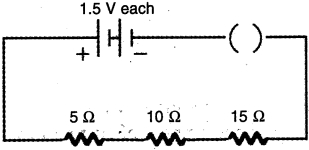
Draw a schematic diagram of an electric circuit consisting of a battery of two cells each of $1.5\, V$,$5\, \Omega$,$10\, \Omega$ and $15\, \Omega$ resistors and a plug key,all connected in series.
Solution
(N/A) To construct the circuit,connect the two $1.5\, V$ cells in series to form a battery of $3\, V$.
Connect this battery in series with the three resistors of $5\, \Omega$,$10\, \Omega$,and $15\, \Omega$ and a plug key.
The schematic diagram is shown below.
Connect this battery in series with the three resistors of $5\, \Omega$,$10\, \Omega$,and $15\, \Omega$ and a plug key.
The schematic diagram is shown below.
0 likes
View Solution27
MediumMCQ
What is the lowest resistance that can be obtained by combining four coils of resistances $4\, \Omega, 8\, \Omega, 12\, \Omega$ and $24\, \Omega$?
A
$2\, \Omega$
B
$1\, \Omega$
C
$4\, \Omega$
D
$48\, \Omega$
Solution
(A) To obtain the lowest equivalent resistance from a given set of resistors,they must be connected in a parallel combination.
For resistors connected in parallel,the equivalent resistance $R_p$ is given by the formula:
$\frac{1}{R_p} = \frac{1}{R_1} + \frac{1}{R_2} + \frac{1}{R_3} + \frac{1}{R_4}$
Substituting the given values $R_1 = 4\, \Omega, R_2 = 8\, \Omega, R_3 = 12\, \Omega$,and $R_4 = 24\, \Omega$:
$\frac{1}{R_p} = \frac{1}{4} + \frac{1}{8} + \frac{1}{12} + \frac{1}{24}$
The least common multiple $(LCM)$ of $4, 8, 12$,and $24$ is $24$.
$\frac{1}{R_p} = \frac{6 + 3 + 2 + 1}{24} = \frac{12}{24} = \frac{1}{2}$
Therefore,$R_p = 2\, \Omega$.
0 likes
View Solution28
Easy
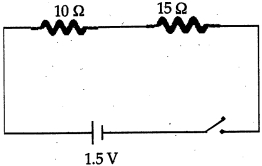
Draw a schematic diagram of a circuit consisting of a cell of $1.5 \, V$, a $10 \, \Omega$ resistor, a $15 \, \Omega$ resistor, and a plug key, all connected in series.
Solution
(N/A) To draw the circuit diagram in series, connect the components one after another in a single loop. The circuit includes a cell of $1.5 \, V$, two resistors of $10 \, \Omega$ and $15 \, \Omega$, and a plug key, all joined in a series combination as shown in the diagram.
0 likes
View Solution29
Easy
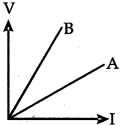
The $V-I$ graph for series and parallel combination of two metallic resistors is as shown in the figure. Which graph represents parallel combination? Justify your answer.
Solution
(A) According to Ohm's law, $V = IR$, which implies $R = V/I$.
In a $V-I$ graph, the slope of the line represents the resistance $(R = \text{slope} = \tan \theta)$.
Graph $A$ has a smaller slope compared to graph $B$, which means graph $A$ represents a lower resistance.
In a parallel combination of resistors, the equivalent resistance is always less than the individual resistances, whereas in a series combination, the equivalent resistance is greater than the individual resistances.
Therefore, graph $A$ represents the parallel combination because it corresponds to the lower resistance value.
0 likes
View Solution30
MediumMCQ
Out of the following bulbs rated $40 \ W, 220 \ V$,$60 \ W, 220 \ V$,and $100 \ W, 220 \ V$,which one will glow the brightest when connected in series to a supply of $220 \ V$?
A
$40 \ W$ bulb
B
$60 \ W$ bulb
C
$100 \ W$ bulb
D
All will glow with equal brightness
Solution
(A) The resistance of a bulb is given by the formula $R = \frac{V^2}{P}$.
Since all bulbs have the same voltage rating $(V = 220 \ V)$,the resistance is inversely proportional to the power $(R \propto \frac{1}{P})$.
Therefore,the $40 \ W$ bulb has the highest resistance.
When bulbs are connected in series,the same current $(I)$ flows through each bulb.
The power dissipated (brightness) in each bulb is given by $P_{actual} = I^2 R$.
Since $I$ is constant for all bulbs in series,the brightness is directly proportional to the resistance $(P_{actual} \propto R)$.
Because the $40 \ W$ bulb has the highest resistance,it will dissipate the most power and glow the brightest.
0 likes
View Solution31
Easy
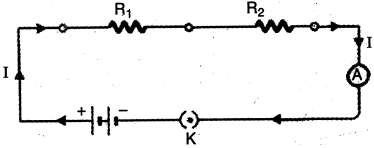
$(i)$ Draw a circuit diagram to show how two resistors are connected in series.
$(ii)$ In a circuit,if two resistors of $5 \ \Omega$ and $10 \ \Omega$ are connected in series,how does the current passing through the two resistors compare?
$(ii)$ In a circuit,if two resistors of $5 \ \Omega$ and $10 \ \Omega$ are connected in series,how does the current passing through the two resistors compare?
Solution
(N/A) $(i)$ The circuit diagram showing two resistors $R_1$ and $R_2$ connected in series is provided in the image.
$(ii)$ When resistors are connected in series,the same amount of electric current $(I)$ flows through each resistor. Therefore,the current passing through the $5 \ \Omega$ resistor is equal to the current passing through the $10 \ \Omega$ resistor.
$(ii)$ When resistors are connected in series,the same amount of electric current $(I)$ flows through each resistor. Therefore,the current passing through the $5 \ \Omega$ resistor is equal to the current passing through the $10 \ \Omega$ resistor.
0 likes
View Solution32
Medium
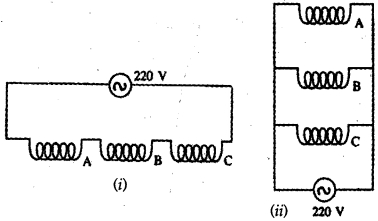
The diagram below shows two ways of connecting three bulbs $A, B$ and $C$ to a $220 \,V$ main in a room. Name the two arrangements. Which of them would you prefer for household electricity? Give two reasons.
Solution
(D) The arrangement shown in figure $(i)$ is a series arrangement. The arrangement in figure $(ii)$ is a parallel arrangement.
We would prefer the parallel arrangement for household electricity. The reasons are:
$(i)$ In a series arrangement,if one of the bulbs fuses,the circuit breaks and the other bulbs also cease to glow. However,in a parallel arrangement,if one bulb fuses,the other bulbs continue to glow because they are connected in independent branches.
$(ii)$ In a series arrangement,the total resistance of the circuit increases as more bulbs are added,which reduces the current and makes the bulbs glow less brightly. In a parallel arrangement,each bulb receives the full voltage of the source,so the brightness of one bulb remains unaffected when another bulb is switched on or off.
0 likes
View Solution33
MediumMCQ
If you connect three resistors having values $2 \, \Omega$, $3 \, \Omega$, and $5 \, \Omega$ in parallel, will the value of total resistance be less than $2 \, \Omega$, greater than $5 \, \Omega$, or lie between $2 \, \Omega$ and $5 \, \Omega$? Explain.
A
Less than $2 \, \Omega$
B
Greater than $5 \, \Omega$
C
Between $2 \, \Omega$ and $5 \, \Omega$
D
Equal to $10 \, \Omega$
Solution
(A) In a parallel combination of resistors, the equivalent resistance is always less than the smallest individual resistance in the circuit.
Since the smallest resistor is $2 \, \Omega$, the total resistance must be less than $2 \, \Omega$.
This can be calculated using the formula for parallel resistors:
$\frac{1}{R_p} = \frac{1}{R_1} + \frac{1}{R_2} + \frac{1}{R_3}$
$\frac{1}{R_p} = \frac{1}{2} + \frac{1}{3} + \frac{1}{5}$
$\frac{1}{R_p} = \frac{15 + 10 + 6}{30} = \frac{31}{30}$
$R_p = \frac{30}{31} \approx 0.967 \, \Omega$
Thus, the total resistance is approximately $0.967 \, \Omega$, which is less than $2 \, \Omega$.
0 likes
View Solution34
MediumMCQ
Three bulbs of $40\, W$,$60\, W$,and $100\, W$ are connected in series across the mains. Across which bulb is the potential difference highest? Across which is it lowest?
A
$40\, W$ (highest),$100\, W$ (lowest)
B
$100\, W$ (highest),$40\, W$ (lowest)
C
$60\, W$ (highest),$40\, W$ (lowest)
D
$40\, W$ (highest),$60\, W$ (lowest)
Solution
(A) In a series circuit,the current $(I)$ flowing through all components is the same.
According to Ohm's Law,the potential difference $(V)$ across a resistor is given by $V = I \times R$.
Since $I$ is constant,$V$ is directly proportional to the resistance $(R)$: $V \propto R$.
The power rating of a bulb is given by $P = \frac{V^2}{R}$,which implies $R = \frac{V^2}{P}$.
For a fixed voltage rating,the resistance is inversely proportional to the power rating $(R \propto \frac{1}{P})$.
Therefore,the bulb with the lowest wattage $(40\, W)$ has the highest resistance,and the bulb with the highest wattage $(100\, W)$ has the lowest resistance.
Consequently,the potential difference is highest across the $40\, W$ bulb and lowest across the $100\, W$ bulb.
0 likes
View Solution35
Medium
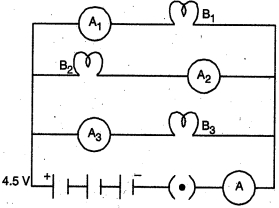
$B_{1}$,$B_{2}$ and $B_{3}$ are three identical bulbs connected as shown in the figure. When all the three bulbs glow,a current of $3 \, A$ is recorded by the ammeter $A$.
$(i)$ What happens to the glow of the other two bulbs when the bulb $B_{1}$ gets fused?
$(ii)$ What happens to the reading of $A_{1}$,$A_{2}$,$A_{3}$ and $A$ when the bulb $B_{2}$ gets fused?
$(i)$ What happens to the glow of the other two bulbs when the bulb $B_{1}$ gets fused?
$(ii)$ What happens to the reading of $A_{1}$,$A_{2}$,$A_{3}$ and $A$ when the bulb $B_{2}$ gets fused?
Solution
(N/A) $(i)$ Since the bulbs are connected in parallel,the potential difference across each bulb remains the same $(4.5 \, V)$. Therefore,if bulb $B_{1}$ fuses,the other two bulbs ($B_{2}$ and $B_{3}$) will continue to glow with the same intensity.
$(ii)$ Initially,the total current $I = 3 \, A$ is divided equally among the three identical bulbs in parallel,so each bulb draws $I_{1} = I_{2} = I_{3} = 1 \, A$.
When bulb $B_{2}$ fuses,it creates an open circuit in its branch,so the current through it becomes zero. Thus,the reading of $A_{2}$ becomes $0 \, A$.
Since $B_{1}$ and $B_{3}$ remain connected in parallel,they still experience the same potential difference and draw $1 \, A$ each. Therefore,$A_{1}$ shows $1 \, A$ and $A_{3}$ shows $1 \, A$.
The total current $A$ recorded by the main ammeter will be the sum of the currents in the remaining branches: $A = 1 \, A + 1 \, A = 2 \, A$.
0 likes
View Solution36
Medium
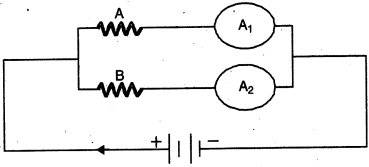
In the circuit diagram shown,the two resistance wires $A$ and $B$ are of the same length and same material,but $A$ is thicker than $B$. Which ammeter,$A_{1}$ or $A_{2}$,will indicate a higher reading for current? Give a reason.
Solution
(A) Ammeter $A_{1}$ will show a higher reading.
Resistance $R$ of a wire is given by the formula $R = \rho \frac{l}{A_{c}}$,where $\rho$ is resistivity,$l$ is length,and $A_{c}$ is the cross-sectional area.
Since wires $A$ and $B$ are of the same material and length,$\rho$ and $l$ are constant.
Therefore,$R \propto \frac{1}{A_{c}}$.
Since wire $A$ is thicker than wire $B$,it has a larger cross-sectional area $(A_{c})$,which means it has lower resistance.
According to Ohm's law,$I = \frac{V}{R}$. Since both wires are connected in parallel,the potential difference $V$ across them is the same.
Because wire $A$ has lower resistance,the current $I$ flowing through it will be higher.
Thus,ammeter $A_{1}$ will show a higher reading.
0 likes
View Solution37
Medium
Three $V-I$ graphs are drawn individually for two resistors and their series combination. Out of $A, B, C$,which one represents the graph for the series combination of the other two? Give a reason for your answer.
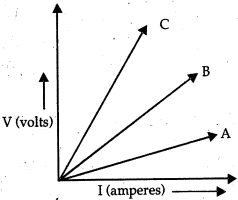
Solution
(C) We know that for a $V-I$ graph,the slope represents the resistance $(R = V/I)$.
In a series combination,the equivalent resistance $(R_s = R_1 + R_2)$ is always greater than the individual resistances ($R_1$ and $R_2$).
Therefore,the graph with the highest slope represents the series combination.
In the given graph,line $C$ has the maximum slope compared to lines $A$ and $B$.
Thus,$C$ represents the series combination of the other two resistors.
0 likes
View Solution38
MediumMCQ
Electric current flows through three lamps when arranged in $(a)$ a series and $(b)$ a parallel circuit. If the filament of one lamp breaks,explain what happens to the other two lamps in both cases.
A
In a series circuit,the other two lamps will stop glowing.
B
In a parallel circuit,the other two lamps will continue to glow normally.
C
In a series circuit,the other two lamps will glow brighter.
D
In a parallel circuit,the other two lamps will stop glowing.
Solution
(A) In a series combination,all components are connected in a single path. If the filament of one lamp breaks,the circuit becomes open,and the flow of current is interrupted throughout the entire circuit. Therefore,the other two lamps will stop glowing.
$(b)$ In a parallel combination,each lamp is connected in a separate branch across the power source. If the filament of one lamp breaks,it only affects that specific branch. The other two lamps remain connected to the voltage source and will continue to glow normally.
$(b)$ In a parallel combination,each lamp is connected in a separate branch across the power source. If the filament of one lamp breaks,it only affects that specific branch. The other two lamps remain connected to the voltage source and will continue to glow normally.
0 likes
View Solution39
Difficult
Find the equivalent resistance of the following circuit.
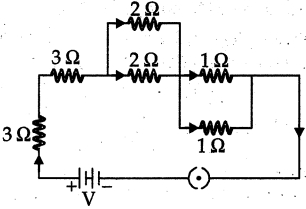
Solution
$(7.5 \, \Omega)$ The circuit consists of resistors in series and parallel combinations.
First, consider the two $2 \, \Omega$ resistors connected in parallel. Let their combined resistance be $R_{P1}$.
$\frac{1}{R_{P1}} = \frac{1}{2} + \frac{1}{2} = 1 \implies R_{P1} = 1 \, \Omega$.
Next, consider the two $1 \, \Omega$ resistors connected in parallel. Let their combined resistance be $R_{P2}$.
$\frac{1}{R_{P2}} = \frac{1}{1} + \frac{1}{1} = 2 \implies R_{P2} = 0.5 \, \Omega$.
Finally, the total equivalent resistance $R$ of the circuit is the sum of the series components:
$R = 3 \, \Omega + 3 \, \Omega + R_{P1} + R_{P2}$
$R = 6 \, \Omega + 1 \, \Omega + 0.5 \, \Omega = 7.5 \, \Omega$.
0 likes
View Solution40
Medium
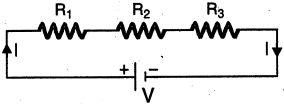
Derive the relation $R = R_{1} + R_{2} + R_{3}$ when three resistors $R_{1}, R_{2}$ and $R_{3}$ are connected in series in an electric circuit.
Solution
(N/A) Consider three resistors of resistances $R_{1}, R_{2}$ and $R_{3}$ connected in series to a cell of potential $V$ as shown in the figure. Since the three resistors are connected in series,the current $I$ flowing through each of them is the same.
By Ohm's law,the potential drop across each resistor is given by:
$V_{1} = IR_{1}, V_{2} = IR_{2}$ and $V_{3} = IR_{3}$
Since $V$ is the total potential in the circuit,by the conservation of energy,we have:
$V = V_{1} + V_{2} + V_{3}$ $...(1)$
Substituting the values of $V_{1}, V_{2}$ and $V_{3}$ in equation $(1)$,we get:
$V = IR_{1} + IR_{2} + IR_{3}$ $...(2)$
If $R_{S}$ is the equivalent resistance of the series combination,then by Ohm's law:
$V = IR_{S}$ $...(3)$
Comparing equations $(2)$ and $(3)$,we have:
$IR_{S} = IR_{1} + IR_{2} + IR_{3}$
Dividing both sides by $I$,we get:
$R_{S} = R_{1} + R_{2} + R_{3}$ $...(4)$
Thus,in a series combination,the equivalent resistance is the sum of the individual resistances.
0 likes
View Solution41
Medium
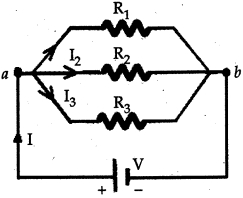
Derive an expression for equivalent resistance when three resistors of resistance $R_{1}, R_{2}$ and $R_{3}$ are connected in parallel.
Solution
(N/A) Consider three resistors $R_{1}, R_{2}$ and $R_{3}$ connected in parallel as shown in the figure.
When the total current $I$ reaches point $a$,it splits into three parts: $I_{1}$ flowing through $R_{1}$,$I_{2}$ flowing through $R_{2}$,and $I_{3}$ flowing through $R_{3}$.
Since charge must be conserved,the total current $I$ entering point $a$ must be equal to the sum of the currents leaving that point. Therefore,we have:
$I = I_{1} + I_{2} + I_{3}$ $...(1)$
Since the resistors are connected in parallel,the potential difference $V$ across each resistor is the same. According to Ohm's law,the current through each resistor is:
$I_{1} = \frac{V}{R_{1}}, I_{2} = \frac{V}{R_{2}}, I_{3} = \frac{V}{R_{3}}$
Substituting these values into equation $(1)$,we get:
$I = \frac{V}{R_{1}} + \frac{V}{R_{2}} + \frac{V}{R_{3}}$ $...(2)$
If $R_{P}$ is the equivalent resistance of the parallel combination,then the total current $I$ can be written as:
$I = \frac{V}{R_{P}}$ $...(3)$
Comparing equations $(2)$ and $(3)$,we have:
$\frac{V}{R_{P}} = \frac{V}{R_{1}} + \frac{V}{R_{2}} + \frac{V}{R_{3}}$
Dividing both sides by $V$,we get the expression for equivalent resistance:
$\frac{1}{R_{P}} = \frac{1}{R_{1}} + \frac{1}{R_{2}} + \frac{1}{R_{3}}$
0 likes
View Solution42
Medium
$(a)$ What is the total resistance of $n$ resistors each of resistance $R$ connected in:
$(i)$ series?
$(ii)$ parallel?
$(b)$ Calculate the resultant resistance of $3$ resistors $3 \ \Omega, 4 \ \Omega$,and $12 \ \Omega$ connected in parallel.
$(i)$ series?
$(ii)$ parallel?
$(b)$ Calculate the resultant resistance of $3$ resistors $3 \ \Omega, 4 \ \Omega$,and $12 \ \Omega$ connected in parallel.
Solution
(N/A) In a series combination,the total resistance is the sum of individual resistances:
$R_{S} = R + R + \dots + R \ (n \ \text{times}) = nR$
In a parallel combination,the reciprocal of the total resistance is the sum of the reciprocals of individual resistances:
$\frac{1}{R_{P}} = \frac{1}{R} + \frac{1}{R} + \dots + \frac{1}{R} \ (n \ \text{times}) = \frac{n}{R}$
Therefore,$R_{P} = \frac{R}{n}$
$(b)$ For resistors connected in parallel,the resultant resistance $R_{P}$ is given by:
$\frac{1}{R_{P}} = \frac{1}{R_{1}} + \frac{1}{R_{2}} + \frac{1}{R_{3}}$
$\frac{1}{R_{P}} = \frac{1}{3} + \frac{1}{4} + \frac{1}{12}$
Taking the least common multiple $(LCM)$ of $3, 4$,and $12$,which is $12$:
$\frac{1}{R_{P}} = \frac{4 + 3 + 1}{12} = \frac{8}{12} = \frac{2}{3}$
$R_{P} = \frac{3}{2} = 1.5 \ \Omega$
0 likes
View Solution43
Medium
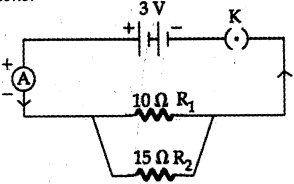
Study the following circuit and answer the following questions:
$(i)$ State the type of combination of the two resistors in the circuit.
$(ii)$ How much current would flow through:
$(a)$ $10 \, \Omega$ resistor and
$(b)$ $15 \, \Omega$ resistor?
$(iii)$ What would be the ammeter reading?
$(i)$ State the type of combination of the two resistors in the circuit.
$(ii)$ How much current would flow through:
$(a)$ $10 \, \Omega$ resistor and
$(b)$ $15 \, \Omega$ resistor?
$(iii)$ What would be the ammeter reading?
Solution
(N/A) $(i)$ The two resistors are connected in a parallel combination because both ends of the resistors are connected to the same two points in the circuit.
$(ii)$ According to Ohm's law,$I = \frac{V}{R}$. Since the resistors are in parallel,the potential difference $(V)$ across each resistor is $3 \, V$.
$(a)$ Current through the $10 \, \Omega$ resistor: $I_1 = \frac{V}{R_1} = \frac{3 \, V}{10 \, \Omega} = 0.3 \, A$.
$(b)$ Current through the $15 \, \Omega$ resistor: $I_2 = \frac{V}{R_2} = \frac{3 \, V}{15 \, \Omega} = 0.2 \, A$.
$(iii)$ The ammeter measures the total current $(I)$ flowing through the circuit,which is the sum of the currents through the individual branches:
$I = I_1 + I_2 = 0.3 \, A + 0.2 \, A = 0.5 \, A$.
Therefore,the ammeter reading is $0.5 \, A$.
0 likes
View Solution44
Difficult
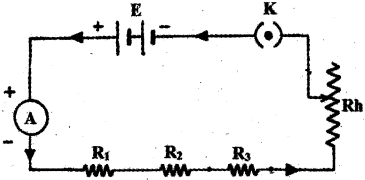
Draw a labelled circuit diagram showing three resistors $R_{1}, R_{2}$ and $R_{3}$ connected in series with a battery $(E)$,a rheostat $(Rh)$,a plug key $(K)$ and an ammeter $(A)$ using standard circuit symbols. Use this circuit to show that the same current flows through every part of the circuit. List two precautions you would observe while performing the experiment.
Solution
(N/A) The circuit diagram is as shown in the image.
Join three resistors of different values in series. Connect them with a battery,an ammeter,a rheostat,and a plug key,as shown in the figure. Close the plug key. Note the ammeter reading. Change the position of the ammeter to anywhere in between the resistors. Note the ammeter reading each time. We observe that the value of the current in the ammeter is the same,independent of its position in the electric circuit. It means that in a series combination of resistors,the current is the same in every part of the circuit or the same current flows through each resistor.
Precautions:
$(i)$ The current should not be passed for a long time to avoid heating.
$(ii)$ All the connections should be tight.
0 likes
View Solution45
Medium
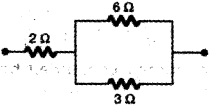
Calculate the equivalent resistance in the combination shown in the figure below.
Solution
(N/A) The resistors $6 \, \Omega$ and $3 \, \Omega$ are connected in parallel.
Therefore,the equivalent resistance $R_P$ is given by:
$\frac{1}{R_P} = \frac{1}{R_1} + \frac{1}{R_2}$
$\frac{1}{R_P} = \frac{1}{3} + \frac{1}{6} = \frac{2+1}{6} = \frac{3}{6} = \frac{1}{2}$
Thus,$R_P = 2 \, \Omega$.
Now,the $2 \, \Omega$ resistor and the parallel combination $R_P$ are in series.
Therefore,the total equivalent resistance $R$ is:
$R = 2 \, \Omega + R_P = 2 \, \Omega + 2 \, \Omega = 4 \, \Omega$.
The equivalent resistance of the circuit is $4 \, \Omega$.
0 likes
View Solution46
Difficult
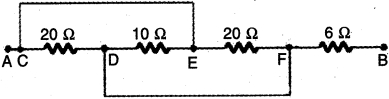
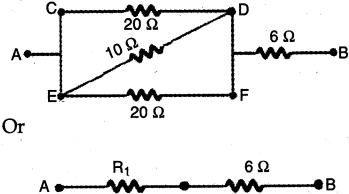
Calculate the equivalent resistance between the points $A$ and $B$ in the following combination.
Solution
$(11 \Omega)$ The given circuit can be redrawn by identifying the nodes connected by wires. Points $A$ and $C$ are at the same potential, and points $E$ and $F$ are connected to $D$ via a wire, effectively making them parallel.
It is clear that the resistances $20 \Omega$ (between $C$ and $D$), $10 \Omega$ (between $D$ and $E$), and $20 \Omega$ (between $E$ and $F$) are in a parallel combination between the effective nodes.
If $R_{1}$ is the effective resistance of these three parallel resistors, then:
$\frac{1}{R_{1}} = \frac{1}{20} + \frac{1}{10} + \frac{1}{20}$
$\frac{1}{R_{1}} = \frac{1 + 2 + 1}{20} = \frac{4}{20} = \frac{1}{5}$
Therefore, $R_{1} = 5 \Omega$.
Now, the resistor $R_{1}$ and the $6 \Omega$ resistor are in series. Therefore, the equivalent resistance $R$ between $A$ and $B$ is:
$R = R_{1} + 6 \Omega$
$R = 5 \Omega + 6 \Omega = 11 \Omega$.
0 likes
View Solution47
DifficultMCQ
When two resistors of resistances $R_{1}$ and $R_{2}$ are connected in parallel,the net resistance is $3 \, \Omega$. When connected in series,its value is $16 \, \Omega$. Calculate the values of $R_{1}$ and $R_{2}$.
A
$4 \, \Omega$ and $12 \, \Omega$
B
$6 \, \Omega$ and $10 \, \Omega$
C
$8 \, \Omega$ and $8 \, \Omega$
D
$2 \, \Omega$ and $14 \, \Omega$
Solution
(A) When $R_{1}$ and $R_{2}$ are connected in parallel,the net resistance $(R_{p})$ is given by:
$\frac{1}{R_{p}} = \frac{1}{R_{1}} + \frac{1}{R_{2}}$
Therefore,we have:
$R_{p} = \frac{R_{1} R_{2}}{R_{1} + R_{2}} = 3 \, \Omega$ $...(1)$
When $R_{1}$ and $R_{2}$ are connected in series,the net resistance $(R_{s})$ is given by:
$R_{s} = R_{1} + R_{2} = 16 \, \Omega$ $...(2)$
Substituting equation $(2)$ into equation $(1)$:
$\frac{R_{1} R_{2}}{16} = 3 \implies R_{1} R_{2} = 48$ $...(3)$
From equation $(2)$,$R_{2} = 16 - R_{1}$. Substituting this into equation $(3)$:
$R_{1}(16 - R_{1}) = 48$
$16R_{1} - R_{1}^{2} = 48$
$R_{1}^{2} - 16R_{1} + 48 = 0$
$(R_{1} - 12)(R_{1} - 4) = 0$
Thus,$R_{1} = 12 \, \Omega$ or $R_{1} = 4 \, \Omega$.
If $R_{1} = 12 \, \Omega$,then $R_{2} = 4 \, \Omega$. If $R_{1} = 4 \, \Omega$,then $R_{2} = 12 \, \Omega$.
Therefore,the resistances are $4 \, \Omega$ and $12 \, \Omega$.
0 likes
View Solution48
Medium
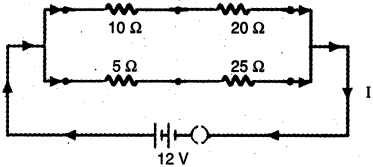
If a $12 \ V$ battery is connected to the arrangement of resistances given below,calculate
$(i)$ the total effective resistance of the arrangement and
$(ii)$ the total current flowing in the circuit.
$(i)$ the total effective resistance of the arrangement and
$(ii)$ the total current flowing in the circuit.
Solution
(N/A) $(i)$ Resistors of value $10 \ \Omega$ and $20 \ \Omega$ are connected in series,therefore,their equivalent resistance is
$R_{S} = 10 + 20 = 30 \ \Omega$
Similarly,resistors of value $5 \ \Omega$ and $25 \ \Omega$ are in series,therefore,their equivalent resistance is
$R_{S_{1}} = 5 + 25 = 30 \ \Omega$
Now,$R_{S}$ and $R_{S_{1}}$ are in parallel,therefore,we have
$R_{P} = \frac{R_{S} \times R_{S_{1}}}{R_{S} + R_{S_{1}}} = \frac{30 \times 30}{30 + 30} = \frac{900}{60} = 15 \ \Omega$
$(ii)$ The total current is given by Ohm's law:
$I = \frac{V}{R_{P}} = \frac{12}{15} = 0.8 \ A$
0 likes
View Solution49
MediumMCQ
Two identical resistors,each of resistance $2 \Omega$,are connected in turn: $(i)$ in series,and $(ii)$ in parallel to a battery of $12 \text{ V}$. Calculate the ratio of power consumed in the two cases.
A
$1:4$
B
$4:1$
C
$1:2$
D
$2:1$
Solution
(B) Given: $R_{1} = 2 \Omega, R_{2} = 2 \Omega, V = 12 \text{ V}$.
$(i)$ When resistors are connected in series,the equivalent resistance is:
$R_{S} = R_{1} + R_{2} = 2 + 2 = 4 \Omega$.
Power consumed in series is:
$P_{S} = \frac{V^{2}}{R_{S}} = \frac{12^{2}}{4} = \frac{144}{4} = 36 \text{ W}$.
$(ii)$ When resistors are connected in parallel,the equivalent resistance is:
$R_{P} = \frac{R_{1} R_{2}}{R_{1} + R_{2}} = \frac{2 \times 2}{2 + 2} = \frac{4}{4} = 1 \Omega$.
Power consumed in parallel is:
$P_{P} = \frac{V^{2}}{R_{P}} = \frac{12^{2}}{1} = 144 \text{ W}$.
The ratio of power consumed in the two cases (parallel to series) is:
$\frac{P_{P}}{P_{S}} = \frac{144}{36} = 4:1$.
0 likes
View Solution50
Medium
$A$ piece of wire having resistance $R$ is cut into four equal parts. $(a)$ How will the resistance of each part compare with the original resistance? $(b)$ If the four parts are placed in parallel,how will the joint resistance compare with the resistance of the original wire?
Solution
(N/A) Since the wire is divided into four equal parts,the new length of each part becomes one-fourth of the original length. Since resistance is directly proportional to length $(R \propto l)$,the resistance of each part becomes one-fourth of the original resistance,$i.e., R' = R/4$.
$(b)$ When these four parts are connected in parallel,the equivalent resistance $R_p$ is given by the formula:
$\frac{1}{R_p} = \frac{1}{R'} + \frac{1}{R'} + \frac{1}{R'} + \frac{1}{R'}$
Substituting $R' = R/4$:
$\frac{1}{R_p} = \frac{4}{R} + \frac{4}{R} + \frac{4}{R} + \frac{4}{R} = \frac{16}{R}$
Therefore,$R_p = R/16$.
Thus,the joint resistance is $1/16$ times the resistance of the original wire.
0 likes
View SolutionElectricity — Resistors in Series and Parallel · Frequently Asked Questions
1Are these Electricity questions useful for JEE and NEET?
Yes. All questions in this section are mapped to JEE Main and NEET exam patterns. Previous year questions from JEE Main, NEET, GUJCET and state-level exams are included with full solutions.
2Can I switch to Hindi or Gujarati for these questions?
Yes. Use the language tabs in the hero section or the sidebar to view the same questions and solutions in English, Hindi or Gujarati.
3How do I generate a question paper from this subtopic?
Use the Vedclass Exam Paper Generator — select the chapter and subtopic, set difficulty, and generate Sets A, B, C, D automatically. First 3 chapters of every subject are free.
Vedclass Products
For Students
Vedclass Test Series
Mock tests in real JEE/NEET style with performance analysis. 5-day free trial.
Start Free TrialFor Teachers
Exam Paper Generator
Generate Set A/B/C/D papers from this chapter in 2 minutes. 3 chapters free.
Try FreeFor Institutes
Online Exam Module
Live online exams with unlimited students, 360° analytics & white-label branding.
See DemoFor Teachers & Institutes
Generate a Electricity Exam Paper in 2 Minutes
Select subtopic & difficulty — Sets A, B, C, D auto-generated with No Repeat logic.
First 3 chapters of every subject are free — no payment required.