
A English
Resistors in Series and Parallel Questions in English
Class 10 Science · Electricity · Resistors in Series and Parallel
84+
Questions
English
Language
100%
With Solutions
Showing 34 of 84 questions in English
51
Medium
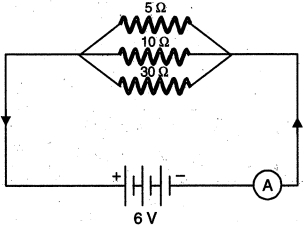
$(a)$ For the circuit shown in the diagram,calculate:
$(i)$ The value of current through the $30\, \Omega$ resistor.
$(ii)$ The total resistance of the circuit.
$(b)$ Give two advantages of connecting electrical devices in parallel with a battery.
$(i)$ The value of current through the $30\, \Omega$ resistor.
$(ii)$ The total resistance of the circuit.
$(b)$ Give two advantages of connecting electrical devices in parallel with a battery.
Solution
(N/A) $(i)$ According to Ohm's law,the current $I$ through a resistor is given by $I = V / R$. Since the resistors are connected in parallel,the potential difference across each resistor is the same,i.e.,$V = 6\, V$.
For the $30\, \Omega$ resistor:
$I = 6\, V / 30\, \Omega = 0.2\, A$.
$(ii)$ For a parallel combination of resistors $R_1 = 5\, \Omega$,$R_2 = 10\, \Omega$,and $R_3 = 30\, \Omega$,the equivalent resistance $R_P$ is given by:
$1 / R_P = 1 / R_1 + 1 / R_2 + 1 / R_3$
$1 / R_P = 1 / 5 + 1 / 10 + 1 / 30$
$1 / R_P = (6 + 3 + 1) / 30 = 10 / 30 = 1 / 3$
Therefore,$R_P = 3\, \Omega$.
$(b)$ Two advantages of connecting electrical devices in parallel are:
$(i)$ If one device fails or is switched off,the others continue to work.
$(ii)$ Each device gets the full voltage of the power supply.
0 likes
View Solution52
Medium
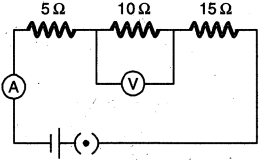
Three resistors of $5 \, \Omega$,$10 \, \Omega$,and $15 \, \Omega$ are connected in series,and the combination is connected to a battery of $30 \, V$. An ammeter and a voltmeter are connected in the circuit. Draw a circuit diagram to connect all the devices in the correct order. What is the current flowing through the circuit and the potential difference across the $10 \, \Omega$ resistor?
Solution
(N/A) The circuit diagram is as shown in the image.
Given:
$R_1 = 5 \, \Omega$,$R_2 = 10 \, \Omega$,$R_3 = 15 \, \Omega$
$V = 30 \, V$
Since the resistors are connected in series,the total resistance $R$ is:
$R = R_1 + R_2 + R_3$
$R = 5 + 10 + 15 = 30 \, \Omega$
The current $I$ flowing through the circuit is given by Ohm's Law:
$I = V / R = 30 \, V / 30 \, \Omega = 1 \, A$
The potential difference $V'$ across the $10 \, \Omega$ resistor is:
$V' = I \times R_2 = 1 \, A \times 10 \, \Omega = 10 \, V$
0 likes
View Solution53
Difficult
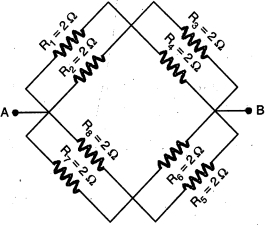
Find the equivalent resistance across the two ends $A$ and $B$ of this circuit.
Solution
(1) From the diagram,we observe that the following pairs of resistors are in parallel:
$R_1$ and $R_2$,$R_3$ and $R_4$,$R_5$ and $R_6$,and $R_7$ and $R_8$.
Since each resistor has a value of $2 \, \Omega$,the equivalent resistance for each parallel pair is:
$\frac{1}{R_{12}} = \frac{1}{R_1} + \frac{1}{R_2} = \frac{1}{2} + \frac{1}{2} = 1 \, \Omega \implies R_{12} = 1 \, \Omega$.
Similarly,$R_{34} = 1 \, \Omega$,$R_{56} = 1 \, \Omega$,and $R_{78} = 1 \, \Omega$.
Now,$R_{12}$ and $R_{34}$ are in series,so their equivalent resistance is:
$R_{1234} = R_{12} + R_{34} = 1 + 1 = 2 \, \Omega$.
Also,$R_{56}$ and $R_{78}$ are in series,so their equivalent resistance is:
$R_{5678} = R_{56} + R_{78} = 1 + 1 = 2 \, \Omega$.
Finally,$R_{1234}$ and $R_{5678}$ are in parallel between points $A$ and $B$. The net resistance $R_{eq}$ is:
$\frac{1}{R_{eq}} = \frac{1}{R_{1234}} + \frac{1}{R_{5678}} = \frac{1}{2} + \frac{1}{2} = 1 \, \Omega^{-1}$.
Therefore,the equivalent resistance is $1 \, \Omega$.
0 likes
View Solution54
Medium
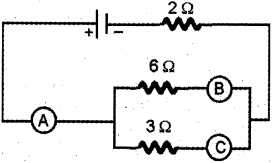
In the figure given below,$A, B$,and $C$ are three ammeters. The ammeter $B$ reads $0.5\, A$. (All the ammeters have negligible resistance.) Calculate:
$(i)$ the readings in the ammeters $A$ and $C$.
$(ii)$ the total resistance of the circuit.
$(i)$ the readings in the ammeters $A$ and $C$.
$(ii)$ the total resistance of the circuit.
Solution
(A) $(i)$ The current in the parallel branches is inversely proportional to the resistance of the branch. The branches containing ammeters $B$ and $C$ have resistances of $6\,\Omega$ and $3\,\Omega$ respectively.
$\frac{\text{Reading of ammeter } C}{\text{Reading of ammeter } B} = \frac{6\,\Omega}{3\,\Omega} = 2$
Therefore,the reading of ammeter $C = 2 \times 0.5\, A = 1.0\, A$.
The reading of ammeter $A$ is the total current in the circuit,which is the sum of currents in the parallel branches:
Reading of ammeter $A = (0.5 + 1.0)\, A = 1.5\, A$.
$(ii)$ Let the total resistance of the circuit be $R$. The circuit consists of a $2\,\Omega$ resistor in series with a parallel combination of $3\,\Omega$ and $6\,\Omega$ resistors.
First,calculate the equivalent resistance of the parallel part $(R_p)$:
$\frac{1}{R_p} = \frac{1}{3} + \frac{1}{6} = \frac{2+1}{6} = \frac{3}{6} = \frac{1}{2}$
$R_p = 2\,\Omega$
Now,the total resistance $R = 2\,\Omega + R_p = 2\,\Omega + 2\,\Omega = 4\,\Omega$.
0 likes
View Solution55
Medium
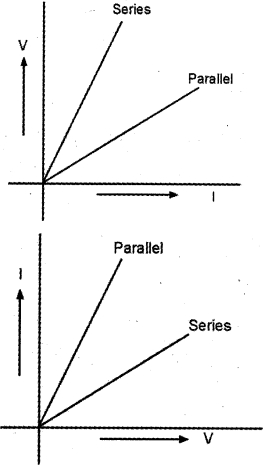
Two students perform experiments on series and parallel combinations of two given resistors $R_{1}$ and $R_{2}$ and plot the following $V-I$ and $I-V$ graphs. Which of the graphs is (are) correctly labelled in terms of the words 'series' and 'parallel'? Justify your answer.
Solution
(A) In a series combination,the equivalent resistance $R_{s} = R_{1} + R_{2}$ is greater than the individual resistances. In a parallel combination,the equivalent resistance $R_{p} = (R_{1}R_{2}) / (R_{1} + R_{2})$ is smaller than the individual resistances.
$1$. For the $V-I$ graph (top): The slope of the graph represents resistance $(R = V/I)$. Since $R_{s} > R_{p}$,the line for 'series' must have a steeper slope than the line for 'parallel'. Thus,the top graph is correctly labelled.
$2$. For the $I-V$ graph (bottom): The slope of the graph represents conductance $(1/R = I/V)$. Since $R_{s} > R_{p}$,the conductance for parallel $(1/R_{p})$ is greater than for series $(1/R_{s})$. Therefore,the line for 'parallel' must have a steeper slope than the line for 'series'. Thus,the bottom graph is also correctly labelled.
Conclusion: Both graphs are correctly labelled.
0 likes
View Solution56
EasyMCQ
There is a frill of $20$ bulbs connected in series in a room. One bulb gets fused. The remaining $19$ are again joined in series and connected to the same supply. Will the light increase or decrease in the room?
A
Increase
B
Decrease
C
Remain the same
D
Zero
Solution
(A) The light will increase.
In a series circuit,the total resistance $R$ is the sum of the resistances of individual bulbs $(R = R_1 + R_2 + ... + R_{20})$.
The power consumed by the circuit is given by the formula $P = \frac{V^2}{R}$,where $V$ is the supply voltage and $R$ is the total resistance.
When one bulb is removed (or fused),the total resistance of the circuit decreases because there are now only $19$ bulbs in series.
Since the power $P$ is inversely proportional to the resistance $R$ $(P \propto \frac{1}{R})$,a decrease in total resistance leads to an increase in the total power consumed by the remaining bulbs.
Therefore,the brightness of the light in the room will increase.
0 likes
View Solution57
Medium
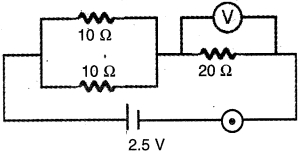
You are given three resistors of $10\, \Omega, 10\, \Omega, 20\, \Omega$,a battery of emf $2.5\, V$,a key,an ammeter,and a voltmeter. Draw a circuit diagram showing the correct connections of the given components such that the voltmeter gives a reading of $2.0\, V$.
Solution
(N/A) To get a reading of $2.0\, V$ across the $20\, \Omega$ resistor,we need to arrange the circuit such that the voltage divider rule provides the desired potential difference.
$1$. Connect the two $10\, \Omega$ resistors in parallel. Their equivalent resistance is $R_p = \frac{10 \times 10}{10 + 10} = 5\, \Omega$.
$2$. Connect this parallel combination $(5\, \Omega)$ in series with the $20\, \Omega$ resistor.
$3$. The total resistance of the circuit is $R_{eq} = 5\, \Omega + 20\, \Omega = 25\, \Omega$.
$4$. The total current in the circuit is $I = \frac{V}{R_{eq}} = \frac{2.5\, V}{25\, \Omega} = 0.1\, A$.
$5$. The voltage across the $20\, \Omega$ resistor is $V = I \times R = 0.1\, A \times 20\, \Omega = 2.0\, V$.
$6$. Thus,the voltmeter should be connected in parallel across the $20\, \Omega$ resistor as shown in the diagram.
0 likes
View Solution58
EasyMCQ
$A$ heater is joined in parallel with a $60\, W$ bulb and connected to the mains. If the $60\, W$ bulb is replaced by a $100\, W$ bulb,will the rate of heat produced by the heater be more,less,or remain the same?
A
More
B
Less
C
Remain the same
D
Cannot be determined
Solution
(C) In a parallel circuit,the voltage across each component remains the same as the supply voltage $(V)$.
The rate of heat produced by a heater is given by the formula $P = V^2 / R$,where $V$ is the voltage and $R$ is the resistance of the heater.
Since the heater is connected in parallel to the mains,its voltage $V$ remains constant regardless of the bulb connected in parallel with it.
Therefore,replacing the $60\, W$ bulb with a $100\, W$ bulb does not change the voltage across the heater.
Consequently,the rate of heat produced by the heater remains the same.
0 likes
View Solution59
Medium
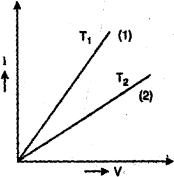
The $I-V$ graphs of two resistors,and their series combination,are shown below. Which one of these graphs represents the series combination of the other two? Give reasons for your answer.
Solution
(A) In an $I-V$ graph,the slope represents the conductance,which is the reciprocal of resistance $(1/R)$.
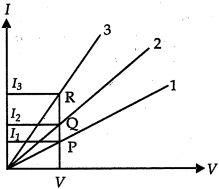
To determine the series combination,draw a vertical line from any point on the $V$ axis such that it intersects the graphs $1, 2,$ and $3$ at points $P, Q,$ and $R$ respectively,as shown in the provided solution image.
For a constant potential $V$,the currents corresponding to the three graphs are $I_1, I_2,$ and $I_3$.
From the graph,we observe that $I_1 < I_2 < I_3$.
Since $R = V/I$,for a fixed $V$,a smaller current implies a larger resistance. Therefore,$R_1 > R_2 > R_3$.
In a series combination,the equivalent resistance $(R_s = R_a + R_b)$ is always greater than the individual resistances ($R_a$ and $R_b$).
Since graph $1$ has the lowest current for a given potential,it corresponds to the highest resistance. Thus,graph $1$ represents the series combination of the other two resistors (graphs $2$ and $3$).
0 likes
View Solution60
EasyMCQ
$n$ equal resistors are first connected in series and then connected in parallel. The ratio of the maximum to the minimum resistance is
A
$n$
B
$n^{2}$
C
$1 / n$
D
$1 / n^{2}$
Solution
(B) Let the resistance of each resistor be $R$.
When $n$ resistors are connected in series,the equivalent resistance is $R_{s} = nR$.
When $n$ resistors are connected in parallel,the equivalent resistance is $R_{p} = R / n$.
The ratio of the maximum resistance (series) to the minimum resistance (parallel) is given by:
Ratio $= R_{s} / R_{p} = (nR) / (R / n) = n^{2}$.
0 likes
View Solution61
EasyMCQ
In a circuit containing two unequal resistors connected in parallel:
A
the current is same in both the resistors.
B
the current is large in the larger resistance.
C
the voltage drop is larger across the larger resistance.
D
the voltage is same across both the resistors.
Solution
(D) When resistors are connected in parallel, the potential difference (voltage) across each resistor remains the same.
According to Ohm's Law, $V = IR$, which implies $I = V/R$.
Since $V$ is constant for both resistors, the current $I$ is inversely proportional to the resistance $R$ $(I \propto 1/R)$.
Therefore, the resistor with the smaller resistance will have a larger current, and the resistor with the larger resistance will have a smaller current.
Thus, the voltage is the same across both resistors.
0 likes
View Solution62
EasyMCQ
The equivalent resistance in series combination is
A
larger than the largest resistance.
B
smaller than the largest resistance.
C
smaller than the smallest resistance.
D
larger than the smallest resistance.
Solution
(A) In a series combination of resistors,the equivalent resistance $(R_{eq})$ is the sum of individual resistances: $R_{eq} = R_1 + R_2 + R_3 + ... + R_n$.
Since each individual resistance is positive,the sum $R_{eq}$ will always be greater than any single individual resistance present in the circuit.
Therefore,the equivalent resistance is larger than the largest individual resistance.
Since each individual resistance is positive,the sum $R_{eq}$ will always be greater than any single individual resistance present in the circuit.
Therefore,the equivalent resistance is larger than the largest individual resistance.
0 likes
View Solution63
MediumMCQ
Two wires of the same metal have the same length, but cross-sections are in the ratio $3 : 1$. They are joined in series. The resistance of the thicker wire is $10\, \Omega$. The total resistance of the combination will be:
A
$40/3\, \Omega$
B
$5/2\, \Omega$
C
$100\, \Omega$
D
$40\, \Omega$
Solution
(D) The resistance of a wire is given by the formula $R = \rho \frac{L}{A}$, where $\rho$ is the resistivity, $L$ is the length, and $A$ is the cross-sectional area.
Since both wires are of the same metal, $\rho$ is constant. Given that $L$ is also the same, we have $R \propto \frac{1}{A}$.
Let $A_1$ be the area of the thicker wire and $A_2$ be the area of the thinner wire. Given $A_1 : A_2 = 3 : 1$, so $A_1 = 3A$ and $A_2 = A$.
The resistance of the thicker wire $(R_1)$ is $10\, \Omega$. Since $R_1 = \frac{\rho L}{3A} = 10\, \Omega$, then $\frac{\rho L}{A} = 30\, \Omega$.
The resistance of the thinner wire $(R_2)$ is $R_2 = \frac{\rho L}{A} = 30\, \Omega$.
When joined in series, the total resistance $R_{total} = R_1 + R_2 = 10\, \Omega + 30\, \Omega = 40\, \Omega$.
0 likes
View Solution64
MediumMCQ
You are given three equal resistors. The number of resistances which can be obtained by joining them in series and in parallel grouping is
A
four
B
three
C
two
D
six
Solution
(A) Let the resistance of each resistor be $R$. We can combine these three resistors in the following ways:
$1$. All three in series: $R_{eq} = R + R + R = 3R$.
$2$. All three in parallel: $1/R_{eq} = 1/R + 1/R + 1/R = 3/R$,so $R_{eq} = R/3$.
$3$. Two in series and one in parallel with them: $R_{eq} = (2R \times R) / (2R + R) = 2R^2 / 3R = (2/3)R$.
$4$. Two in parallel and one in series with them: $R_{eq} = R + (R \times R) / (R + R) = R + R/2 = (3/2)R$.
Thus,there are $4$ distinct equivalent resistance values that can be obtained.
0 likes
View Solution65
EasyMCQ
If resistors are connected in series,the current through each resistor remains the same.
A
True
B
False
Solution
(A) In a series circuit,there is only one path for the electric current to flow. Therefore,the amount of charge passing through any point in the circuit per unit time is constant. As a result,the current $(I)$ flowing through each resistor connected in series is the same.
0 likes
View Solution66
EasyMCQ
If resistors are connected in parallel,the voltage across each remains the same.
A
True
B
False
Solution
(A) In a parallel circuit,all components are connected across the same two points (nodes).
Therefore,the potential difference (voltage) across each resistor is equal to the total voltage supplied by the source.
This is a fundamental property of parallel circuits.
Therefore,the potential difference (voltage) across each resistor is equal to the total voltage supplied by the source.
This is a fundamental property of parallel circuits.
0 likes
View Solution67
EasyMCQ
$A$ series circuit has only one conducting path for the electrons that move through it; a parallel circuit has multiple conducting paths.
A
True
B
False
Solution
(A) In a series circuit,all components are connected end-to-end,forming a single continuous loop for the current to flow. Therefore,there is only one path for the electrons.
In a parallel circuit,components are connected across the same two points,creating multiple branches. This allows the current to divide and flow through different paths simultaneously.
In a parallel circuit,components are connected across the same two points,creating multiple branches. This allows the current to divide and flow through different paths simultaneously.
0 likes
View Solution68
EasyMCQ
If five equal pieces of wire having $5\, \Omega$ resistance are made and connected in parallel,then their equivalent resistance will be $......$
A
$0.2\, \Omega$
B
$1\, \Omega$
C
$5\, \Omega$
D
$25\, \Omega$
Solution
(A) When a wire of resistance $R$ is cut into $n$ equal pieces,the resistance of each piece becomes $R' = R/n$.
Here,the original resistance $R = 5\, \Omega$ and the number of pieces $n = 5$.
Therefore,the resistance of each piece $R' = 5\, \Omega / 5 = 1\, \Omega$.
When $n$ resistors of equal resistance $R'$ are connected in parallel,the equivalent resistance $R_{eq}$ is given by $R_{eq} = R'/n$.
Substituting the values,$R_{eq} = 1\, \Omega / 5 = 0.2\, \Omega$.
0 likes
View Solution69
EasyMCQ
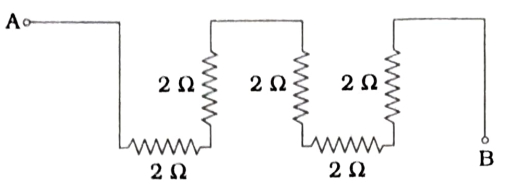
What will be the equivalent resistance between points $A$ and $B$ of the following electric circuit?
A
$1\, \Omega$
B
$2\, \Omega$
C
$5\, \Omega$
D
$10 \, \Omega$
Solution
(D) In the given circuit,all the resistors are connected in series.
When resistors are connected in series,the equivalent resistance $R_{eq}$ is the sum of individual resistances.
$R_{eq} = R_1 + R_2 + R_3 + R_4 + R_5$
Here,there are $5$ resistors,each of $2 \, \Omega$.
$R_{eq} = 2 \, \Omega + 2 \, \Omega + 2 \, \Omega + 2 \, \Omega + 2 \, \Omega = 10 \, \Omega$.
Therefore,the equivalent resistance between points $A$ and $B$ is $10 \, \Omega$.
0 likes
View Solution70
EasyMCQ
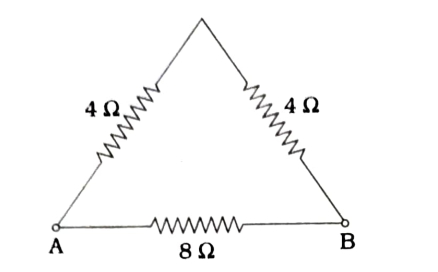
The equivalent resistance between points $A$ and $B$ of the following electric circuit will be $.........$
A
$4 \, \Omega$
B
$8 \, \Omega$
C
$2 \, \Omega$
D
$16 \, \Omega$
Solution
(A) In the given circuit,there are two branches connected between points $A$ and $B$.
Branch $1$ consists of two resistors of $4 \, \Omega$ each,connected in series. The equivalent resistance of this branch is $R_1 = 4 \, \Omega + 4 \, \Omega = 8 \, \Omega$.
Branch $2$ consists of a single resistor of $8 \, \Omega$ connected directly between $A$ and $B$.
Now,these two branches ($R_1 = 8 \, \Omega$ and $R_2 = 8 \, \Omega$) are connected in parallel.
The equivalent resistance $R_{eq}$ is given by the formula: $\frac{1}{R_{eq}} = \frac{1}{R_1} + \frac{1}{R_2}$.
Substituting the values: $\frac{1}{R_{eq}} = \frac{1}{8} + \frac{1}{8} = \frac{2}{8} = \frac{1}{4}$.
Therefore,$R_{eq} = 4 \, \Omega$.
0 likes
View Solution71
EasyMCQ
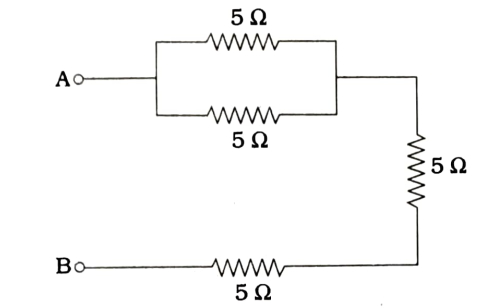
The equivalent resistance between points $A$ and $B$ in the following electric circuit is:
A
$2.5 \, \Omega$
B
$5 \, \Omega$
C
$12.5 \, \Omega$
D
$20 \, \Omega$
Solution
(C) $1$. Identify the parallel combination: Two resistors of $5 \, \Omega$ each are connected in parallel. The equivalent resistance $(R_p)$ of this parallel part is given by $\frac{1}{R_p} = \frac{1}{5} + \frac{1}{5} = \frac{2}{5}$,so $R_p = 2.5 \, \Omega$.
$2$. Identify the series combination: The circuit now consists of three resistors in series: the equivalent resistance $R_p = 2.5 \, \Omega$,and two other resistors of $5 \, \Omega$ each.
$3$. Calculate total resistance: The total equivalent resistance $(R_{eq})$ is the sum of these resistances in series: $R_{eq} = 2.5 \, \Omega + 5 \, \Omega + 5 \, \Omega = 12.5 \, \Omega$.
0 likes
View Solution72
EasyMCQ
Three resistors $R_{1}$,$R_{2}$,and $R_{3}$ are connected in parallel between points $A$ and $B$. The equivalent resistance $R$ is given by:
A
$R_{1} + R_{2} + R_{3}$
B
$\frac{1}{R_{1}} + \frac{1}{R_{2}} + \frac{1}{R_{3}}$
C
$\frac{R_{1}R_{2}R_{3}}{R_{1}R_{2} + R_{2}R_{3} + R_{3}R_{1}}$
D
$\frac{R_{1} + R_{2} + R_{3}}{3}$
Solution
(C) When resistors are connected in parallel,the reciprocal of the equivalent resistance is equal to the sum of the reciprocals of the individual resistances.
For three resistors $R_{1}$,$R_{2}$,and $R_{3}$ connected in parallel,the formula is:
$\frac{1}{R} = \frac{1}{R_{1}} + \frac{1}{R_{2}} + \frac{1}{R_{3}}$
To find $R$,we take the reciprocal of the sum:
$R = \frac{1}{\frac{1}{R_{1}} + \frac{1}{R_{2}} + \frac{1}{R_{3}}}$
$R = \frac{R_{1}R_{2}R_{3}}{R_{1}R_{2} + R_{2}R_{3} + R_{3}R_{1}}$
Since the provided options were incomplete or incorrect regarding the final expression for $R$,the correct relationship is defined by the sum of reciprocals.
0 likes
View Solution73
EasyMCQ
If three resistors of $5 \Omega$,$10 \Omega$,and $15 \Omega$ are connected in series,the equivalent resistance $R$ is equal to ........ (in $\Omega$)
A
$10$
B
$15$
C
$5$
D
$30$
Solution
(D) When resistors are connected in series,the equivalent resistance $R$ is the sum of the individual resistances.
The formula for equivalent resistance in series is $R = R_1 + R_2 + R_3$.
Given values are $R_1 = 5 \Omega$,$R_2 = 10 \Omega$,and $R_3 = 15 \Omega$.
Substituting these values into the formula: $R = 5 \Omega + 10 \Omega + 15 \Omega = 30 \Omega$.
Therefore,the equivalent resistance is $30 \Omega$.
The formula for equivalent resistance in series is $R = R_1 + R_2 + R_3$.
Given values are $R_1 = 5 \Omega$,$R_2 = 10 \Omega$,and $R_3 = 15 \Omega$.
Substituting these values into the formula: $R = 5 \Omega + 10 \Omega + 15 \Omega = 30 \Omega$.
Therefore,the equivalent resistance is $30 \Omega$.
0 likes
View Solution74
EasyMCQ
What is the equivalent resistance of resistors $R_{1}$ and $R_{2}$ connected in parallel connection?
A
$\frac{1}{R_{1}}+\frac{1}{R_{2}}$
B
$\frac{R_{1}+R_{2}}{R_{1} R_{2}}$
C
$\frac{R_{1} R_{2}}{R_{1}+R_{2}}$
D
$\frac{R_{1}+R_{2}}{2}$
Solution
(C) When resistors $R_{1}$ and $R_{2}$ are connected in parallel,the reciprocal of the equivalent resistance $R_{eq}$ is equal to the sum of the reciprocals of the individual resistances.
The formula is given by: $\frac{1}{R_{eq}} = \frac{1}{R_{1}} + \frac{1}{R_{2}}$.
To simplify this,we find a common denominator,which is $R_{1} R_{2}$.
So,$\frac{1}{R_{eq}} = \frac{R_{2} + R_{1}}{R_{1} R_{2}}$.
Taking the reciprocal of both sides,we get the equivalent resistance: $R_{eq} = \frac{R_{1} R_{2}}{R_{1} + R_{2}}$.
0 likes
View Solution75
EasyMCQ
Two resistors of $3 \Omega$ and $6 \Omega$ are connected in parallel. The equivalent resistance $R$ is:
A
$9 \Omega$
B
$1/9 \Omega$
C
$2 \Omega$
D
$4.5 \Omega$
Solution
(C) When resistors are connected in parallel,the equivalent resistance $R$ is given by the formula: $\frac{1}{R} = \frac{1}{R_1} + \frac{1}{R_2}$.
Given $R_1 = 3 \Omega$ and $R_2 = 6 \Omega$.
Substituting the values: $\frac{1}{R} = \frac{1}{3} + \frac{1}{6}$.
Finding a common denominator: $\frac{1}{R} = \frac{2}{6} + \frac{1}{6} = \frac{3}{6}$.
Therefore,$\frac{1}{R} = \frac{1}{2}$.
Thus,$R = 2 \Omega$.
Given $R_1 = 3 \Omega$ and $R_2 = 6 \Omega$.
Substituting the values: $\frac{1}{R} = \frac{1}{3} + \frac{1}{6}$.
Finding a common denominator: $\frac{1}{R} = \frac{2}{6} + \frac{1}{6} = \frac{3}{6}$.
Therefore,$\frac{1}{R} = \frac{1}{2}$.
Thus,$R = 2 \Omega$.
0 likes
View Solution76
EasyMCQ
Which of the following is true for a series combination of three resistors?
A
The current flowing through each resistor is the same.
B
The voltage drop across each resistor is the same.
C
The equivalent resistance is smaller than the smallest individual resistor.
D
The equivalent resistance is equal to the average value of the three resistors.
Solution
(A) In a series combination of resistors,the resistors are connected end-to-end such that the same amount of electric current $(I)$ flows through each resistor.
According to Ohm's Law $(V = IR)$,since the current $(I)$ is constant and the resistance $(R)$ of each resistor may differ,the voltage drop $(V)$ across each resistor will be different.
The equivalent resistance $(R_{eq})$ in a series circuit is the sum of individual resistances $(R_{eq} = R_1 + R_2 + R_3)$,which is always greater than the largest individual resistor.
Therefore,the statement that the current flowing through each resistor is the same is correct.
0 likes
View Solution77
EasyMCQ
Which of the following is true for a parallel combination of two resistors?
A
The current flowing through each resistor is the same.
B
The voltage across each resistor is less than the individual resistance.
C
The equivalent resistance is less than the smallest individual resistance.
D
The equivalent resistance is greater than the largest individual resistance.
Solution
(C) In a parallel combination of resistors,the potential difference $(V)$ across each resistor remains the same.
However,the current $(I)$ divides among the resistors based on their resistance values.
The formula for equivalent resistance $(R_{eq})$ in parallel is given by $\frac{1}{R_{eq}} = \frac{1}{R_1} + \frac{1}{R_2} + ... + \frac{1}{R_n}$.
Due to this reciprocal relationship,the equivalent resistance $(R_{eq})$ is always smaller than the smallest individual resistance in the circuit.
Therefore,option $C$ is correct.
0 likes
View Solution78
EasyMCQ
Which of the following statements is $NOT$ true for a series combination of two resistors?
A
The total voltage drop across all resistors is equal to the sum of the voltage drops across each individual resistor.
B
The electric current flowing through each resistor is the same.
C
The value of the equivalent resistance is equal to the sum of the values of all individual resistors.
D
The value of the equivalent resistance is smaller than the value of the smallest individual resistor.
Solution
(D) In a series combination of resistors:
$1$. The current $(I)$ flowing through each resistor remains the same.
$2$. The total voltage $(V)$ across the combination is the sum of the individual voltage drops: $V = V_1 + V_2 + ... + V_n$.
$3$. The equivalent resistance $(R_{eq})$ is the sum of the individual resistances: $R_{eq} = R_1 + R_2 + ... + R_n$.
$4$. Because $R_{eq}$ is the sum of all resistances,it is always greater than the value of the largest individual resistor in the series.
Therefore,the statement that the equivalent resistance is smaller than the smallest resistor is false.
0 likes
View Solution79
EasyMCQ
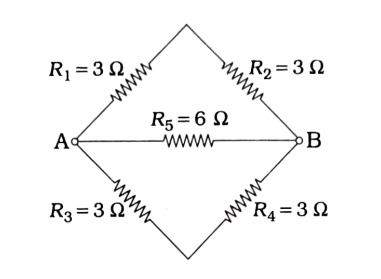
What is the equivalent resistance between points $A$ and $B$ in the given electrical circuit (in $\Omega$)?
A
$18$
B
$2$
C
$4$
D
$6$
Solution
(B) The circuit consists of two parallel branches connected between points $A$ and $B$.
Branch $1$ consists of resistors $R_1$ and $R_2$ in series: $R_{s1} = R_1 + R_2 = 3 \ \Omega + 3 \ \Omega = 6 \ \Omega$.
Branch $2$ consists of resistors $R_3$ and $R_4$ in series: $R_{s2} = R_3 + R_4 = 3 \ \Omega + 3 \ \Omega = 6 \ \Omega$.
Branch $3$ consists of resistor $R_5$ connected directly between $A$ and $B$: $R_5 = 6 \ \Omega$.
Now,these three branches ($R_{s1}$,$R_{s2}$,and $R_5$) are connected in parallel.
The equivalent resistance $R_{eq}$ is given by: $\frac{1}{R_{eq}} = \frac{1}{R_{s1}} + \frac{1}{R_{s2}} + \frac{1}{R_5}$.
Substituting the values: $\frac{1}{R_{eq}} = \frac{1}{6} + \frac{1}{6} + \frac{1}{6} = \frac{3}{6} = \frac{1}{2}$.
Therefore,$R_{eq} = 2 \ \Omega$.
0 likes
View Solution80
EasyMCQ
Five bulbs are connected in a series circuit. If the third bulb in the middle blows out,what happens?
A
The first and second bulbs remain on.
B
The fourth and fifth bulbs remain on.
C
The remaining four bulbs remain on.
D
All the remaining bulbs turn off.
Solution
(D) In a series circuit,there is only one path for the flow of electric current.
If any one component (like a bulb) in the series circuit blows out or is disconnected,the circuit becomes open (broken).
Because the current cannot flow through an open circuit,the flow of electricity stops completely.
Therefore,if the third bulb blows out,the entire circuit is interrupted,and all the remaining bulbs will turn off.
0 likes
View Solution81
EasyMCQ
Five bulbs are connected in a parallel circuit. If the second bulb blows out,what happens?
A
The remaining four bulbs remain lit.
B
The first bulb remains lit.
C
The last three bulbs remain lit.
D
None of the bulbs remain lit.
Solution
(A) In a parallel circuit,each electrical appliance (or bulb) is connected across the same potential difference independently.
Since each bulb has its own separate path for the flow of current,the failure or blowing out of one bulb does not affect the operation of the other bulbs.
Therefore,if the second bulb blows out,the remaining four bulbs will continue to receive the same voltage and will remain lit.
Since each bulb has its own separate path for the flow of current,the failure or blowing out of one bulb does not affect the operation of the other bulbs.
Therefore,if the second bulb blows out,the remaining four bulbs will continue to receive the same voltage and will remain lit.
0 likes
View Solution82
EasyMCQ
What is the equivalent resistance of a circuit when three resistors of $5 \Omega$,$10 \Omega$,and $30 \Omega$ are connected in parallel (in $\Omega$)?
A
$45$
B
$15$
C
$5$
D
$3$
Solution
(D) When resistors are connected in parallel,the equivalent resistance $(R_{eq})$ is given by the formula:
$\frac{1}{R_{eq}} = \frac{1}{R_1} + \frac{1}{R_2} + \frac{1}{R_3}$
Given $R_1 = 5 \Omega$,$R_2 = 10 \Omega$,and $R_3 = 30 \Omega$.
Substituting these values into the formula:
$\frac{1}{R_{eq}} = \frac{1}{5} + \frac{1}{10} + \frac{1}{30}$
To add these fractions,find the least common multiple $(LCM)$ of $5, 10,$ and $30$,which is $30$.
$\frac{1}{R_{eq}} = \frac{6}{30} + \frac{3}{30} + \frac{1}{30} = \frac{10}{30} = \frac{1}{3}$
Therefore,$R_{eq} = 3 \Omega$.
0 likes
View Solution83
EasyMCQ
Three resistors $R_{1} = 5 \Omega$,$R_{2} = 10 \Omega$,and $R_{3} = 30 \Omega$ are connected in parallel to a $12 \; V$ battery. Which resistor will have the highest current flowing through it?
A
$R_{1}$
B
$R_{2}$
C
$R_{3}$
D
All of them are equal
Solution
(A) In a parallel circuit,the potential difference $(V)$ across each resistor is the same.
According to Ohm's Law,$I = V / R$.
Since $V$ is constant,the current $(I)$ is inversely proportional to the resistance $(R)$: $I \propto 1 / R$.
Therefore,the resistor with the smallest resistance will have the highest current flowing through it.
Given $R_{1} = 5 \Omega$,$R_{2} = 10 \Omega$,and $R_{3} = 30 \Omega$,the smallest resistance is $R_{1} = 5 \Omega$.
Thus,the highest current flows through $R_{1}$.
0 likes
View Solution84
EasyMCQ
When three resistors of $5 \Omega$,$10 \Omega$,and $30 \Omega$ are connected in parallel in a circuit,what will be the equivalent resistance?
A
Less than $10 \Omega$ and more than $5 \Omega$
B
Less than $5 \Omega$
C
More than $10 \Omega$ and less than $30 \Omega$
D
More than $30 \Omega$
Solution
(B) In a parallel combination of resistors,the equivalent resistance $(R_{eq})$ is given by the formula: $\frac{1}{R_{eq}} = \frac{1}{R_1} + \frac{1}{R_2} + \frac{1}{R_3}$.
Substituting the given values: $\frac{1}{R_{eq}} = \frac{1}{5} + \frac{1}{10} + \frac{1}{30}$.
Finding the common denominator $(30)$: $\frac{1}{R_{eq}} = \frac{6 + 3 + 1}{30} = \frac{10}{30} = \frac{1}{3}$.
Therefore,$R_{eq} = 3 \Omega$.
In a parallel circuit,the equivalent resistance is always less than the smallest individual resistance present in the circuit. Since the smallest resistance is $5 \Omega$,the equivalent resistance must be less than $5 \Omega$.
0 likes
View SolutionElectricity — Resistors in Series and Parallel · Frequently Asked Questions
1Are these Electricity questions useful for JEE and NEET?
Yes. All questions in this section are mapped to JEE Main and NEET exam patterns. Previous year questions from JEE Main, NEET, GUJCET and state-level exams are included with full solutions.
2Can I switch to Hindi or Gujarati for these questions?
Yes. Use the language tabs in the hero section or the sidebar to view the same questions and solutions in English, Hindi or Gujarati.
3How do I generate a question paper from this subtopic?
Use the Vedclass Exam Paper Generator — select the chapter and subtopic, set difficulty, and generate Sets A, B, C, D automatically. First 3 chapters of every subject are free.
Vedclass Products
For Students
Vedclass Test Series
Mock tests in real JEE/NEET style with performance analysis. 5-day free trial.
Start Free TrialFor Teachers
Exam Paper Generator
Generate Set A/B/C/D papers from this chapter in 2 minutes. 3 chapters free.
Try FreeFor Institutes
Online Exam Module
Live online exams with unlimited students, 360° analytics & white-label branding.
See DemoFor Teachers & Institutes
Generate a Electricity Exam Paper in 2 Minutes
Select subtopic & difficulty — Sets A, B, C, D auto-generated with No Repeat logic.
First 3 chapters of every subject are free — no payment required.